If you have started looking for international schools in Chiyoda, you have probably already hit the strangest problem in Tokyo school-hunting: half the schools you find no longer exist. Chiyoda International School Tokyo, the K-12 school that opened in Yonbancho in 2018, closed its primary and middle sections in the summer of 2021 and its high school in the spring of 2022 — and it is still listed on relocation guides and directory sites today. Chiyoda is a genuinely unusual ward. It has the smallest resident population of Tokyo’s 23 wards, around 69,800 people, yet roughly 900,000 commute in each day. Embassies, ministries and corporate headquarters sit on top of a small, quiet residential pocket in Bancho and Kojimachi. That combination produces a short but interesting list of schools. This guide covers the eight international schools and preschools genuinely located in Chiyoda as of August 2026, one new school confirmed to open in 2027, published fees where they exist, and what to do when the ward simply does not have what your child needs.
Quick Answer: Your Options in Chiyoda
If you only read one section, read this. Below are the schools covered in this guide, plus the online option — so you can see every route side by side before the details.
- Phoenix House International School (Yonbancho) | ¥3.10m-3.45m per year — Ages: Prep 1 to Prep 6, roughly ages 5-11. Year groups follow the British 1 September to… / Fees: ¥3,100,000 (Prep 1-2), ¥3,250,000 (Prep 3-4), ¥3,450,000 (Prep 5-6) per year, tax…
- Tokyo Chinese School (Gobancho) | fees on enquiry — Ages: kindergarten through senior high, roughly 3 to 18 / Fees: not published; enquire directly
- KIDS EDU International Preschool & Academy (Gobancho) | fees on enquiry — Ages: 2 through primary school / Fees: not published; enquire directly. Eligible families receive subsidy of up to ¥37,000…
- Wisdom Academy PRIME Ichigaya-Iidabashi (Kudankita) | fees on enquiry — Ages: 3 to 18; younger preschool places from around 18 months, subject to confirmation / Fees: vary widely by membership type and plan; enquire directly
- Hybrid Mom Preschool Nursery Chiyoda Fujimi (Fujimi) | fees on enquiry — Ages: 0 to 5 (pre-primary) / Fees: not published; enquire directly, and ask whether subsidy applies
- Anchor Kids International School (Kajicho) | fees on enquiry — Ages: 1 to 6 (pre-primary) / Fees: not published; enquire directly
- Au Pays des Sakuras (Iidabashi) | fees on enquiry — Ages: 2 to 4 / Fees: not published; enquire directly
- FortuneStars (Sotokanda) | fees on enquiry — Ages: 1 to 5, capacity 6 / Fees: not published; enquire directly
- NIJIN GLOBAL ACADEMY (online) — Ages 6–18 / opening September 2027, currently taking opening-update registrations / fees around one-fifth of a typical campus international school / Japanese-language support. An option when commute or fees are the wall.
Quick Answer: The International Schools in Chiyoda, at a Glance
- Phoenix House International School (Yonbancho) | ages 5-11 (Prep 1-6) | ¥3.10m-3.45m per year | The ward’s only full-time international school. English National Curriculum
- Tokyo Chinese School (Gobancho) | kindergarten to senior high | fees on enquiry | Trilingual Chinese, Japanese and English. Founded 1929
- KIDS EDU International Preschool & Academy (Gobancho) | ages 2 to primary | fees on enquiry | US Creative Curriculum plus Montessori and STEAM, open 9:00-19:00
- Wisdom Academy PRIME Ichigaya-Iidabashi (Kudankita) | ages 3 to 18 | fees on enquiry | English-immersion after-school with care until 22:00
- Hybrid Mom Preschool Nursery Chiyoda Fujimi (Fujimi) | ages 0-5 | fees on enquiry | Dual-language immersion with a parents’ work lounge on site
- Anchor Kids International School (Kajicho) | ages 1-6 | fees on enquiry | One minute from Kanda Station, bilingual care built around travel-based learning
- Au Pays des Sakuras (Iidabashi) | ages 2-4 | fees on enquiry | The ward’s only French-language preschool workshop
- FortuneStars (Sotokanda) | ages 1-5 | fees on enquiry | A six-child international preschool for families who want very small groups
- ECC International Preschool Kojimachi (Kojimachi, opening April 2027) | ages 2-3 at launch | fees on enquiry | IEYC inquiry curriculum combined with Japanese early-years practice
- NIJIN GLOBAL ACADEMY (online, opening September 2027, ages 6-18, around one-fifth the cost of an in-person international school, Japanese-language support built in) | No commute, no ward boundaries. Currently taking registrations for opening updates
International schools in Chiyoda: how many, where, and what they cost
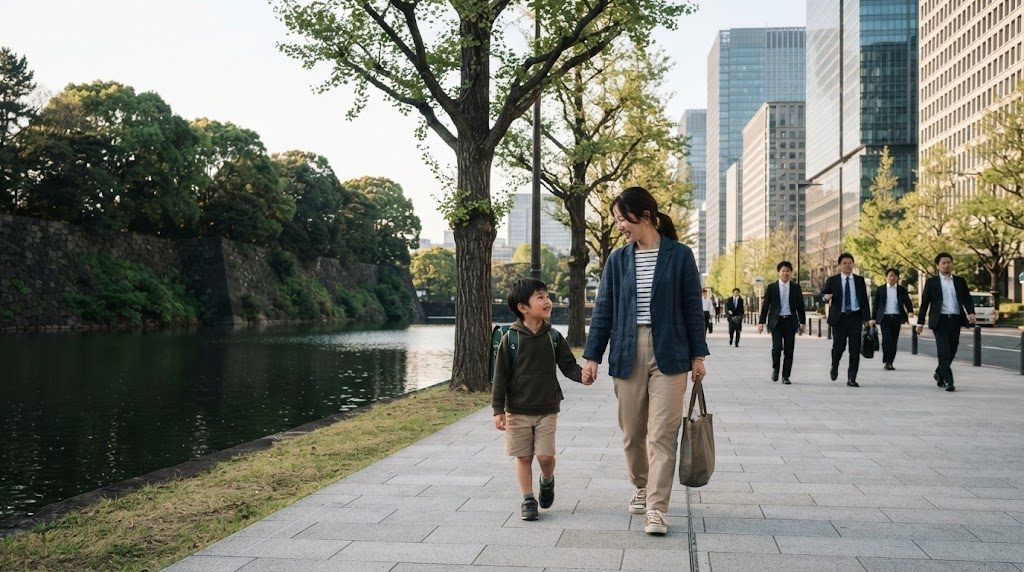
Chiyoda’s school map can be summarised in one line: few schools, but each one distinct. With fewer than 70,000 residents, the ward simply never developed the dense cluster of preschools you find in Meguro, Setagaya or Minato. What it has instead is a tight concentration of options west of the Imperial Palace, in Bancho, Kojimachi, Kudan and Fujimi. Phoenix House in Yonbancho, Tokyo Chinese School and KIDS EDU in Gobancho, Wisdom Academy in Kudankita, Hybrid Mom in Fujimi — almost every serious option in the ward sits within about a kilometre of Ichigaya, Kojimachi or Kudanshita station.
The eastern half of the ward is different. Around Kanda, Kajicho and Sotokanda you will find small bilingual nurseries such as Anchor Kids and FortuneStars, generally serving families who work in the area rather than families who live there. Marunouchi, Otemachi and Kasumigaseki have essentially no schools for residents at all. If you are house-hunting, that geography matters more than it does in most wards.
On fees, Chiyoda is unusually opaque — with one exception. Phoenix House International School publishes a full fee schedule every year, and its 2026-27 Finance and Fees Policy sets tuition at ¥3,100,000 for Prep 1-2, ¥3,250,000 for Prep 3-4 and ¥3,450,000 for Prep 5-6, all inclusive of consumption tax and of the annual enrichment and building maintenance charges. On top of that sit a ¥60,000 registration fee, a ¥500,000 enrolment fee and a ¥500,000 school development fee for new pupils. Families using the school bus pay roughly ¥360,000 more per year. In other words, Chiyoda’s only full-time option sits squarely in the same band as the established schools of Minato and Shibuya.
Every other school in the ward keeps fees private and shares them at a tour or an information session. Whatever you are quoted, judge it on the full annual outlay — entrance fee, facilities levy, materials, lunch and transport — rather than on tuition alone. Our breakdown of international school costs in Japan walks through the line items most families forget.
Note: fee information reflects publicly available sources as of August 2026. Please confirm current figures on each school’s official website.
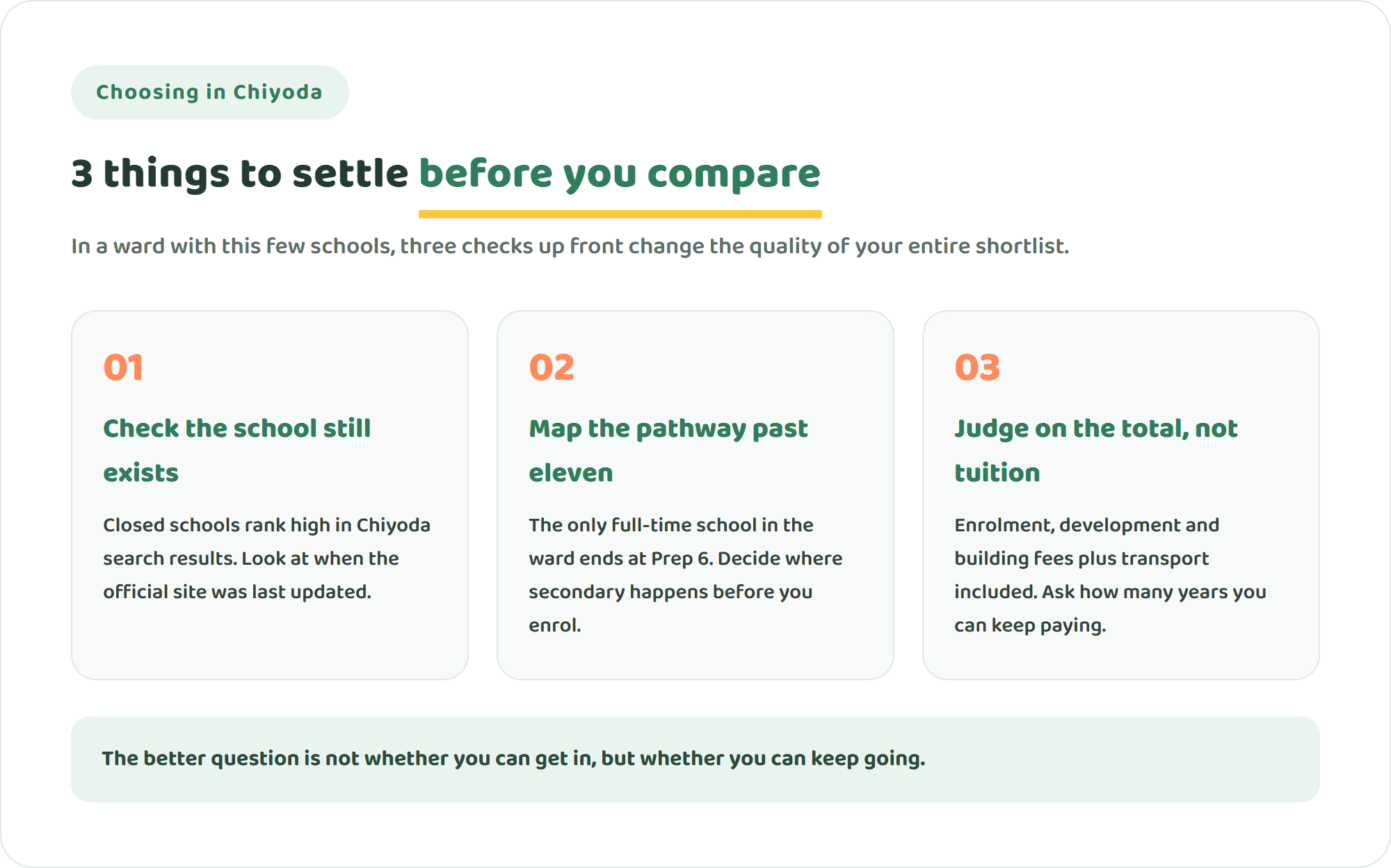
All eight international schools in Chiyoda, by age range and cost
What follows is every school we could verify as operating in Chiyoda in August 2026. We have not padded the list to a round number. Eight schools exist, and only one of them teaches primary-age children full time in English. Read the list in this order: age range first, then cost, then educational philosophy. In a ward this small, the first filter usually decides the answer.
1. Phoenix House International School (Yonbancho) | ¥3.10m-3.45m per year
Walkable from Ichigaya, Kojimachi and Hanzomon stations, Phoenix House is the only full-time international school in Chiyoda. It is a British prep school following the National Curriculum of England, running Prep 1 to Prep 6 with a maximum roll of 288. It opened in August 2021 in the buildings vacated by Chiyoda International School Tokyo, and is operated by CEA Private Schools, the group behind Rugby School Japan. Its most distinctive feature is the North Peak enrichment campus in Hokkaido: residential outdoor programmes there are included in the tuition fee rather than billed as trips. Class sizes are small, school clubs are covered by tuition, and the school publishes its complete fee policy as a PDF each year — a level of transparency that is genuinely rare in Tokyo.
- Curriculum: National Curriculum of England — English, maths, science, humanities, modern languages, music, computing, art, design and technology, PE
- Ages: Prep 1 to Prep 6, roughly ages 5-11. Year groups follow the British 1 September to 31 August birthday cut-off
- Fees: ¥3,100,000 (Prep 1-2), ¥3,250,000 (Prep 3-4), ¥3,450,000 (Prep 5-6) per year, tax included. Plus ¥60,000 registration, ¥500,000 enrolment and ¥500,000 school development fee. With school bus: ¥3,460,000-¥3,810,000. Official 2026-27 figures
- Best for: families in Bancho and Kojimachi who want a small British prep education without leaving the ward
Official website | Finance and Fees Policy
2. Tokyo Chinese School (Gobancho) | fees on enquiry
Founded in 1929 and settled in Gobancho since 1948, Tokyo Chinese School runs a twelve-year programme from primary through senior high, with a kindergarten section as well. It gained formal school-corporation status in 2008. Teaching is trilingual — Mandarin, Japanese and English, which puts it in a different category from an English-medium international school but makes it one of the very few options in Chiyoda where a child can stay from age three to eighteen. Primary intake is capped at 40 per year group, and transfer places open only where a year group has vacancies, so availability is the first thing to ask about.
- Curriculum: trilingual Mandarin, Japanese and English across a twelve-year integrated programme
- Ages: kindergarten through senior high, roughly 3 to 18
- Fees: not published; enquire directly
- Best for: families with Chinese-speaking heritage, or anyone looking for a multilingual rather than English-only environment
3. KIDS EDU International Preschool & Academy (Gobancho) | fees on enquiry
Four minutes from JR Ichigaya and eight from Yotsuya, KIDS EDU combines a preschool with an academy for primary-age children. The early-years programme is built on the Creative Curriculum, widely used in the United States, with Montessori elements and a STEAM English strand. It runs 9:00 to 19:00, which makes it workable for two-career households, and — unusually for this ward — the same setting continues after your child starts primary school, through after-school English, STEM and programming, piano and violin. It is an approved facility under Japan’s early childhood education subsidy scheme.
- Curriculum: Creative Curriculum plus Montessori and STEAM English; after-school academy for primary years
- Ages: 2 through primary school
- Fees: not published; enquire directly. Eligible families receive subsidy of up to ¥37,000 per month for ages 3-5
- Best for: Bancho and Kojimachi families who want one English setting that carries on past age six
4. Wisdom Academy PRIME Ichigaya-Iidabashi (Kudankita) | fees on enquiry
Three minutes from JR Ichigaya, on the fourth floor of the Seven Annex building in Kudankita, this site was previously known as SUPER GLOBAL PRESCHOOL Ichigaya-Iidabashi. Today it operates as an English-immersion after-school serving ages 3 through to the final year of high school. The programme includes Jolly Phonics, ICT-based Discovery Time, social and emotional learning, and a STEAM Lab, alongside roughly thirty enrichment activities. Care runs until 22:00. For families whose children attend a Japanese school, this is the most practical way in Chiyoda to keep a serious English environment running after 3pm.
- Curriculum: English-immersion after-school — phonics, SEL, STEAM Lab, around 30 enrichment options
- Ages: 3 to 18; younger preschool places from around 18 months, subject to confirmation
- Fees: vary widely by membership type and plan; enquire directly
- Best for: dual-career families combining a Japanese school with English immersion and late pickup
5. Hybrid Mom Preschool Nursery Chiyoda Fujimi (Fujimi) | fees on enquiry
A short walk from Iidabashi and Kudanshita, this unlicensed nursery runs dual-language immersion in English and Japanese, with foreign teachers paired with bilingual Japanese childcare staff. The curriculum weaves science and maths thinking across subjects, and a bilingual chef runs cooking and food-education sessions. Two features stand out for working parents: a web camera system so you can check in on the day, and a communication lounge where parents can work on site. It accepts children from birth and offers Saturday care.
- Curriculum: English and Japanese dual-language immersion with food education and cross-subject inquiry
- Ages: 0 to 5 (pre-primary)
- Fees: not published; enquire directly, and ask whether subsidy applies
- Best for: Iidabashi and Kudan families who want English from infancy without losing Japanese
6. Anchor Kids International School (Kajicho) | fees on enquiry
One minute from JR Kanda Station, Anchor Kids opened in October 2022 with a capacity of 29 children. Alongside the usual intellectual, physical and character development, it builds its identity around tabi-iku, or travel-based learning, with the curriculum designed jointly by educators and travel professionals. Native and bilingual teachers share every class, and afternoon lessons can be taken in either Japanese or English. Hours run 8:30 to 18:30. For parents commuting into Otemachi or Marunouchi, this is probably the easiest drop-off in the ward.
- Curriculum: bilingual care with a travel-based learning concept; afternoon lessons in Japanese or English
- Ages: 1 to 6 (pre-primary)
- Fees: not published; enquire directly
- Best for: parents working in Kanda, Otemachi or Marunouchi who want to minimise the daily detour
7. Au Pays des Sakuras (Iidabashi) | fees on enquiry
On the second floor of the Koyo building near Iidabashi Station, this is a small French-language workshop-style preschool for children aged two to four — the only non-English European language setting in the ward. For francophone families, and for those who may later look towards the Lycée Français International de Tokyo, it is a natural first step. The operation is small and session-based, so confirm opening days and availability directly.
- Curriculum: French-language atelier and workshop-based early years
- Ages: 2 to 4
- Fees: not published; enquire directly
- Best for: francophone households and families building towards French-track schooling
8. FortuneStars (Sotokanda) | fees on enquiry
Four minutes from Suehirocho Station, FortuneStars opened in 2021 with a deliberately tiny model: a maximum of six children, aged one to five. Despite the scale it offers extended hours, temporary childcare, meals cooked on site and a parent communication app. For a child who finds large groups overwhelming, or who has struggled in a bigger preschool, it is a rare kind of option in central Tokyo. Places are correspondingly scarce, so enquire early.
- Curriculum: small-group English-medium early years focused on early language exposure
- Ages: 1 to 5, capacity 6
- Fees: not published; enquire directly
- Best for: families near Sotokanda, Akihabara and Yushima looking for a very small, calm setting
Note: as of August 2026 we could not confirm an official website for this school — the URL carried by nursery directory sites now resolves to a different operator — so please contact the school directly about visits and availability.
Opening April 2027: ECC International Preschool Kojimachi
Announced in April 2026, this is the first new international school Chiyoda has gained in years. ECC — a language education group with more than sixty years of history in Japan — will open its first international preschool on the second floor of the Hulic Kojimachi building at Kojimachi 3-2 in April 2027. The programme pairs IEYC, the International Early Years Curriculum used in more than sixty countries, with ECC’s own English methodology, taught by foreign teachers working alongside bilingual Japanese childcare staff. It opens with 15 places each in the two-year-old and three-year-old classes, adding four-year-olds in 2028 and five-year-olds in 2029. Core hours are 9:00-16:00 with extended care from 8:00 to 19:00. If your child is around two now, this belongs on your list.
Check before you visit: Chiyoda has an unusual number of closed schools
The single biggest time-waster when researching schools in Chiyoda is chasing institutions that have shut. Chiyoda International School Tokyo is the obvious case. Backed by Musashino University, it opened in Yonbancho in April 2018 with plans for twelve year groups and 480 pupils, and was covered enthusiastically at the time. Its primary and middle sections closed at the end of July 2021 and the high school at the end of March 2022 — yet it still appears in relocation guides and directory listings today.
Sakura International School’s Chiyoda campus in Iwamotocho needs the same caution. It remains listed on municipal facility registers and nursery search sites, but the operator’s official campus list no longer includes it, and the Chiyoda campus URL now redirects to the Nihombashi campus in Chuo Ward, as of August 2026. Confirm enrolment status directly before you plan around it. In a ward with this few schools, information freshness alone can halve your shortlist.
Local schools versus international schools: the Chiyoda dilemma
Chiyoda poses a question most Tokyo wards do not. Its public schools carry real prestige — the Bancho Elementary to Kojimachi Junior High pathway has been a byword for central Tokyo state education for decades, and Kudan Secondary School offers a six-year municipal track. For internationally minded families living in Bancho or Kojimachi, the choice between a highly regarded local school and an international one is genuinely close.
There is no universal answer, but three questions help. First, what is the English for? If the goal is an overseas university, an English-medium environment from early on matters a great deal. If it is international outlook within a Japanese education, a local school plus a serious after-school English programme is far more affordable. Second, how many years can you fund it? Six years at Phoenix House approaches ¥20 million, and there is no secondary continuation inside the ward, so the bill after age eleven has to be part of the plan. Third, where will your child feel at home? In a ward this small, a small school also means fewer alternatives if the fit turns out to be wrong. One more thing worth saying plainly: there is no obligation to solve this inside Chiyoda. With the Hanzomon, Yurakucho and Toei Shinjuku lines running through it, the ward is one of the easiest places in Tokyo to commute out of.
When Chiyoda does not have it: Minato, Shinjuku and beyond
If you look only within Chiyoda for a school that carries your child past age eleven, the search ends quickly. Widening by one ward changes everything. Minato is the natural first move — fifteen minutes from Kojimachi through Nagatacho and Akasaka, and home to several of Tokyo’s long-established full-time international schools. See our guide to international schools in Minato.
Shinjuku is the second. Ichigaya Station straddles the Chiyoda-Shinjuku boundary, so from Bancho much of the ward is effectively walking distance; international schools in Shinjuku covers the Yotsuya and Shinanomachi options. For a wider range of curricula and price points, look at international schools in Shibuya, and if the bayside towers are on your housing list, international schools in Koto is worth a read. To compare across the whole city rather than ward by ward, start with our guide to international schools in Tokyo.
Comparing the three routes open to Chiyoda families
Listing schools is one thing; choosing between them is another. It helps to think of Chiyoda in three categories: full-time international schools inside the ward, preschools and English after-school programmes inside the ward, and online international schools that remove the commute entirely. The table below sets out how each tends to perform, including where each one falls short.
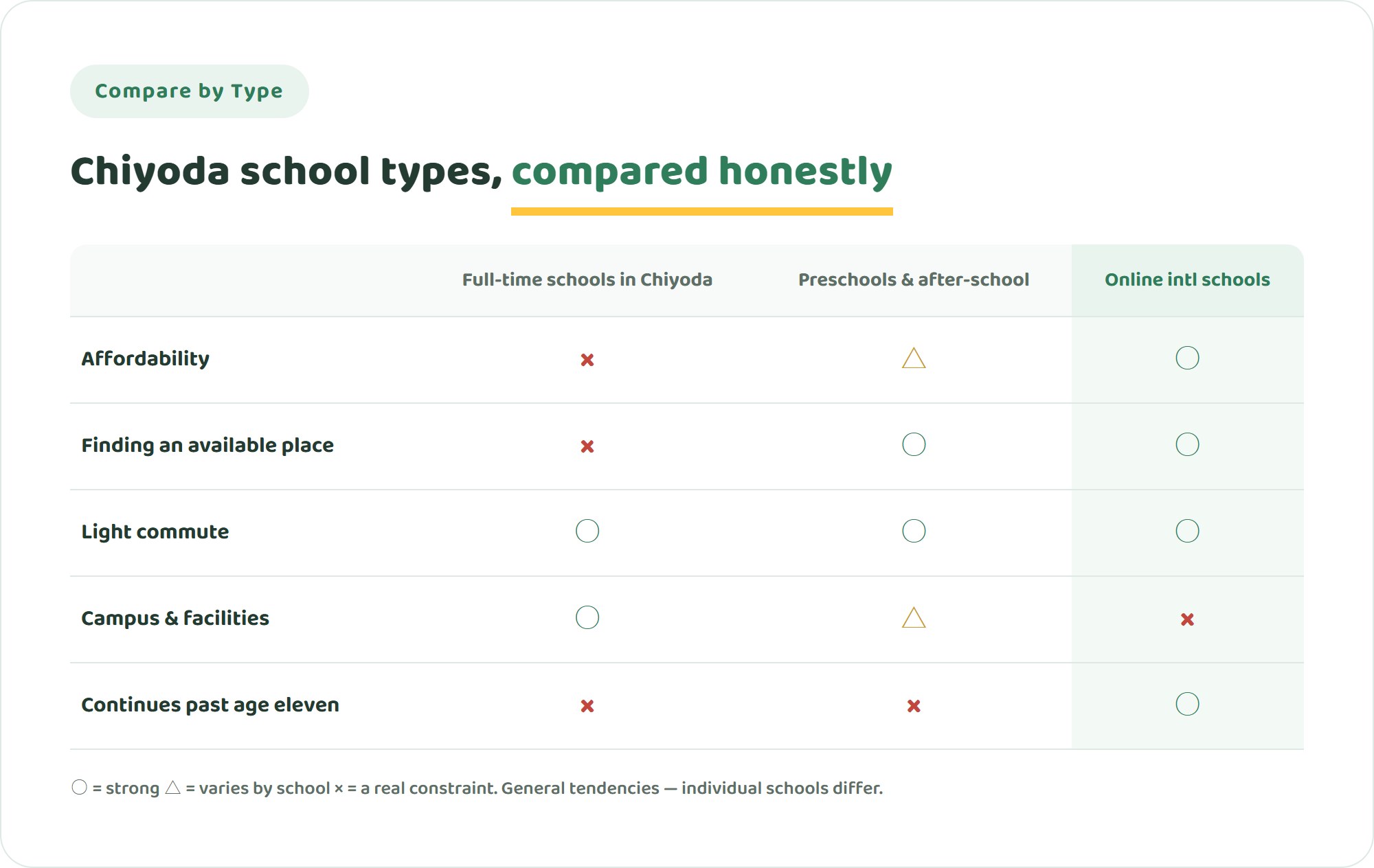
Phoenix House, the ward’s only full-time school, is refreshingly transparent about cost and deliberately small — but with six year groups and 288 places, there may simply be no opening in your child’s year. Preschools are the easiest to reach on foot or by bicycle and some qualify for subsidy, yet most end at six, which puts you back in the same search two or three years later. The third route is the one families overlook. An online school removes the question of which ward you can afford to live in and how far a seven-year-old can reasonably travel each morning. In central Tokyo, where residential space is tight and commutes are the hidden cost of every decision, that is not a small thing.
See how learning works online →
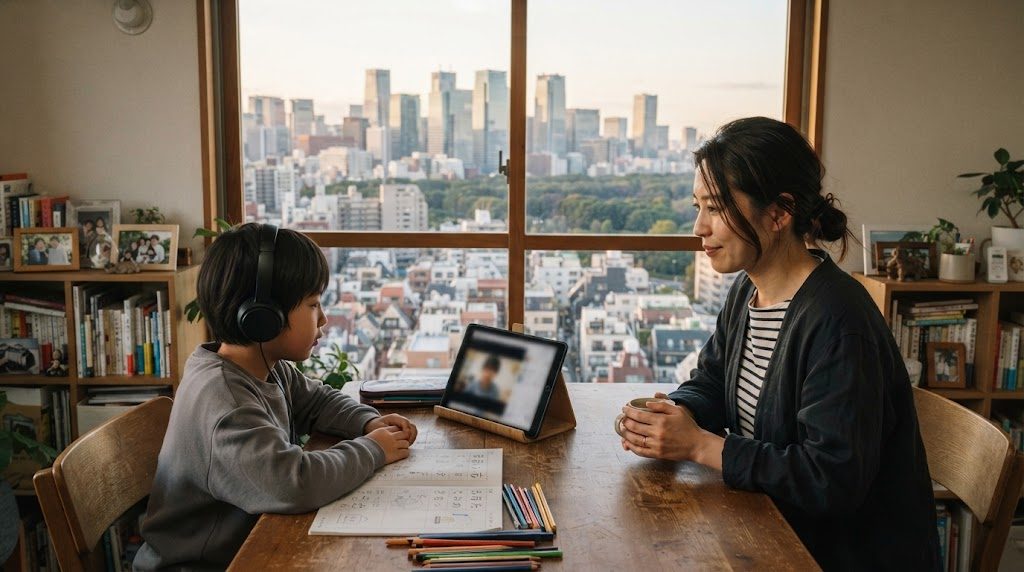
When fees or the commute are the barrier: online as an eighth option
Chiyoda is a fine place to raise a child. The palace moat, the quiet streets of Bancho, the strength of the local schools — the ward has a great deal going for it. But the arithmetic is what it is: one full-time international school, fees starting in the ¥3 million range, and a commute out of the ward from age eleven onward. For plenty of families, that is where the plan stalls. If you want an international education for your child but cannot see how to sustain it for a decade, there is another route that does not depend on a daily journey.
NIJIN GLOBAL ACADEMY (NGA) is an online international school opening in September 2027. It is run by NIJIN Inc., the Japanese company behind NIJIN Academy, an alternative school with more than 1,000 enrolled students. We do not rank children by test scores. Learning happens in small groups built around dialogue, with the aim that each child comes to like themselves and the world around them. We serve students aged 6 to 18 across Asia and Oceania, wherever they live, and the programme is designed so that children can move gradually into English with Japanese-language support underneath them. Our target is roughly one-fifth the cost of an in-person international school.
To be straightforward with you: NGA has not opened yet, and we have no track record to point to. We cannot offer a playing field, a science lab or the physical school experience that a campus provides. What we can offer is a way to connect with the world without the commute and without the fee structure that puts international education out of reach — which, if you are comparing options in Chiyoda, may be worth a look.
Frequently asked questions
Q. What is the youngest age international schools in Chiyoda accept?
A. From birth, if you count nurseries. Hybrid Mom Preschool Nursery Chiyoda Fujimi takes children from 0, Anchor Kids and FortuneStars from age 1, and KIDS EDU and Au Pays des Sakuras from age 2. For full-time schooling, Phoenix House starts at Prep 1 (around age 5) and Tokyo Chinese School has a kindergarten section. From April 2027, ECC International Preschool Kojimachi will open with two-year-old and three-year-old classes. Filtering by your child’s age is almost always the fastest way to shorten this list.
Q. Can my child continue in English past primary school in Chiyoda?
A. Not within the ward. Phoenix House ends at Prep 6, around age 11, so families move to Minato, Shinjuku, Shibuya or further afield for secondary. Tokyo Chinese School is the one option offering a continuous path to 18, though its medium of instruction is trilingual rather than English-only. Plan the secondary step before you enrol, not after. If you are also weighing how to keep your child’s Japanese strong while they study in English, our sister service Tomodachi Japan, an online Japanese programme for children run by NIJIN, is worth knowing about.
Q. We are on a diplomatic or corporate posting for three years. Is an international school in Chiyoda realistic?
A. It depends on your child’s age and your timing. Phoenix House admits through six rounds across the school year and uses a Discovery Day assessment, so applying roughly a year ahead is sensible, and mid-year places depend entirely on whether a year group has space. For shorter postings with younger children, the preschools in the ward are far more flexible and considerably cheaper. Also check what your employer covers: in Chiyoda, where fees start above ¥3 million, the education allowance in your package often decides the question before anything else does.
The time you spend deciding is time spent caring
There is no correct answer to this. In a ward like Chiyoda, where the options are few and the local schools are genuinely good, the useful question is rarely which school is best — it is which choice your family can sustain for years. Fees, commutes, your child’s temperament: every household weighs these differently. The fact that you are weighing them at all is the clearest sign of how seriously you are taking your child’s future. Take your time, visit two or three schools, and compare how they feel rather than how they read. And if you would like to keep a non-commuting route on the table as well, we would be glad to keep you posted.
International Schools in Other Cities
- International Schools in Nagoya: All 8 Schools
- International Schools in Minato: Fees
- International Schools in Setagaya: All 14 Schools
- International Schools in Nakano, Tokyo
- International Schools in Tsukuba: Fees
- International Schools in Sendai: 7 Picks and Fees
- International Schools in Kanazawa
- International Schools in Karuizawa: All 4 Schools
- International Schools in Tokyo
- International Schools in Shibuya, Tokyo
- International Schools in Koto, Tokyo
- International Schools in Shinagawa, Tokyo
- International Schools in Meguro: All 8 Schools
- International Schools in Chofu and ASIJ Fees