Taito is one of the most international corners of Tokyo. Roughly one resident in ten holds a foreign passport, Ueno and Asakusa fill with visitors from everywhere every single day, and the guesthouses around Iriya and Minowa have been home to newcomers for decades. So it comes as a shock when you search for international schools in Taito and find nothing but English preschools and after-school clubs. Where, exactly, does a six-year-old go? The uncomfortable answer is the honest one: as of August 2026 there is not a single full-day international school in Taito for primary, middle or high school age. This guide lists every English-medium option that genuinely exists inside the ward — five of them — with ages, published fees and what each one is actually for. Then it shows you the two neighbouring wards that Taito families realistically commute to, and one option that removes the commute entirely.
Quick Answer: Your Options in Taito
- Harmony Preschool International (HAPI), Higashi-Ueno | ages 2–5, plus a small after-school English class for primary pupils and a Saturday class for ages 2–6 | around ¥70,000 a month as a guide for a three-year-old attending five days (roughly ¥840,000 a year, official) | the only school in Taito operating as an international preschool
- Kids UP Ueno, Higashi-Ueno | ages 3 to grade 6 | fees on enquiry | opened February 2025, the brand’s first site in Taito; pick-up from selected local schools and kindergartens
- Meiko Kids e Ueno-Asakusa, Matsugaya (Kappabashi) | preschool course through grade 6 | fees on enquiry | all-English after-school and preschool, up to five hours of English a day, with school pick-up
- ASK Bilingual Nursery Asakusabashi | 45 days old to school age | fees on enquiry (Tokyo-certified nursery) | daily English from infancy, open 7:30–20:30 Mon–Sat and Sundays too
- Asakusa English School, Asakusa | preschool through primary | the co-located Lepton classroom starts at ¥7,810 a month for one lesson a week (tax included, official) | American teachers, American curriculum, conversation plus phonics and reading
- NIJIN GLOBAL ACADEMY (online, opening September 2027, ages 6–18, aiming at about one-fifth of on-campus fees, Japanese-language support built in) | an online international school you can attend from anywhere; registration for opening updates is open now
How International Schools in Taito Actually Work — and What They Cost
Start with the numbers. On 1 August 2026 Taito had 217,629 residents, of whom 21,444 were foreign nationals — about 9.9 per cent, one of the higher shares among Tokyo’s 23 wards (Taito Ward resident register). Ueno, Okachimachi, Asakusa and Kuramae have been trading with the world for generations, and the local public schools reflect that. It is entirely reasonable to assume the ward would have a matching set of international schools. It does not.
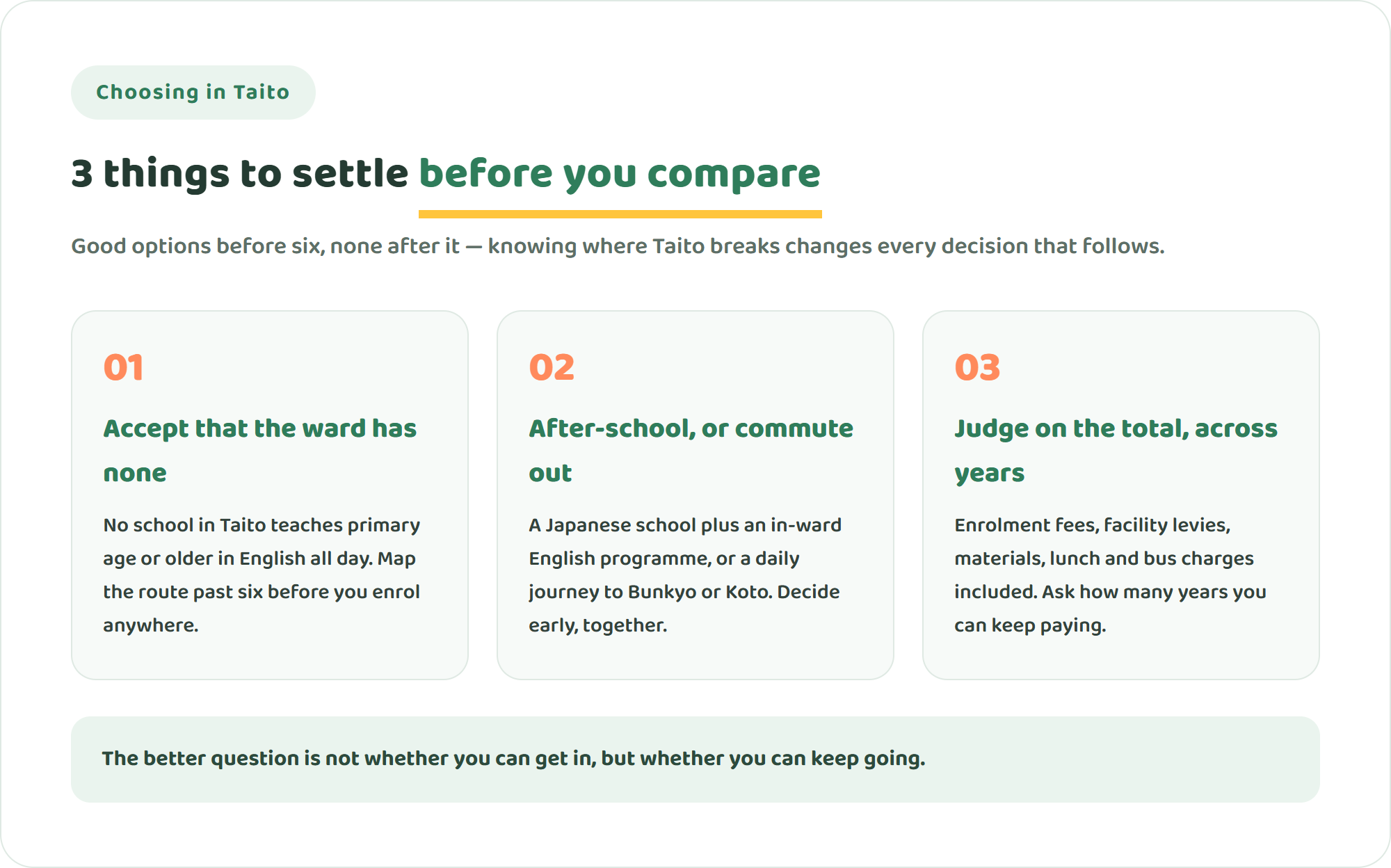
What Taito does have is a reasonably good early-years landscape. Between HAPI in Higashi-Ueno, ASK Bilingual Nursery in Asakusabashi, Meiko Kids e in Matsugaya and Kids UP in Higashi-Ueno, a child aged two to six can spend their days in English inside the ward without much difficulty. The break comes the moment they turn six. Several of those same providers do accept primary-age children — but every one of them does so as an after-school or Saturday programme. Your child attends a Japanese primary school by day and switches into English in the afternoon. There is no school in Taito where a seven-year-old learns maths, science and literature in English from morning to home time. By middle and high school age, even the after-school options thin out to cram schools and conversation classes.
This is not a failing peculiar to Taito. International schools in Tokyo cluster hard around the wards where corporate expatriates have historically lived — Minato, Shibuya, Setagaya — and around the newer bayside developments. Taito, with its craft workshops, wholesale streets and long-settled communities, was never on that map. The practical consequence for you is simple: plan from the start on the assumption that the ward alone will not carry you through. If you want the citywide picture before narrowing down, start with international schools across Tokyo.
On money. HAPI is the one provider in Taito publishing figures: roughly ¥70,000 a month for a three-year-old attending the five-day main class — about ¥840,000 a year — plus a ¥50,000 enrolment fee (¥20,000 on renewal), ¥480 a day for lunch and ¥50 for snacks; the Saturday class is ¥5,000 a month. Kids UP and Meiko Kids e do not publish rates, because they vary sharply with days and hours, so both are enquiry-only. The Lepton classroom at Asakusa English School starts at ¥7,810 a month for weekly lessons. Step outside the ward for a genuine full-day school and the order of magnitude changes: roughly ¥600,000 to ¥3 million a year in neighbouring Koto, and about ¥1.52 million a year for the primary school in Bunkyo. Judge every option on the total, not the headline tuition — entrance fees, facility levies, materials, lunch and bus charges add up fast. Our breakdown of what international school really costs sets out the line items.
Note: fees and details reflect publicly available information as of August 2026. Always confirm the current figures with each school.
All 5 International Schools in Taito, by Age Range and Fees
Below is every English-medium school and programme that genuinely operates inside Taito Ward. There are five, not seven, and padding the list would not help you. Read them in this order — age range first, fees second, educational philosophy third — and the shortlist writes itself.
1. Harmony Preschool International (HAPI), Higashi-Ueno | about ¥70,000 a month for five days at age three
An eight-minute walk from Inaricho Station and within walking distance of JR Ueno, HAPI is the only setting in Taito that operates as an international preschool. It opened in 2015 and its classes are genuinely multinational. The school built its own Global Sensitive Curriculum, organised around three strands — cultural sensitivity, identity sensitivity and sense sensitivity — which is a considered way of saying that English is treated as a way of living alongside other cultures rather than a subject to be drilled. Main classes run 09:30–15:00, with wraparound care from 08:00 to 19:00, which makes it workable for two-income households. Two extras matter for the long game: a small after-school English class for primary-age children on Monday and Thursday afternoons, and a Saturday class for ages 2–6 held at the school’s second address in Higashi-Ueno 3-chome. If you live in Taito and want an English environment your child does not have to leave at six, this is where to start.
- Curriculum: the school’s own Global Sensitive Curriculum, covering culture, identity and sensory learning in an English environment
- Ages: 2–5 for the main class (age as of 2 April); plus a primary after-school English class and a Saturday class for ages 2–6
- Fees: vary by age and attendance; as a guide, about ¥70,000 a month for a three-year-old attending five days (roughly ¥840,000 a year). Enrolment ¥50,000 (¥20,000 on renewal), lunch ¥480 a day, snacks ¥50 a day, Saturday class ¥5,000 a month (official, August 2026). Eligible for municipal subsidy
- Best for: families in Ueno, Okachimachi and Inaricho who want one place that carries them from toddler years into the primary after-school years
Official website / Admissions and fees
2. Kids UP Ueno, Higashi-Ueno | fees on enquiry
Eight minutes from the Iriya exit of JR Ueno Station and five from Inaricho on the Ginza Line, this site opened in February 2025 as the brand’s first location in Taito. It runs a KINDY course for ages three to six, an ELEMENTARY after-school course for grades 1–6, and a SPECIALIST track for children who already have a foundation and want to push further. The model is long-immersion: several unbroken hours in English every afternoon, delivered through sport, games and craft rather than worksheets, on a curriculum supervised by university faculty. Crucially for working parents, there is a shuttle from selected primary schools and kindergartens in Taito, Chiyoda and part of Arakawa, so the after-school pick-up problem and the English problem get solved by the same booking. The centre operates 11:00–20:00.
- Curriculum: long-immersion English after-school care building the four skills, supervised by university faculty
- Ages: 3–6 (KINDY), grades 1–6 (ELEMENTARY), plus an advanced track for stronger students
- Fees: not published; enquire directly, as rates depend on course, days per week and hours
- Best for: families in Ueno, Inaricho and Iriya whose children attend Japanese primary school but need their afternoons to be in English
3. Meiko Kids e Ueno-Asakusa, Matsugaya | fees on enquiry
Five minutes from Asakusa Station on the Tsukuba Express and nine from Iriya, this centre sits on Kappabashi Kitchen Town, the kitchenware street that draws chefs from around the world. Run by the Meiko education group, it describes itself as an all-English after-school and preschool with up to five hours of English a day, taught by a mixed team of native and bilingual instructors. What distinguishes it is the number of entry points: a preschool course, an elementary course, a pre-member option, an Eiken preparation track and a weekend course. The elementary course includes pick-up from school plus homework support, so children arrive, settle, get their Japanese homework done and then move into English activities, science and programming. Places are capped, and groups are deliberately small.
- Curriculum: all-English after-school care and preschool, with homework support, Eiken preparation, programming and science
- Ages: preschool course through grade 6, plus a weekend course
- Fees: not published; enquire directly, as rates depend on course and days attended
- Best for: families in Asakusa, Iriya, Tawaramachi and Matsugaya who need after-school English with a school pick-up attached
4. ASK Bilingual Nursery Asakusabashi | fees on enquiry (Tokyo-certified nursery)
Five minutes from Asakusabashi Station on the JR Sobu Line and from Kuramae on the Toei Asakusa Line, this is a Tokyo-certified nursery (nintei hoikusho) rather than an international school — but the bilingual brief in its name is real. Children meet English every day from infancy, the stated aim being that they reach school age without ever having built up resistance to the language. It takes children from 45 days old to school age, with capacity for 38, and layers gymnastics, music, dance and food education around the bilingual core. Opening hours are unusually generous: 07:30–20:30 Monday to Saturday and 08:00–18:00 on Sundays, with extended, holiday, temporary and special-needs care available. For families in the south of the ward who want English present from year one without committing to a private preschool budget, this is a genuinely useful option — and as a certified nursery it may qualify for ward fee assistance, so check with Taito Ward alongside the school.
- Curriculum: bilingual care with daily English alongside Japanese, plus gymnastics, music, dance and food education
- Ages: 45 days old to school age (capacity 38)
- Fees: not published; enquire directly. As a Tokyo-certified nursery it may be eligible for Taito Ward fee assistance — confirm with the ward office
- Best for: families in Asakusabashi, Kuramae and Torigoe who need long hours from infancy with English built in
5. Asakusa English School, Asakusa | Lepton classroom from ¥7,810 a month
On the second floor of the Makita Building in Asakusa 5-chome, this school is taught by American teachers following an American curriculum, with an emphasis on native pronunciation and reading developing side by side from an early age. It runs classes for preschoolers through primary pupils, and shares premises with a Lepton classroom — an individualised children’s English programme — so families can combine conversation-led lessons with structured, self-paced work on reading and writing. This is a once- or twice-a-week class rather than a school, and it is important to be clear about that. But for households in the northern part of Taito, around Asakusa and Senzoku, it is the most affordable way to keep English going week after week. Lessons run Tuesday to Saturday, mostly in the late afternoon and evening.
- Curriculum: American curriculum with American teachers (conversation, pronunciation, reading), plus individualised Lepton lessons
- Ages: preschool through primary (the Lepton classroom is mainly primary and up); confirm which classes are currently running
- Fees: Lepton from ¥7,810 a month for one lesson a week and ¥9,790 for two (tax included), plus textbooks at ¥2,200–¥2,640 each and registration and annual fees (official, August 2026). School classes on enquiry
- Best for: families in Asakusa, Senzoku and Imado who want to build the habit first, at one or two sessions a week
Beyond these five, Taito has a number of Japanese nurseries that build English into the weekly programme — Rikka Gakuen in Yanaka, Cherish Ohisama and Cherish Asakusa, Cherish Nursery School Ueno in Ueno-Sakuragi, Pocket Land Asakusa Tower and Pocket Land Iriya, and HOPPA Ueno-Okachimachi. They are not international preschools and should not be compared to one, but if your priority is a solid Japanese foundation with regular English exposure, they belong on your list. What none of them changes is the central fact: no school in Taito teaches primary, middle or high school pupils in English all day. Every plan you make for a child aged six or older has to start from there.
When Taito Runs Out: International Schools in Bunkyo and Koto
Searching for a full-day school inside Taito ends in a dead end, so the practical move is to widen the map by one ward. To the west, international schools in Bunkyo include MEES International School in Hakusan, whose primary division takes children aged 6–12 for a full day in English at roughly ¥1.52 million a year, and the Bunkyo campus of Aoba-Japan International School in Honkomagome, which runs grades 10–12 through to the IB Diploma. From Ueno, Negishi or Iriya you are looking at about half an hour with one change on the Namboku, Chiyoda or Toei Oedo lines.
The option Taito families most often overlook sits to the south-east. International schools in Koto include K. International School Tokyo in the Kiyosumi-Shirakawa and Monzen-Nakacho area — an IB continuum from K1 to grade 12 — which is roughly ten minutes from Kuramae or Shin-Okachimachi on the Toei Oedo Line via Morishita. UIA International School of Tokyo in Kiba (ages 3–18, Cambridge, about ¥1.37–2.22 million a year) and Tokyo YMCA International School in Toyocho are around half an hour, taking the Hibiya Line from Ueno or Naka-Okachimachi to Kayabacho and changing to the Tozai Line. And if cost is the binding constraint, India International School in Japan’s Tokyo campus runs from kindergarten to grade 12 with tuition from roughly ¥600,000 a year. For families in the south of Taito — Asakusabashi, Kuramae, Torigoe, Misuji — Koto is often the more realistic direction, not Bunkyo.
One caution before you commit. A commute of thirty minutes each way, sustained across six years of primary school, is around 1,400 hours of your child’s life. Count the changes, the morning crowding and the rainy days, and ride the actual route at the actual hour at least once with your child before you decide.
Choosing What Actually Fits Your Family
Lists are easy; deciding is not. It helps to collapse the Taito situation into three types: English preschools and after-school programmes inside the ward, full-day international schools in neighbouring Bunkyo or Koto, and online international schooling with no commute at all. The table below sets out how each type tends to perform on cost, continuity past age six, commute, campus experience and Japanese-language support.
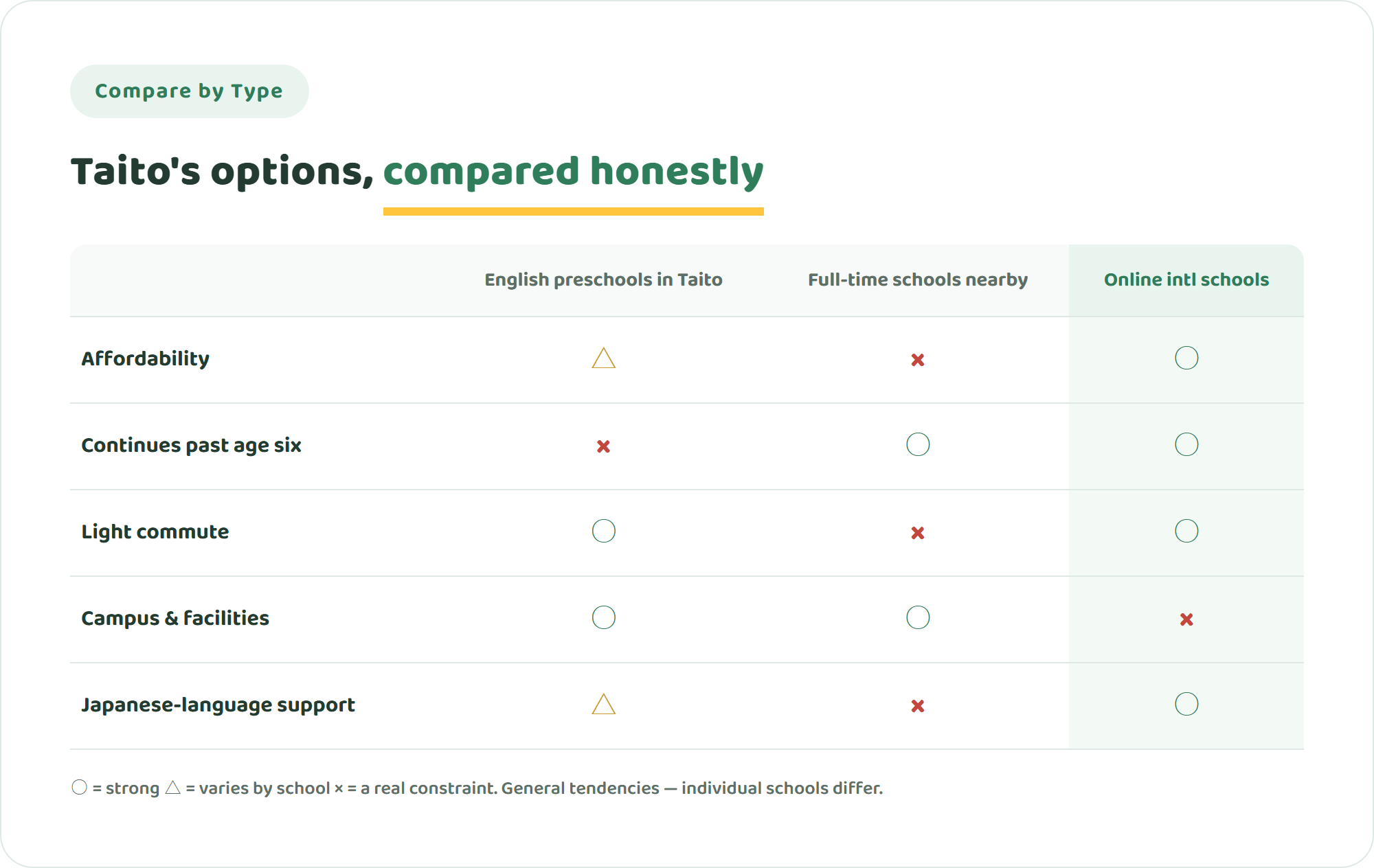
The in-ward options win on convenience and on price — walkable or a short cycle away, starting in the tens of thousands of yen a month, and sometimes eligible for free early-childhood education or ward assistance. What they cannot do is continue. At six, or at the end of primary school, you will be searching again. A full-day school in Bunkyo or Koto buys that continuity, but you pay for it twice: ¥1.5–3 million a year, and an hour of your child’s day, every day. The third route is the one most families never price out. With no commute and no dependence on how many campuses happen to sit inside your ward, an online school makes your postcode irrelevant to your child’s education. If you have found yourself asking whether you could really sustain these fees for ten years, our piece on whether international school is simply too expensive is worth reading before you decide.
See how learning works online →
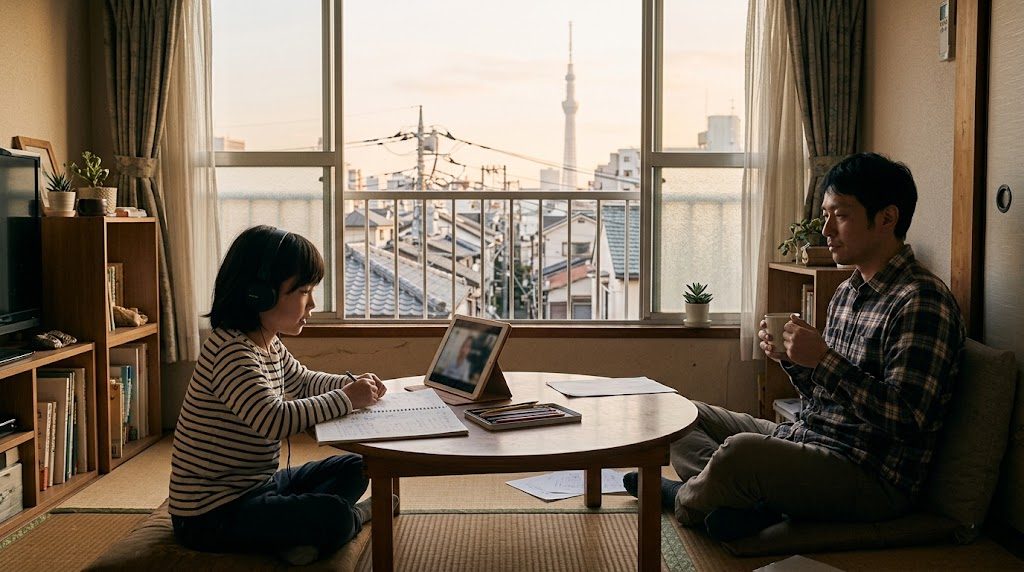
When Fees or the Commute Are the Barrier: The Online Alternative
Taito is a wonderful place to raise a child. The woods of Ueno Park, the fireworks on the Sumida, the craftspeople of Kappabashi still making things by hand — few parts of Tokyo give a childhood so much texture. But the facts remain: no full-day international school inside the ward for a child of six or older, a real commute if you choose one outside it, and fees between ¥1.5 and ¥3 million a year for as long as you continue. For many families those are not inconveniences; they are walls. If you have been thinking that you want an international education for your child but cannot see how to sustain it, there is another route that does not assume a commute at all.
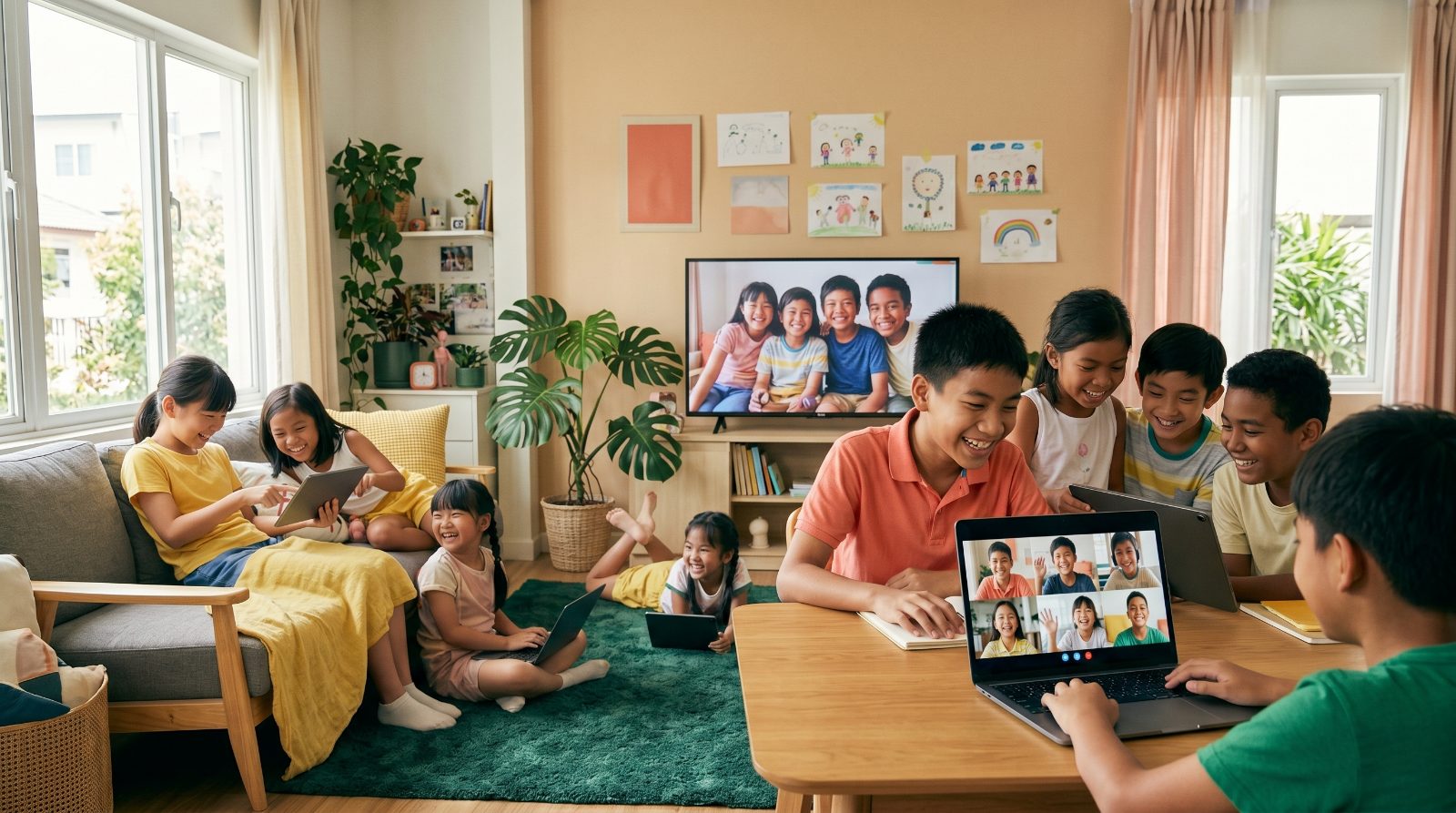
NIJIN GLOBAL ACADEMY (NGA) is an online international school opening in September 2027. It is run by NIJIN Inc., the Japanese company behind NIJIN Academy, an alternative school with more than 1,000 students enrolled in Japan. We do not rank children by test scores. Learning happens in small groups built around dialogue, with a simple aim: that children come to like themselves and like the world. We are for ages 6 to 18 across Asia and Oceania, wherever you live, and the programme is designed so that children can move into English gradually with Japanese-language support underneath them. We are working towards fees of roughly one-fifth of an on-campus international school.
In fairness, we should say the obvious: NGA has not opened yet, and our track record is still ahead of us. We cannot offer the playground, the corridors and the school hall in the way a campus can. But learning that connects your child to the world without a commute and without those fees is, we think, worth putting on the list — especially in a ward where the full-day option simply does not exist.
Frequently Asked Questions
Q. From what age can my child start at an international school in Taito?
A. The earliest is ASK Bilingual Nursery Asakusabashi, which takes babies from 45 days old. Harmony Preschool International accepts children from age two (as of 2 April) and Kids UP Ueno from three; Meiko Kids e Ueno-Asakusa also runs a preschool course. From primary age onward, Kids UP Ueno, Meiko Kids e, HAPI’s after-school class and Asakusa English School all accept children — but every one of them is an after-school or Saturday programme attended alongside a Japanese primary school. Since there is no full-day school in the ward, the first question to settle is not which school, but where your child will spend the school day itself.
Q. Is there anywhere in Taito my primary-age child can attend full time in English? What about Japanese support?
A. As of August 2026, no. There is no school in Taito teaching primary, middle or high school pupils in English all day. The three workable paths are: a Japanese school combined with an in-ward English after-school programme such as Kids UP Ueno or Meiko Kids e; commuting to Bunkyo (MEES primary division, Aoba-Japan Bunkyo campus) or Koto (K. International School Tokyo, UIA, Tokyo YMCA, India International School in Japan); or online schooling with no commute. Japanese-language support varies enormously between schools in both hours and philosophy, so ask about it specifically before you enrol. If keeping Japanese strong while the English hours grow is a worry, our sister service Tomodachi Japan (online Japanese for children, also run by NIJIN) may help.
Q. Can my child stay enrolled at a Taito public school while attending an international school? And when can we transfer in?
A. This one matters, and Taito Ward addresses it directly. For children of Japanese nationality, the ward states that attending most international schools does not discharge the compulsory-education obligation under the School Education Act. It also warns that a child transferring into a Japanese primary or junior high school may be placed below their age-appropriate grade, and that admission to Japanese junior and senior high schools can be affected. For dual-nationality children, exemption from the obligation may be granted where the child could later choose foreign nationality and alternative education is secured — but exemption does not confer a Japanese public-school graduation record. Applications go to the School Affairs Division of the Taito Board of Education through an online form, and families moving into Taito must reapply locally even if a previous ward approved them. Speak to the division before you commit to a pathway. On timing, transfers generally follow the April or August–September intakes, with an English assessment and interview, so contact schools about a year ahead of when you want to start.
No School in Your Ward Is Not the Same as No Way Forward
Discovering that your ward has no full-day international school at all is genuinely deflating. But it closes one door, not the corridor. You can build on the English settings inside Taito alongside a Japanese school. You can ride the Oedo Line ten minutes into Koto. You can let go of the commute entirely. Fees, distance, your child’s temperament, how many years you can realistically sustain a choice — every family weighs these differently, and there is no ranking that answers it for you. The fact that you are here, reading carefully, is itself evidence of how seriously you are taking your child’s future. Visit two or three places in person, unhurried, and compare how they feel. And if you would like to keep the no-commute option in view as well, we would be glad to have you on our list.
International Schools in Other Cities
- International Schools in Tsukuba: Fees
- International Schools in Sendai: 7 Picks and Fees
- International Schools in Shinjuku: Fees
- International Schools in Karuizawa: All 4 Schools
- International Schools in Sapporo: Fees
- International Schools in Dubai: Fees
- International Schools in Seoul
- International Schools in Setagaya: All 14 Schools
- International Schools in Shanghai
- International Schools in Tokyo
- International Schools in Minato: Fees
- International Schools in Shibuya, Tokyo
- International Schools in Koto, Tokyo
- International Schools in Shinagawa, Tokyo
- International Schools in Meguro: All 8 Schools