If you are house-hunting around Nakameguro, Daikanyama or Jiyugaoka — or you already live there — the search for international schools in Meguro tends to hit the same wall for everyone. Plenty of English-speaking preschools appear. Almost nothing appears for children aged six and up. That is not a gap in your research; it is the actual shape of the ward. Meguro is rich in early-years provision and unusually thin on full-time schooling beyond kindergarten. This guide lists the eight international schools genuinely located in Meguro Ward, sorted by the two things families most often get confused about — the age range each one serves and what it costs — then covers the neighbouring wards worth adding to your list, and an option that removes the commute entirely if fees or distance turn out to be the real obstacle.
Quick Answer: Your Options in Meguro
If you only read one section, read this. Below are the schools covered in this guide, plus the online option — so you can see every route side by side before the details.
- KAIS International School, Elementary & Middle (Nakane) — about ¥2.09–2.26 million a year — Ages: Pre-K (age 3) to Grade 12. The Meguro campus covers Pre-K to Grade 8; Grades 9-12… / Fees: annual tuition ¥2,094,358 (Pre-K-G2), ¥2,144,358 (G3-G8), ¥2,260,659 (G9-G12), plus…
- Gregg International School (Jiyugaoka) — fees on enquiry — Ages: K3 to Grade 6 (early years and elementary). Confirm the entry age for the youngest… / Fees: not published; issued on acceptance. Enquire directly
- Aoba-Japan International School, Meguro Campus (Aobadai) — about ¥2.10–2.33 million a year — Ages: 18 months to 6 years (K2-K5, kindergarten only) / Fees: annual tuition ¥2,098,000 (K2) and ¥2,332,000 (K3-K5), official 2026-2027 figures…
- Tokyo International School Nakameguro Kindergarten & After School — fees on enquiry — Ages: kindergarten ages 3-5 (KG1-KG3); after school Grades 1-4, minimum two days a week / Fees: not published online; provided at information sessions or on request
- Aoba-Japan Bilingual Preschool, Shimomeguro — fees on enquiry — Ages: 2 to 5 years / Fees: not published online; enquire directly (also ask whether the school qualifies for…
- Kodomo Edu International School (Nakameguro & Toritsudai-Yakumo) — fees on enquiry — Ages: roughly 2 to 6 years (early years). Confirm class structure directly / Fees: not published online; enquire directly
- Laurus International School of Science, Jiyugaoka (Midorigaoka) — fees on enquiry — Ages: roughly 18 months to 6 years. The Jiyugaoka campus is early years only / Fees: vary by campus, age and hours; check the official tuition page or enquire
- Sunnyside International Kindergarten (Jiyugaoka) — fees on enquiry — Ages: 2 to 6 years / Fees: not published online; enquire directly (ask about subsidy eligibility)
- NIJIN GLOBAL ACADEMY (online) — Ages 6–18 / opening September 2027, currently taking opening-update registrations / fees around one-fifth of a typical campus international school / Japanese-language support. An option when commute or fees are the wall.
International schools in Meguro: the landscape and what they cost
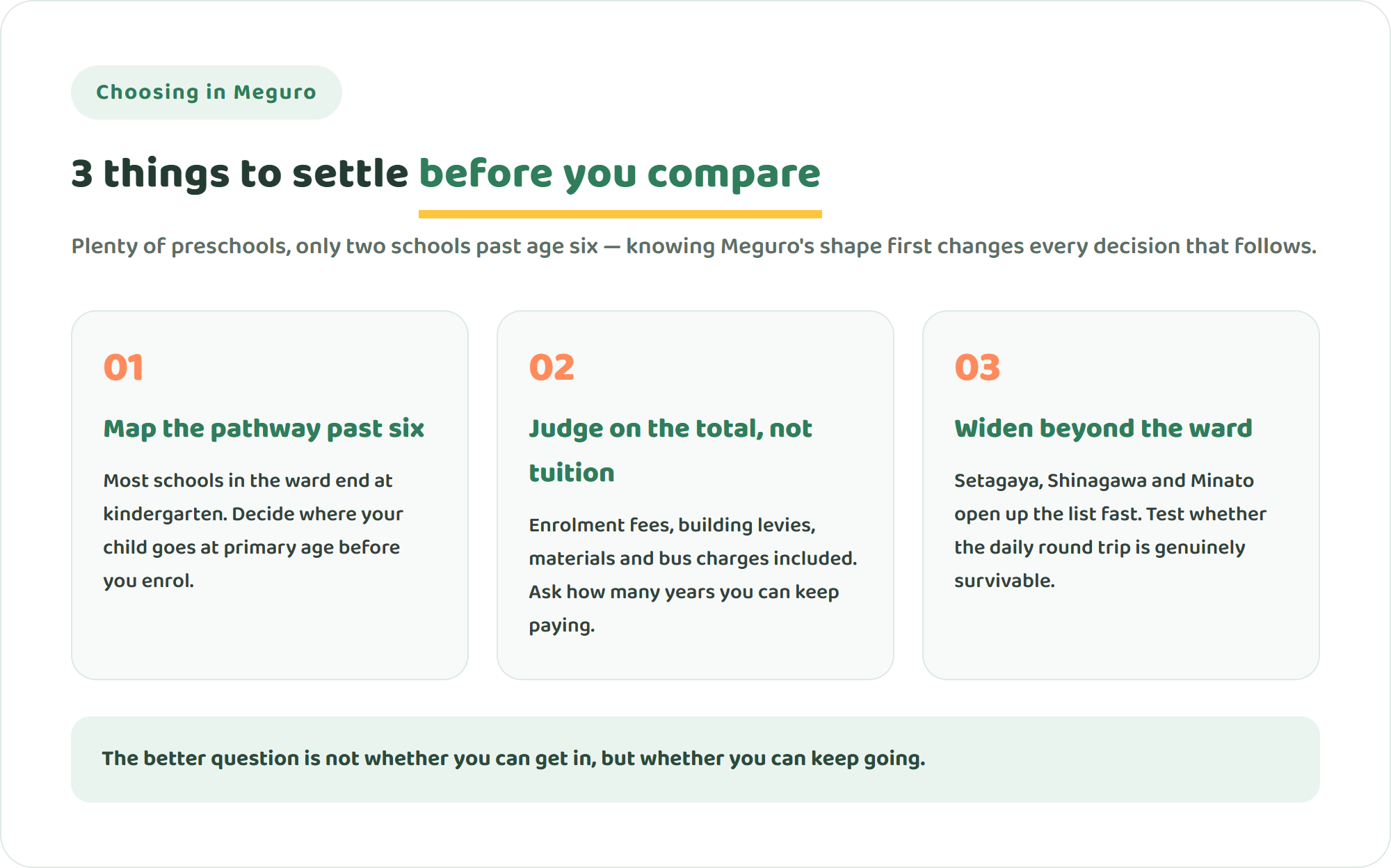
Here is the fact that shapes everything else. Meguro Ward is abundant in preschools and extremely short of full-time schools. Nakameguro, Aobadai, Shimomeguro, Jiyugaoka and Yakumo are dotted with English-medium preschools and kindergartens. But when you look for a school that takes children through the primary and middle years in English, the ward has just two: KAIS International School’s elementary and middle campus in Nakane, and Gregg International School in Jiyugaoka. No school in Meguro runs all the way to Grade 12 — KAIS moves its high school students to a campus in neighbouring Shinagawa Ward.
Families who do not know this often enrol a two-year-old in a lovely local preschool and then face the question of what happens at six with very little runway. The single most useful thing you can do in Meguro is to map out the pathway past kindergarten before you enrol in one. That is what distinguishes this ward from Minato or Setagaya, where through-schools are plentiful.
On fees, transparency is limited. Only two schools in the ward publish figures openly. KAIS International School lists annual tuition of roughly ¥2,094,000 to ¥2,261,000 depending on grade (2025-2026), and Aoba-Japan International School’s Meguro kindergarten campus lists ¥2,098,000 to ¥2,332,000 (2026-2027). Both sit in the low ¥2 million range — noticeably below the roughly ¥3 million entry point at the best-known schools in Minato and Setagaya. Everything else in the ward quotes on enquiry, often on a monthly basis. Whatever figure you are given, read it as tuition only: enrolment fees, building maintenance levies, materials and bus charges add hundreds of thousands of yen in year one. Our guide to what international school really costs breaks down where the money goes.
Please note: all fees below are publicly available information as of July 2026. Always confirm current figures directly with each school.
All eight international schools in Meguro Ward, by age range and fees
Rather than padding this out to a round number, here is what actually exists. Eight schools of substance operate in Meguro Ward. Two of them take children past kindergarten; the other six are early years. Read them in this order — age range first, fees second, educational philosophy third — and the shortlist becomes much shorter, much faster.
1. KAIS International School, Elementary & Middle (Nakane) — about ¥2.09–2.26 million a year
A short walk from Toritsu-Daigaku station on the Tokyu Toyoko line, KAIS is the only school in Meguro that carries children from Pre-K through the middle years. It follows a US-standards-aligned programme, with AP courses available at high school level. The high school campus itself sits in Kami-Osaki, Shinagawa Ward, so the pathway is: elementary and middle in Meguro, Grades 9 to 12 in Shinagawa. Class sizes are small, and — unusually for this ward — the full fee schedule is published openly, which makes budgeting straightforward.
- Curriculum: US-standards-aligned programme; AP courses in the high school years
- Ages: Pre-K (age 3) to Grade 12. The Meguro campus covers Pre-K to Grade 8; Grades 9-12 are in Kami-Osaki, Shinagawa
- Fees: annual tuition ¥2,094,358 (Pre-K-G2), ¥2,144,358 (G3-G8), ¥2,260,659 (G9-G12), plus a one-time enrollment fee of ¥350,000 and building maintenance fee of ¥300,000, with materials and trip fees on top. Official 2025-2026 figures
- Best suited to: families around Toritsu-Daigaku and Jiyugaoka who want an English-medium pathway past age six without leaving the ward
Official website / tuition page
2. Gregg International School (Jiyugaoka) — fees on enquiry
Founded in 1986 and a short walk from Jiyugaoka station, Gregg is the ward’s other option for primary-aged children. The school states it serves K3 through Grade 6, with early years and elementary sharing one building. It is deliberately small, with a low student-to-teacher ratio and individualised reading in the early years and an individualised writing programme in lower elementary. Opening hours run from 8:00 to 18:00, which matters a great deal to dual-income households. Fees are not published online — they are issued with the letter of acceptance — so you will need to ask directly.
- Curriculum: English-medium, interdisciplinary and project-based, integrating science, history and the arts; individualised reading and writing programmes
- Ages: K3 to Grade 6 (early years and elementary). Confirm the entry age for the youngest classes directly
- Fees: not published; issued on acceptance. Enquire directly
- Best suited to: families near Jiyugaoka wanting a small, family-feel school through the primary years
3. Aoba-Japan International School, Meguro Campus (Aobadai) — about ¥2.10–2.33 million a year
Within walking distance of Daikanyama station, this is the kindergarten campus of Aoba-Japan International School, an IB-authorised group with K-12 campuses in Hikarigaoka and Harumi. The Meguro campus is early years only. Inquiry-led learning is supplemented with STEAM, Japanese language, music, taiko drumming, violin, calligraphy and art, and K4-K5 students receive swimming instruction. A school bus links Ebisu, Shirokanedai, Hiroo, Roppongi, Minami-Aoyama, Shinanomachi and Daikanyama. Worth knowing: at primary age, children transfer to Hikarigaoka or Harumi, which changes the commute substantially.
- Curriculum: IB-based inquiry and cross-curricular early years learning, plus STEAM and Japanese
- Ages: 18 months to 6 years (K2-K5, kindergarten only)
- Fees: annual tuition ¥2,098,000 (K2) and ¥2,332,000 (K3-K5), official 2026-2027 figures, plus first-year enrolment and facility development fees, lunch and bus charges
- Best suited to: Daikanyama and Nakameguro families wanting an IB-grounded inquiry environment before primary school
Official website / tuition page
4. Tokyo International School Nakameguro Kindergarten & After School — fees on enquiry
Set in a green pocket of Nakameguro near Nakameguro Park, this campus belongs to Tokyo International School, whose main campus is in Minami-Azabu. The kindergarten runs an inquiry-based curriculum in English from 9:00 to 14:00 with extended care available. What makes this campus distinctive is that it also runs an after-school programme for children in Grades 1 to 4, so families whose children attend a Japanese elementary school can keep an English environment going in the afternoons. Online academic courses are offered for Grades 5-6.
- Curriculum: inquiry-based English-medium learning; school bus, lunch programme and after-school clubs available
- Ages: kindergarten ages 3-5 (KG1-KG3); after school Grades 1-4, minimum two days a week
- Fees: not published online; provided at information sessions or on request
- Best suited to: families combining a Japanese elementary school with a sustained English environment after hours
5. Aoba-Japan Bilingual Preschool, Shimomeguro — fees on enquiry
Housed in a converted family home in Shimomeguro, reachable from both Musashi-Koyama and Meguro stations, this preschool follows an inquiry-based approach aligned to the IB Primary Years Programme, with STEAM woven through. Rinshi-no-Mori Park is a five-minute walk away, so outdoor time is genuinely part of the week. Core hours run 8:10 to 16:00 with extended care until 18:30, and after-school activities include gymnastics, karate, ballet, dance and programming. School buses serve several neighbourhoods.
- Curriculum: inquiry-based bilingual early years learning aligned to the IB PYP, with STEAM
- Ages: 2 to 5 years
- Fees: not published online; enquire directly (also ask whether the school qualifies for Japan’s early childhood education subsidy)
- Best suited to: Shimomeguro and Musashi-Koyama families wanting an English foundation without losing Japanese
6. Kodomo Edu International School (Nakameguro & Toritsudai-Yakumo) — fees on enquiry
With campuses in Kamimeguro and Yakumo, Kodomo Edu practises the Reggio Emilia approach, the Italian model in which projects grow out of what children are genuinely curious about. The school describes its aim as developing both cognitive and non-cognitive skills through sensory, hands-on experience. The centre of gravity here is expression rather than instruction: atelier work, documentation and dialogue matter more than drilling vocabulary. A good fit if you want your child noticed as an individual rather than processed through a syllabus.
- Curriculum: Reggio Emilia-inspired, project-based learning in English
- Ages: roughly 2 to 6 years (early years). Confirm class structure directly
- Fees: not published online; enquire directly
- Best suited to: Nakameguro and Toritsu-Daigaku families who want learning to start from the child’s own curiosity
7. Laurus International School of Science, Jiyugaoka (Midorigaoka) — fees on enquiry
Located in Midorigaoka, moments from Jiyugaoka station, this is the preschool and kindergarten campus of a group built entirely around STEM education. Science sits at the centre of the curriculum, with experiments and observation conducted in English. Families choose between a five-hour option (9:00-14:00) and a full day (8:30-18:00); a school bus, a mother-and-toddler programme, after-school classes and seasonal camps are all available. Because the group also operates primary and secondary schools elsewhere in Tokyo, there is a route onward within the same organisation.
- Curriculum: English-medium, STEM and science-led inquiry
- Ages: roughly 18 months to 6 years. The Jiyugaoka campus is early years only
- Fees: vary by campus, age and hours; check the official tuition page or enquire
- Best suited to: Jiyugaoka families with a child who loves experiments and asking why
8. Sunnyside International Kindergarten (Jiyugaoka) — fees on enquiry
Run by the Japanese education company J PREP, Sunnyside occupies a warm, house-like building in Jiyugaoka with four classrooms and an atelier. Its approach blends literacy teaching, Montessori elements and Reggio-inspired practice: children learn by doing, exploring through art, music and dance while building the foundations of reading, writing and maths in both English and Japanese. It is registered as a childcare facility eligible for Japan’s early childhood education subsidy programme.
- Curriculum: bilingual early years learning combining literacy instruction, Montessori and Reggio-inspired practice
- Ages: 2 to 6 years
- Fees: not published online; enquire directly (ask about subsidy eligibility)
- Best suited to: Jiyugaoka families wanting literacy foundations and creative expression in equal measure
Beyond these eight, Meguro has a number of smaller English immersion preschools — Zoo-phonics Academy’s main school in Kakinokizaka among them — so the under-sixes are genuinely well served. But it bears repeating: once your child turns six, the ward offers two full-time options. That single fact is the crux of school-hunting in Meguro.
When Meguro runs out of options: Setagaya and Shinagawa
If you restrict the search to Meguro’s borders, you will run out of choices at primary age. Widening the commute by one ward changes everything. Directly west, Setagaya Ward holds two of Japan’s most established international schools: St. Mary’s International School in Seta, a boys’ school running from Reading Prep to Grade 12 with published 2026-2027 tuition of about ¥2.86–3.05 million a year, and Seisen International School in Yoga, an IB World School for girls. Both are a manageable bus or train ride from Jiyugaoka and Toritsu-Daigaku. Our guide to international schools in Setagaya goes into detail.
Shinagawa Ward, immediately south, matters too. KAIS International School’s high school campus is in Kami-Osaki, so students continue there from the Meguro elementary and middle campus, and the Musashi-Koyama and Fudomae areas hold several English preschools that are often closer than Meguro’s own for families in Shimomeguro and Himonya. See international schools in Shinagawa for those. And if you would rather compare across the whole capital — including Minato and Shibuya — start with our overview of international schools in Tokyo.
How to work out which one fits your family
Listing schools is the easy part; choosing is harder. It helps to think of Meguro in three groups: the two full-time schools inside the ward, the early-years preschools, and a third category most families never consider — online international schools with no commute at all. The table below sets out how each group tends to perform on the criteria that decide whether a school works over years, not months.
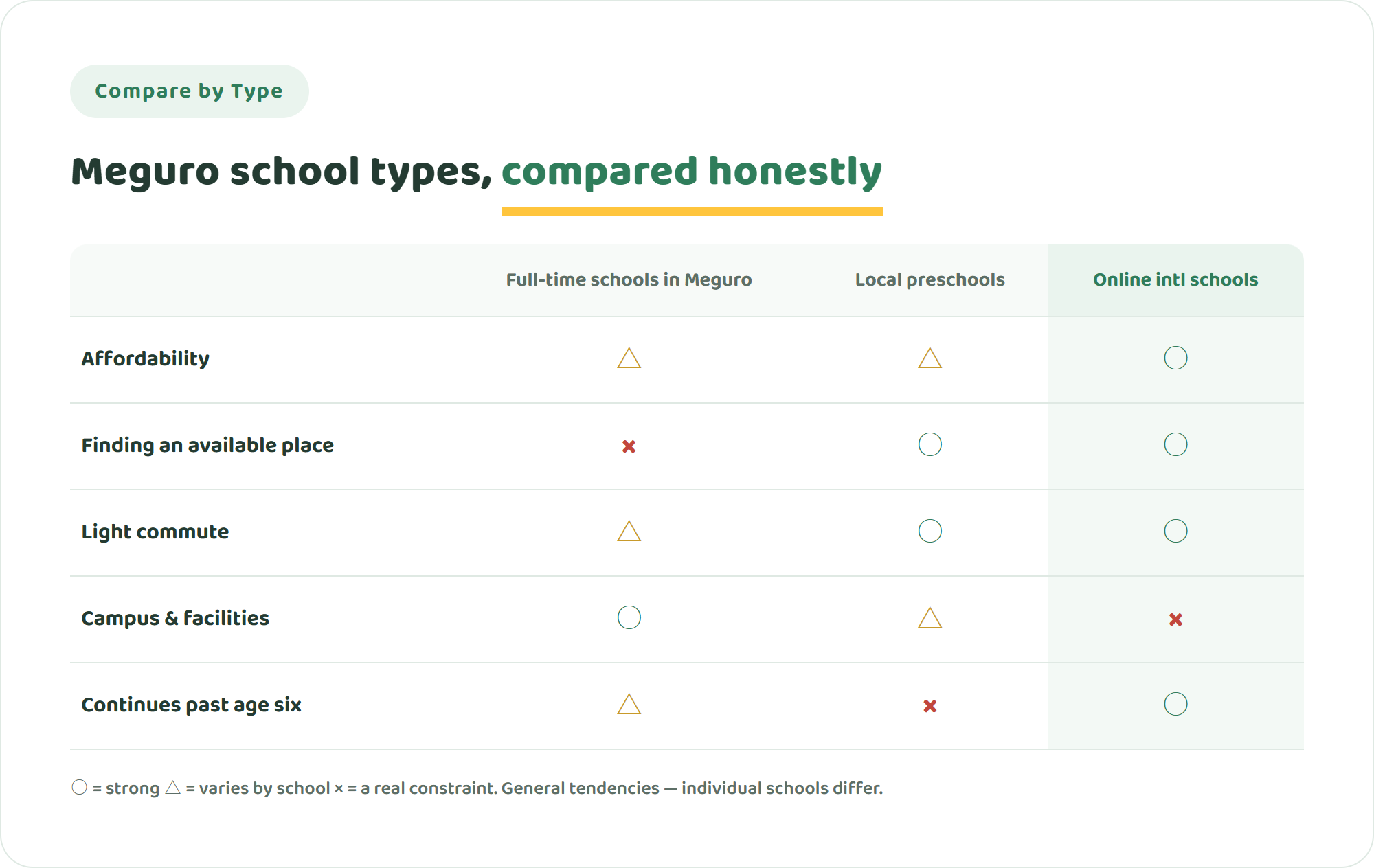
Meguro’s two full-time schools are attractive on price by central Tokyo standards — low ¥2 millions rather than ¥3 million-plus. The constraint is arithmetic: with only two schools, a place in your child’s year group may simply not exist when you need it. The preschools are wonderfully low-friction while your child is small, and some qualify for the national subsidy, but every one of them ends at six. Then there is the third route, which removes distance from the equation entirely: if learning happens online, where you live and how far you can travel stop determining what your child can access. If cost rather than conviction is what is holding you back, it is worth reading whether international school is simply too expensive before ruling anything out.
See how learning works online →
When fees or the commute are the real barrier: another kind of option
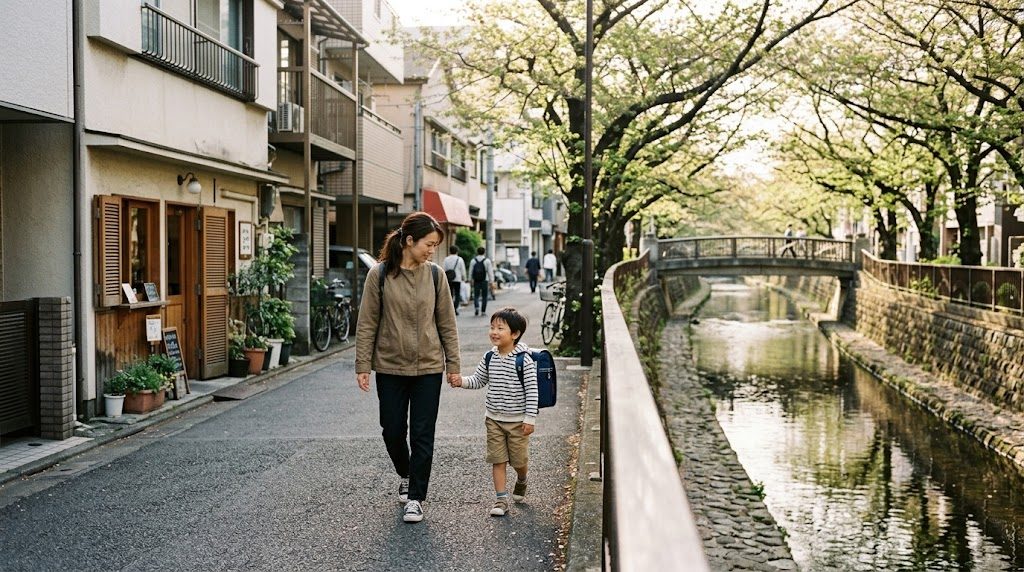
Meguro is a fine place to raise children — the cherry trees along the Meguro River, the calm of Jiyugaoka, well-regarded local public schools. Even so, the constraints are real: two full-time international schools in the entire ward, fees starting in the low ¥2 millions, and a longer daily journey for anyone who chooses a school beyond the ward boundary. If you find yourself thinking that you want an international education for your child but cannot picture carrying the cost and the commute for a decade, there is another kind of option, one that assumes no commute at all: an online international school.
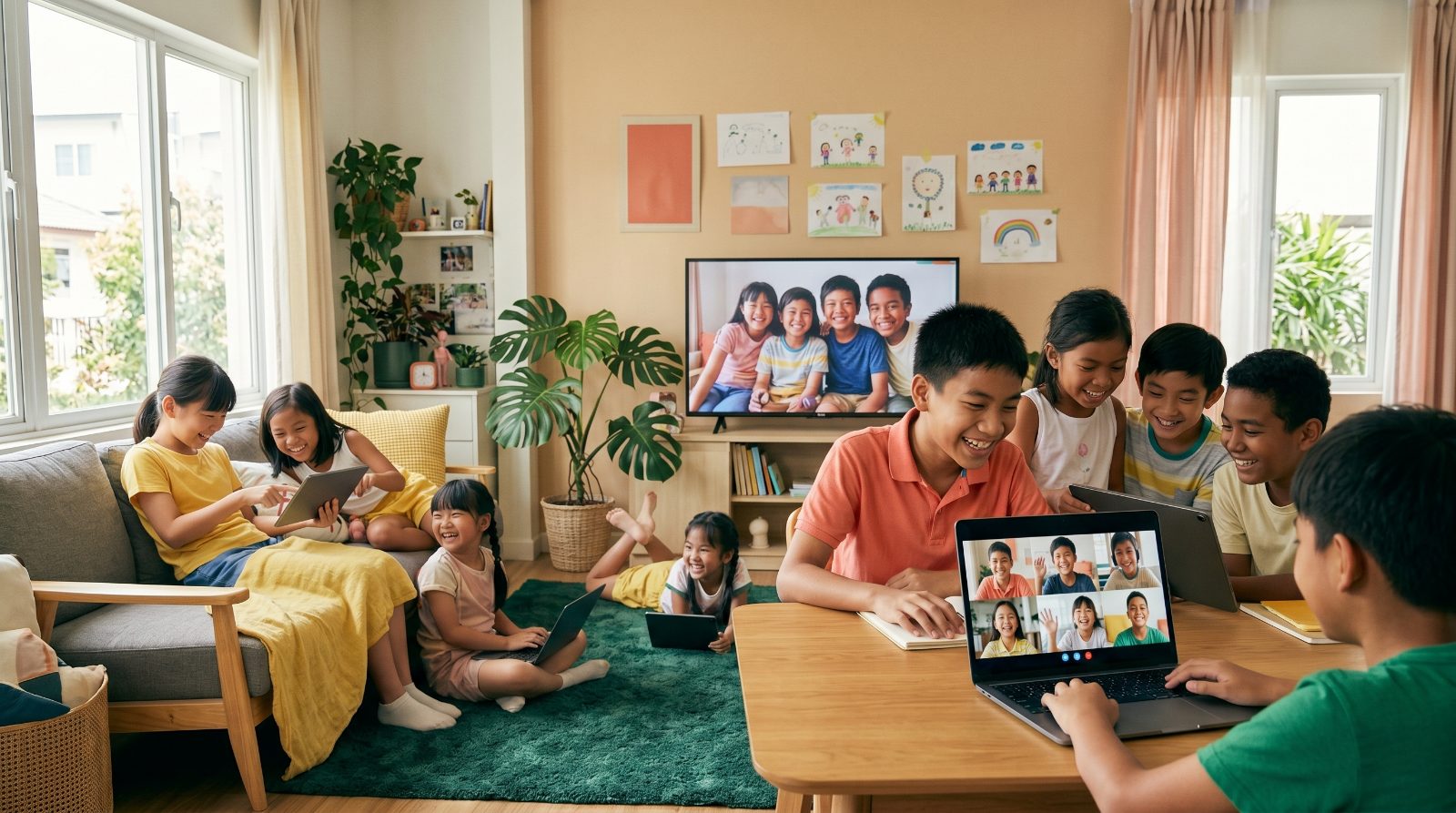
NIJIN GLOBAL ACADEMY (NGA) is an online international school opening in September 2027. It is run by NIJIN Inc., the company behind NIJIN Academy, an alternative school in Japan with more than 1,000 enrolled students. NGA is built on the idea of stepping away from ranking children by test scores, with small-group, dialogue-centred learning aimed at helping students come to like themselves and the world around them. It is open to children aged 6 to 18 across Asia and Oceania, wherever they live, and it is designed so that Japanese remains a support while English is introduced gradually. We are working towards tuition at roughly one-fifth of a bricks-and-mortar international school.
In fairness, we should say plainly that NGA has not opened yet and has no track record to show you. Nor can an online school replicate a playground, a science lab or a sports field. But if the barriers in front of you are cost and distance rather than conviction, learning that connects your child to the world from your own home in Meguro is worth putting on the list.
Frequently asked questions
Q. From what age can my child start at an international school in Meguro?
A. For early years, as young as 18 months. Aoba-Japan International School’s Meguro campus and Laurus Jiyugaoka both start at around 18 months; Aoba-Japan Bilingual Preschool Shimomeguro, Kodomo Edu and Sunnyside take children from age two; Tokyo International School’s Nakameguro kindergarten starts at three. For full-time schooling, KAIS International School admits from Pre-K (age three) and Gregg International School from K3. Filter by your child’s age first — it removes most of the confusion immediately.
Q. Which schools in Meguro take primary-aged children, and what about Japanese support?
A. Only two: KAIS International School’s elementary and middle campus in Nakane, and Gregg International School in Jiyugaoka, which runs to Grade 6. Everything else in the ward is early years, so from age six most families either look to Setagaya, Shinagawa or Minato, or combine a Japanese elementary school with an English after-school programme such as the one at Tokyo International School Nakameguro. Japanese-language provision varies enormously between schools — ask specifically how many hours a week are taught and by whom, because this is where families most often have regrets later.
Q. Can we transfer mid-year, and when should we start applying?
A. Most schools do accept transfers, but in a ward with so few schools the real variable is whether a place exists at all in your child’s year group. Intakes cluster around the start of the academic year — April or August/September depending on the school — and an English assessment, a student interview and a parent meeting are common. Start contacting schools roughly a year before you want to enrol, and attend the open houses. Where a school has its own feeder preschool, external places are narrower still.
The time you spend deciding is time spent caring
There is no single right answer in school choice. In a ward like Meguro, where the options genuinely are limited, the useful question is not which school is best but which one your family can sustain for years. Fees, distance, and your own child’s temperament all pull in different directions, and no two families weigh them the same way. The fact that you are still deliberating is evidence of how seriously you are taking your child’s future. Take your time, visit two or three schools in person, and compare how they feel rather than how they read. And if you would like to keep a no-commute route on the list as well, we would be glad to keep you posted.
International Schools in Other Cities
- International Schools in Chofu and ASIJ Fees
- International Schools in Fukuoka: Fees
- International Schools in Ho Chi Minh City
- International Schools in Melbourne
- International Schools in Nagoya: All 8 Schools
- International Schools in Minato: Fees
- International Schools in Manila
- International Schools in Musashino, Tokyo
- International Schools in Nakano, Tokyo
- International Schools in Tokyo
- International Schools in Shibuya, Tokyo
- International Schools in Setagaya: All 14 Schools
- International Schools in Koto, Tokyo
- International Schools in Shinagawa, Tokyo
- International Schools in Shinjuku: Fees