Search for international schools in Arakawa and you will usually find exactly one listing, dated somewhere around 2020, with an address that may no longer be correct. That is a strange result for a ward where roughly one resident in eight holds a foreign passport. So we did the slow version: we pulled Arakawa City’s own official registers, opened every school website, and checked each address and fee against the source. Here is what is actually there. Five places in Arakawa run an English-immersion programme, and exactly one of them publicly takes children of primary-school age — at a fee level that will surprise anyone who has been quoted Minato or Shibuya prices. This guide gives you all five with verified ages and fees, which ones the ward has confirmed for the childcare subsidy, the address that appears two different ways in two different government documents, and the realistic options once your child outgrows the ward.
Quick Answer: Your Options in Arakawa
- Everest International School, Japan — Arakawa Campus (Arakawa 8-chome, near Machiya) | Age 2 to Grade V | ¥50,000–60,000 per month, roughly ¥600,000–720,000 a year (published fee structure; admission ¥50,000–60,000 and books ¥25,000–30,000 extra) | the only school in Arakawa that publicly enrols primary-age children
- Tokyo International Preschool, Minami-Senju Campus (registered as Minami-Senju International Preschool) | 1y5m to primary age | Fees on request (not published) | Five-day kindergarten division, 9:00–14:00; on the ward’s subsidy-confirmed list
- AUBE Machiya PREPSCHOOL (Machiya 2-chome) | Preschool age | Fees on request | Open 7:30–20:30; English plus Chinese sessions on set days and swimming inside programme hours; on the subsidy-confirmed list
- Aloha International Preschool, Minami-Senju (Minami-Senju 1-chome) | 9 months to Grade 6, depending on class | Fees on request | All-English, but the five-day kindergarten runs only at the Kita-Senju campus in Adachi
- Kids Duo Nippori (Nishi-Nippori 1-chome, by Mikawashima Station) | Age 3 to Grade 6 | Fees on request, varies by days per week | After-school English immersion, not a full-day international school
- MEES International School, Hakusan Elementary (Bunkyo) | Ages 6–12 | ¥1,515,938 a year for the full-day programme, 2026–2027, before tax (admission ¥180,000 and other fees extra) | the closest full-day primary school to Arakawa
- Aoba-Japan International School, Bunkyo Campus (Honkomagome) | Grades 10–12 | ¥2,862,000 a year, 2026–2027 | the route to an IB Diploma within commuting distance
- NIJIN GLOBAL ACADEMY (online / opening September 2027 · ages 6–18 · around one-fifth of on-site fees · Japanese-language support built in) | An online international school with no catchment area. It has not opened yet; registration for opening updates is open now
International schools in Arakawa: the real landscape and what they cost
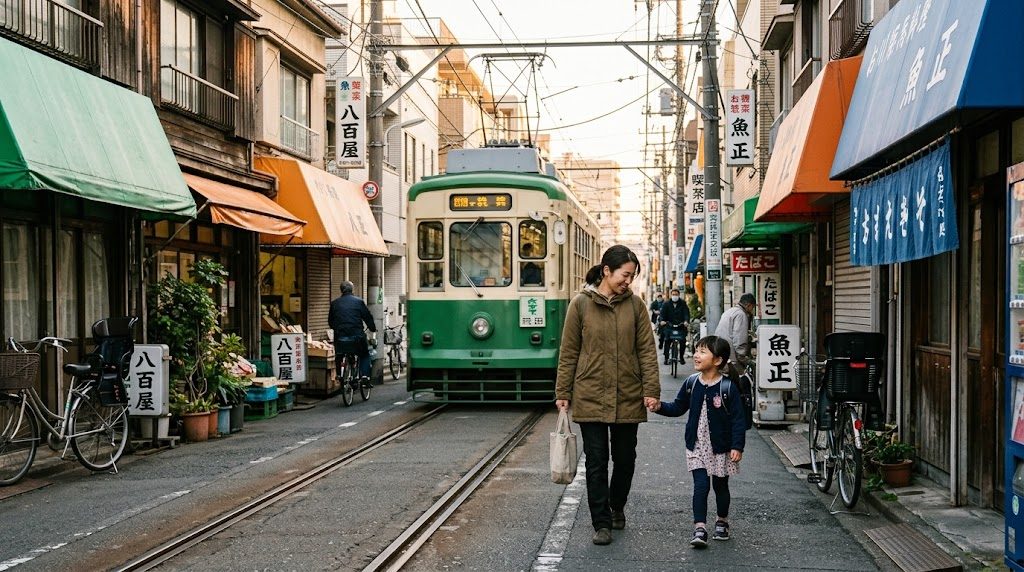
Arakawa is one of the most international wards in Tokyo, and almost nobody writing about schools has noticed. According to the ward’s own population statistics, of 226,694 residents on 1 August 2026, 26,403 were foreign nationals — about 11.6 per cent, or roughly one in eight. The direction of travel is just as telling: in that single month the Japanese population fell by 20 while the foreign population grew by 286. Walk the shopping streets around Minami-Senju, Machiya or Nippori and the numbers stop being abstract.
So why does the search result for international schools in Arakawa show one entry from six years ago? Partly because Arakawa’s international character is not the expatriate-package kind that built the schools of Minato and Shibuya. It is the kind formed by families who live here, work here and are raising children here, often on ordinary salaries. The schools that grew out of that are a completely different species from the traditional city-centre institutions — and they price accordingly.
Two official documents settle the question of what exists. Arakawa City publishes a register of notified unlicensed childcare facilities (current as of 27 April 2026) and a separate list of facilities confirmed as eligible for the early-childhood education subsidy (current as of 1 November 2025). Cross-referencing them, the notified facilities offering English or international daytime care are Everest Kids Arakawa, Minami-Senju International Preschool, and AUBE Machiya PREPSCHOOL, together with its sister sites AUBE Machiya Nursery and the newly opened AUBE Machiya PREP PLUS. Add Aloha International Preschool’s Minami-Senju site, which is actively recruiting on its own website but does not appear on either register, and the after-school provider Kids Duo Nippori, and you get five options in the ward, counting each operator once.
Laid out by age, the shape of the ward looks like this.
- Ages 0–2: Aloha’s Music & Movement from nine months, Tokyo International Preschool from 1y5m, the AUBE sites. Genuine choice here
- Ages 3–5: all five have provision. This is Arakawa’s strongest band, and three of the settings are subsidy-confirmed
- Ages 6–12: one full-day option, Everest Arakawa Campus (Grades I–V). Everything else at this age is after-school — Kids Duo, Aloha’s afterschool, Tokyo International Preschool’s elementary classes
- Ages 13–18: nothing full-day inside the ward. You widen the commute into Bunkyo, Kita or Koto, or you drop the commute altogether
Fees follow that shape, and the headline is that Arakawa is cheap by Tokyo standards. Everest’s published structure puts kindergarten levels at ¥60,000 a month and Grades I–X at ¥50,000 a month — about ¥600,000 to ¥720,000 a year. English-immersion preschools in Minato and Shibuya routinely run ¥1.5m to ¥2.5m a year. That is not a discount; it is a different order of magnitude. The other three settings do not publish figures, so you must ask, but any setting on the ward’s subsidy-confirmed list can put up to ¥37,000 a month within reach for children aged three to five if your household meets the criteria. That single line item moves a family budget more than most fee negotiations do, so confirm your own case at the ward office.
Step outside the ward for a full-day place at secondary age and the arithmetic changes completely: roughly ¥1.52m a year for full-day primary in Bunkyo, ¥2.86m a year at IB Diploma level. If you have not yet worked out which parts of a quoted fee are actually optional, our breakdown of what international school really costs is worth ten minutes before you start comparing. For the wider picture, see the guide to international schools across Tokyo.
All five international schools in Arakawa, described honestly
What follows is every setting we could verify as operating in September 2026, ordered by how far up the age range it goes. They all use the word international. They are not remotely the same kind of place.
1. Everest International School, Japan — Arakawa Campus (Arakawa 8-chome)
Everest International School, Japan (EISJ) was founded in April 2013 to serve children of the Nepalese diaspora alongside Japanese and other international students, with an explicit mission of “quality and affordable English medium education.” It runs campuses in Ogikubo, Shin-Okubo and Asagaya, and in 2025 opened a fourth at Arakawa 8-22-3, within walking distance of Machiya Station on the Chiyoda Line, Keisei Line and the Toden tram.
Arakawa City’s register lists the site as Everest Kids Arakawa, capacity 60, operating 09:00–17:00, notified from 21 April 2025; the ward added it to the subsidy-confirmed list on 1 November 2025. The school’s own admissions announcements for the Arakawa campus cover Playgroup, Nursery, Lower Kindergarten and Upper Kindergarten plus Grades I to V — which makes this the only place in the ward where a primary-age child can learn in English every day.
- Curriculum: English-medium international curriculum. Across the organisation, provision extends to Grade X, Grades XI–XII and a Cambridge track
- Ages: from 2 (Playgroup, Nursery, LKG, UKG) plus Grades I–V at this campus
- Fees: published structure — Nursery to UKG ¥60,000 a month (admission ¥60,000, books ¥30,000, one month refundable deposit); Grades I–X ¥50,000 a month (admission ¥50,000, books ¥25,000). Roughly ¥600,000–720,000 a year. The Arakawa campus has advertised opening-period concessions, so ask what actually applies to you
- Best for: families who want English-medium schooling past kindergarten without a seven-figure annual bill, and who want their child growing up in a genuinely multinational room
2. Tokyo International Preschool, Minami-Senju Campus (Minami-Senju 8-chome)
The Minami-Senju campus of Tokyo International Preschool sits at Minami-Senju 8-8-1, on the ground floor of the Mothers House building inside Tokyo Frontier City Park & Parks — literally in the west-exit rotary of Minami-Senju Station, where the JR Joban Line, Tsukuba Express and Hibiya Line meet. For a parent who commutes, no location in this ward is easier. The operator is Global Kids Garden Co., Ltd.; the ward register lists it as Minami-Senju International Preschool, capacity 54, Monday to Saturday 09:00–18:10, operating since 1 September 2011.
The programme splits into Preschool (1y5m–3y, full time 9:00–13:00 or half time 9:00–11:00, classes of ten), a five-day Kindergarten Division (9:00–14:00, classes of ten to twelve with a native and a bilingual teacher), After Kinder (kindergarten age to Grade 1, 15:40–17:00, plus a longer Saturday class) and Elementary classes at 17:10–18:10. The kindergarten division spends an hour each afternoon on mathematics, Japanese, art and Montessori work, with care until 17:00, bus service and a choice of school lunch or packed lunch — a set of details aimed squarely at two-income households.
- Curriculum: all-English, with afternoon mathematics, Japanese, art, Montessori and weekly PE in the kindergarten division. Unlicensed childcare facility, on the ward’s subsidy-confirmed list
- Ages: 1y5m to primary age, depending on class. Full-day provision ends at kindergarten
- Fees: not published; ask directly. Subsidy-confirmed, so ages three to five may qualify for support
- Best for: families who pass through Minami-Senju Station daily, and those planning on Japanese primary school but unwilling to let the English stop
3. AUBE Machiya PREPSCHOOL (Machiya 2-chome)
Run by AUBE INTERNATIONAL Co., Ltd. at Machiya 2-21-2, this preschool appears on the ward register with capacity 30, hours of 07:30–20:30 and a start date of 1 April 2021, and it is on the subsidy-confirmed list. Two things make it distinctive: the sheer length of the day, and a curriculum that does not stop at English — there are Chinese sessions on set days and swimming lessons inside programme hours.
The same operator runs AUBE Machiya Nursery (Arakawa 6-4-11, corporate-led childcare, 07:00–22:00, capacity 12, open since March 2019) and AUBE Machiya PREP PLUS, which opened in April 2026 at Machiya 1-21-11 with capacity 15 and the same long hours. Three settings from one operator within a few minutes’ walk of Machiya Station gives you something rare in this ward: the ability to move between settings as your circumstances change without changing provider.
- Curriculum: English-centred, with Chinese sessions on set days and swimming during programme hours
- Ages: preschool; check each sister site, as the bands differ
- Fees: not published; ask directly. On the ward’s subsidy-confirmed list
- Best for: households needing genuinely long hours, and parents who want more than one language and some physical activity in the mix
4. Aloha International Preschool, Minami-Senju (Minami-Senju 1-chome)
Aloha International Preschool‘s Minami-Senju site is at Minami-Senju 1-43-1, three minutes from the Arakawa Ward Office tram stop on the Toden line and eight minutes from Minowa Station on the Hibiya Line. It is an all-English setting built around inquiry-based learning informed by the IB Primary Years Programme.
Read the campus split carefully before you plan around it. Minami-Senju offers Music & Movement (9 months to 1y11m, weekly, 14:00–14:50), Preschool (1y5m–3y, one to five days a week, 10:00–14:00) and Afterschool (age 3 to Grade 6, from one day a week, 16:00–18:00). The five-day Kindergarten for ages three to six runs only at the Kita-Senju campus, which is in Adachi Ward, and the school bus operates from Kita-Senju only. One further note: the Minami-Senju site does not appear on Arakawa’s register of notified facilities (27 April 2026) or its subsidy-confirmed list (1 November 2025), so do not assume subsidy eligibility — check with both the ward office and the school.
- Curriculum: all-English and inquiry-based; the school announced IB PYP authorisation in 2025
- Ages: 9 months to Grade 6, but only the three classes above run at Minami-Senju
- Fees: not published; ask directly
- Best for: families near the ward office or Minowa who want to start with one or two days a week rather than commit to full time
5. Kids Duo Nippori (Nishi-Nippori 1-chome)
Kids Duo Nippori is at Nishi-Nippori 1-3-6, second floor of the Esprit building — three minutes from Mikawashima Station on the Joban Line and six from Shin-Mikawashima on the Keisei Line. Despite the name, do not head for Nippori Station. It takes children from age three to Grade 6, Monday to Friday, 11:00–20:00, with a native speaker and a bilingual staff member on duty and English used for the whole session.
- Curriculum: English-immersion after-school care. This is not an academic international school
- Ages: 3 to Grade 6
- Fees: vary by days per week; ask directly
- Best for: families using the local public school who want the after-school hours to run in English, and who need childcare cover anyway
Listings to double-check before you visit an international school in Arakawa
The slowest part of writing this was verifying what other pages claim. Arakawa has an unusual amount of stale information sitting high in search results. This is a practical warning, not a criticism of any school.
- Minami-Senju International Preschool has two addresses in circulation. Most aggregator pages, and the ward’s own subsidy list dated 1 November 2025, give Minami-Senju 7-28-2, Eiraku Building 2F. The ward’s facility register dated 27 April 2026 and the school’s own website both give Minami-Senju 8-8-1, Tokyo Frontier City Park & Parks. Call before you set out
- “Arakawa has one international school” is out of date. Most portals still show a single entry because they have not picked up the Everest Arakawa campus (2025) or AUBE Machiya PREP PLUS (2026). The ward’s own PDFs are the reliable source
- Round-ups from 2020–2022 still rank. Arakawa looks like a ward where nothing changes, but in two years it gained a full-day option and an additional sister site. Check the date on anything you read, including this page
- Aloha Minami-Senju is operating but unlisted. Its website is live with recruitment notices dated July 2026, yet it appears on neither ward register. Treat subsidy eligibility as an open question to be confirmed, not assumed
“The directory showed one school and there were actually five” is the specific gap Arakawa families fall into. Ten minutes with the ward’s own PDF saves considerably more than ten minutes later.
Past Grade V, the commute begins: schools near Arakawa
Even with Everest covering Grades I–V, there is no full-day international school in Arakawa for secondary age. The compensation is transport: Nippori and Nishi-Nippori put you on the Yamanote Line, Machiya puts you on the Chiyoda Line, and Bunkyo, Kita and Koto are all genuinely commutable.
6. MEES International School, Hakusan Elementary (Bunkyo)
MEES International School‘s Hakusan campus is five minutes from Hakusan Station on the Mita Line, with a 400-square-metre open space, maker studios and gym facilities, and project-based learning at the centre of the elementary programme. It is an IB PYP candidate school. For 2026–2027 the full-day programme (8:30–15:00) is ¥1,515,938 a year, with a ¥20,000 application fee, ¥180,000 entrance fee, ¥40,000 materials fee and ¥50,000 development fund on top — all before tax, lunch included. The optional bus is ¥220,000 a year and afternoon English support ¥30,000–40,000 a month. From Machiya it is four minutes on the Chiyoda Line to Sendagi and a short walk; from Nishi-Nippori it is inside half an hour. This is the nearest full-day primary school to Arakawa.
7. Aoba-Japan International School, Bunkyo Campus (Honkomagome)
The Bunkyo campus of Aoba-Japan International School takes Grades 10 to 12 and runs through to the IB Diploma. Published tuition for 2026–2027 is ¥2,862,000 for Grades 6–12, with entrance and facility fees in year one and lunch and bus charged separately. It is about twenty minutes from Nishi-Nippori via the Yamanote and Namboku lines — a realistic destination if the plan is to finish with an IB Diploma.
Koto Ward is also a straight run on the Hibiya Line, and holds K. International School Tokyo (roughly ¥2.85m–3.02m a year) and India International School in Japan (around ¥600,000 a year); see the guide to international schools in Koto. For the neighbouring wards, there are separate guides to Taito, Kita, Bunkyo and Sumida.
Fees and details here reflect information published as of September 2026. Always confirm the current figures with each school directly.
Comparing the options: what actually fits your family
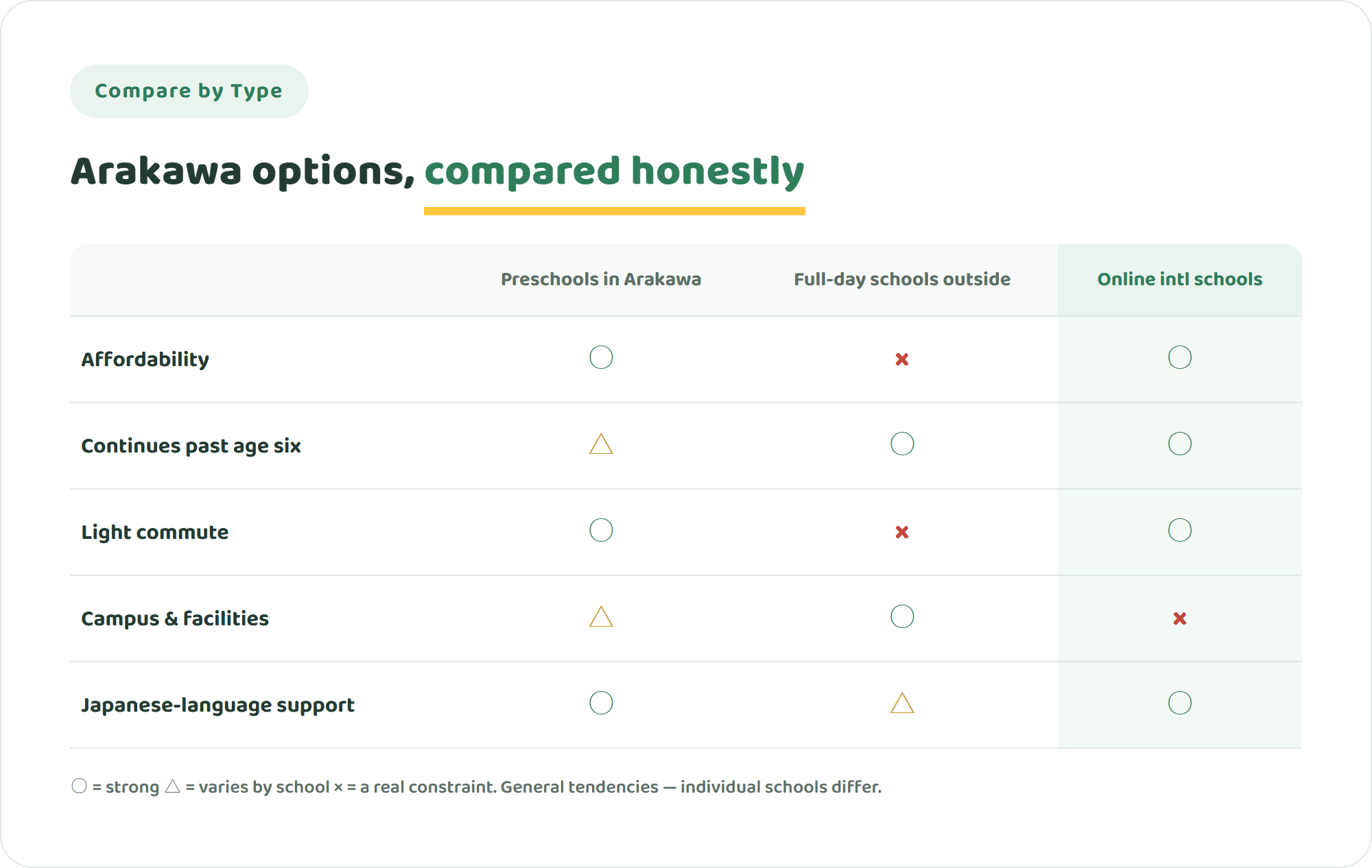
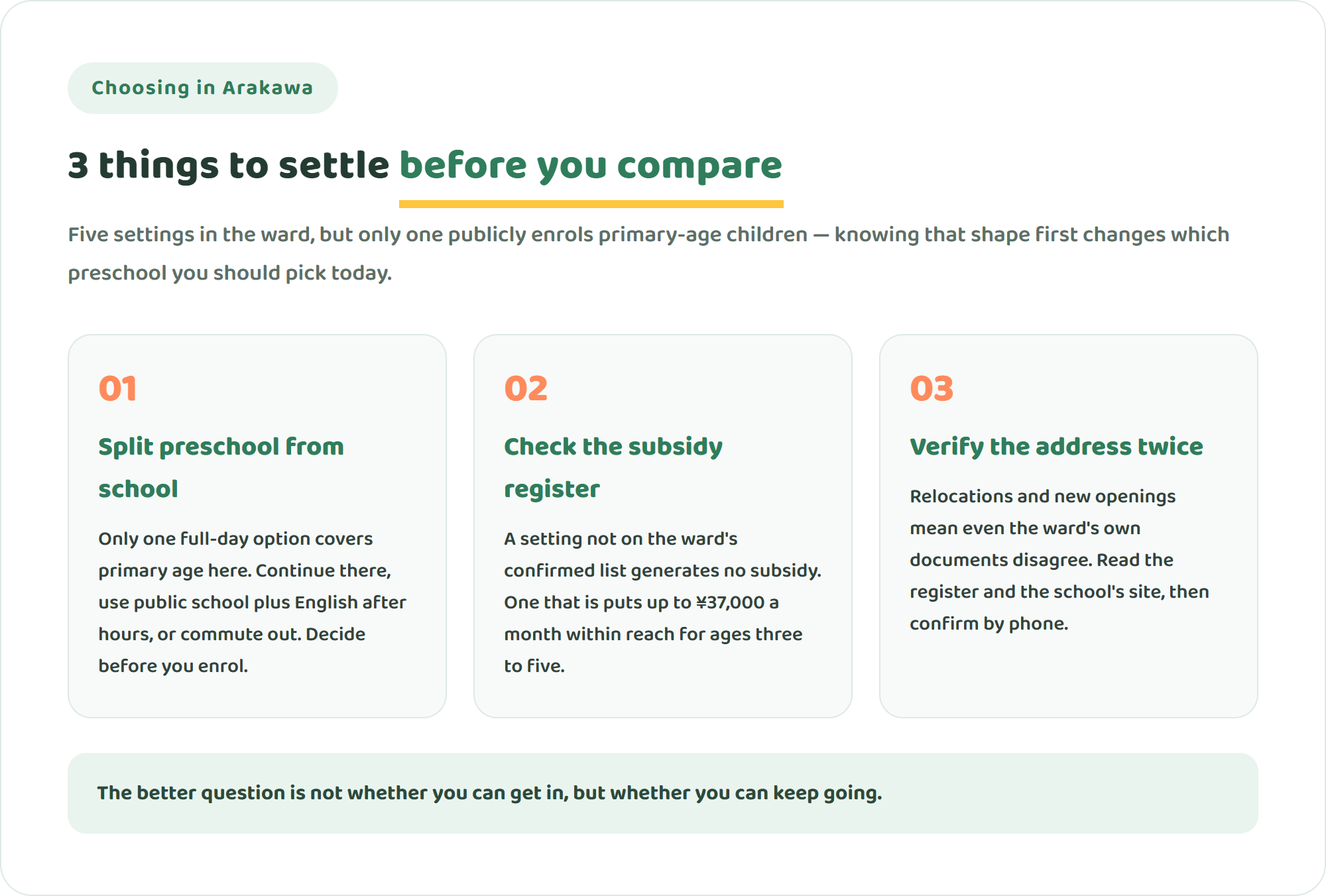
The single most useful move in Arakawa is to treat the preschool years and the school years as two separate decisions from the start. The ward’s preschools are affordable and easy to reach. But at age six a decision arrives whether you have prepared for it or not: continue into Everest’s primary years, use the local public school with English after hours, commute into Bunkyo, or drop the commute entirely. Deciding that in advance changes which preschool you should pick today.
Second, check the subsidy register rather than the marketing. A setting that is not on the ward’s confirmed list cannot generate a subsidy payment, however good it is; one that is on the list puts up to ¥37,000 a month within reach for ages three to five. Meals, extended hours, transport and materials sit outside the subsidy, which is exactly where the gap between “the fee looked low” and “the bank statement did not change much” opens up.
Third, and specific to this ward, verify the address in both the register and the school’s own site. Arakawa has had enough relocations and new openings that even the ward’s own documents currently disagree with each other. Opening a map on the morning of a school visit is not the moment to find that out; one phone call prevents it.
See how learning works online →
When fees or the commute are the obstacle: an eighth option
If your reaction to the list above was “one full-day school past kindergarten means no fallback if it doesn’t suit my child” — or “so secondary school means leaving the ward anyway” — that is a fair reading, not pessimism. There is one more direction worth knowing about.
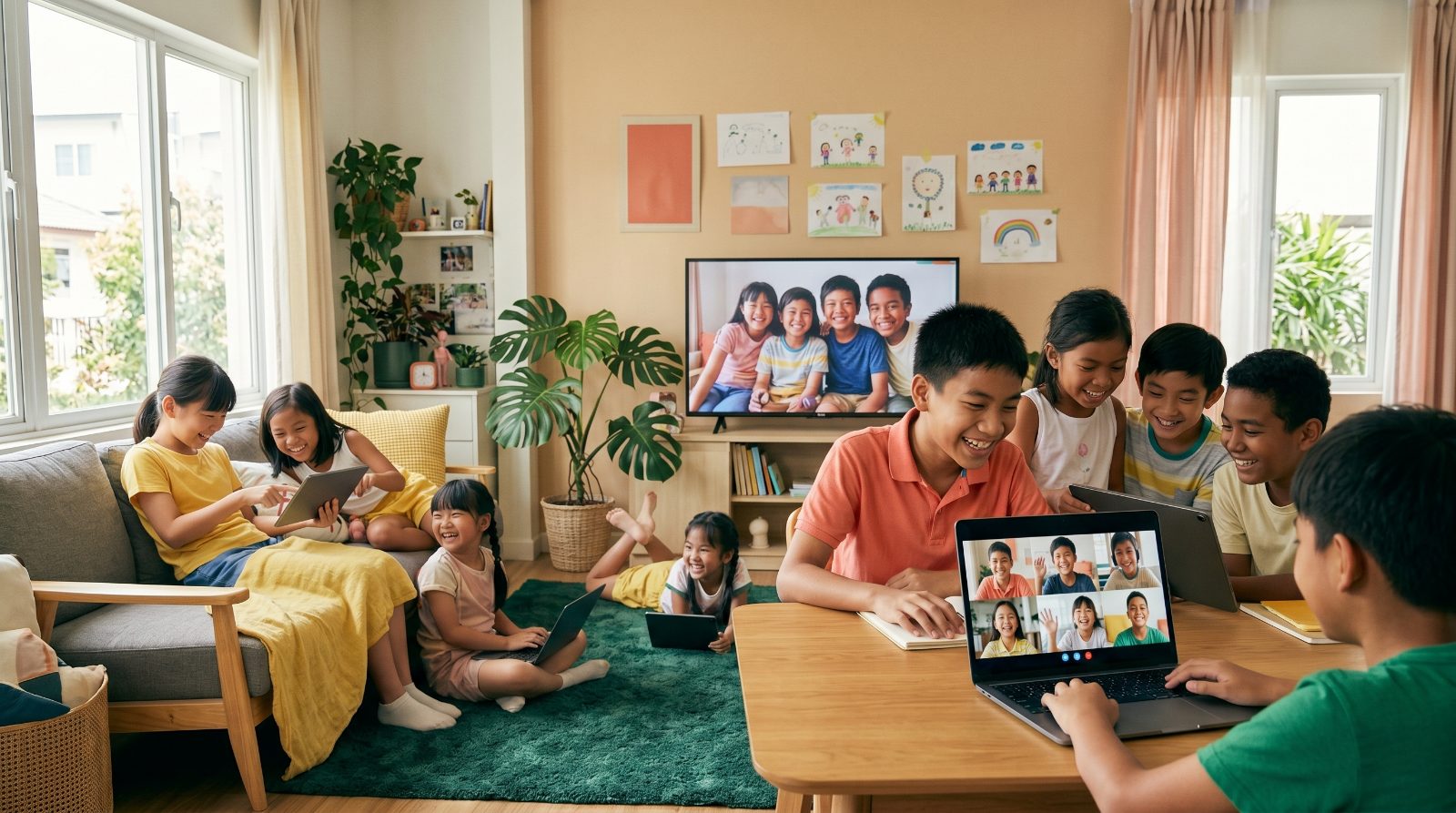
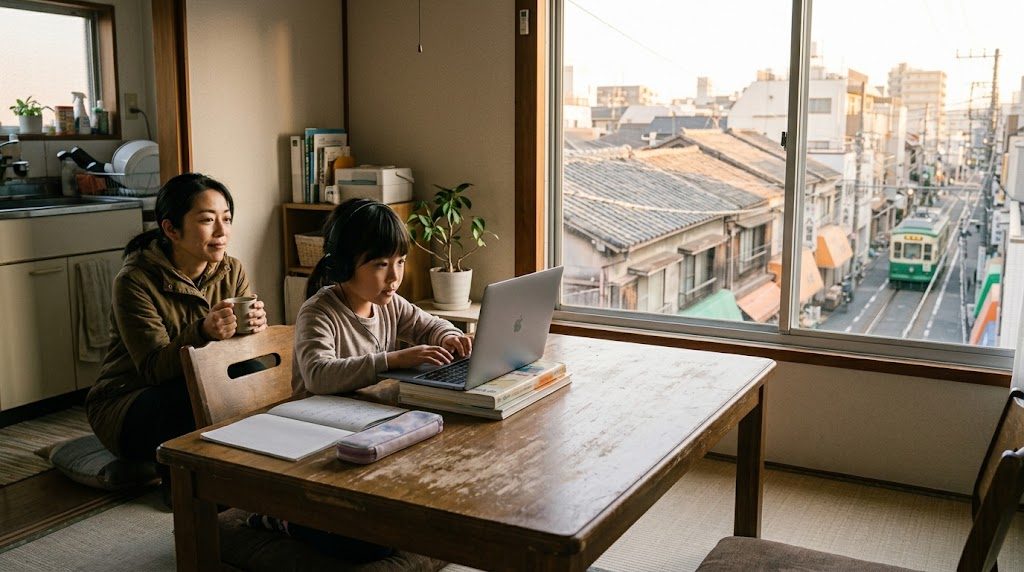
NIJIN GLOBAL ACADEMY is an online international school opening in September 2027, operated by NIJIN Inc. in Japan. The company already runs NIJIN Academy, an alternative school in Japan with more than 1,000 enrolled students. The new school is for ages 6 to 18 across Asia and Oceania. Being online, it has no catchment area, and a family in Arakawa attends from home.
What it is built around is a deliberate refusal to rank children by test scores, small-group dialogue rather than lecture, and a curriculum organised around learning to like yourself and the world. Fees are targeted at around one-fifth of on-site international school fees, and the design assumes Japanese-language support underneath, so a child moves into English gradually rather than being dropped into it.
Two honest caveats. First, it has not opened yet — there is no graduate record to show you, and there will not be one for some years. Second, it is not the same experience as a physical school. A screen does not replace a playground or a shared lunch table. But for Arakawa families looking at a single full-day option for school-age children, the condition of “zero commute, worldwide classmates” genuinely changes what is possible.
Frequently asked questions
Q. From what age can my child start at an international school in Arakawa?
Aloha’s Music & Movement class at Minami-Senju starts at nine months, Tokyo International Preschool’s Minami-Senju campus takes children from 1 year 5 months, and Everest Arakawa Campus starts at two with Playgroup. So there is provision from around age one. The constraint is at the other end: only Everest publicly enrols primary-age children in the ward, so it is worth mapping out your plan for age six and beyond before you enrol anywhere at age two.
Q. Is there Japanese-language support? I worry my child’s Japanese will fall behind.
Most Arakawa settings are all-English by design, though some build in Japanese-language work — Tokyo International Preschool’s kindergarten division spends afternoon time on Japanese and mathematics, for example. Still, the more hours a child spends in English, the more deliberately you need to plan where reading and writing in Japanese will be supported. Literacy does not develop on its own. Reading at home helps, and so does a structured place to study Japanese: for families worried about this, our sister service Tomodachi Japan (online Japanese for children, also run by NIJIN) is worth a look.
Q. Can we transfer in mid-year?
The ward’s preschool settings are all unlicensed childcare facilities, so mid-year entry is usually negotiable when there is space, and Everest Arakawa runs rolling admissions. Outside the ward it is harder: full-day international schools take transfers according to year-group capacity and your child’s English level. Some, like MEES, offer paid afternoon English support, but those places are limited too. If a transfer is on your horizon, contact schools six months to a year before your target date — it materially widens what is available. Capacity, entry requirements and fees can all change, so confirm the current position directly.
You thought there was one option. There are five
Looking for an international school in Arakawa is genuinely harder than it should be. The search results show a single school, the addresses in round-up articles are years out of date, and the verification work falls on you.
But open the ward’s registers and work through them, and this neighbourhood turns out to have five entrances rather than one — with a school that carries English-medium learning through primary years at fees an order of magnitude below the Tokyo norm. Settle what happens after age six and every other decision gets lighter. Enrolling locally while touring Bunkyo schools is a reasonable plan. So is public school plus English after hours. So is dropping the commute and going online. None of them is the wrong answer. The only real mistake is arriving at the March before primary school with the question still open.
The hours you are spending on this are hours spent taking your child seriously. Please don’t spend them being hard on yourself. That you are researching this at all is already the thing that matters.
International Schools in Other Cities
- International Schools in Meguro: All 8 Schools
- International Schools in Kobe: All 20 Schools
- International Schools in Yokohama: Full Comparison
- International Schools in Chofu and ASIJ Fees
- International Schools in Fukuoka: Fees
- International Schools in Ho Chi Minh City
- International Schools in Bangkok
- International Schools in Bunkyo, Tokyo
- International Schools in Chiyoda, Tokyo
- International Schools in Tokyo
- International Schools in Minato: Fees
- International Schools in Shibuya, Tokyo
- International Schools in Setagaya: All 14 Schools
- International Schools in Koto, Tokyo
- International Schools in Shinagawa, Tokyo