
If you are searching for part-time online teaching jobs you can do from home, you are probably not looking to relocate, retrain, or hand your whole week to one employer. You want a few hours that pay, use the training you already have, and fit around the rest of your life. That is a legitimate way to work in education, and it is more available now than it was five years ago — but the listings are a mixed field, and the good ones look almost identical to the bad ones from the outside.
This guide is written from the school side. It covers the four shapes part-time work actually takes at an online international school, what the people reviewing your application are really weighing, how to make time zones survivable, and the five warning signs that separate a real school from an agency with a website. Where we describe our own roles at NIJIN GLOBAL ACADEMY, we stick to what is actually stated — including the part that will put some readers off: on the international track, founding roles begin as volunteer positions ahead of our 2027 opening, and detailed terms are shared later in the process.
The four shapes part-time online teaching actually takes
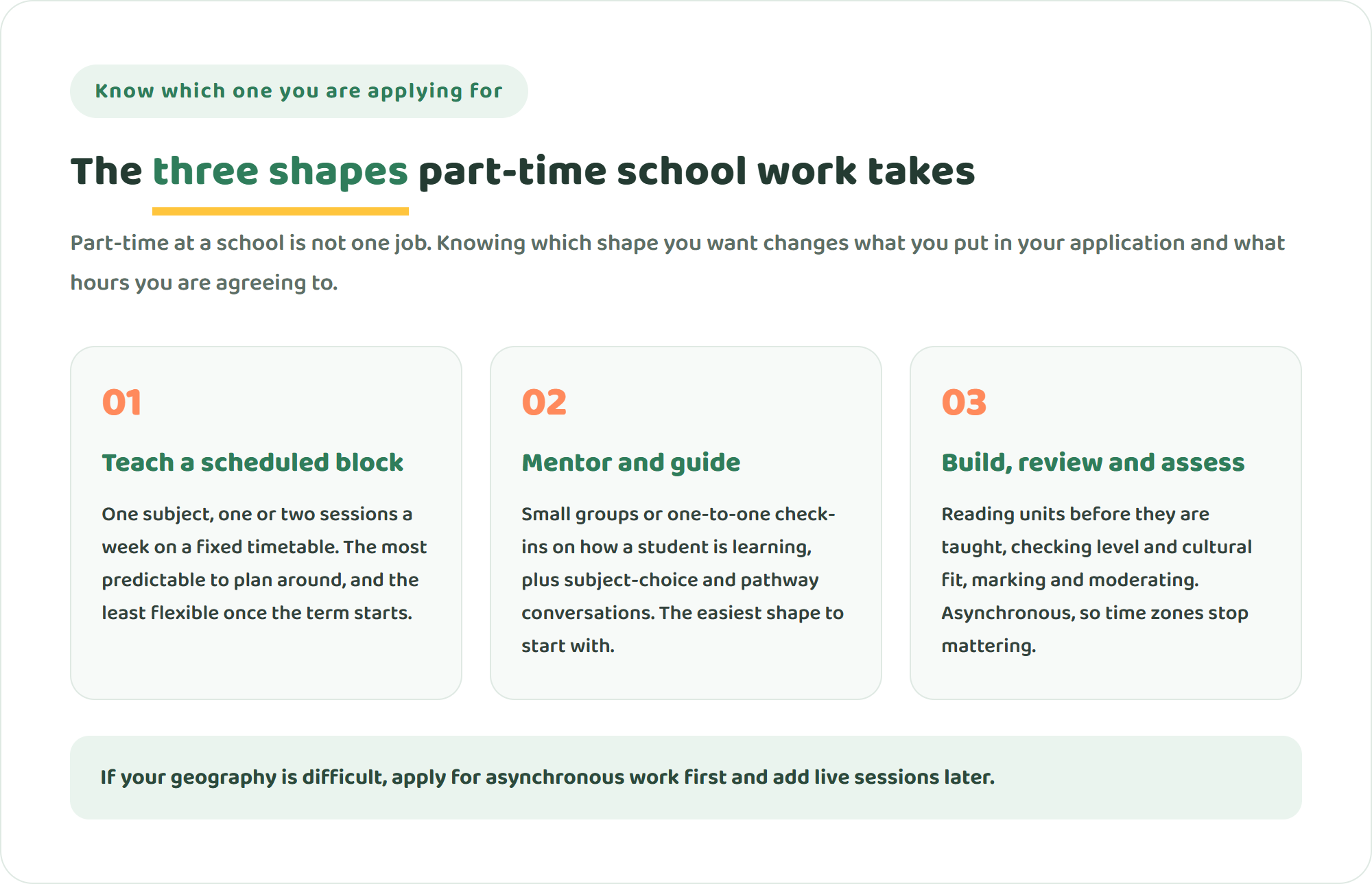
Teaching a scheduled block. You take one subject, one or two sessions a week, on a fixed timetable for a term. This is the closest thing to classroom teaching and the most predictable to plan a life around. It also has the least flexibility: the class exists at that hour whether or not your week is going well.
Mentoring. Small groups or individual check-ins, focused on how a student is learning rather than what they are learning. Experienced teachers are usually stronger at this than they expect, because it draws on pastoral judgement rather than subject delivery. It is also the easiest kind of work to start with while you are still employed elsewhere.
Materials review and assessment. Reading units before they are taught, checking level and cultural fit, marking, moderating. Asynchronous, so time zones stop mattering almost entirely. If you have a young family or another job, this is often the only shape that genuinely fits.
Guidance and pathway conversations. Talking with students and families about subject choices, portfolios and where a route actually leads. Undervalued in job listings and badly needed at schools serving families across several countries.
What schools are actually looking at
Two honest points, because they save applicants a lot of wasted effort.
First, an accent is not a qualification. Plenty of listings still imply otherwise, and some employers do screen that way. We do not, and neither do the international schools worth working for. What gets read carefully is whether you can plan a sequence of lessons, whether you can hold a room of children you cannot physically stand next to, and whether you can be understood clearly by a twelve-year-old whose English is their second or third language. Teachers trained in the Philippines, Malaysia, India and Singapore are frequently better at that last one than teachers from monolingual settings, for the obvious reason.
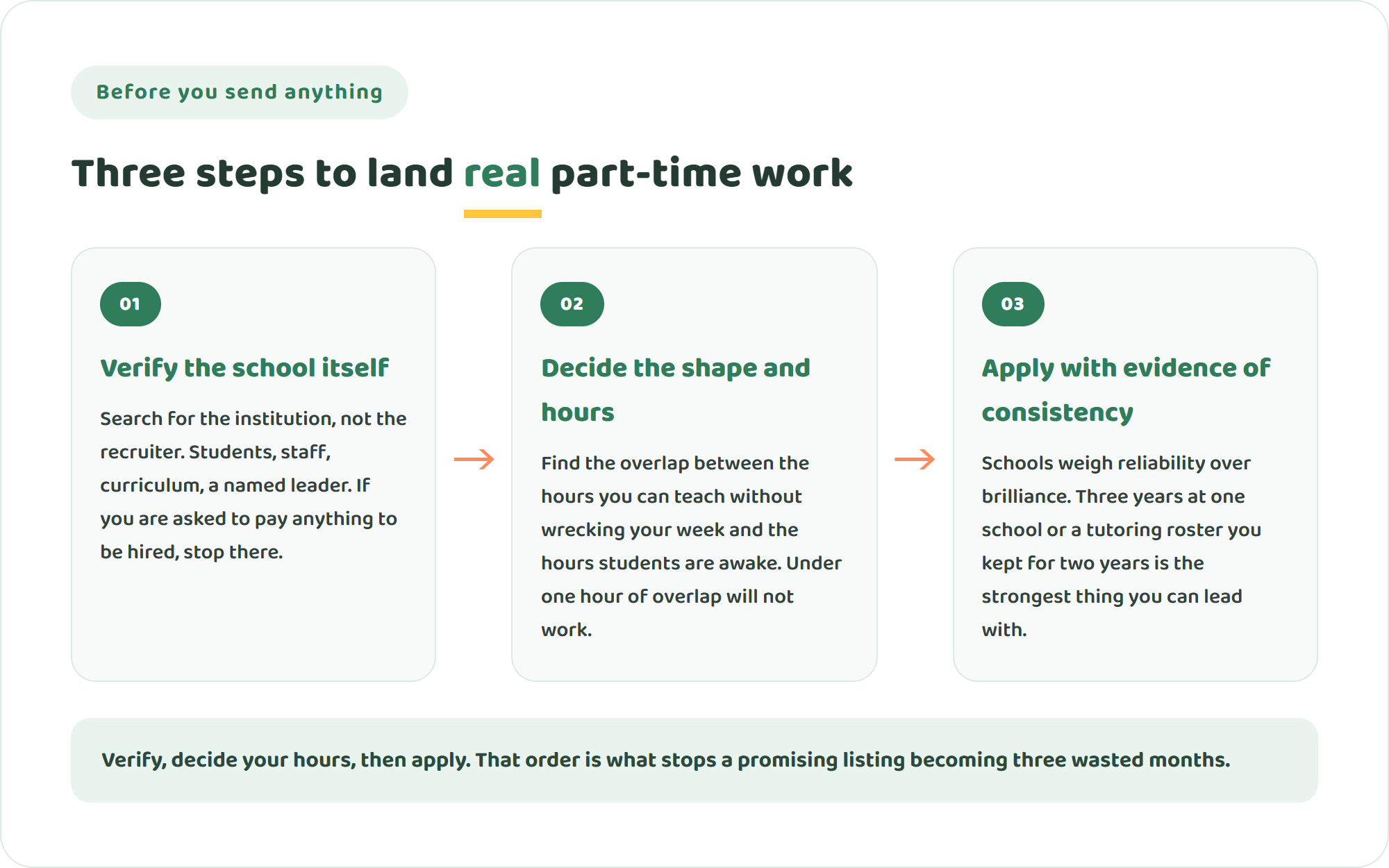
Second, schools are looking for reliability more than brilliance. A part-time teacher who is present, on time, prepared, and answers messages within a day is worth more to a timetable than a spectacular teacher who is unpredictable. If your application can evidence consistency — three years at the same school, a tutoring roster you kept for two years — lead with it.
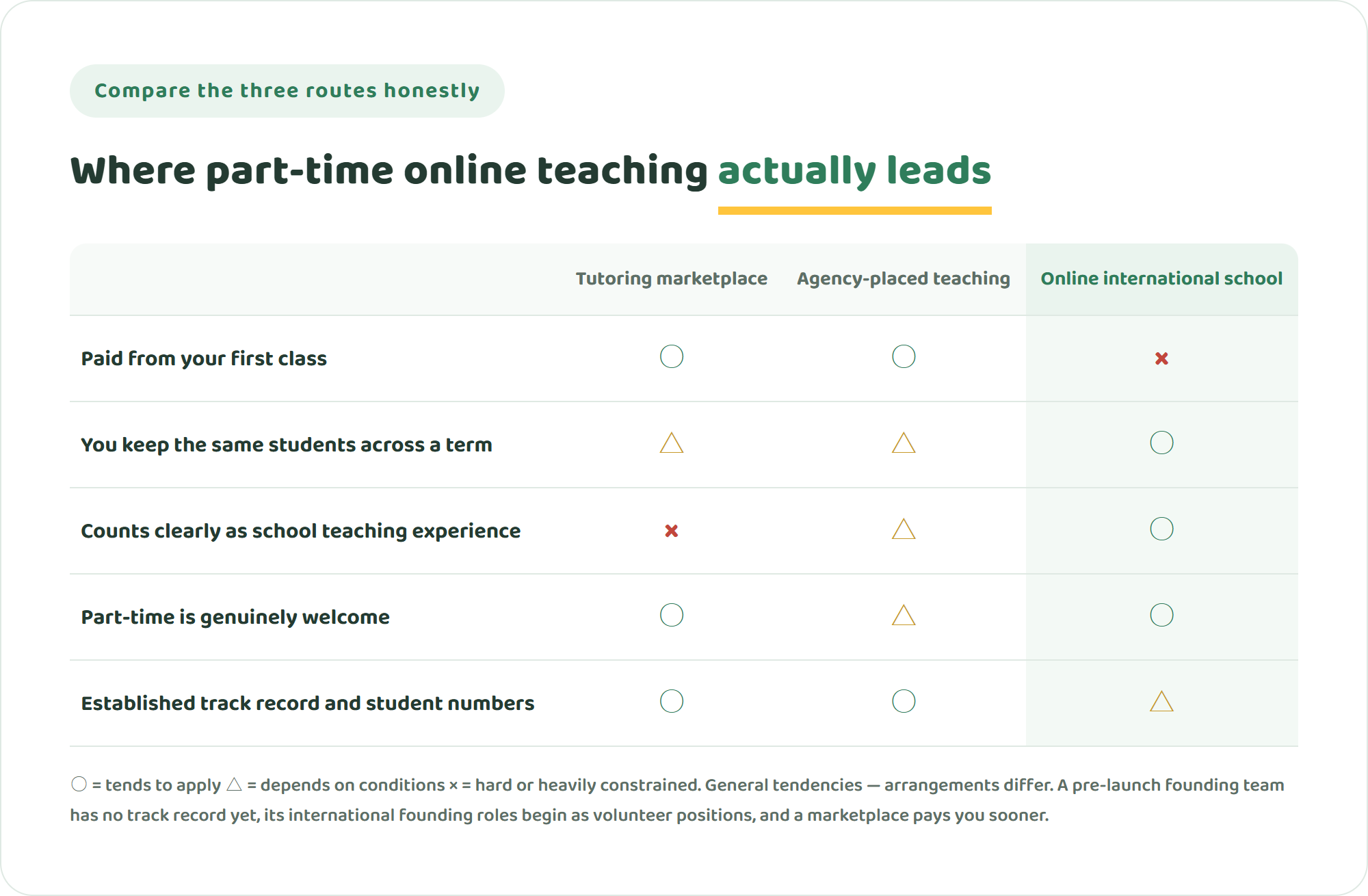
A note on how we describe ourselves. NGA is building a genuinely multinational faculty, not an all-native-speaker one, and we would rather say so plainly than let you find out later. We are fully remote, which means we hire wherever a strong teacher happens to live and there is no visa process and no relocation cost — for us or for you. On terms we will not flatter ourselves either: founding roles on the international track begin as volunteer positions ahead of the 2027 opening, and detailed terms are shared later in the process. Even one class a week is welcome, and you can take on non-teaching work — marketing, web, partnerships, HR — alongside teaching. If that shape is one you can use, see the NIJIN GLOBAL ACADEMY founding member roles →. If you need paid work this month, it is better to know now.
Time zones: the part nobody warns you about
Most disappointment in remote teaching traces back to hours, not pay. Before you apply anywhere, work out two things: the window in your own day when you can teach without wrecking it, and the window when the students are actually awake. If those two overlap by less than an hour, no amount of goodwill will fix it.
Some practical patterns. If you are in Southeast Asia teaching students in Asia, you are broadly in the same band and live sessions are straightforward. If you are in North America or Europe, live sessions with Asian students land early morning or late evening — workable once or twice a week, punishing five times. And if you are in Australia or New Zealand, the overlap with East and Southeast Asia is one of the friendliest in the world and badly underused.
The escape hatch is asynchronous work. Materials review, marking, recorded feedback and written mentoring are all real, paid, valued work that does not require you and the student to be awake simultaneously. If your geography is difficult, apply for those first and add live sessions later.
Five signs a listing is not a real school
Say this plainly, because people lose money to it every week.
1. You are asked to pay anything. Registration, placement, training, a background check you must buy through them, equipment. A real employer never bills you to be hired. This is the single clearest signal, and it ends the conversation.
2. There is no school behind the school. Search for the institution itself, not the recruiter. If you cannot find students, staff, a curriculum, an address or a named leader, you are looking at a middleman — or at nothing.
3. The pay is described but never written down. Real offers survive being put in writing before you start. Vague ranges that only firm up after you have taught a few sessions rarely firm up in your favour.
4. An unpaid trial that is really a class. A short demo lesson is normal practice. Teaching a real group of students for several weeks unpaid, presented as a step toward a paid job that never quite arrives, is not a trial. That is different from a volunteer role that is described as a volunteer role from the start, bounded, and chosen with your eyes open — which is what our own international founding roles are.
5. Urgency. Pressure to sign today, decide within hours, or send documents before anything has been explained. Legitimate schools hire slowly because they intend the arrangement to last.
Where a founding role fits — and where it does not
NIJIN GLOBAL ACADEMY is an online international school opening in September 2027, built around learning that is not organised by test rank. We are recruiting founding members now, and two things about the structure matter for part-time applicants. Alongside teaching you can take marketing, web, partnerships or HR, and the commitment scales with what you can actually give. And on the international track, these roles begin as volunteer positions, with detailed terms shared later in the process. English at roughly CEFR B2 is the guide, and the willingness to build something that does not exist yet counts for more than a long CV.
Even one class a week is welcome, which is why this suits people who want to give back to education while living abroad rather than to add a salary. Several of the most useful people to a new school are experienced teachers who show up for a single session and mean it.
Where a founding role does not fit: if you need income this month, a marketplace or an established school will serve you better. We have not opened yet, so there is no track record, no settled routine and no long list of alumni to point at. That is a real cost, and anyone who tells you otherwise about a pre-launch school is selling something.
FAQ
Can I teach online part-time from home without a teaching licence?
For some roles, yes — mentoring, materials review and tutoring often weigh demonstrated skill and subject knowledge more heavily than certification. For timetabled class teaching, most international schools want a licence or an equivalent qualification. Read each listing rather than assuming either way.
How many hours a week is realistic?
Start lower than you think. One live session plus preparation is usually three to four hours in reality, not one. Teachers who begin with a single weekly commitment and grow it stay; teachers who start at ten hours alongside another job usually stop within a term.
Does part-time online teaching count as real experience?
At a school, yes — you are on the timetable, you plan, assess and report, and it belongs on your CV as teaching. Marketplace tutoring is valued differently by different employers, so keep records of what you taught and to whom either way.
Can I apply from outside Japan?
Yes. NGA is fully remote and our team is intentionally multinational, so there is no visa requirement and no relocation cost attached to applying. What we ask is that your available hours genuinely overlap with the students you would be working with.
Start with one honest hour
The version of this that works is almost always smaller than the version people imagine. One class a week, one mentoring group, one unit of materials to review — chosen because it fits your life rather than because it looked impressive in a listing. Do that well for a term, and the next opportunity comes to you. Teaching is one of the few fields where a small, consistent contribution compounds into something people trust.
Working at an International School — More Articles
- international school teacher salary
- how to become an international school teacher
- career change from teaching
- career change from teaching in your 30s and 40s
- how much do teachers earn?
- how to become an IB teacher
- jobs for moving abroad
- careers with a teaching license
- qualifications to teach English
- teach one class a week online
- online teaching jobs from home in India
- teaching jobs without a license
- online school jobs
- thinking of quitting teaching
- international school staff jobs
- remote jobs that use English
- digital nomad teaching jobs
- bilingual remote jobs
Bring the teaching. Keep the life you have built around it.