
If you teach in Japan, or are thinking about it, the single most useful document you can learn to read is the education service salary scale — the published grid your employer uses to set your base pay. Here is what it tells you. On Tokyo’s scale (in force 1 April 2026), a university graduate hired as a kyoyu (regular teacher) is placed at grade 2, step 9 = ¥259,300 per month. Where performance is satisfactory, the rule is one increment a year, four steps as the standard — so ten years later you are at grade 2, step 49 = ¥320,300. A difference of ¥61,000 a month in base pay, calculable today from public documents.
That is the striking thing about how the Japanese teacher pay scale works: your pay in ten years is already written down. It is a genuine source of security, and at the same time it means the ceiling is written down too. This article explains how to read the grid rather than quoting national averages, because the method transfers to any prefecture or designated city.
| Where to look | What it tells you | Tokyo example (education service scale, 1 April 2026) |
|---|---|---|
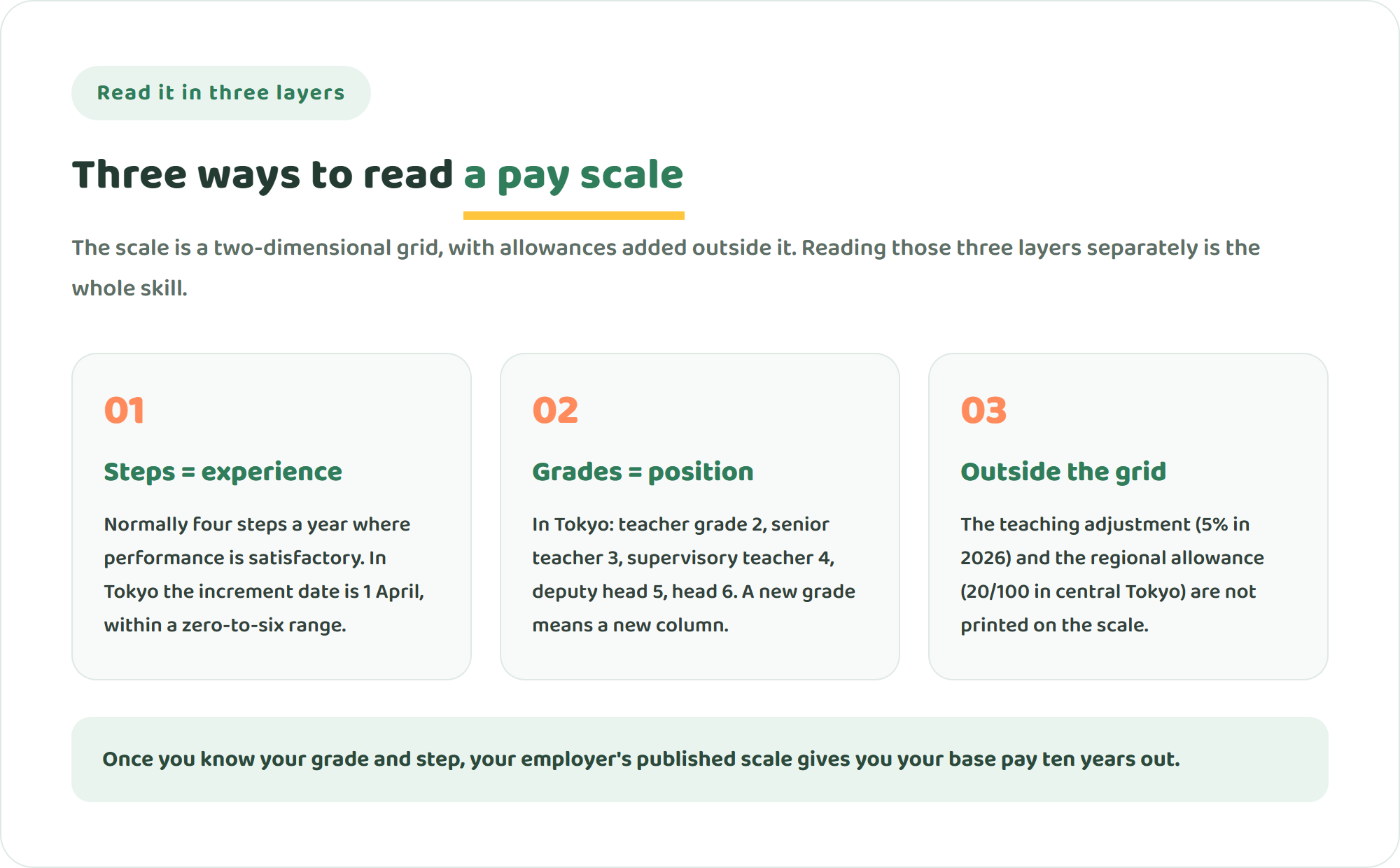
| Step (down the grid) | Years of service. Normally four steps a year where performance is satisfactory | Grade 2 step 9 = ¥259,300 → ten years on, grade 2 step 49 = ¥320,300 (base pay +¥61,000/month) |
| Grade (across the grid) | Your position level. Moving up shifts you to a different column | Teacher = grade 2 (top ¥393,000) / senior teacher = grade 3 (¥433,900) / supervisory or advisory teacher = grade 4 (¥464,300) / deputy head = grade 5 / head = grade 6 (¥535,600) |
| Teaching adjustment | Not on the grid. A flat percentage paid in place of overtime pay | The statute sets 10%; a transitional schedule puts it at 5% in 2026. In Tokyo it applies to grades 4 and below (not to school leaders) |
| Regional allowance | Not on the grid. Varies with where you are posted | 20/100 in the wards and the Tama area, 12/100 outside Tokyo, 10/100 on the islands |
Sources: Tokyo Metropolitan Personnel Commission, salary scales in force 1 April 2026; Tokyo Metropolitan Board of Education, teacher remuneration; Tokyo rules on starting salary, promotion and increments. Figures are monthly base pay only, excluding allowances and the twice-yearly bonus.
The rest of this article takes those four rows apart in order.
The scale is a grid: steps run down, grades run across
A Japanese public school teacher’s base pay is not negotiated. It is the cell where your step and your grade intersect. Your payslip or appointment notice will say something like “grade 2, step 49”, and those two numbers fix your monthly base pay to the yen.
Steps: experience moves you down the column
Under Tokyo’s rules on starting salary, promotion and increments, the increment date is 1 April each year (art. 13) and the number of steps awarded is four for an employee rated in the middle band, within a range of zero to six steps (art. 14). That is the whole mechanism behind “pay rises with age” in Japanese teaching. Columns run out, though: on Tokyo’s scale grade 2 ends at step 177.
Grades: a change of position moves you across
Grades reflect responsibility. In Tokyo’s appointment system, a regular teacher sits at grade 2, a senior teacher at grade 3, a supervisory or advisory teacher at grade 4, a deputy head at grade 5 and a head at grade 6. Each column starts higher: step 1 of grade 3 is ¥296,600, step 1 of grade 4 is ¥318,600. Steps come with time; grades come through selection. The two are not the same kind of growth.
Where you start: qualification sets the cell, prior experience moves it
There is no single starting salary. What is fixed is which cell you begin in. Tokyo’s starting salary table places a university graduate at grade 2 step 9, a junior college graduate at grade 2 step 1 and a high school graduate (assistant teacher and similar) at grade 1 step 1. Grade 2 step 1 is ¥241,600, so the qualification difference is ¥17,700 of base pay on day one.
The part newcomers most often miss is credit for prior experience. The same rules allow steps to be added equal to the assessed months of prior experience divided by three (art. 3(4)) — roughly one step per three months. Conversion rates differ by the type of experience, but time spent teaching abroad, on fixed-term contracts, or in industry is not automatically valued at zero. If you enter Japanese public education mid-career, this is the number worth checking on your appointment notice.
Ten, twenty and thirty years out
Below is the same teacher — hired as a university graduate at grade 2 step 9, gaining the standard four steps a year, staying in grade 2 — read straight off Tokyo’s scale.
| Years of service | Grade and step | Monthly base pay | Gain over the previous decade |
|---|---|---|---|
| On appointment | Grade 2, step 9 | ¥259,300 | — |
| After 10 years | Grade 2, step 49 | ¥320,300 | +¥61,000 |
| After 20 years | Grade 2, step 89 | ¥362,700 | +¥42,400 |
| After 30 years | Grade 2, step 129 | ¥378,300 | +¥15,600 |
| Top of grade 2 | Grade 2, step 177 | ¥393,000 | — |
Source: Tokyo Metropolitan Personnel Commission, education service salary scale in force 1 April 2026. Base pay only, advanced at the standard four steps a year; allowances, the teaching adjustment and the twice-yearly bonus are excluded.
The shape matters more than the amounts. The ¥61,000 gained in the first decade becomes ¥42,400 in the second and ¥15,600 in the third: the steps are evenly numbered, but the money between them narrows as you go down. Reality will differ — prior-experience credit moves your starting cell, the annual increment can be anywhere from zero to six steps, a change of grade moves you to another column, and the scale itself is revised each year on the personnel commission’s recommendation (Tokyo’s 2025 recommendation raised the scales by 3.4% on average). Even so, the skeleton of your next thirty years can be drawn today.
Very few employers let you see the numbers before you apply, and we are not one of them either — what we can do is be plain about how the role starts. See the founding member roles at NIJIN GLOBAL ACADEMY → — founding roles begin as volunteer positions ahead of the September 2027 opening, and the detailed terms are shared later in the process, and you can shape the role across teaching and non-teaching work. If you have just calculated your own ten-year figure and want to grow your career and see more of the world, it is at least a fair comparison to have in hand.
What the grid does not show: the teaching adjustment and allowances
Two things sit outside the scale. The first is the teaching adjustment, paid instead of overtime. The statute sets it at 10% of monthly base pay (4% for kindergarten teachers), but a transitional schedule puts it at 5% in 2026, then 6% in 2027, 7% in 2028, 8% in 2029, 9% in 2030 and 10% from January 2031. Note that it changes on 1 January, not at the start of the school year in April. The increase comes from Act No. 68 of 2025 (promulgated 18 June 2025, in force 1 April 2026). In Tokyo it applies to grades 4 and below; deputy heads and heads are excluded.
The second is allowances. Tokyo pays a regional allowance of 20/100 in the wards and Tama area, 12/100 outside Tokyo and 10/100 on the islands, plus dependants’ and housing allowances and a special allowance for compulsory education teachers. This is why the Board of Education’s published example of a new graduate’s starting salary — about ¥326,100 (as at 1 April 2025, when the teaching adjustment was 4%) — is well above the grid figure. For context, the national average monthly pay for elementary and lower secondary teaching staff was ¥424,411 at an average age of 41.3 (Ministry of Internal Affairs and Communications, 2025 survey; excludes the bonus).
The comfort of a calculable future — and its ceiling
Public school teaching in Japan gives you something most labour markets do not: the entire blueprint is public. It also means the ceiling is public. The highest figure printed on Tokyo’s education service scale is ¥535,600, at grade 6 step 65. Within the grid there are exactly two directions — accumulate steps, or move up a grade — and the pace and the limit of both are set by the system, not by you.
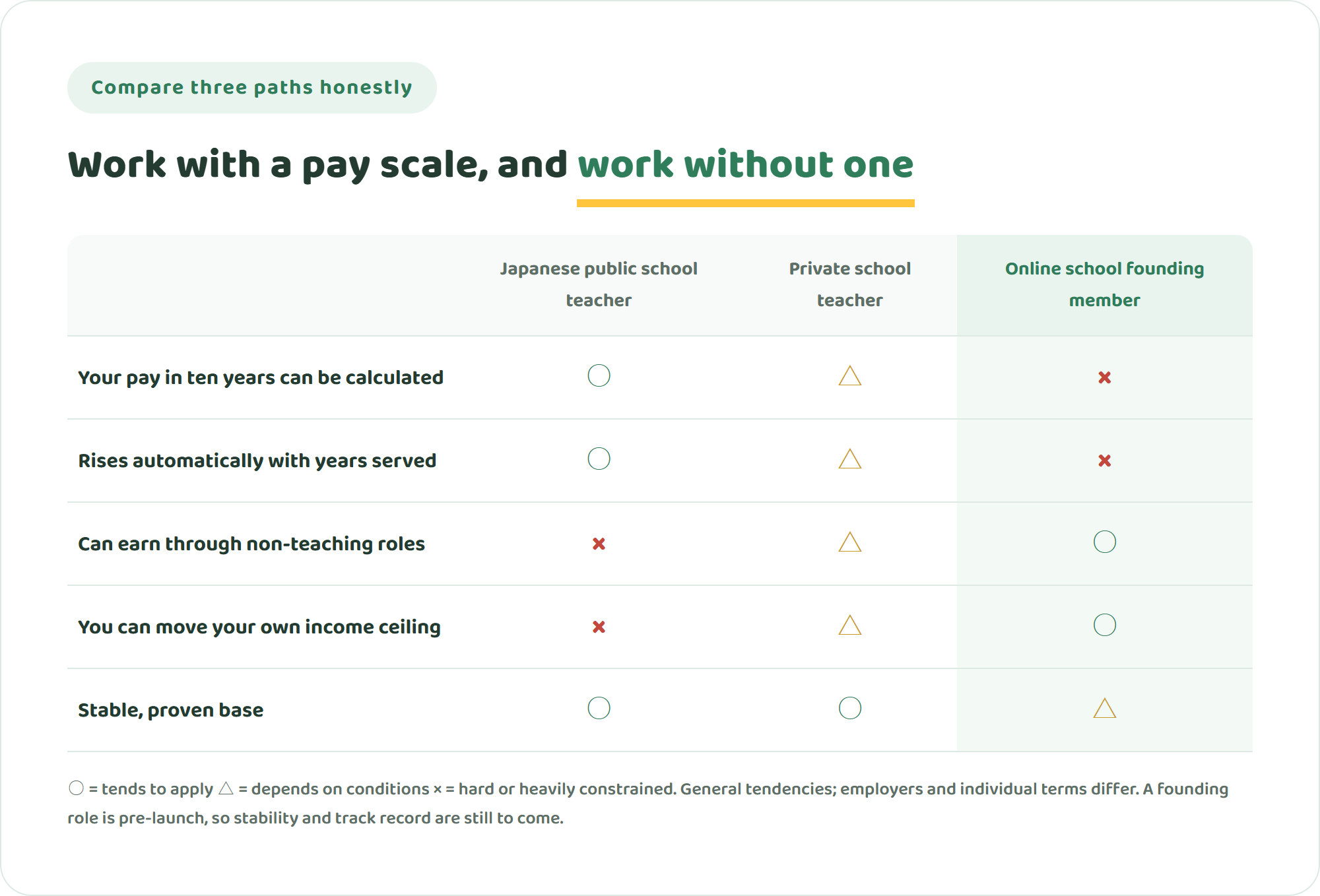
None of this is a criticism of the profession. A scale that advances reliably every year is a solid foundation for a life. But a solid foundation is also a single pillar. Add one of teaching’s neighbouring skills — building materials, communicating, forming partnerships — and there are two. For how teacher pay compares across sectors, see how much teachers earn in Japan; for reading offers at international schools, see international school teacher salaries.
A third way: growth that cannot be looked up
The founding member roles at オンラインインターナショナルスクールのNIJIN GLOBAL ACADEMY (NGA), an online international school opening in September 2027, are the mirror image of a salary scale. Where a scale publishes every number years in advance, this one does not: internationally, founding roles begin as volunteer positions ahead of the opening, and the detailed terms come later in the process. Unlike a scale, growth is driven by role rather than step: alongside teaching, you can take on marketing, web, partnerships or HR across five working patterns.
The work is fully remote and designed around working while travelling, so there is no posting to relocate for. What matters at application is English at around CEFR B2+ and the willingness to build something from nothing; classroom experience is welcome but not required. In fairness, though: nothing rises automatically with years served, and a pre-launch school has no track record yet. The comfort of knowing your pay a decade out does not exist here.
How to read your own scale in three steps
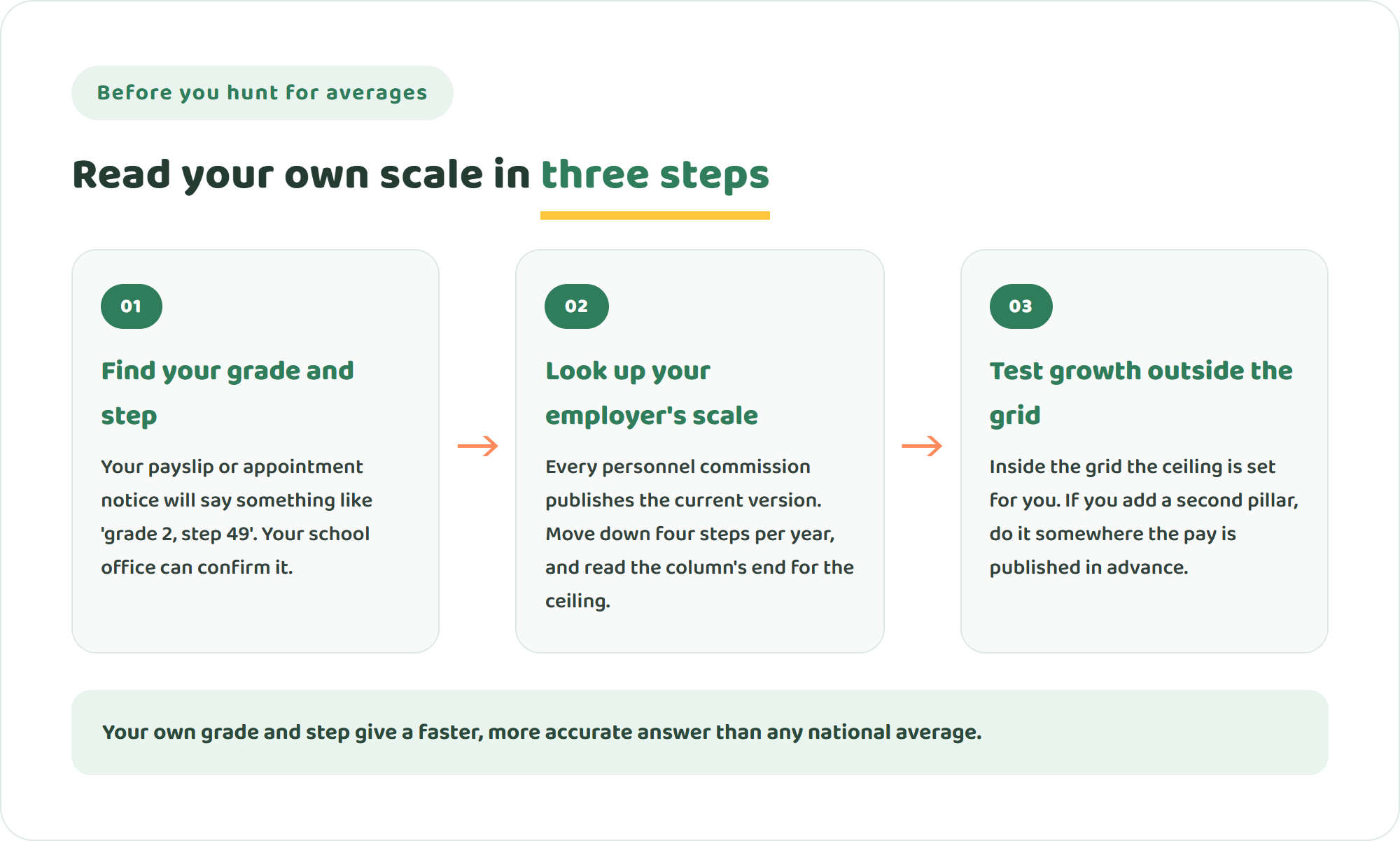
First, find your grade and step on your payslip or appointment notice. Second, look up your employer’s scale — every prefectural personnel commission publishes the current version, usually as Excel or CSV as well as PDF. Move down four steps per year to project forward, and read the bottom of the column for the ceiling. Third, test one source of growth outside the grid. NGA’s selection runs from application to a group interview, an internship and a final presentation, so you can try before you decide.
Frequently asked questions
Where do I find my own grade and step?
On your monthly payslip, or on the appointment notice issued when you receive an increment. If it is not obvious, your school office or the board of education’s payroll section can tell you.
When and by how much does pay rise?
It depends on the employer’s rules. In Tokyo the increment date is 1 April, and the award is four steps for a mid-band performance rating, within a zero-to-six range. Check your own employer’s rules on starting salary, promotion and increments.
Does experience outside Japan count?
It can. Prior service is converted into assessed months of experience, and Tokyo’s rules allow steps to be added equal to those months divided by three. Conversion rates vary by the type of experience, so the placement on your appointment notice is the authoritative answer.
Why is my actual pay different from the figure on the scale?
Because the scale shows monthly base pay only. The teaching adjustment, regional, dependants’ and housing allowances and the twice-yearly bonus are all added separately.
Knowing your next ten years cuts both ways
Learning to read the scale is worth the hour it takes. It converts a vague unease about money into a specific number, and a specific number is something you can actually decide about. For some people the number brings relief; for others it brings the thought that one pillar of income is not enough. Both are reasonable responses. What matters is that the choice is made from your own grid rather than someone else’s average — and that changing how your income is designed does not have to mean giving up teaching.
Working at an International School — More Articles
- international school teacher salary
- how to become an international school teacher
- career change from teaching
- career change from teaching in your 30s and 40s
- how much do teachers earn?
- how to become an IB teacher
- jobs for moving abroad
- remote teaching jobs from the Philippines
- online teaching jobs in Malaysia
- international school staff jobs
- high-paying jobs that use English
- elementary school teacher salary in Japan
- junior high school teacher salary in Japan
- high school teacher salary in Japan
- school principal salary in Japan
- teacher bonuses in Japan
- private school teacher salary in Japan
- online international school teacher salary
Keep the teaching. Redesign the income.
Sources
- Tokyo Metropolitan Personnel Commission, salary scales in force 1 April 2026 (education service scale): saiyou.metro.tokyo.lg.jp
- Tokyo Metropolitan Board of Education, teacher remuneration system: kyoiku.metro.tokyo.lg.jp
- Tokyo rules on the starting salary, promotion and increments of school employees: reiki.metro.tokyo.lg.jp
- Tokyo Metropolitan Board of Education, teacher appointment system (positions and grades): kyoiku.metro.tokyo.lg.jp
- Tokyo Metropolitan Board of Education, teacher training handbook FY2026 (starting salary examples): spt.metro.tokyo.lg.jp
- e-Gov, Act on Special Measures concerning Salaries of Education Personnel of Public Compulsory Education Schools: laws.e-gov.go.jp
- Ministry of Internal Affairs and Communications, 2025 survey of local public employee salaries: soumu.go.jp
- Tokyo Metropolitan Government, outline of the 2025 personnel commission recommendation: metro.tokyo.lg.jp