“How much do you need to earn to afford an international school?” Search that and the numbers come at you fast — benchmarks for international school household income that someone swears are the floor, and others saying you had better be well above them. You had just found a school that seemed right for your child, and had started to picture it properly. Then you hit the number, and you stop. “Are we even in the room for this?” A great many parents quietly close the tab right there.
Let’s be clear from the start: this article won’t tell you those figures are wrong, and it won’t tell you they’re right. What it will do is take them apart. Any benchmark for international school household income is simply a sum run on someone else’s assumptions — change the assumptions and the answer changes. That’s why two families on identical incomes can have completely different experiences, one comfortable, the other squeezed. By the end, you’ll be able to work out your own family’s affordable line.

What the “international school household income” figure actually means
Start with where that number comes from. The household income figures quoted for an international school aren’t drawn from official statistics, and no school sets them as an admissions requirement. In almost every case they are the answer to a single division sum: annual tuition divided by the share of a household budget that education is assumed to take.
For that denominator, a commonly cited rule of thumb is that education spending is comfortable at somewhere around 10 to 20% of household income. That isn’t a regulation or an official standard — it’s closer to a planning rule of thumb than to anything official — but it’s a useful frame. Put annual tuition at ¥3 million, decide you’ll carry it on a fifth of your income, and out pops ¥15 million. Move to 15% and the same tuition demands ¥20 million. Put tuition at ¥2 million instead, and you land on the ¥10 million figure you saw at the top of your search. The numbers circulating online are almost all produced this way, which means they measure something other than what they appear to: not how much you earn, but how large a share of your life you’re prepared to hand to tuition.
This is why income alone tells you so little. Two families earning the same amount — one with a paid-off home, one carrying a heavy city rent — have wildly different room to move. Income is only the number at the door; your capacity is decided by everything inside the household budget. It also helps to be clear on what an international school is, since the category covers an enormous range and the cost picture varies with it.
What really decides it isn’t income — it’s the total to graduation
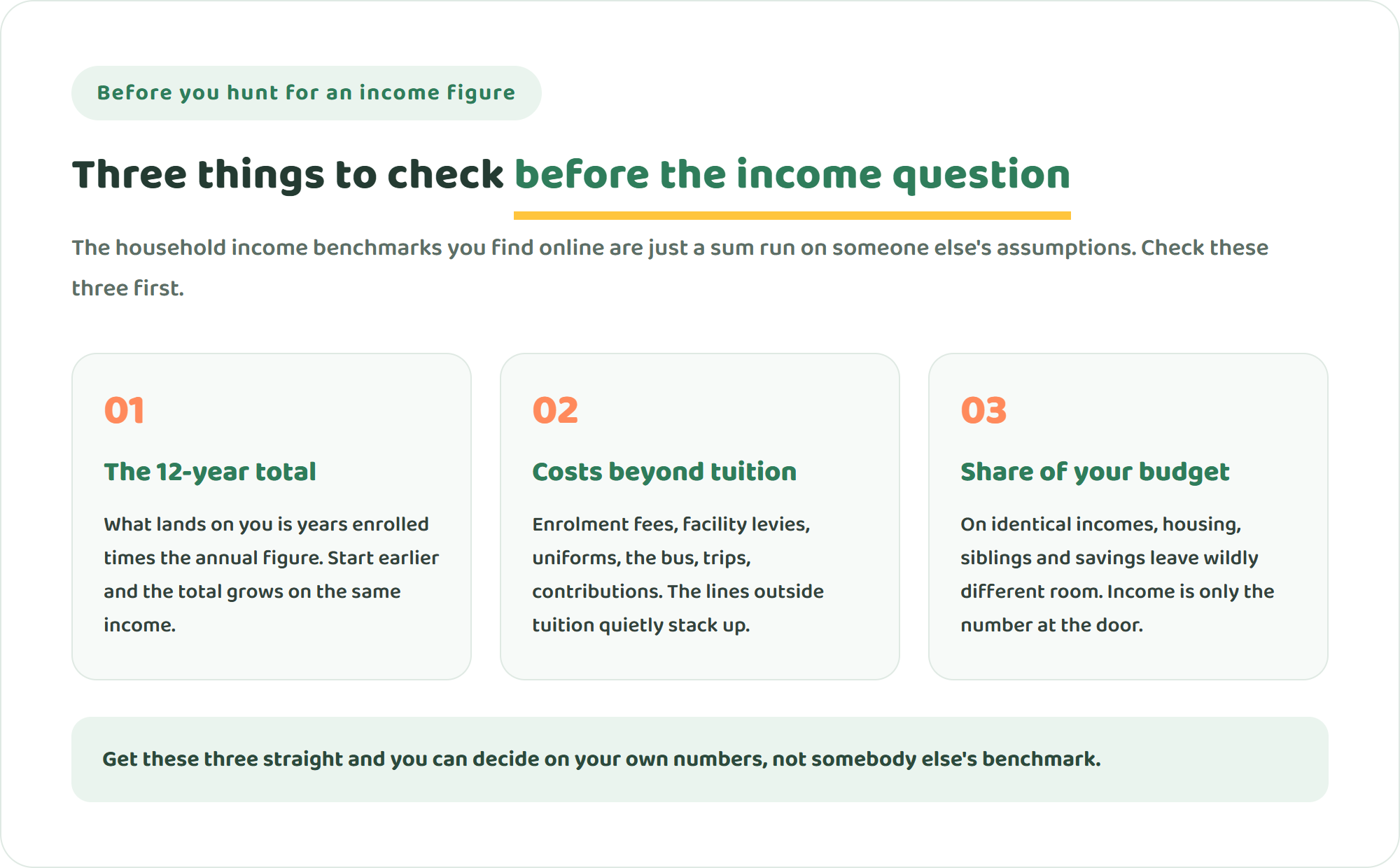
The reason income framing misleads is that it only describes one year. Primary through to the end of secondary is twelve years; starting in middle school is still six. What actually lands on your household is years enrolled multiplied by the annual figure — and the earlier your child starts, the larger that gets, on exactly the same income. Tuition isn’t the whole of it, either.
- Enrolment and registration fees — usually a single large hit in the first year.
- Facility and capital levies — many campuses charge these every year.
- Uniforms, devices and materials — prescribed items need replacing as your child grows.
- School bus — varies enormously with distance, and is far from trivial across a year.
- Trips, sports and co-curricular activities — these grow as your child moves up the school.
- Voluntary contributions and parent association fees — nominally optional, but safer to budget for.
In Japan, tuition at an international school is often described as somewhere in the region of ¥2–4 million a year, but the spread across schools, year groups and cities is very wide, and everything above sits on top of it. Always confirm the actual figures with each school’s official information — and for a sense of the landscape, see our overview of what international school tuition actually costs. The move that changes everything is simple: instead of working backwards from income, estimate what will leave your account between now and graduation first.
The most expensive outcome of all is stopping partway
This is the part we most want to leave you with. The financial risk that genuinely hurts isn’t failing to get in. It’s getting in and not being able to stay.
Incomes don’t only rise. Careers change, health changes, currencies move, a younger sibling reaches school age. When a family stretches to enrol and later has to withdraw, what’s lost is not only money. The friendships your child finally built, a curriculum severed halfway through, and — hardest of all — the possibility that your child concludes they were the reason the family struggled. Those are far harder to recover than any fee you paid.
So the question to settle isn’t “can we get in.” It’s “can we keep this going for twelve years.” A school chosen with a little room to spare leaves a household lighter; a school chosen at the absolute limit makes every invoice a small crisis. If the education is comparable, there’s no reason to choose the second.

Practical ways to lower the cost, short of earning more
Before you conclude the income isn’t there, look at the other side of the equation. Income is hard to change quickly. The total is a design choice. There are five realistic levers.
1. Check what public support exists — and whether it applies. Japan has free early childhood education and care, and a tuition support scheme at upper secondary level. However, many international schools are not “Article 1” schools — the category of formally recognised schools under Japan’s School Education Act — and where that is the case they often fall outside these schemes. Treatment varies with accreditation status and local authority practice, so confirm the latest official information with both the school and your municipality. We’ve mapped this in our guide to subsidies and ways to save on international school fees.
2. Ask about scholarships and sibling discounts. Some schools run means-based or merit scholarships, and many reduce fees for a second or third child. These are often a footnote in the admissions pack — ask directly rather than assuming.
3. Narrow the years, not the ambition. You don’t have to buy all twelve. Building a strong first-language foundation locally and entering an international school for the upper years changes the total dramatically.
4. Consider a “double school” arrangement. Your child stays enrolled at their local school and attends an international programme after school or at weekends. Costs are far lighter than full-time, and first-language learning isn’t given up.
5. Put an online international school on the list. With no campus, no bus fleet and no facilities to maintain, the underlying cost structure is different in kind, not just in degree.
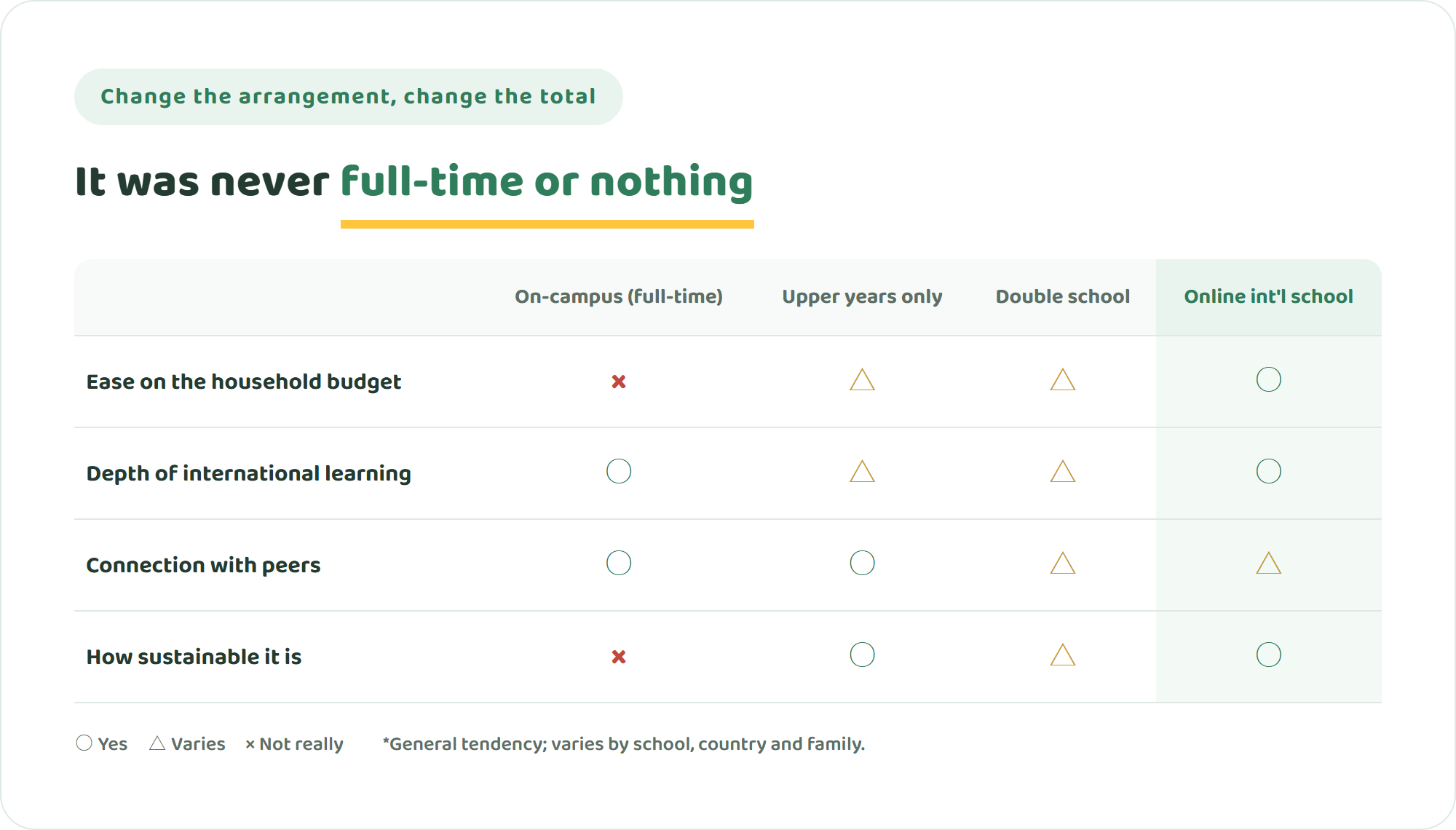
What the table shows is that this was never a binary between full-time and giving up. Adjust the intensity a little and the load on your household falls sharply; cut too far and peer connection starts to thin. There’s no universally right column — only the intensity your family can sustain for twelve years.
See how learning works at NGA →
Three steps to find your family’s affordable line
Here’s how to turn all of this into something you can do. Paper and the calculator on your phone, half an hour.
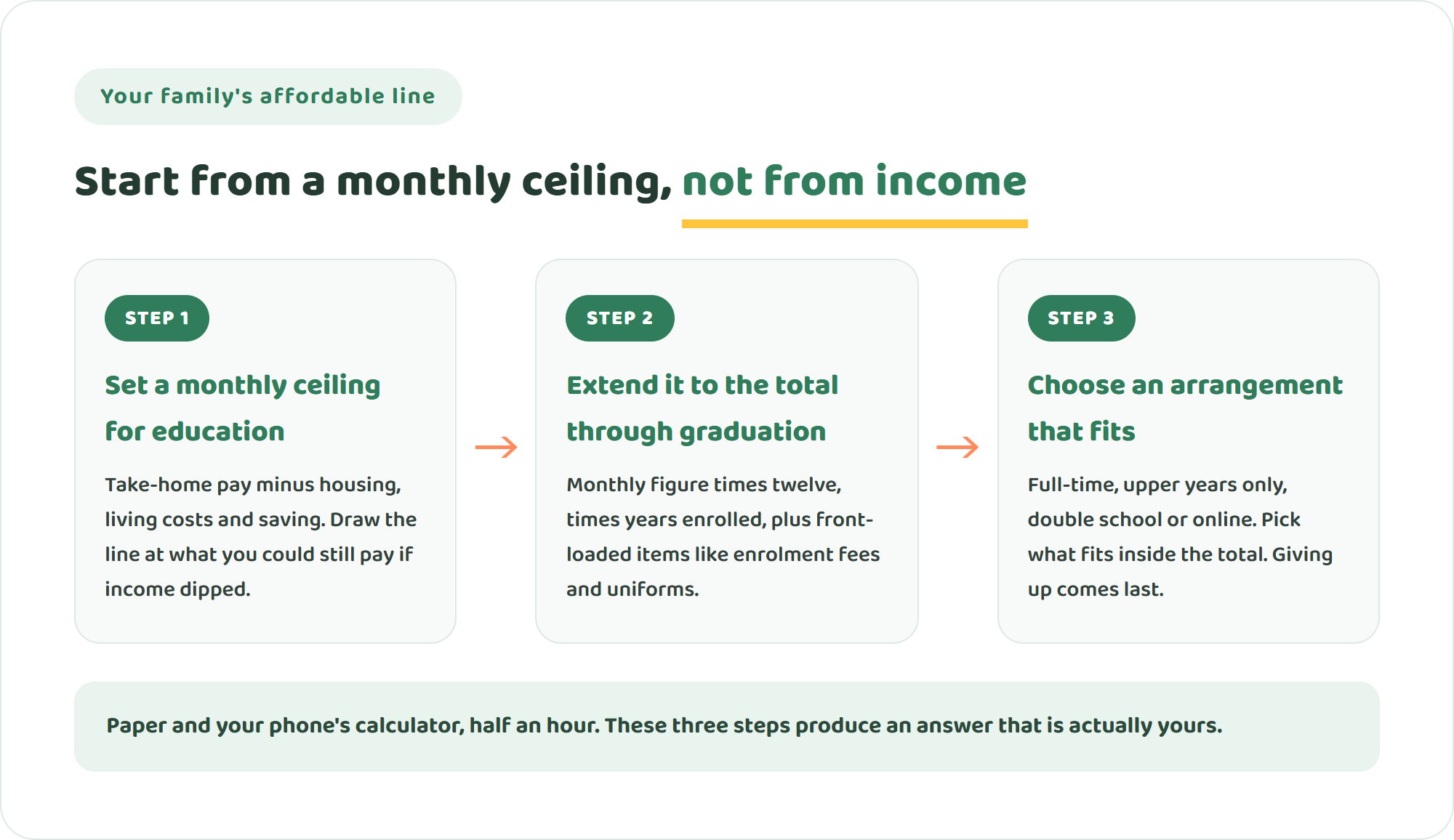
STEP 1 — set a monthly ceiling for education. Not from gross income, but from take-home pay minus housing, living costs and non-education saving. The crucial discipline is to draw the line at what you could still pay if income dipped. A ceiling that depends on bonuses arriving isn’t a sustainable line.
STEP 2 — extend it to the total through graduation. Multiply that monthly figure by twelve, then by the years you expect your child to be enrolled, and add the front-loaded items. That result is the maximum total your household can carry without strain — worth a hundred times more to you than any income benchmark.
STEP 3 — choose an arrangement that fits inside it. If full-time on campus fits, wonderful. If it doesn’t, you still have moves: fewer years, a double-school arrangement, an online international school. Giving up is the last resort, not the first.
Where NGA sits in all of this
With that laid out, here is where we — NIJIN GLOBAL ACADEMY (NGA) — fit. NGA is an online international school beyond the exam race, opening in September 2027, operated by NIJIN Inc.. We also run NIJIN Academy, one of Japan’s largest alternative schools, where over 900 children are already learning. Our founder, Tatsuro Hoshino, received the Grand Prix at JCI JAPAN TOYP 2025, which carries the Prime Minister’s Encouragement Award.
What makes NGA different on cost is structural: with no campus to build or maintain, the underlying economics simply aren’t the same. That’s why we’re aiming for tuition at roughly one-fifth of an on-campus international school. The figure isn’t final, so we won’t quote a number here — when it’s set, the people on our opening updates list will hear it first. What we’re building is learning that doesn’t rank children by test scores: small-group dialogue and psychological safety at the base, the whole world as the material. And above all, we’ve put a family being able to keep going without stretching at the centre of the design.
Frequently asked questions
Can we afford an international school on a modest household income?
Income alone doesn’t settle it. Housing costs, the number of children and your savings position change your real capacity enormously. Even if full-time on-campus tuition is out of reach, the total is something you can redesign — fewer years enrolled, a double-school arrangement, or an online international school. Run the three steps above and get your own ceiling first.
Can public subsidies be used for international school fees?
Japan does have free early childhood education and care, and a tuition support scheme at upper secondary level. But many international schools aren’t “Article 1” schools under the School Education Act, and in those cases they often fall outside such schemes. Because treatment depends on accreditation status and local authority practice, always confirm with the school and your municipality.
Our income should rise in a few years — is it fine to stretch now?
An expectation isn’t a guarantee. Tuition is a fixed cost that runs for years, so draw your line at what you could still pay if today’s income did not continue. If more room appears later, there’s plenty you can add — exchange programmes, summer schools, extra activities. Withdrawing a child from a school they’ve settled into is far harder to undo.
Your family’s answer matters more than anyone’s income figure.
“How much do you need to earn to afford an international school?” There is no single correct reply. There is only the answer that comes out of your take-home pay, your life, and the time you want your child to have. The averages online don’t know your household. You do.
And if the option in front of you is genuinely too expensive, that is not a reason to give up on an international education. Change the arrangement and you change the economics. NIJIN GLOBAL ACADEMY opens in September 2027, and we’ll share how the learning works, first-cohort enrolment, and yes — tuition, as soon as it’s settled. Your child’s education is still yours to choose.
Get opening updates by email →
More on choosing an international education
- What Is the International Baccalaureate?——IB vs Cambridge, honestly compared
- Starting International School in the Elementary Years——What changes, and what it costs
- How Much Does an International Preschool Cost in Japan?——Fees, subsidies, and the step after kindergarten
- Minerva Virtual Academy Fees for Families in Asia——Paid upfront, taught on UK hours
- American Online Schools for International Students——5 compared on tuition, time zones and eligibility
- Stanford OHS vs Laurel Springs——Live seminars or self-paced, read from Asia
- Alpha School vs Sora vs Primer——Which new school model a family in Asia can use
- Can You Raise a Bilingual Child Without Speaking English?——What parents can realistically do at home
- School Refusal? An Online International School Can Reopen Learning——A route back into learning
- How Do You Nurture the Skills Standardized Tests Cannot Measure?——Beyond exam scores