“Teaching jobs without a license.” If you typed those words, your finger may have hovered for a moment — a little hope, and a lot more doubt. You would love to work in education, to connect children with English and the wider world. But you don’t hold a teaching license, and you have never worked in a school. “Without a license, can I even apply?” More people than you might think reach a page like this carrying exactly that hesitation.
This article meets that doubt honestly. First, we will be candid about whether you can work in education without a teaching license or experience — as a general matter, since what’s actually possible varies a great deal by school and by role. Then we will look at the strengths you already hold beyond a license — your expertise, your business skills, your character — and how they translate into education. That part is useful with or without us. Finally, as a “third path,” we introduce — without a hard sell — the option of joining the founding team of an online international school that looks for people who can build from zero and uses an internship-style process to make your real skills visible.

Can you get teaching jobs without a license?
Honestly, the truthful answer is that whether a license is required varies a great deal by school and by role — there’s no single rule. As a general matter, it’s true that full-time positions teaching core subjects in a foreign curriculum (such as the IB) often ask for a teaching license and classroom experience from your home country. But education holds other ways to be involved, too. Assistant roles teaching English or a specific subject; after-school and extracurricular coaching; classes drawing on expertise in art, music, or programming; and the “non-teaching” back office — operations, admin, and communications. Depending on the role, these can weigh hands-on experience, character, and language ability more heavily than a certificate.
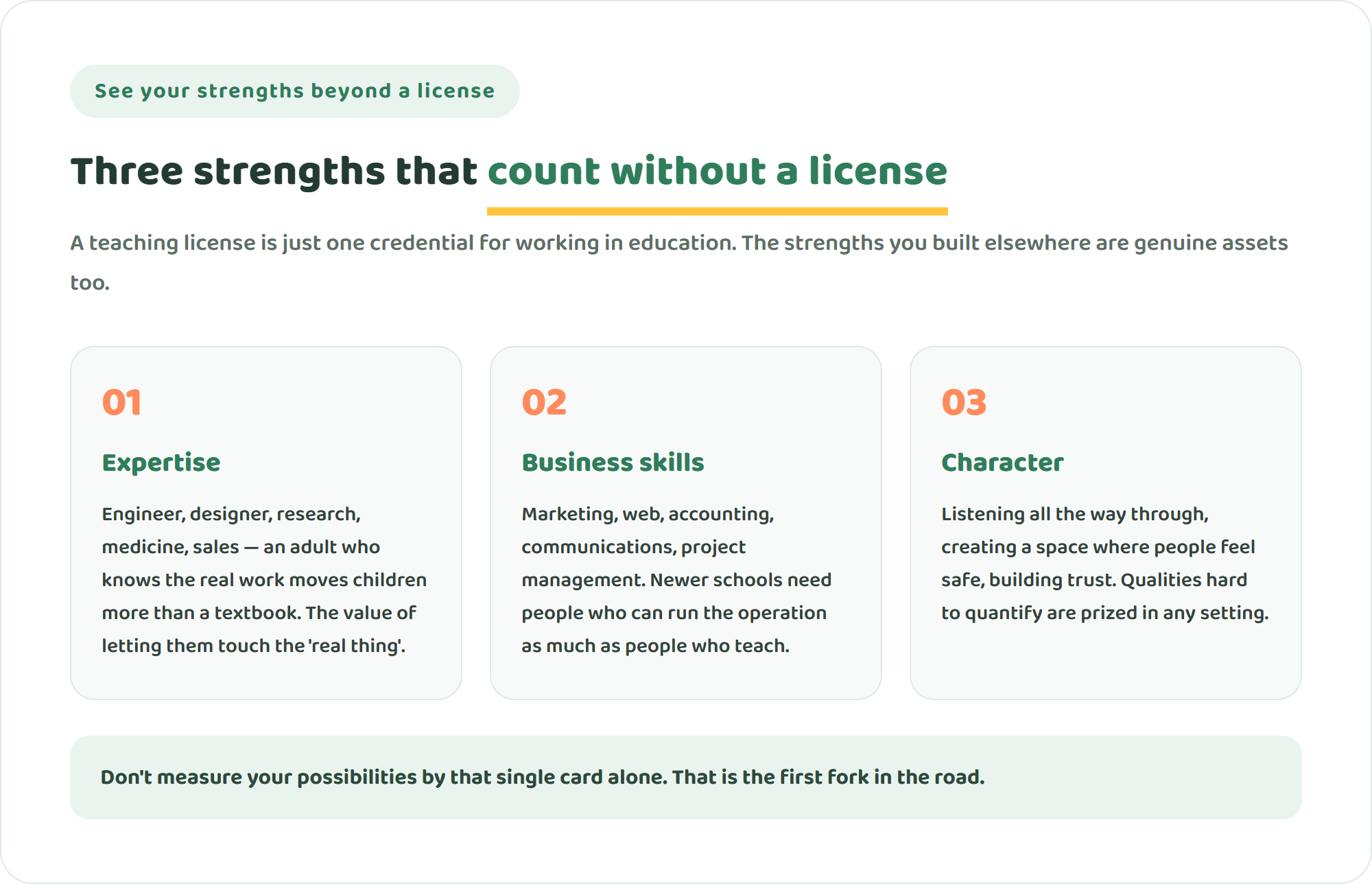
In other words, “no license, so education is off the table” is often just an assumption. Of course, you shouldn’t force your way into roles built around a license. What matters is not to measure your possibilities by that single card alone. As the figure shows, the expertise, business skills, and character you built elsewhere genuinely carry value in education, too. That is the fork in the road.
Take stock of your strengths beyond a license — expertise, business skills, character
This is the heart of the article. If you want to work in education without a license, do this first: take stock of the strengths you hold beyond a certificate. Just as a licensed teacher owns a “method of teaching,” you own something else. First, expertise. Engineer, designer, researcher, salesperson, medicine, farming — whatever the field, an adult who knows the real work moves children far more than a textbook can. Letting them touch the “real thing” is a value no license replaces.
Second, business skills. Marketing, web, accounting, communications, project management — these are indispensable to running a school as an organisation. Newer schools in particular need people who can “run the operation” as much as people who teach. Third, character. Listening to a child all the way through, creating a space where people feel safe, building trust among adults — qualities that are hard to quantify are prized in any setting precisely for that reason. Write out your past work and activities, then rename each one: “what is this good for in an education setting?” That alone brings into focus what you can offer even without a license. This stocktaking widens your options whether or not you ever apply to us.
See NIJIN GLOBAL ACADEMY’s founding-member roles →
A third path — where a license is not the only gate
There is another path, worth looking at before you conclude that no license means education is closed to you. It is to bring the strengths you hold beyond a license and join the side that builds a school from zero. The founding-member roles that NIJIN GLOBAL ACADEMY (NGA) is recruiting for ahead of its September 2027 opening are built on exactly that idea. The table below sets three ways of being involved side by side: licensed teaching roles, education jobs that don’t require a certificate, and joining an online international school’s founding team.
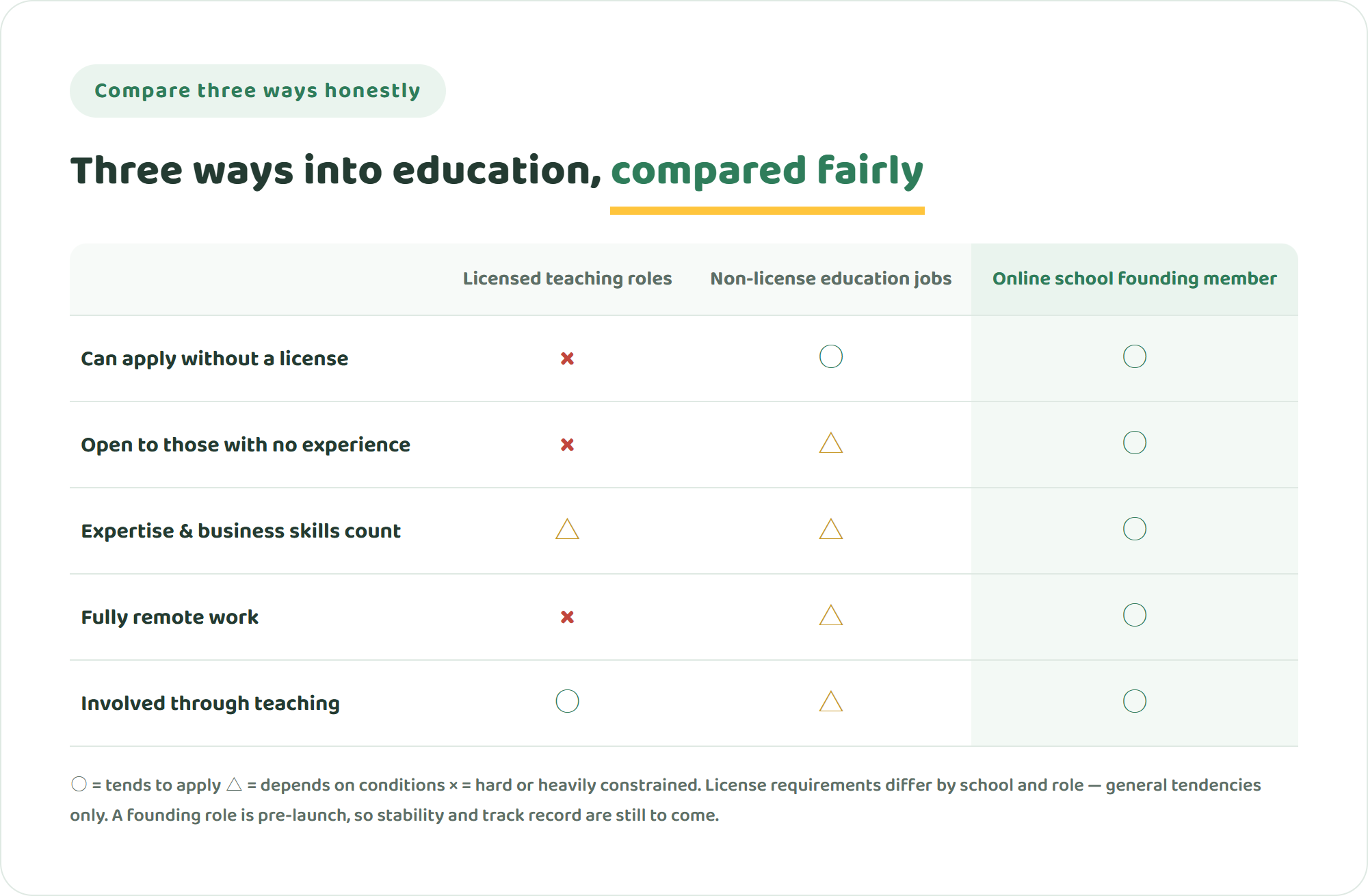
As the table makes plain, the founding-member path is not a cure-all. Precisely because it is a pre-launch phase, the stability and track record of an established school are still to come. Even so, for someone who wants to work in education without a license or experience, this way of working holds real appeal. First, NGA welcomes people who can build from zero — we look at the drive to build a school together more than at a license or a glossy résumé. Second, you can combine teaching with running the business: beyond lessons, you can choose your involvement from five working styles spanning marketing, web, partnerships, and HR, so your strengths beyond a license apply directly. Third, we say plainly what the terms are — founding roles on this track begin as volunteer positions ahead of our September 2027 opening, and the detailed terms are shared later in the process.
Above all, NGA stands for learning beyond test scores — no ranking of children by exam results. Our view of education, built around small-group dialogue that starts from “what do you think?”, is laid out in how we learn. Because it is learning where diverse adults bring real experience — not drilling fixed answers — the strengths of an unlicensed specialist or a business builder truly come alive. What we ask is roughly English at CEFR B2+ and an appetite for building from zero. The experience from your current field is never wasted.

From no license to applying — three steps
Here is a manageable, three-step way to turn worry into action.
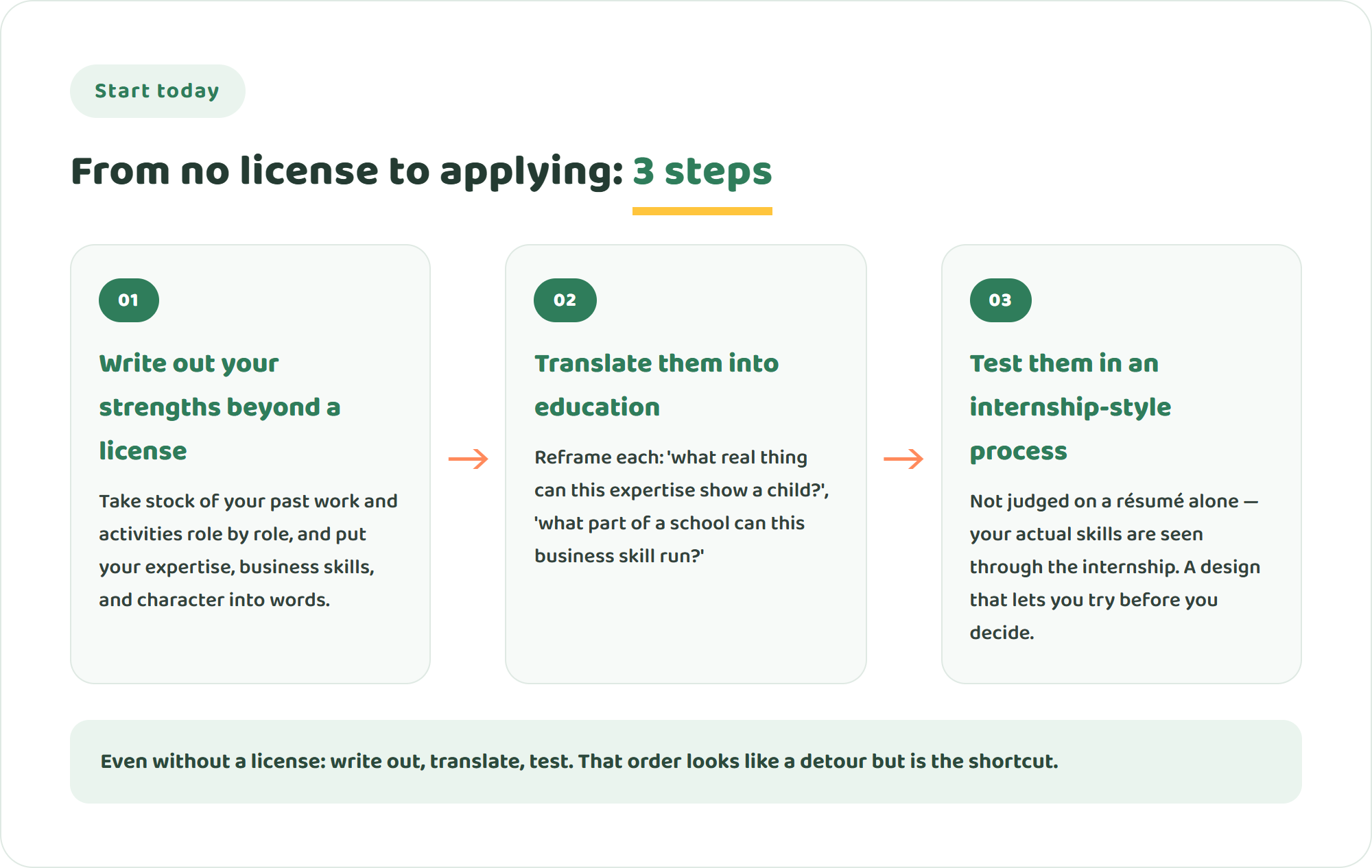
First, write out your strengths beyond a license. As in the chapter above, take stock of your past work and activities, role by role. Second, translate them into an education setting — “what ‘real thing’ can this expertise show a child?”, “what part of a school can this business skill run?”. Third, test them through an internship-style process. NGA’s selection runs from document screening to a group interview, an internship at NIJIN Academy, and a final presentation (applications are via a Google Form). Because the internship is built into the selection process, you are judged on your actual skills rather than on a license or résumé alone — so the things a document cannot convey still get seen.
Frequently asked questions
I have no teaching license at all. Can I still apply?
Yes. NGA does not require a teaching license. If anything, we welcome people who can build from zero. What matters more than a certificate is the expertise and business skills you hold and your drive to build a school together. That said, some general job listings do require a license, so always check the conditions for each role you apply to.
I’ve never worked in education either. Won’t that count against me?
Our recruiting page does not say anything about experience being required or waived, so we will not claim it is “not required.” What we can say is what is written there: we are looking for people who can build from zero, and the selection process includes an internship at NIJIN Academy, so you are seen on your actual skills and fit rather than your résumé alone. How much experience matters in practice is something to ask directly during selection.
I’m not that confident in my English. Is that OK without a license?
We assume roughly CEFR B2+, but we are not looking for native-level perfection. Separately from any license, we look at your willingness to use English to work with children and peers around the world, and to keep growing it. You can confirm the exact expectations during selection.
My expertise has nothing to do with education. Is it still useful?
It becomes a strength. Engineer, designer, sales, research, medicine — in any field, an adult who knows the real work offers children genuine learning. NGA values learning where diverse adults bring their experience, so expertise from outside education often comes into its own.
Chosen for what you can offer — not for a certificate.
If you searched “teaching jobs without a license,” some wish to be part of someone’s learning genuinely lives in you. A teaching license is only one entrance into education; the expertise, business skills, and character you built elsewhere can become real learning for a child, too. There is no need to stall out of a sense that a missing license holds you back. Write out your strengths, translate them into education, and test them small — each step moves you toward a path where you are chosen for who you are, not for a certificate. What you can offer is almost certainly more than you think.
Working at an International School — More Articles
- international school teacher salary
- how to become an international school teacher
- career change from teaching
- career change from teaching in your 30s and 40s
- how much do teachers earn?
- how to become an IB teacher
- jobs for moving abroad
- careers with a teaching license
- qualifications to teach English
- teach one class a week online
- online teaching jobs from home in India
- part-time online teaching jobs from home
- international school staff jobs
- remote jobs that use English
- digital nomad teaching jobs
- bilingual remote jobs
- career change from tutoring
- life after leaving teaching
Chosen for what you can offer, not for a certificate.