“I don’t want to go to school today.” One ordinary morning, your child says it out of nowhere, and something in your chest goes cold. You ask why, and get no clear answer. The clock is moving. Not knowing what the right response even is, you hear yourself asking, “What’s wrong?” When a child does not want to go to school, that is usually how it arrives — mid-rush, with no warning and no instructions.
Before anything else, one thing worth holding on to: those words are also a sign your child trusts you. Some children carry it without ever being able to put it into words — which is exactly why the fact that yours said something matters. This article walks through how to meet that morning, the well-meant responses that tend to shut a child down, and five honest options for how your child can learn. What it will not do is tell you to push them out the door, or to keep them home. That decision belongs to you and your child.
When your child does not want to go to school, start here
“I don’t want to go” is rarely a declaration that they will never go again. Often it is the body’s way of saying today is too much. And a child usually cannot explain why — which is entirely normal. Few adults can put into words why Monday morning feels so heavy. That is why how you meet those first words shapes how easy it stays to talk afterwards. And if a morning went badly, it can always be repaired.
Where most parents stumble has nothing to do with a lack of love. If anything, it is that the sheer strength of the worry comes out unfiltered. Three responses in particular are meant kindly and tend to close a child’s mouth.
The first is pressing for a reason. “Why?” “Did someone say something?” The more you stack the questions, the more a child concludes that not having an answer is their own failing. The second is hunting for a cause and someone to blame — the teacher, another child, or your own parenting. Looking for a culprit feels like progress, but it moves away from how your child actually feels. The third is rushing ahead to fix it: a transfer, a tutor, a counsellor, all lined up at once. The faster a parent moves, the more easily a child reads it as “I am a problem to be solved.”
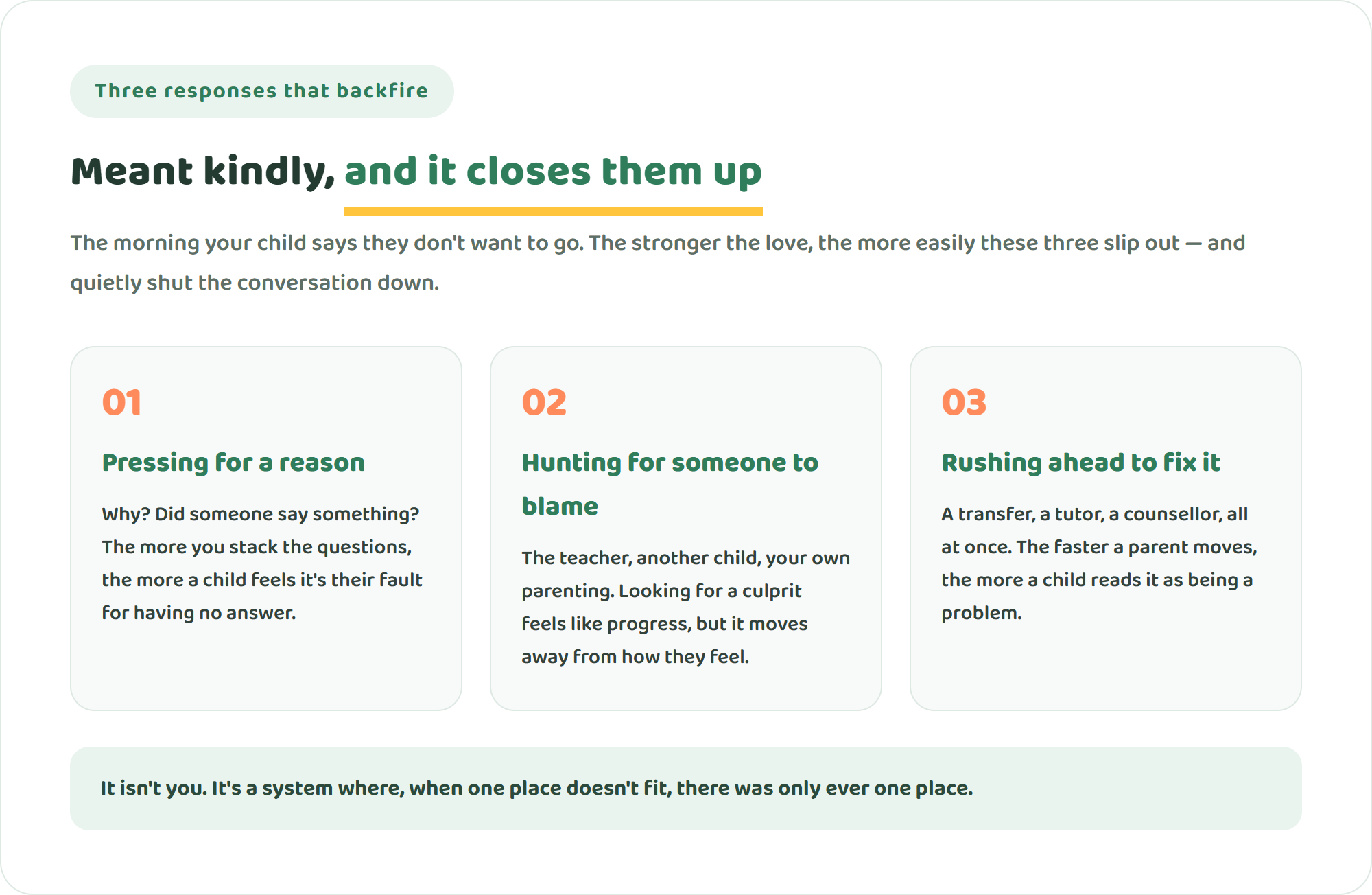
All three surface because you care. What you can do instead is almost startlingly simple: “Okay. You don’t want to go today.” Receive it as it is, without adding a verdict or a solution. That alone teaches a child, all over again, that this is a person they can tell the truth to.
It isn’t your fault. The problem is the system, not the people
“Was it something in how I raised them?” Most parents blame themselves first, and in nearly every case that self-blame simply isn’t accurate. According to Japan’s Ministry of Education (MEXT) annual survey on student guidance issues, published in 2025, the number of elementary and junior high school students recorded as long-term non-attenders (futōkō) reached 353,970 in fiscal 2024 (April 2024 to March 2025) — the highest on record. Around 350,000 children. A figure that size is not the result of individual families failing; it points at the shape of the system itself.
At NIJIN GLOBAL ACADEMY we work from a simple principle: don’t blame people, fix the structure. Not the child, not the teacher, not the parent. The real problem is that when one setting doesn’t fit, there has effectively been only one place to go. Same hour, same room, same number of people, every day. Plenty of children thrive in that shape. For a child sensitive to noise or crowds, it is closer to sprinting from morning to evening.
Rather than making a child keep running in shoes that don’t fit, you can change the shoes. There is a growing view that stepping back is not a retreat but a transition into a different way of learning — see choosing to step away from school on purpose. And if you are not ready to attach any label to your child yet, that is fine. Knowing the options without naming anything is more than enough to move forward.
Five real options that open up after “I don’t want to go”
Go to school, or stay home. What looks like a binary is in fact much wider. Here are five common paths, with what each is and isn’t good for. Read them with one question in mind: which one fits your child right now?

1. Adjust the environment at their current school. Bring in more than the homeroom teacher — the school nurse, the counsellor, the year head. A separate room, a shorter day, attending only for events, a change of seat. The advantage is that your child keeps the friendships they already have; the limit is that it does little when the school itself is the source of the strain. Attending as usual while adding a second, different learning setting after hours is another realistic way to spread the load.
2. A public support centre or an alternative learning centre. Municipal support rooms are typically low-cost and coordinate easily with the enrolled school, while independent centres range from drop-in spaces to structured academic support. The strength is gentle contact with peers again; the hurdles are distance, cost, and the fact that getting used to yet another new place is itself hard work.
3. Homeschooling. One thing to know first: in Japan a child stays enrolled at their local school while learning at home, so homeschooling is not a legal substitute for compulsory schooling. With that said, it is the quietest option, and the best one for getting a child’s own pace back. They can rest and restart from whatever genuinely interests them. Honestly, though, it asks a great deal of the parent, and connection with peers thins out easily.
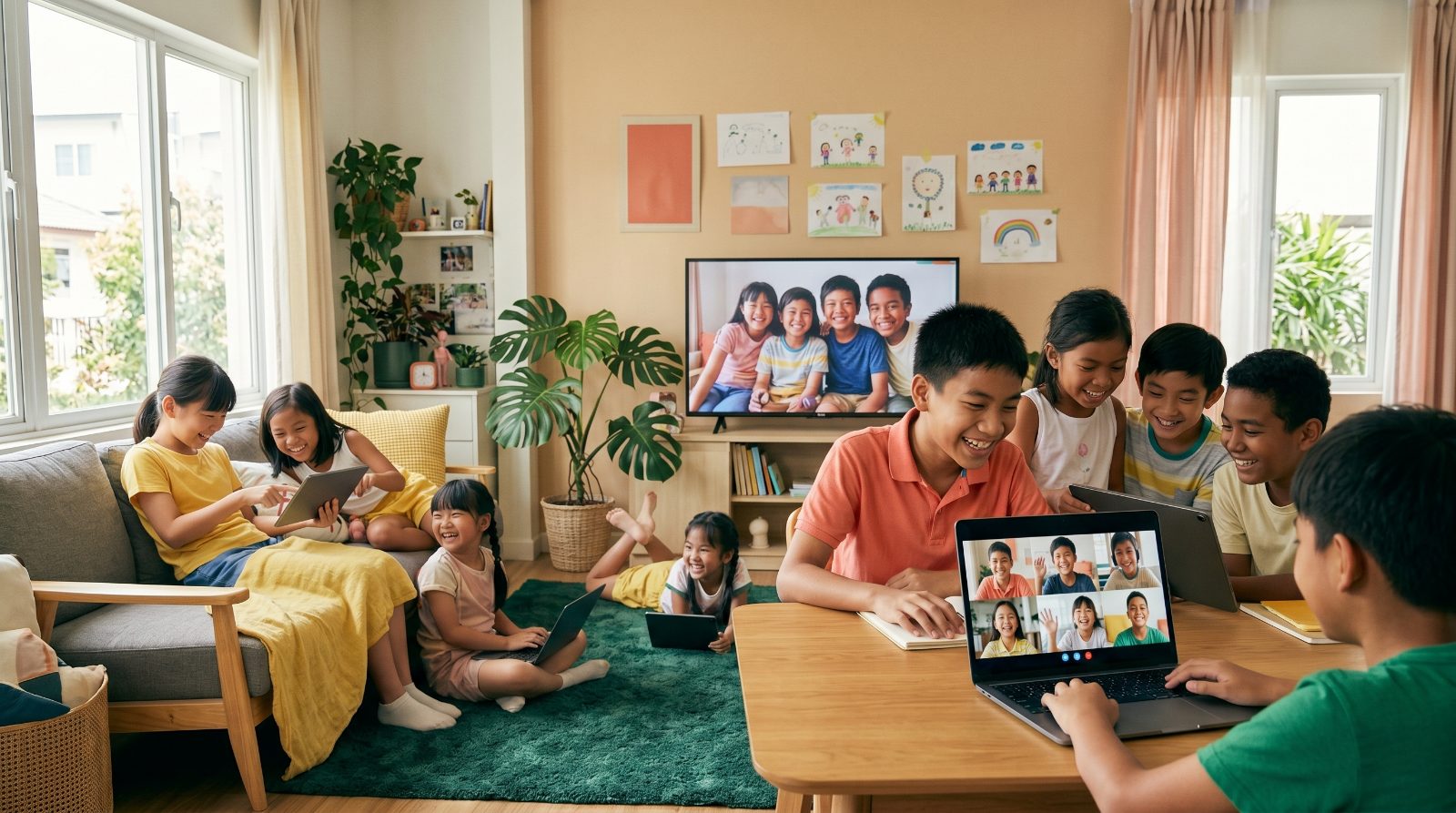
4. An online school. Your child takes part from the one place that already feels safe, without carrying classroom tension into it. No commute, and it flexes around days when their health dips. For more, see learning with the world when school isn’t working. The drawbacks: some children want more than what a screen can carry, and a daily rhythm still has to be built.
5. An alternative school. Inquiry-based, Jena Plan, Steiner and others differ in their whole philosophy of education. Being seen by a measure other than test scores can be genuinely restorative for a child who has concluded they are no good. They are few, and one may not exist within reach. If an international route interests you, it helps to first understand what an international school is so you can compare fairly.
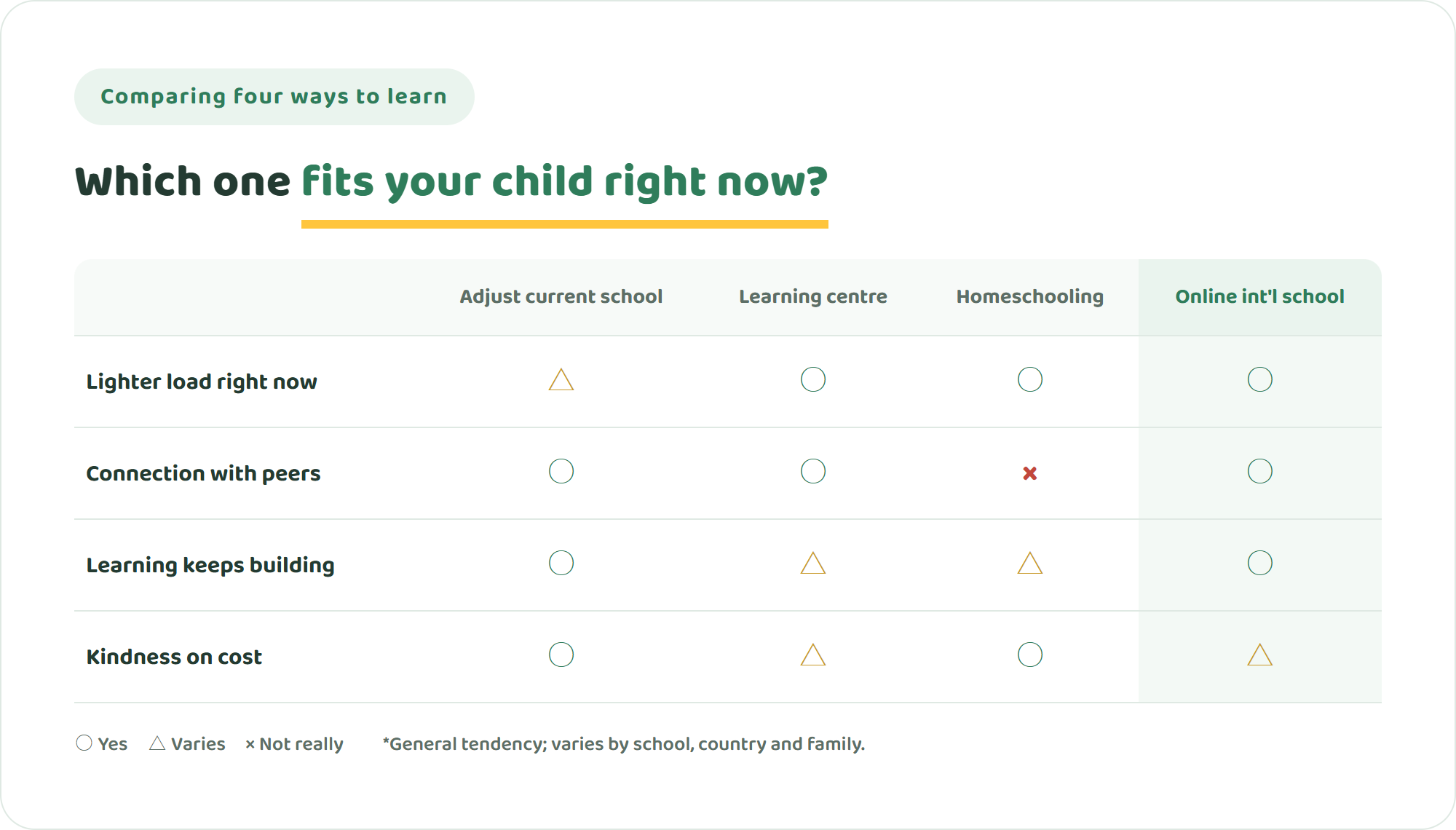
What the table makes clear is that no option ticks every box. If easing the emotional load comes first, all three routes away from the current classroom are lighter. If contact with peers matters most, school or a learning centre is stronger. If you want learning that keeps building and peers alongside it, adjusting things at the current school or something like an online international school comes into view. Deciding which row your family puts first may be the most useful thing a parent can do right now.
Three steps a parent can take, in this order
Knowing the options doesn’t mean it’s time to choose. Skip the order, and even a good place won’t land, because your child’s heart hasn’t caught up.
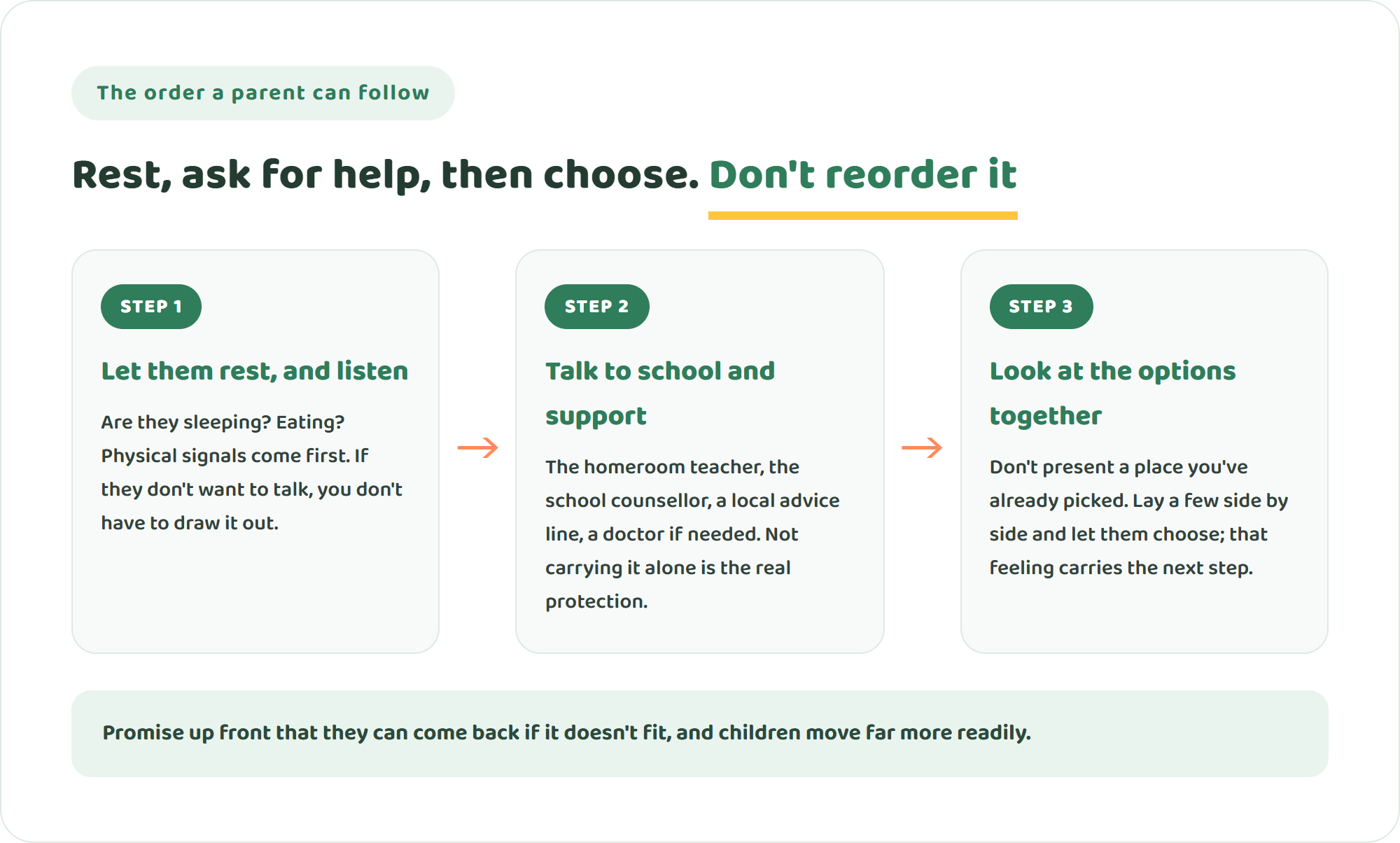
STEP 1 is to let them rest, and listen. Are they sleeping? Eating? Put the physical signals first. If they don’t want to talk, you don’t have to draw it out. Eating a meal together, watching the same show side by side — that is enough to carry the message that this place is safe. STEP 2 is to talk to the school and to professional support. The homeroom teacher, the school counsellor, a local education advice line, and a paediatrician if needed. Not carrying it alone as a family is the strongest protection there is. In Japan, two free helplines take calls from parents as well as children: MEXT’s 24-hour Children’s SOS line (0120-0-78310) and the Ministry of Justice’s Children’s Human Rights hotline (0120-007-110).
One thing that comes before any of this: if your child is not sleeping, not eating, or carrying persistent anxiety or low mood, put a doctor or a mental health professional ahead of any decision about how they learn. Choosing a way to learn can wait until body and mind have recovered a little.
STEP 3 — only now — look at the learning options together. The word that matters is “together.” Instead of presenting a place you have already chosen, put a few brochures or trial sessions side by side and let your child pick. The feeling of having chosen it themselves is what carries the next step. Promise up front that they can come back if it doesn’t fit, and children move far more readily than you’d expect.
See how learning works at NGA →
A third option — at NGA, a child chooses the group size and how they take part
If the online route caught your attention, here is where we stand. NIJIN GLOBAL ACADEMY (NGA) is an online international school beyond the exam race, opening in September 2027 and operated by NIJIN Inc.. NIJIN Academy, one of Japan’s largest alternative schools, already has over 900 children enrolled — many of whom once had a morning exactly like the one you’ve just had.
What we hold above everything is psychological safety. In practice that means each child chooses how many people they engage with, and how. Whether the camera goes on, whether they speak aloud, is theirs to decide. Writing in the chat counts as taking part. So does showing what they made. Learning is designed around small-group dialogue, so no child will be put on the spot in front of a crowd, and we do not rank children by test scores. The world itself is the material, and the ground beneath it all is coming to love yourself and the world.
And in fairness, there are times when NGA is not the right fit. When a child is near their limit and resting — doing nothing at all — has to come first, any school can wait. If in-person professional care is what’s needed, that comes first too. School will still be there once recovery has begun. Compare us honestly with the other options, and choose us only if it feels right for your child.
Frequently asked questions
If my child says they don’t want to go, should I let them stay home?
There is no single right answer. That said, when physical signals are present — trouble sleeping or eating, stomach aches or headaches in the morning — it is generally considered fine to put rest first. If you’re unsure, speak to the homeroom teacher, the school counsellor or your doctor that same day. Deciding “what about today?” together each morning, rather than treating one day off as the whole answer, wears everyone down far less.
My child won’t tell me why. What should I do?
Assume that not being able to say is the normal case — very often the child doesn’t know either. Instead of questioning, try “I’m here whenever you want to talk,” and simply carry on with ordinary days beside them. Some children open up more easily over a notebook, a letter, or while playing a game. Visiting a support service on your own, as the parent, is also a legitimate move.
Will time away from school hurt their future options?
Pathways are far broader than they used to be — distance high schools, equivalency qualifications, curricula that lead to internationally recognised credentials. Rules differ by region and by school, so check the official information from the school your child is enrolled in and any school they may apply to. More important than an unbroken record, we’d argue, is your child recovering the sense that learning isn’t something they hate.
How your child learns is still a choice.
“I don’t want to go to school” is not the end of anything. It is the earliest possible notice that the current shape doesn’t fit. The morning your child does not want to go to school may be, for you, where the worry begins — and for them, the day they started looking for a way of learning that fits. You have not done anything wrong. You simply hadn’t been shown the options.
NIJIN GLOBAL ACADEMY opens in September 2027. We’ll send you news of our first cohort, along with how our learning works — small-group dialogue where a child decides even whether the camera goes on, and a classroom connected to the world. You don’t have to decide anything today. Just hold on to this: there is a road on the far side of “I’m not going.”
Honest Answers to Your Worries — related reading
- Will My Child Lose Their Mother Tongue?
- The Honest Pros and Cons of International School
- Disadvantages of Bilingualism in Childhood: Myths vs Research
- Who Regrets International School — and Who Doesn’t
- International School Special Needs: What to Look For
- International School vs Local School: How to Decide
- Does International School Hurt Your Child’s Home Language?
- When Your Child Is Struggling at International School
- Do International Schools Make Children Fluent in English?
- Is International School Worth It? What Happens to Graduates
- Should I Send My Child to International School?
- Transfer From a Local School to an International School
- Disadvantages of Early English Education: What Research Says
- What Happens to International School Graduates
Get opening updates by email →
More on choosing an international education
- How Much Household Income Do You Need for an International School?——Budgeting so it lasts
- What Is the International Baccalaureate?——IB vs Cambridge, honestly compared
- Starting International School in the Elementary Years——What changes, and what it costs
- How Much Does an International Preschool Cost in Japan?——Fees, subsidies, and the step after kindergarten
- Minerva Virtual Academy Fees for Families in Asia——Paid upfront, taught on UK hours
- American Online Schools for International Students——5 compared on tuition, time zones and eligibility
- Stanford OHS vs Laurel Springs——Live seminars or self-paced, read from Asia
- Alpha School vs Sora vs Primer——Which new school model a family in Asia can use
- Can You Raise a Bilingual Child Without Speaking English?——What parents can realistically do at home
- School Refusal? An Online International School Can Reopen Learning——A route back into learning