If you are researching the high school teacher salary in Japan, the honest starting point is that Japan publishes a great deal about monthly pay and almost nothing about annual income. Here are the two headline figures. The average monthly salary of full-time high school teachers is JPY 359,300 (MEXT School Teachers Survey, FY2025 interim report, as of 1 October 2025), and the annual income of a public high school teacher works out at roughly JPY 7.07 million on an estimated basis.
Those two numbers are not the same kind of number. The first is base pay only — no allowances, no bonuses. The second does not exist as an official statistic at all; it has to be estimated by combining several government surveys, and we show the arithmetic below. Everything here is in yen only, with no currency conversion, because the exchange rate would obscure what the underlying data actually says.
| What the figure is | Amount | Source (as of) |
|---|---|---|
| High school teacher average monthly salary / estimated annual income | JPY 359,300 (base pay only) / approx. JPY 7.07 million per year (estimate) | MEXT School Teachers Survey, FY2025 interim / estimate from MIC 2025 local government pay survey + NPA 2025 recommendation |
| Public vs private, average monthly salary | Public JPY 353,200 / Private JPY 355,300 | Same survey, FY2022 final figures |
| By position (high school) | Principal JPY 487,200 / Vice-principal JPY 445,700 / Teacher JPY 351,500 / Instructor JPY 249,800 | Same survey, FY2022 final figures |
| Monthly pay including allowances (public) | JPY 442,668 per month (average age 44.5) | MIC survey of local government pay, 1 April 2025 (upper secondary education service) |
| Private-sector benchmark | All employees JPY 4.78 million / regular employees JPY 5.45 million per year | National Tax Agency survey, 2024 income year |
Each of these is built differently. Here is how.
Why “average monthly salary” is not a Japanese teacher’s monthly pay
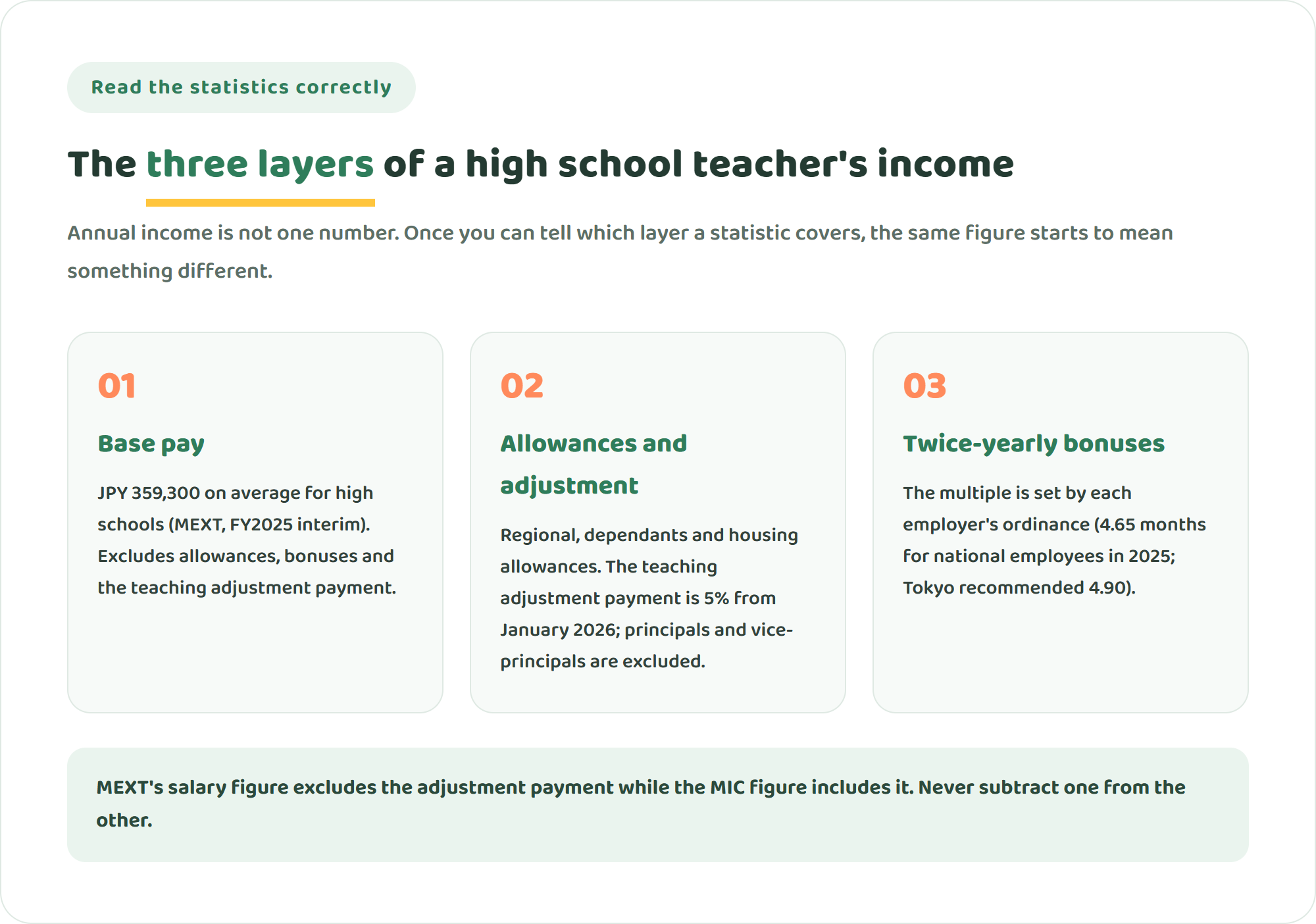
Definitions come first, because this is where most English-language summaries of Japanese teacher pay go wrong. The monthly salary reported in MEXT’s School Teachers Survey is base pay only. The survey’s own note states that allowances and the adjustment payment are excluded — so no regional allowance, no dependants or housing allowance, no twice-yearly bonus, and not even the teaching adjustment payment. The FY2025 figures are also an interim report and may move when finalised.
For pay including monthly allowances you need a different survey. The Ministry of Internal Affairs and Communications survey of local government pay puts the average monthly pay of the upper secondary education service at JPY 442,668 as of 1 April 2025 (average age 44.5), made up of JPY 378,305 in salary plus JPY 64,363 in monthly allowances. Note that this survey’s salary figure includes the teaching adjustment payment while MEXT’s does not, so the two cannot be subtracted from each other, and that its category also covers special-needs schools and specialised training colleges.
That teaching adjustment payment is a distinctive feature of Japanese public education: teachers do not receive overtime pay, and receive this flat percentage of base pay instead. The statutory rate is 10 percent, but under transitional provisions it is 5 percent from 1 January 2026, rising by one point each year to 10 percent from 1 January 2031 — on a calendar-year, not fiscal-year, schedule. Principals, deputy principals and vice-principals are excluded from it.
About JPY 7.07 million a year — with the arithmetic shown
No Japanese government statistic reports teacher annual income directly. It has to be estimated, so here is the estimate in full: average monthly pay JPY 442,668 × 12 months = JPY 5,312,016; bonuses JPY 378,305 × 4.65 months = JPY 1,759,118; total JPY 7,071,134, or roughly JPY 7.07 million.
Now the caveats, because they matter more than the headline. The 4.65 months is the annual bonus multiple for national public employees under the 2025 National Personnel Authority recommendation. Public school teachers are local government employees, and each prefecture sets its own multiple by ordinance — Tokyo recommended 4.90 months in 2025. Beyond that: bonuses are actually calculated on base pay plus regional and position-based additions, so this method tends to understate; the figure reflects a national average age of 44.5; and retirement benefits are excluded. For context, the National Tax Agency reports average annual pay of JPY 4.78 million for all employees and JPY 5.45 million for regular employees in the 2024 income year — but that is a survey of actual annual earnings, so it is not directly comparable with monthly base pay statistics.
Public vs private high schools: almost identical averages, very different distributions
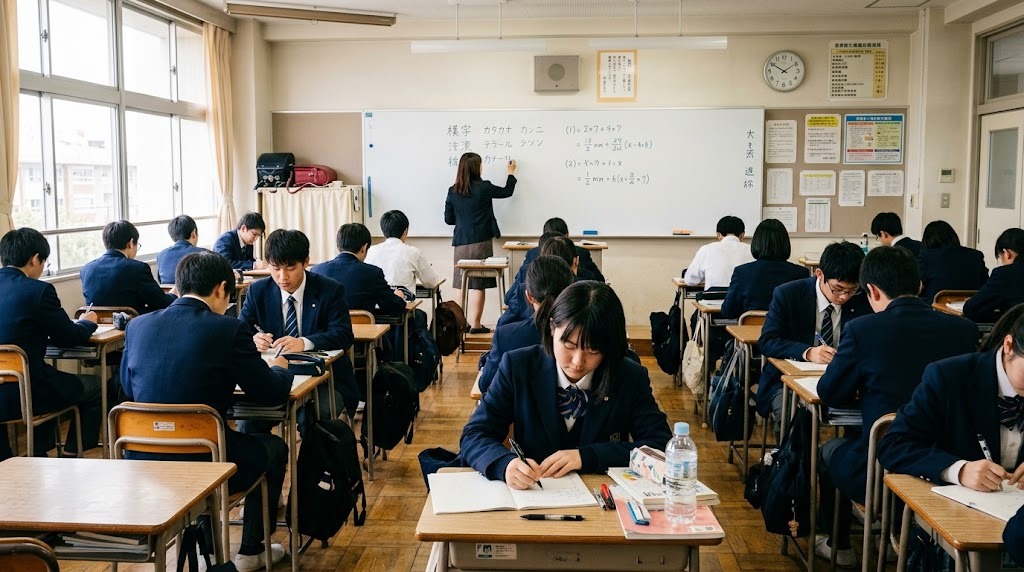
This is where Japanese high schools differ from other school levels. In the FY2025 interim figures, average monthly salary was JPY 362,800 at national schools, JPY 359,300 at public schools and JPY 359,300 at private schools. The FY2022 final figures show the same pattern: JPY 353,200 public, JPY 355,300 private. At elementary and junior high level, private averages sit clearly above public ones; at high school level that gap disappears.
But an identical average does not mean an identical reality. Among private high schools, 20.0 percent of teachers are in the JPY 450,000-and-above band while 13.4 percent are below JPY 250,000. The distribution is polarised, so the same average can mean very different things depending on which school you join — and neither “private pays more” nor “private pays less” is a defensible statement from the averages alone.
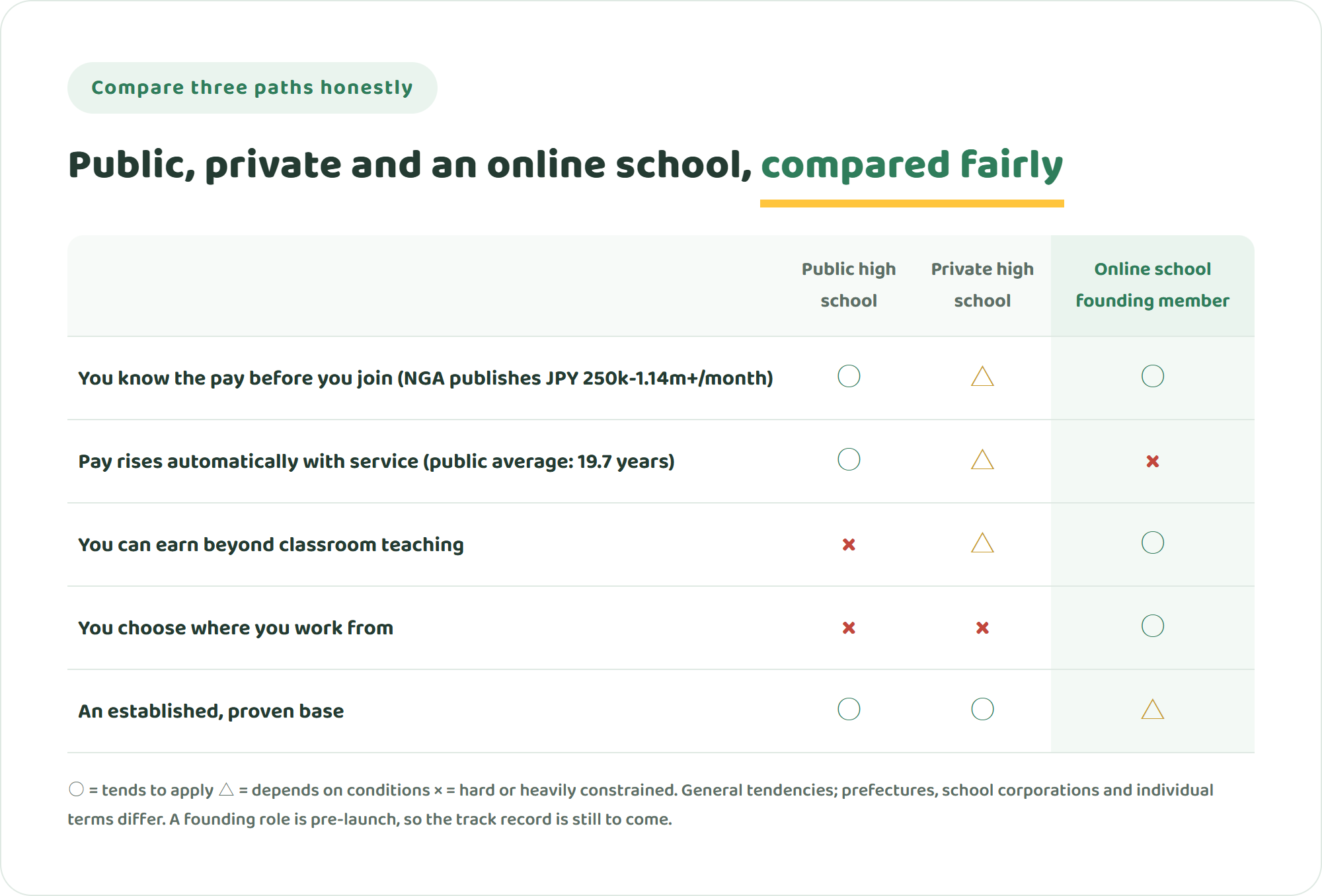
Length of service differs too. Average years of service in FY2022 were 19.7 years in public and 15.4 years in private high schools, meaning private teachers reach a comparable base salary with more than four fewer years of service. That comparison covers base pay only, not bonuses, severance or pension arrangements. The average age of public high school teachers is 46.0.
Can a high school teacher in Japan reach JPY 10 million? What the data can and cannot say
Straight answer: the published statistics go as far as average monthly salary by position, and no further. We could not find any official data showing whether or when a teacher reaches an annual income of JPY 10 million.
What we can show is the largest published figure. Average monthly salary by position in high schools (School Teachers Survey, FY2022 final, all school types) is principal JPY 487,200, vice-principal JPY 445,700, deputy principal JPY 442,100, senior teacher JPY 411,100, teacher JPY 351,500 and instructor JPY 249,800 — all base pay only, excluding allowances and bonuses. High school principals sit above their elementary and junior high counterparts, reflecting a different grade structure in the pay scale.
Turning any of those into annual income would require adding regional allowances, management allowances and each employer’s bonus calculation base, and no national statistic combines them. So this article will not tell you that a principal earns JPY 10 million, or that any particular age does. It will tell you where to check: the education service pay scale, salary ordinance and annual recommendation published by the personnel commission of each prefecture or designated city. Those documents contain the top step of each grade and the allowance rates, which is exactly what a ceiling is made of.
Private high schools are less predictable still. Pay follows each school corporation’s own rules and varies by contract type. The private school mutual aid association reports a standard monthly remuneration of JPY 406,336 for high schools (end of September 2025), but that is a social insurance grade band with a floor and a ceiling, not actual pay, and it includes administrative staff. If you are applying to private schools, reading each posting’s base pay, allowances, contract type and increment rules will tell you far more than any average.
Some employers remove that uncertainty by publishing the numbers before you apply — we cannot claim to be one of them, so here is what we do instead: we tell you how the role actually starts. See the founding member roles at NIJIN GLOBAL ACADEMY → — founding roles begin as volunteer positions ahead of the September 2027 opening, and the detailed terms are shared later in the process, which is worth knowing before you apply. If you have read this far because you want to grow your career and move your own income ceiling, it gives you something concrete to compare against.
A third way of working: terms stated plainly, and a second income pillar
A Japanese high school teacher’s income grows in two ways — accumulating steps, or moving up a grade. A scale that rises reliably every year is a real strength, and nothing here is an argument against it. It does, however, come with a single pillar holding up the whole structure.
オンラインインターナショナルスクールのNIJIN GLOBAL ACADEMY (NGA), an online international school opening in September 2027, is designed around a different answer. First, the terms are said plainly before you apply: internationally, founding roles begin as volunteer positions ahead of the opening. Second, income is diversified: alongside teaching you can take on marketing, web, partnerships or HR across five working patterns. Third, the role is fully remote, built for people who want to work while travelling. What we look for is around CEFR B2+ English and the appetite to build something from zero, including from outside the classroom. It is not a universal answer: there is no automatic annual increment, and as a pre-launch school our track record is still ahead of us.
Three steps to find the real number for a specific role
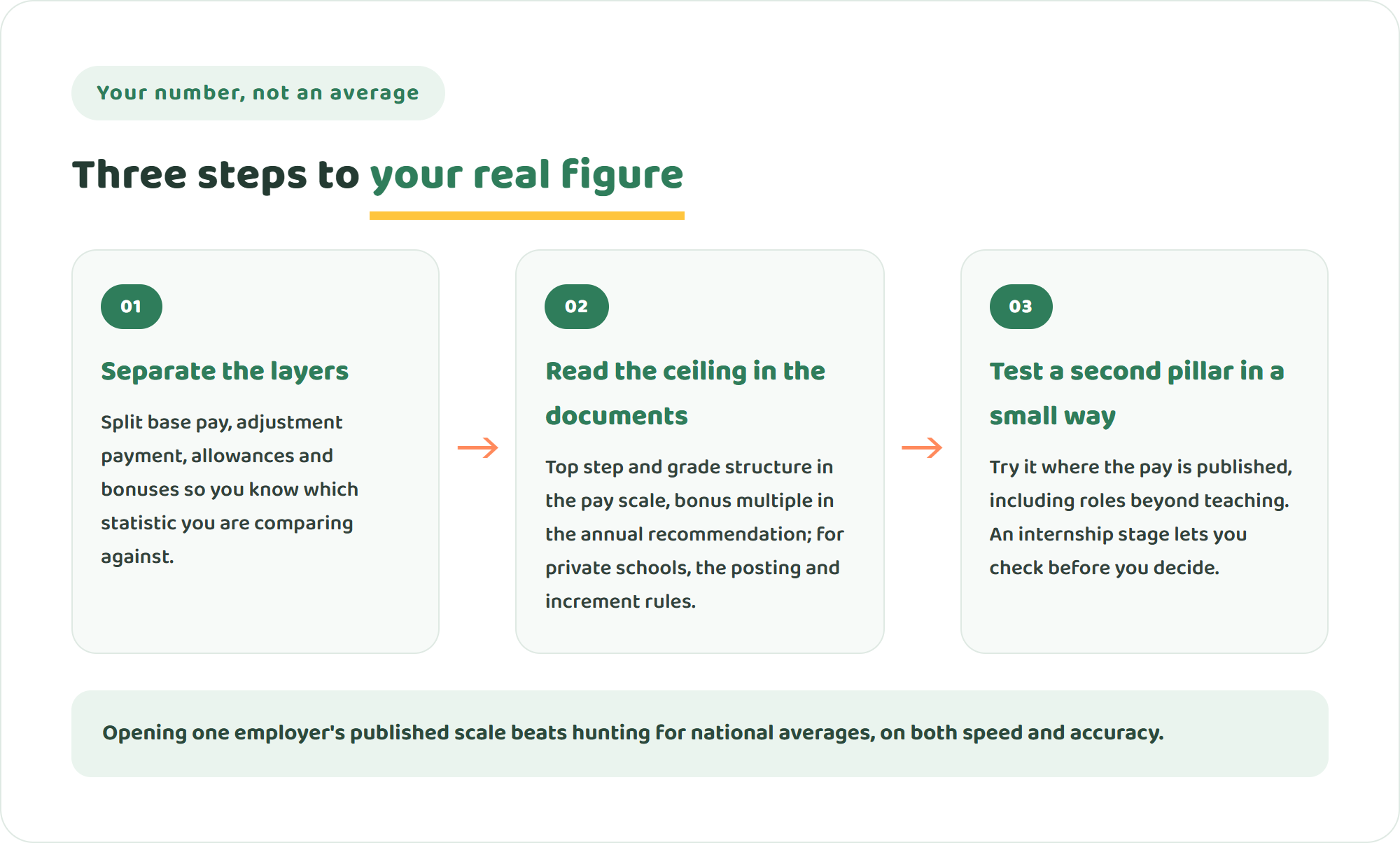
First, separate the layers: base pay, teaching adjustment payment, allowances and bonuses, so you know which statistic you are comparing against. Second, read the published documents for the ceiling: the top step and grade structure in the pay scale, and the bonus multiple in the annual recommendation, turn a vague ten-year outlook into a number. For private and international schools, the posting and its increment rules play the same role. Third, test a second pillar in a small way. NGA’s process runs from application to a group interview, an internship at NIJIN Academy and a final presentation, so you can try before you decide.
For teacher pay across all school levels, see how much teachers earn and how the pay is set. For the international sector specifically, see international school teacher salaries.
Frequently asked questions
What is the starting salary for a high school teacher in Japan?
There is no single national figure, because each prefecture sets pay by ordinance. As one published example, the Tokyo Metropolitan Board of Education lists a starting salary of about JPY 326,100 for university graduates entering elementary, junior high or high schools (as of 1 April 2025, when the adjustment payment was 4 percent), with commuting allowances and bonuses paid separately.
Do high school teachers earn more in private schools?
Not according to the averages: FY2022 figures were JPY 353,200 public and JPY 355,300 private. Because private pay is polarised — 20.0 percent above JPY 450,000, 13.4 percent below JPY 250,000 — the only reliable method is to read each school corporation’s terms in its posting.
Can a foreign teacher be paid on the same scale?
Public school employment conditions are set by each prefecture’s ordinances and normally require Japanese teaching certification, so eligibility and terms depend on the employer rather than on any national rule. Private and international schools set their own terms, which is why the posting is always the primary source. Fully remote online schools, including NGA, are not bound to a single location at all.
Pay is something you can design, not only look up
If you came here asking what a high school teacher in Japan earns, you now have the published figures, the estimate with its arithmetic, and a clear line marking where the official data stops. That line matters as much as the numbers: anyone who tells you exactly what a teacher earns at 40 is going beyond what Japan actually publishes. Within the structure, though, there is more room than it first appears — including the option of keeping the teaching and redesigning only the income around it.
Working at an International School — More Articles
- international school teacher salary
- how to become an international school teacher
- career change from teaching
- career change from teaching in your 30s and 40s
- how much do teachers earn?
- how to become an IB teacher
- jobs for moving abroad
- online international school teacher salary
- remote teaching jobs from the Philippines
- online teaching jobs in Malaysia
- international school staff jobs
- high-paying jobs that use English
- elementary school teacher salary in Japan
- junior high school teacher salary in Japan
- school principal salary in Japan
- how the Japanese teacher pay scale works
- teacher bonuses in Japan
- private school teacher salary in Japan
Keep the teaching you love. Redesign how the income around it is built.