If you are researching a junior high school teacher salary in Japan — because you are considering teaching here, comparing an offer, or simply curious how the system works — the honest starting point is this: the number most often quoted is not a salary at all. Japan’s Ministry of Education (MEXT) School Teachers Survey (FY2025, interim report) puts the average monthly base salary of full-time junior high school teachers at 344,500 yen (as of 1 October 2025). That figure is base pay only. It excludes every allowance, both bonus payments, and the teacher adjustment allowance described below.
Japan publishes no official statistic for teachers’ annual income. From the published monthly figures, a reasonable estimate is about 6.79 million yen a year — and this article shows the full calculation rather than asking you to trust it. It also answers the question that makes junior high school different from elementary school in Japan: club activities (bukatsu). Junior high homeroom teachers record 2 hours 18 minutes at school on weekend days, against 36 minutes for elementary teachers. How that time is — and is not — converted into pay is a matter of statute, and it is worth understanding before you form a view.
| Item | Figure | Source and date |
|---|---|---|
| Average monthly base salary and estimated annual income | 344,500 yen (base pay only) / est. approx. 6,790,000 yen a year | MEXT School Teachers Survey FY2025 (interim) / annual figure estimated from MIC and NPA data |
| Public vs private | Public 341,600 yen / Private 381,400 yen (28.5% of private teachers are at 450,000 yen or above) | Same survey, base pay only |
| By position | Teacher 324,700 yen / Vice-principal 428,100 yen / Principal 445,900 yen | Same survey, FY2022 confirmed figures |
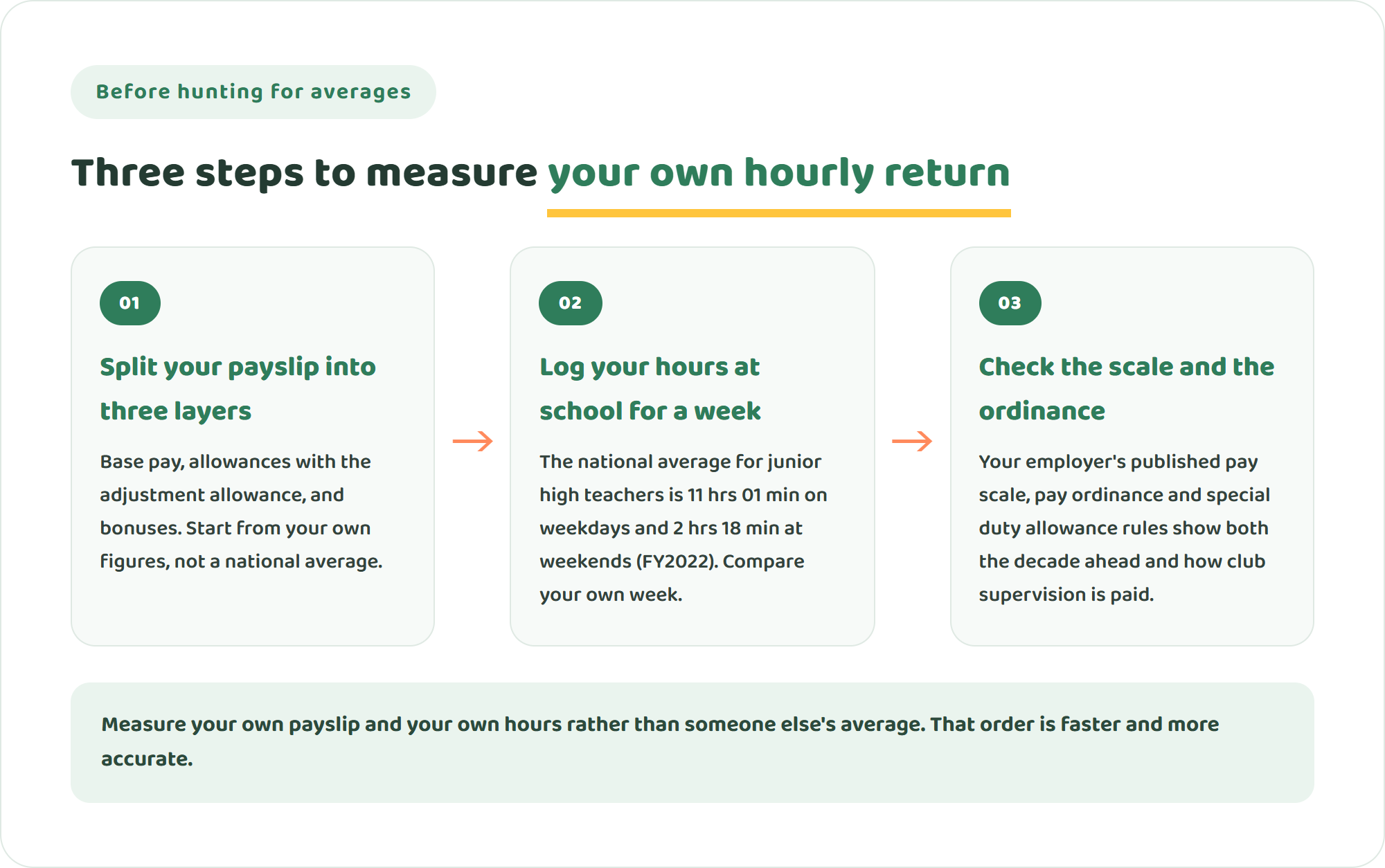
| Hours at school per day (teachers) | 11 hrs 01 min on weekdays / 2 hrs 18 min on weekend days | MEXT Teacher Working Conditions Survey, FY2022 |
| Teacher adjustment allowance | 5% of monthly base salary (from January 2026), rising in stages to the statutory 10% | Kyutokuho, Article 3 and Supplementary Provision 2 |
Each of these numbers is unpacked below.
What the 344,500 yen figure actually is
Across school types, the averages are 336,600 yen for elementary, 344,500 yen for junior high and 359,300 yen for high school. Junior high sits between the two — but FY2025 is an interim report, so the confirmed figures may shift.
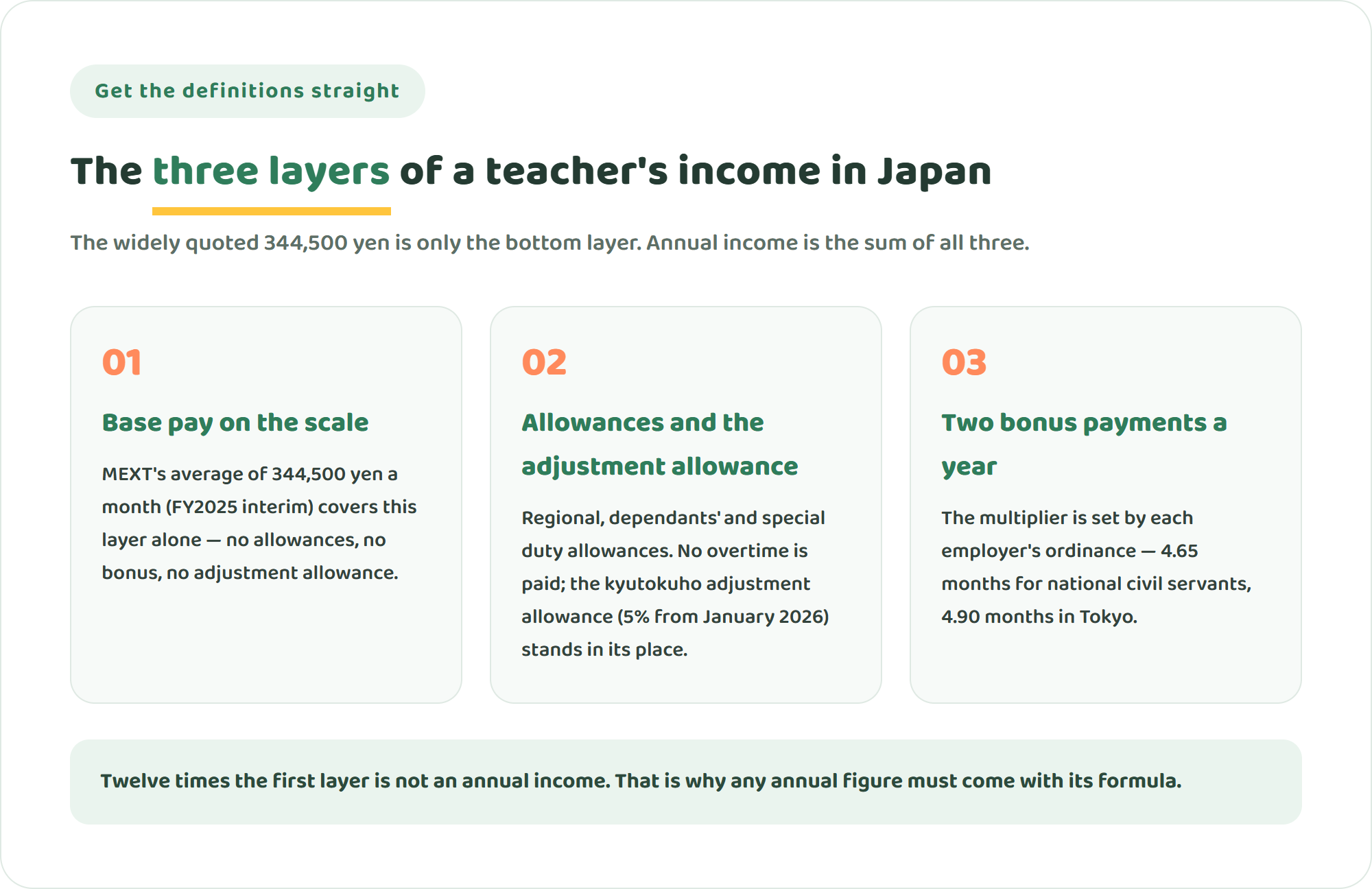
The Japanese term is kyuryo getsugaku, and it means the figure on the pay scale before anything is added: no regional allowance, no dependants’ allowance, no housing allowance, no June and December bonus, no adjustment allowance. Multiplying 344,500 yen by twelve does not give you an annual income. Private schools (381,400 yen) look higher than public ones (341,600 yen), but the average alone settles nothing: 28.5% of private junior high teachers sit at 450,000 yen or above, so the private distribution is not so much higher as considerably wider.
Starting salary, and how pay moves with position
Public school teachers in Japan are employed by the 47 prefectures and 20 designated cities, each with its own pay ordinance and personnel commission recommendation, so levels differ by employer. As one published example, the Tokyo Metropolitan Board of Education lists a starting salary of about 326,100 yen a month for a university graduate entering an elementary, junior high or high school (as of 1 April 2025, when the adjustment allowance was 4%), with commuting and bonus payments made separately.
By position, the most recent confirmed data (FY2022) gives, for junior high schools: teacher 324,700 yen, senior teacher 402,600 yen, vice-principal 428,100 yen, principal 445,900 yen — again base pay only. Note that the headline 344,500 yen includes principals and vice-principals; a classroom teacher on their own averages 324,700 yen. The average age of a public junior high teacher is 42.5. For the wider picture across school types, see how much teachers in Japan earn.
Why club activities do not generate overtime pay
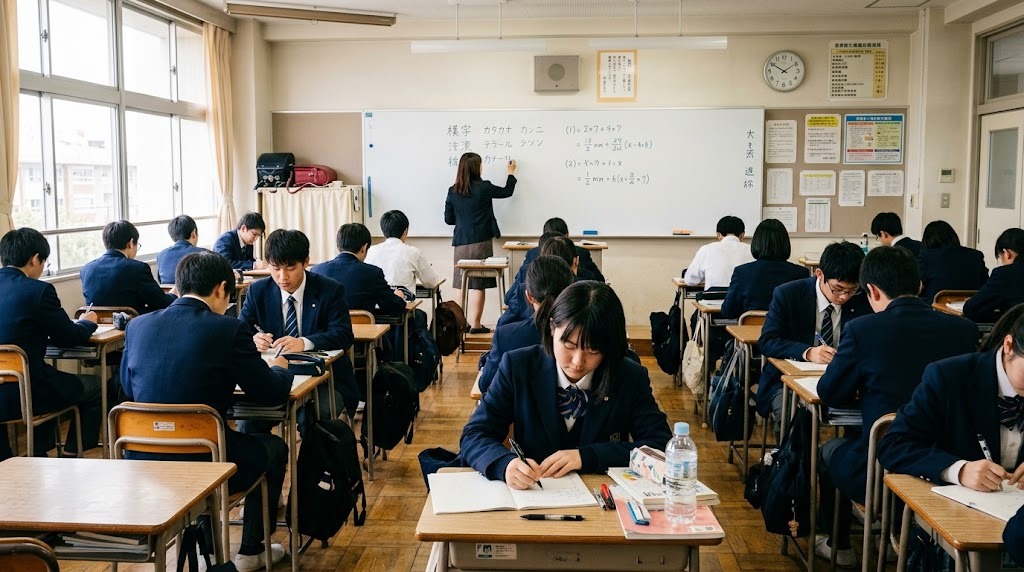
This is the part that surprises most people arriving from other systems. Under Japan’s MEXT Teacher Working Conditions Survey (FY2022), junior high teachers record 11 hours 01 minute at school on a weekday and 2 hours 18 minutes on a weekend day; elementary teachers record 10 hours 45 minutes and 36 minutes. The weekend gap is largely club activities. Both figures fell from the previous survey in 2016 (11 hrs 32 min and 3 hrs 22 min). One caution: hours at school is not the legal definition of working hours.
The pay mechanism is statutory. Teachers at public schools in Japan are not paid overtime. Instead, a law known as the kyutokuho provides a teacher adjustment allowance: a fixed percentage of monthly base salary, paid regardless of how many hours are worked. The statutory rate is 10%, and a transitional provision sets 5% from 1 January 2026, rising by one point a year until the full 10% applies from 1 January 2031. Note that the steps run by calendar year, not by Japan’s April fiscal year. On the public junior high average of 341,600 yen, 5% is roughly 17,080 yen a month; actual payment follows each employer’s ordinance. Principals and vice-principals are excluded from it entirely.
Club supervision itself falls under a separate special duty allowance. The Ministry of Internal Affairs (MIC) 2025 survey of local government pay reports 2,552 yen per employee for elementary and junior high teaching staff in April 2025 — a one-month, per-head average across everyone in the category, not the amount a coach receives. Rates are set locally.
So what is the annual income? The 6.79 million yen estimate, in full
No public statistic reports teachers’ annual income directly, so any figure you see is an estimate. Treat with suspicion any that does not show its working. Here is ours. The MIC 2025 survey reports, for elementary and junior high teaching staff: average age 41.3, average monthly base salary 364,069 yen (this definition does include the adjustment allowance), monthly allowances 60,342 yen, and total monthly pay of 424,411 yen, which excludes bonuses.
The arithmetic: 424,411 × 12 = 5,092,932 yen. Bonuses at 364,069 × 4.65 months = 1,692,921 yen. Total 6,785,853 yen, or about 6.79 million yen. The 4.65 months is the national civil service figure (2025 National Personnel Authority recommendation); public school teachers are local government employees, so their multiplier is set locally — Tokyo’s is 4.90 months. The limits, stated plainly: the bonus base should also include regional and dependants’ allowances, so this estimate runs low; it is a national average at age 41.3; retirement benefits are excluded; and the category also covers kindergarten teachers. And no, we are not going to divide that figure by the hours-at-school data to produce an hourly rate. Hours at school is not a legal working-hours measure, and the resulting number would travel further than it deserves. The materials are all here; the reading is yours.
See NIJIN GLOBAL ACADEMY’s founding member roles → — we will say it plainly: founding roles on this track begin as volunteer positions ahead of our September 2027 opening, and the detailed terms are shared later in the process. No guessing required — better to know that before you decide anything.
A third way of working: designing time and income together
The structure above, in one sentence: in Japanese public schools, hours worked and the amount paid are deliberately not linked. A scale that rises reliably each year is a real strength, and nothing here is a criticism of the profession.
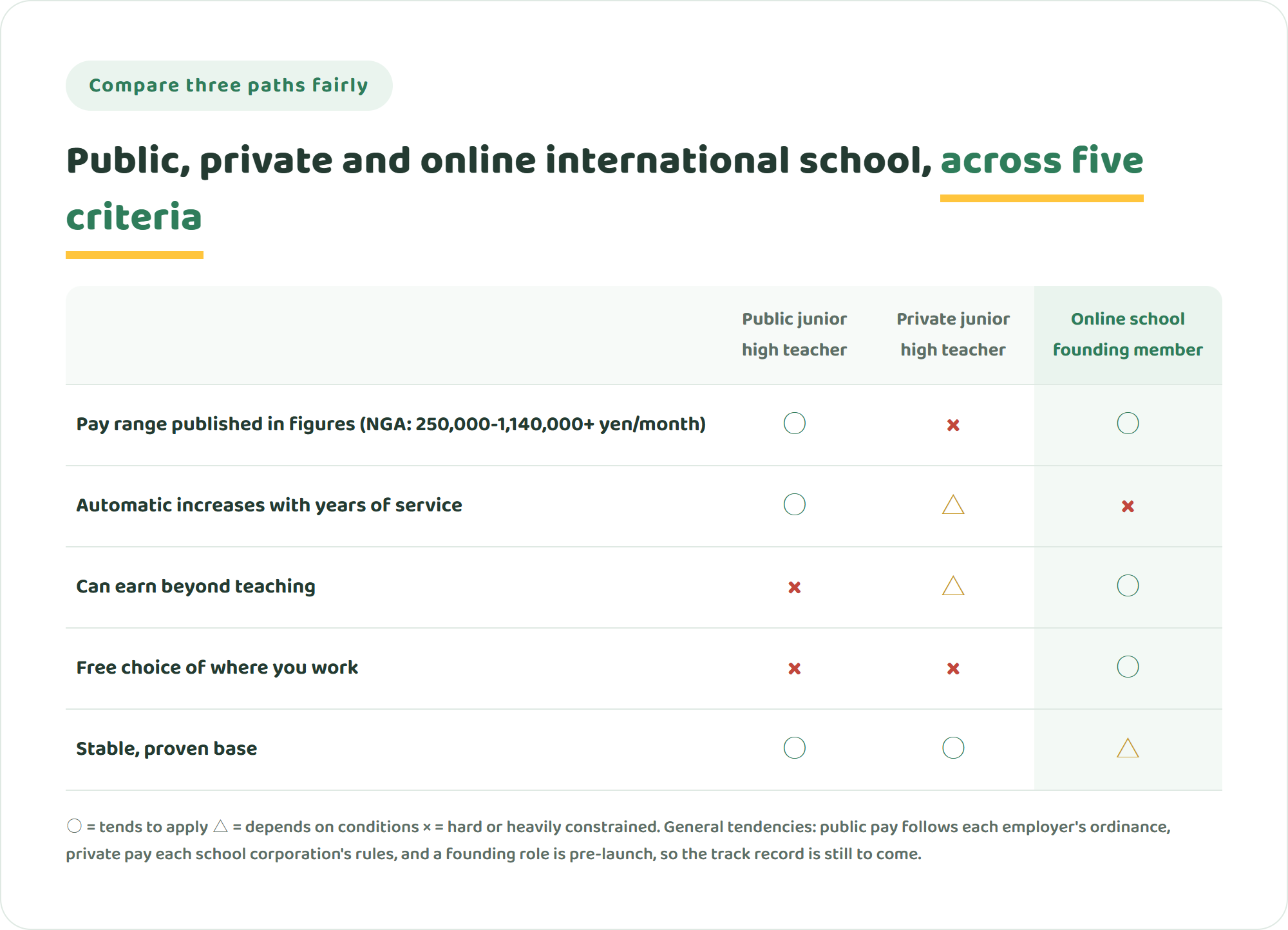
NIJIN GLOBAL ACADEMY (NGA), an online international school opening in September 2027, is designing that relationship differently for its founding team. The terms are said plainly: internationally, founding roles begin as volunteer positions ahead of the opening. There are five working patterns from part-time to full-time, and you can add a second income stream beyond teaching — marketing, web, partnerships, HR. And the role is fully remote, built around working from anywhere in the world. Keep the teaching; take back the design of your time and place — from early-morning club practice to mornings that belong to you. We look for English at around CEFR B2+ and people who enjoy building from zero. For salaries across the sector, see international school teacher salaries. It is not for everyone: there is no automatic seniority increase, and the school has yet to open.
Frequently asked questions
How does a Japanese teacher’s salary compare internationally?
Carefully, is the honest answer. Japanese figures are published as monthly base pay, while many countries publish gross annual salaries; bonuses, allowances, pension arrangements and the cost of living all differ. Compare our estimated annual figure with another country’s annual figure — never the 344,500 yen monthly base pay with an annual number elsewhere.
Is club activity supervision paid?
Not as overtime. Public school teachers receive no overtime pay; the kyutokuho’s teacher adjustment allowance (5% of base salary from January 2026, reaching the statutory 10% from January 2031) replaces it. Club supervision may attract a special duty allowance, set by each local employer.
Do private junior high schools pay more?
Private average base pay is 381,400 yen against 341,600 yen in public schools, but each school corporation sets its own rules and the spread is wide. Check base pay, allowances, contract type and renewal terms in each individual posting.
Know the numbers first, then choose how you work
If you have read this far, you are trying to see the profession clearly rather than through either romance or complaint. Base pay of 344,500 yen, an estimated 6.79 million yen a year, 11 hours 01 minute on weekdays and 2 hours 18 minutes at weekends, an adjustment allowance of 5% — none of these are numbers meant to push you anywhere. They are a measuring stick for your own situation. Whether you stay, come to Japan, or redesign the relationship between your time and your income, the teaching itself does not have to be given up.
Working at an International School — More Articles
- international school teacher salary
- how to become an international school teacher
- career change from teaching
- career change from teaching in your 30s and 40s
- how much do teachers earn?
- how to become an IB teacher
- jobs for moving abroad
- online international school teacher salary
- remote teaching jobs from the Philippines
- online teaching jobs in Malaysia
- international school staff jobs
- high-paying jobs that use English
- elementary school teacher salary in Japan
- high school teacher salary in Japan
- school principal salary in Japan
- how the Japanese teacher pay scale works
- teacher bonuses in Japan
- private school teacher salary in Japan
Keep the teaching. Take back the design of your time and income.