If you are looking for a school principal salary in Japan, here is the figure first. According to Japan’s Ministry of Education (MEXT) School Teachers Survey, FY2022 (final figures), the average monthly base salary of an elementary school principal was JPY 447,500. The head teacher (kyōtō, the deputy who runs day-to-day operations) averaged JPY 426,300, and a classroom teacher JPY 308,200 — a gap of roughly JPY 139,000 a month between principal and teacher.
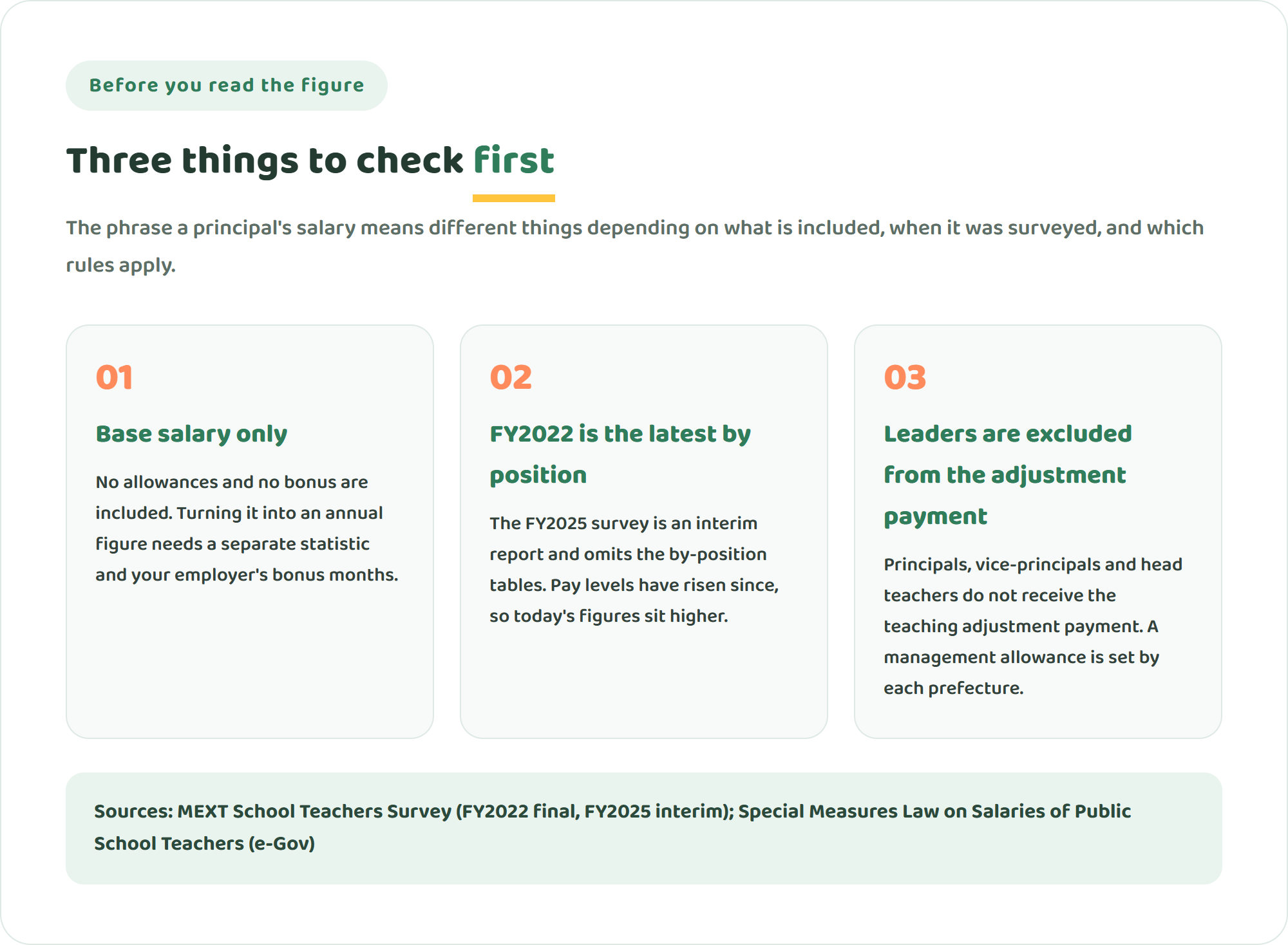
One caution before you read further: this is base salary only. It excludes every allowance, the twice-yearly bonus, and the teaching adjustment payment. Converting it into an annual figure takes an extra step, which we do below with the formula shown.
| School type | Principal (monthly base salary) | Head teacher / kyōtō |
|---|---|---|
| Elementary school | JPY 447,500 (FY2022) | JPY 426,300 (FY2022) |
| Lower secondary school | JPY 445,900 (FY2022) | JPY 428,100 (FY2022) |
| Upper secondary school | JPY 487,200 (FY2022) | JPY 445,700 (FY2022) |
Source: MEXT School Teachers Survey, FY2022 final figures, Tables 25, 36 and 57. National, public and private schools combined, as of 1 October 2022. Base salary only; allowances and adjustment payments excluded.
Below we break down how that figure is built, why the latest data by position is from 2022, and what it looks like as an annual income.
Principal, vice-principal and head teacher, by school type
MEXT publishes average base salary by position for each school type. Adding classroom teachers to the same table shows where school leadership actually sits.
| School type | Principal | Vice-principal | Head teacher | Senior teacher | Teacher |
|---|---|---|---|---|---|
| Elementary | 447,500 | 440,200 | 426,300 | 402,000 | 308,200 |
| Lower secondary | 445,900 | 435,800 | 428,100 | 402,600 | 324,700 |
| Upper secondary | 487,200 | 442,100 | 445,700 | 411,100 | 351,500 |
| Special needs school | 470,400 | 451,900 | 446,600 | 414,200 | 329,800 |
Same source (special needs schools: Table 77). Monthly base salary in JPY, allowances and adjustment payments excluded.
Two things to hold onto. First, FY2022 is the most recent year published by position: the FY2025 round of the survey has so far been released only as an interim report, which does not include the by-position salary tables. Second, pay levels have risen since — the Tokyo Metropolitan Personnel Commission recommended an average salary-schedule revision of 3.4% in October 2025, for example. So read the table for the relationship between positions, and assume today’s actual figures sit above it.
The gap between principal and classroom teacher, in base salary alone, runs from JPY 121,200 (lower secondary) to JPY 139,300 (elementary) a month. Over twelve months that is roughly JPY 1.45–1.67 million — before any effect on bonuses, which we deliberately leave uncalculated because the bonus base includes regional and position allowances we cannot verify nationally.
If you want teacher pay by school type and age rather than by position, see how much teachers earn in Japan. For the international sector, see international school teacher salaries.

Why upper secondary principals earn the most — and why the deputy ranks are not fixed
At JPY 487,200, the upper secondary principal is the highest-paid position in the table, around JPY 40,000 above elementary and lower secondary principals. This is not a judgement about school types: different salary schedules with different grade structures apply, and both the schedules and the grades are set by each prefecture’s own ordinance.
The two deputy roles are not ranked consistently either. In elementary schools the vice-principal (JPY 440,200) sits above the head teacher (JPY 426,300); in upper secondary schools the head teacher (JPY 445,700) sits above the vice-principal (JPY 442,100). Whether a school has a vice-principal at all, and which grade each role is assigned, varies by employer — so it cannot be generalised.
School leaders are excluded from the teaching adjustment payment
This detail is easy to miss and it matters. Public school teachers in Japan receive no overtime pay. Instead, a teaching adjustment payment is added to their monthly base salary under the Special Measures Law on Salaries of Public School Teachers (Article 3). The rate is being raised in stages: 5% from January 2026, rising by one point each year to the statutory 10% in January 2031 — with the switch on 1 January, not the start of the fiscal year.
But principals, vice-principals and head teachers are excluded from it. The climb toward 10% does not apply to their base pay. A separate management allowance exists for these positions, but the amount is set by each prefecture’s ordinance and we could not verify a national published figure, so we do not state one here.
Hours are part of the picture too. In MEXT’s Teacher Working Conditions Survey (FY2022, final figures), average time at school on a weekday was 10 hours 23 minutes for elementary principals, 11 hours 45 minutes for vice-principals and head teachers, and 10 hours 45 minutes for classroom teachers; in lower secondary schools the deputy figure was 11 hours 42 minutes. Time at school is not the same as legally defined working hours, but it belongs in the same decision as the money.
What does that look like as an annual income?
There is no official statistic for Japanese teachers’ annual income — the government publishes monthly figures only. Using the Ministry of Internal Affairs and Communications’ Survey of Local Government Employee Salaries (as of 1 April 2025) and the National Personnel Authority’s 2025 recommendation of 4.65 months of bonus, the estimate works out as follows.
・Elementary and lower secondary teaching staff: average monthly pay JPY 424,411 × 12 = JPY 5,092,932; bonus JPY 364,069 × 4.65 = JPY 1,692,921. Total approx. JPY 6.79 million.
・Upper secondary teaching staff: JPY 442,668 × 12 = JPY 5,312,016; bonus JPY 378,305 × 4.65 = JPY 1,759,118. Total approx. JPY 7.07 million.
Treat these as estimates, not guarantees. The bonus base actually includes regional and position-linked allowances, so the calculation understates rather than overstates. These are national averages for all teaching staff at average ages of 41.3 and 44.5 — not principals. Given the by-position gaps above, a principal or head teacher sits above these figures, but the exact number depends on the prefecture’s ordinance and the individual’s step. Note also that 4.65 months is the national civil service figure; public school teachers are local government employees, and Tokyo, for instance, moved from 4.85 to 4.90 months in its 2025 recommendation.
The catch: the seats are few, and the timing is not yours
Promotion into school leadership is a real way to raise income in Japan — the statistics show it plainly. What the statistics also show is scale: the same national survey counts 605,911 elementary and lower secondary teaching staff employed by local governments. Each school has one principal and, typically, one head teacher. You do not need to count the posts to see that the seats are structurally limited. And appointment does not follow your own timetable: it depends on selection processes and staffing cycles beyond your control. The money goes up, but you do not choose when.
Which is why there is a second direction: not climbing a grade, but adding a role. Combine teaching with building (curriculum and materials), communicating (marketing), or connecting (partnerships and operations), and income rests on two pillars instead of one. See the NIJIN GLOBAL ACADEMY founding member roles → — founding roles begin as volunteer positions ahead of the September 2027 opening, and the detailed terms are shared later in the process — worth knowing before you apply. Wanting to grow your career is not in conflict with loving the classroom.
A third way of working: add roles instead of waiting for a grade
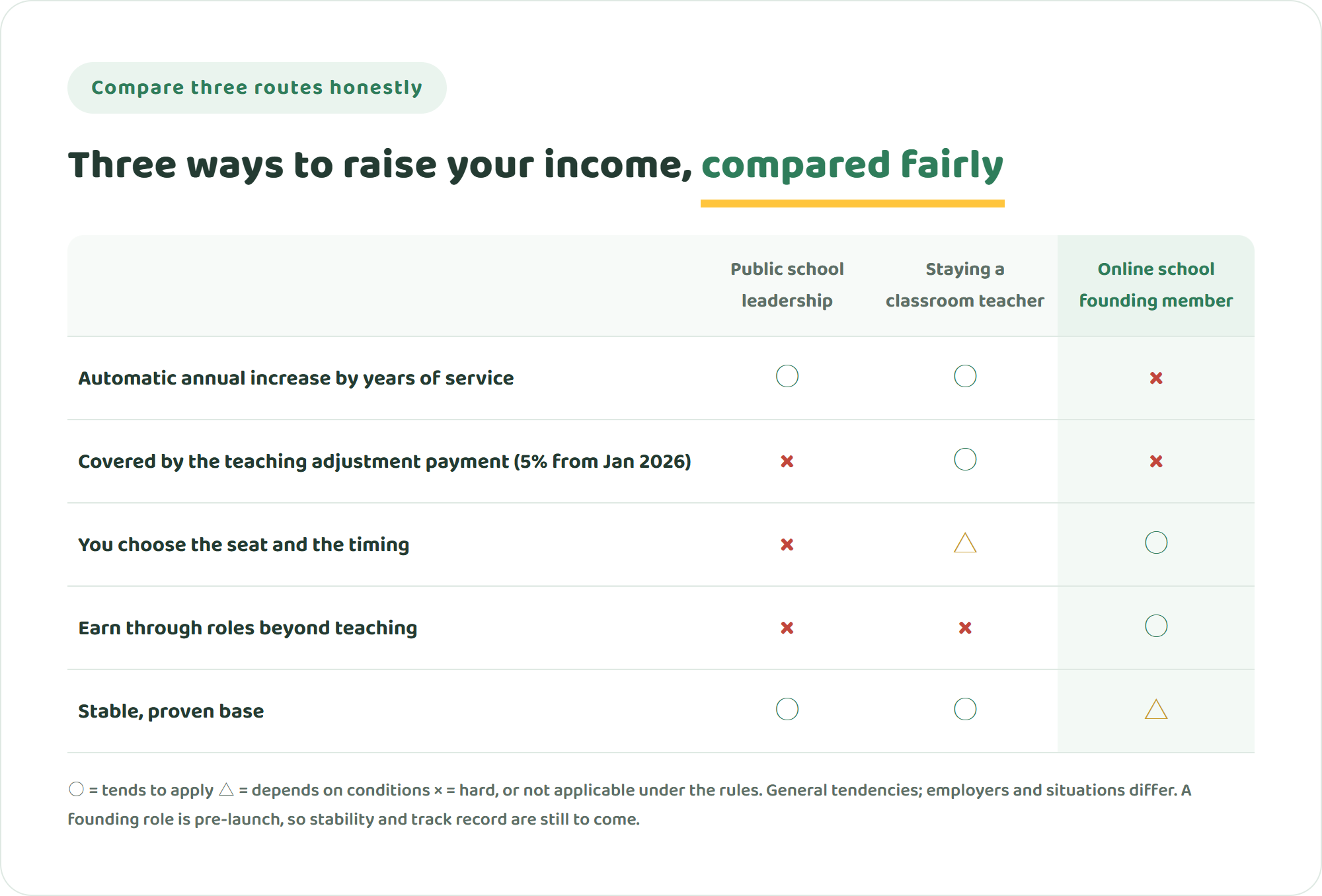
The founding members NIJIN GLOBAL ACADEMY (NGA) is recruiting ahead of its September 2027 opening face the pay question directly, even when the answer is uncomfortable: internationally, founding roles begin as volunteer positions ahead of the opening, and the detailed terms are shared later in the process. Alongside teaching you can take on marketing, web, partnerships or HR across five working patterns — income designed by adding roles rather than waiting for a grade.
The role is fully remote, built around working while travelling. What we look for is English at roughly CEFR B2+ and the appetite to build from zero, experience or not. It is not a universal answer: there is no automatic annual increase, and the school has not opened yet, so stability and track record are still to come. What it does offer is the ability to move without waiting for a seat to open.
Three steps to work out your own number
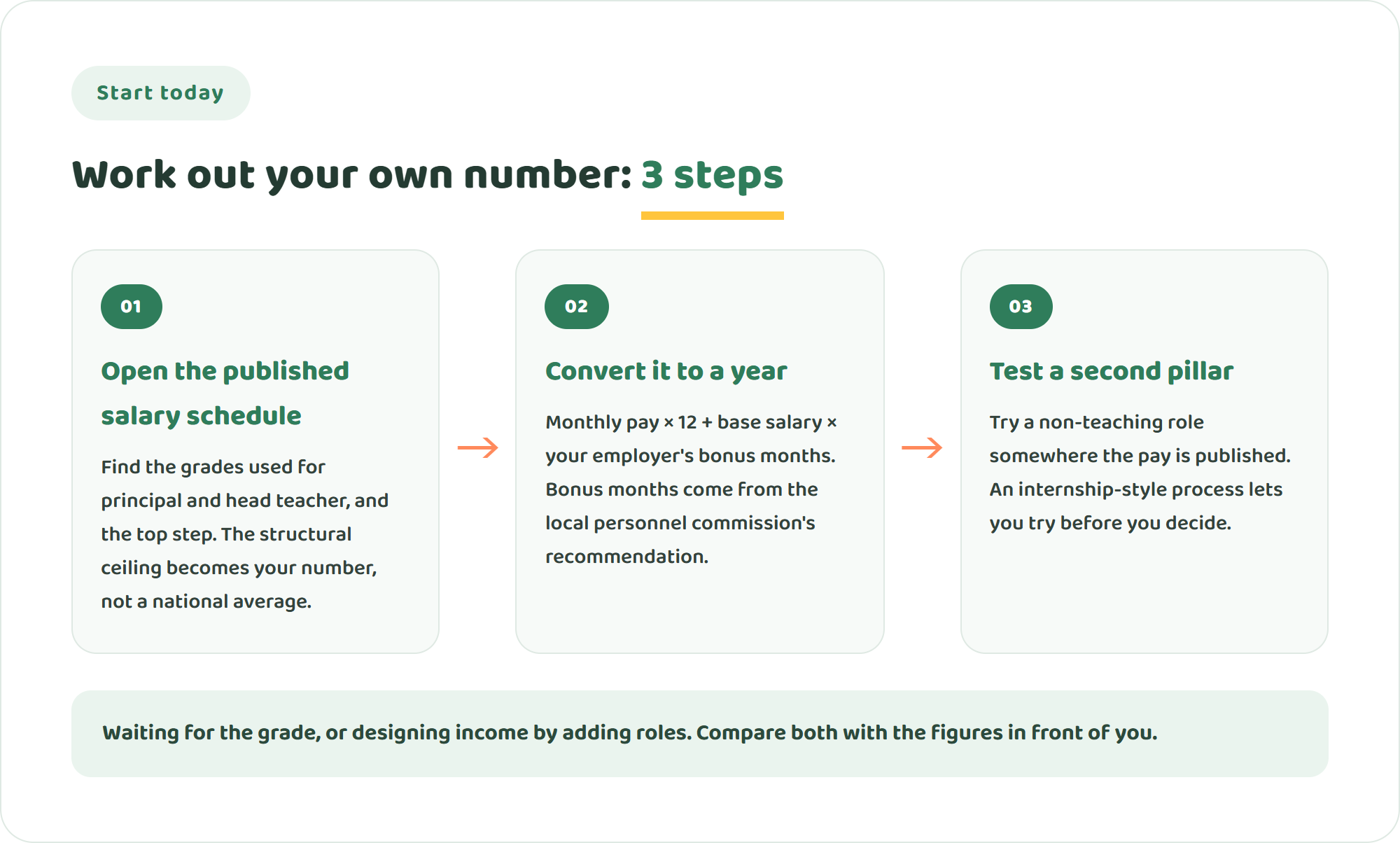
First, open your employer’s published salary schedule and find the grades used for principal and head teacher, plus the top step. That is the structural ceiling. Second, convert it to a year: monthly pay × 12 + base salary × your employer’s bonus months. Third, test a second pillar somewhere the terms are stated plainly. NGA’s process runs from application to a group interview, an internship and a final presentation, so you can try before you commit.
FAQ
How much more does a head teacher earn than a classroom teacher?
In FY2022 base salary, the gap was JPY 118,100 a month in elementary schools and JPY 103,400 in lower secondary schools — around JPY 1.2–1.4 million a year in base pay alone. The total difference also involves bonuses and the management allowance, which are set by each prefecture.
Do private school principals earn more?
The by-position statistics combine national, public and private schools, and we could not find a published figure for private school principals alone. Across all positions, average base salary in FY2025 (interim) was JPY 365,300 at private elementary schools and JPY 381,400 at private lower secondary schools — but the spread is wide (28.5% of private lower secondary teachers are at JPY 450,000 or above), so averages alone prove little.
Can a principal in Japan earn JPY 10 million a year?
We will not assert a figure. Structurally, the estimate above (JPY 6.79–7.07 million on average) is joined by the by-position gap, the management allowance and differences between prefectures. Put your employer’s top step, grade structure and allowance rules side by side and you can calculate it for your own case.
How long does it take to become a principal?
It depends on each employer’s leadership selection requirements, so no fixed number applies. For context, average years of service for full-time teachers were 16.2 years in elementary, 16.8 in lower secondary and 18.4 in upper secondary schools (FY2022).
Decide with the figures in front of you
If you searched for a school principal salary in Japan, you are trying to hold two things at once: responsibility for a school, and a clear view of your own life. School leadership pay does rise, measurably so. It is also a route where neither the number of seats nor the timing is yours to set. So compare both roads — waiting for the grade, and designing income by adding roles — with the actual figures in front of you. Keeping the joy of teaching while changing only the design of your income is a real option.
Working at an International School — More Articles
- international school teacher salary
- how to become an international school teacher
- career change from teaching
- career change from teaching in your 30s and 40s
- how much do teachers earn?
- how to become an IB teacher
- jobs for moving abroad
- online international school teacher salary
- remote teaching jobs from the Philippines
- online teaching jobs in Malaysia
- international school staff jobs
- high-paying jobs that use English
- elementary school teacher salary in Japan
- junior high school teacher salary in Japan
- high school teacher salary in Japan
- how the Japanese teacher pay scale works
- teacher bonuses in Japan
- private school teacher salary in Japan
Check the figures first, then choose how you want to work.