“How to become an international school teacher.” If you searched that, there was probably as much uncertainty in you as excitement. You want to talk with children about the world in English, to deliver learning that a test score can’t measure, inside a mix of cultures. And yet, the more you look, the fuzzier the requirements get: What qualifications do international schools actually require? Do I need a teaching license? How good does my English have to be? Can I really apply with no experience? If you reached this page late at night, still unsure what it actually takes, you are far from alone.
This article lays out the “how” honestly. First, we cover the usual routes in, then the part most people are really searching for: the international school teacher qualifications that come up again and again — a degree, a teaching license or QTS, PGCE, IB certificates, TEFL/TESOL — and which school groups actually weigh them. One important caveat runs through all of it: requirements vary a great deal by school, curriculum and country. Then we look at what you can start preparing today, which moves your case forward no matter which route you take, and whether or not you ever apply to us. Finally, as a “third entry point” that welcomes people who can build from zero more than any credential, we introduce — without a hard sell — the option of joining the founding team of the online international school we open in September 2027.

How to become an international school teacher — the routes, honestly
The first thing worth saying is that there is no single “do this and you’re guaranteed in” answer. “International school” spans everything from large, traditional institutions to tiny programs, from onsite campuses to fully online schools — and what each one asks for differs a great deal. With that in mind, the common ways in sort into roughly three routes, shown below.
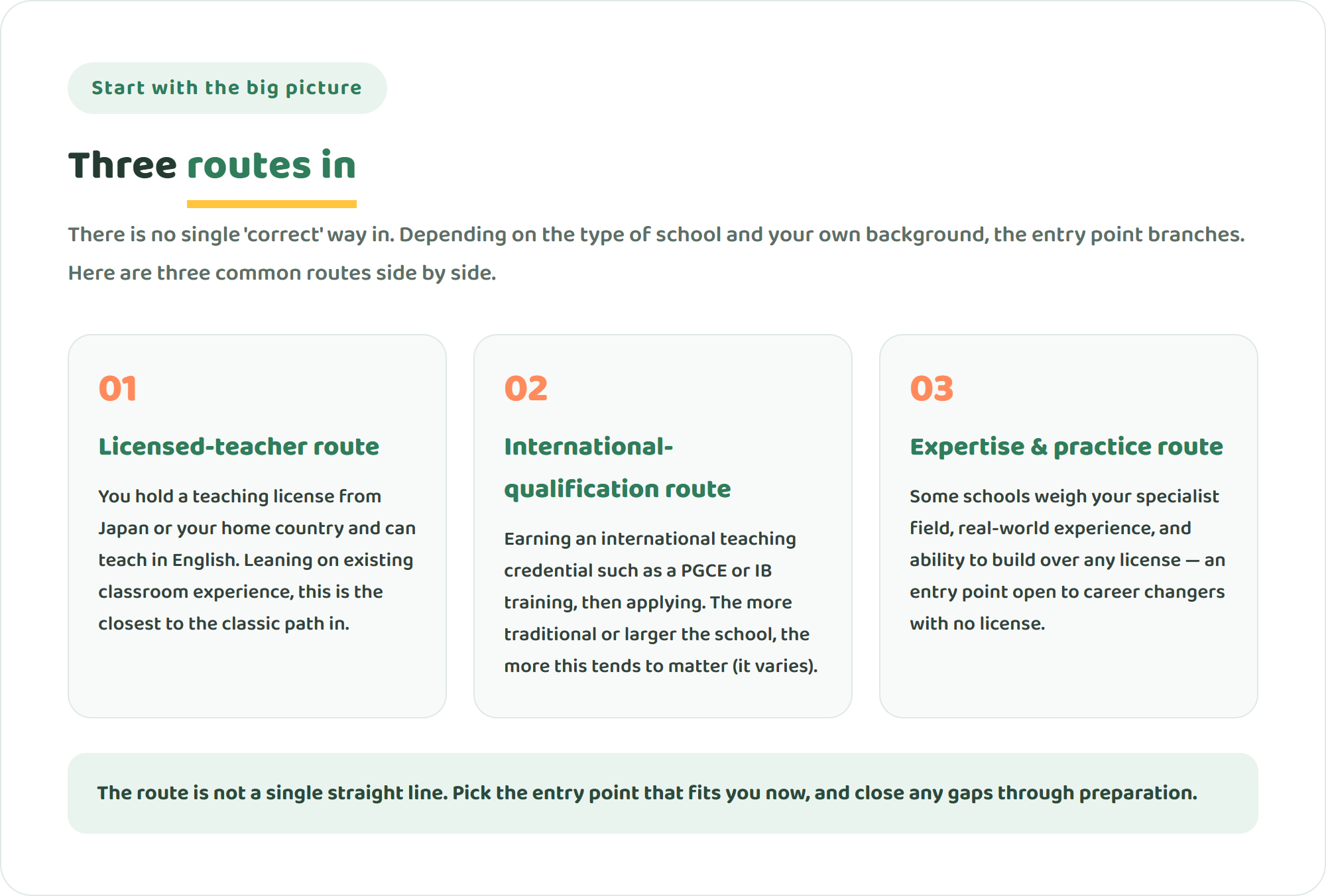
The first is the licensed-teacher route: you hold a teaching license from your home country and can teach in English, and you apply by leaning on your existing classroom experience — the closest thing to the classic path. The second is the international-qualification route: earning a credential such as a PGCE or IB-related training, then applying. The more traditional or larger the school, the more this tends to matter. The third is the expertise-and-practice route: some schools weigh the depth of your specialist field, your real-world experience, and your ability to help build the learning over any license — an entry point genuinely open to career changers with no license. Which route suits you depends on where you stand today.
What qualifications do international schools actually require?
This is the question underneath most searches, so let’s take it head on. Before the specifics, one honest caveat that applies to every line below: requirements vary by school, curriculum and country, and they change over time. Nothing here is an eligibility rule. Treat it as a map of the credentials that come up most often in international recruitment, then check the awarding body’s official information, and the individual school’s own vacancy page, for current requirements before you spend money or years on anything.
The baseline: a degree — often one that matches your subject
Across most established international schools, a bachelor’s degree is the floor. For secondary subject teaching, schools frequently want the degree to line up with the subject you’ll teach — a maths teacher with a maths degree, a science teacher with a science degree — and may ask for transcripts to show enough subject coursework. This is not only the school’s preference: in some countries the immigration or education ministry ties the work permit to a matching degree, so the school has little discretion. For primary and early years, a Bachelor of Education or an equivalent initial teacher-training qualification is more commonly expected than a subject degree. Guidance published by international teacher-recruitment agencies such as Search Associates also notes that some countries do not recognise degrees or teacher training completed fully online — worth confirming for the region you’re targeting.
A teaching license or qualified teacher status (state license, QTS, PGCE)
The second layer is initial teacher certification — the credential that says a recognised authority has licensed you to teach. What it’s called depends on where you trained:
- A state or national teaching license (for example a US state teaching license, or the equivalent issued in Canada, Australia, New Zealand or elsewhere). Proves you completed accredited teacher training and are licensed to teach in that jurisdiction. This is the credential most international schools mean when a vacancy says “certified teacher”.
- QTS — Qualified Teacher Status (England). The status that lets you teach in England’s state schools; widely recognised by British-curriculum schools overseas. The UK Department for Education also runs iQTS, an international route to a comparable status that can be taken from outside the UK — see the UK government’s Get Into Teaching pages for what it currently involves and who is eligible.
- PGCE — Postgraduate Certificate in Education, and its international variant the iPGCE. An academic teaching qualification usually taken after a first degree. Note that a PGCE and QTS are not automatically the same thing — some PGCE programmes include QTS and some do not, and the iPGCE is typically an academic qualification without QTS attached. If this route matters to you, confirm with the provider exactly what the award includes.
Who it’s for: if you already teach, or trained as a teacher, this is your strongest card and often the fastest way into a traditional school. If you’re changing careers, it’s the layer that takes the most time and money to add — which is why the later sections of this article look at what else you can build in the meantime.
IB certificates in teaching and learning — a supplement, not a substitute
Schools running the International Baccalaureate often ask for, or strongly prefer, IB educator certificates and IB professional-development workshops in the relevant programme (PYP, MYP or the Diploma Programme). What these prove is that you can teach within the IB framework — inquiry-led planning, the learner profile, IB assessment. What they generally do not do is replace initial teacher certification: recruitment guidance repeatedly notes that ministries of education tend not to treat IB training as equivalent to a teaching license, so IB-focused teachers are usually expected to hold both. Check the IB’s own official information for the current list of recognised certificates and providers.
TEFL and TESOL — powerful, but for a specific kind of role
TEFL (Teaching English as a Foreign Language) and TESOL (Teaching English to Speakers of Other Languages) certificates prove you can teach English as a language. For English-language teaching, EAL support and language-school roles they can be the main qualification. For subject teaching at a mainstream international school they are usually treated as a useful addition rather than a substitute for a teaching license — and the weight given to them varies enormously with the length and rigour of the course, so a short online certificate and a long course with assessed teaching practice are not read the same way. Quality and recognition differ by provider; verify with the provider and with the school before assuming a given certificate will count.
Experience — and why visa rules often set the real bar
Experience is the requirement people most often underestimate. Recruitment guidance for international schools commonly cites around two years of full-time classroom experience as a working expectation, and — this is the part that surprises applicants — it is frequently the destination country’s work-permit rules rather than the school that make it non-negotiable. A school may love your application and still be unable to sponsor you. Requirements differ country by country and are revised periodically, so check the current immigration guidance for the country you’re aiming at rather than relying on any article, including this one.
International school teacher qualifications at a glance
The table below sums up the same ground in one view. It describes general tendencies in international recruitment, not fixed rules — individual schools and countries differ.
| Qualification | Who it’s for | What it proves | Where it tends to count most |
|---|---|---|---|
| Bachelor’s degree (subject or education) | Almost everyone | Academic grounding in what you’ll teach | Nearly all established schools; often tied to work-permit rules |
| State / national teaching license | Trained and serving teachers | A recognised authority has licensed you to teach | American-curriculum and most traditional onsite schools |
| QTS / iQTS | Teachers trained in, or training toward, the English system | Qualified teacher status recognised in England | British-curriculum international schools |
| PGCE / iPGCE | Graduates entering teaching, or teachers formalising their training | Postgraduate-level study of teaching (QTS not always included) | British-curriculum and academically selective schools |
| IB certificates in teaching and learning | Teachers moving into IB programmes | You can teach within the IB framework | IB World Schools — usually alongside a teaching license |
| TEFL / TESOL | Language teachers and career changers | You can teach English as a language | English-language and EAL roles; a supporting credential elsewhere |
| Specialist expertise + a record of teaching | Career changers without a license | Depth only you can bring, plus proof you can teach it | Online, small and newly launching schools |
Read down that last column and a pattern appears: the same credential is worth very different amounts depending on which kind of school you’re applying to. That’s the next section.
Requirements differ by school group: British, American, IB, and online
“International school” is not one category. The curriculum a school follows largely decides which qualifications it reaches for first. The sketches below are general tendencies — always read the school’s own vacancy page.
British-curriculum international schools
These typically look for a bachelor’s degree plus QTS, iQTS, a PGCE, or an equivalent teaching qualification from your home country. Familiarity with the English national curriculum, IGCSE and A Levels is a real advantage. Experience is valued but, depending on the school and the country’s visa rules, is not always an absolute requirement.
American-curriculum international schools
Here the expectation usually centres on a recognised state teaching license (or the equivalent from another country) together with a degree — often in the subject taught. Two years of experience is a commonly cited working expectation, and AP experience is a plus at high-school level.
IB World Schools
IB schools generally want a degree in education or a related field, a valid teaching license, and IB-specific professional development for the programme you’d teach. Previous experience inside an IB school is frequently preferred. As above, the IB training is normally expected in addition to a teaching license, not instead of one.
Online and newly launching international schools
This group is the least standardised and, for career changers, often the most open. Because there is no campus, no visa sponsorship and no ministry gatekeeping the hire in the same way, the emphasis shifts toward your English, your subject depth, your ability to teach well through a screen, and your appetite to help build the school. Some still require a license; many weigh demonstrated ability more heavily. It’s the group where “no license” least often means “no chance” — and it’s where we sit.
What English level do you need? “It depends” is the honest answer
The other thing most people researching “how to become” want to know is the English level. Here we’ll stay honest and avoid absolutes. If you’ll be teaching subjects in English, many schools look for roughly CEFR B2 or above as a guide. That does not mean “native-level or nothing” — it’s simply one marker of “able to teach using English, and to keep growing it.” Some schools also ask for a specific IELTS or TOEFL score, particularly where a work visa is involved; the only reliable source for that number is the school and the country’s immigration guidance. The table below lays out what each type of school tends to expect overall.
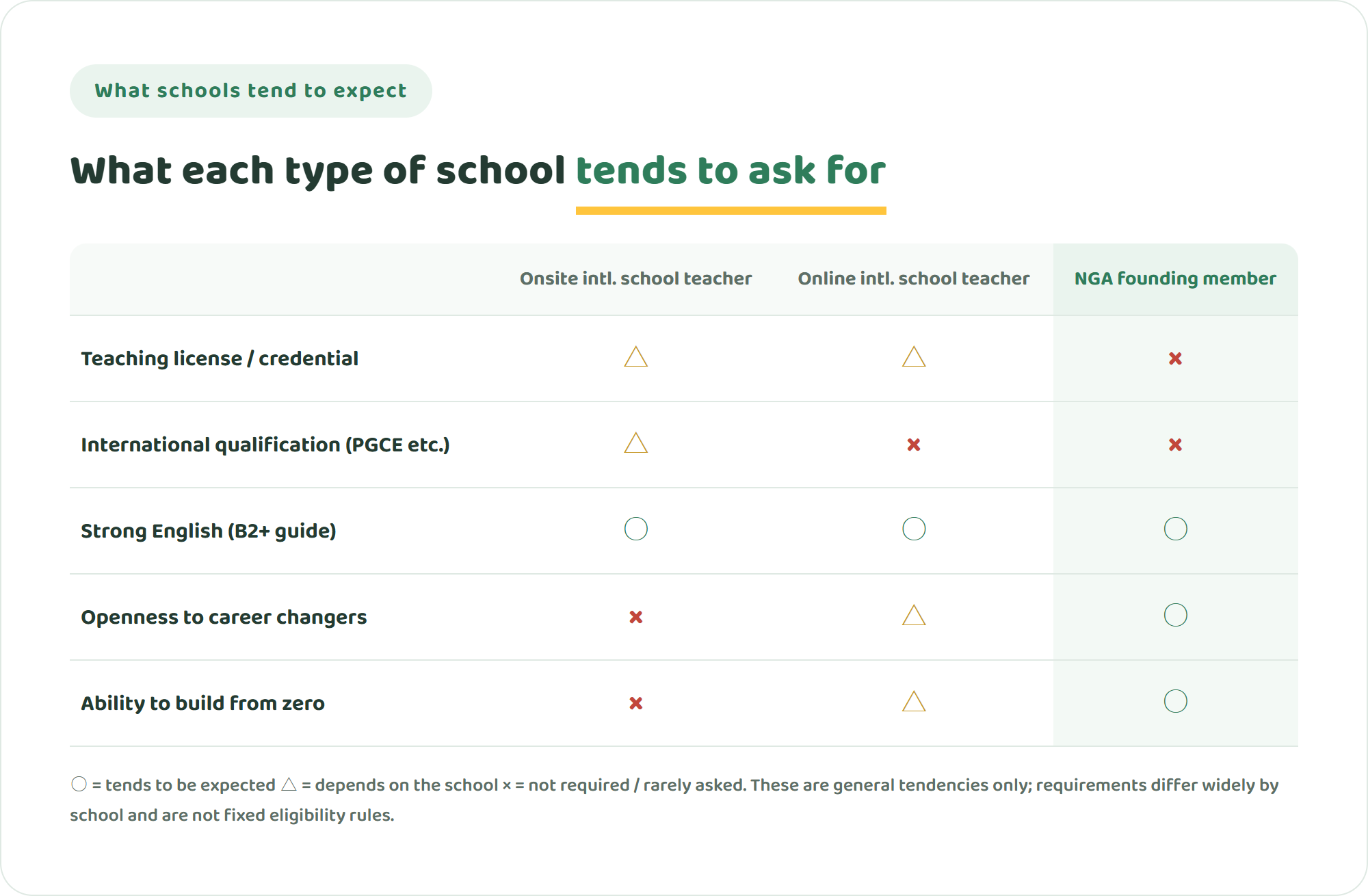
What the table makes clear is that “no license means no chance” is simply not true. Traditional onsite schools tend to weight a license or international qualification heavily, while online international schools and pre-launch schools tend to look instead at your English, your expertise, and your appetite to build the school alongside them. In other words, the “how” is not one fixed path — you can choose the entry point that matches what you already carry. Which is exactly why the preparation in the next section pays off.
What you can prepare today — English, expertise, and practice
This is the heart of the article. Whichever route you take — and even if you never apply to us — here is a manageable, three-step way to move your case steadily forward.
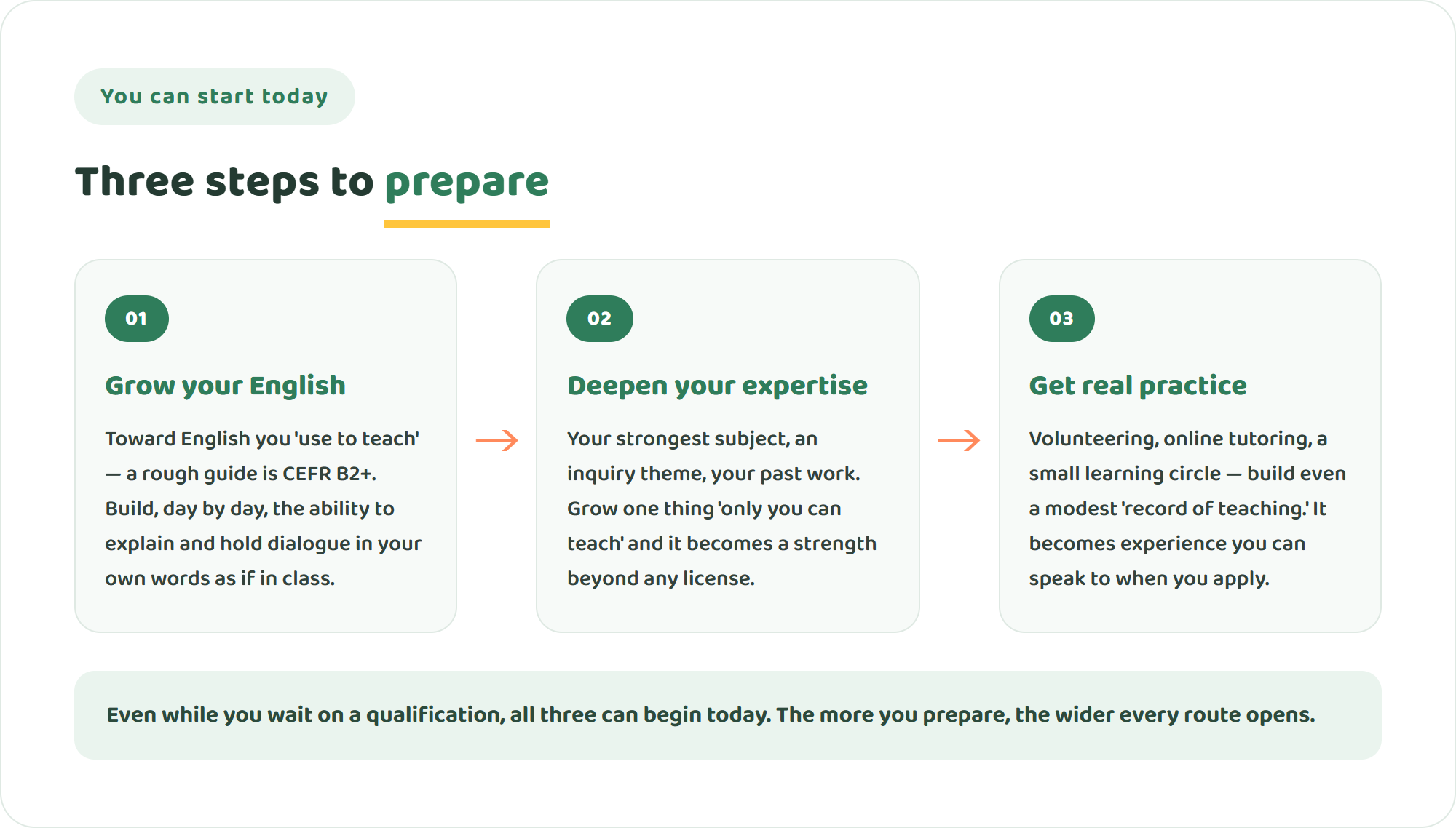
First, grow your English. Aim not for exam English but for English you use to teach. A rough guide is CEFR B2+. Picturing real lessons, build day by day the ability to explain in your own words and hold a dialogue with children. Second, deepen your expertise. Your strongest subject, a theme you want to explore, your past work — grow one thing “only you can teach” and it becomes a solid strength beyond any license. Third, get real practice. Volunteering, online tutoring, a small local learning circle — build even a modest “record of actually teaching.” Concrete experience you can speak to at application time will describe you more eloquently than any qualifications box.
And if you’re weighing a formal qualification on top of that, sequence it: decide which school group you actually want to work in first, then choose the credential that group reaches for — rather than paying for a certificate and hoping it fits somewhere.
See NIJIN GLOBAL ACADEMY’s founding-member roles →
Builders over credentials — NGA as a third entry point
So far we’ve covered the “how” in general terms. To close, here is a slightly different angle. The founding-member roles that NIJIN GLOBAL ACADEMY (NGA) is recruiting for ahead of its September 2027 opening are an entry point that welcomes people who can build from zero more than any credential. You’ll use English, so we assume roughly CEFR B2+ as a guide — but we do not make a teaching license or a glossy résumé a hard requirement. What we look for is the appetite to build the learning together, and a genuine connection to learning beyond test scores, where children aren’t ranked by exam results. Our view of education is laid out in how we learn.
What makes this a reassuring “way in” is that the selection lets you try as you go, rather than leaping in blind. NGA’s process runs in four steps: (1) document screening → (2) a group interview → (3) an internship at NIJIN Academy → (4) a final presentation (applications are via a Google Form). Step three, the internship, is a stretch where you — the applicant — get to test whether this fits you, too. More than a certificate on paper, we look together at the aptitude that shows up when you’re actually with children. The work is fully remote, with several ways to contribute beyond teaching — marketing, web, partnerships, HR — and internationally the founding roles begin as volunteer positions, with detailed terms shared later in the process. Rather than “joining a finished school,” you “move to the side that builds it” — which is, itself, a new way into teaching at an international school.
None of this is a knock on qualified teachers or on traditional schools. A teaching license represents real training and real craft, and the schools that require one are right to. We’re simply saying that it is not the only door — and that if yours is still ahead of you, there is worthwhile work you can do now.

Frequently asked questions
What qualifications do you need to be an international school teacher?
Most established international schools look for a bachelor’s degree plus a recognised teaching qualification — a state or national teaching license, QTS or iQTS, or a PGCE — with IB certificates in teaching and learning added for IB programmes and TEFL/TESOL for English-language roles. Experience of around two years is a common working expectation, often driven by work-permit rules rather than the school itself. Requirements vary by school, curriculum and country, so always check the awarding body’s official information and the school’s own vacancy page for current requirements.
Is a PGCE the same as QTS?
Not necessarily. QTS is the status that qualifies you to teach in England’s state schools; a PGCE is an academic qualification in education. Some PGCE programmes lead to QTS and some do not, and the international iPGCE is typically academic only. If a school’s vacancy specifies QTS, confirm with your provider exactly what your award includes before applying.
Do IB certificates replace a teaching license?
Generally no. IB educator certificates show you can teach within the IB framework, and IB World Schools often want them — but recruitment guidance consistently notes that ministries and schools usually expect them in addition to initial teacher certification, not instead of it. Confirm the current position with the IB and with the school.
Can I become an international school teacher without a teaching license?
It depends on the school. Some international schools do require a license, but others weight expertise, character, and English ability and don’t ask for one. Online international schools and pre-launch schools in particular tend to look at “can you build the learning with us?” more than the credential itself. NGA, too, does not make a license a hard requirement.
How good does my English need to be to apply?
If you’ll teach subjects in English, many schools look for roughly CEFR B2 or above as a guide. That does not mean native-level perfection. What matters is the willingness to use English to work with children and peers around the world, and to keep growing it. Some schools also set a specific IELTS or TOEFL score, particularly where a visa is involved — the surest way to confirm the exact level is within a given school’s selection process.
I have no experience — is it too late to start preparing now?
No. The three steps in this article — grow your English, deepen your expertise, get real practice — can all begin today, without waiting on a qualification. A small “record of actually teaching” in particular gives you something concrete to speak to when you apply. The more you prepare, the more steadily every route opens.
You open in September 2027. Is there any point applying now?
Yes. It’s precisely because it’s pre-launch that founding members help design the substance of the learning itself. NGA’s selection includes an internship at NIJIN Academy, so you build experience and test your fit before the real thing. If you’re drawn to “moving to the side that builds,” now is arguably the moment.
There’s no single right “how.” So there’s an entry point that fits you.
If you searched “how to become an international school teacher,” you almost certainly carry a wish: to reach diverse children in English, with learning a score can’t measure. There is more than one road to that wish. The route that leans on a license, the route through an international qualification, the route you carve with expertise and practice — and a third entry point that welcomes builders over credentials. If a qualification is missing from your profile today, there’s no need to rush. Work out which school group you’re aiming at, check what that group genuinely asks for, and in the meantime grow your English, deepen your expertise, practice in small ways. Each step widens the entry, on every route. Your “I want to become one” moves genuinely closer, starting with what you prepare today.
Working at an International School — More Articles
- international school teacher salary
- career change from teaching
- career change from teaching in your 30s and 40s
- how much do teachers earn?
- how to become an IB teacher
- jobs for moving abroad
- careers with a teaching license
- qualifications to teach English
- teach one class a week online
- online teaching jobs from home in India
- part-time online teaching jobs from home
- teaching jobs without a license
- online school jobs
- thinking of quitting teaching
- international school staff jobs
- remote jobs that use English
- digital nomad teaching jobs
- bilingual remote jobs
Start “I want to teach” from the side that builds it.