When you searched for digital nomad teaching jobs, part of you was already picturing it: a laptop open in a café with the sea somewhere behind it, a lesson finishing, an afternoon still ahead. And in the same breath you probably thought: which jobs actually survive that life? Does the money hold up? Would anyone hire me from another time zone? Wanting to see more of the world — not as a tourist passing through, but as someone who lives there for a while — is not a frivolous wish. It is just a wish that needs a plan.
This article gives you that plan honestly. First, what nomad work really looks like — the types of jobs, the income swings, and the parts nobody puts in the highlight reel. Then, what people who sustain this life for years actually do differently: how they design around time zones, how they choose work judged on output, and how they keep their skills compounding. Finally, a path that gets overlooked in most nomad job lists — teaching — using the founding team we are recruiting for an online international school opening in September 2027 as a concrete example.

What digital nomad jobs actually are: three types
“Nomad work” covers wildly different realities. The clearest way to sort the job types you see advertised is not by industry but by how the income is made.
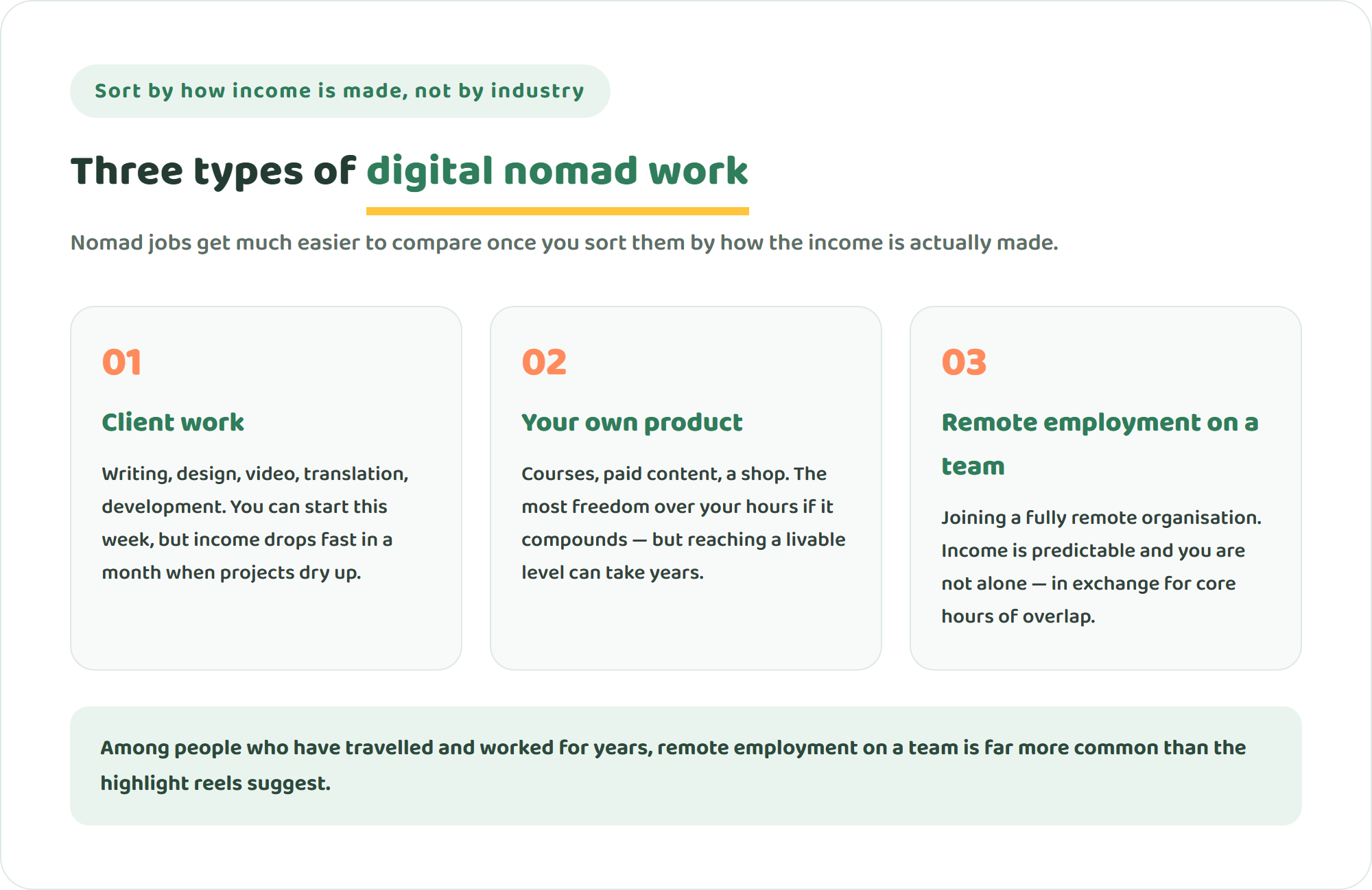
The first is client work: writing, design, video editing, translation, development. You can start this week, and rates rise as your portfolio does. But in a month when projects dry up, income drops fast. Whether you can absorb the gap between a strong month and a thin one decides whether you last.
The second is your own product: online courses, paid content, a shop. If it compounds, this offers the most freedom over your hours — but it commonly takes months or years to reach a livable level, and you need a plan for the runway in between.
The third is remote employment on a team: joining an organisation built to be fully remote. Engineers, marketers, support staff, online teachers. Income is more predictable, and you are not carrying everything alone. The trade-off is real: core hours for meetings mean you owe the team some overlap. It is rarely said out loud, but among people who have travelled and worked for five or ten years, this third type is unusually common.
The honest downsides: time zones, connectivity, isolation, paperwork
People who leave on enthusiasm alone tend to break on four things. Any article that skips them is selling you something.
Time zones. If your clients or colleagues are in Asia and you are in Europe or Latin America, your working hours become your nights. That gap wears people down faster than they expect. Connectivity. Accommodation Wi-Fi is a lottery, and it fails on the day of the meeting that matters; a backup SIM and a known coworking space are insurance, not luxuries. Isolation. Constant movement keeps relationships shallow, and having nobody to share a win with is heavier than it sounds.
Fourth, visas, tax and social insurance. A growing number of countries now offer some form of digital nomad visa, but the conditions of stay and where you owe tax vary enormously by country and by your own circumstances. Whether you may work on a tourist visa, how tax residency is determined, how pensions and health cover are handled — none of this transfers cleanly from someone else’s blog post to your situation. Check each country’s official guidance and consult a qualified tax professional. We will not make claims here that only your own advisor can make.
What people who last actually do: three conditions
The difference between quitting within a year and doing this for a decade is rarely talent. It is design.
First, fix the time zone before the destination. Most people choose the country first, which is backwards. Decide the hours you will work, then choose from the countries where those hours are humane — if your work anchors to Asia, that points to Southeast Asia and Oceania. This single reordering prevents most burnout.
Second, choose work judged on output, not hours. If you are paid for time in a seat, changing your location changes nothing. Work assessed on what you delivered — building, planning, running things, and teaching, where the result is how a child changed — is where location freedom actually lives.
Third, choose work where skills compound. Task-by-task work keeps your rate flat and leaves you standing in the same place in three years. Before you apply, ask whether the scope widens and the autonomy grows.
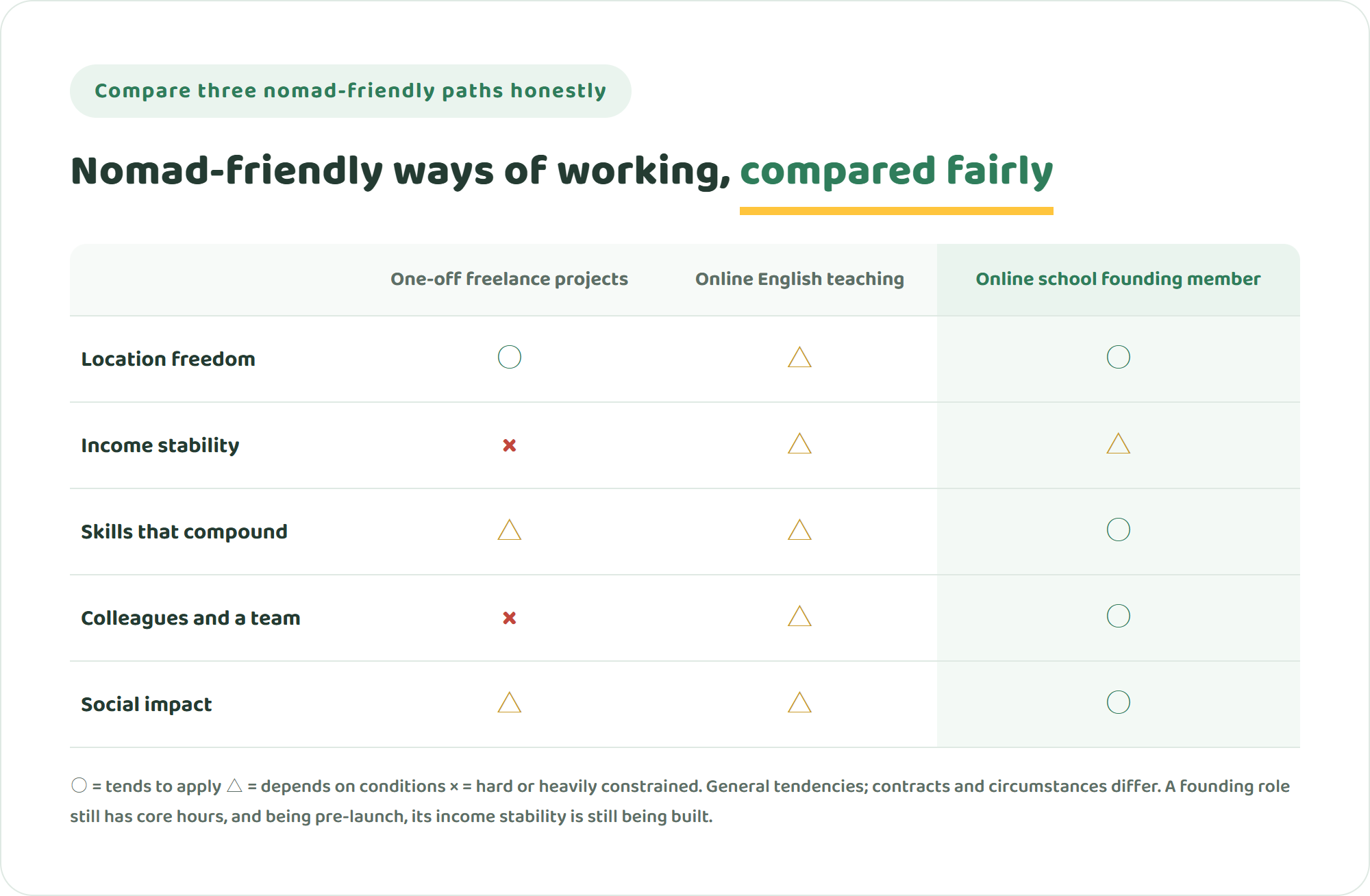
Notice that every column carries a △ or an ×. Location freedom and income stability tend to pull against each other. The starting point is not finding a path with no trade-offs; it is deciding which trade-off you can live with.
See NIJIN GLOBAL ACADEMY’s founding-member roles →
The overlooked option: teaching while you travel
Most nomad job lists are dominated by tech and creative roles. Yet teaching is unusually well suited to this life: the materials and the dialogue both live on the screen, and the work is judged by substance rather than hours logged.
NIJIN GLOBAL ACADEMY (NGA) is an online international school opening in September 2027, built on learning beyond test scores. The founding-member roles we are recruiting now are fully remote and designed around the premise of “working while travelling the world.” Which country you live in, and which city you move to next, is yours to decide. For anyone who wants to see more of the world with their own eyes, that stops being how you spend a holiday and becomes how you work.
There are five working styles, from part-time to full-time, and roles beyond teaching — marketing, web, partnerships, HR. We are also straight about the terms: founding roles on this track begin as volunteer positions ahead of our September 2027 opening, and the detailed terms are shared later in the process. Being told that before you even apply, rather than discovering it later, is what income visibility actually has to mean when your income travels with you.
What we look for is English at roughly CEFR B2+, agreement with the idea that children should not be ranked by exam scores, and an appetite for building from zero. Our approach, centred on small-group dialogue that begins with “what do you think?”, is set out in how we learn. Selection runs from documents to a group interview, an internship at NIJIN Academy, and a final presentation — so you can try before you decide. None of this requires you to dismiss the work you do now. It only removes the constraint of where you do it.

Three steps to prepare for working while you travel
You do not need to buy a plane ticket yet. Take it in this order.
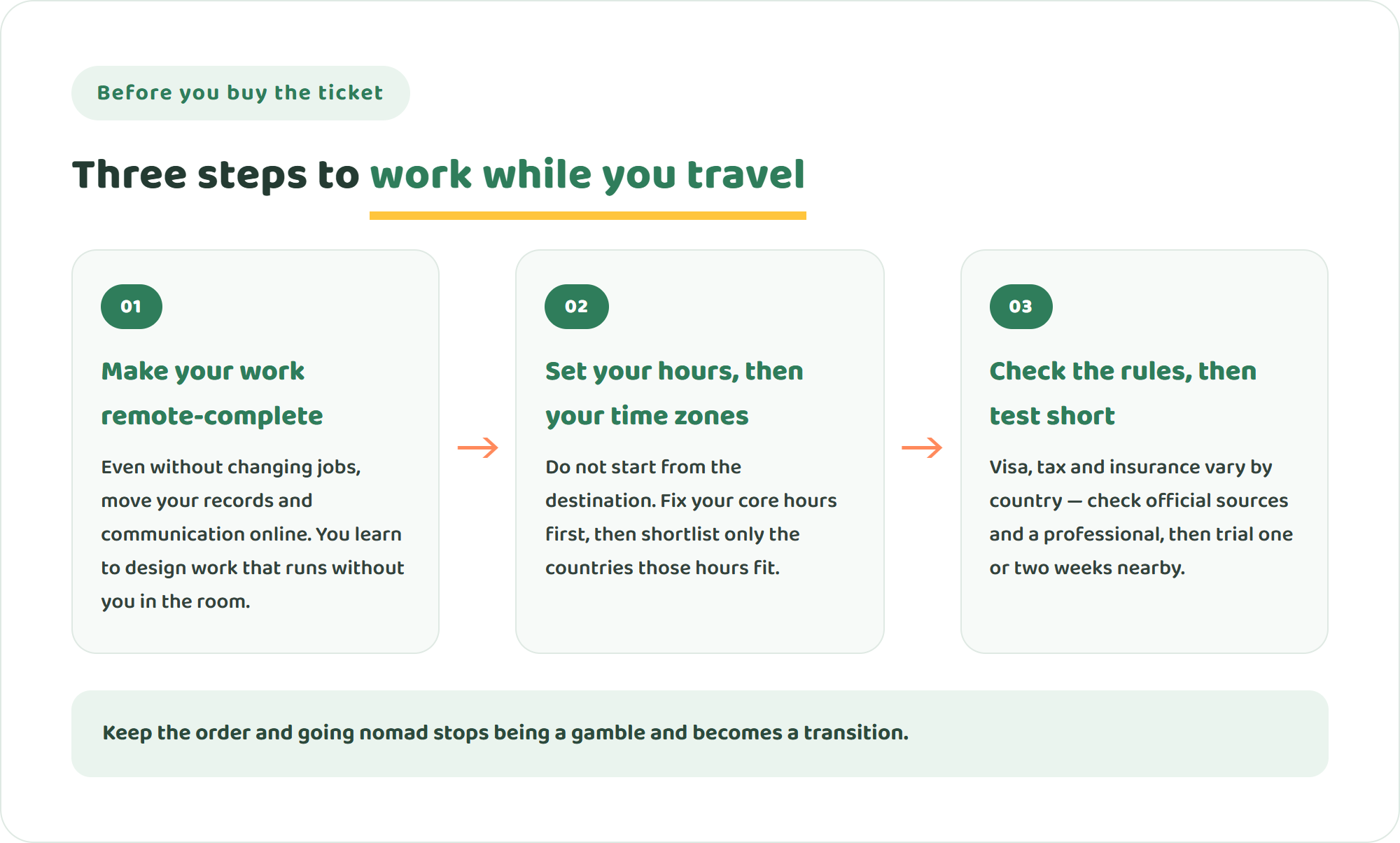
First, make your current work remote-complete. Even without changing jobs, moving how you document and communicate into shared online form teaches you to design work that runs without you in the room. Second, set your hours and your time-zone range — fix the core hours, then shortlist countries that fit them. Third, check the rules and test short. Confirm visa, tax and insurance requirements with official sources and a professional, then trial one or two weeks in a nearby time zone. Bandwidth, stamina, focus, loneliness — you learn those only in the field.
Frequently asked questions
Can I start nomad work with no experience?
It depends on the type. Client work generally has the widest entry point because you can build a record from small projects. Remote employment involves a selection process, but your existing professional experience counts directly. For NGA’s founding-member roles, we welcome people energised by building from zero.
How much English do I need?
Enough to handle daily interaction widens your options considerably when you are moving between countries. For NGA’s roles we assume roughly CEFR B2+, but we are not looking for native-level perfection — we look at the willingness to use it and keep growing.
What kind of income can I expect?
Across nomad work in general, income varies too much by field, track record and workload to quote a single benchmark. For NGA, the international founding-member track begins as a volunteer role ahead of the 2027 opening, and detailed terms are shared later in the process. Specific figures and terms are discussed during selection.
Can you really teach children online across time zones?
NGA is built around small-group dialogue, so engagement carries well over a screen. Class times are scheduled, so an extreme time-zone gap needs discussion — but once your time-zone range is designed, the place itself is open. The details are confirmed during selection.
How should I handle visas and tax?
This varies enormously by country and by your own circumstances. Whether a digital nomad visa exists, its conditions, tax residency and filing obligations are not uniform, so check official sources for your destination and consult a qualified tax professional.
Travelling is not an escape. It is a way of choosing how you work.
If you searched for digital nomad teaching jobs, what you wanted was probably not easy work. It was work that means something, done on your own terms of time and place. Seen from a distance it looks out of reach; designed properly — time zones first, output-based work, skills that compound — it moves steadily closer. And if you have ever felt the particular satisfaction of watching someone learn something, put education on your list of options. A morning in a new city, and a child’s eyes lighting up on the other side of the screen: that combination genuinely exists.
Working at an International School — More Articles
- international school teacher salary
- how to become an international school teacher
- career change from teaching
- career change from teaching in your 30s and 40s
- how much do teachers earn?
- how to become an IB teacher
- jobs for moving abroad
- remote teaching jobs
- remote jobs that use English
- high-paying jobs that use English
- careers with a teaching license
- private school teacher career change
- qualifications to teach English
- elementary school teacher salary in Japan
- junior high school teacher salary in Japan
- high school teacher salary in Japan
- school principal salary in Japan
- how the Japanese teacher pay scale works
Teach the world while you travel it.