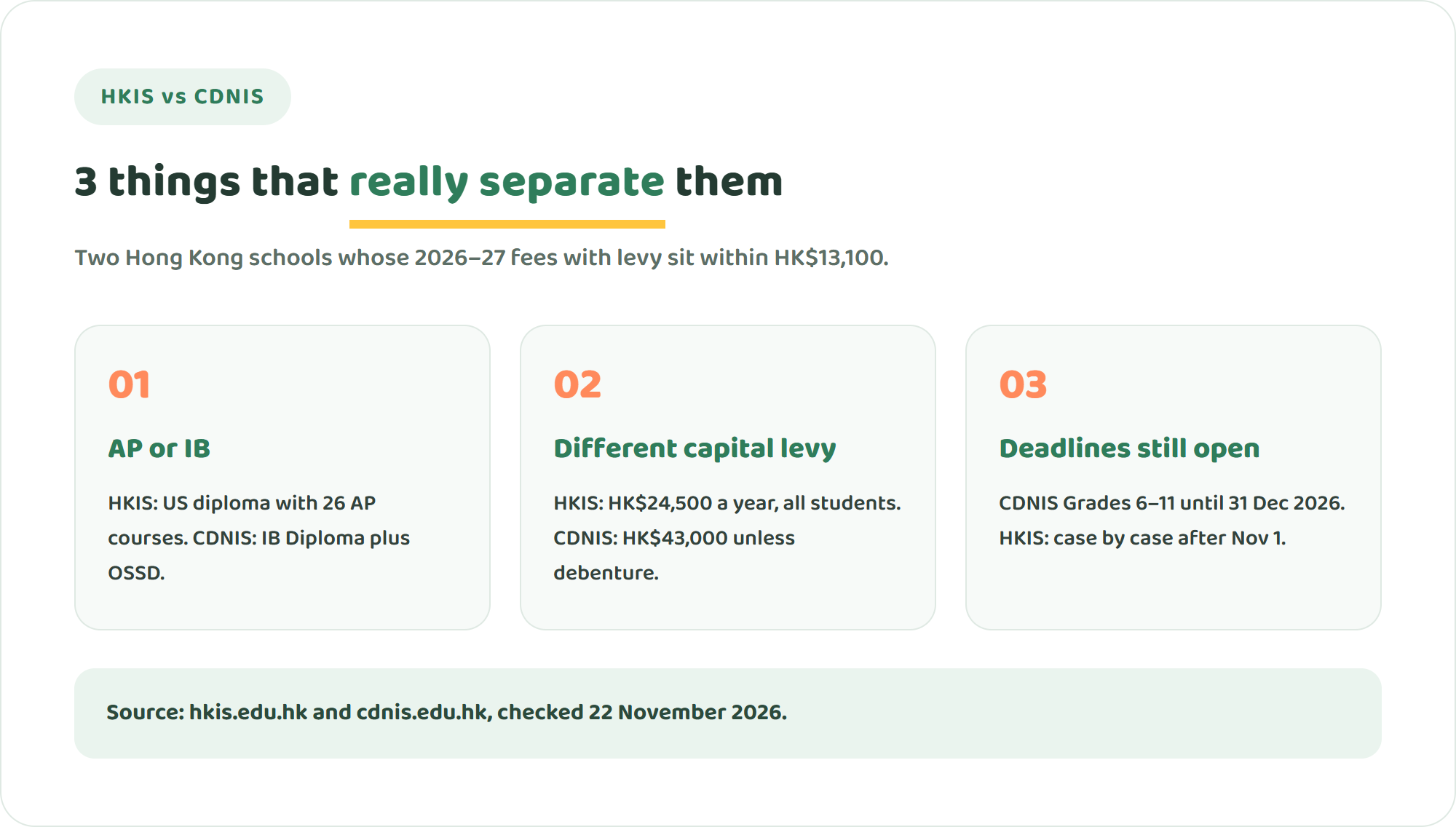
HKIS vs CDNIS, in one paragraph: Hong Kong International School (HKIS) and the Canadian International School of Hong Kong (CDNIS) are both not-for-profit international schools on the south side of Hong Kong Island, both take children from the early years to Grade 12, and their 2026–27 annual fees, including the capital levy, sit within about HK$13,100 of each other in every grade. The real difference is the route to graduation. HKIS is an American-style, WASC-accredited school founded in 1966, grounded in the Christian faith and respecting all faiths, with a US-style high school diploma and 26 Advanced Placement (AP) courses. CDNIS, founded in 1991, is an IB World School running the Primary Years, Middle Years and Diploma Programmes, and says it is the only school outside Canada where students graduate with both the IB Diploma and the Ontario Secondary School Diploma (OSSD). All figures below come from the two schools’ official websites, checked 22 November 2026.
If you searched for HKIS vs CDNIS, you are probably moving to Hong Kong, or already there, and trying to decide between two of the city’s best-known international schools. This page does not rank them. Both are well established, well resourced and selective. Instead, it puts the official facts side by side, including the things a quick fee search does not add up for you: the full cost from Grade 6 to Grade 12, how much cash you need before the first day, how the two capital levy and debenture systems differ, which application deadlines are still open for 2027–28, and how each school chooses students. It ends with options for families who find neither school fits, including NIJIN GLOBAL ACADEMY (NGA), a very different online school for ages 6–18 that opens in September 2027 (planned).
The short answer: which family fits HKIS, which fits CDNIS
- HKIS may fit better if: your child is likely to apply to US universities. HKIS describes itself as an American-curriculum, college-preparatory school; it reports that about 80% of a typical class goes on to colleges and universities in the United States, and it offers 26 AP courses.
- HKIS may fit better if: your child is coming from an accredited American-curriculum school overseas. HKIS gives “Priority B” to overseas applicants who have spent at least two consecutive years in such a school.
- HKIS may fit better if: you value a school with a stated Christian foundation. HKIS was founded by Lutheran missionaries with American business leaders, includes religion credits in its diploma, and welcomes children of all faiths or none.
- CDNIS may fit better if: you want the IB from start to finish, or a Canadian qualification. Every CDNIS student in Grades 11–12 is enrolled in the IB Diploma Programme and also works towards the OSSD.
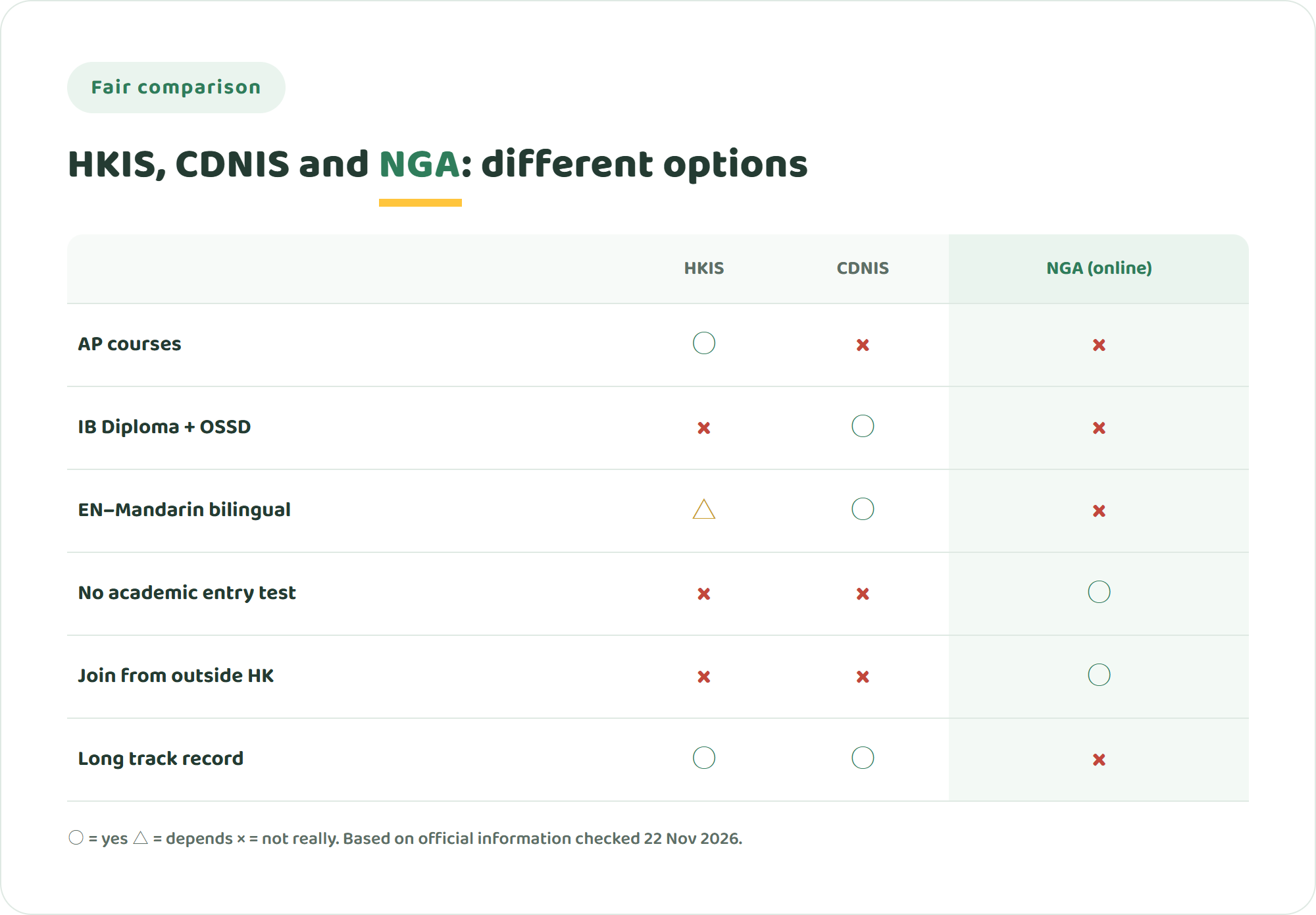
- CDNIS may fit better if: you want an English–Mandarin bilingual start. CDNIS runs a bilingual programme from Nursery to Grade 3 and is extending it to Grade 5 by 2028/2029. HKIS teaches Mandarin from Reception 1 to Grade 5 and has a smaller Dual Language Immersion track.
- CDNIS may fit better if: your child is two, or you are applying for Grades 6–11 late in 2026. CDNIS has a Nursery from age 2, and its Grades 6–11 deadline for 2027/2028 is 31 December 2026; HKIS’s deadlines have passed.
- Neither may fit if: your family will not live in Hong Kong with a parent, your child needs to start without academic selection, or you need a much lower budget. See the options further down this page.

HKIS vs CDNIS vs NIJIN GLOBAL ACADEMY at a glance (official data)
HKIS and CDNIS details below come from each school’s official website for 2026–27 (and 2027–28 admissions), checked 22 November 2026. NGA is included because it is the kind of alternative many families never hear about, not because it resembles these two schools. It is online, has no campus in Hong Kong, and is not yet open.
| Item | Hong Kong International School (HKIS) | Canadian International School of Hong Kong (CDNIS) | NIJIN GLOBAL ACADEMY |
|---|---|---|---|
| School type | Not-for-profit, American-style day school founded in 1966, grounded in the Christian faith and respecting all faiths | Not-for-profit IB World School founded in 1991 | Online international school focused on Asia and Oceania, operated by NIJIN Inc. (Japan) |
| Ages / grades | Reception 1 (age 4) to Grade 12; over 3,100 students | Nursery (age 2) to Grade 12; more than 2,100 students | Ages 6–18; opening September 2027 (planned) |
| Campuses | Primary: 23 South Bay Close, Repulse Bay. Middle and High School: 1 Red Hill Road, Tai Tam | Main campus: 36 Nam Long Shan Road, Aberdeen. Early Years Centre: The Southside, Wong Chuk Hang | No campus; classes are live online |
| Curriculum | Standards-based American curriculum; HKIS high school diploma (22 credits); 26 AP courses | IB PYP, MYP and Diploma Programme, with Ontario curriculum standards; IB Diploma plus OSSD in Grades 11–12 | Subjects learned in English with a bilingual English–Japanese mentor; CEFR-based English levels; optional Cambridge IGCSE / A-Level pathway listed |
| Annual fee 2026–27 (HK$) | Tuition HK$231,600–272,600 plus capital levy HK$24,500 | Tuition HK$142,800 (Nursery) to HK$261,500 (Grades 11–12), plus capital levy HK$43,000 from EY1 unless covered by a debenture | Not yet published; described as far more affordable than a typical international school |
| One-off charges for new students | Application HK$2,000; entry fee HK$15,000 | Application HK$2,350; assessment HK$1,650; entry fee HK$12,500; reservation deposit HK$80,000 (credited to the first term) | No enrolment, facility or uniform fees; materials included |
| Debentures | Optional: Family HK$3 million, Standard Corporate HK$3 million, Comprehensive Corporate HK$5 million | Not compulsory; no new debentures issued; second-hand transfers only (indicative HK$2.8 million Capital Debenture, May 2026) | None |
| Selection | Application review, then a pre-entry assessment for invited applicants (computer-based adaptive test from Grade 3); priority system A/B/C | Assessment or interview, school reports and teacher reference; two-stage screening with priority for debenture holders, siblings and Canadian citizens | No academic entrance exam, no English requirement |
| Accreditation | Fully accredited by WASC; member of EARCOS | IB World School; OSSD authorised by the Ontario Ministry of Education; CIS and WASC listed on the Education Bureau’s site | Not yet accredited; no graduates yet |
| Timetable and time zone | In person, Hong Kong time; High School 7:45am–3:00pm (first period 8:35am) | In person, Hong Kong time; Education Bureau lists 7:30am–5:00pm, Monday to Friday | Small live online groups of about 8; built for Asia–Oceania daytime, so it suits Hong Kong hours but may fall outside the day in Europe or the Americas |
Sources: HKIS tuition and fees 2026–27, HKIS how to apply, HKIS admissions FAQ, HKIS High School Academic Profile 2026–2027 (PDF), CDNIS tuition fees 2026/2027, the CDNIS Admissions Information Guide (PDF, dated 1 August 2026), CDNIS key dates, CDNIS IB programmes and the Education Bureau’s international schools listing for CDNIS, all checked 22 November 2026.
Fees side by side, grade by grade (2026–27)
Both schools state fees in Hong Kong dollars and bill tuition in two instalments a year. HKIS publishes tuition per semester plus a capital levy of HK$12,250 per semester (HK$24,500 a year), which every student pays. CDNIS publishes annual tuition and a separate annual capital levy of HK$43,000 for students from Early Years 1 up, which is waived only if the student is covered by a CDNIS debenture. The table adds the levy so that you compare like with like. Neither school had published 2027–28 fees when we checked; both say fees are reviewed every year (HKIS fees are also subject to Education Bureau approval).
| Grade (2026–27, HK$) | HKIS tuition + capital levy | CDNIS tuition + capital levy |
|---|---|---|
| Nursery (age 2) | No Nursery | HK$142,800 half day, bilingual; no capital levy (guide PDF: HK$142,780 in 11 instalments) |
| Early Years 1 | No equivalent (HKIS starts at Reception 1, age 4) | HK$161,000 + HK$43,000 = HK$204,000 |
| Reception 1 / Early Years 2 (age 4) | HK$231,600 + HK$24,500 = HK$256,100 | HK$209,200 + HK$43,000 = HK$252,200 |
| Reception 2 / Preparatory (age 5) | HK$256,100 | HK$217,200 + HK$43,000 = HK$260,200 |
| Grades 1–2 | HK$256,100 | HK$260,200 |
| Grades 3–5 | HK$256,100 | HK$200,000 + HK$43,000 = HK$243,000 |
| Grades 6–8 | HK$244,500 + HK$24,500 = HK$269,000 | HK$223,100 + HK$43,000 = HK$266,100 |
| Grades 9–10 | HK$272,600 + HK$24,500 = HK$297,100 | HK$244,800 + HK$43,000 = HK$287,800 |
| Grades 11–12 | HK$297,100 | HK$261,500 + HK$43,000 = HK$304,500 |
| Application and assessment | Application fee HK$2,000, non-refundable | Application HK$2,350 + assessment HK$1,650 (Nursery: application HK$1,800), non-refundable |
| Entry fee (new students, once) | HK$15,000; waived if returning within 2 years | HK$12,500 from EY1; waived if returning within 2 years |
| Included in tuition | Basic school supplies for Reception 1 to Grade 8 | From Grade 4: technology fee (HK$1,500) and IBDP examination fee (HK$6,000); Grades 11–12: IBDP textbook fee (HK$2,000) |
| Extras | Bus (mandatory for primary), lunch, uniform to Grade 8, a MacBook for Grades 6–12; Middle School PEAK HK$3,000–12,500; High School Interim HK$3,000–26,000 | Uniform, iPad (Grades 1–3), laptop (Grades 4–12), bus, lunch, field trips; Experience Week (Grades 3–12) HK$1,500–60,000 |
| Sibling discount | Not published on the official site | Not published on the official site |
Read across the table and the pattern is mixed rather than one-sided. CDNIS is lower at age 4 (Early Years 2 against Reception 1, by HK$3,900), in Grades 3–5 (by HK$13,100 a year), Grades 6–8 (by HK$2,900) and Grades 9–10 (by HK$9,300). HKIS is lower in Reception 2 to Grade 2 (by HK$4,100) and in Grades 11–12 (by HK$7,400), where the CDNIS fee includes IB exam and textbook fees. Note that the CDNIS tuition web page lists “Grade 2” twice with the same amount; the guide PDF groups Preparatory to Grade 2 at HK$217,200.
Grade 6 to Grade 12 at today’s prices
This uses official 2026–27 numbers only, assumes no fee rises, no debenture and no extras, and adds the one-off charges once. Real totals will be higher because both schools review fees every year.
| Cost line | HKIS | CDNIS |
|---|---|---|
| Grades 6–8 | 3 × HK$269,000 = HK$807,000 | 3 × HK$266,100 = HK$798,300 |
| Grades 9–10 | 2 × HK$297,100 = HK$594,200 | 2 × HK$287,800 = HK$575,600 |
| Grades 11–12 | 2 × HK$297,100 = HK$594,200 | 2 × HK$304,500 = HK$609,000 |
| One-off charges | HK$2,000 + HK$15,000 = HK$17,000 | HK$2,350 + HK$1,650 + HK$12,500 = HK$16,500 |
| Total, seven years | HK$2,012,400 | HK$1,999,400 |
Over seven years the gap is HK$13,000, well under 1% of the total. From Grade 1 to Grade 12 (twelve years) the totals are HK$3,292,900 at HKIS and HK$3,248,800 at CDNIS, a gap of HK$44,100, mostly from CDNIS’s lower Grade 3–5 fees (our arithmetic). For one child, the fee schedule should not decide this choice. Our guide to international school fees across Asia shows how both compare with schools in other Asian cities.
Cash before the first day
The timing of payments differs more than the totals. At HKIS, a new student pays a reservation deposit on acceptance equal to the first semester’s fees, including the entry fee. For a new Grade 6 student that is HK$122,250 + HK$12,250 + HK$15,000 = HK$149,500, plus the HK$2,000 application fee paid earlier: HK$151,500 (our arithmetic). At CDNIS, a reservation deposit of HK$80,000 secures the place and is credited to the first term. The first invoice then includes half the annual tuition plus the full annual capital levy and the entry fee: HK$111,550 + HK$43,000 + HK$12,500 = HK$167,050 for Grade 6, plus HK$4,000 in application and assessment fees: HK$171,050 before the first day (our arithmetic; the exact due dates are set in the acceptance letter and invoice). HKIS’s reservation deposit for new students is refundable only with written notice within 10 calendar days of the payment due date or before the semester starts, whichever is earlier. If an employer pays fees, check which lines the package covers, because levies and entry fees are often treated differently from tuition.
Debentures and capital levies: two different systems
HKIS sells three non-interest-bearing debentures directly: a Family Debenture (HK$3 million, for several children of one family), a Standard Corporate Debenture (HK$3 million, one child) and a Comprehensive Corporate Debenture (HK$5 million, several children of one family). HKIS says debentures are not mandatory, do not guarantee admission, and place a qualified applicant at the top of the wait pool. They retain their value but cannot be sold; only the Family Debenture can be transferred, and only to the purchaser’s children or grandchildren. Debenture applications for the next school year are due by 1 November. The fees page does not say whether a debenture changes the HK$24,500 annual capital levy, which it describes as paid by all students.
CDNIS is not issuing new debentures. A family can only buy an existing debenture on the second-hand market, through the school, once the child has a firm place or is already enrolled. The school’s indicative transfer prices as of May 2026 were HK$2,800,000 for a Capital Debenture and HK$10,000,000 for a Gold Corporate Debenture. A debenture covers one student and exempts that student from the HK$43,000 annual capital levy, and debenture holders or applicants receive priority once they meet the assessment requirements. Over the seven years from Grade 6 to Grade 12, the CDNIS levy alone comes to 7 × HK$43,000 = HK$301,000 (our arithmetic). Most families pay the levy; debentures are usually a company decision.
Entry: deadlines, assessments and priority
Both schools run a wait pool rather than a simple waiting list, and both give priority to certain groups. For 2027–28 entry, the dates and steps on the official sites are as follows.
| Step | HKIS (2027–28 entry) | CDNIS (2027/2028 entry) |
|---|---|---|
| Application window | 1 May 2026 to 1 October 2026 (Reception 1 to Grade 5); 1 May to 1 November 2026 (Grades 6–12); later applications on a case-by-case basis | Early Years to Grade 5: until 2 October 2026; Nursery: 1–30 November 2026; Grades 6–11: until 31 December 2026; Grade 12 applications closed (normally only for students already in an IB Diploma Programme) |
| Assessment | By invitation. Reception 1–2: in-person developmental and English assessment; Grades 1–2: phonics, numeracy and English; Grades 3–12: computer-based adaptive test in maths, reading, writing and oral language | Nursery and EY1: play-based (Jan–Feb and Nov–Dec); EY2–Grade 2: Nov–Dec; Grades 3–12: Feb–Apr, on site or online interview for overseas applicants |
| Decisions | From March, on a rolling basis | Two-stage screening: ranking (Excellent, Good, Marginal, Not suitable), then priority weighting |
| Priority | A: debenture holders. B: faculty children, siblings, alumni children, returning students, overseas applicants from accredited American-curriculum schools (2+ years) or international schools outside Hong Kong and the Greater Bay Area. C: applicants at schools in Hong Kong or the Greater China area | Debenture holders or potential holders, siblings at CDNIS, Canadian citizens (plus alumni and staff children for Nursery and EY1 scheduling) |
| Living arrangements | Must live with at least one parent in full-time residence in Hong Kong; valid visa or right of abode; health insurance required | Must live with a parent or guardian who is a full-time Hong Kong resident; valid HKID or passport with residency status |
| Main entry points | Not published on the official site | Nursery and Grade 6 |
Applying to both
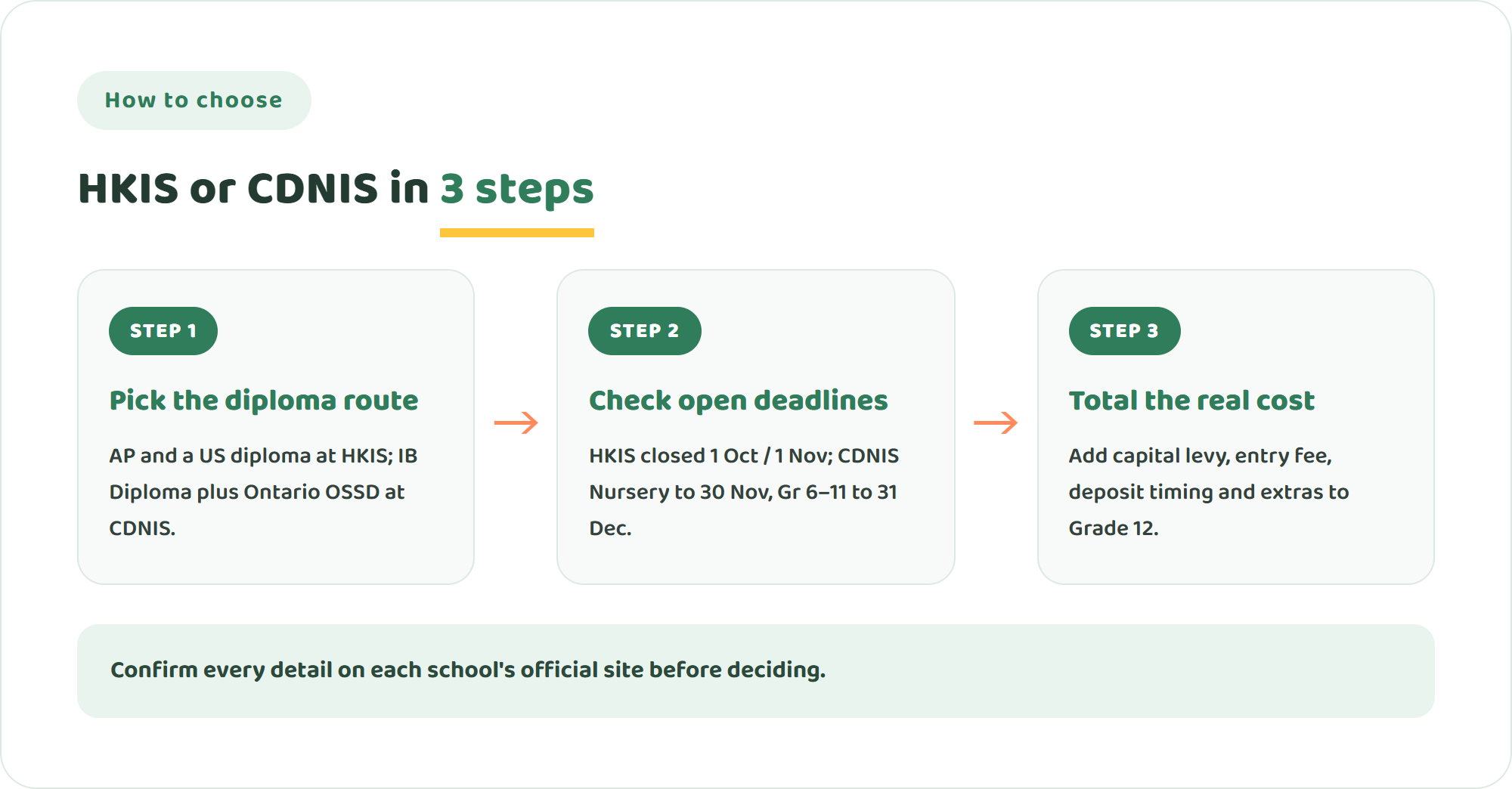
Nothing on either school’s pages forbids applying to both, and many relocating families do. Applying to both for one child costs HK$6,000 in non-refundable application and assessment fees (HK$2,000 at HKIS plus HK$4,000 at CDNIS). Timing matters right now: as of 22 November 2026, the HKIS deadlines for 2027–28 have passed (late applications are considered case by case), while CDNIS is still accepting Nursery applications until 30 November and Grades 6–11 until 31 December 2026. HKIS also notes that students arriving from a country with a different school calendar generally continue in the grade they have just completed.
Curriculum: AP and a US diploma, or the IB with an Ontario diploma
This is the real fork between the two schools. HKIS uses a standards-based American curriculum designed with the Understanding by Design model. To graduate, a student earns at least 22 credits, including English (4), mathematics (3), laboratory science (2), social studies (2), world languages (2), arts (1.5), religion (1.5) and PE (1.5), and completes a Senior Project. High School students choose from 26 AP courses, with limits by grade (for example, Grade 10 students are limited to 1.0 AP credit). HKIS’s 2026–27 profile reports that the class of 2026 sat 1,713 AP exams, with 95% scoring 3 or above and 80% scoring 4 or 5. The week-long Interim off-campus programme is a graduation requirement.
CDNIS follows the IB from Nursery to Grade 12, drawing on Ontario curriculum standards in the Lower School. In Grades 9–10 students complete the MYP while earning their first OSSD credits; in Grades 11–12 every student is enrolled in the IB Diploma Programme (CDNIS calls it “open-access”) and completes the remaining OSSD requirements, including 30 credits, 40 hours of community involvement and the Ontario literacy test. CDNIS points out that some universities value the term-by-term OSSD grades, which arrive before final IB results in July. Students joining in Grades 9–11 have their transcripts reviewed for transfer credit.
So if your teenager is aiming mainly at US colleges and likes choosing courses, HKIS’s AP model is a natural fit. If you expect to apply in Canada, the UK or several countries at once, or your child may move again, the IB plus OSSD at CDNIS offers two recognised qualifications. Both schools publish university guidance in detail; ask each one about your child’s subjects. For a wider view of the systems, see our explainer on types of international schools.
The school day, languages and life on campus
School day. HKIS publishes hours by division: Reception 1–2, 8:00am–1:50pm; Grades 1–2, 8:00am–2:50pm; Grades 3–5, 7:55am–2:50pm; Grades 6–8, 7:50am–3:05pm; Grades 9–12, 7:45am–3:00pm, with the first High School period at 8:35am. Its year is 180 days in two semesters (2026–27: 13 August to 11 December 2026 and 4 January to 16 June 2027). CDNIS does not publish class times by grade on the pages we read; the Education Bureau’s listing shows 7:30am–5:00pm, Monday to Friday.
Class sizes. HKIS lists maximum class sizes of 16–18 in Reception 1, 18–21 in Reception 2 to Grade 2, and 21–24 from Grade 3. The Education Bureau lists an average class size of 15–26 at CDNIS.
Languages. At HKIS, Mandarin is compulsory from Reception 1 to Grade 5, and a Dual Language Immersion programme (Chinese and English) began in two Reception 1 classes in 2025–26. At CDNIS, children learn in English and Mandarin from Nursery, with the bilingual track reaching Grade 5 by 2028/2029; French and Mandarin are offered in Grades 6–8, and Chinese A supports the IB Bilingual Diploma.
Location. HKIS’s primary campus is in Repulse Bay and its secondary campus in Tai Tam. CDNIS’s main campus is in Aberdeen, with its Early Years Centre in Wong Chuk Hang. Both are on the south side of Hong Kong Island, so for most families the daily bus journey from home matters more than any difference on paper.

Common concerns, answered honestly
“We missed the deadline”
HKIS considers late applications case by case, and CDNIS says Grade 6 and above applications after 31 December may not be considered, depending on places. If you are moving mid-year, apply to more than one school and ask each how its wait pool works for your child’s grade.
“Do we need a debenture to get in?”
No, at either school. Both say debentures are optional and do not guarantee admission. They do raise priority for applicants who meet the entry standard, which is why corporate debentures are common among company transferees.
“My child’s English is still developing”
HKIS assesses English language proficiency for every applicant, and says it accepts students with mild additional needs when space and resources are available. CDNIS offers learning support “subject to available resources”. Neither page we read describes a full English-as-an-additional-language programme, so ask each school directly.
“Is HKIS only for Christian families?”
No. HKIS says it welcomes children of all faiths, including those with no religious tradition. Religion is part of its curriculum and diploma, taught as the study of Christianity and other world religions, so it is worth discussing with your child.
“What will extras really add?”
Neither school publishes a typical annual extras figure. Budget for bus, lunch, uniform and a laptop at both, plus experiential programmes: HKIS lists HK$3,000–26,000 for High School Interim, and CDNIS lists HK$1,500–60,000 for Experience Week.
Which suits which family
- A family with one child entering Grade 6: fees differ by well under 1% over seven years. Decide on AP and a US diploma or the IB plus OSSD, and on how your child felt on each visit.
- A family planning for US universities: HKIS’s AP courses and US-style transcript are built for that path, though CDNIS graduates also apply to the US.
- A family that may move again: the IB Diploma travels well between countries, and CDNIS adds a Canadian diploma.
- A family with a two- or three-year-old: only CDNIS has a Nursery and Early Years 1; HKIS starts at Reception 1 (age 4).
- A family applying in December 2026 for Grades 6–11: CDNIS’s window is still open; HKIS is case by case.
- A Canadian family: CDNIS gives priority to Canadian citizens at the second screening stage.
Families moving around the region often also compare American schools elsewhere in Asia, such as Shanghai American School and Taipei American School. If you are choosing between British schools in Singapore instead, our Tanglin vs Dulwich comparison uses the same method.
If neither fits: other routes and NIJIN GLOBAL ACADEMY
Other Hong Kong schools. Hong Kong has many other international schools with different curricula and fee levels; check each school’s official fees page, as fees change every year. If the budget is the main issue, our page on more affordable international schools in Asia is a useful start. If a campus school is not the right step at all, our online international schools compared guide, our explainer on how an online international school day works and our look at online vs in-person international school costs are good starting points.
NIJIN GLOBAL ACADEMY (NGA) is a different kind of option. It is an online international school for ages 6–18 focused on Asia and Oceania, opening in September 2027 (planned), with free trial classes monthly from September 2026 and pre-opening trial classes in April–May 2027. Its first cohort is 100 students, and it is operated by NIJIN Inc. in Japan, whose alternative school NIJIN Academy has more than 1,000 students. NGA does not rank children by test scores. Lessons are small-group live dialogue (classes of about 8), subjects are learned in English with a bilingual English–Japanese mentor, English levels follow the CEFR, and students join social co-creation projects with companies and governments plus international exchange. An optional Cambridge IGCSE / A-Level pathway is listed on the curriculum and timetable page. There is no academic entrance exam, no English requirement. It can run alongside a local school or as the main school, and it travels with the family if they relocate. Tuition is not yet published; NGA says it will be far more affordable than a typical international school, with no enrolment, facility or uniform fees, materials included and sibling discounts.
Be clear about the trade-offs. NGA is not yet open, is not yet accredited and has no graduates or track record. It has no campus, no sports fields, no AP or IB Diploma, and nothing like the decades of history at HKIS and CDNIS. Its timetable is built for Asia–Oceania daytime, which suits families in Hong Kong, but for families in Europe or the Americas live classes may fall outside their day. If your child is ready for a selective school and you can secure a place, HKIS and CDNIS offer something NGA does not. NGA may be worth a look if your child is still learning English, you move countries often, you want a route without academic selection, or you need a much lower budget than either school.
FAQ
Which is more expensive, HKIS or CDNIS?
It depends on the grade. Including the capital levy, CDNIS is lower in Grades 3–10 and HKIS is lower in Reception 2 to Grade 2 and in Grades 11–12. From Grade 6 to Grade 12, the totals including one-off charges are HK$2,012,400 at HKIS and HK$1,999,400 at CDNIS, a gap of HK$13,000 (our arithmetic from official 2026–27 fees, checked 22 November 2026).
Does HKIS offer the IB, and does CDNIS offer AP?
No to both on the official pages we read. HKIS offers an American diploma with 26 AP courses. CDNIS offers the IB PYP, MYP and Diploma Programme together with the Ontario Secondary School Diploma.
Do you need a debenture for HKIS or CDNIS?
No. Debentures are optional at both schools and do not guarantee admission, but they give priority to applicants who meet the entry standard. HKIS sells debentures from HK$3 million; CDNIS issues no new debentures, and existing ones transfer second-hand (indicatively HK$2.8 million for a Capital Debenture as of May 2026).
When are the application deadlines for 2027–28?
HKIS: 1 October 2026 for Reception 1 to Grade 5 and 1 November 2026 for Grades 6–12, with later applications considered case by case. CDNIS: 2 October 2026 for Early Years to Grade 5, 1–30 November 2026 for Nursery and 31 December 2026 for Grades 6–11.
What are the alternatives to HKIS and CDNIS?
Families compare other Hong Kong international schools with different curricula, and American or IB schools elsewhere in Asia. NIJIN GLOBAL ACADEMY is an online option for ages 6–18, with no academic entrance exam, no English requirement; it opens in September 2027 and is not yet accredited.
Choosing calmly, with your child in the room
HKIS and CDNIS are both strong, long-established schools, and on fees they are almost level. That leaves you free to choose on what really matters: whether your teenager is heading for AP and US colleges or the IB with a Canadian diploma, which deadlines are still open when you arrive, how you feel about each school’s community, and where you will live. Visit both if you can, ask the questions above, and listen to how your child felt walking around each campus. There is more than one good path, and a settled, happy child usually does well on any of them.
Tuition and admissions details were checked on the official websites on 22 November 2026. Schools revise fees every year — always confirm on the official site before applying.