If you have been searching for an international school in Nerima, you have probably already hit the wall: plenty of English preschools appear, but almost nothing for a child of primary age. Nerima is Tokyo’s second most populous ward and one of its greenest — Hikarigaoka Park, Shakujii Park, wide streets, families everywhere. What it does not have is the cluster of international schools you find in Minato, Shibuya or Setagaya. In fact, only one full-time international school in Nerima teaches children beyond kindergarten. This guide lists all six international schools in Nerima genuinely located in the ward, adds one unusual option that most families overlook, maps the realistic choices in neighbouring Itabashi and Higashi-Kurume, and then does the arithmetic almost nobody does before enrolling: what a daily commute actually costs a family over six years.
Quick Answer: Your Options in Nerima
If you only read one section, read this. Below are the schools covered in this guide, plus the online option — so you can see every route side by side before the details.
- Aoba-Japan International School, Hikarigaoka Campus | ¥2.33M–¥2.86M per year — Ages: 3–15 (K3–Grade 9); Grades 10–12 at the Harumi campus, Chuo Ward / Fees: Approx. ¥2,332,000 (K3–K5) / ¥2,518,000 (Grades 1–5) / ¥2,862,000 (Grade 6 and…
- Mizuho School (Ishigamidai) | Fees on enquiry — Ages: Roughly 2–5 (preschool), plus after-school for kindergarten and primary children / Fees: Not published; enquire directly (also ask whether Japan’s early childhood education…
- Twinkle Star International School (Toyotama-kita) | Fees on enquiry — Ages: Preschool 2–4 / Kindergarten 3–6 / Afternoon programme 2–12 / ICT 7–18 / Fees: Not published; varies by number of days, so enquire directly
- First Learning Oizumi Gakuen | Fees on enquiry — Ages: 18 months–6 years, plus classes for primary-age children / Fees: Depends on course and days attended; enquire directly (sibling and friend discounts…
- Belgrave International Kindergarten & Preschool (Kasugacho) | Fees on enquiry — Ages: 20 months–5 years (preschool/kindergarten); English courses for children through… / Fees: Varies widely by course; enquire directly
- Star International Preschool & English (Takanodai) | Fees on enquiry — Ages: Preschool through primary age (confirm current class structure) / Fees: Not published; enquire directly
- NIJIN GLOBAL ACADEMY (online) — Ages 6–18 / opening September 2027, currently taking opening-update registrations / fees around one-fifth of a typical campus international school / Japanese-language support. An option when commute or fees are the wall.
Quick Answer: The International Schools in Nerima, at a Glance
- Aoba-Japan International School, Hikarigaoka Campus | Ages 3–15 (K3–Grade 9) | Approx. ¥2.33M–¥2.86M per year | The ward’s only full-time IB school; Grades 10–12 move to the Harumi campus in Chuo
- Mizuho School (Ishigamidai) | Ages 2–5 plus after-school for primary children | Fees on enquiry | IB-authorised early years education combined with Montessori
- Twinkle Star International School (Toyotama-kita) | Ages 2–6, afternoon programmes to age 12 | Fees on enquiry | Neighbourhood immersion school running since 2002
- First Learning Oizumi Gakuen | 18 months–6 years plus primary classes | Fees on enquiry | Small-group English immersion built on a US early-years programme
- Belgrave International Kindergarten & Preschool (Kasugacho) | From 20 months | Fees on enquiry | Two sites near Hikarigaoka, British teachers, phonics-first
- Star International Preschool & English (Takanodai) | Preschool through primary age | Fees on enquiry | Five minutes from Nerima-Takanodai Station, strong focus on writing
- (Worth knowing) Tokyo Gakugei University International Secondary School (Higashi-Oizumi) | Ages 12–18 | National school, so costs are far below private international schools | Not an international school, but Japan’s first national school authorised for both IB MYP and DP
- NIJIN GLOBAL ACADEMY (online / opening September 2027, ages 6–18, around one-fifth of on-campus international school fees, with Japanese-language support) | Currently taking registrations for opening news
International schools in Nerima: the landscape and what fees look like
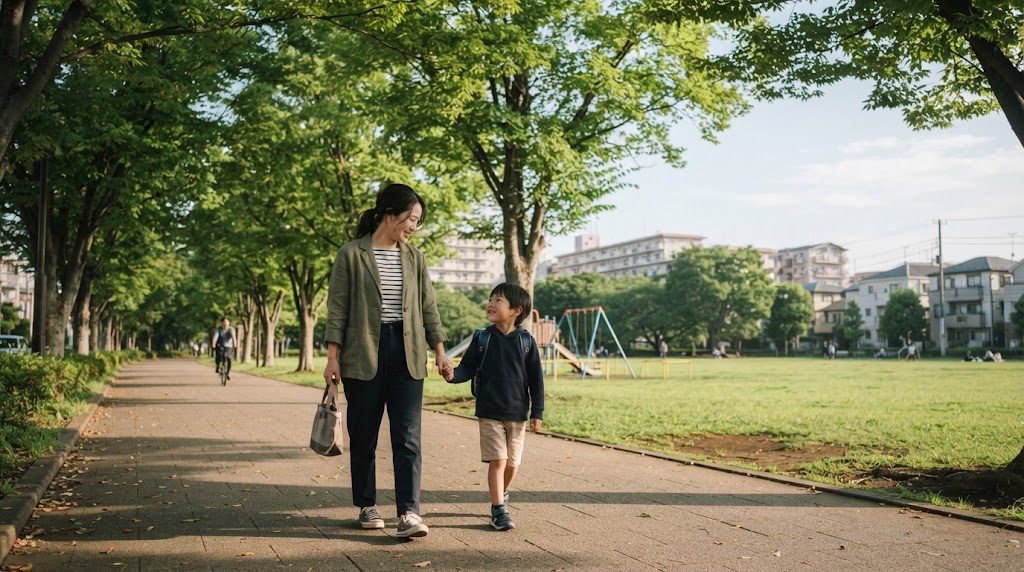
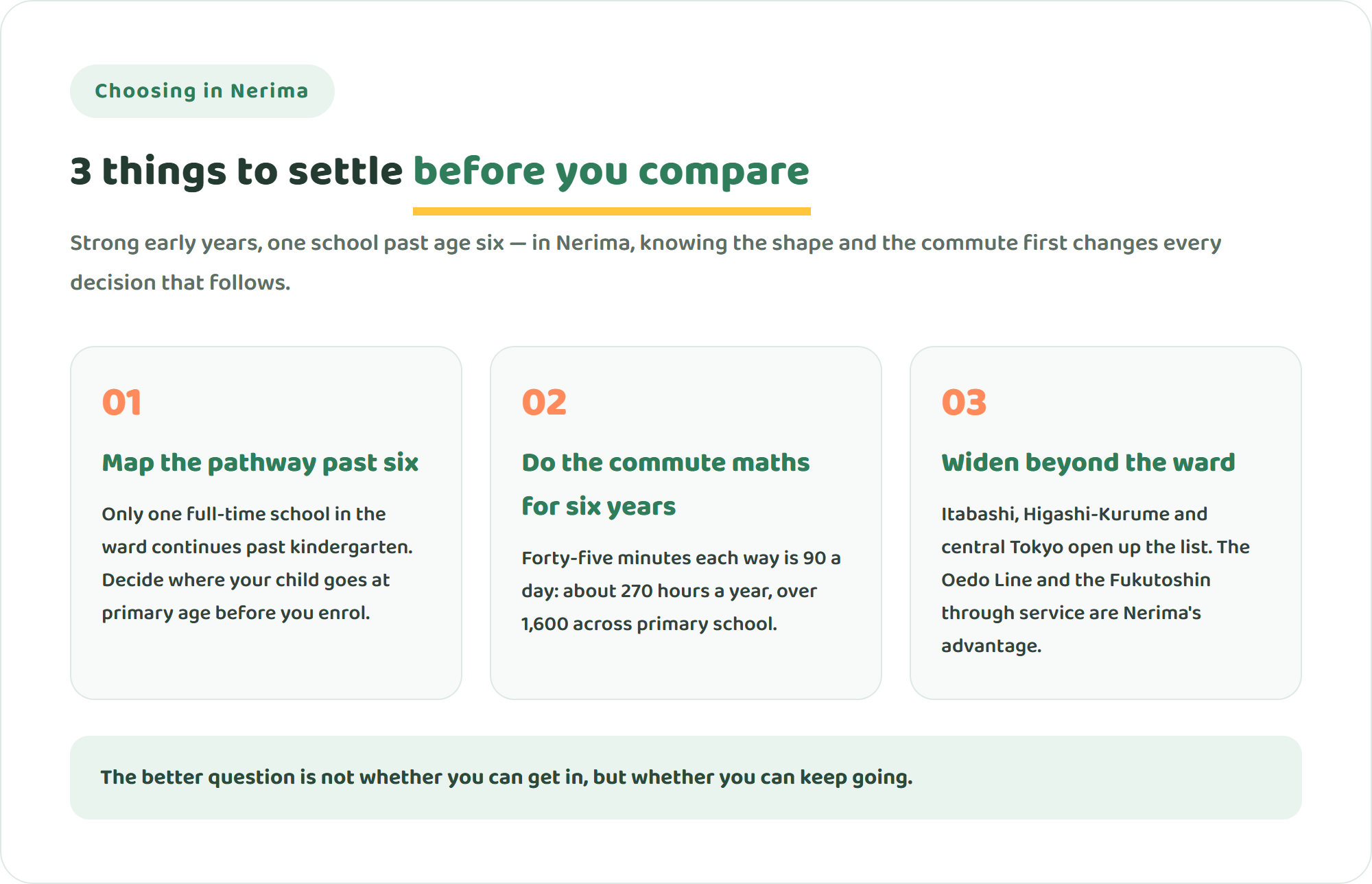
The shape of Nerima can be summed up in one line: rich in English early years, concentrated in a single school after that. Toyotama-kita, Takanodai, Ishigamidai, Higashi-Oizumi and Kasugacho all have English preschools within walking or cycling distance. But once your child turns six, the ward offers exactly one full-time international school — Aoba-Japan International School’s Hikarigaoka campus — and even that stops at Grade 9, with high school taught at the Harumi campus in Chuo Ward.
Families who do not know this often enrol at two or three, then face the question “where next?” in the autumn before primary school starts, with very little time to plan. The single most useful thing you can do in Nerima is to map the pathway past age six before you enrol anywhere.
On fees, Aoba is the only school in the ward publishing figures. For 2026–2027 the annual school fee is about ¥2,332,000 for K3–K5, ¥2,518,000 for Grades 1–5 and ¥2,862,000 from Grade 6 (K2 is about ¥2,098,000), before one-time enrolment and facility development fees, lunch and bus charges. Most preschools in the ward do not publish rates and quote on enquiry. Judge on the total you will actually pay, not the headline tuition — our breakdown of international school costs walks through the line items families tend to forget.
Please note: fees and details here reflect public information as of August 2026. Always confirm the current figures on each school’s official site.
All six international schools in Nerima, by age range and fees
What follows is every international school genuinely located in Nerima Ward. We are not padding the list to reach a round number — six real schools described accurately will serve you better than a longer list you cannot use. Read them in this order: age range first, commute second, then fees and educational approach.
1. Aoba-Japan International School, Hikarigaoka Campus | ¥2.33M–¥2.86M per year
About a 15-minute walk from Hikarigaoka Station on the Toei Oedo Line, this IB World School is the only place in Nerima where a primary or middle school child can learn in English all day. More than 570 students from K3 through Grade 9 work through transdisciplinary units in an inquiry-led programme. The campus has a sports pitch, a swimming pool, a gymnasium and a halal-certified on-site lunch programme, and school buses serve early years and primary families from several parts of Tokyo. From Grade 10 students continue the IB Diploma at the Harumi campus in Chuo Ward, so check the high-school commute before you commit.
- Curriculum: International Baccalaureate, inquiry-led and transdisciplinary
- Ages: 3–15 (K3–Grade 9); Grades 10–12 at the Harumi campus, Chuo Ward
- Fees: Approx. ¥2,332,000 (K3–K5) / ¥2,518,000 (Grades 1–5) / ¥2,862,000 (Grade 6 and above) per year, 2026–2027 official figures, plus first-year enrolment and facility fees, lunch and bus
- Best for: Families in Hikarigaoka, Tagara or Kasugacho who want an English-medium pathway that stays inside the ward
2. Mizuho School (Ishigamidai) | Fees on enquiry
Run by the Mizuho Gakuen school corporation in Ishigamidai, near Kami-Shakujii, this is an IB-authorised school that also draws on Montessori practice — an unusual combination in Tokyo’s early years market. Classes run from infant and toddler groups through preschool and kindergarten, and an after-school programme (EG5) takes kindergarten and primary-age children, which makes it a workable option for families whose child attends a Japanese elementary school but needs a daily English environment. Early drop-off and extended care, plus maths, science, art, music and sport, round out a broad day.
- Curriculum: IB-informed bilingual early years education combined with Montessori
- Ages: Roughly 2–5 (preschool), plus after-school for kindergarten and primary children
- Fees: Not published; enquire directly (also ask whether Japan’s early childhood education subsidy applies)
- Best for: Shakujii and Kami-Shakujii families who want an IB and Montessori environment before primary school
3. Twinkle Star International School (Toyotama-kita) | Fees on enquiry
Within walking distance of Nerima Station, this school has been running since 2002. Alongside preschool (2–4) and kindergarten (3–6) it offers afternoon programmes for ages 2–12, an ICT programme for ages 7–18 and continuation classes for kindergarten graduates, which means your child does not have to lose contact with English at age six. Classes of 12–18 are taught entirely in English by native-speaking teachers, and preschool attendance can be as little as two days a week — a genuinely flexible way to start. Families travel in from Nerima, Suginami, Toshima and Nakano.
- Curriculum: Activity-based English immersion with phonics, taught by native-speaking teachers
- Ages: Preschool 2–4 / Kindergarten 3–6 / Afternoon programme 2–12 / ICT 7–18
- Fees: Not published; varies by number of days, so enquire directly
- Best for: Nerima and Toyotama families who want to begin with two days a week rather than commit to full immersion
4. First Learning Oizumi Gakuen | Fees on enquiry
A short walk from Oizumi-Gakuen Station on the Seibu Ikebukuro Line, this preschool in Higashi-Oizumi is unusually granular about age: a half-day preschool from 18 months, a full preschool from age two, immersion classes for the younger kindergarten years, a Kinder School for the older ones, and ESL/ELD classes for primary-age children. The programme is built on a US early childhood model, every class is led by a non-Japanese teacher, group sizes are deliberately small, and the school is an approved Eiken test venue. For families in Oizumi and toward Hoya, it combines a short commute with a clear ladder of levels.
- Curriculum: English immersion based on a US early childhood programme, small groups throughout
- Ages: 18 months–6 years, plus classes for primary-age children
- Fees: Depends on course and days attended; enquire directly (sibling and friend discounts available)
- Best for: Oizumi families who want to increase English exposure gradually rather than all at once
5. Belgrave International Kindergarten & Preschool (Kasugacho) | Fees on enquiry
Two sites in Kasugacho, walkable from Hikarigaoka and Nerima-Kasugacho stations on the Oedo Line. The preschool and kindergarten accept children from 20 months, and an English school division continues through to high school age, so a child can stay in the same place from toddler phonics all the way to Eiken and TOEFL preparation. Teaching is led by British staff with careful attention to pronunciation in small groups. For Hikarigaoka families, the appeal is continuity: English does not stop when kindergarten ends.
- Curriculum: British-style English education, phonics-led preschool and kindergarten plus a school-age English division
- Ages: 20 months–5 years (preschool/kindergarten); English courses for children through high school age
- Fees: Varies widely by course; enquire directly
- Best for: Hikarigaoka and Kasugacho families who want one place their child can stay with for years
6. Star International Preschool & English (Takanodai) | Fees on enquiry
Five minutes on foot from Nerima-Takanodai Station, this is a small school combining a preschool with English classes for primary-age children. Its distinguishing feature is an emphasis on phonics and written English rather than conversation alone, taught by teachers holding qualifications such as CELTA and adapted to each child’s pace. If you want a small setting where progress is tracked individually, and you live within cycling distance of Shakujii-Koen, Nerima-Takanodai or Fujimidai, it is worth a visit.
- Curriculum: Phonics and writing-focused English programme, preschool plus school-age classes
- Ages: Preschool through primary age (confirm current class structure)
- Fees: Not published; enquire directly
- Best for: Families around Nerima-Takanodai and Shakujii-Koen who want literacy, not just spoken English
Beyond these six, Nerima has children’s English schools such as Sunny International School in Heiwadai, and English-language after-school care (Kids Duo) with locations in Shakujii, Oizumi-Gakuen, Hikarigaoka, Nakamurabashi, Sakuradai and Tagara. Combining a Japanese elementary school with an English afternoon is a legitimate and popular route here. Before six and after school, Nerima is well served. It is the school day itself, past age six, where the ward narrows to one.
Not an international school, but worth knowing: a national IB school inside Nerima
Eight minutes from Oizumi-Gakuen Station sits Tokyo Gakugei University International Secondary School, a six-year national secondary school in Higashi-Oizumi. It is not an international school in the usual sense — it operates under Japanese school law — but it was the first national or public school in Japan authorised for both the IB Middle Years Programme and the Diploma Programme. Its Diploma is dual-language: three of the six subjects are studied in English and three in Japanese, so students can pursue an internationally recognised qualification without letting go of their Japanese. Because it is a national school, costs are dramatically lower than private international schools, but entry is by competitive selection and places are limited.
Whether or not it suits your family, its presence in Nerima is a useful corrective to a common assumption: an international education does not have to mean an international school. Selection procedures and costs change year to year, so check the official site. Official site
Before you widen the search to Itabashi, Higashi-Kurume or central Tokyo, do the commute maths
Search only within Nerima and the list past age six is one school long. So most families start looking outward — and that is where Nerima’s real constraint appears. It is not transport quality. The Oedo Line starts at Hikarigaoka, so you usually get a seat, and it reaches Roppongi and Azabu-Juban without a change. The Seibu Ikebukuro Line runs through to the Fukutoshin and Tokyu Toyoko lines via Kotake-Mukaihara, so Oizumi-Gakuen and Shakujii-Koen reach Shibuya without changing either. The constraint is the total: home to station on foot, train, then station to school gate on foot. Forty-five minutes each way is an ordinary figure for a Nerima family attending a central Tokyo school.
Forty-five minutes each way is 90 minutes a day. At roughly 180 school days a year, that is 270 hours annually and more than 1,600 hours across six years of primary school — two full months of a child’s life spent travelling. Some families weigh that against what the school offers and decide it is worth it. Others look at a six-year-old and decide it is not. There is no correct answer, but do the calculation before you compare tuition, not after. Children who tire easily or struggle with early mornings are the ones for whom the commute, rather than the academics, ends up prompting a change of school.
With that in mind, here are the realistic options outside the ward. Itabashi first: Camelot International School in Mukaihara, two minutes from Kotake-Mukaihara Station, teaches Grades 1 to 12 on the Cambridge international curriculum through IGCSE and A Levels. From Ekoda, Hikawadai or Heiwadai it can be a shorter trip than Hikarigaoka. New Hope International Preschool in Narimasu (ages 3–6) and Mulberry International School in Komone (from six months through primary age) are also within reach from Oizumi and Hikarigaoka.
Then Higashi-Kurume, immediately west of Oizumi: Christian Academy in Japan (CAJ) offers a K-12 North American curriculum taught in English, and for families in Oizumi or Hoya the journey can be shorter than any central Tokyo school. Check its published fee schedule directly, as rates are revised annually.
And central Tokyo, which Nerima reaches better than its reputation suggests — one line to Shinjuku and Roppongi, a through service to Shibuya. If the commute is acceptable, the established schools open up. We cover them ward by ward in our guides to international schools in Shinjuku, Shibuya and Setagaya. To compare across the whole city, start with our guide to international schools in Tokyo.
Comparing the options: what actually fits your family
A list of schools rarely answers the real question. In Nerima it helps to think in three types: the ward’s one full-time international school, its preschools and English after-school programmes, and online international schooling with no commute at all. The table below sets out how each type tends to perform on cost, commute and continuity — honestly, including where each falls short.
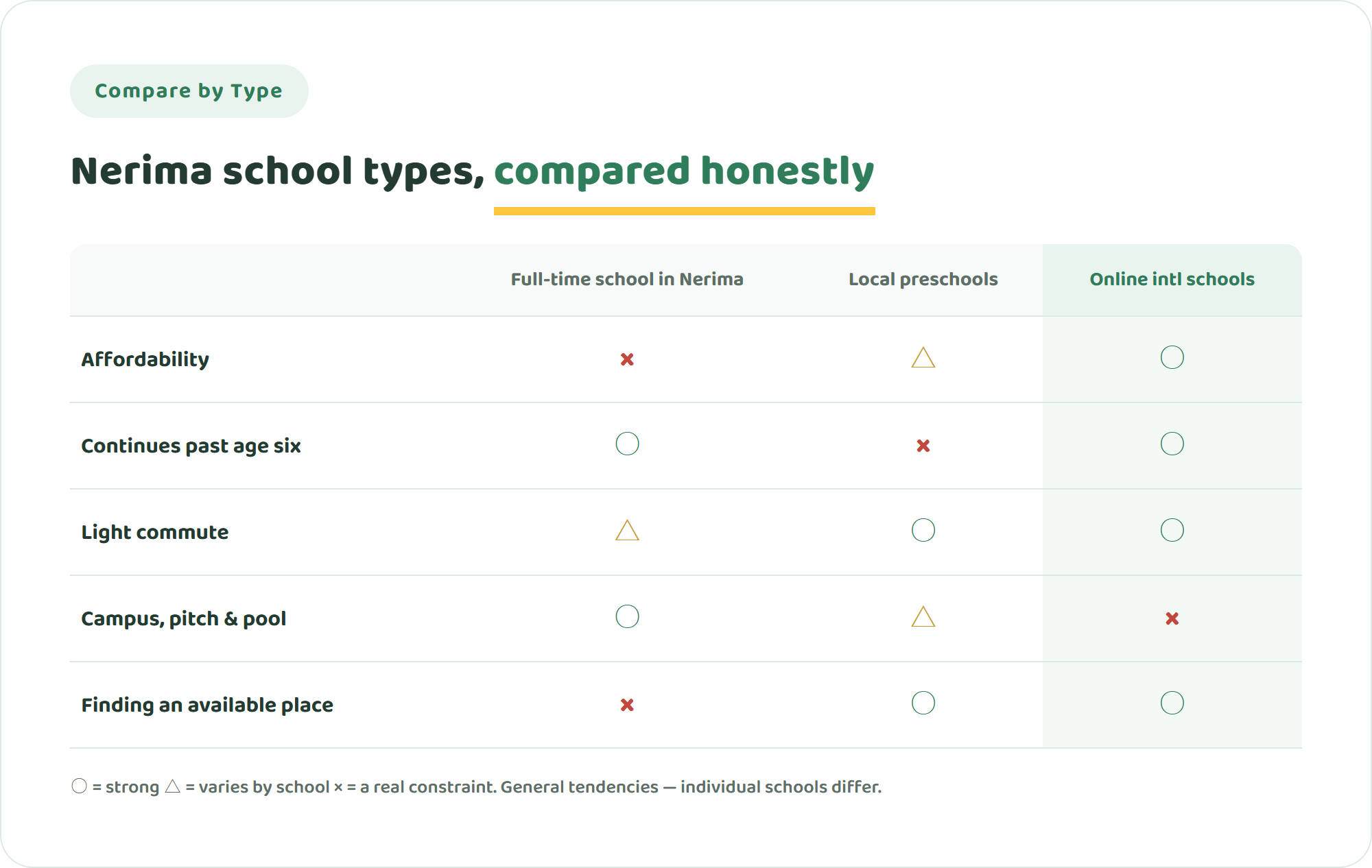
The ward’s one full-time school offers what only a campus can — an IB programme, a pool, a pitch, a shared lunch — but at ¥2.33M to ¥2.86M a year, and with no guarantee a place will be free in your child’s year group. Preschools win on convenience and can qualify for early childhood subsidies, but every family using one must find a “next” at age six. And in a ward where distance is the deciding variable, the third route deserves more attention than it usually gets: with no commute, where you live stops limiting what your child can learn. If the cost itself is the sticking point, our honest look at whether international school is too expensive may help you decide.
See how learning works online →
When fees or the commute are the wall: online as an eighth option
Nerima is a genuinely good place to raise children — the parks, the space, the calm residential streets. But one full-time international school past age six, fees approaching ¥2.9M a year, and a 90-minute daily round trip if you look outside the ward: for many families, at least one of those is a wall. If you find yourself thinking “I want this for my child, but not for six years at this cost,” there is another route that does not require a commute at all.
NIJIN GLOBAL ACADEMY (NGA) is an online international school opening in September 2027. It is run by NIJIN Inc., the company behind NIJIN Academy, an alternative school in Japan with more than 1,000 enrolled students. We do not rank children by test scores. Learning happens in small groups built around dialogue, with one aim: that a child comes to like themselves, and to like the world. We serve ages 6 to 18 across Asia and Oceania, wherever a family lives, and the design assumes Japanese-language support while English builds gradually. Fees are intended to be around one-fifth of an on-campus international school.
To be straight with you: we have not opened yet, and our track record is still ahead of us. We cannot offer the pool, the pitch or the playground that a campus does. But taking 90 minutes a day back from your family’s life, at a fraction of the cost, is worth putting on your Nerima shortlist.
Frequently asked questions
Q. What is the youngest age international schools in Nerima accept?
A. Among preschools, First Learning Oizumi Gakuen starts at 18 months and Belgrave at 20 months, with Mizuho School and Twinkle Star taking children from around age two. For full-time schooling, Aoba-Japan International School’s Hikarigaoka campus begins at K3 (age three) and continues to Grade 9. Narrowing by your child’s current age is the fastest way to build a realistic shortlist.
Q. Which schools in Nerima take primary-age children, and what about Japanese support?
A. Only one school in the ward teaches primary and middle school children in English all day: Aoba-Japan International School, Hikarigaoka, through Grade 9. Everything else in Nerima is centred on the early years, so from age six most families either look outside the ward (Itabashi, Higashi-Kurume or central Tokyo) or combine a Japanese elementary school with an English after-school programme. Japanese-language support varies enormously between schools, in both hours and philosophy, so ask before you enrol. If maintaining your child’s Japanese is a worry, our sister service Tomodachi Japan (online Japanese for children, also run by NIJIN) is worth a look.
Q. Can we transfer mid-year, and is an hour-long commute realistic?
A. Most schools do accept transfers, but in a ward with few schools the real variable is whether a place exists at all. Intakes usually align with April or the August–September start, and an English assessment and interview are common. Start contacting schools around a year before you want to enrol, and attend open houses. On the commute: for younger children, whether a school bus serves your address is often decisive. If there is no bus, or you live off the route, budget realistically for how many years a parent will be doing the trip.
The time you spend deciding is time spent caring
There is no single right school. In a ward like Nerima, where options are few and distance is the deciding factor, the useful question is not “which is best?” but “which could we sustain for years?” Fees, the walk to the station, your child’s stamina — every family’s answer is different. The fact that you are weighing this carefully is itself evidence of how seriously you take your child’s future. Visit two or three schools, and if you can, ride the actual commute at the actual hour. And if you would like to know more about the option that does not involve a commute at all, we would be glad to keep you posted.
International Schools in Other Cities
- International Schools in Tsukuba: Fees
- International Schools in Sendai: 7 Picks and Fees
- International Schools in Shinjuku: Fees
- International Schools in Karuizawa: All 4 Schools
- International Schools in Sapporo: Fees
- International Schools in Dubai: Fees
- International Schools in Singapore
- International Schools in Suginami, Tokyo
- International Schools in Sumida, Tokyo
- International Schools in Tokyo
- International Schools in Minato: Fees
- International Schools in Shibuya, Tokyo
- International Schools in Setagaya: All 14 Schools
- International Schools in Koto, Tokyo
- International Schools in Shinagawa, Tokyo