If you have been reading about Stanford Online High School, Laurel Springs School has probably turned up in the same search. Both are private American online schools. Both accept students who live outside the United States. Both award an accredited US high school diploma. So when it comes to Stanford OHS vs Laurel Springs, what actually separates them?
In short: they are designed in opposite ways. Stanford OHS is a selective school built around small, live, discussion-based seminars held at fixed times. Laurel Springs is a self-paced school where the coursework is open around the clock. Full-time high school tuition differs by roughly three times, and for a family living in Asia, the deciding factor is often something the fee table doesn’t show: what time the classes fall in your own time zone. This Stanford OHS vs Laurel Springs comparison uses only each school’s official 2026–27 information.

Stanford OHS vs Laurel Springs at a glance
Both schools are accredited private schools that grant a US diploma. Beyond that, here is how they differ.
| Item | Stanford Online High School | Laurel Springs School |
|---|---|---|
| Founded | 2006, within Stanford University | 1991, Ojai, California |
| Grades | 7–12 | K–12 |
| Learning model | Live seminars (average 12 students, never more than 17) | Self-paced and asynchronous (weekly live Workshop in the Academy only) |
| High school tuition, 2026–27 | $31,900 full-time; $19,140 part-time | $11,700 ($17,250 in the Academy) |
| Single course (high school) | $6,380 | $900–$2,200 |
| Admission | Selective; fall entry only | Records review and placement; start on almost any Wednesday |
| Accreditation | WASC and CAIS | WASC and Cognia |
| English | Full written and spoken fluency expected | No English test, but fluent academic English needed |
Sources: Stanford Online High School and Laurel Springs School official websites, checked 22 September 2026. US dollars; books, materials and application fees are extra.
Tuition: a threefold gap that reflects what you are buying
Here are the published 2026–27 prices side by side.
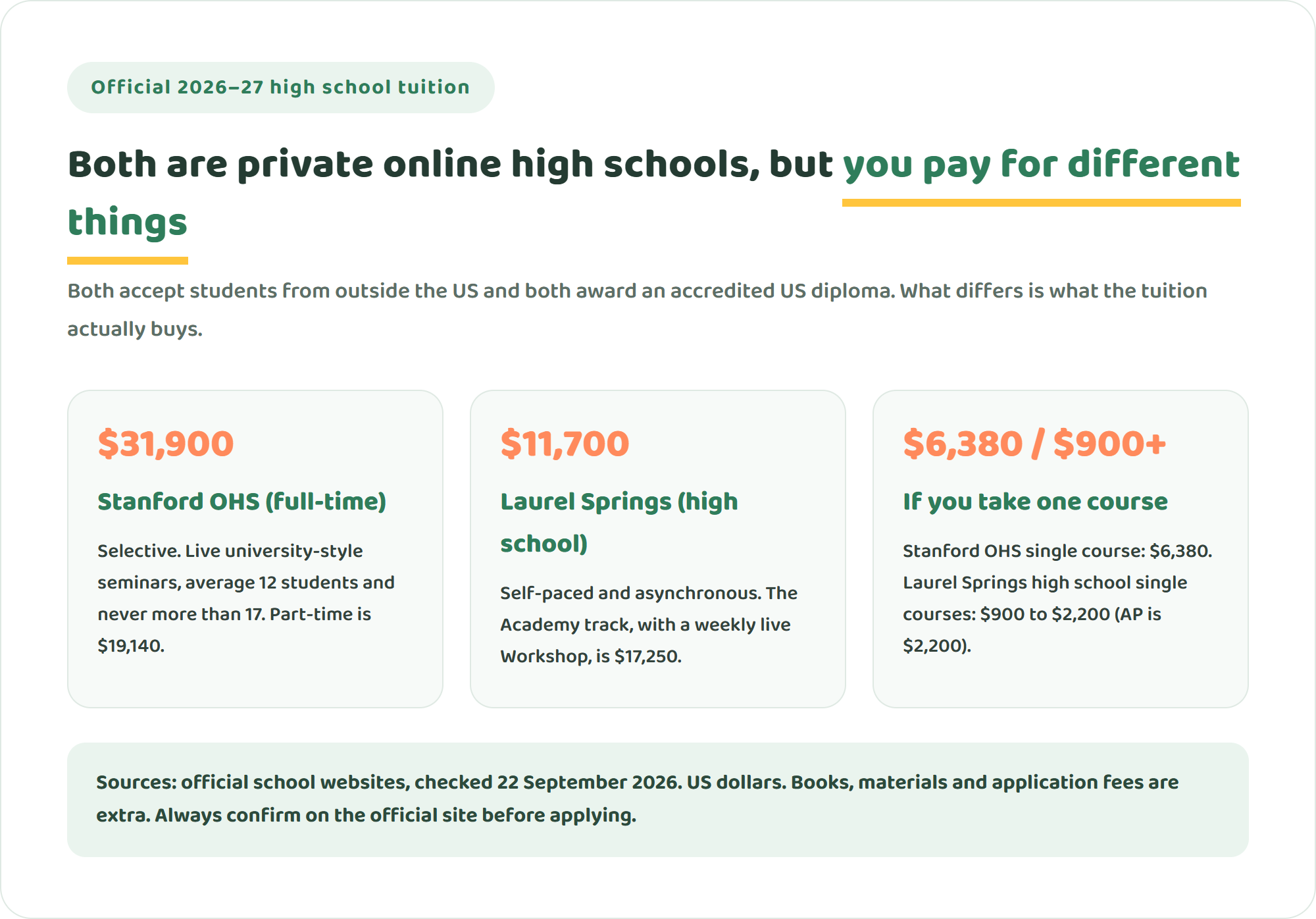
Stanford OHS charges $31,900 a year for full-time study (four or more courses), and the rate is the same for international and domestic families. On top of that come a $100 application fee and books and materials of roughly $30 to $1,300 a year. Four years of full-time high school come to 4 × $31,900 = $127,600 in tuition alone. The important counterweight is need-based financial aid, which is open to families outside the US. The school reports $2.5 million in tuition aid for 2025–26 across 145 recipients, with most recipients having 75% to 100% of tuition covered. There are no merit scholarships.
Laurel Springs charges $11,700 a year for its main high school program, or $46,800 over four years. The Academy track, which adds a weekly live Workshop and a more structured rhythm, costs $17,250 a year. Sibling, military and pay-in-full discounts exist, but the percentages are not published on the official site.
The gap does not mean the more expensive school is the better one. Stanford OHS tuition pays for small seminars, mostly taught by instructors with doctorates, and the scheduling work that makes live teaching across time zones possible. Laurel Springs tuition pays for a support system around self-paced study: a catalogue of 300+ courses, one-to-one help from certified teachers, 24/7 tutoring through Tutor.com, and an assigned college counselor. Our full breakdowns are in Stanford Online High School tuition and review and Laurel Springs School tuition and review.
Convert the timetable, and the difference becomes obvious
For a family in Asia, this is the section that matters most.
Stanford OHS: classes tend to land in the Asian morning
Stanford OHS runs a college-style block schedule. Most courses meet twice a week (Monday/Wednesday or Tuesday/Thursday), with about 2.5 hours of live meetings per course each week. High school students add 5.5 to 7.5 hours of coursework per course, and the school’s own rule of thumb is 8 to 10 hours a week per course.
Most sections are scheduled between 7:15am and 9pm Pacific Time, within an extended school day of 6am to 10pm. For international students, the school says it schedules classes between 6:00am and 10:30pm in the student’s own local time. Apply that to Japan and, by our own arithmetic for the daylight-saving months, the realistic window runs from about 6am to 2pm Japan time (an hour later, to about 3pm, during the winter months). For Singapore, Hong Kong or Manila, it is roughly 6am to 1pm, plus a short slot late in the evening. In other words, Stanford OHS sections for students in East and Southeast Asia tend to fall in the morning and around midday — often the same hours as a local school day.
The master schedule is rebuilt every spring and the school meets more than 90% of scheduling requests, but it also warns that you cannot know in advance when a particular course will run. For students attending another school full-time, Stanford OHS itself recommends taking just one course a year. If your child is at a local school in Asia, one course in an early-morning slot is a sensible ceiling to plan around.
Laurel Springs: almost no time-zone problem, but it asks for self-direction
The core Laurel Springs program is asynchronous. Material sits in the learning platform and students work through it whenever suits them; the school says there is deliberately no template for a typical day, and students get 10 personal days each semester. A student in Tokyo or Bangkok can study after local school, in the evening or at weekends.
The live pieces are where the nuance lies. Laurel Springs’ international page says its virtual clubs and activities suit students available during US-friendly hours, and the times of Academy Workshops are not published. If you are considering the Academy from Asia, ask which Workshop sections run at hours your child can attend before you pay. For a broader look at how live and self-paced models shape a day, see how an online international school works.

Admission: a selective school vs a rolling start
Stanford OHS is selective. The school says it receives far more applicants than it can admit and cannot accept every qualified applicant; it does not publish an acceptance rate. An application needs two 400-word essays, a recent analytical writing sample, two teacher recommendations (one humanities or social science, one maths or science), transcripts for the current and past two years, and a parent questionnaire. A standardised test score (SSAT, ISEE, PSAT, PreACT, SAT or ACT) is required for homeschooled applicants and for students at schools that teach in a language other than English — which includes most local schools in Japan, Korea, China and much of Southeast Asia.
For 2027–28 entry, the application deadline is 7 January 2027, optional interviews must be requested by 11 November 2026, and decisions come in March 2027. Entry is in the fall only. The school is also explicit that it is not a feeder to Stanford University.
Laurel Springs admits on a rolling basis after an application, a records review and placement, and students can begin on almost any Wednesday. No English test is required, but everything is taught in English, so fluent academic English is assumed.
That shared assumption is the point families in Asia most often miss: both schools are built for children who can already learn in English. For a child still building their English, either school will be heavy going.
Five questions, side by side
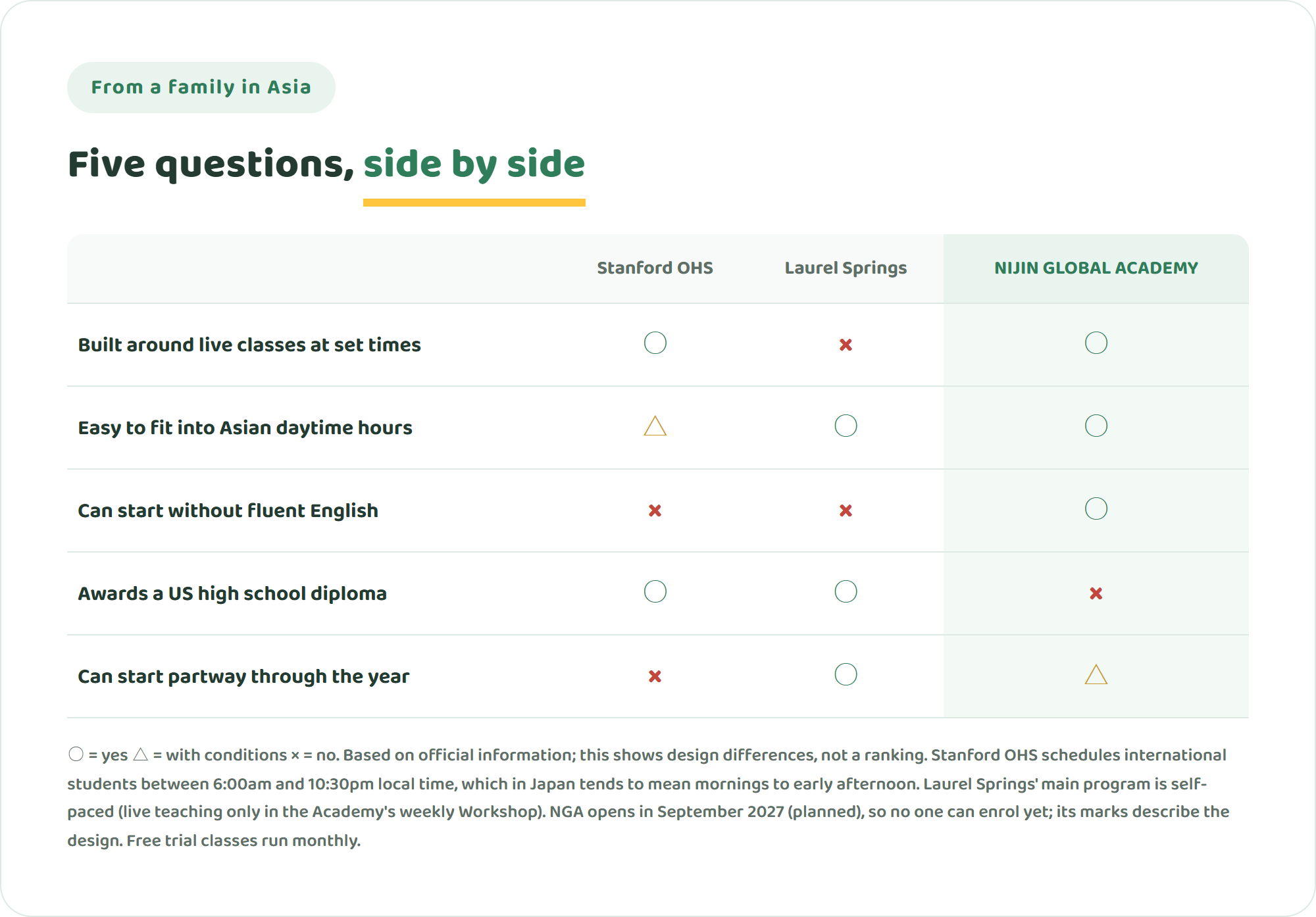
The pattern is clear: the richer the live teaching, the harder it is to fit into Asian daytime hours, and the reverse. If your child values debating with classmates in real time, Stanford OHS is built for that. If you want a US diploma without disrupting life at home, Laurel Springs is built for that. Neither is better in the abstract; the question is which fits your child.
NIJIN GLOBAL ACADEMY (NGA), which publishes this site, is a different kind of school, and we include it for contrast rather than as a like-for-like rival. It is an online international school opening in September 2027 (planned). It will not award a US diploma, and it is not yet accredited and has no graduates. What it is designed around is small live classes of about eight, timed for Asia and Oceania daytime, no entrance exam, no English requirement, and a bilingual English–Japanese mentor alongside subject learning in English. You can read how that works in our curriculum.
Which child suits which school?
Stanford OHS tends to suit a child who…
- enjoys arguing a point in English and is already working above grade level;
- is happy to be on camera with the same small group at fixed times each week;
- either makes Stanford OHS their main school, or is willing to limit it to a single course alongside a local school.
Laurel Springs tends to suit a child who…
- can plan their own week, or has an adult at home who can keep an eye on progress;
- has training, performances or family travel that make fixed class times difficult;
- needs to start mid-year rather than wait for the fall.
And if your child says, “I don’t get much done on my own, but I also can’t do live classes that clash with my local school day”? Then neither school may be the right fit, and it is worth comparing online schools that run live classes in Asian hours. American online schools for international students: 5 compared and British vs American online international schools are good next reads.
Decide in this order before you apply
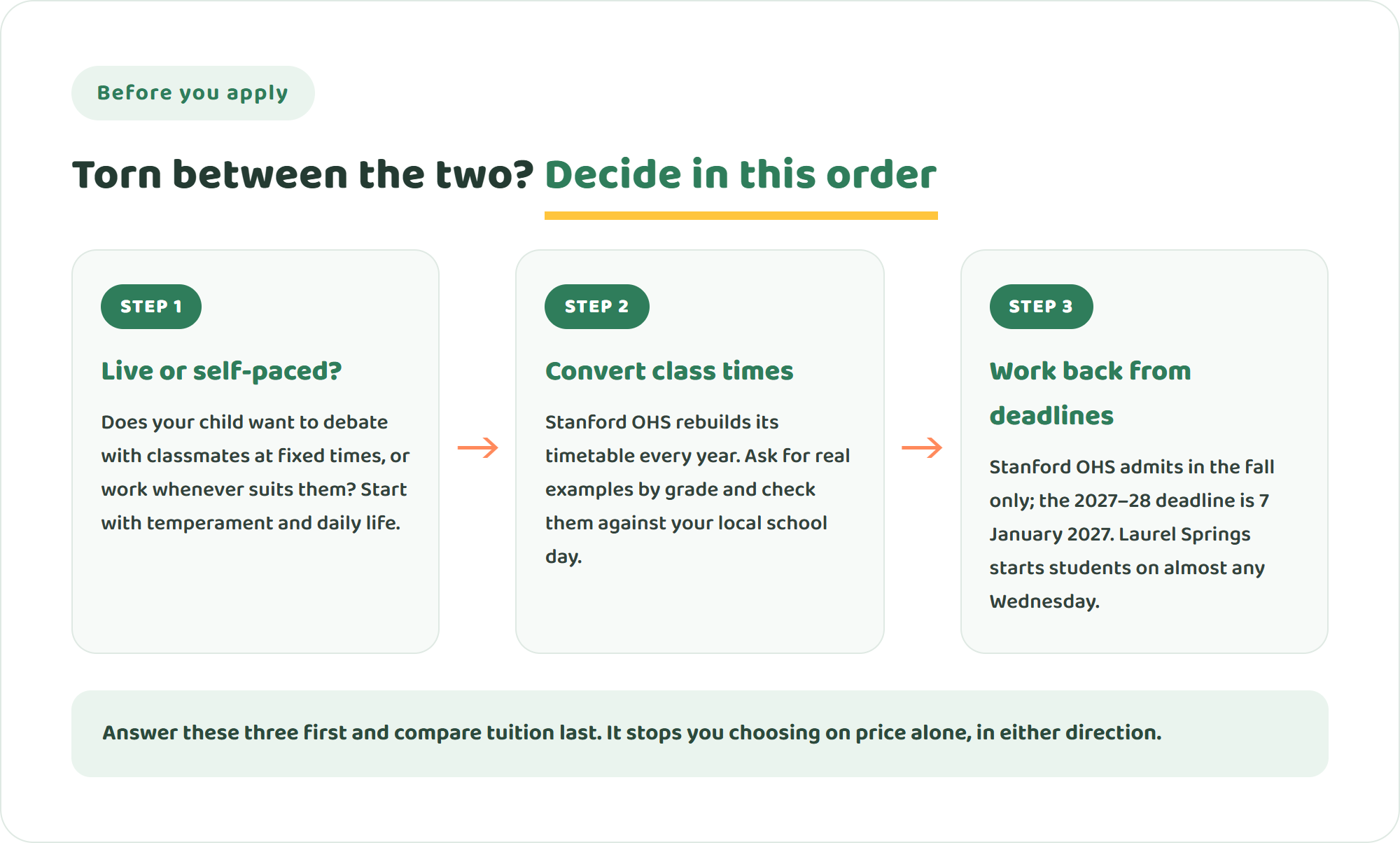
First, live or self-paced. Second, rewrite the timetable in your local time. Third, work back from the deadlines. If Stanford OHS is on your list for 2027–28, the interview request closes on 11 November 2026 and the application on 7 January 2027 — which means now is the time to start collecting recommendations and writing samples.
It also helps to think about what the diploma is for. How a US diploma is treated depends on the university and the country you are applying in; we explain the questions to ask in where online international school graduates go.

FAQ
Is Stanford OHS better than Laurel Springs?
Not in general. Stanford OHS is more selective and built on live seminars; Laurel Springs is more flexible and built on self-paced study. Both are accredited and both award a US diploma. The better school is the one whose timetable and teaching style fit your child.
Can my child take Stanford OHS or Laurel Springs alongside a local school in Asia?
Yes, both offer part-time or single-course options. Stanford OHS offers part-time (two to three courses) and single courses; Laurel Springs offers one to three individual courses. Because Stanford OHS sections for Asia tend to fall in the morning, check carefully that they don’t clash with the local school day.
Which is cheaper?
Laurel Springs, on published prices: $11,700 a year for high school against $31,900 for full-time Stanford OHS. But Stanford OHS offers substantial need-based aid to international families, so apply for aid before ruling it out on cost.
Does my child need fluent English?
Yes, for both. Stanford OHS states that full fluency is expected, and Laurel Springs says students need fluent academic English, even though neither requires a test.
Picture the day before you compare the price
Stanford OHS and Laurel Springs are both established schools with real track records. That is exactly why it is tempting to choose on reputation or price. The mismatches families report later tend to be practical ones: classes that clash with the local school day, or self-paced work that quietly stalls. What time, with whom, and in what way will your child learn? If you can picture that clearly, the right school is much easier to see.
NIJIN GLOBAL ACADEMY is an online international school scheduled to open in September 2027, with trial classes planned for April and May 2027. We are designing it around small live classes held in Asia and Oceania daytime hours, where children are never ranked by test scores and have room to grow to like themselves and the world. We will share our curriculum, timetable and approach to fees by email as they are confirmed.
There is no need to decide today. Try rewriting one school’s timetable in your local time — it narrows the list faster than any fee table.
Get opening updates by email →
More on choosing an international education
- Alpha School vs Sora vs Primer——Which new school model a family in Asia can use
- Can You Raise a Bilingual Child Without Speaking English?——What parents can realistically do at home
- School Refusal? An Online International School Can Reopen Learning——A route back into learning
- How Do You Nurture the Skills Standardized Tests Cannot Measure?——Beyond exam scores
- The Best Age to Start Learning English for Kids——Too early? Too late?
- Online International Education in Asia and Oceania: 7 Options Compared——An honest comparison
- Where Do International School Graduates Go?——University outcomes, honestly
- Affordable International Education for Your Child——How to keep costs down
- Positive School Refusal: Supporting a Child Who Learns Outside School——Practical support for families
- International School Fees in Asia by Country——An honest comparison, and the online third path