Alpha School, Sora Schools and Primer tend to come up together whenever people talk about the “new wave” of American schools. All three were founded to do school differently, all three use technology in the classroom, and all three get described, loosely, as AI schools or microschools. Put them side by side, though, and they turn out to be three very different things.
This Alpha School vs Sora vs Primer comparison uses only what each school publishes on its official website. It covers what each one is, how the school day works, what it costs, and how it is accredited. Then it asks the question that matters most if you live in Tokyo, Singapore, Bangkok or Sydney: which of the three can your family actually use from where you are? The short answer is that, for 2026 at least, only one of them is realistically open to families outside the US, and even that one comes with conditions.
Alpha School vs Sora vs Primer at a glance
| Item | Alpha School | Sora Schools | Primer |
|---|---|---|---|
| Format | In-person campus network | Fully online | In-person microschools |
| Founded | 2014, Austin, Texas | 2019 | 2019; first campus in Miami, 2023 |
| Grades | PreK/K–8 at most campuses; K–12 at some | 6–12 | K–8 |
| Core idea | About 2 hours a day of adaptive, mastery-based software for core academics; life-skills workshops for the rest of the day | Live classes plus 12-week project “expeditions”; mastery-based assessment | Teacher-led reading, writing and maths at each child’s level; project “Pursuits” in the afternoon |
| Who teaches | Software delivers most instruction; adults are “guides” | Live teachers; 9:1 student-teacher ratio | A “Primer Leader” teacher per cohort, supported by adaptive tools |
| Published cost | $10,000–$75,000 a year by campus (Austin $40,000) | $17,900 a year; Flexible Tuition $7,500–$16,000 | Out-of-pocket after state scholarships: $0–$6,752 (FL, AZ); up to $10,710 (TX); $500 (AL) |
| Accreditation | Cognia | WASC and Cognia (grades 9–12) | Cognia “Accreditation with Merit” (school’s statement) |
Sources: official websites of Alpha School (checked 22 September 2026), Sora Schools and Primer (checked 25 September 2026). US dollars.
Alpha School: two hours of software, a full day of school
Alpha School is a private school network that began in Austin in 2014 and now lists more than 40 campuses across the United States, most serving kindergarten to grade 8. Its model, 2 Hour Learning, puts core academics — maths, reading, language and science — onto adaptive software each morning. Students only move on once they have mastered a topic. The adults on campus are called guides rather than teachers; according to the school’s FAQ, their job is motivation, mentoring and coaching, and they start on a salary of $100,000.
The most common misunderstanding is that students are only at school for two hours. They are not. The two hours are the academic block, and the rest of a full school day goes to workshops in public speaking, entrepreneurship, leadership and financial literacy, plus outdoor time. At the Austin campus the day runs from 8:15am to 4pm.
Tuition is set campus by campus, from $10,000 a year in Brownsville, Texas, to $75,000 in San Francisco and Palo Alto, with Austin at $40,000 and most campuses between $40,000 and $65,000. There is a $100 application fee, a $1,000 deposit that is credited to tuition, and a 5% discount for second and subsequent children. The school says tuition covers all activities and trips. It reports MAP Growth results in the top 1–2% nationally; those are its own figures, and independent long-term studies of the model are not published on the official site. For the full fee list and the most common questions from parents, see our Alpha School tuition and review.
Sora Schools: a live online school built on projects
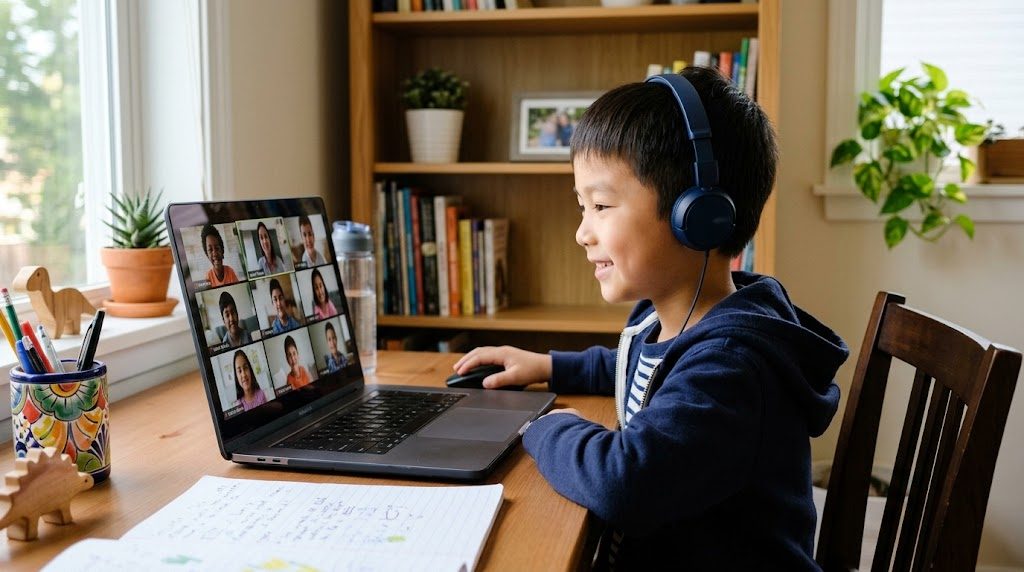
Sora Schools is a fully online private school for grades 6–12, founded in 2019. Where Alpha compresses academics into software, Sora leans on people: students spend about 3.5 hours a day in live meetings, including a daily advisory check-in, live classes and office hours, with a 9:1 student-to-teacher ratio. Classes run Monday, Tuesday, Thursday and Friday; Wednesday is a community day for clubs, all-school meetings and one-to-one time with teachers. Learning is organised into 12-week interdisciplinary “expeditions” that end in a project presentation.
Full tuition is $17,900 a year ($1,790 a month). The school says most families pay less through need-based Flexible Tuition, which ranges from $7,500 to $16,000, with a median of about $8,700. State education savings accounts can cover tuition for some families in Arizona, Utah, West Virginia and New Hampshire. Sora states that its WASC and Cognia accreditation centres on grades 9–12. More detail is in our Sora Schools tuition and review.
Primer: small in-person schools funded by state scholarships
Primer is a network of small private schools for kindergarten to grade 8 in four states: Florida, Alabama, Arizona and Texas. Classrooms mix grades into three bands (K–2, 3–5 and 6–8). Mornings are reading, writing and maths at each child’s level, taught by a teacher called a Primer Leader with adaptive tools in support; afternoons are hands-on projects called Pursuits. Primer states that it has earned Cognia “Accreditation with Merit”, though it does not say which campuses or from when.
Primer is also the most unusual of the three on price. It does not publish a sticker price at all. Instead it publishes what families typically pay out of pocket once their state’s scholarship or education savings account has been applied: $0 to $6,752 a year in Florida and Arizona depending on household income, up to $10,710 in Texas, and a flat $500 in Alabama, plus a one-time $20 enrolment fee. Those figures depend on state programmes that are generally only for residents. See our Primer microschool tuition and review for the state-by-state detail.
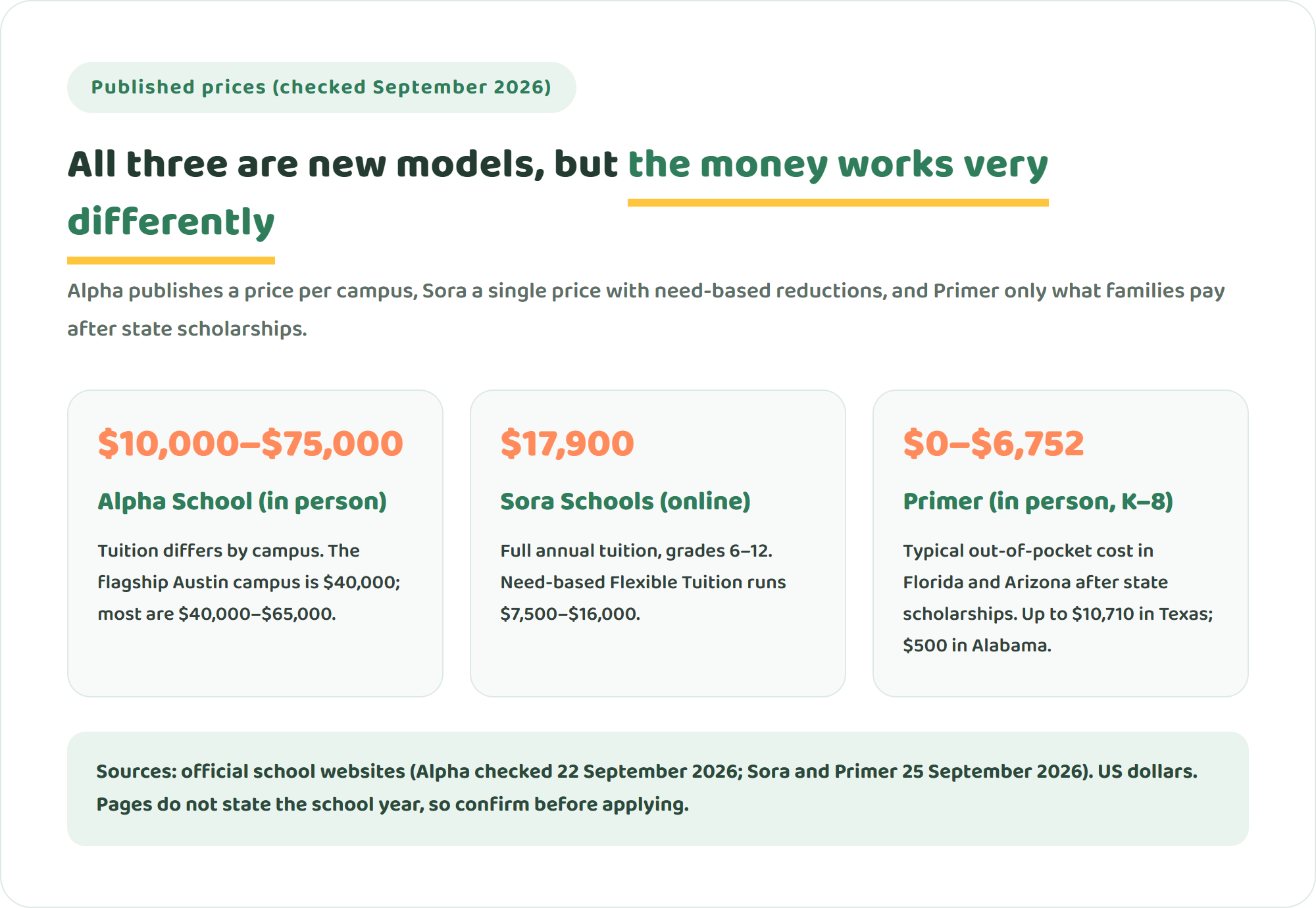
Seen together, the three price lists tell you a lot about the three schools. Alpha charges like a premium private day school, Sora like a mid-priced online school with generous aid, and Primer like a school designed around public school-choice money. None of those models travels abroad unchanged.
Which of the three can a family in Asia actually use?
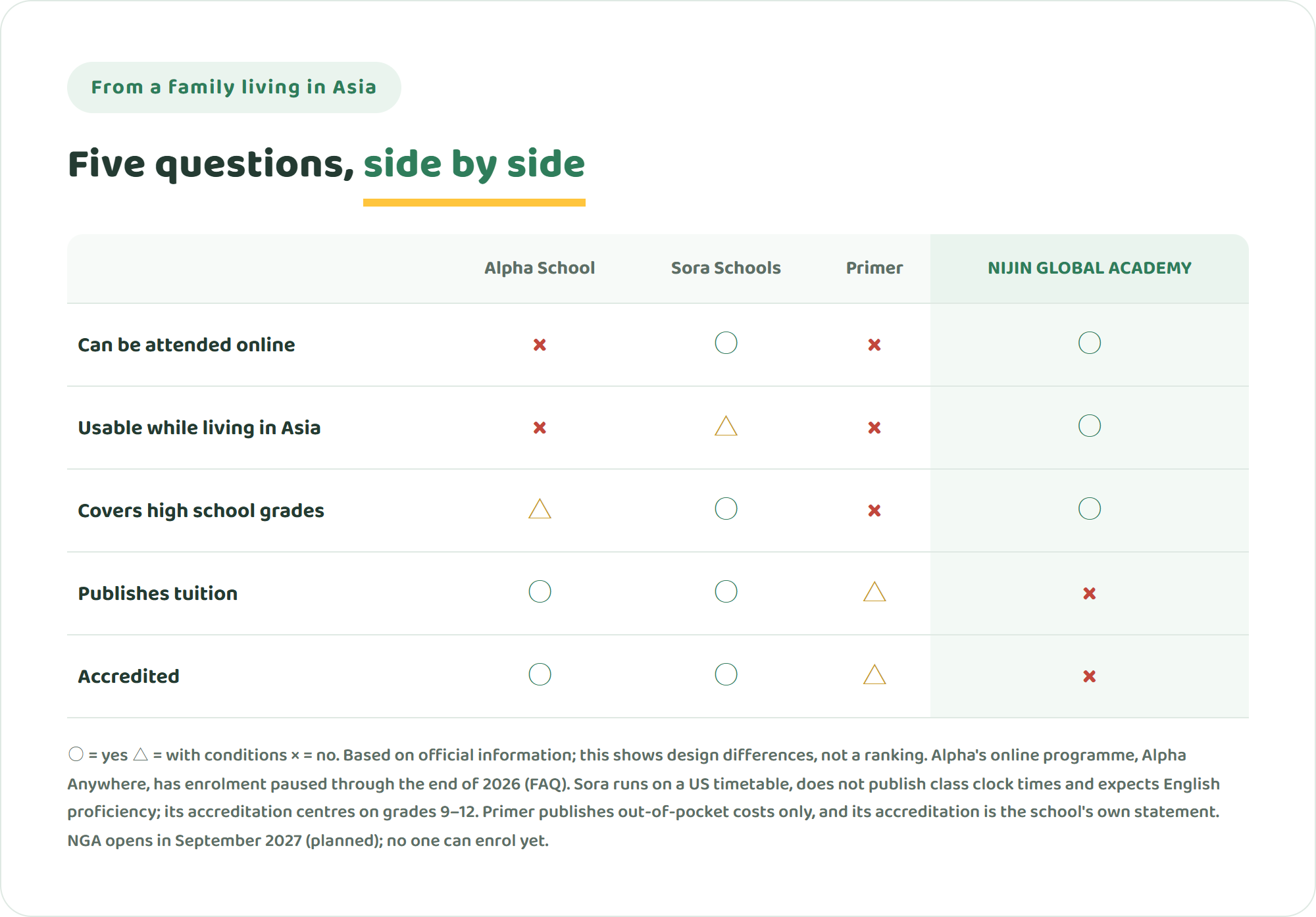
Alpha School is an in-person school, and its FAQ says so. Its at-home version, Alpha Anywhere, was announced as “available worldwide” on Alpha’s blog in May 2026, but the FAQ checked on 22 September 2026 says enrolment is paused through the end of 2026, and no price is published. For now, the only route in from Asia is relocating near a campus.
Primer is in person too, in four US states, and its low out-of-pocket prices depend on those states’ scholarship programmes. It is worth a look only if your family is moving to one of those states.
Sora Schools is the one that could, in principle, be used from Asia: it is fully online and says it serves families living abroad. Two conditions matter. The first is time. Sora’s schedule blocks are built around a US school day, and their clock times are not published. A US school morning falls roughly between late evening and the small hours across East and Southeast Asia, so ask admissions exactly which local hours each block covers before you apply. The second is English: all lessons are in English and the school expects students to demonstrate English proficiency.
What families outside the US can take from these schools
Even when you cannot enrol, these three schools are worth understanding, because each one makes a clear argument about how school time could be used.
- From Alpha: progress in the basics can follow the child’s understanding rather than the calendar, and time saved can go to public speaking, building things and working with others.
- From Sora: online school does not have to be lonely or passive. Daily contact with an advisor and project work presented to real audiences keep students connected.
- From Primer: technology works best when it supports a teacher who knows the child, not when it replaces one.
If you are exploring alternatives more broadly, what an alternative school is and how to choose one and Acton Academy tuition and review (a learner-driven network with campuses in 30 countries) are useful next reads. If mastery-based learning appeals but you need it online, Khan World School @ ASU Prep publishes an international rate.
Three questions to ask about any new school model
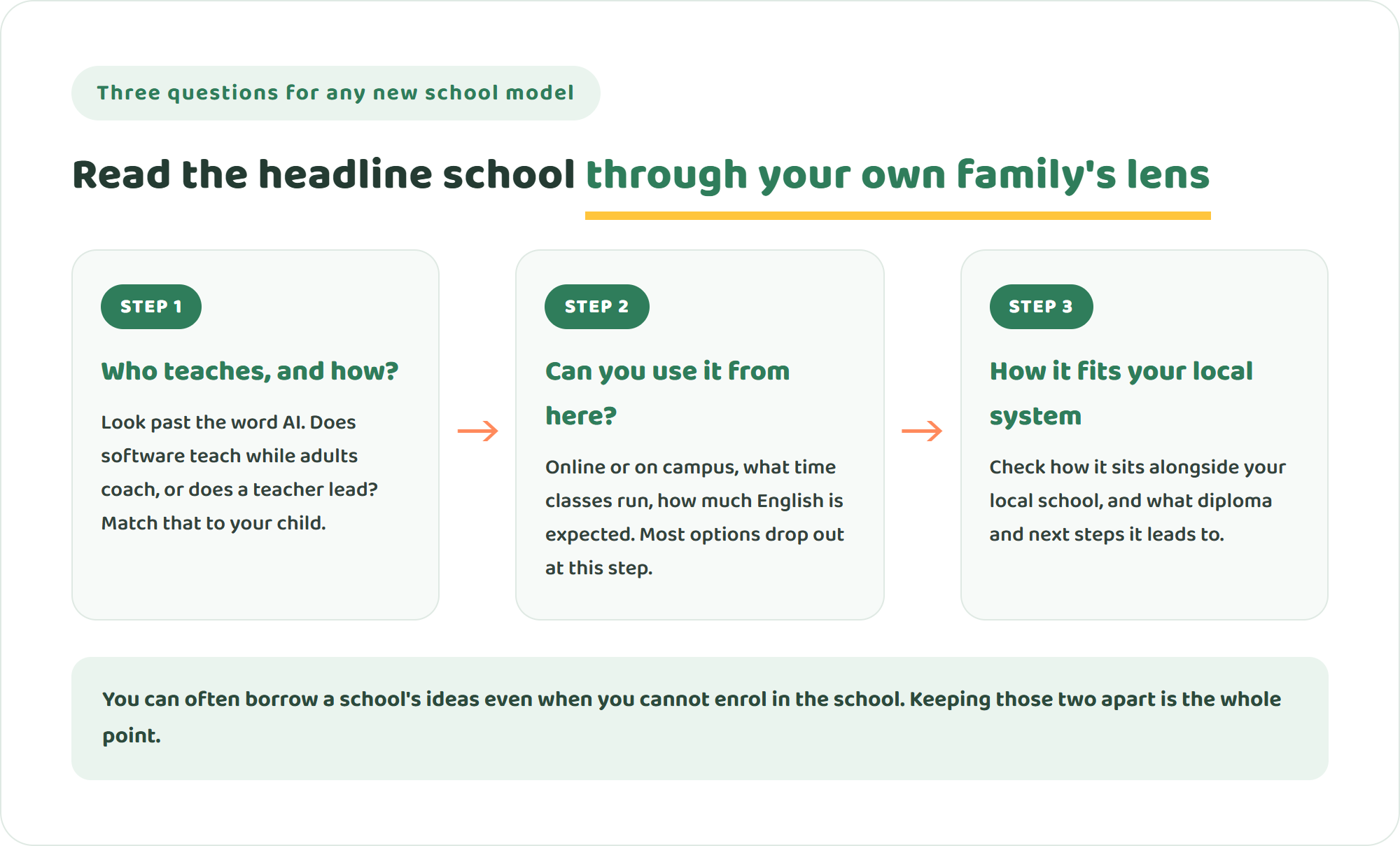
Who teaches, and how? Look past the word AI. Alpha has software teach while adults coach. Primer has a teacher lead while software supports. Sora has live teachers and classmates with projects at the centre. The same label covers very different days for a child.
Can you use it from where you live? Is it online or on campus? What time are live classes in your time zone? How much English is expected on day one? This is where most headline schools drop off the list for families in Asia. Our comparison of American online schools for international students goes through the ones that do accept students from abroad.
How does it fit your local system? Think about how an online or overseas school sits alongside your child’s current school, and what diploma or records it leads to. Many families start by combining a local school with online learning, rather than replacing one with the other.
Where NIJIN GLOBAL ACADEMY fits
NIJIN GLOBAL ACADEMY (NGA), which publishes this site, is not one of these schools and is not built like any of them. It is an online international school for ages 6–18 opening in September 2027 (planned). It does not hand core academics to software. It is designed around small live classes of about eight, where children learn through dialogue with teachers and classmates, timed for daytime in Asia and Oceania. There is no entrance exam and no English requirement; children learn subjects in English alongside a bilingual English–Japanese mentor, with English levels based on the CEFR.
To be clear about what NGA is not yet: it has not opened, it is not yet accredited, it has no graduates, and its tuition has not been published. If its approach — never ranking children by test scores, and giving them room to grow to like themselves and the world — sounds like a fit, you can read more in our curriculum.

FAQ
Is Alpha School better than Sora or Primer?
They are not really competing for the same families. Alpha is an in-person school built on adaptive software and afternoon workshops, Sora is a live online school built on projects, and Primer is a teacher-led in-person school for K–8 funded largely by state scholarships. The better fit depends on your child, your budget and where you live.
Can international students attend Alpha School online?
Not at the moment. Alpha Anywhere, the online version, has enrolment paused through the end of 2026 according to the school’s FAQ (checked 22 September 2026). Check the official site for when enrolment reopens and at what price.
Is Sora Schools available outside the US?
Sora is fully online and says it serves families abroad, but classes run on a US timetable whose clock times are not published, and students are expected to be proficient in English. Ask admissions which local hours the schedule blocks fall in before applying.
Why is Primer so cheap?
Because Primer’s published prices are what families pay after state scholarships or education savings accounts in Florida, Arizona, Texas and Alabama. Without those programmes, the full tuition is not published on the official site.
You can learn from a school you cannot join
Alpha School, Sora and Primer get attention because each asks whether school time could be used better. For most families in Asia, none of them is a school you can simply sign up for today. But the ideas travel: let the basics follow the child’s pace, and give the time that frees up to projects, people and the wider world.
NIJIN GLOBAL ACADEMY is scheduled to open in September 2027, with trial classes planned for April and May 2027. We will share our curriculum, timetable and approach to fees by email as they are confirmed.
There is no need to decide anything today. Try reading one of these schools’ “day in the life” pages with your child — it is a quick way to find out what matters to your family.
Get opening updates by email →
More on choosing an international education
- Can You Raise a Bilingual Child Without Speaking English?——What parents can realistically do at home
- School Refusal? An Online International School Can Reopen Learning——A route back into learning
- How Do You Nurture the Skills Standardized Tests Cannot Measure?——Beyond exam scores
- The Best Age to Start Learning English for Kids——Too early? Too late?
- Online International Education in Asia and Oceania: 7 Options Compared——An honest comparison
- Where Do International School Graduates Go?——University outcomes, honestly
- Affordable International Education for Your Child——How to keep costs down
- Positive School Refusal: Supporting a Child Who Learns Outside School——Practical support for families
- International School Fees in Asia by Country——An honest comparison, and the online third path
- Are There Subsidies for International Schools?——Realistic ways to lower the cost