“Online is supposed to be so much cheaper.” If you have just closed the fee page of an international school in Singapore, Bangkok, Manila, Shanghai or Kuala Lumpur, that sentence is probably why you started comparing online vs in-person international school cost at all. The two really are built on different economics. But settling the question with the words “cheaper” or “dearer” is exactly how families end up with a budget that breaks in year three.
This article does not try to guess anyone’s tuition figure. It does something more useful: it lays out every line that leaves your account across one year, side by side. On campus, costs stack up outside tuition. Online, a different set of costs stacks up outside tuition — in your home, on your equipment, and in your own time. Writing honestly about only one of them would be useless, so we will do both. By the end you should be able to draw the line your own family can sustain, in your own numbers.
Compare the annual outflow, not the tuition line
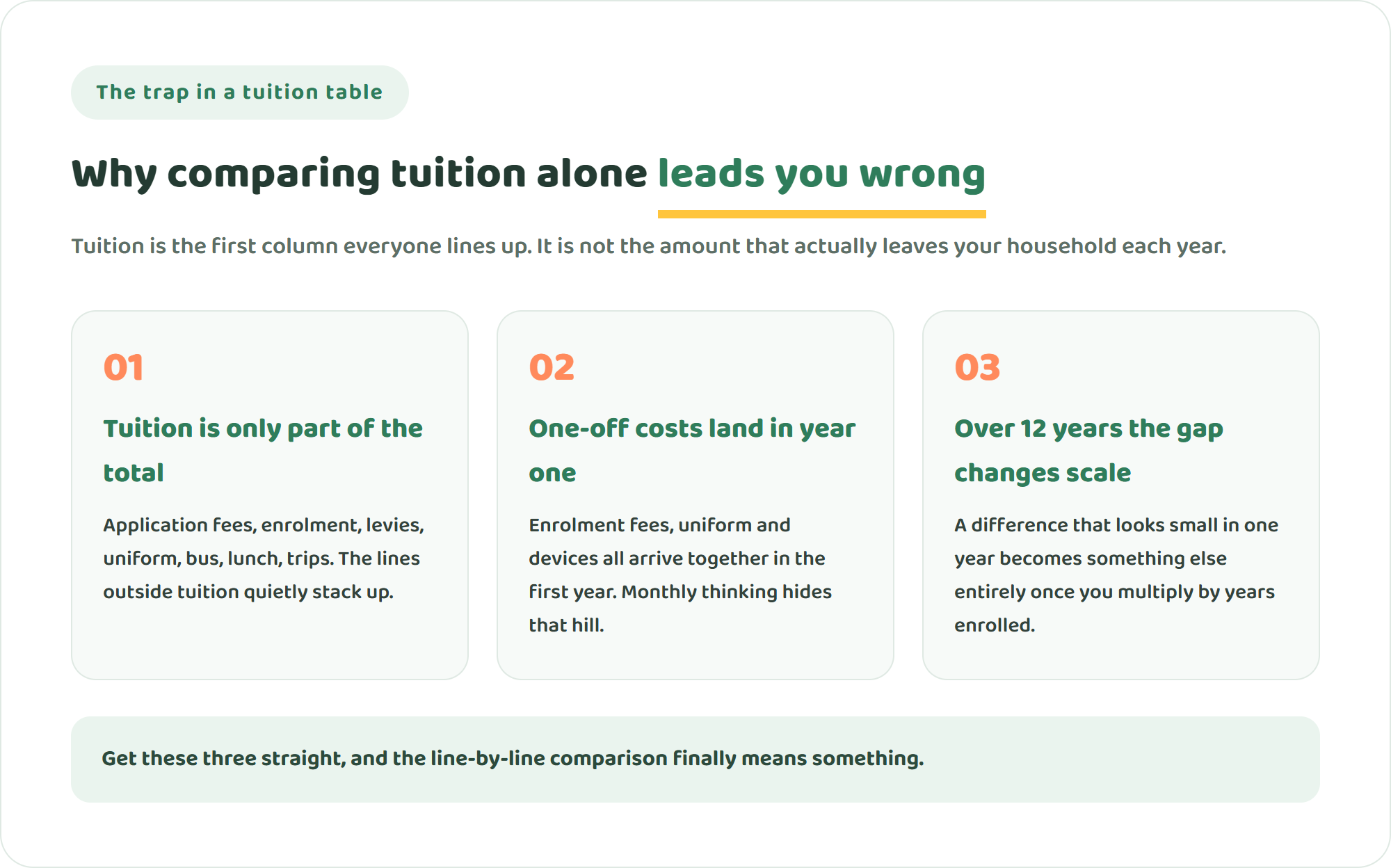
The single most common mistake in school research is lining schools up by tuition alone. Tuition is the largest single item, certainly. It is not the amount that leaves your household. From the moment you apply, in your first enrolled year, and then quietly every year after, items appear that were never printed on the fee page you compared.
The number worth comparing is one number: what this household actually pays out over twelve months. And it does not stop after one year. Primary through the end of secondary is twelve years; starting in middle school is still six. A gap that looks small in a single year becomes something else entirely once you multiply it by the years enrolled.
So the rest of this article is a line-item view of the online vs in-person international school cost question. On-campus first, then online. Both have columns that never appear on page one of the prospectus.
In-person international school cost: what sits outside tuition
The defining feature of a campus school is that every family is jointly maintaining a physical place. There are buildings, a bus fleet, a canteen, sports fields. That is a large part of the appeal — and the cost of keeping it running has to be allocated to households through some line item. The table below sets out the items that most often sit outside tuition, with their nature and the reason each is easy to miss.

| Line item | Nature | Why it gets missed |
|---|---|---|
| Application and registration fees | Per application | You pay them once per school, and applying to several multiplies them. Usually non-refundable, offer or no offer. |
| Enrolment fee | First year only | Charged separately from tuition and often substantial. It surprises families who have been thinking in monthly terms. |
| Facility and capital levy | Annual (first year only at some schools) | Funds buildings and equipment, and is frequently published on a different page from the headline fees. |
| Uniform, materials and devices | Front-loaded, then as your child grows | Prescribed items must be replaced every time your child outgrows them, and some schools specify a laptop or tablet model. |
| School bus or daily transport | Annual | Priced by distance and paid every school day, so the annual figure is far from trivial. |
| Canteen and lunch | Annual | Where catering is compulsory it is a fixed cost you cannot opt out of. Packed lunches simply move the cost into your time. |
| Trips, camps and co-curriculars | Annual, rising with year group | Formally optional, but when most of the class is going, opting out stops feeling like a real choice. |
| Housing within reach of the school | Annual (moving costs once) | The rent premium for living in the school’s catchment never appears on a fee schedule, yet it can be the biggest item of all. |
We deliberately avoid quoting figures here, and not to be evasive. The spread across schools, cities and year groups is so wide that an average would mislead you more than it helps. Depending on the country, annual tuition can sit in the low thousands of US dollars or well into the tens of thousands. Hold the range loosely and confirm the current numbers on each school’s own website. For a sense of how the levels differ between cities, see our comparison of international school fees across Asia, and for the wider trade-offs of a campus education, the pros and cons of international schools.
Online international school cost: what moves into your home
This is the section we most want to write honestly. We are not going to tell you that online is cheaper across the board. The campus, the bus, the canteen and the uniform do disappear as line items. In exchange, costs a campus school was absorbing on your behalf move into your household. Compare without counting those, and your online budget will be just as wrong as an on-campus one.

1. Devices, connectivity and a proper place to sit. Daily online learning does not survive on a shared family tablet. It needs a capable device, a connection that holds up, decent light and a chair they can sit in comfortably through a whole lesson. Treat this as the front-loaded equivalent of uniforms and prescribed materials — and if two siblings are in lessons at the same time, you need two of everything.
2. Your own time alongside them — the invisible line item. This is the one families underestimate most. The younger the child, the more you are needed for getting them logged in, sorting out technical problems and keeping the day on track. A campus school was doing that for you. It never appears in a currency column, yet for two-income households it can matter more than the money does. It does ease as children get older, so how heavy it feels depends a great deal on your child’s age right now.
3. Buying back face-to-face contact. An online school does not automatically supply physical activity or the experience of bumping up against other people in the same room. Sports clubs, community activities, music, camps. An honest budget assumes you will pay for that separately. Any estimate that leaves this out will fall apart later.
4. Living around a time zone you did not choose. Enrol with a school based on the other side of the world and lessons may land in your evening or before dawn. The transport cost is zero, but the family’s waking hours are now shaped by a timetable. It is not a currency figure — and it is often what decides whether the arrangement lasts.
With all that said: counted by number of line items and by the size of the first-year hit, online does make the total easier to hold down. Just frame it as a different cost structure rather than as “cheap”, and you will plan better. We go deeper into the numbers in are online international schools actually affordable?
Four arrangements, judged on the same four points
Now put those line items against the realistic options. It was never a straight choice between campus and online. Moving house to live within reach of a school is one route; keeping your child at a local school and adding an international programme after hours — a double-school arrangement — is another.
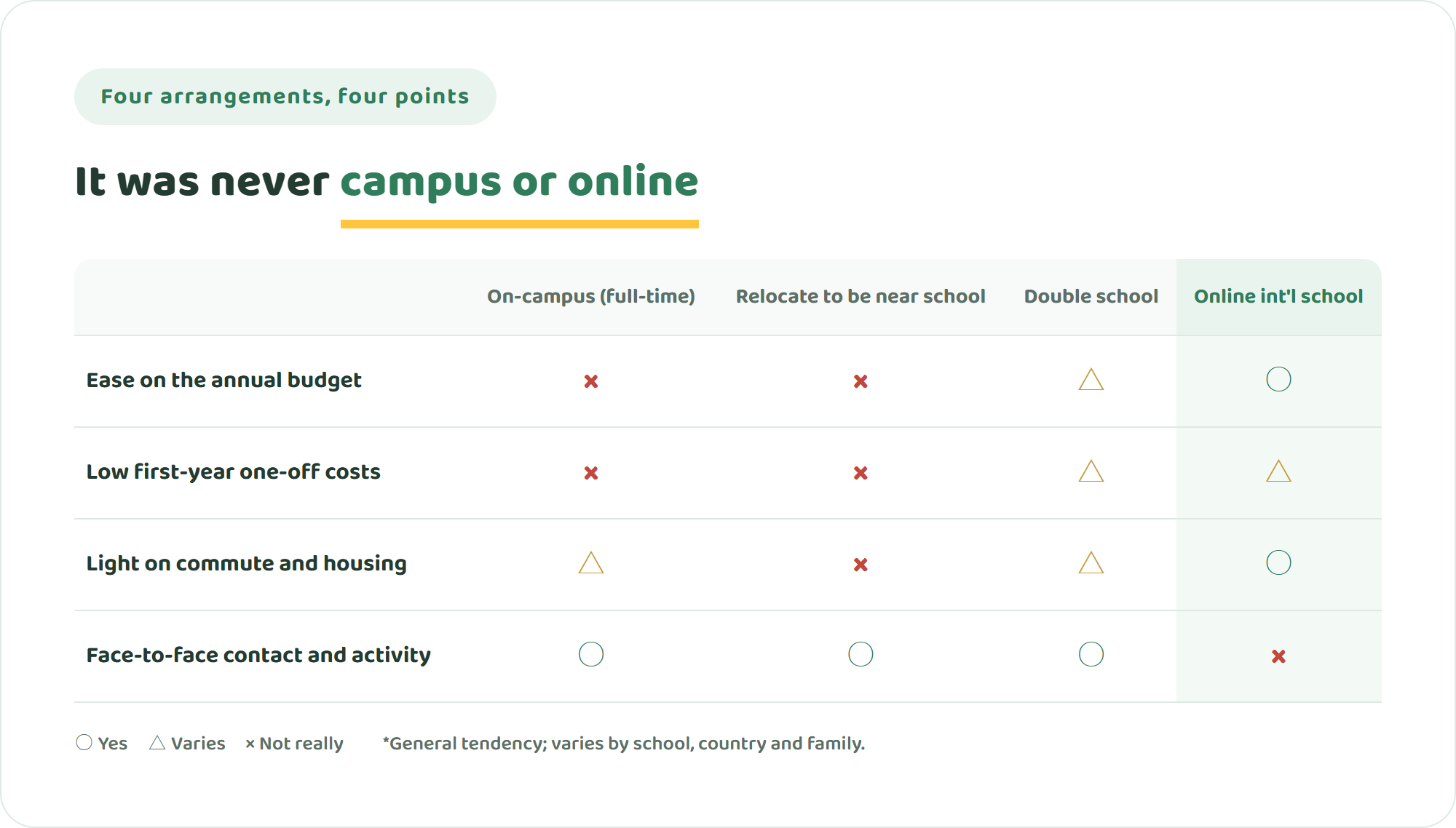
As the table shows, the online column takes a clear “no” on face-to-face contact and physical activity. We would like to mark that row differently, but it would not be true. If you weigh the online vs in-person international school cost and choose the online side, plan for how your family will fill that row — that, to us, is what choosing without regret actually looks like.
See how learning works at NIJIN GLOBAL ACADEMY →
How to find the line your family can sustain
Once the line items are on paper, all that is left is turning them into your own numbers. Half an hour with a sheet of paper and the calculator on your phone is enough.
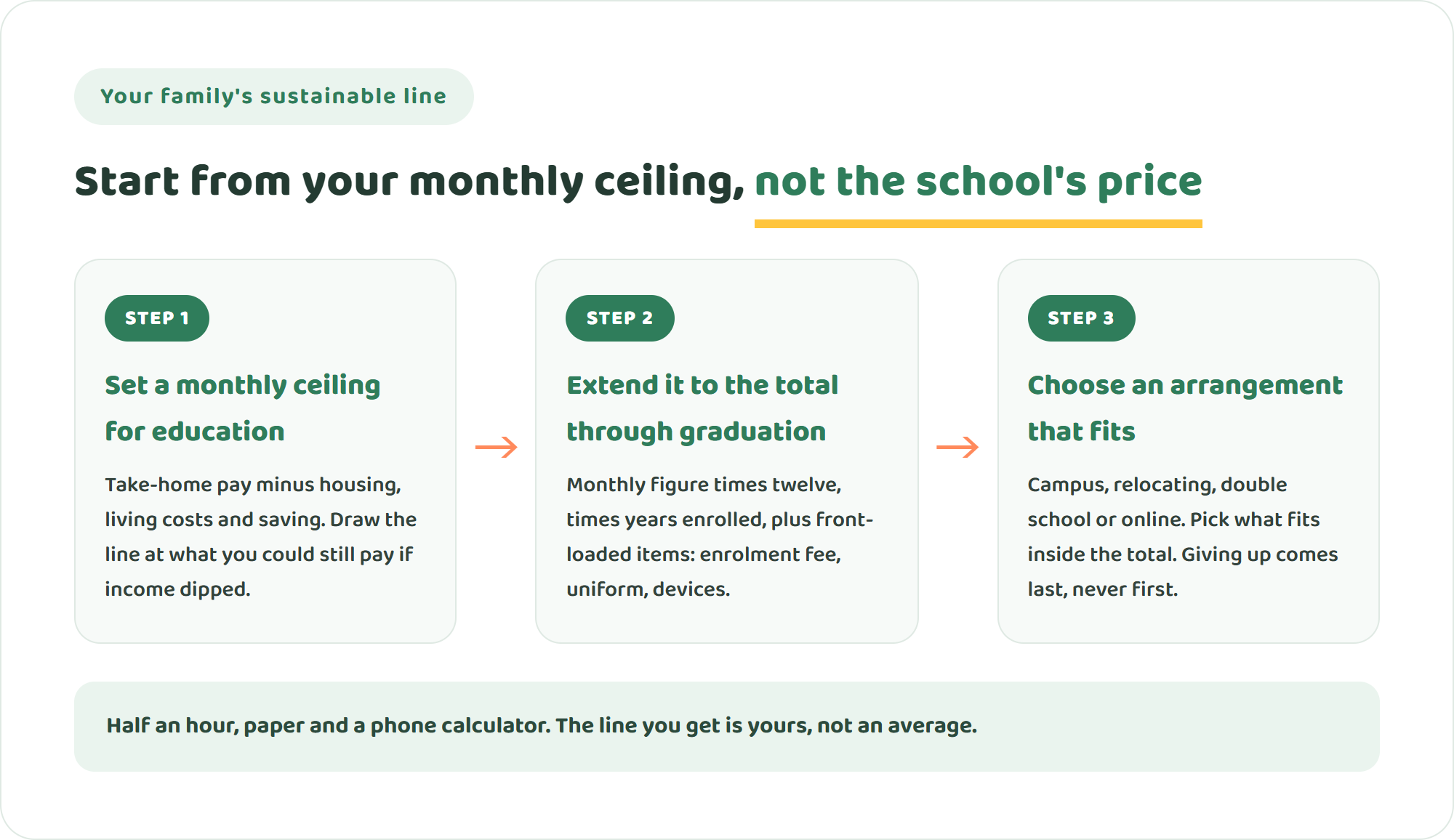
STEP 1 — set a monthly ceiling for education. Not from gross income, but from take-home pay minus housing, living costs and saving. The discipline that matters is drawing the line at what you could still pay if income dipped. A ceiling that depends on a bonus arriving is not a sustainable line.
STEP 2 — extend it to the total through graduation. Multiply that monthly figure by twelve, then by the years you expect your child to be enrolled, and add the front-loaded items: enrolment fee, uniform, devices. That is the maximum total your household can carry without strain. Remember that campus schools front-load heavily, and that online has its own smaller hill in equipment.
STEP 3 — choose an arrangement that fits inside it. If a campus school fits, wonderful. If it does not, you still have moves: look only at schools you can reach without moving house, use a double-school arrangement, or go online. Giving up is the last resort, never the first.
Frequently asked questions
How much does the total actually change if we go online?
Counted by number of line items and by the size of the first-year outlay, the total is generally easier to hold down than a campus school. But devices, connectivity and the cost of buying back face-to-face contact move onto your household, so the real gap is often narrower than the tuition gap suggests. Check each school’s actual figures on its own site, then run them through the line items above.
Can we switch to a campus school later?
In most cases yes, though entry points, availability of places and language requirements vary enormously between schools. On the money side, expect the one-off costs — enrolment, uniform, materials — to be charged again in the year you switch. If you think a switch is likely, ask about transfer requirements early rather than at the point of applying.
How does it change with more than one child?
On campus, whether a school offers a sibling discount can move the total substantially. Online, tuition is charged per child and simultaneous lessons mean a device per child as well. On the other hand, the savings on transport and on housing near a school grow with every additional child. Compare the totals after multiplying by the number of children, not before.
Is there any financial help available?
Many schools run means-tested or merit scholarships and reduce fees for second and third children, and some employers include an education allowance in relocation packages. Public subsidy schemes differ completely from country to country, and international schools frequently sit outside them. Ask the admissions office directly and confirm anything you are told against official information — this is not an area to plan on assumptions.
Not which is cheaper, but which one you can hold for twelve years
Work through the online vs in-person international school cost line by line and the real question turns out not to be which costs less — it is which shape of cost fits the life your family actually lives. Share the upkeep of a campus, and you get the morning walk, the field after school, the shared lunch table. Let those items go, and you get freedom over where you live and a lighter first year. Each side asks for something, and each side gives something back.
We are NIJIN GLOBAL ACADEMY (NGA), an online international school opening in September 2027, operated by NIJIN Inc. Our sister school, NIJIN Academy, already has over 900 children learning with it. With no campus to build or maintain, the underlying economics are simply different — that is where we sit on this comparison. It also means we are the ones responsible for the row we marked “no” above, and we are designing now so that face-to-face contact and physical activity are not left entirely to families. A preview term of trial classes is being prepared for spring 2027, ahead of the September opening.
Our own tuition is not finalised, so we will not quote a number here. When it is set, the people on our opening updates list will hear it first, together with details of the founding intake. You do not have to decide anything today. Start by writing the line items out and drawing your family’s line.