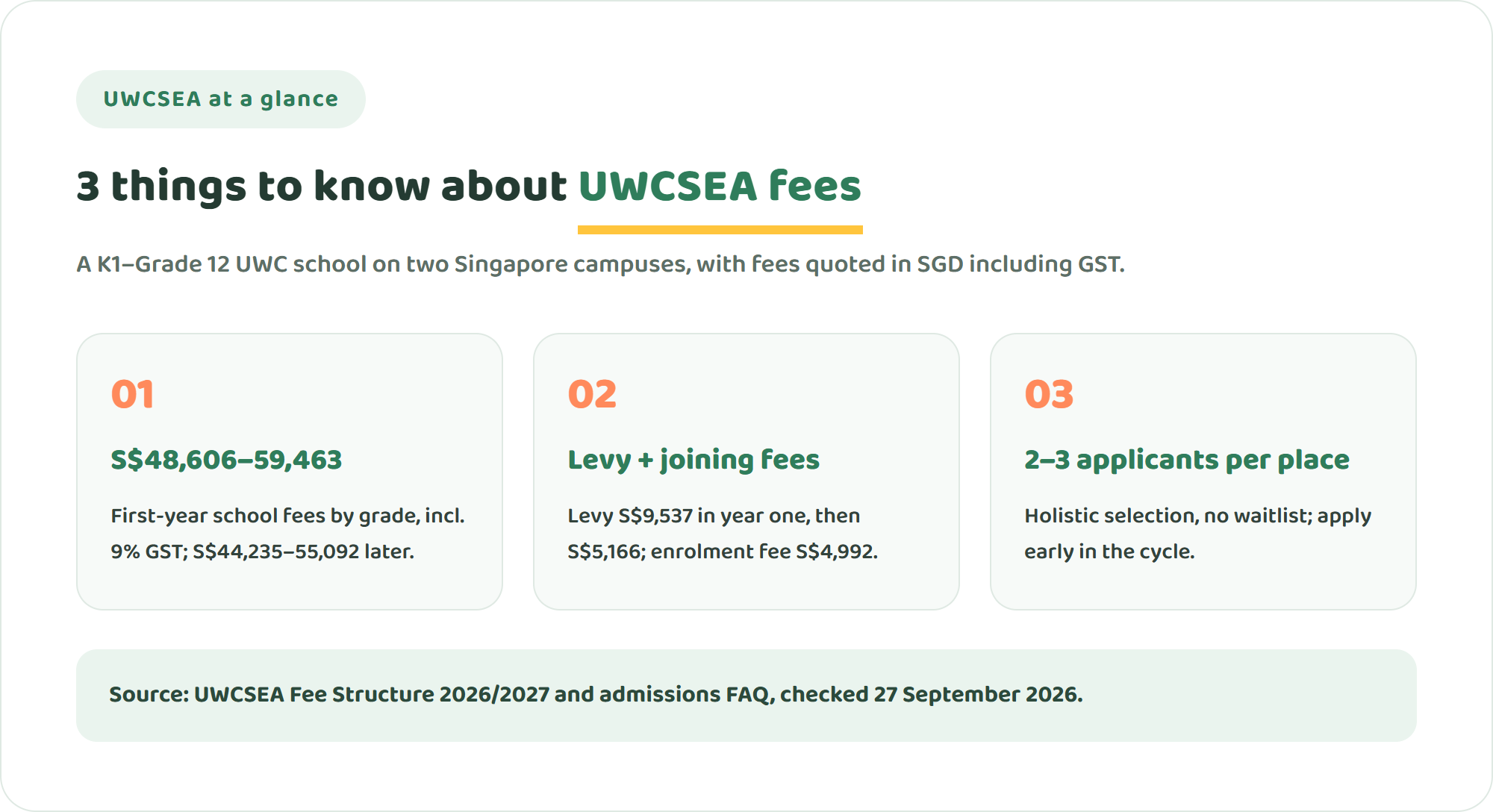
UWCSEA fees for the 2026–27 school year range from S$48,606 to S$59,463 in a student’s first year and from S$44,235 to S$55,092 a year after that, depending on grade (Singapore dollars, including 9% GST, from the official UWCSEA Fee Structure 2026/2027, checked 27 September 2026). On top of that, a new student pays a one-off S$627 application fee per campus and a S$4,992 enrolment fee, and families should budget for outdoor education trips, a MacBook from Grade 6, uniforms and, in Grade 12, IB exam fees. The same fee schedule applies at both the Dover and East campuses.
If you searched “UWCSEA fees”, “UWCSEA tuition” or “affordable alternatives to SAS or UWCSEA in Singapore”, you are probably a family relocating to Singapore and trying to understand what United World College of South East Asia really costs, what the development levy is, how hard it is to get a place, and what else is out there at a similar or lower price. This page answers those questions from UWCSEA’s own website first, then compares it fairly with Singapore American School, Tanglin Trust School and NIJIN GLOBAL ACADEMY, a different kind of option: an online international school that opens in 2027.
The short answer: who UWCSEA suits — and who it doesn’t
- Suits: families who will live in Singapore for several years and want a values-driven, holistic school from Kindergarten 1 to Grade 12. UWCSEA’s learning programme has five parts — academics, activities, outdoor education, personal and social education, and service — and the school treats all five as part of the diploma.
- Suits: students heading for the IB Diploma. UWCSEA says it has one of the largest IB Diploma cohorts in the world (642 students in the Class of 2026, with a 98.9% pass rate) and that its Dover Campus was the first school in Asia to offer the IB Diploma.
- Suits: teenagers who want boarding in Singapore. The school says it is the only international school in Singapore with on-site residential boarding for Grades 9–12.
- Suits: families who value a deliberately diverse community; each campus has more than 80 nationalities.
- Harder fit: families who need a guaranteed place on a fixed date. UWCSEA says it typically receives two to three applications per place, there is no waitlist, and January places depend on how many students leave during Term 1.
- Harder fit: children with little or no English. From Grade 1 up, students without one to three years of English-medium schooling are “unlikely to meet” the entry requirements, and applicants needing EAL support are usually considered only in the second offer round.
- Harder fit: families on a tighter budget, or whose employer does not cover school fees: a first-year high school place costs about S$65,000 once joining fees are included.

What UWCSEA is
United World College of South East Asia (UWCSEA) is an international school in Singapore and one of the member schools and colleges of the UWC movement, whose mission is to make education a force to unite people, nations and cultures for peace and a sustainable future. The school opened in 1971 on Dover Road, in the west of Singapore near the National University of Singapore. A second campus, UWCSEA East, started in 2008; its purpose-built campus in Tampines, in the north-east of the island, opened in 2011. Each campus runs its own Infant, Junior, Middle and High Schools, and each is home to around 3,000 students.
The curriculum is international rather than national. In Grades 9 and 10, students follow UWCSEA’s own designed and assessed courses — not IGCSEs — built with the IB Diploma in mind. In Grades 11 and 12, the vast majority take the two-year IB Diploma Programme; some take IB Certificate courses instead. Every student who meets the school’s criteria graduates with a UWCSEA High School Diploma, which also requires sustained commitment to service and outdoor education. One practical detail for families with young children: UWCSEA Dover plans to move to a new campus in Tengah in August 2032, and the school says students in Grade 7 or above in 2026/27 will not be affected.
| Item | UWCSEA (official) |
|---|---|
| Type | Private, non-government international school; member of the UWC movement; registered with Singapore’s Committee for Private Education (PEI) |
| Founded | 1971 (Dover Campus); East Campus opened in 2011 |
| Campuses | Dover (west, Dover Road; moving to Tengah in 2032) and East (Tampines) |
| Grades / ages | Kindergarten 1 to Grade 12 (about ages 4–18) |
| Students | More than 3,000 at Dover and more than 2,800 at East, each with 80+ nationalities |
| Curriculum | UWCSEA learning programme; UWCSEA-designed Grade 9/10 courses; IB Diploma in Grades 11–12 |
| Accreditation | Council of International Schools (CIS) and WASC (Accrediting Commission for Schools); IB World School |
| School year | Mid-August to late June; Term 1 of 2026/27 runs 13 August – 18 December 2026 |
| Boarding | On-site boarding; Grade 8 boarding ends from August 2027, then Grades 9–12 only |
UWCSEA tuition and fees (2026–27, official)
These figures come from the official UWCSEA Fee Structure 2026/2027 (dated 13 January 2026) and the official Fee Schedule page. All amounts are in Singapore dollars and include 9% GST where applicable. The school says fees are reviewed every year.
The key thing to understand is that UWCSEA’s “school fees” are made of two parts: tuition, which is the same every year for a given grade band, and a development levy for campus maintenance, renewal and future building projects. The levy is S$9,537 in a student’s first year and S$5,166 in each later year. That is why the first year is more expensive than the years that follow.
| Grade band | Tuition | School fees, first year (tuition + S$9,537 levy) | School fees, second and later years (tuition + S$5,166 levy) |
|---|---|---|---|
| K1–Grade 1 | S$39,069 | S$48,606 | S$44,235 |
| Grades 2–5 | S$40,743 | S$50,280 | S$45,909 |
| Grades 6–8 | S$46,866 | S$56,403 | S$52,032 |
| Grades 9–10 | S$47,313 | S$56,850 | S$52,479 |
| Grades 11–12 | S$49,926 | S$59,463 | S$55,092 |
Joining fees (one-off, non-refundable). The application fee is S$627 per campus for a day student (S$1,254 if you apply to both campuses), or S$841 for a boarding application, which is considered for both campuses. The enrolment fee is S$4,992, invoiced when you accept a place together with the first term’s fees. The school states that “there is no deposit payable”. For families applying for three or more children for August 2026 entry, the enrolment fee is reduced by 25% for the third child and by 50% for the fourth and later children. UWCSEA’s FAQ adds that the application fee is not refunded if an application is closed because the student clearly does not meet the eligibility criteria — for example, needing more English support than the EAL programme covers — so read the English requirements before you pay.
Boarding. Residential boarding costs S$45,288 a year plus an S$348 amenities fund, on top of the school fees. Boarders in Grades 8–10 must commit to a full year, and Grade 11 entrants must stay for the full two-year IB Diploma. The school’s age-and-grade page says that from August 2027 boarding will only be available from Grade 9.
Other compulsory costs (estimates published by the school).
- Laptop: every student in Grades 6–12 needs an up-to-date Apple MacBook (estimated S$1,800 with AppleCare+ as of August 2025, education discount included). Primary devices are provided and included in the fees.
- Outdoor education trips (2025/26 prices for reference): S$360 (Grade 2, Singapore Zoo camp) to S$1,937 (Grade 8, six days in Thailand); S$1,700–6,000 for Grade 9 and new Grade 10 expeditions; up to S$2,350 for Grade 11 Project Week.
- Uniform: S$300–400 for Kindergarten to Grade 10; S$80–120 (shirts only) for Grades 11–12.
- IB assessment fees: billed in Term 3 of Grade 12, about S$1,200–1,800 depending on subjects.
Optional costs. The school bus is run by an outside contractor and costs roughly S$670 to S$2,687 per term for a two-way service, depending on distance. Canteen meals are typically S$4–8 a day. Instrumental music lessons, some language programmes (Home Languages, the Dutch programme at Dover, the Foreign Language and Culture programme at East) and weekend or holiday programmes cost extra. Most lunchtime and after-school activities for Grade 2 and above have no extra charge.
Payment and refunds. Fees are billed in three equal termly instalments, in advance. To accept an offer you pay the enrolment fee plus Term 1 tuition and levy (and boarding, if relevant) within two weeks; those acceptance fees are not refundable if you later cancel. Payment is by bank transfer, GIRO, PayNow or credit card through a third party (with a processing fee of about 2.6% for Singapore cards and 3.3% for international cards); cash is not accepted. Each term has a published withdrawal deadline — for 2026/27, 13 April 2026, 21 September 2026 and 18 January 2027 — by which you must give online notice to secure a refund of fees already paid. Full refund conditions are in the school’s Standard Terms and Conditions. A general sibling discount on tuition is not published on the official site; only the enrolment fee discount above is.
Scholarships and financial aid. UWCSEA’s scholarships are UWC scholarships: they are allocated through more than 150 UWC national committees around the world, which carry out a financial means assessment, rather than by the school directly. The school says it welcomes more than 100 scholars. A needs-based bursary scheme for ordinary fee-paying day students is not published on the official site. In practice, many relocating families’ fees are paid by an employer, so check your package first.
Total-cost example (official 2026/27 numbers only). One new student joining Grade 9 and staying to graduation would pay, at 2026/27 rates: S$56,850 (Grade 9, first year) + S$52,479 (Grade 10) + S$55,092 (Grade 11) + S$55,092 (Grade 12) = S$219,513 in school fees, plus S$627 + S$4,992 in joining fees = S$225,132, before trips, laptop, uniform and about S$1,200–1,800 of IB exam fees. Two children joining Grades 2 and 4 would pay 2 × (S$50,280 + S$627 + S$4,992) = S$111,798 in their first year. Real totals will be higher because fees are reviewed annually. For context on how these numbers compare with online schooling, see our guide to online vs in-person international school costs.
How a school day works: schedule, campus life and time zones
UWCSEA is a full-time, in-person day and boarding school, so a school day looks very different from an online programme. According to the school’s section pages, Middle School on both campuses starts at 8am and finishes at 3pm; at East, the Junior School day also runs from 8am to 3pm and the Infant School day from 8am to 2pm. Many students stay on for the activities programme after school, and some train for sport before school. The Middle School timetable is built on 40 periods a week, and students spend most lessons with their mentor group. Exact High School bell times are not published on the pages we checked.
The year runs from mid-August to late June in three terms. Outdoor education is part of the programme rather than an optional extra: Grades 1 and 2 have overnight experiences in Singapore, and from Grade 3 students join an overseas expedition each year, mostly in Malaysia and Thailand, building up to longer expeditions in the High School. Service — regular work with community partners in Singapore and the region — is also built into every year.
Time zones. Singapore is on UTC+8. For families moving from the United States, the UK, Canada or Europe, that matters in two ways. First, if you are comparing UWCSEA with an online school your child already attends at home, check whether that school’s live classes will fall in Singapore daytime; many US online schools will not. Second, UWCSEA’s residency rule means that day students must live with at least one parent who is resident and present in Singapore for at least 90% of each school term, so it does not work for a family that will split time between countries. For a picture of how online international schools structure the day instead, see a day at an online international school.
Accreditation, diploma and university recognition
UWCSEA’s accreditations page lists both campuses as accredited by the Council of International Schools (CIS) and by WASC (the Accrediting Commission for Schools), and as an authorised IB World School. The same page lists memberships including the UWC movement, Round Square and boarding associations, and shows both campuses as registered Private Education Institutions with Singapore’s SkillsFuture Singapore; Dover’s current registration runs to 17 July 2027 and East’s to 9 March 2027.
Graduates who meet the school’s criteria receive the UWCSEA High School Diploma, and most also earn the IB Diploma, with results arriving in the July after Grade 12. The school’s IB results page reports that the Class of 2026 cohort of 642 students had a pass rate of 98.9%, against a world average of 82.6%. Average points are shown on that page as charts, including the average of the top 50 and top 100 students, which the school suggests using when comparing with schools that have much smaller cohorts. UWCSEA also says that on average 99% of its students enrol at universities worldwide, and publishes a long list of 2024–2026 acceptances across the US, UK, Canada, Australia, Europe and Asia.
A common question from US families is whether an IB Diploma from Singapore is recognised back home. The IB Diploma is widely recognised by universities internationally, and UWCSEA’s university list includes many US colleges; the school runs a university advising programme within its personal and social education curriculum. If your child will need a specific US or UK credential, ask admissions how the UWCSEA transcript and Grade 9/10 courses are described to universities.
UWCSEA vs NIJIN GLOBAL ACADEMY vs two other options (official data)
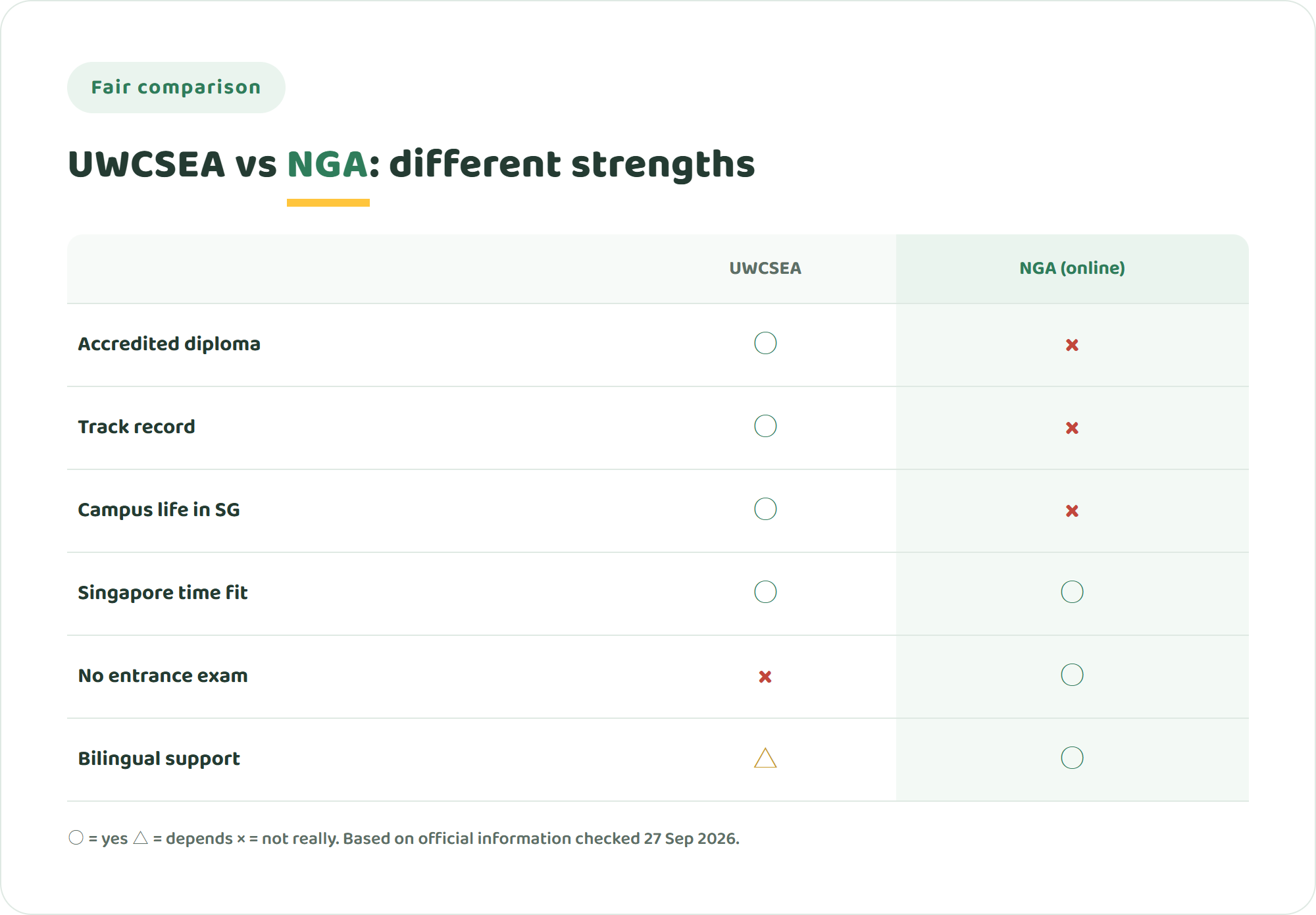
Below, UWCSEA is compared with two Singapore schools in a similar price range that relocating families often consider together — Singapore American School (SAS), a US-curriculum school in Woodlands, and Tanglin Trust School, a British-curriculum school — and with NIJIN GLOBAL ACADEMY (NGA). NGA is a different kind of option, not a replacement for a Singapore campus school: it is online, has not opened yet, and has no accreditation or graduates.
| Item | UWCSEA | NIJIN GLOBAL ACADEMY | Singapore American School | Tanglin Trust School |
|---|---|---|---|---|
| School type | In-person international day and boarding school, two campuses; UWC movement | Online international school (opening September 2027, planned) | In-person non-profit US-curriculum day school | In-person British-curriculum international school |
| Grades / ages | K1–Grade 12 (about 4–18) | Ages 6–18 | Preschool–Grade 12 | Nursery–Year 13 |
| Tuition (2026–27) | Tuition S$39,069–49,926; school fees incl. levy S$48,606–59,463 in year one, S$44,235–55,092 later | Not yet published (no enrolment, facility or uniform fees; materials included; sibling discounts) | Tuition S$32,510–43,780 + S$9,030 facility fee | Annual fees S$36,300–58,080 (incl. Building Fund) |
| Joining fees (new student) | Application S$627 per campus; enrolment S$4,992; no deposit | No enrolment fee | Application S$2,500; registration S$8,660 (US passport/Green Card) or S$9,900 | Application S$1,000; enrolment S$4,500; capital levy S$4,500 |
| First year, upper-secondary example | S$65,082 (Grades 11–12: 59,463 + 627 + 4,992) | Not yet published | S$63,970 / S$65,210 (High School, incl. application) | S$68,080 (Sixth Form: 58,080 + 1,000 + 4,500 + 4,500) |
| Curriculum | UWCSEA programme; own Grade 9/10 courses; IB Diploma | Subjects learned in English; CEFR-based English levels; co-creation projects; optional Cambridge IGCSE / A-Level pathway | US curriculum; large Advanced Placement programme | British curriculum; A Levels or IB Diploma in Sixth Form |
| Classes & time zone | Full in-person day in Singapore (UTC+8), e.g. 8am–3pm in Middle School | Small live online groups of about 8; timetable built for Asia & Oceania daytime — fits Singapore, may not fit the Americas/Europe | Full in-person day in Singapore | Full in-person day in Singapore |
| Accreditation / diploma | CIS and WASC; IB World School; UWCSEA High School Diploma + IB Diploma | Not yet accredited; no graduates yet | WASC (per the school’s fee document) | See official site (the school reports “Outstanding” British Schools Overseas inspection) |
| Admission | Holistic selection; 2–3 applications per place; English requirements from Grade 1; parent residency rule | No entrance exam; no English requirement | Priority lanes (Lane 1 = US passport or Green Card); see official site | See official site |
| Start dates | August (main); limited January places; 2027/28 applications opened 1 September 2026 | Opens September 2027; free trial classes monthly from September 2026 | See official site | See official site |
Sources: UWCSEA Fee Structure 2026/2027, UWCSEA admissions FAQ, UWCSEA accreditations, SAS tuition and fees (2026-27 Fixed Fee Schedule), Tanglin Trust School fees 2026/27, NGA’s curriculum and timetable page — checked 27 September 2026. All Singapore fees are in SGD and include 9% GST.

Reviews and common concerns, answered honestly
Parents who write about UWCSEA tend to praise its mission, its service and outdoor programmes and its breadth of opportunities, and to raise questions about cost, getting a place and the size of the school. Below are the recurring themes and where UWCSEA addresses them on its own site.
“Why is the first year so much more expensive?”
Because of the development levy. New students pay S$9,537 in their first year and S$5,166 in each year after that, on top of tuition, plus the one-off S$4,992 enrolment fee. The school says the levy funds maintenance, renewal and replacement of campus facilities and approved capital projects — relevant as Dover prepares to move to its new Tengah campus in 2032.
“How hard is it to get a place?”
UWCSEA is open about this. It says it typically receives two to three applications per place at each campus, keeps an eligible pool rather than a waitlist, and allocates places using holistic criteria (the student’s background, experience and fit, plus cohort balance such as gender and month of birth), not only academic results. It admits between 800 and 1,000 new students a year. Applying earlier in the cycle means being considered for more of the places, and a dual-campus application gives the school more flexibility but does not greatly improve your chances. Dover does not create new Kindergarten 2 places each year; East adds 22.
“Is it right for a child who is still learning English?”
Partly. UWCSEA runs an English as an Additional Language (EAL) programme in every grade, but EAL places are limited and applicants needing EAL support in K1–Grade 8 are usually considered only in the second offer round. From Grade 1, children without some English-medium schooling are unlikely to meet the entry criteria; Middle School applicants generally need two to three years of English-medium schooling, and High School applicants three or more.
“Is it too big?”
With roughly 3,000 students per campus, UWCSEA is large. The school’s answer is structure: each campus is split into Infant, Junior, Middle and High Schools, students spend most of their day with a mentor group, and the school argues that a large IB cohort allows an unusually wide range of subjects. Families who prefer a small school should visit both campuses before deciding.
“Do students get pushed out before the IB?”
The school addresses this rumour directly in its admissions FAQ: moving from Grade 10 to Grade 11 is “not subject to any academic thresholds”. Students choose IB subjects in Grade 10, and in rare cases the Head of Grade discusses the combination with the family.
“Can we live elsewhere and board, or leave our child with a relative?”
Day students must live with a legal parent resident in Singapore for at least 90% of the school term; living with a relative or family friend is not allowed except in exceptional cases. Boarding is the alternative from Grade 8 now, and from Grade 9 from August 2027. Singapore citizens can apply but face priority placement rules and a Ministry of Education waiver process, explained on the school’s residency page.
Alternatives to UWCSEA worth comparing
Singapore American School — a large non-profit school with a US curriculum and an extensive Advanced Placement programme, useful for American families who expect to return to US schools or universities. Its first-year cost is similar to UWCSEA’s once registration and facility fees are counted, and families holding a US passport or Green Card are in Lane 1 for admissions priority.
Tanglin Trust School — a British-curriculum school from Nursery to Year 13, offering both A Levels and the IB Diploma in its Sixth Form, which suits families who may move back to the UK or want a choice of post-16 pathway. Its annual fees are published on one line that includes the Building Fund.
NIJIN GLOBAL ACADEMY (NGA) — an online international school for ages 6–18 focused on Asia and Oceania, opening in September 2027 (planned), with a first cohort of 100 students. Classes are small live dialogue groups of about 8, subjects are learned in English with a bilingual (English–Japanese) mentor, and English is taught by CEFR level. There is no entrance exam and no English requirement, and NGA can run alongside a local school or as the main school, and travels with the family if they move again. Tuition is not yet published; NGA says it will be far more affordable than a typical international school, with no enrolment, facility or uniform fees, materials included and sibling discounts. Its timetable is built for Asia–Oceania daytime, which fits Singapore. The honest limitations: it is not yet open, not yet accredited, has no graduates and no campus in Singapore. Free trial classes run monthly from September 2026. It is operated by NIJIN Inc. in Japan, whose alternative school NIJIN Academy has more than 1,000 students.
For a wider view of Singapore’s schools, see our guide to international schools in Singapore. If you are weighing online options too, our overview of online international schools compared covers the main names, and our reviews of Stanford Online High School tuition and Laurel Springs School tuition explain two US online schools that some globally mobile families use — keeping in mind that their live sessions run on US time.
FAQ
How much does UWCSEA cost per year?
For 2026/27, UWCSEA’s school fees (tuition plus development levy) are S$48,606–59,463 in a student’s first year and S$44,235–55,092 in later years, depending on grade, including 9% GST. New students also pay a S$627 application fee per campus and a S$4,992 enrolment fee. Boarding adds S$45,288 a year plus a S$348 amenities fund.
Is UWCSEA accredited?
Yes. UWCSEA’s accreditations page lists both campuses as accredited by the Council of International Schools (CIS) and WASC, and as an IB World School. Both campuses are also registered Private Education Institutions in Singapore.
Can international students enrol at UWCSEA?
Yes — most students are international, from more than 80 nationalities on each campus. Day students must live with a parent resident in Singapore for at least 90% of each term; students living outside Singapore can apply as boarders from Grade 8 (from Grade 9 from August 2027). Applicants must meet the English requirements for their grade.
Is UWCSEA worth it?
It depends on your child and your plans. UWCSEA is a strong fit for families staying several years in Singapore who want a mission-driven school with outdoor education, service and a large IB Diploma programme. It is a weaker fit for families on a short posting, children with little English, or those who need certainty of a place by a fixed date. If your employer does not cover fees, compare the first-year total, not just tuition.
What are the alternatives to UWCSEA?
Families often compare it with Singapore American School (US curriculum and AP) and Tanglin Trust School (British curriculum with A Levels or IB). For families in Asia and Oceania who want a small bilingual live-online option, NIJIN GLOBAL ACADEMY opens in September 2027 (planned); it is not yet accredited and its tuition is not yet published.
Choosing calmly before a move
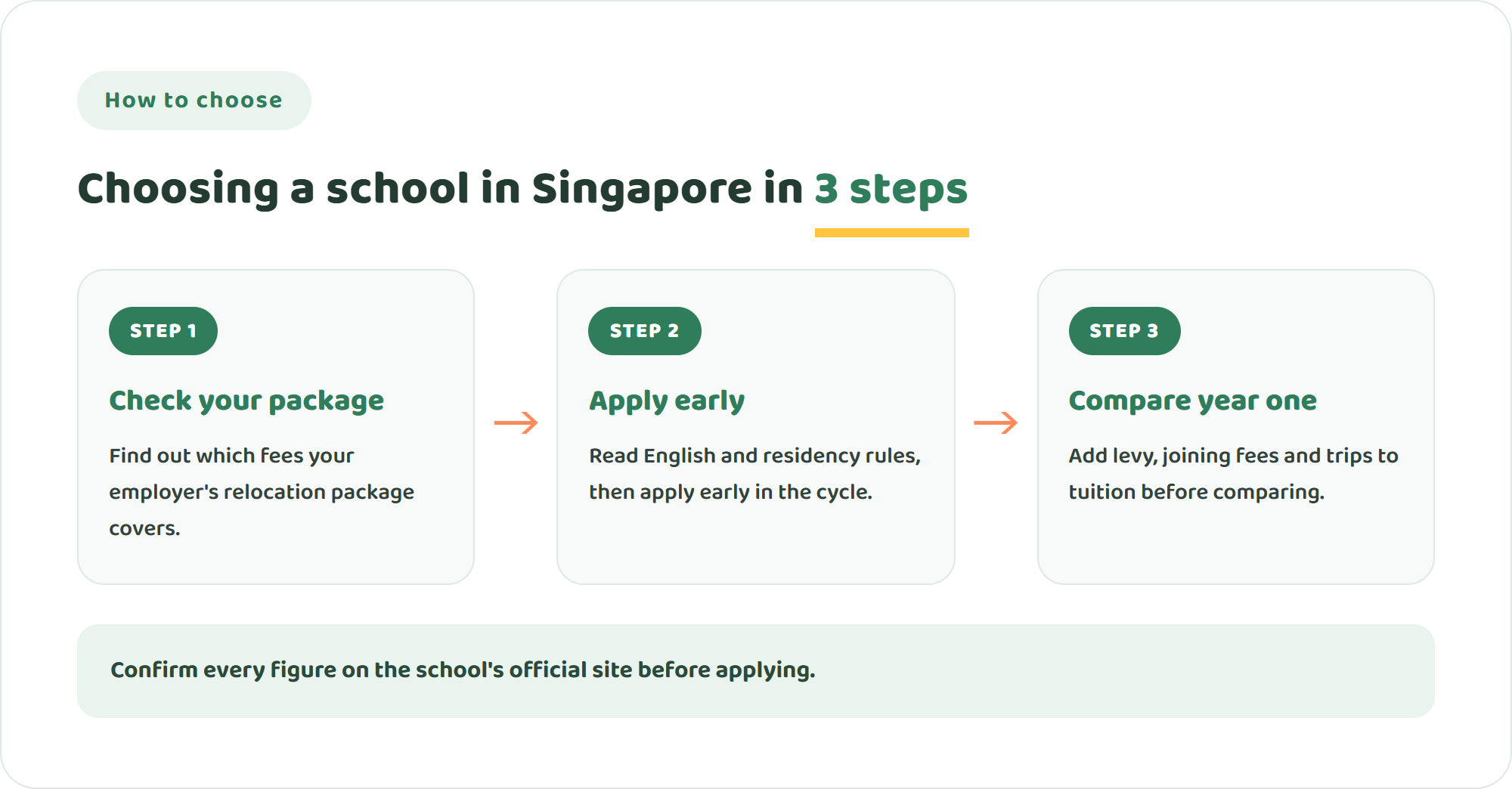
UWCSEA is one of the most established international schools in Asia, and its fees reflect a full campus school with outdoor education, service and one of the world’s largest IB programmes. If a Singapore posting is ahead of you, the most useful next steps are simple: check what your relocation package pays for, read the English and residency requirements before paying the application fee, and apply early in the cycle if you are sure. It is also sensible to keep one or two other options in view, because places are limited. There is no need to rush — the right school is the one that fits your child and the years you will actually spend in Singapore. You can read more about why some families choose an online international school.
Tuition and admissions details were checked on the official websites on 27 September 2026. Schools revise fees every year — always confirm on the official site before applying.