If you have just moved into one of the towers in Harumi, Kachidoki or Tsukishima — or into a Nihonbashi apartment within walking distance of the office — you have probably already discovered the awkward truth about Chuo City. It is one of the fastest-growing residential wards in Japan, packed with young families, and yet almost every international option that turns up in a search is a preschool. The question that follows is always the same: where does my child go once they turn six? This guide lists all eight international schools in Chuo Ward, Tokyo — every one genuinely located here, sorted by the two things that actually decide your shortlist — ages served and fees — then shows you where families widen the search when the ward runs out of options, and what a fully online international school can offer if commute or cost is the real obstacle.
Quick Answer: Your Options in Chuo
If you only read one section, read this. Below are the schools covered in this guide, plus the online option — so you can see every route side by side before the details.
- Chuo International School, Tokyo Campus (Minato / Shintomicho) — about ¥1.04m–¥1.36m a year — Ages: 3–12 (K1–K3, G1–G6). Secondary years mean moving to another school / Fees: tuition ¥358,000 per term (Elementary) and ¥260,000–¥365,000 per term…
- Sunshine Kids Academy Tokyo (Minato / Shintomicho) — fees on enquiry — Ages: 3 months to 3 years / Fees: not published; enquire directly
- Aoba-Japan Bilingual Preschool, Harumi Campus — fees on enquiry — Ages: 1–5 (K1–K5), early years only / Fees: not published; enquire directly (also ask about Japanese preschool subsidy…
- Tokyo International School Kachidoki Kindergarten / After School — fees on enquiry — Ages: kindergarten 3–5; after school Grades 1–4 (two or three days a week minimum) / Fees: shared via information pack or briefing session; enquire directly
- Sakura International School Nihonbashi — fees on enquiry — Ages: 0–6 (parent-and-child, infant, kindergarten divisions). Elementary is in… / Fees: not published; request the information pack
- KOA International Preschool (Nihonbashi Tomizawacho) — fees on enquiry — Ages: 2–6 (preschool) and 6–10 (after school) / Fees: not published; enquire directly
- FUTURE Jidoen Nihonbashi (Nihonbashi Tomizawacho) — fees on enquiry — Ages: regular class 2–6; playgroup 18 months to pre-school; after class age 4 through… / Fees: not published; enquire directly (¥37,000 monthly subsidy applies for ages 3–5)
- T.N.G Montessori Academy (Tsukiji) — fees on enquiry — Ages: 0–6 (parent-and-child through pre-school classes) / Fees: not published; enquire directly
- NIJIN GLOBAL ACADEMY (online) — Ages 6–18 / opening September 2027, currently taking opening-update registrations / fees around one-fifth of a typical campus international school / Japanese-language support. An option when commute or fees are the wall.
Quick Answer: The International Schools in Chuo, at a Glance
- Chuo International School, Tokyo Campus (Minato, Shintomicho)|ages 3–12 (K1–G6)|roughly ¥1.04m–¥1.36m per year (tuition plus facility & materials)|the only full-time school in the ward that goes to Grade 6. Montessori + Cambridge
- Sunshine Kids Academy Tokyo (Minato, Shintomicho)|3 months–3 years|enquire|the 0–3 division in the same building, feeding straight into the school above
- Aoba-Japan Bilingual Preschool, Harumi Campus|ages 1–5|enquire|inside Harumi Triton Square; inquiry-based learning framed on the IB PYP, open 8:00–19:30
- Tokyo International School Kachidoki Kindergarten / After School|ages 3–5 plus Grades 1–4|enquire|lets you keep English going after a Japanese elementary school day
- Sakura International School Nihonbashi|ages 0–6|enquire|Japanese–English bilingual inquiry learning; parent-and-child classes start in pregnancy
- KOA International Preschool (Nihonbashi Tomizawacho)|ages 2–6 (after school 6–10)|enquire|Reggio Emilia-inspired project work in small groups
- FUTURE Jidoen Nihonbashi|18 months–6 years (after class to Grade 6)|enquire|7:30–19:00 hours and government preschool subsidy eligibility
- T.N.G Montessori Academy (Tsukiji)|ages 0–6|enquire|Montessori blended with Reggio Emilia in a small, calm setting
- NIJIN GLOBAL ACADEMY (online / opening September 2027 · ages 6–18 · around one-fifth of on-campus fees · Japanese-language support built in)|an online international school with no commute. Currently taking sign-ups for opening updates
International schools in Chuo: the real shape of the market and what they cost
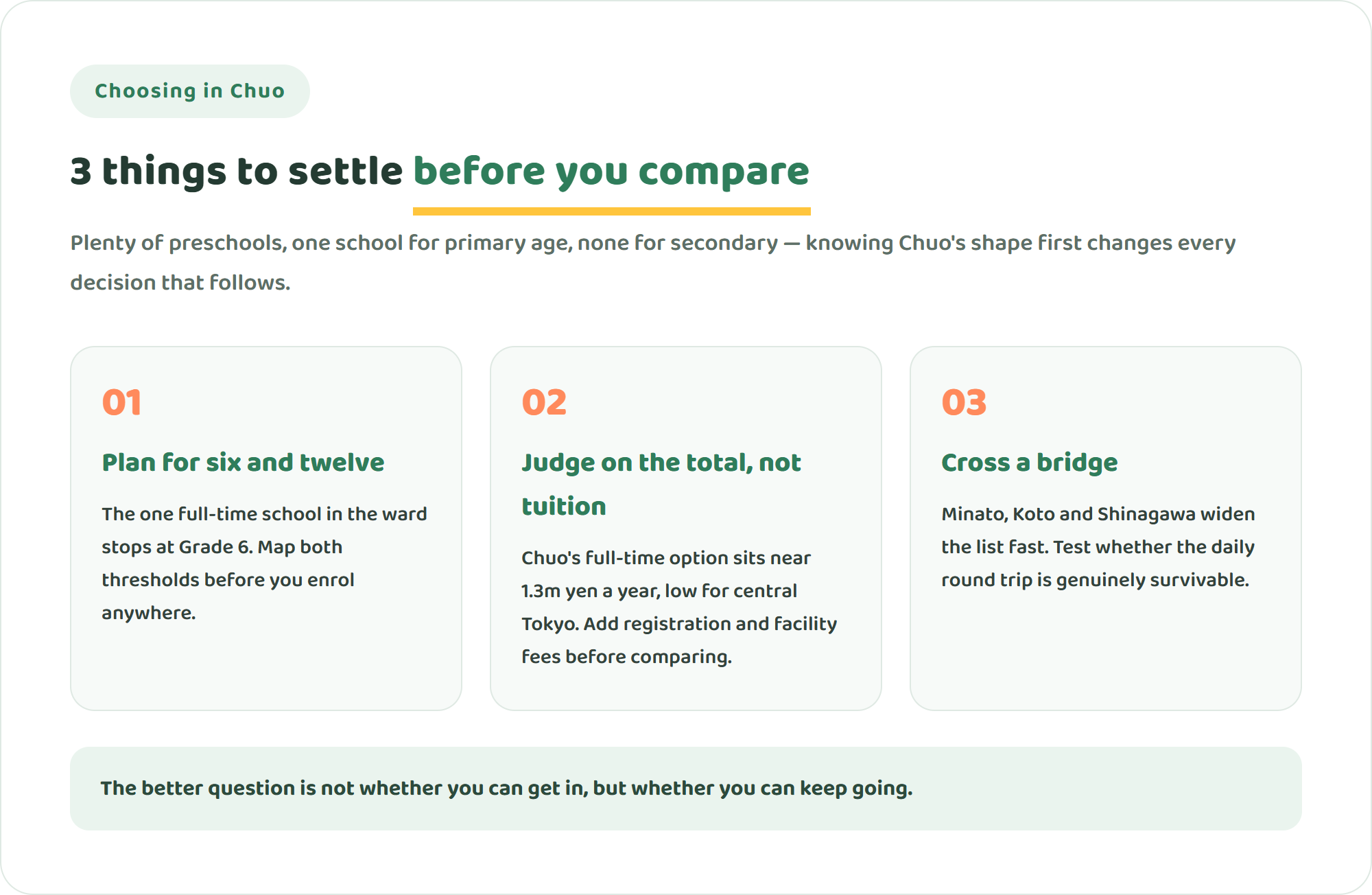
Chuo Ward can be summed up in one line: plenty of preschools, exactly one full-time school for primary age, and nothing at all for secondary. Nihonbashi, Ningyocho, Tsukiji, Hatchobori, Tsukishima, Kachidoki and Harumi all have somewhere a young child can spend the day in English. But once you look for a full-time international school that teaches the primary years, there is a single answer inside the ward — Chuo International School in Minato, Chuo City — and it stops at Grade 6.
That shape sits awkwardly against the ward’s demographics. Chuo’s population was about 192,000 as of August 2026, and the Tsukishima district alone — Tsukishima, Tsukuda, Kachidoki, Harumi and Toyomi — accounts for roughly 92,000 of them. In other words, close to half the ward lives in the bayside tower belt, and the ward’s own projections expect both the total population and the share of children to keep climbing. The cohort keeps growing; the number of school places inside the ward does not. That is exactly why families here benefit from planning two thresholds at once — age six and age twelve — before they enrol anywhere at age two or three.
On fees, most schools in Chuo do not publish numbers, but the one full-time school does, and it is worth reading carefully. Tuition at Chuo International School runs about ¥358,000 per term for Elementary (G1–G6) and ¥260,000–¥365,000 per term for Kindergarten (K1–K3). The school year has three terms, so annual tuition works out to roughly ¥1.07m for elementary and ¥0.78m–¥1.10m for kindergarten. Add the facility and materials fee of about ¥85,000–¥95,000 per term and the yearly total lands at roughly ¥1.33m–¥1.36m for elementary and ¥1.04m–¥1.38m for kindergarten, with a ¥250,000 registration fee and a ¥20,000 application fee in year one.
Here is the part that surprises most families. Nishimachi International School in neighbouring Minato Ward lists ¥3,129,000 in annual tuition for 2026–2027, or roughly ¥3.53m once the education enhancement and school growth fund fees are added. Measured against that, Chuo is unusually affordable for central Tokyo. Whether it is affordable for your household is a different question, and fees are revised regularly — always compare the total, not the headline tuition. If you want the full anatomy of an international school bill, see our breakdown of what international school actually costs.
Note: fees and details above reflect information published as of August 2026. Always confirm the current figures on each school’s official site.
All 8 international schools in Chuo Ward, by age range and fees
What follows is every international school genuinely located in Chuo City — not a padded top-seven list. There are eight main ones. Only a single school takes primary-age children full time; the rest are early years. Read them in this order and the decision gets simpler: ages served first, fees second, educational approach last.
1. Chuo International School, Tokyo Campus (Minato / Shintomicho) — about ¥1.04m–¥1.36m a year
A short walk from Shintomicho Station on the Yurakucho Line and Hatchobori on the Hibiya Line, this is the only school in Chuo Ward where a child can stay from age three through Grade 6. It pairs Montessori practice with the Cambridge curriculum in an English-immersion setting, organised into Kindergarten (K1–K3, ages 3–6), Lower Elementary (G1–G3) and Upper Elementary (G4–G6), with an after-school programme for ages 3–12. There is a sister campus in Shin-Urayasu, Chiba. Three things make it easy to evaluate: fees are published openly, need-based scholarships can cover up to 45% of tuition, and sibling discounts apply (10% for a second child, 25% for a third).
- Curriculum: Montessori plus the Cambridge curriculum, taught in English immersion
- Ages: 3–12 (K1–K3, G1–G6). Secondary years mean moving to another school
- Fees: tuition ¥358,000 per term (Elementary) and ¥260,000–¥365,000 per term (Kindergarten); facility and materials ¥85,000–¥95,000 per term; three terms a year. Annual total roughly ¥1.33m–¥1.36m (Elementary) and ¥1.04m–¥1.38m (Kindergarten), plus a ¥250,000 registration fee and ¥20,000 application fee
- Good fit for: families in Hatchobori, Tsukiji or Tsukishima who want the whole primary stage taught in English without leaving the ward
2. Sunshine Kids Academy Tokyo (Minato / Shintomicho) — fees on enquiry
This is the 0–3 division housed in the same building as Chuo International School at 3-5-10 Minato. It takes children from three months to thirty-six months, combining Montessori materials with Cambridge Early Years in a hands-on environment built around purposeful play and practical life activities. The real advantage is continuity: at age three a child moves upstairs into K1, which means one location can carry a family for eleven years or more — something no other option in Chuo currently offers.
- Curriculum: Montessori plus Cambridge Early Years
- Ages: 3 months to 3 years
- Fees: not published; enquire directly
- Good fit for: dual-income households who want the whole pathway to primary settled from the infant stage
3. Aoba-Japan Bilingual Preschool, Harumi Campus — fees on enquiry
On the second floor of Harumi Triton Square, a walk from Kachidoki Station on the Oedo Line, this is arguably the most convenient preschool in the bay area. Learning is inquiry-based and framed on the International Baccalaureate Primary Years Programme, with four units of inquiry a year from the K3 class upward. Core hours run 9:00–17:00, with extended care from 8:00 in the morning and until 19:30 in the evening. For families in the Harumi, Kachidoki and Tsukishima towers, being able to walk or cycle to drop-off is worth a great deal on a weekday morning. Note that this campus is early years only, so the age-six pathway needs planning before you enrol.
- Curriculum: bilingual early years learning built on the IB PYP inquiry framework
- Ages: 1–5 (K1–K5), early years only
- Fees: not published; enquire directly (also ask about Japanese preschool subsidy eligibility)
- Good fit for: working parents in the Harumi and Kachidoki towers who need drop-off to fit around a commute
4. Tokyo International School Kachidoki Kindergarten / After School — fees on enquiry
On the ground floor of Forefront Tower in Kachidoki 3-chome, this campus combines a kindergarten and an after-school programme under one roof. It belongs to Tokyo International School, the IB World School based in Minami-Azabu, and delivers the group’s inquiry-based approach in English. The distinctive feature is the pairing: kindergarten for ages 3–5, plus an after-school programme for Grades 1 to 4. That makes it a genuine option for families who send their child to a Japanese public elementary school in Chuo and want English to continue in the afternoons. A Saturday course, seasonal schools and an online academic course are also available.
- Curriculum: inquiry-based learning delivered in English
- Ages: kindergarten 3–5; after school Grades 1–4 (two or three days a week minimum)
- Fees: shared via information pack or briefing session; enquire directly
- Good fit for: families committed to a Japanese school day who want English to keep growing alongside it
5. Sakura International School Nihonbashi — fees on enquiry
Six minutes on foot from Kodemmacho Station, occupying the first two floors of a building in Nihonbashi Kobunacho. Part of the Kansai International Academy group founded in Kobe, it combines inquiry learning with English-medium childcare and puts explicit emphasis on the non-cognitive skills no test measures. The structure is gradual: a parent-and-child class open from pregnancy, an infant division for ages one and two with short and long courses, then a kindergarten division for ages three to six. Note that this campus is early years only — the group’s elementary division is in Minami-Azabu, Minato Ward, so age six is still a decision point.
- Curriculum: Japanese–English bilingual inquiry learning, with a focus on non-cognitive development
- Ages: 0–6 (parent-and-child, infant, kindergarten divisions). Elementary is in Minami-Azabu
- Fees: not published; request the information pack
- Good fit for: Nihonbashi and Ningyocho families who want English built up gradually without losing Japanese
6. KOA International Preschool (Nihonbashi Tomizawacho) — fees on enquiry
A ground-floor school in Nihonbashi Tomizawacho served by four stations — Bakuro-Yokoyama, Higashi-Nihombashi, Ningyocho and Kodemmacho. It works from the Reggio Emilia approach, building group projects around each child’s own interests and strengths. The emphasis sits on expressing yourself in English rather than being drilled in it, which suits families who want close attention in a small setting. Alongside the 2–6 preschool there is an after-school programme for ages 6–10, so English can continue once a child starts elementary school.
- Curriculum: Reggio Emilia-inspired project-based learning in English
- Ages: 2–6 (preschool) and 6–10 (after school)
- Fees: not published; enquire directly
- Good fit for: Nihonbashi families who prefer learning that starts from a child’s curiosity rather than a syllabus
7. FUTURE Jidoen Nihonbashi (Nihonbashi Tomizawacho) — fees on enquiry
On the same street as KOA, this English-medium childcare centre runs its regular classes from 7:30 to 19:00, which is what makes it realistic for parents working full time in the city. English is layered with lessons in early learning, art, music, dance and physical activity, so children build experience while they build language. There is also a playgroup for 18 months to pre-school age (Monday, Wednesday and Friday mornings) and an after class for ages four through Grade 6 from once a week — meaning a child can keep coming after elementary school starts, which is rare in Chuo. The centre is covered by Japan’s preschool subsidy scheme for ages three to five, with the official site citing ¥37,000 a month in support.
- Curriculum: English-medium childcare with early learning, art, music, dance and physical activity
- Ages: regular class 2–6; playgroup 18 months to pre-school; after class age 4 through Grade 6
- Fees: not published; enquire directly (¥37,000 monthly subsidy applies for ages 3–5)
- Good fit for: Nihonbashi and Ningyocho parents whose first constraint is opening hours
8. T.N.G Montessori Academy (Tsukiji) — fees on enquiry
Spread across several floors of a building in Tsukiji 6-chome, this school blends the Montessori method with Reggio Emilia into its own programme. It runs in stages — Parent & Child, Little People for toddlers, and Saplings for the pre-school year — covering ages zero to six continuously. Creativity, collaboration and independence are the stated priorities, with protected time for children to choose and pursue their own work. A summer camp for ages 1.5 to 6 also runs. The setting, near St. Luke’s International Hospital, is noticeably calm for central Tokyo and within walking distance of Tsukiji, Akashicho and Minato.
- Curriculum: an original programme blending the Montessori method with Reggio Emilia
- Ages: 0–6 (parent-and-child through pre-school classes)
- Fees: not published; enquire directly
- Good fit for: Tsukiji and Akashicho families looking for a small, unhurried Montessori environment
Beyond these eight, Chuo also has smaller English-language schools worth a look: Tokyo International Preschool has a Tsukishima campus connected directly to Tsukishima Station and a Nihonbashi Ningyocho campus; Owl International School runs Nihonbashi and Tsukishima sites; and River City English School sits right outside Kachidoki Station. For the early years, Chuo is genuinely well supplied. But it bears repeating — only Chuo International School takes primary-age children full time, and that single fact drives most decisions in this ward.
When Chuo runs out: options in Minato and Koto
Search only inside Chuo for a pathway past age six — and especially past age twelve — and you will hit a wall. The practical answer is to cross a bridge. Minato Ward, immediately west, is one of the densest international school clusters in Japan; Nishimachi International School in Moto-Azabu runs Kindergarten through Grade 9 and lists ¥3,129,000 in annual tuition for 2026–2027 (around ¥3.53m with the annual education enhancement and school growth fund fees), and several full K–12 pathways sit nearby. From Ginza or Tsukiji the trip is shorter than the map suggests. See our guide to international schools in Minato.
Koto Ward, to the east, deserves equal attention. From Harumi and Kachidoki, Toyosu and Ariake are barely any distance at all, and the bayside redevelopment has brought a steady stream of English preschools and after-school programmes with it. Our guide to international schools in Koto covers those, and heading south from Nihonbashi and Tsukiji opens up international schools in Shinagawa as well. If you would rather ignore ward boundaries entirely and compare across the whole city, start with international schools across Tokyo.
Comparing the three routes honestly
Lists only get you so far. In Chuo the choice really comes down to three routes: the one full-time school inside the ward, a large established school outside it in Minato or Koto, and an online international school with no commute at all. The table below sets out how each one tends to perform on cost, continuity and daily burden — including where each is weak.
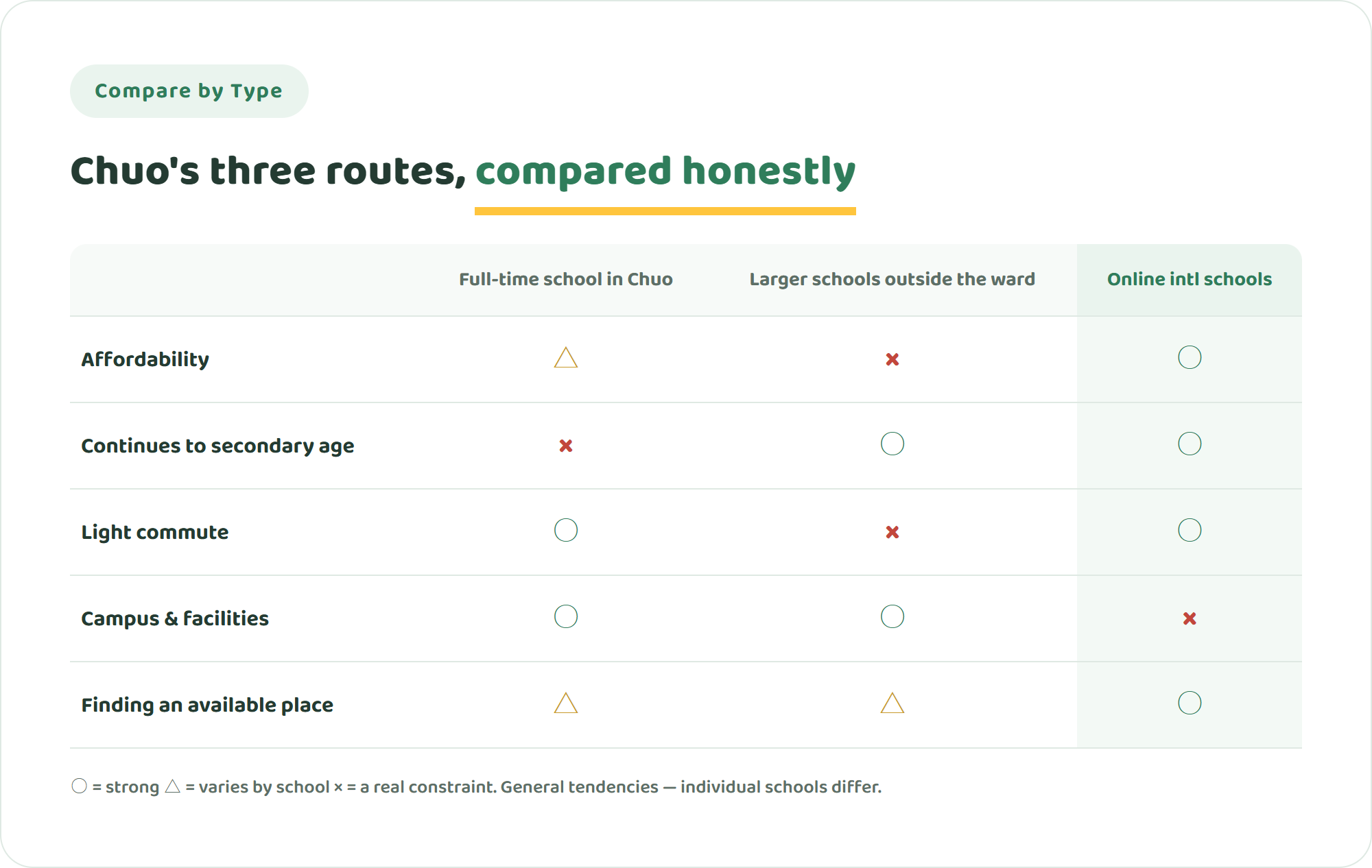
The single full-time school in Chuo offers something unusual for central Tokyo — annual costs in the ¥1.3m range and a commute you can do on foot or by bicycle. But with only one school, a place may simply not exist in your child’s year group, and Grade 6 forces a second search regardless. Larger schools outside the ward carry you from kindergarten through secondary in one institution, at the cost of fees in the ¥3m range and a long daily round trip. The third route is the one most families overlook. With no commute at all, learning stops depending on where you happen to live or how far you are willing to travel. If your child attends a Chuo public school and you want an international element alongside it, our piece on whether international school is too expensive may help you weigh it up.
See how learning works online →
When fees or the commute are the real obstacle: the online option
Chuo is a genuinely good place to raise a child — the streets of Nihonbashi, Ginza a few minutes away, the waterfront parks of Tsukishima and Harumi, and a ward government known for generous family support. Even so, the constraints are real: one full-time international school for primary age, an exit at Grade 6, and fees in the ¥3m range if you look outside the ward. Plenty of families reach the same point — wanting an international education, unsure they can sustain the burden for a decade. If that is where you are, a school that does not require a commute at all is worth putting on the list.
NIJIN GLOBAL ACADEMY (NGA) is an online international school opening in September 2027. It is run by NIJIN Inc., the company behind NIJIN Academy, an alternative school in Japan with more than 1,000 enrolled students. Our approach rejects ranking children by test scores, centres on small-group dialogue, and aims at a simple goal: helping children come to like themselves and the world. It serves ages 6–18 across Asia and Oceania, wherever a family lives, and is designed so children can move into English gradually with Japanese-language support in place. We are working toward fees at roughly one-fifth of an on-campus international school.
To be straightforward with you: NGA has not opened yet, and our track record is still ahead of us. We cannot offer the playground, the corridors and the physical campus life a bricks-and-mortar school provides. What we can offer is learning that connects your child to the world without a commute and at a fraction of the cost — which, if you are weighing options in Chuo right now, may be worth a look.
Frequently asked questions
Q. What age can children start at international schools in Chuo?
A. In the early years, as young as a few months old. Sunshine Kids Academy Tokyo takes children from three months; Sakura International School Nihonbashi and T.N.G Montessori Academy run parent-and-child classes from birth; Aoba-Japan Bilingual Preschool Harumi and FUTURE Jidoen Nihonbashi start around age one to eighteen months; KOA International Preschool starts at two; and Tokyo International School Kachidoki Kindergarten starts at three. The one full-time school, Chuo International School, begins at K1 (age three). Narrowing by your child’s age is always the fastest first filter.
Q. Is there anything for primary age, and what about Japanese-language support?
A. Inside the ward, the only full-time option for primary age is Chuo International School, which runs to Grade 6. Everything else is early years, so from age six most families either look to Minato, Koto or Shinagawa, or combine a Japanese elementary school with English in the afternoons. For that afternoon route, Chuo has three options: Tokyo International School Kachidoki After School (Grades 1–4), KOA (ages 6–10) and FUTURE Jidoen Nihonbashi (through Grade 6). Japanese-language support varies enormously between schools in both hours and philosophy, so ask directly before you enrol — this matters most for families who intend their child to re-enter the Japanese system later.
Q. Can we transfer mid-year, and when is the best time to apply?
A. Most schools do accept transfers, but in a ward with a single full-time school, whether a place exists at all is the bigger variable. Chuo International School runs a September start on three terms (Term 1 is September to December), so most movement follows that calendar, while preschools generally align with the Japanese April year. Expect an English assessment, a child interview and a parent meeting in some cases. Start contacting schools and attending open houses about a year before your intended start date, and bear in mind that where a preschool feeds its own kindergarten, external places narrow further.
The time you spend deciding is time spent caring
There is no single right answer in school choice. In a ward like Chuo, where the number of children keeps rising while full-time places stay at one school, the useful question is not which school is best but how many years your family can genuinely sustain. Fees, travel time, your child’s temperament — every household weighs these differently. The fact that you are sitting with this decision at all is evidence of how seriously you are taking your child’s future. Take your time, visit two or three schools in person, and compare how they feel. And if you would also like to know what the no-commute route looks like, we would be glad for you to keep our opening in mind.
International Schools in Other Cities
- International Schools in Yokohama: Full Comparison
- International Schools in Chofu and ASIJ Fees
- International Schools in Fukuoka: Fees
- International Schools in Ho Chi Minh City
- International Schools in Melbourne
- International Schools in Nagoya: All 8 Schools
- International Schools in Kita, Tokyo
- International Schools in Kobe: All 20 Schools
- International Schools in Tokyo
- International Schools in Minato: Fees
- International Schools in Shibuya, Tokyo
- International Schools in Setagaya: All 14 Schools
- International Schools in Koto, Tokyo
- International Schools in Shinagawa, Tokyo