You line up a stack of brochures, compare website after website, and still the question won’t settle: “Is this really the right school?” Many families reach exactly this point when they start looking at international schools. There is no shortage of options — what’s missing is a measuring stick. And so it becomes tempting to decide on name recognition or a tuition figure alone. But this is where your child will spend years of their daily life. You want to choose calmly, from a place of clarity.
This piece is about how to choose an international school without regret — seven questions worth asking before you decide. Accreditation and curriculum, the English level required, the total cost, class size, values and fit, graduate pathways, and the trial-and-conversation stage. Not a sales pitch, but a practical measuring stick for spotting the one school that truly fits your child. It helps to be clear first on what an international school is — that alone makes every comparison easier.

First, three traps that trip families up
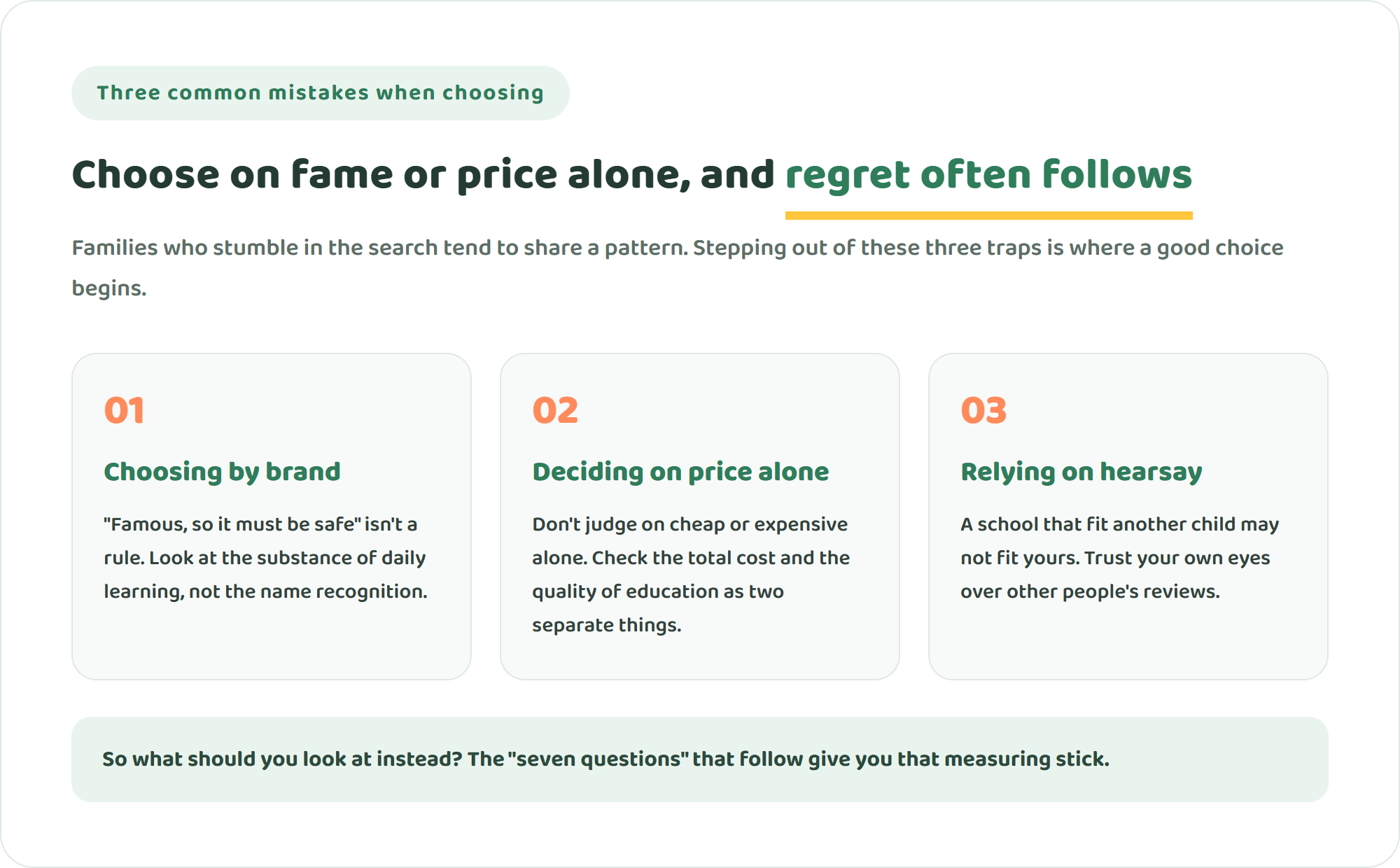
Before the seven questions, let us share the mistakes families most often fall into. The patterns that trip people up have something in common. Choosing by brand — “it’s famous, so it must be safe.” Deciding on price alone — “pricier is better,” or “cheaper is a bargain.” And leaning too hard on hearsay — “that family said it was good.” Each looks reasonable, yet in each the subject is someone else, or a number — not your child.
How to choose an international school: seven questions to ask
Now to the heart of it. Run each candidate school through the same seven questions below. Almost no school scores full marks on every one. What matters is spotting which points your family cannot compromise on.
1. Accreditation and curriculum — IB or Cambridge, and what you value
The foundation is which curriculum a school runs and what it is accredited for. The internationally known routes are the International Baccalaureate (IB), which emphasises inquiry and thinking, and Cambridge International, known for structured study and international exams; some schools lead to qualifications like the IGCSE at the secondary stage. But “accredited” doesn’t automatically mean “right for you.” Check that the accreditation matches how your child learns and where they hope to go.
2. English level — required to enter, or grown from here?
Next, look at the place English holds. Schools split into those that “require a certain English level to enrol” and those that “assume home-language support and grow English from here.” Is there a large gap between your child’s current English and what the school expects? If English worries you, it is more reassuring to check the depth of language support after enrolment than the level demanded at entry.
3. Tuition and total cost — can you see beyond the fees?
Tuition alone won’t show you the real picture. Enrolment fees, facilities, materials, uniforms, event costs — and sometimes commuting or even relocation. Only by comparing the annual total does the impact on your household become clear. It helps to see how international school fees break down so you can compare figures fairly. Judge on neither cheapness nor expense alone, but on “what that amount actually buys.”
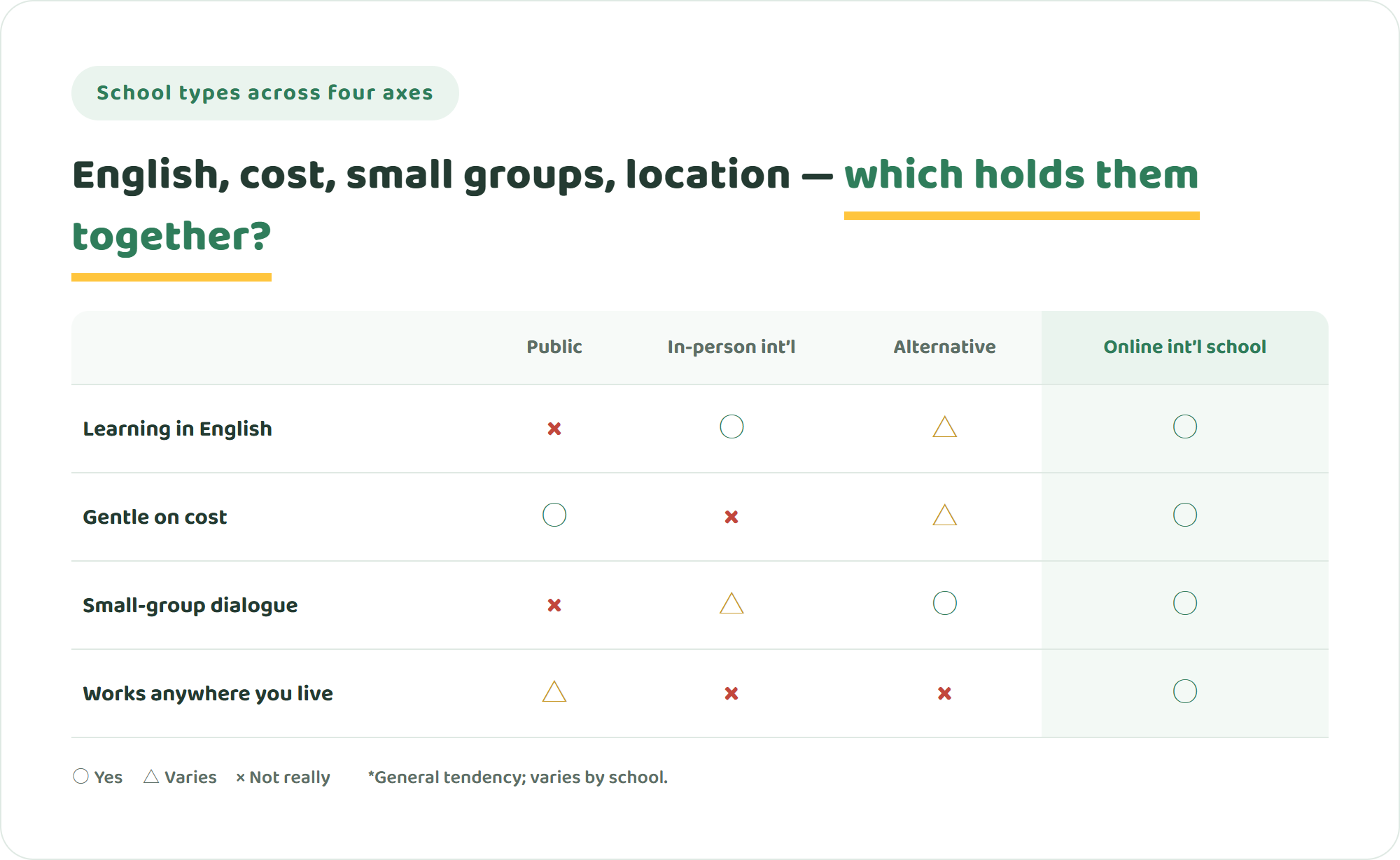
You can see how each type has its strong and weak sides. An in-person international school is strong on the English environment but heavy on tuition and commuting; a public school is gentle on cost but limited as a place to learn in English. In recent years an online international school — small-group learning that works wherever you live — has become a realistic option too. The heart of how to choose an international school without regret is not which type is “correct,” but which fits your family’s priorities.
4. Class size and teaching style — is each child seen?
Even within “international,” a large lecture-style school and a small, dialogue-centred one offer completely different daily experiences. Can your child voice their own opinion and be seen by teachers as an individual? Whether a school values small-group dialogue is a point to check by watching classes closely during a visit.
5. Values and fit — can you share what the school holds dear?
Easily overlooked, yet arguably the most important, is the fit of values. Some schools rank children by test scores; others build on each child’s interests and individuality. Does what the school truly holds dear overlap with your family’s hopes? When this is misaligned, even good conditions won’t last.
6. Graduate pathways — can you see the exit, not just the entrance?
Check the exit, not only the entrance. Where do graduates go, and how do roads to universities abroad and at home open up? Seeing real examples of where international school graduates go lets you picture concretely how the learning connects to the future. For a newly opening school, ask carefully about the pathways it aims for and the support behind them.
7. Trial and conversation — do you experience it firsthand, and do they answer you honestly?
Finally, always confirm with your own eyes. Join an info session or trial and watch your child’s reaction. And notice how honestly the school answers your anxious questions. A school that speaks frankly about weaknesses and who it does or doesn’t suit — not only the convenient parts — is one you can trust after enrolment too.
See how online learning works →
Turning seven questions into a decision
Even with the questions in hand, the more you gather, the deeper the hesitation. What matters is not the volume of information but comparing on the same measuring stick. These three steps turn what you’ve gathered into a decision.

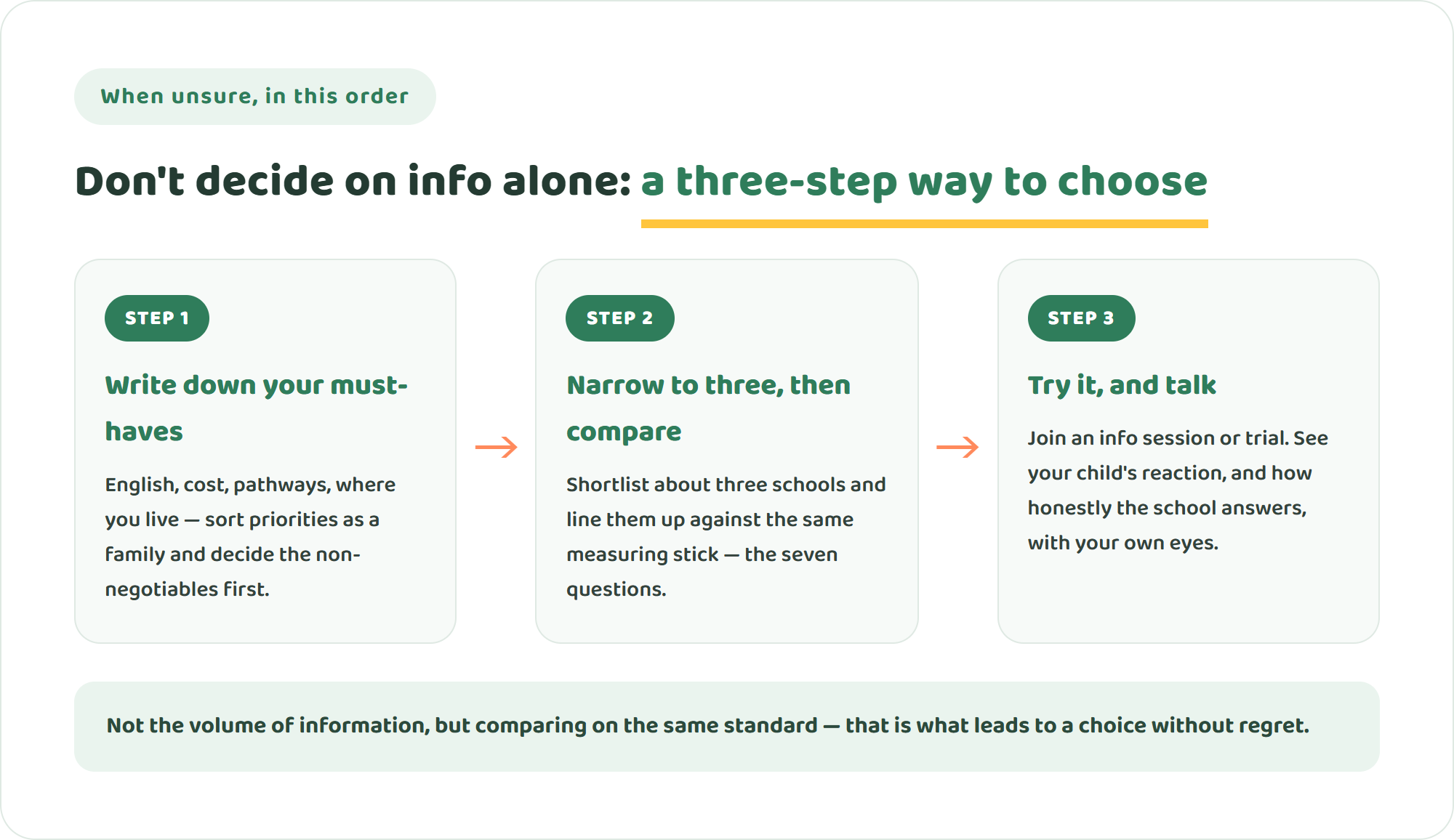
First, write down your must-haves as a family. Deciding which of English, cost, pathways, and location comes first keeps the axis of comparison steady. Next, shortlist about three schools and line them up against the seven questions. Finally, always try it, and talk — confirm not the brochure but the actual class, your child’s expression, and how honestly the school answers. In this order, you can decide without being tossed around by information.
Where NGA sits among these
As one option we’d genuinely want you to run through these seven questions, here is our NIJIN GLOBAL ACADEMY (NGA). NGA is an online international school beyond the exam race, opening in September 2027, operated by NIJIN Inc. NIJIN Academy, the alternative school we run in Japan, already has over 1000 children learning with us.
What we aim for is learning built on coming to love yourself and the world. Rather than ranking children by test scores, we start from each child’s interests; it works wherever you live; children connect with the world through small-group dialogue; and we’re aiming for tuition around one-fifth of an on-campus international school — within reach. Details of accreditation and curriculum, and formal fees, we’ll share step by step as we move toward opening. Please compare us fairly against other schools on the same seven questions, and add us to your shortlist if it feels right for your child.
Frequently asked questions
In the end, which question matters most?
It varies by family, but in most cases “fit of values” is the foundation. Even when accreditation and cost look good, a mismatch between what the school holds dear and your family’s hopes tends to cause strain after enrolment. Put into words “what our family wants from learning” first, then read the seven questions against it — your priorities will settle.
Can we still choose an international school if my child’s English is shaky?
Yes. What matters is not the English level at entry but how thorough the language support is afterward. Some schools are designed around home-language support so a child meets English gradually. Choose one that treats English as “something to grow” rather than “an entry requirement,” and even a child new to it can take that first step with confidence.
Is an online international school worth choosing over an in-person one?
Depending on your goals, very much so. Its strengths are working wherever you live, keeping small-group dialogue, and costing less than an in-person international school. That said, for families who prioritise the close contact only in-person allows, a reachable in-person school may fit better. Here too, comparing fairly on the seven questions helps you decide.
Choose “because it fits my child,” not “it seems fine.”
There is no perfect answer in choosing a school. But there is a way to choose without regret: not being swept along by fame or price, but comparing with the same measuring stick of seven questions, with your child as the subject. Accreditation, English, cost, small groups, values, pathways, trial — check them one by one in that order, and “it seems fine” turns into “because it fits my child.”
NIJIN GLOBAL ACADEMY opens in September 2027. We’ll share how our learning works — beyond the exam race, within-reach pricing, and connection with the world through small-group dialogue — along with first-cohort enrolment news, straight to your inbox. May your school search become a step you never regret.
Honest Answers to Your Worries — related reading
- Will My Child Lose Their Mother Tongue?
- The Honest Pros and Cons of International School
- Disadvantages of Bilingualism in Childhood: Myths vs Research
- Who Regrets International School — and Who Doesn’t
- International School Special Needs: What to Look For
- International School vs Local School: How to Decide
- Does International School Hurt Your Child’s Home Language?
- When Your Child Is Struggling at International School
- Do International Schools Make Children Fluent in English?
- Is International School Worth It? What Happens to Graduates
- Should I Send My Child to International School?
- Transfer From a Local School to an International School
- Disadvantages of Early English Education: What Research Says
- What Happens to International School Graduates
Get opening updates by email →
More on choosing an international education
- 6 International Qualifications You Can Earn Online——An honest guide
- When Your Child Does Not Want to Go to School——How to respond, and 5 real options
- How Much Household Income Do You Need for an International School?——Budgeting so it lasts
- What Is the International Baccalaureate?——IB vs Cambridge, honestly compared
- Starting International School in the Elementary Years——What changes, and what it costs
- How Much Does an International Preschool Cost in Japan?——Fees, subsidies, and the step after kindergarten
- Can You Raise a Bilingual Child Without Speaking English?——What parents can realistically do at home
- School Refusal? An Online International School Can Reopen Learning——A route back into learning
- How Do You Nurture the Skills Standardized Tests Cannot Measure?——Beyond exam scores
- The Best Age to Start Learning English for Kids——Too early? Too late?