“I don’t want my child to struggle with English. But I’m not fluent myself, and we can’t afford expensive materials or a conversation school.” If you’re standing at the doorway with a worry like that, you’re far from alone. Here’s the honest bottom line: what really matters when you want to help your child learn English at home isn’t special materials or fluent parents. It’s the small things, stacked up day after day in ordinary life.
This piece gathers ten practical ways to help your child learn English at home. Every one can start today, and most cost little or nothing. One important premise first: you can raise a bilingual child even if you don’t speak English — you don’t need perfect pronunciation to teach. If timing is on your mind, see also the best age to start English. Now, let’s look at it honestly and realistically.
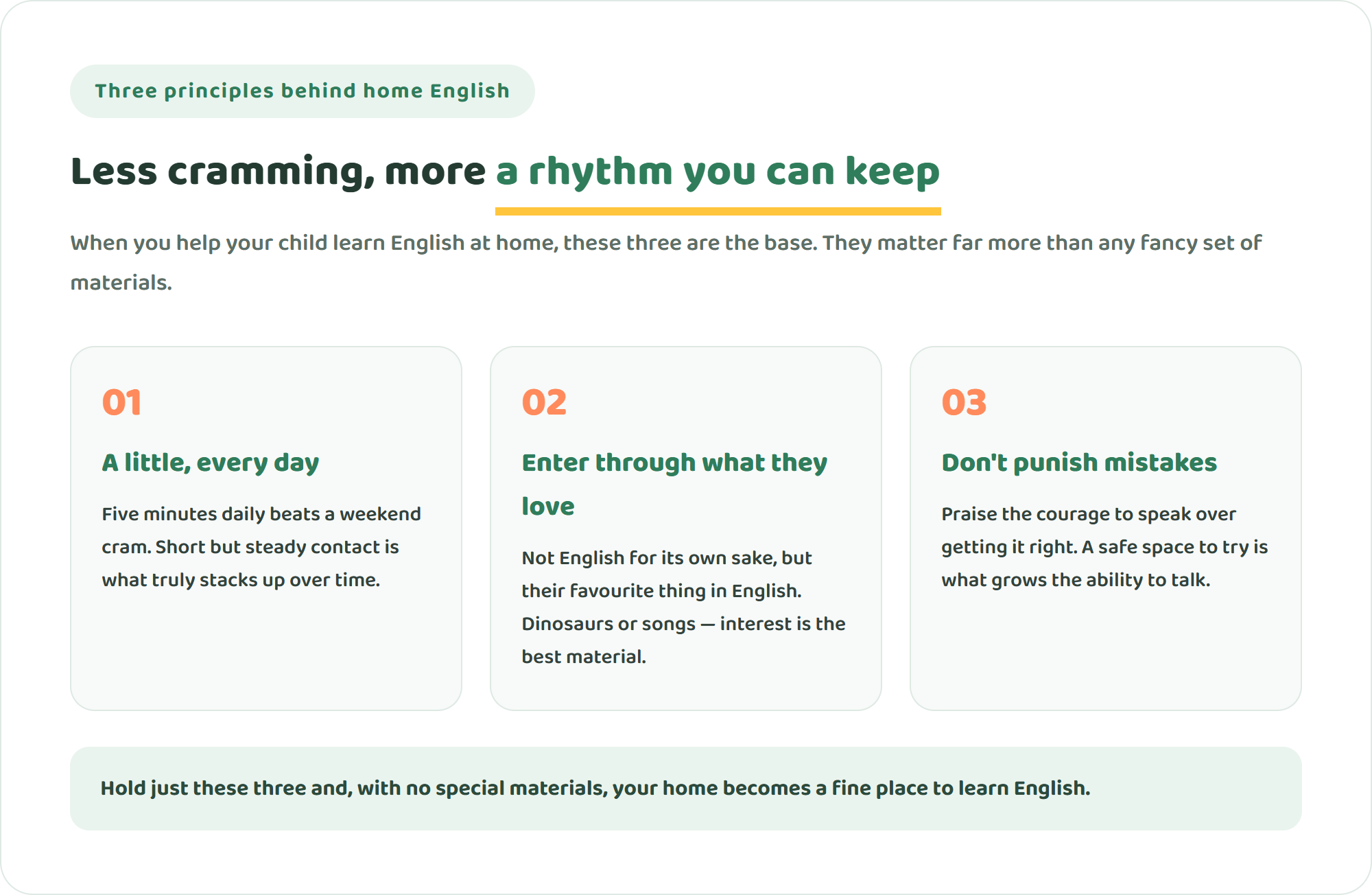
Three principles for helping your child learn English at home
Before the ten ways, let me share the ground they stand on. Holding these three matters far more than memorising any technique: a little every day rather than a lot at once, enter through what they love, and don’t punish mistakes. Keep these principles and any set of materials becomes an ally.
1. A few minutes daily, not one big session
English is a bit like exercise. A short daily dose beats hours crammed into a weekend. The reason is simple: language sticks when you meet it again before you forget it. Start with five minutes a day, placed at a fixed point in your routine. You can lengthen it later — but only once the habit itself has taken hold.
2. Read aloud — including in English
If you already read picture books together, just slip one English book into the mix. Nervous about your pronunciation? It’s fine. Children delight far more in your voice and the shared page-turning than in “correct” sounds. Start with short, picture-heavy books, and reread the same one — through repetition, children naturally absorb whole chunks of language.
3. Songs, rhymes and action songs — let it in through the ears
Children are geniuses at learning a whole song without understanding a word of it. English songs and action rhymes deliver correct sounds and rhythm while the child simply has fun. Playing them in the background during chores is plenty. Even a child too young to sit at a desk can soak in English through song. Hum along, and you become the best model there is.
4. Not “English for its own sake,” but their favourite thing in English
Dinosaurs, trains, princesses, space — what is your child absorbed in? Preparing an English version of that passion is the surest shortcut. A child who tenses up at “study English” will happily watch a favourite dinosaur video in English. When it comes to helping your child learn English at home, nothing is a stronger engine than interest. Let English be not the goal, but a tool for widening a world they already love.
5. Use videos and apps “with a purpose”
Screen time gets cast as the villain. But watching aimlessly and choosing with a purpose are worlds apart. Decide “this one today” and watch together; afterwards, ask in your home language, “which part did you like?” That alone turns passive viewing into learning. Rather than banning screens, it’s more realistic to make them a skilful ally.
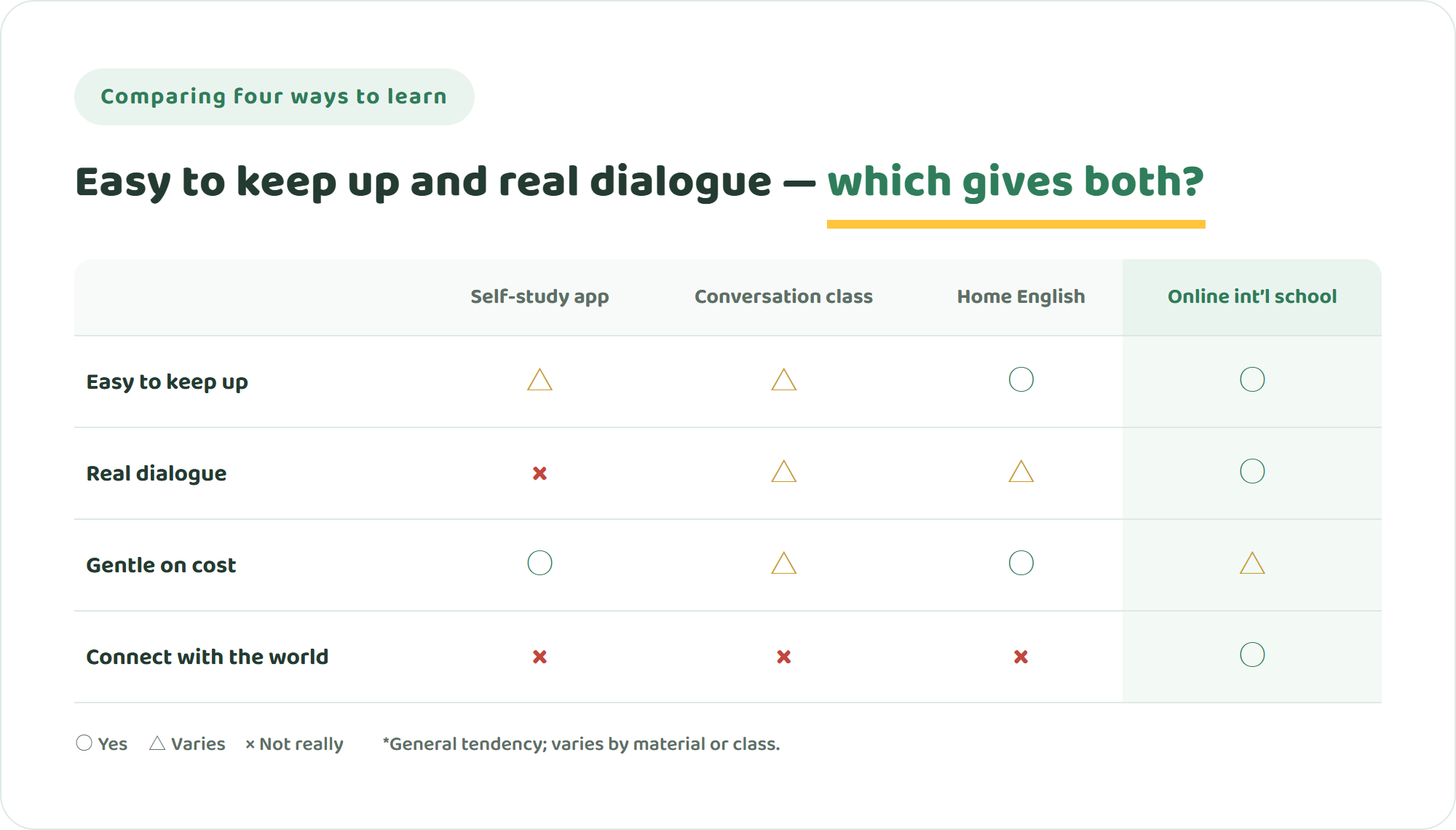
As the table shows, each way of learning has its strengths and blind spots. Home English shines on being easy to keep up and gentle on cost. Honestly, though, home alone struggles to reach “real dialogue” or the experience of connecting with the world. That’s exactly why we think the realistic move is to combine several approaches rather than rely on one.
See how online learning works →
6. Build small English routines into daily life
“Good morning” in the morning, “Good night” before bed, “Here you are” at snack time. Adding one short English phrase to a fixed daily moment turns English from “study” into “part of life.” Because the moment happens every day, the phrase repeats naturally. In terms of being easy to keep up, this is a beautifully sensible method.
7. Keep output in a “mistakes are fine” atmosphere
Output — speaking and writing — is a big chance to grow. But correct every little error and a child clams up. What matters is to praise the courage to speak over getting it right. A simple “you said it!” draws out the next sentence. Grammatical polish can grow as much as you like, later.
8. Have an online lesson or a conversation partner
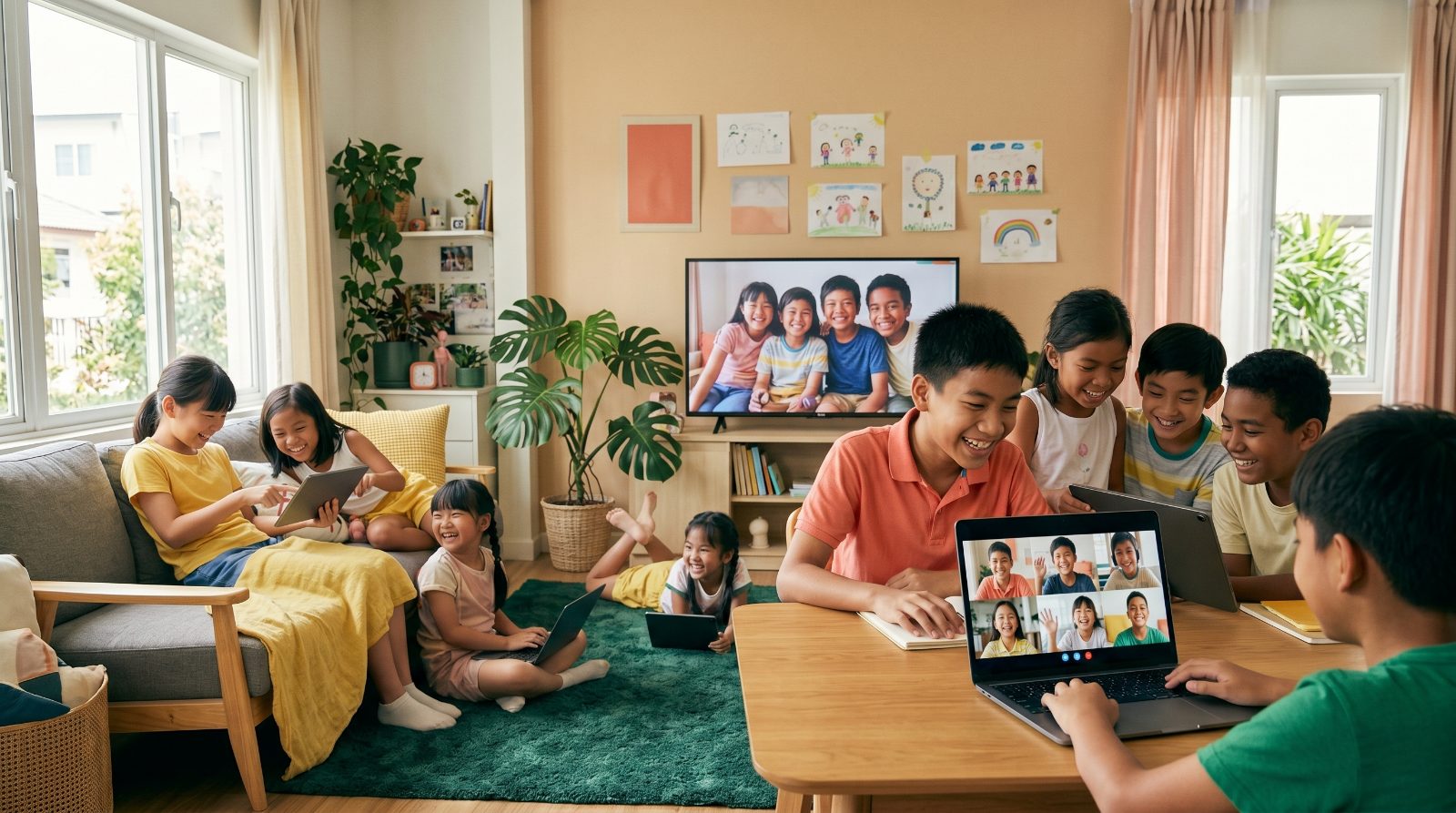
Speaking English with someone outside the family is hard to get within the home alone. Online lessons, or time with someone to talk to in English, carry that priceless success — “my English got through!” Once a week is plenty. The joy of truly connecting with another person pulls out a child’s “I want to talk more” far harder than any drill.
9. Praise the attempt itself, not the result
“You tried it” over “well done.” In English and beyond, children grow most when the fact that they tried — not whether it went well — is what gets acknowledged. Even if they get it wrong or feel shy, praise the very act of opening their mouth first. Stacked up, this raises a child who keeps using English without fearing failure. Improvement follows naturally, further down the road.
10. Learn alongside them, without fear
Last, and what I most want to say: you can help your child learn English at home even if you don’t speak it well. In fact, you cheerfully saying “Mum doesn’t know either — let’s look it up together” is the finest material of all. Watching an adult learn without fearing mistakes, a child learns that “it’s okay to fail at English.” Be not the teacher, but the person happily learning right beside them.

Three first steps to start this week
Ten ways can, ironically, leave you unsure where to begin. So here’s an order you can start this week without strain, gathered into three steps. No need to do it all at once — this small first step is enough.
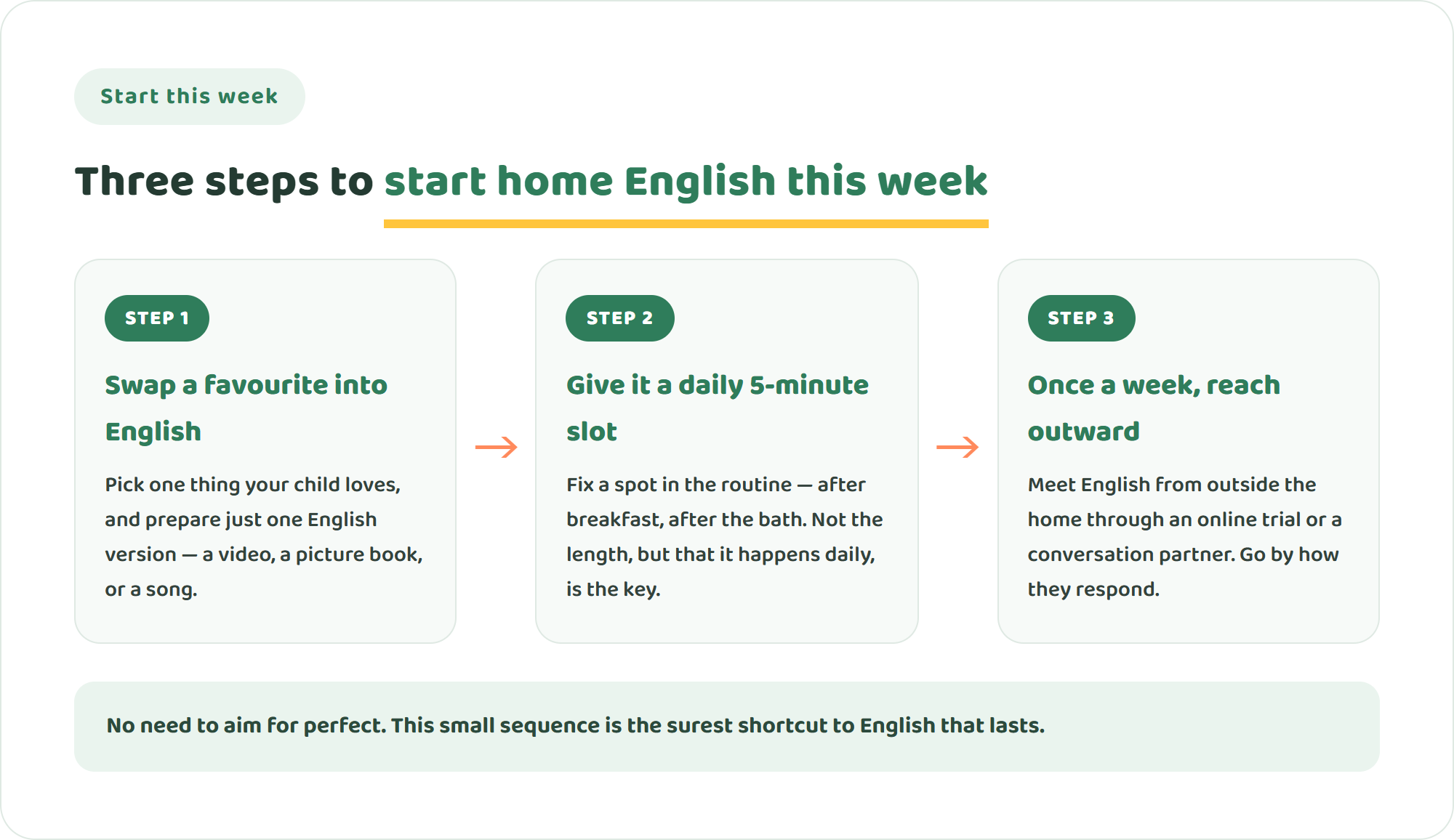
First, pick one thing your child loves and prepare its English version — a video, a book, or a song; just one to begin. Next, give it a daily five-minute slot in your routine, fixed to a moment that always happens, like after breakfast or after the bath. Then, once a week, reach a little toward English from outside the home — try an online trial or a conversation partner, going by how your child responds. These three alone set home English in motion.
Beyond that — if you want English to become “a language for connecting with the world”
All ten ways above are a solid base for helping your child learn English at home. Yet as they continue, many families begin to feel the same thing: “I want English to be not a test subject, but a language that truly connects my child to the world.” That’s where an online option like ours, NIJIN GLOBAL ACADEMY (NGA), can come in.
NGA is an online international school beyond the exam race, opening in September 2027, operated by NIJIN Inc. NIJIN Academy, which we run in Japan, already has over 1000 children learning with us. What we hold dear is small-group dialogue that starts from “what do you think?” As children exchange views with peers around the world through the screen, English naturally becomes “a language they use.” We’re aiming for tuition around one-fifth of an on-campus international school. It’s one option among many, of course — something to consider as a next step, with home English as your base.
Frequently asked questions
Can I really help my child learn English at home even if I don’t speak it well?
Yes, you can. What matters in helping your child learn English at home isn’t the parent teaching, but setting up an environment full of English and cheering on every attempt. Picture books, songs, videos, and online partners can carry the pronunciation and grammar. Your role is to enjoy it beside them and delight in a “you said it!” That is the greatest strength of all.
How much English a day should my child get?
Five minutes a day is plenty to start. Frequency matters more than length. Five minutes every day stacks up more surely than one crammed hour at the weekend. Once your child settles in and starts asking for “more,” lengthen it gradually. Above all, don’t stretch it so far that English becomes something they dislike.
There are so many methods — do I have to do them all?
No, not at all. There’s no need to do all ten. Pick the two or three your child enjoys and simply keep those going. Anything that doesn’t fit, you can drop without guilt. As with the “three first steps” above, start small and keep only what lasts — that’s the approach that works best.
Let English become part of your everyday, together.
Helping your child learn English at home takes no special talent and no expensive materials. All it needs is a small daily habit and the warmth to meet mistakes with a smile. Today, one picture book, one song, or one English video — starting just one widens your child’s world a little. Whether or not you speak English yourself simply doesn’t matter.
NIJIN GLOBAL ACADEMY opens in September 2027. We’ll share how our learning works — beyond the exam race, within-reach pricing, and connection with the world through small-group dialogue — along with first-cohort enrolment news, straight to your inbox. If, beyond home English, you find yourself curious about learning that connects to the world, come and take a look.
Honest Answers to Your Worries — related reading
- Will My Child Lose Their Mother Tongue?
- The Honest Pros and Cons of International School
- Disadvantages of Bilingualism in Childhood: Myths vs Research
- Who Regrets International School — and Who Doesn’t
- International School Special Needs: What to Look For
- International School vs Local School: How to Decide
- Does International School Hurt Your Child’s Home Language?
- When Your Child Is Struggling at International School
- Do International Schools Make Children Fluent in English?
- Is International School Worth It? What Happens to Graduates
- Should I Send My Child to International School?
- Transfer From a Local School to an International School
- Disadvantages of Early English Education: What Research Says
- What Happens to International School Graduates
Get opening updates by email →
More on choosing an international education
- Online High School for Expat and Globally Mobile Families——Learning that moves with you
- How to Choose an International School——7 questions to ask before you enrol
- 6 International Qualifications You Can Earn Online——An honest guide
- When Your Child Does Not Want to Go to School——How to respond, and 5 real options
- How Much Household Income Do You Need for an International School?——Budgeting so it lasts
- What Is the International Baccalaureate?——IB vs Cambridge, honestly compared
- Starting International School in the Elementary Years——What changes, and what it costs
- How Much Does an International Preschool Cost in Japan?——Fees, subsidies, and the step after kindergarten
- Can You Raise a Bilingual Child Without Speaking English?——What parents can realistically do at home
- School Refusal? An Online International School Can Reopen Learning——A route back into learning