If you have started looking at international schools in Manila, you already know the hard part: the choices are wonderful, and the fees can be terrifying. Annual tuition ranges from under ₱200,000 to well over ₱1 million — and that is before matriculation fees, capital development funds, and the daily reality of EDSA traffic. This guide walks you through 7 real, well-regarded international schools in Manila across every price tier, with honest fee ranges, curricula, and who each school actually fits. By the end, you will have a shortlist — and one option you may not have considered yet.
Quick Answer: Your Options in Manila
If you only read one section, read this. Below are the schools covered in this guide, plus the online option — so you can see every route side by side before the details.
- International School Manila (ISM) — Tuition Fees and Overview — Ages — 3 to 18 (Preschool to Grade 12) / Fees — US$9,720 + ₱306,400 (Preschool) up to US$19,660 + ₱623,800 (Grades 11–12) per…
- Brent International School Manila — Tuition Fees and Overview — Ages — 3 to 18 (Nursery to Grade 12) / Fees — billed in USD plus PHP; roughly US$8,400 + ₱390,000 to US$9,400 + ₱430,000 per…
- The British School Manila (BSM) — Tuition Fees and Overview — Ages — 3 to 18 (Nursery to Year 13) / Fees — billed in GBP plus PHP; roughly £7,300 + ₱530,000 to £9,700 + ₱700,000 per year…
- Chinese International School Manila (CISM) — Tuition Fees and Overview — Ages — 5 to 18 (Kindergarten to Grade 12) / Fees — ₱684,700 (Nursery) to ₱1,124,300 (Grades 11–12) per year on the annual plan, per…
- Reedley International School — Tuition Fees and Overview — Ages — 4 to 18 (Pre-K to Grade 12) / Fees — roughly ₱170,000–335,000 per year per school database listings as of 2026 (confirm…
- Southville International School and Colleges — Tuition Fees and Overview — Ages — 3 up to college level / Fees — from roughly ₱190,000 per year, varying by level and programme (public information…
- Domuschola International School — Tuition Fees and Overview — Ages — 3 to 18 (Nursery to Grade 12) / Fees — ₱248,000 (Early Years) to ₱543,200 (Grades 11–12 IBDP) per year, per the official…
- NIJIN GLOBAL ACADEMY (online) — Ages 6–18 / opening September 2027, currently taking opening-update registrations / fees around one-fifth of a typical campus international school / Japanese-language support. An option when commute or fees are the wall.
Can’t justify Manila international school fees?
Families in Manila often face the same wall: the school is right, the fee is not. NIJIN GLOBAL ACADEMY is an online international school with no campus — and no campus fees. Live, small-group lessons in English, at roughly one-fifth the cost of an in-person international school. It is built for children who are not yet fluent in English, so you do not need an English-speaking household to start.
🎁 Register and we will email you the school prospectus (English & Japanese) straight away — plus tuition and trial-class details before anyone else.
Free to join. Unsubscribe any time.
International Schools in Manila: The Landscape and What Fees Really Look Like
Metro Manila is home to more than 20 international schools, clustered around BGC and McKinley Hill in Taguig, with strong options in Makati, Pasig, and the southern corridor toward Las Piñas and Laguna. The variety is remarkable: century-old American and British institutions, IB continuum schools, an English-Mandarin bilingual school, and schools that blend the Philippine K-12 system with international programmes at a fraction of the premium price.
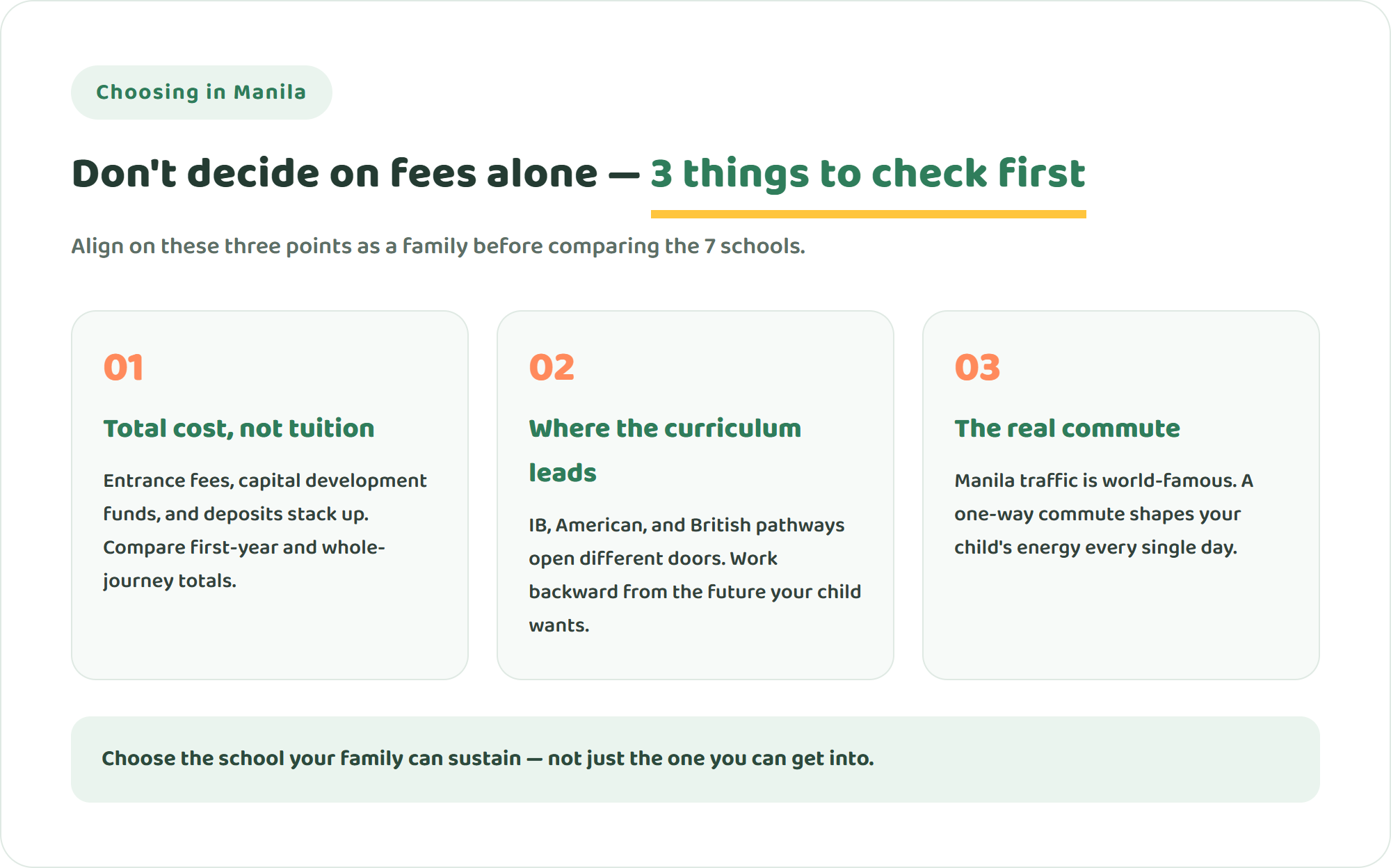
Fees fall roughly into three tiers. Budget-friendly international schools charge around ₱150,000–350,000 per year, mid-tier schools around ₱350,000–550,000, and the premium names run from about ₱650,000 to ₱1.5 million and beyond — often billed partly in US dollars or pounds. First-year costs are significantly higher almost everywhere, because entrance fees, capital development fees, and deposits stack on top of tuition. If you want to understand exactly what those line items mean, see our breakdown of what international school tuition really covers. Note: all fees in this article are based on publicly available information as of July 2026 — always confirm the latest figures on each school’s official website.
Manila International School Tuition Fees at a Glance
Before the individual profiles, here is a side-by-side look at the annual tuition, curriculum, area and student ages for the 7 schools below. Fees are approximate annual ranges (tuition-focused; entrance fees, capital development fees and other charges are usually extra). The list is not ranked by price — scan it to get a feel for the market, then read the profiles that fit your family.
| School | Area | Curriculum | Approx. annual tuition |
|---|---|---|---|
| International School Manila (ISM) | BGC, Taguig | American + IB Diploma | US$9,720 + ₱306,400 to US$19,660 + ₱623,800 (SY2026–27) |
| Brent International School Manila | Biñan, Laguna | American + IB Diploma | US$8,400 + ₱390,000 to US$9,400 + ₱430,000 (K–12) |
| The British School Manila (BSM) | BGC, Taguig | British → IGCSE → IB Diploma | £7,300 + ₱530,000 to £9,700 + ₱700,000 |
| Chinese International School Manila (CISM) | McKinley Hill, Taguig | American + Mandarin + IB Diploma | ₱660,000–1,080,000 |
| Reedley International School | Pasig | American-based + Singapore Math | ₱170,000–335,000 |
| Southville Int’l School and Colleges | Las Piñas | Philippine K-12 + IB Diploma | from ₱190,000 |
| Domuschola International School | Pasig | IB PYP → IGCSE → IB Diploma | Not published (request from school) |
Even within this shortlist, annual tuition runs from around ₱170,000 to well over ₱1 million — and the premium schools bill partly in US dollars or pounds, so exchange rates matter. Always confirm the current fee schedule, plus one-off entrance and capital development fees, directly with each school. ※All figures are based on publicly available information as of July 2026.
The 7 Best International Schools in Manila
Here are 7 schools chosen for reputation, curriculum diversity, and a genuine spread of price points. The order is not a ranking — the best school is the one that fits your child and your family’s priorities.
1. International School Manila (ISM) — Tuition Fees and Overview
Founded in 1920, ISM is the grande dame of Philippine international education. Its sprawling BGC campus hosts a genuinely global student body, world-class facilities, and a college placement record that speaks for itself. High schoolers can pursue the IB Diploma.
- Curriculum — American-style, with the IB Diploma in high school
- Ages — 3 to 18 (Preschool to Grade 12)
- Fees — US$9,720 + ₱306,400 (Preschool) up to US$19,660 + ₱623,800 (Grades 11–12) per year, per the school’s published SY 2026–2027 fee schedule; see the grade-by-grade table below
- Best for — families with the budget who want the most established name and top-tier facilities in the country
International School Manila tuition fees (SY 2026–2027, as published by the school). ISM bills annual tuition in two parts — a US dollar component and a Philippine peso component — so the two lines below are charged together, not as alternatives.
| Grade level | Annual tuition (SY 2026–2027) |
|---|---|
| Preschool 3–4 | US$9,720 + ₱306,400 |
| Elementary (K–Grade 4) | US$15,160 + ₱479,600 |
| Middle School (Grades 5–8) | US$16,520 + ₱524,600 |
| High School (Grades 9–10) | US$17,620 + ₱558,400 |
| High School (Grades 11–12) | US$19,660 + ₱623,800 |
On top of tuition, new students in K–12 pay a one-time matriculation fee of US$4,500 and a one-time facilities enhancement fee of US$4,500. The application fee is US$700 for applications submitted on or after 1 August 2026. Semester payment is available at half the annual tuition. Source: ISM — School Fees. Always confirm current figures with the school, as fees are revised annually.
2. Brent International School Manila — Tuition Fees and Overview
Brent traces its roots to 1909 and runs its Manila campus on spacious, green grounds in Biñan, Laguna — a natural fit for families in Alabang and the south. The school follows an American curriculum with the IB Diploma in the upper years, within a warm Episcopal tradition.
- Curriculum — American, with the IB Diploma
- Ages — 3 to 18 (Nursery to Grade 12)
- Fees — billed in USD plus PHP; roughly US$8,400 + ₱390,000 to US$9,400 + ₱430,000 per year for K–12, lower for early years (official 2025–26 schedule; confirm the latest)
- Best for — southern Metro Manila families who value tradition, space, and a calmer campus setting
3. The British School Manila (BSM) — Tuition Fees and Overview
BSM in BGC is the standard-bearer for British education in the Philippines: the English National Curriculum leading into IGCSE, then the IB Diploma in Years 12–13. It is particularly praised for pastoral care and a structured, well-sequenced academic programme.
- Curriculum — British (English National Curriculum → IGCSE → IB Diploma)
- Ages — 3 to 18 (Nursery to Year 13)
- Fees — billed in GBP plus PHP; roughly £7,300 + ₱530,000 to £9,700 + ₱700,000 per year from primary upward, lower for Nursery (public information as of 2026; confirm the latest)
- Best for — families who want the rigour of a British pathway, including those eyeing UK or European universities
4. Chinese International School Manila (CISM) — Tuition Fees and Overview
Located in McKinley Hill, CISM is a K-12 school built around a distinctive promise: strong English-medium academics on an American core curriculum, with Mandarin taught across all grade levels, capped by the IB Diploma in Grades 11–12.
- Curriculum — American core + Mandarin programme + IB Diploma
- Ages — 5 to 18 (Kindergarten to Grade 12)
- Fees — ₱684,700 (Nursery) to ₱1,124,300 (Grades 11–12) per year on the annual plan, per the official SY2026–27 schedule
- Best for — families who see English-plus-Mandarin bilingualism as a decisive advantage in Asia
| Grade level | Annual tuition |
|---|---|
| Nursery | ₱684,700 |
| Pre-K / Kinder | ₱732,000 |
| Grades 1–5 | ₱874,700 |
| Grades 6–8 | ₱925,300 |
| Grades 9–10 | ₱1,053,000 |
| Grades 11–12 | ₱1,124,300 |
Semestral and quarterly plans cost more than the annual plan. The school states that tuition includes a fully refundable ₱150,000 subject to terms and conditions, and that an application and assessment fee applies at admission. Source: cismanila.org/admissions/fees
5. Reedley International School — Tuition Fees and Overview
Reedley in Pasig has built a loyal following among Filipino families for a reason: a nurturing, deliberately bully-free school culture, an American-based curriculum strengthened with Singapore Math, and optional AP courses in the upper grades — all at a fraction of premium-tier fees.
- Curriculum — American-based + Singapore Math, with optional AP
- Ages — 4 to 18 (Pre-K to Grade 12)
- Fees — roughly ₱170,000–335,000 per year per school database listings as of 2026 (confirm with the school)
- Best for — families who want an international curriculum and a kind, small-community feel without the premium price tag
6. Southville International School and Colleges — Tuition Fees and Overview
Southville in Las Piñas offers something rare: a single institution running from preschool all the way to college, blending the Philippine K-12 framework with international-standard programmes including the IB Diploma. For many local families it hits the sweet spot between local schools and full-price internationals.
- Curriculum — Philippine K-12 + international programmes (IB Diploma available)
- Ages — 3 up to college level
- Fees — from roughly ₱190,000 per year, varying by level and programme (public information as of 2026; confirm with the school)
- Best for — value-conscious families in the south who want continuity from early years through university
7. Domuschola International School — Tuition Fees and Overview
Domuschola is an IB World School in Pasig, often described as one of the most affordable ways to access an IB education in Metro Manila. The pathway runs from the IB Primary Years Programme through Cambridge IGCSE to the IB Diploma, in an intentionally small, personal setting.
- Curriculum — IB PYP → Cambridge IGCSE → IB Diploma
- Ages — 3 to 18 (Nursery to Grade 12)
- Fees — ₱248,000 (Early Years) to ₱543,200 (Grades 11–12 IBDP) per year, per the official SY2026–27 schedule
- Best for — families who want inquiry-based IB education in a small community, at accessible fees
| Grade level | Annual tuition |
|---|---|
| Early Years (ages 3–5) | ₱248,000 (₱62,000 × 4 quarters) |
| Grades 1–5 (ages 6–10) | ₱365,600 (₱91,400 × 4) |
| Grades 6–10 (ages 11–15) | ₱388,000 (₱97,000 × 4) |
| Grades 11–12 IBDP (ages 16–17) | ₱543,200 (₱135,800 × 4) |
The school also states that new students may be required to pay a one-time Matriculation Fee and a Capital Development Fee on enrolment; those amounts are not published on the fee page, so ask admissions directly. Source: domuschola.edu.ph/school-fees-v2
Comparing Your Options: Which International School in Manila Fits Your Family?
Step back and the Manila landscape sorts itself into three broad types: the established premium schools, the mid-tier and newer schools, and — increasingly relevant — online international schools that remove the commute entirely. Here is an honest side-by-side.
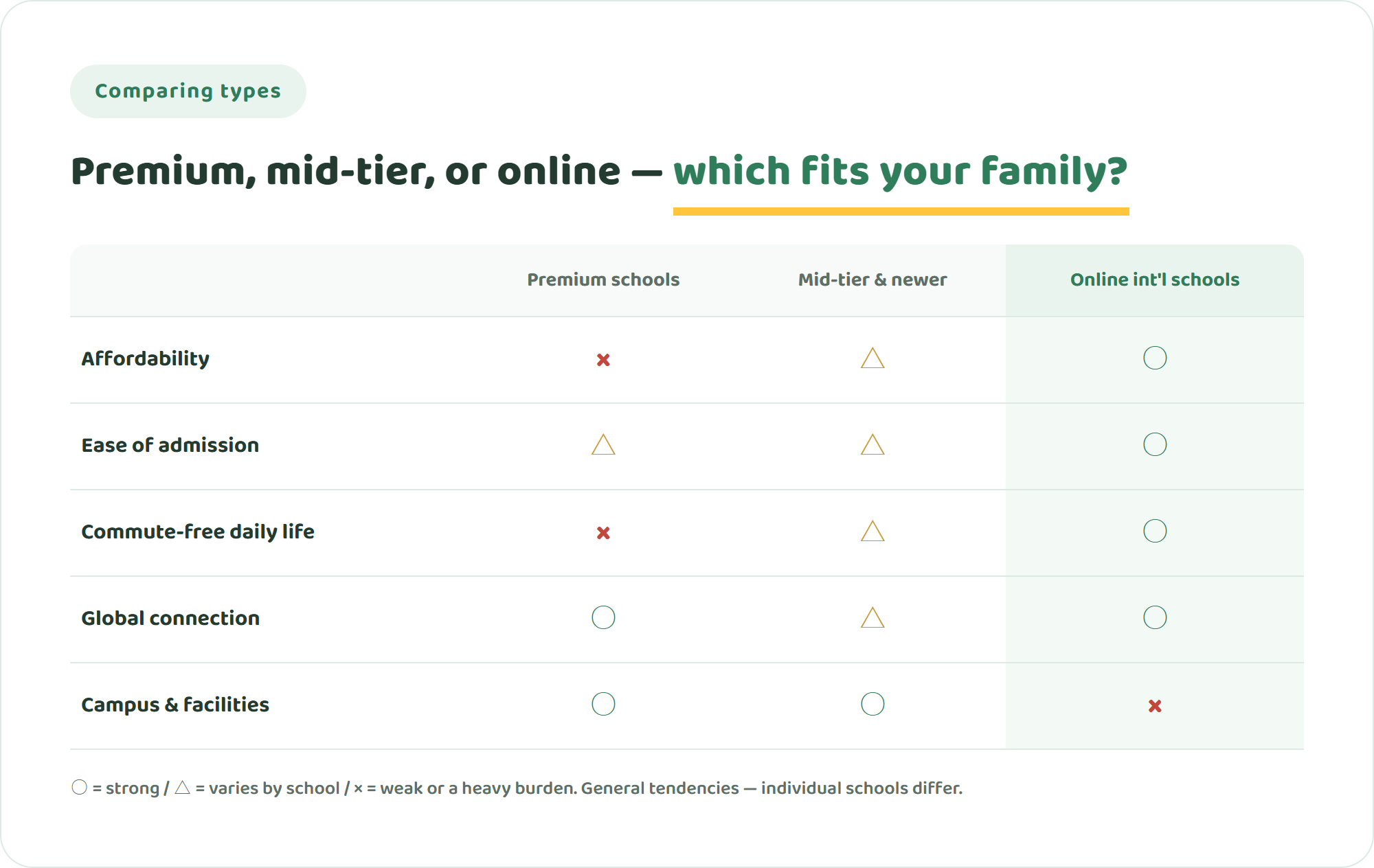
The premium schools deliver extraordinary environments — at extraordinary cost, with waitlists and a daily commute that Manila traffic can turn into hours. Mid-tier schools offer excellent value, but quality varies more from school to school, so campus visits matter. Online international schools flip the equation: dramatically lower fees and zero commute, in exchange for not having a physical campus, playing fields, or face-to-face facilities. No single option checks every box — which is why the most useful step is deciding, as a family, what you can compromise on and what you cannot. If you are curious how learning actually works in an online school, see how learning works online →
When Fees or Traffic Are the Barrier: Online as the 8th Option
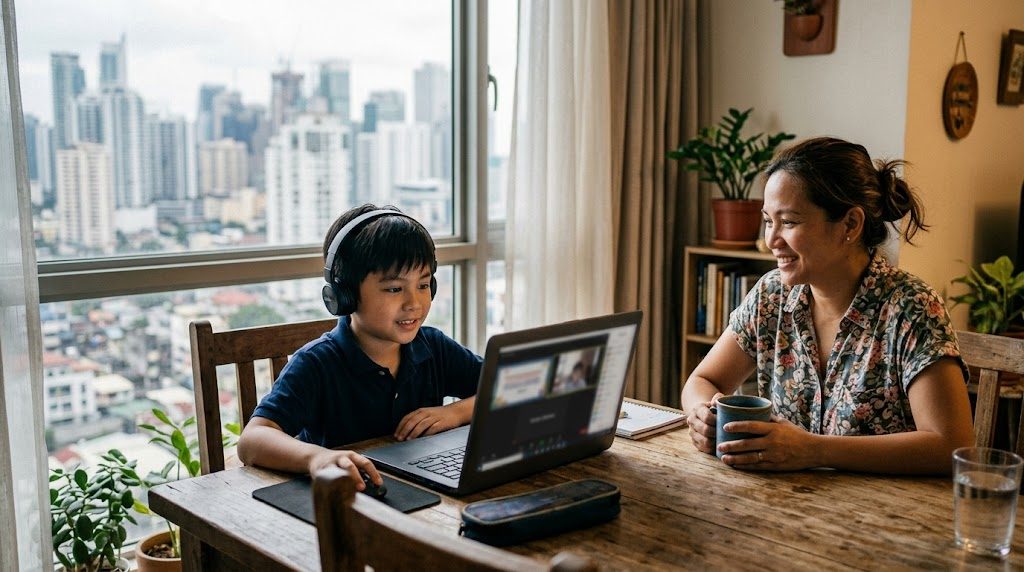
Maybe you read the list above and thought: these schools are wonderful, but the fees are simply out of reach — or the commute would swallow our family’s life. You are far from alone, and it does not mean your child has to miss out on an international education. As we wrote in “Is international school too expensive?”, the value of global education was never really about the building.
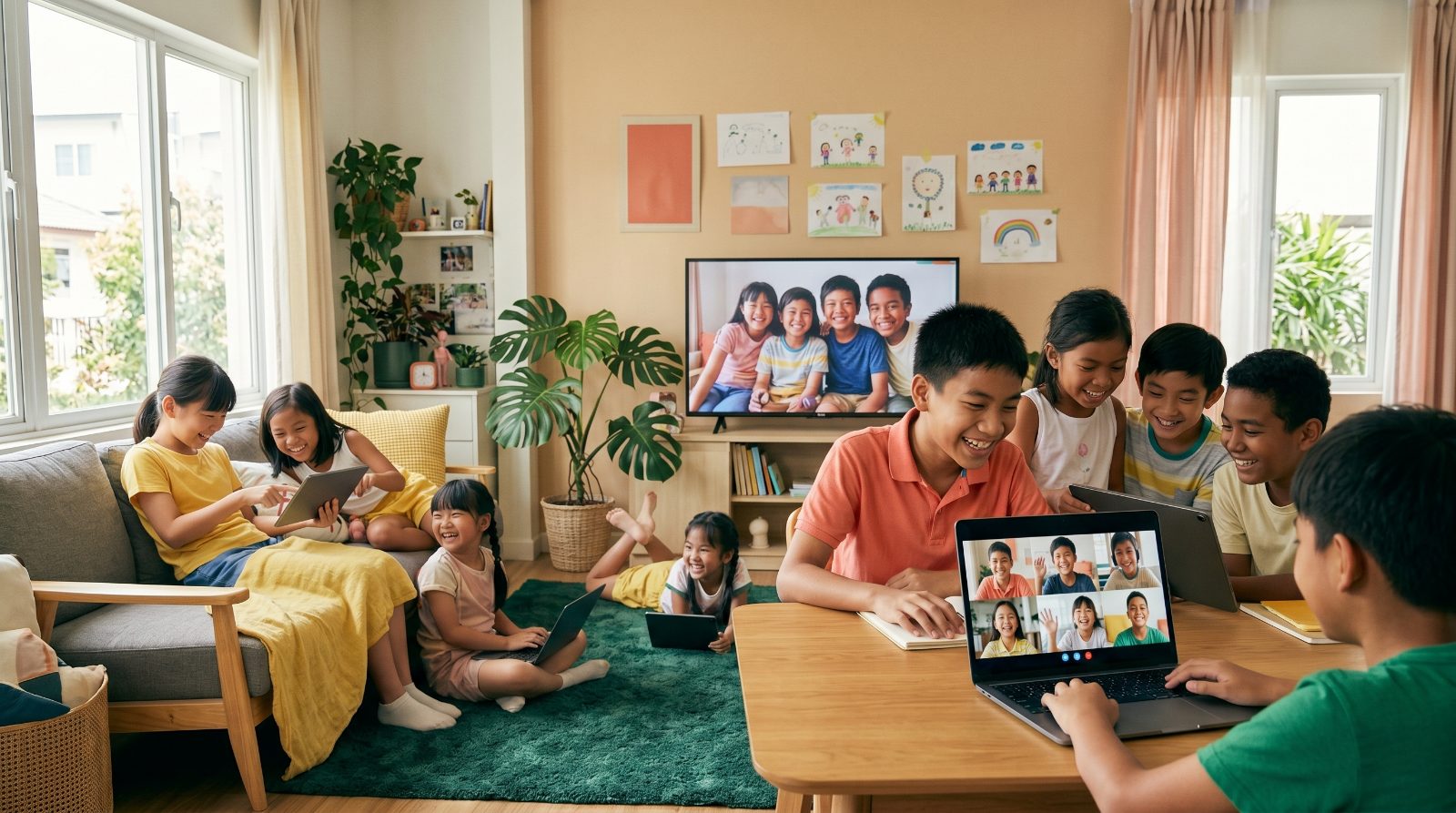
オンラインインターナショナルスクールのNIJIN GLOBAL ACADEMY (NGA) is an online international school opening in September 2027, built for families across Asia and Oceania with children aged 6 to 18. It is run by NIJIN Inc. of Japan, whose alternative school in Japan, NIJIN Academy, already serves more than 1,000 students. NGA’s philosophy is simple and quietly radical: no ranking children by test scores. Learning happens in small groups built on dialogue, with one goal — that each child comes to like who they are and the world they live in. Because it is fully online, it works the same whether you live in BGC, Las Piñas, or a province with no international school at all. And tuition is designed to be about one-fifth of a traditional in-person international school. In fairness, two honest caveats: NGA has not yet opened, so its track record is still to be built — and an online school is not the same experience as a physical campus. Compare it fairly alongside the seven schools above, and choose what truly fits your child.
Frequently Asked Questions
At what age can children start at international schools in Manila?
Most schools accept children from around age 3 into Nursery or Preschool. Popular schools fill early-years seats quickly and often run waitlists, so it pays to inquire a year or more ahead. Admission requirements and slot availability change every year — always confirm directly with the school.
What if my child’s English is still developing?
Many Manila international schools offer EAL/ESL support, though expectations rise with grade level, and some schools assess English at admission. Online schools can be a gentler on-ramp: NGA, for example, is designed so children can build English gradually through small-group dialogue rather than being expected to arrive fluent.
When is the best time to transfer in?
Most international schools in Manila start their academic year around August, so applications typically close in the months before. That said, many schools accept mid-year transfers when seats are available. Entrance assessments and requirements vary by school, so check each admissions office directly.
The Right School Is the One Your Child Can Grow In
With more than 20 international schools, Manila is not a city of scarce options — it is a city where clarity wins. Whether you choose a storied campus in BGC, a value-strong school in Pasig or Las Piñas, or an online school with no campus at all, the goal is the same: a place where your child likes who they are becoming. Take your time. Visit, compare, ask hard questions about fees — and trust what you see in your child’s eyes.
NIJIN GLOBAL ACADEMY opens in September 2027. Be the first to hear how accessible, dialogue-based global education works — and when founding-cohort enrollment opens.
International Schools in Other Cities
- International Schools in Yokohama: Full Comparison
- International Schools in Chofu and ASIJ Fees
- International Schools in Fukuoka: Fees
- International Schools in Ho Chi Minh City
- International Schools in Melbourne
- International Schools in Nagoya: All 8 Schools
- International Schools in Kawasaki
- International Schools in Kita, Tokyo
- International Schools in Kobe: All 20 Schools
- International Schools in Singapore
- International Schools in Bangkok
- International Schools in Kuala Lumpur
- International Schools in Tokyo
- International Schools in Osaka
- International Schools in Sydney