If you are looking for international schools in Sapporo, you have probably already noticed the problem: the lists you find online are padded with English conversation schools, and almost none of them answer the two questions that actually matter — what does it really cost, and can any Japanese government support reduce that cost? Sapporo is a city of 1.9 million people, yet the number of schools that teach in English to school-age children can be counted on one hand. This guide counts them honestly, gives you published fee figures with links to the source, explains exactly where Japan’s tuition subsidies do and do not apply to international schools, and covers the wider options across Hokkaido — including one that does not require a commute at all.
International schools in Sapporo: the real landscape and fee ranges
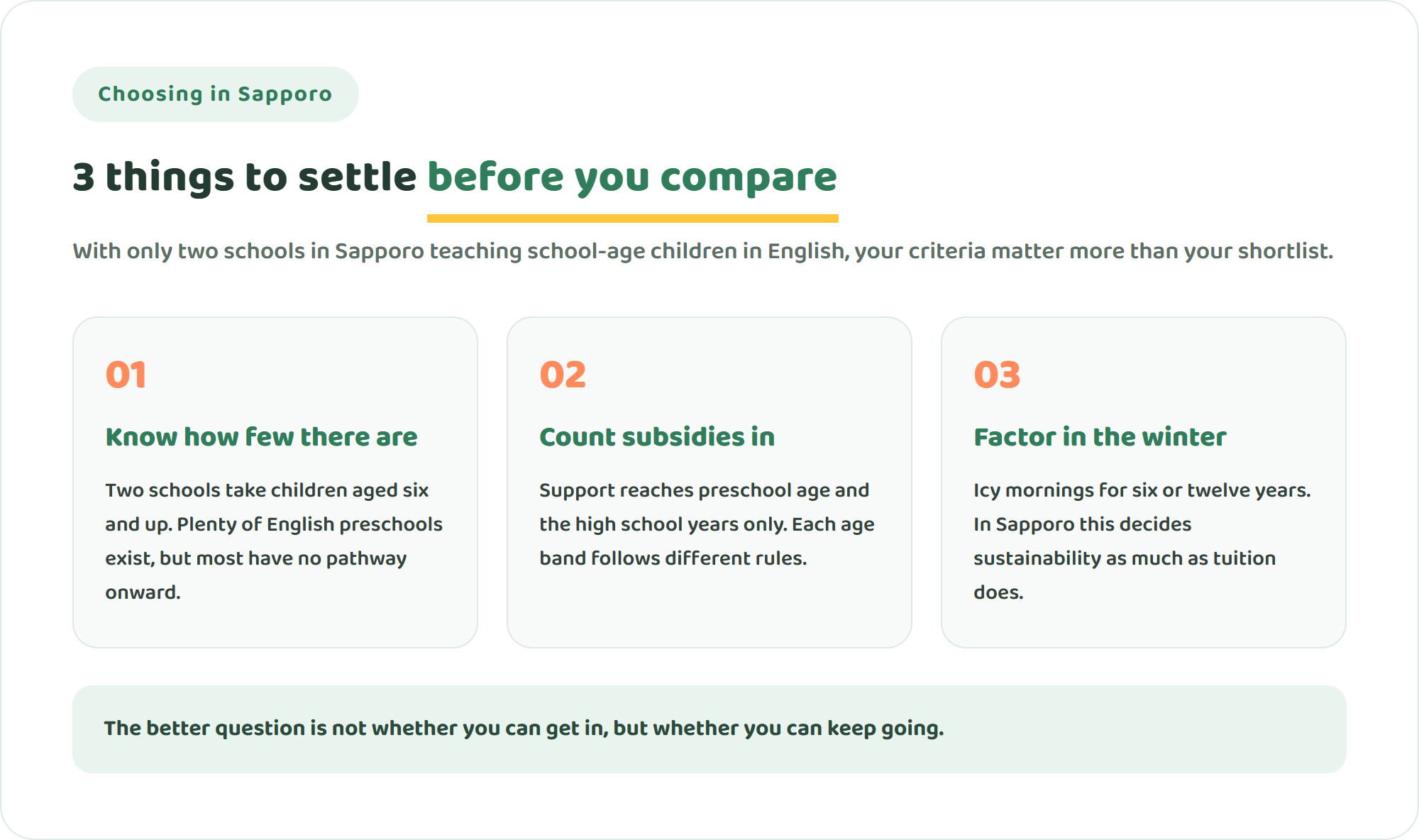
Start with the honest headline. Within Sapporo city limits, only two schools teach school-age children primarily in English: Hokkaido International School (HIS) and Sapporo International School (SIS). That is unusually few for a city of this size. Below school age, the picture changes completely — there are several full-day English immersion preschools and bilingual kindergartens. Sapporo therefore has a built-in cliff edge: plenty of choice at ages three to five, almost none from age six onward. Families who enrol in an English preschool without checking what comes next are the ones who end up scrambling when elementary school begins.
On cost, annual tuition for international schools in Sapporo runs from roughly ¥480,000 to about ¥1,650,000 depending on the school and the grade. That is a wide spread, but it is also notably cheaper than Tokyo, where large international schools routinely charge over ¥3,000,000 a year. Budget for more than tuition, though: entrance fees, annual fees, insurance, technology charges and bus fees typically add another 10-30 per cent in the first year. If you want the full anatomy of what these schools charge, our breakdown of international school tuition costs walks through every line item.
Note: all fees below are publicly available information as of August 2026. Always confirm current figures directly with each school.
The two international schools in Sapporo city: fees and character
We are not going to inflate this into a top seven. There are two, they are very different from each other, and the right question is not which is better but which fits your child’s age, your budget and your family’s values.
1. Hokkaido International School (HIS) | fees and character
Founded in 1958 as the Hokkaido American School, HIS is the oldest and largest international school in Hokkaido, located in Hiragishi, Toyohira Ward, Sapporo. It is accredited by the Western Association of Schools and Colleges (WASC) and runs a full pathway from Early Years through Grade 12. The middle school uses the International Middle Years Curriculum (IMYC), and the high school offers Advanced Placement courses and SAT preparation. The student body draws from more than twenty nationalities, and there is a boarding option. HIS also operates a second campus, HIS Niseko, serving Early Years through Grade 8 with the International Primary Curriculum and a Reggio Emilia-inspired early years programme. If you need a single school from kindergarten to university applications, this is effectively the benchmark in Hokkaido.
- Curriculum: American, WASC-accredited; IMYC in middle school, AP and SAT in high school
- Ages: Early Years (around 3) through Grade 12 at the Sapporo campus
- Fees: Early Years half day ¥1,028,000 / full day ¥1,440,000; Kindergarten-Grade 5 ¥1,584,000; Grades 6-8 ¥1,624,000; Grades 9-12 ¥1,648,000 per year (2026-2027 published schedule). Plus a ¥20,000 application fee, ¥200,000 one-time entrance fee, ¥200,000 annual fee, ¥5,000 accident insurance, ¥10,000 PTA, and a ¥25,000 device management fee for K-5
- Best for: families settled in Sapporo who want one continuous English-medium pathway through to overseas university applications
Official website / Published tuition and fees
2. Sapporo International School (SIS) | fees and character
Established in 2021 in Higashi Ward, north-east Sapporo, SIS teaches an American curriculum aligned to the Common Core State Standards, combined with Arabic, Islamic and Qur’an subjects and elements of the Japanese national curriculum. It is accredited by the Council of Islamic Schools in North America (CISNA) and the Middle States Association Commission on Elementary and Secondary Schools (MSA-CESS), and the school states that it received recognition from Japan’s Ministry of Education in 2025. It currently covers kindergarten, elementary and junior high levels. The striking feature is the fee: ¥480,000 a year, which is remarkably low for an accredited English-medium school anywhere in Japan. Sibling discounts, a 50 per cent reduction for children of Hokkaido University affiliates, and need-based scholarships are all published. The Islamic dimension of the programme is central rather than incidental, so visit and make sure the ethos matches your family before applying.
- Curriculum: American / Common Core, plus Arabic, Islamic and Qur’an studies and Japanese curriculum elements (CISNA and MSA-CESS accredited)
- Ages: KG1 (3.5 years old as of 1 April) through junior high school
- Fees: ¥480,000 per year for a first child (¥40,000 monthly), plus a ¥10,000 application fee and ¥40,000 enrolment fee. Company- or embassy-sponsored placements are ¥200,000 entrance and ¥120,000 monthly. Hokkaido University families pay ¥20,000 monthly
- Best for: families who need an English-medium school at a realistic price, and Muslim families seeking a faith-aligned education in Hokkaido
Official website / Admissions and fees
English immersion preschools and bilingual kindergartens in Sapporo
If your child is not yet school age, the choice widens considerably. These are not international schools in the K-12 sense — most have no pathway beyond age six — but they do offer a full day in English, and they are the realistic entry point for many Sapporo families.
- IKS Sapporo International Kindergarten (Toyohira Ward): a full-day programme from age three that bundles English with music, physical education, piano, ballet and even skiing into the monthly fee. ¥250,000 enrolment, from ¥73,000 per month, ¥14,000 monthly for round-trip bus (published April 2025). The school states it qualifies for reimbursement of up to ¥37,000 per month under Japan’s early childhood education subsidy. Website
- Tokyo International School Sapporo Maruyama (Chuo Ward, three minutes from Nishi-18-chome subway station): a full-day kindergarten for ages three to five plus an after-school programme for elementary Grades 1-4 — a practical way to keep English going while your child attends a local Japanese school. Website
- International Yamanote Kindergarten (Nishi Ward): a bilingual kindergarten with capacity for 160 children, pairing foreign and Japanese teachers, with extended care and summer school.
- Jelly Beans English Preschool (Kita Ward): an all-native-teacher immersion preschool for ages two and up, with a strong phonics focus. Website
Can Japanese tuition subsidies be used at international schools in Sapporo?
This is the question almost no English-language guide answers properly, and the answer genuinely depends on your child’s age band. Here is what the Ministry of Education and the City of Sapporo actually publish.
The starting point: most international schools are not Article 1 schools
Japan’s public education subsidies are built around schools defined in Article 1 of the School Education Act — kindergartens, elementary and junior high schools, and high schools following the national curriculum. Because international schools teach a foreign curriculum, they are generally classified as kakushu gakko (miscellaneous schools) or as unaccredited facilities. As a rule, Article 1 school benefits do not automatically transfer to them.
High school level: HIS appears on MEXT’s designated list
There is an important exception at high school level. MEXT operates a designation scheme for foreign schools under the High School Tuition Support Fund, covering schools verified through an embassy as equivalent to a Japanese high school, or accredited by one of seven internationally recognised bodies (WASC, ACSI, Cognia, NEASC, CIS, COBIS and the International Baccalaureate Organization).
On MEXT’s published list of designated foreign schools (as of 1 March 2026), Hokkaido International School is listed, with the condition that it applies only to years one to three of the high school division. In other words, any support reaches the final three years — the Early Years, elementary and middle school divisions are not covered. Families who assume the subsidy applies across all thirteen years will badly miscalculate their budget.
What changed in April 2026, and the transitional measures
The system was substantially revised in April 2026. According to MEXT’s own Q&A on the tuition support scheme, students who fall outside the new scheme but were already enrolled before 31 March 2026 — explicitly including students at foreign schools designated under the old system — continue to receive support at a level equivalent to the previous scheme, based on household income, under transitional provisions. Students entering from 1 April 2026 may instead qualify for a separate scheme if they meet household income requirements.
Eligibility now also turns on nationality and residence status, which matters a great deal for expatriate families. We are not going to guess at your case: only the school and the prefecture can confirm what applies to you. If you are considering the HIS high school division, contact the school office and Hokkaido Prefecture’s private school affairs division, and ask about your specific enrolment year, income band and residence status.
Preschool age: Sapporo’s childcare subsidy can apply to unlicensed facilities
Below school age there is a subsidy that families genuinely do use. According to the City of Sapporo’s childcare information site, families using unlicensed childcare facilities can receive up to ¥37,000 per month for ages three to five — and up to ¥42,000 for ages zero to two in resident-tax-exempt households — provided they establish a recognised need for childcare and obtain the required certification. Several Sapporo English preschools reference exactly this, including IKS, which advertises reimbursement of up to ¥37,000. Whether it applies depends both on the facility’s registration and on your household certification, so check with the school and your ward office.
Are there Hokkaido or Sapporo-specific grants?
Honestly: from the public information we were able to review, we found no Hokkaido or Sapporo programme that subsidises international school tuition itself. The prefecture’s tuition reduction and scholarship grants are designed around private Article 1 schools, and the city’s assistance programmes are aimed at municipal schools. Rather than searching for a grant that may not exist, your time is better spent on the two mechanisms that can realistically apply: the preschool subsidy and the high school scheme above.
Widening the search: international schools and IB schools across Hokkaido
If Sapporo itself is too thin, Hokkaido offers a little more. HIS Niseko covers Early Years through Grade 8 in Niseko town, and KIU Academy Niseko serves ages six to sixteen with tuition of ¥1,200,000 plus a ¥300,000 entrance fee, ¥200,000 facilities fee and ¥25,000 application fee, with need-based aid of up to 40 per cent available (2026-2027 figures via an international school database; confirm with the school). Both suit families combining a Niseko base with work in the ski or hospitality sector.
There is also a route that families overlook entirely: international education inside the Japanese school system. Sapporo Kaisei Secondary School, a municipal school, became the first public school in Japan authorised for both the IB Middle Years Programme (2017) and the Diploma Programme (2018), and runs a dual-language diploma. Sapporo Nihon University Senior High School in Kitahiroshima was authorised as an IB World School in January 2022, the first private high school in the prefecture to do so. Fees are an order of magnitude lower than at an international school, and students graduate with a Japanese high school qualification as well. For a full view of the region, see our guide to international schools across Hokkaido; if a transfer to the capital is on the horizon, our Tokyo guide covers that market.
Comparing the options honestly
Three broad types cover almost every path open to a Sapporo family: a large K-12 international school like HIS, a small school or English preschool, and an online international school with no commute at all. The table below sets out the trade-offs as fairly as we can.
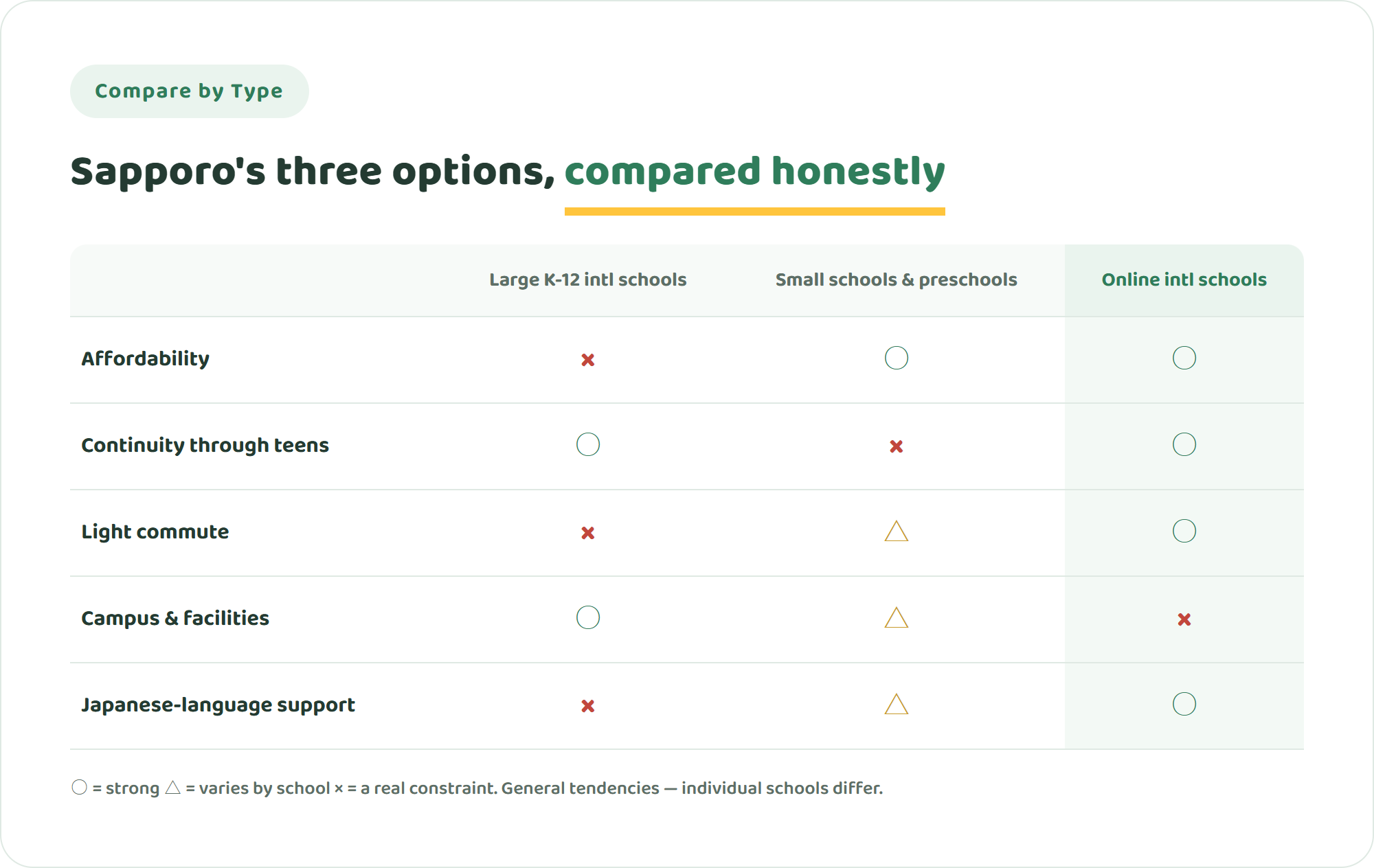
A large K-12 school gives you facilities and a clear pathway, but around ¥1.5 million a year sustained for a decade is a serious commitment, and English fluency becomes a prerequisite as grades rise. Small schools and preschools are easier to enter and easier to afford, but few carry a child through adolescence. And in Sapporo there is a factor that guides written elsewhere in Japan simply miss: winter. A forty-minute commute over ice and snow, every morning, for six or twelve years, is worth weighing as seriously as tuition. Keeping a child in a local Japanese school while adding English separately is a legitimate strategy here, not a compromise.
See how learning works online →
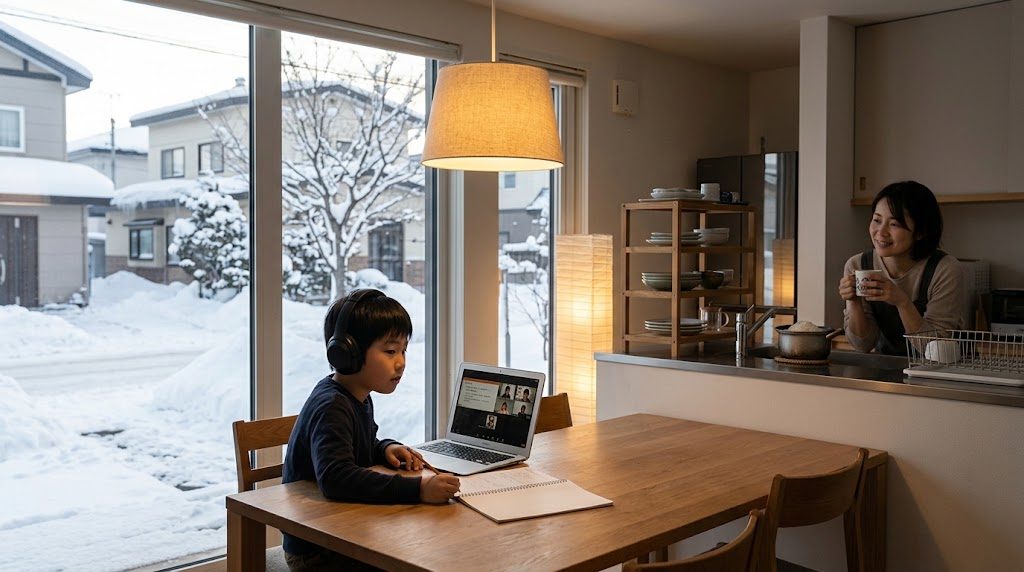
When fees or the commute are the barrier: online as an eighth option
Most families who read this far in Sapporo hit the same wall. Two schools for school-age children. One of them at roughly ¥1.5 million a year for a decade or more. Winter commutes. And a widened search that only reaches as far as Niseko. If that describes you, there is an eighth option that does not depend on where in Hokkaido you live.
NIJIN GLOBAL ACADEMY (NGA) is an online international school opening in September 2027. It is run by NIJIN Inc., the Japanese company behind NIJIN Academy, an alternative school with more than 1,000 students enrolled. Our approach rejects ranking children by test scores, and centres on small-group dialogue and a simple aim: helping each child come to like themselves and the world. We serve ages 6 to 18 across Asia and Oceania, wherever they live, and the programme is designed so that children with Japanese as their home language can move into English gradually. We are working toward fees around one fifth of a campus-based international school.
To be straight with you: NGA has not opened yet, and we have no track record to point to. We cannot replicate a playground, a gymnasium or a school field trip in the way a campus school can. But no icy commute, the same learning wherever in Hokkaido you live, and a cost that does not dominate the family budget — for families in a city with this few options, we think that is worth putting on the list.
Frequently asked questions about international schools in Sapporo
Q. What is the youngest age we can enrol in Sapporo?
A. Around three. Hokkaido International School accepts children from Early Years, and Sapporo International School from KG1 (3.5 years old as of 1 April). English preschools take children from around age two. In Sapporo, though, the second question matters more than the first: before you enrol, check what happens at age six, because most preschools here have no elementary pathway.
Q. Can a child with no English get in, and is there Japanese-language support?
A. It varies sharply by school and by entry point. Early Years entry generally assumes no English at all; entry at upper elementary or high school usually requires enough English to follow lessons. Ask each school directly how many hours of Japanese are taught per week and what support exists for students who need it — for families raising a bilingual child in Japan, that answer is often decisive.
Q. How do we apply for transfers and for tuition support?
A. For transfers, contact schools six to twelve months before your intended start date; places, entry tests and grade placement all vary. For subsidies, preschool support runs through your ward office in Sapporo, while high school support runs through the school and Hokkaido Prefecture. The national scheme was revised in April 2026 and is still in a transition period, so rely on the school and the prefecture rather than on older information online.
Few options is not the same as no options
There is no single right answer in school choice, and in a city where the school-age options narrow to two, the decision feels heavier than it should. The more useful question is not whether your child can get in, but whether your family can sustain it — the fees, the winter mornings, the language demands — for years. Every family answers that differently, and the time you are spending on this is itself evidence of how seriously you take your child’s future. Visit the schools, verify the subsidies at the source, and take your time. And if you would like to keep an option open that does not require a commute at all, we would be glad to keep you posted.
To compare every option across the wider prefecture, see our guide to international schools in Hokkaido Prefecture, which covers schools outside this city and prefecture-wide fee ranges.
International Schools in Other Cities
- International Schools in Dubai: Fees
- International Schools in Meguro: All 8 Schools
- International Schools in Kobe: All 20 Schools
- International Schools in Yokohama: Full Comparison
- International Schools in Chofu and ASIJ Fees
- International Schools in Fukuoka: Fees
- International Schools in Adachi, Tokyo
- International Schools in Arakawa, Tokyo
- International Schools in Ashiya
- International Schools in Tokyo
- International Schools in Osaka
- International Schools in Nagoya: All 8 Schools
- International Schools in Minato: Fees
- International Schools in Shibuya, Tokyo
- International Schools in Setagaya: All 14 Schools