If you have been searching for international schools in Mie Prefecture and keep landing on English-language nurseries, you are not searching badly — you are seeing the market accurately. Mie ranks third among all 47 prefectures for the share of its population made up of foreign residents, and it is home to long-established Brazilian and other South American communities. Yet as of 2026, exactly one full-time international school in the prefecture teaches elementary-age children in English, and no school here accepts international students at junior high level or above. This guide separates the landscape into three honest layers: the single school that continues past kindergarten, the accredited foreign-language schools serving Brazilian and Korean families, and the English-immersion preschools mapped area by area. It then walks through the three routes families here genuinely take when nothing local fits — commuting into Nagoya in neighbouring Aichi, choosing a Japanese school with a strong international programme, and learning online without commuting at all.
Quick Answer: Your Options in Mie Prefecture
If you only read one section, read this. Below are the schools covered in this guide, plus the online option — so you can see every route side by side before the details.
- Commute to an international school in Nagoya, Aichi
- Choose a Japanese school with a strong international programme
- Keep your local school and add international education online
- NIJIN GLOBAL ACADEMY (online) — Ages 6–18 / opening September 2027, currently taking opening-update registrations / fees around one-fifth of a typical campus international school / Japanese-language support. An option when commute or fees are the wall.
International schools in Mie Prefecture: the landscape and fee ranges
Mie is one of Japan’s more internationalised prefectures. According to the prefectural government’s survey of foreign residents by nationality, 71,492 foreign nationals were living in Mie as of 31 December 2025 — up 4,601 (6.9%) in a single year, the highest figure on record, and 4.14% of the prefecture’s population, also a record and the third-highest share of any prefecture. By nationality the largest groups are Vietnam (15,254), Brazil (13,198), the Philippines (8,890), China (6,591) and Indonesia (5,521). Families with Brazilian and other South American roots are concentrated in the automotive and electronics belt around Yokkaichi (13,903 foreign residents), Tsu (11,592) and Suzuka (10,641) — and Suzuka is home to a Brazilian school formally accredited by the prefecture. What has not kept pace at all is the supply of schools where a child can keep learning in English year after year. That gap is the single most important fact about international education in Mie.
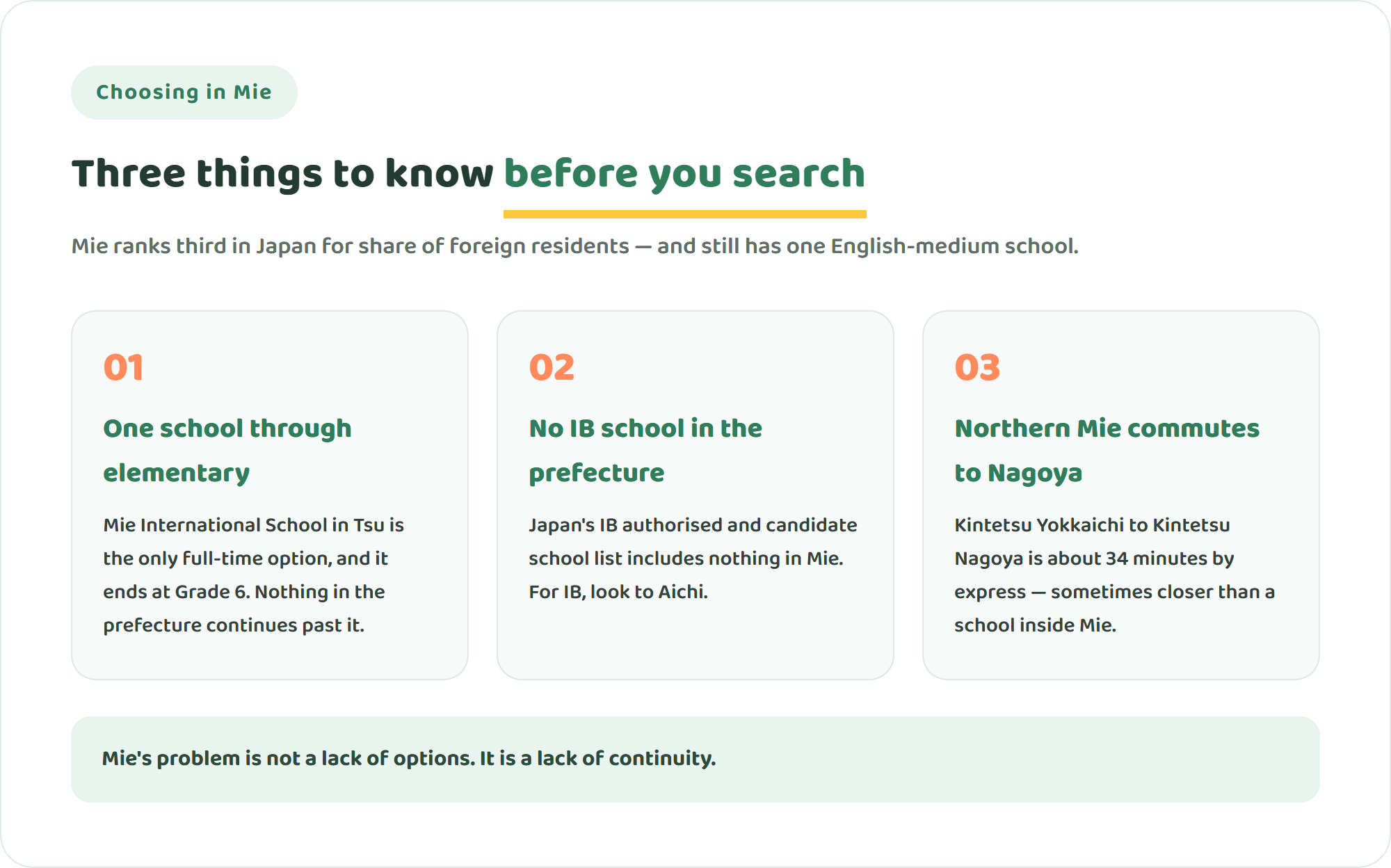
The schools divide into three clear layers. The first is full-time international schooling through elementary age, and it contains exactly one school: Mie International School in Tsu City. The second is the foreign-school layer: Mie Prefecture’s official list of accredited miscellaneous schools (updated 29 May 2026) includes EAS Brazilian School Suzuka and Yokkaichi Korean Elementary and Middle School. The third is the preschool layer — roughly fifteen English-immersion nurseries and kindergartens for children aged about one to five, spread across Yokkaichi, Kuwana, Tsu, Suzuka, Matsusaka and Ise. It is also worth knowing that the list of IB authorised and candidate schools published by Japan’s MEXT-affiliated IB Education Promotion Consortium (265 schools nationwide as of 31 March 2026) contains no school in Mie Prefecture at all.
Fee levels differ sharply between the layers. Preschools generally run about ¥40,000–90,000 per month, and children aged three to five often qualify for Japan’s early-childhood education subsidy, which can cut the effective cost substantially. The elementary division of Mie International School, the prefecture’s only full-time option, publishes annual tuition of ¥1,051,000, plus a ¥175,000 facility fee, ¥72,000 for lunch and ¥60,000 for materials — around ¥1.36 million a year before tax. Set against the ¥2–3.2 million a year charged by the larger international schools in Nagoya, Mie’s profile is distinctive: extremely few options, but noticeably more affordable ones.
Note: fees reflect publicly available information as of July 2026 and are subject to revision. Always confirm current figures directly with each school.
The one international school in Mie that continues to elementary age
Here is the school in Mie Prefecture that accepts children at elementary age, as far as public information allows. There is no padding to reach a round number. There is one.
Mie International School (Tsu City)
Opened in 2019 in Minami-Chuo, Tsu, this is the only full-time international school in the prefecture. It is run by the organisation that has operated Maple Leaf International School in Matsusaka since 2008, and it houses a preschool division (from 12 months to the five-year-old class) and an elementary division covering Grades 1 to 6. The curriculum combines the International Early Years Curriculum (IEYC) and the International Primary Curriculum (IPC) — an inquiry-based framework developed from the English National Curriculum in the 1980s, in which a single theme is explored over roughly six weeks through science, geography, history, art and international perspectives. Mathematics runs on i-Ready aligned to the Common Core, language arts on the IXL adaptive platform, and Japanese-language instruction follows Japan’s national curriculum guidelines so that reading and writing keep developing. Physical education is taught by specialists, and after-school clubs in science and art run alongside extended care until 6:00 pm. The school’s motto is to find your purpose, pursue your passion and change the world. It sits within walking distance of Akogi Station on the JR Kisei Line, which makes it reachable from Suzuka and Matsusaka as well as Tsu itself.
- Curriculum: IEYC and IPC, taught in English, with Japanese language following the national curriculum
- Ages: Preschool from 12 months to the five-year-old class; elementary Grades 1–6 (no junior high or above)
- Fees: Published elementary figures of ¥1,051,000 annual tuition plus ¥175,000 facility fee, ¥72,000 lunch and ¥60,000 materials — roughly ¥1.36 million a year, with a ¥20,000 application fee and ¥200,000 entrance fee (all before tax; uniforms, insurance and activity fees are extra). Preschool tuition is ¥59,100 per month for the three-hour class at ages one to two and ¥78,500 for the five-hour class at ages three to five, with a ¥44,000 entrance fee and ¥77,000 annual facility fee (2026; confirm directly)
- Good fit for: Families in central Mie — Tsu, Suzuka, Matsusaka — who want inquiry-based English-medium learning through elementary school
Mie’s accredited foreign schools
One thing that distinguishes Mie from most Japanese prefectures is that schools teaching in a home language other than Japanese genuinely exist here. The prefecture’s official list of accredited miscellaneous schools, updated on 29 May 2026, includes EAS Brazilian School Suzuka (Escola Alegria de Saber, Suzuka campus) and Yokkaichi Korean Elementary and Middle School. EAS is recognised by Brazil’s Ministry of Education and holds Japanese accredited-school status, offering a pathway to a Brazilian high school qualification. A third entry on the same list, Nikken Gakuen in Yokkaichi, was recorded as temporarily closed as of May 2026.
These are not English-medium international schools — instruction is in Portuguese or Korean. But it would be inaccurate to say that Mie has no international schooling at all. For a family with Brazilian roots, having a school in the prefecture where a child can continue studying in their home language matters a great deal. You can compare other prefectures through our guide to international schools across all 47 prefectures.
English-immersion preschools in Mie Prefecture, by area
For children under six the picture opens up considerably. Here are the main English kindergartens and international preschools by area — with the caveat that these serve early years and do not continue into elementary school.
Northern Mie: Yokkaichi, Kuwana and Asahi
The densest cluster in the prefecture. Kuwana Forest International Preschool in Hoshimigaoka, Kuwana takes children from around 18 months to age five for a five-hour English day from 9:00 to 14:00. Its published 2026 figures are a ¥72,000 entrance fee, monthly tuition of ¥91,200 at age one, ¥86,000 at age two and ¥75,500 for ages three to five, a ¥28,000 annual facility fee and ¥66,000 a year for materials, with extended care to 6:00 pm at ¥180–220 per 15 minutes. Montessori International School in Minami-Matsumoto-cho, Yokkaichi has operated in the city for more than twenty years, running an all-English environment built on the American Montessori method. Morinokuni International Preschool in Oyachi-cho, Yokkaichi accepts children from 12 months to the five-year-old class and stays open from 7:00 to 18:00 on weekdays and Saturdays; third-party databases list ¥39,000–59,000 per month. Also in the area are Sunshine School Yokkaichi in Shibata, Brains Kiddy Club near Akuragawa Station, and Lingua English classrooms in Kuwana and Asahi.
Central Mie: Tsu
Besides the preschool division of Mie International School, the prefectural capital has several English childcare options. Sunshine School Tsu in Tarumi takes children from age two; third-party databases list ¥66,000–71,500 per month. Tsu Mirai Academy in Isshinden accepts children from age one, with published figures of ¥45,000 in childcare fees plus a ¥13,000 facility charge, or ¥58,000 a month. Zoo-phonics Academy Tsu in Nagaoka-cho belongs to a chain known for phonics instruction, and Kids Duo Tsu in Kotobuki-cho runs an English after-school programme for elementary students — a practical way to hold on to an English environment once formal schooling begins.
Suzuka and Kameyama
Green School Suzuka in Sansho, Suzuka combines an all-English preschool with an English after-school programme, giving school-age children up to about four and a half hours a day in English; third-party databases list ¥55,000 per month for weekly enrolment. NOVA Kids Studio Suzuka in Higashi-Asahigaoka and a Lingua English classroom in Akoso-cho round out the area. Suzuka has the third-largest foreign population of any city in Mie, so multicultural life here is simply everyday reality.
Southern Mie: Matsusaka and Ise
Maple Leaf International School in Tamura-cho, Matsusaka has run since 2008 under the same organisation as Mie International School. It takes children from age one to the five-year-old class with capacity for 84, offers three-hour and five-hour courses plus Saturday classes, and covers mathematics, science, art, music and sport in English. As an unlicensed childcare facility it qualifies for Japan’s early-childhood subsidy; third-party databases list ¥56,250–74,750 per month. Also in Matsusaka, Happy Tree International Preschool in Okuroda-cho uses Montessori methods and takes children from age one on a five-hour programme, with a published figure of ¥70,000 per month before tax. In Ise, Zoo-phonics Academy Ise operates in Funae.
Iga and the Higashi-Kishu coast
Honestly stated: we could not confirm any permanent international school or English-immersion preschool in Iga, Nabari, Owase, Kumano or Shima as of July 2026 — even though Iga has 6,328 foreign residents, the fifth-highest count in the prefecture. Large parts of Mie genuinely have nothing within reach. That is the honest picture.
Three options when nothing in the prefecture fits
The wall most Mie families hit is the same one: the early years are manageable, but the path narrows at elementary school and stops entirely at junior high. Here are the three routes that actually work.
1. Commute to an international school in Nagoya, Aichi
Northern Mie is effectively part of the Nagoya commuting belt. A Kintetsu Nagoya Line express covers Kintetsu Yokkaichi to Kintetsu Nagoya in about 34 minutes for ¥760 (2026 published figures), and Kuwana is closer still. For plenty of families, Nagoya is a shorter trip than a school an hour away inside Mie.
The leading candidate is Nagoya International School (NIS), which takes students from age three to Grade 12 and was the first school in Aichi authorised for all three IB programmes — PYP, MYP and DP — alongside WASC and CIS accreditation. Its published 2026-27 fees are ¥2,190,000 for the Early Learning Centre, ¥2,700,000 for elementary (Grades 1–5), ¥3,120,000 for middle school (Grades 6–10) and ¥3,180,000 for high school (Grades 11–12), plus a ¥50,000 application fee, a ¥1,000,000 entrance fee and a ¥250,000 annual facilities development fee. A step down in price, Aichi International School (AIS) in Meito Ward, Nagoya publishes ¥1,089,000 a year for kindergarten (ages three to five) and ¥1,331,000 for elementary (Grades 1–6), with facility fees of ¥88,000–96,800 and entrance fees of ¥55,000–440,000. See our guides to international schools in Nagoya and international schools in Aichi Prefecture for the full picture. Aichi also has IB authorised schools at secondary level — Nagoya International Junior High School (MYP), Nagoya International High School (DP) and Kokusai High School (DP) — so the options after elementary are far deeper than anything inside Mie.
The honest counterweight is the commute itself. Thirty to forty minutes each way looks fine on paper, but home-to-station and station-to-school time sits on top of it. Ask whether a six-year-old can do that round trip every morning, and keep doing it for six years. Before you shortlist, multiply the door-to-door time by six years and see how it feels.
2. Choose a Japanese school with a strong international programme
You do not have to attend an international school to get an internationally minded education. Mie Prefectural Tsu-Nishi High School in Tsu runs an International Science course established in 2000, pairing rigorous maths and science with an international outlook; it has been designated a Super Science High School since 2007 and runs experiment programmes with Mie University plus a Global Challenge Programme that includes an English camp. In the private sector, St Joseph Girls’ Academy Junior and Senior High School in Handa, Tsu is a UNESCO Associated School with a strong emphasis on intercultural understanding, English classes taught entirely in English, term-length study abroad and regular incoming exchange students.
The honest limit: neither is an English-immersion track where subjects across the board are taught in English. If you want to keep Japanese school enrolment while deepening English and intercultural learning, this route is practical. If your goal is learning subjects in English, it will not get you there.
3. Keep your local school and add international education online
The third route takes the commute out of the equation. Some families keep their child enrolled at the local public school and study subjects in English online after school or at weekends; others make an online international school the centre of learning instead. In a prefecture like Mie, where there is often simply no reachable school nearby, this has quietly become the most realistic third path. More on that below.
Comparing the options: what actually fits your family
Mie’s one full-time school, the schools in Nagoya, and online international schools are not ranked best to worst — they fit different constraints. Lay them against five criteria and the decision gets much clearer: affordability, ease of admission, commute burden, in-person campus experience, and whether the path can continue through high school.
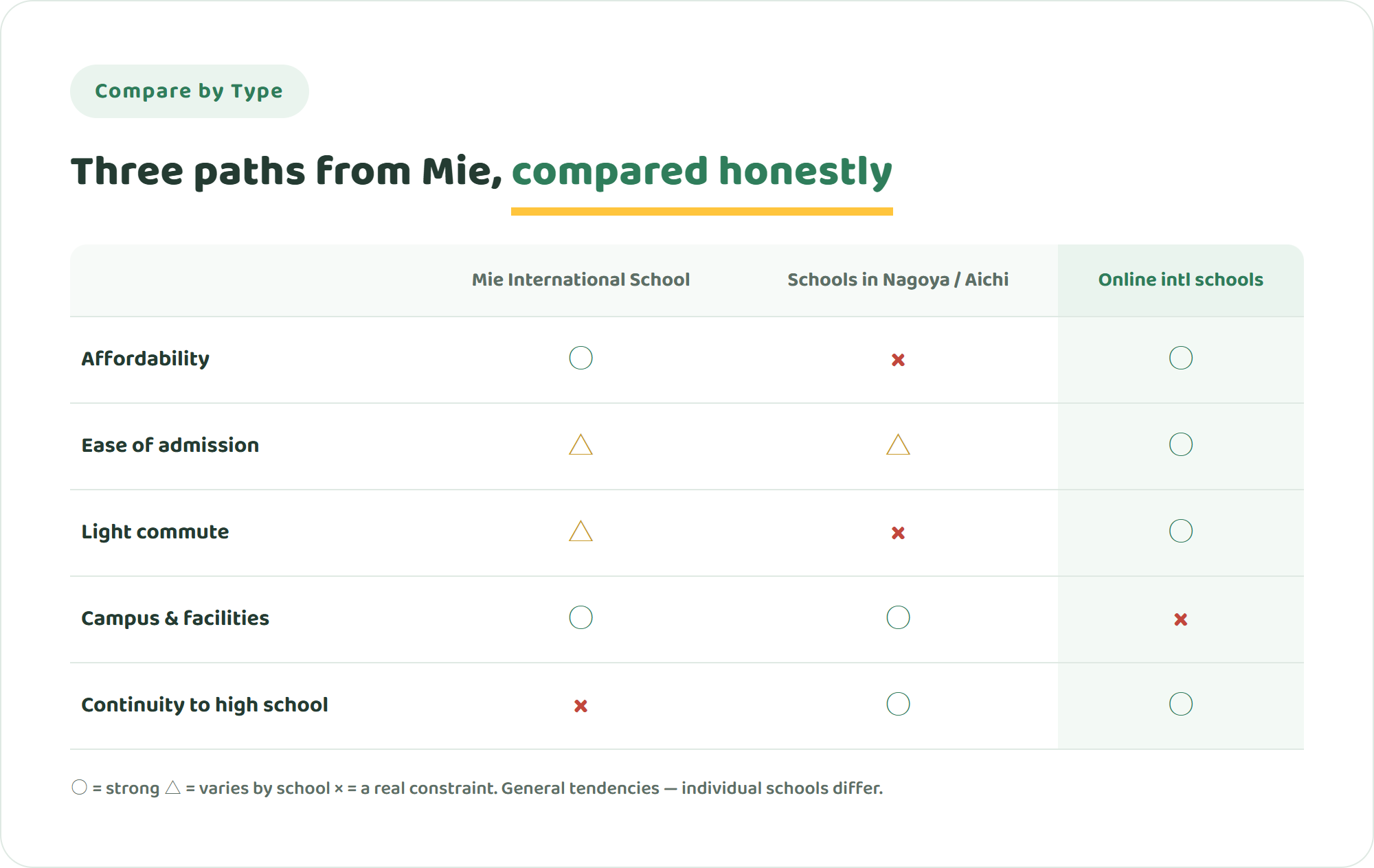
In Mie, the row that catches most families is the last one. Mie International School, the prefecture’s only English-medium option, ends at Grade 6 — meaning that at junior high age you will be choosing again, either in Aichi or in a different format entirely. NIS in Nagoya does continue to graduation, but fees rise to ¥2.7–3.18 million a year with a ¥1 million entrance fee on top. If you want the cost picture in more detail, our breakdown of what international school actually costs covers the fees beyond tuition that catch families out.
See how learning works online →
When nothing is within reach — the online option
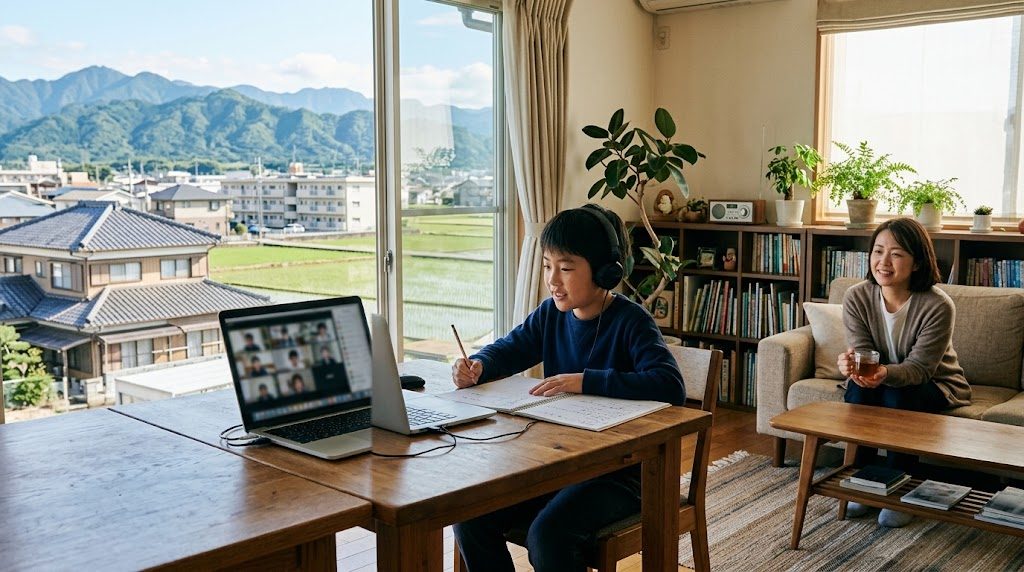
Some readers will finish the list above thinking: nothing here continues past elementary school, and a daily trip into Nagoya is not workable. That is precisely the family NIJIN GLOBAL ACADEMY (NGA) is being built for. We are an online international school opening in September 2027.
NGA is run by NIJIN Inc., the Japanese company behind NIJIN Academy, an alternative school with over 1,000 students enrolled. What we care about is moving away from ranking children by test scores. Learning happens in small, dialogue-centred groups, built around a simple aim: helping children come to like themselves and the world. We serve ages 6 to 18 across Asia and Oceania, and because location is irrelevant, a family in Yokkaichi, Iga or Owase has exactly the same access as one in a major city. Japanese-language support underpins the programme so children can move into English gradually. Our goal is to make tuition roughly one-fifth of a bricks-and-mortar international school.
The honest caveats: we have not opened yet, so our track record is still ahead of us. And an online school cannot reproduce a playground, a school field, or the feeling of sitting shoulder to shoulder in the same room. Even so, for a good number of Mie families, this is what turns “there is nothing near us, so we will give up” into “we do not need to get there at all”.
Frequently asked questions
Q. Can families anywhere in Mie reach these schools?
A. Not evenly, unfortunately. The one full-time international school is in Tsu, and the preschools cluster in Yokkaichi, Kuwana, Tsu, Suzuka, Matsusaka and Ise. From Iga, Nabari, Owase or Kumano, even an in-prefecture school typically means well over an hour each way. Mie runs roughly 170 kilometres north to south, so the phrase “inside the prefecture” can be misleading. Map the actual route and travel time first, then ask whether your family can sustain that every morning for six years.
Q. Do families commute from Mie to schools in Nagoya?
A. In northern Mie, yes — it is a realistic option. A Kintetsu Nagoya Line express runs from Kintetsu Yokkaichi to Kintetsu Nagoya in about 34 minutes, and the trip is shorter again from Kuwana. Aichi offers far more choice than Mie, including IB authorised schools at secondary level, which matters for families who want the path to continue. But school bus coverage varies enormously between schools, and season tickets add up substantially over a year. Check both the bus routes and the fares before you shortlist.
Q. What about Japanese-language support?
A. It depends on the school. Mie International School continues Japanese-language instruction following Japan’s national curriculum guidelines, while some environments are almost entirely English. Many parents worry their child will end up strong in neither language. Whatever you choose, put “how is Japanese maintained?” on your list of questions at every school visit, and ask to see the actual weekly timetable rather than the brochure description.
Choose what you can sustain, not just what you can reach
Finding an international school in Mie Prefecture is genuinely hard. One school through elementary age, no IB authorised school, and depending on where you live, the answer may not lie inside the prefecture at all. But that is not the same as saying international education is out of reach for your child. Mie has the third-highest share of foreign residents in Japan, accredited foreign schools where children learn in their home language, and Nagoya just over half an hour away by train. There are four routes here, not one: a school in Mie, a commute into Aichi, a Japanese school with a strong international programme, or learning online.
The better question is not which school will accept your child, but which kind of learning your family can keep going for years. There is no need to rush. Start today by checking one commute route. Even that will change how the map looks.
International School Guides for Other Prefectures
- International Schools in Hyogo Prefecture
- International Schools in Kyoto Prefecture
- International Schools in Shiga Prefecture
- International Schools in Nara Prefecture
- International Schools in Hokkaido Prefecture
- International Schools in Kanagawa Prefecture
- International Schools in Aichi Prefecture
- International Schools in Miyagi Prefecture
- International Schools in Miyazaki Prefecture
- International Schools in Nagano Prefecture
- International Schools in Nagasaki Prefecture
- International Schools in Niigata Prefecture
- International Schools in Oita Prefecture
- International Schools in Okayama Prefecture
- Browse all 47 prefectures of Japan