“I’d love for my child to have an international education — but honestly, could our family keep paying for it?” Have you ever quietly closed a brochure with that thought? The wish to give your child a learning that connects them to the world, and the worry about the monthly household budget — if you’re caught between the two, you are far from alone.
Do you assume that an international education is a special thing, only for the wealthy? On-campus international schools are indeed expensive. But if you change the shape of how a child learns, affordable international education for your child is genuinely within reach. In this piece, we’ll share practical ways of thinking that let you give your child a global education without straining the family budget.

Loosen the assumption that “international education must be expensive”
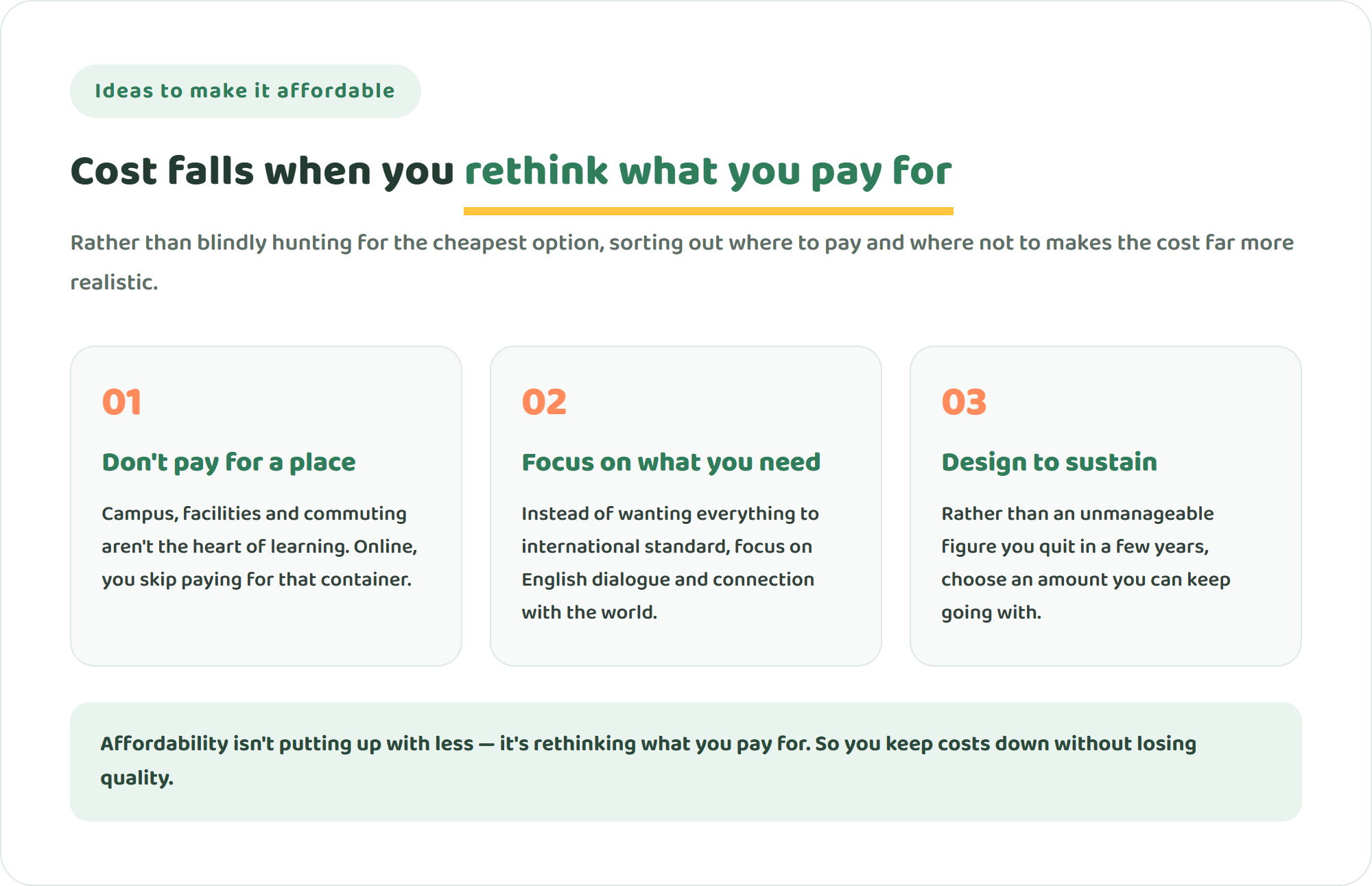
Most families give up on international education less because of the actual figure and more because of the belief that “it’s bound to be expensive.” It’s true that on-campus tuition squeezes the household. But much of that cost goes to the building and the system of getting there — lavish facilities, a large playground, a school bus. These are not the heart of learning; they’re an expensive “container.”
Put the other way around: choose a form where you don’t have to pay for that container, and the cost of international education falls structurally. Affordability isn’t the result of putting up with less — it’s the result of rethinking what you pay for. Let’s start by loosening this assumption.
Five ways of thinking to make international education affordable
Rather than blindly hunting for the cheapest option, sorting out “where to pay, and where not to” makes the cost far more realistic. Here are five ideas worth holding onto.
- 1. Choose online over commuting — with no campus upkeep, utilities, or travel costs, you can receive the same global learning at a more affordable price. This is an age when you can connect to the world from home.
- 2. Choose a form with no facility or commuting fees — enrolment fees, facility upkeep, uniforms, and long commutes add up to a heavy burden. A way of learning that structurally avoids these lightens the monthly load.
- 3. Focus on the learning you truly need — instead of wanting “everything to international standard,” focus on the axis your family values most, such as the ability to converse in English or connection with the world. Concentrating on what’s needed raises the value for money.
- 4. Combine public support with what you can do at home — municipal schooling support and various schemes differ in eligibility and amount, so always check with each school or office, but they may be usable. Reading aloud at home and free learning resources also support learning at no cost.
- 5. Design a cost you can sustain — international education doesn’t end in a single year. Rather than an unmanageable figure you quit after a few years, choosing an amount you can keep going with lets your child’s learning accumulate.
Points to check so “affordable” and “quality” go together
One caution, though: don’t choose on price alone. If lowering the cost hollows out the quality of learning, you’ve defeated the purpose. To keep international education affordable while judging its quality, check these points.
- Is there real dialogue in a small group? — cheap one-way streaming rarely creates the felt sense of connecting with the world. Look for genuine dialogue.
- Is there a grown-up who walks alongside? — a mentor or homeroom adult devoted to each child means your family doesn’t carry it all alone.
- Is there home-language support? — is there a safety net so a child new to English isn’t left behind? Sometimes support is thinned out in exchange for a lower price.
- Does it connect to pathways after graduation? — does the learning open into future options, such as universities at home or abroad?
Only when this “foundation of quality” is present alongside a low price does an affordable international education truly mean something.
See how learning works at NGA →
A realistic answer — the “online international school,” and where NGA fits
The option that puts all of these ideas into one shape is the online international school. NIJIN GLOBAL ACADEMY (NGA) is an online international school beyond the exam race, opening in September 2027. Instead of ranking children by test scores, we care about each child learning to love themselves and the world.
NGA can keep costs down not through discounts or making do with less, but because we hold no campus and need no commuting system — that structure itself lowers the cost. So even at a lower price, we don’t let go of real dialogue in small groups or the quality of learning that connects children to the world. Tuition is expected to be around one-fifth of an on-campus international school. The specific figure is something we share first, by email, with those who sign up for opening updates.
We’ll say honestly that low price is not our only selling point. What NGA cares about is small groups and real dialogue, and the experience of connecting with the world alongside peers across Asia and Oceania. NIJIN Academy, which we run in Japan, already has over 1000 children learning with us. Now we’re bringing that education online, in a more within-reach form, to the world.

Four options, compared honestly on cost
There are several paths to a global learning. Let’s compare an on-campus international school, an online international school, online English lessons, and homeschooling on cost and breadth. Because figures vary greatly by country and school, we show them here as tendencies.
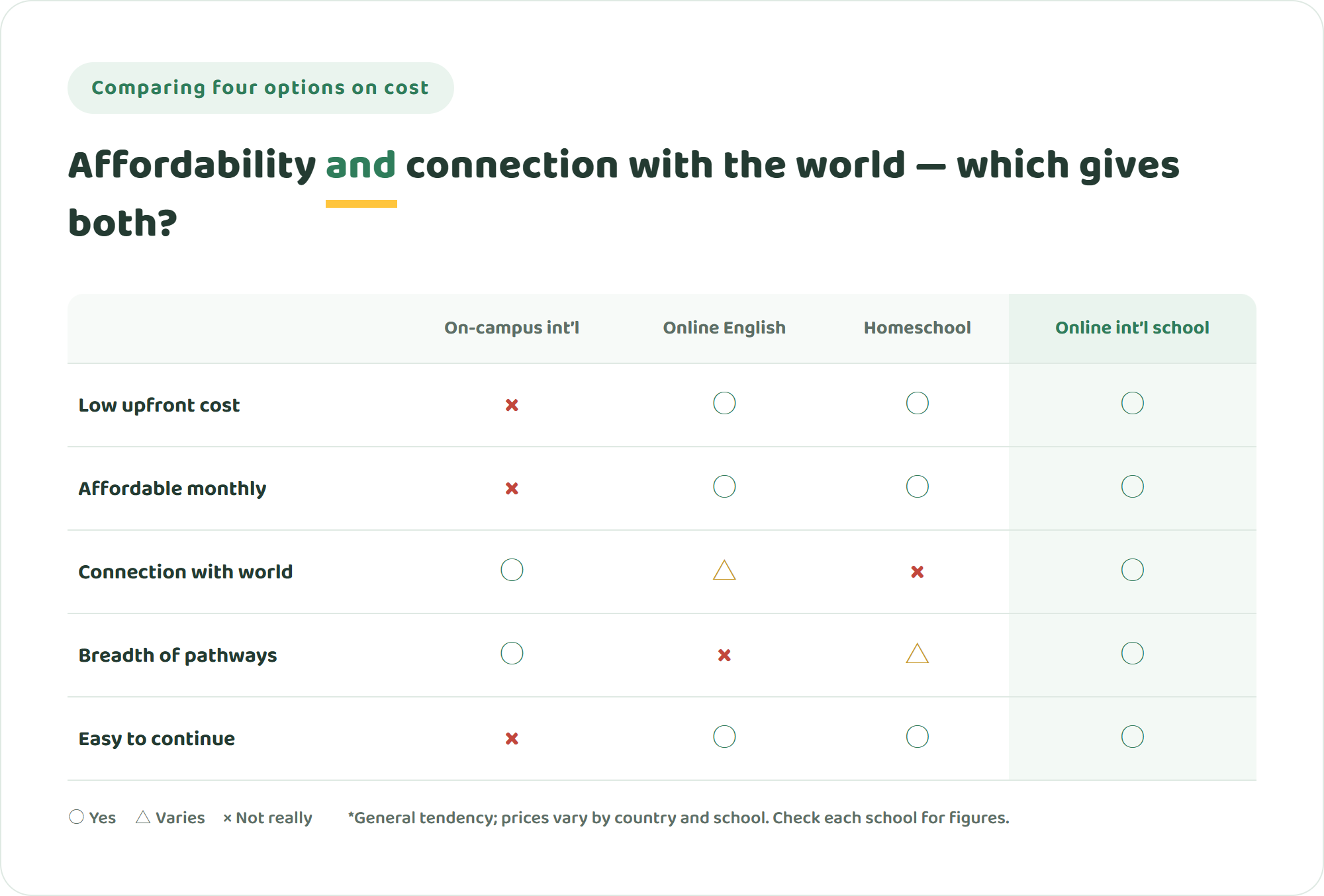
What the table reveals is that the big fork in the road is whether a path lets you hold both affordability and connection with the world. Online English is affordable but its pathways tend to be limited. An online international school is a realistic option that keeps costs down without giving up the breadth of a global education.
Who it suits, and who it doesn’t — honestly
To be clear: because it’s online, it isn’t identical to an on-campus school. Your child won’t share the air of the same room or run around a playground at break. For families who want to prioritise a dense, in-person group experience above all, something may feel missing.
On the other hand, if your family wants to “continue a global education while keeping costs down,” if your child “can settle and learn at home,” or “values connection with the world,” an online international school tends to fit very well. What matters is less about choosing the most expensive school and more about how you set up learning that suits your child, in a form your family can sustain.
Three steps to avoid regret over education costs
When it comes to cost, judging by the immediate monthly fee alone tends to lead to regret. There’s an order to deciding in a way that keeps international education affordable without regret.
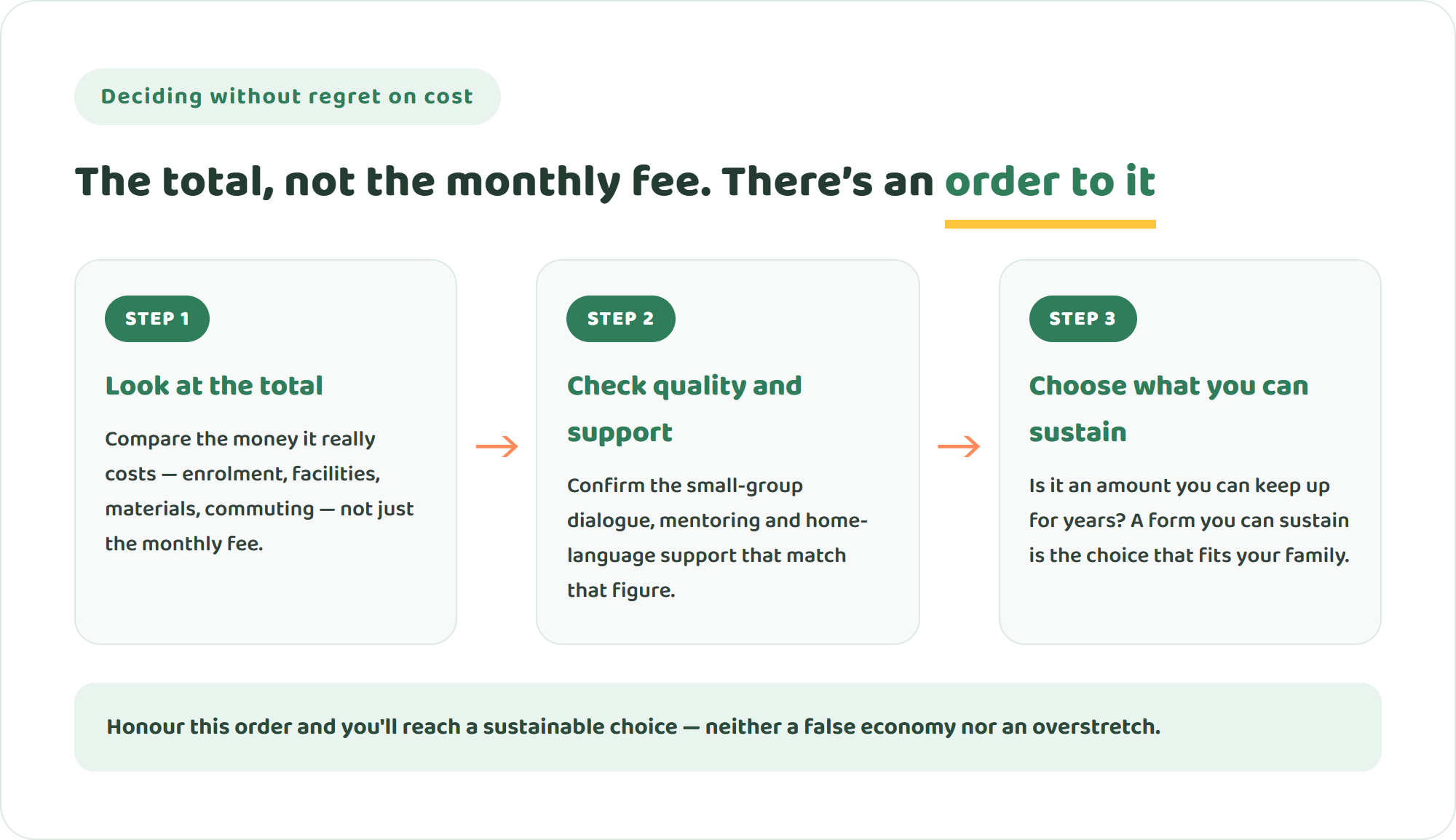
First, look at the total, not the monthly fee. Lay out the “money it really costs” — enrolment, facilities, materials, commuting — and the picture changes. Next, check whether the quality and support match that figure. And finally, choose by whether it’s an amount you can sustain for years. Honour this order, and you’ll arrive at a choice that fits your family — neither a false economy nor an overstretch.
Frequently asked questions
If I make international education affordable, won’t the quality drop too?
It depends on how the cost is lowered. When it’s made cheap through discounts or cutting support, quality tends to fall too. But when the structure itself — no campus, no commuting — lowers the cost, you can keep costs down while holding the quality. Checking for small-group dialogue and generous support is how you tell the difference.
How much more affordable is online international education compared to on-campus?
It varies by school, but with no facility or commuting fees, it’s generally much lower than an on-campus international school. In NGA’s case, we use around one-fifth of an on-campus international school as a guide. The specific figure is something we share first by email with opening updates.
Can we use public support?
Eligibility and amounts differ by municipality and scheme. Please always check with your local office or each school about what support may be available. Combining no-cost reinforcement — reading aloud at home, free learning resources — is effective alongside it.
Don’t let cost close the door to the world.
International education isn’t only for some families. Rethink what you pay for and choose a form you can sustain, and your family, too, can give your child a learning that connects them to the world. What matters is choosing not the most expensive school, but the learning you can keep going with.
NIJIN GLOBAL ACADEMY opens in September 2027. We’ll share concrete ways to give your child an international education while keeping costs down, along with first-cohort enrolment news, straight to your inbox. We’ll also share the specific tuition first with those who sign up for opening updates. A global education, within reach for your child.
Get opening updates by email →
Related: A cheaper alternative to a Singapore international school · How much does international school cost?
More on choosing an international education
- Positive School Refusal: Supporting a Child Who Learns Outside School——Practical support for families
- International School Fees in Asia by Country——An honest comparison, and the online third path
- Are There Subsidies for International Schools?——Realistic ways to lower the cost
- A Cheaper Alternative to a Singapore International School——Affordable online options
- Affordable International Schools in Bangkok——Fees, and an online alternative
- 10 Ways to Help Your Child Learn English at Home——What parents can do
- Online High School for Expat and Globally Mobile Families——Learning that moves with you
- How to Choose an International School——7 questions to ask before you enrol
- 6 International Qualifications You Can Earn Online——An honest guide
- When Your Child Does Not Want to Go to School——How to respond, and 5 real options