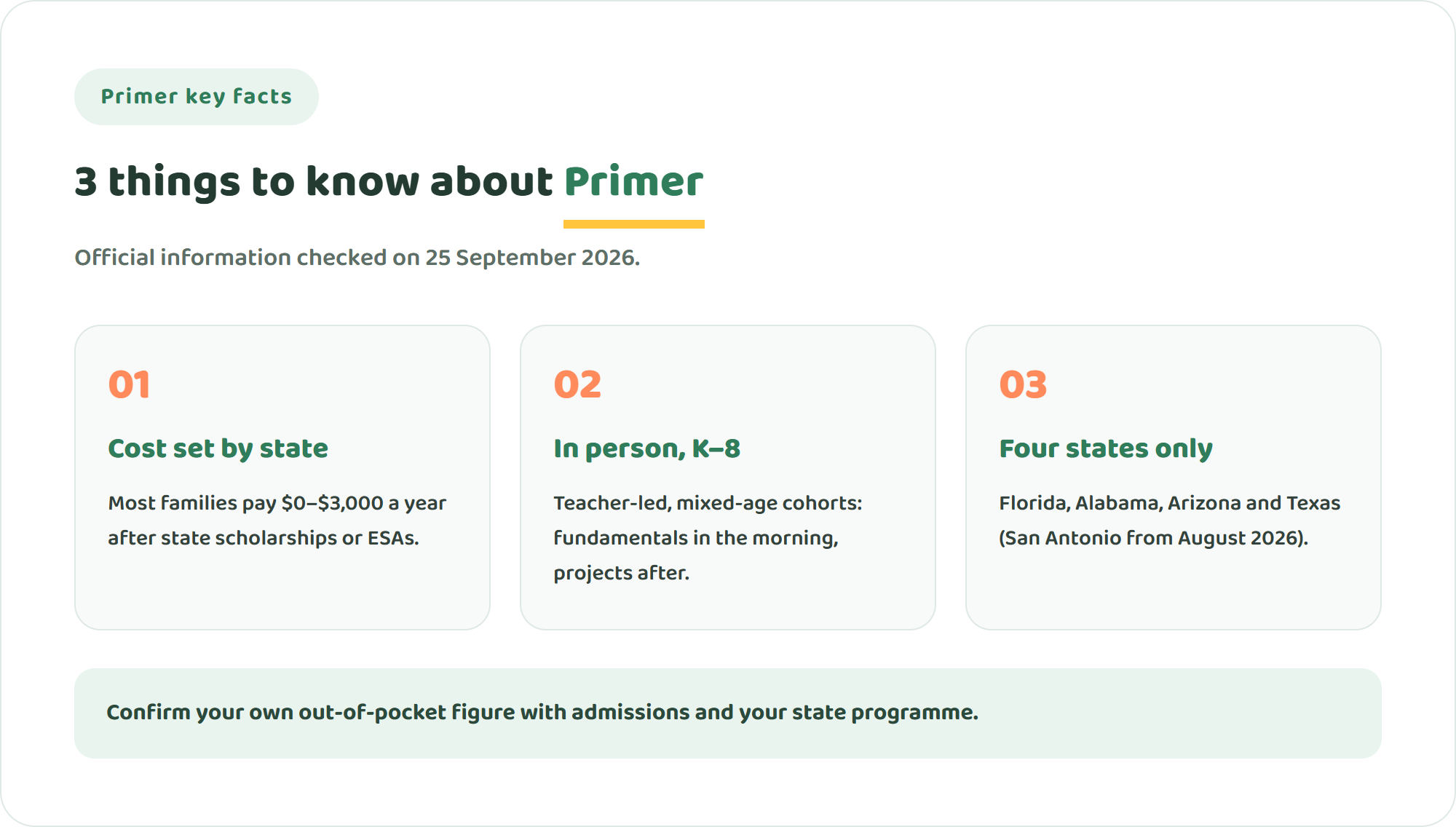
Primer does not publish one sticker price. Its official tuition page says “most Primer families pay between $0 and $3,000 per year”, because tuition is largely covered by each state’s scholarship or education savings account (ESA) programme. What a family pays out of pocket depends on the state and on household income. In Texas it is $0 for households earning $75,000 or less, and up to $10,710 per student above that. In Florida and Arizona it ranges from $0 to $6,752 a year. In Alabama it is a flat $500 a year (primer.com/tuition, checked 25 September 2026). On top of that there is a one-time $20 enrolment fee. Uniforms and optional aftercare are extra.
If you searched “primer microschool tuition”, “primer microschool review” or “primer school cost”, this guide sets out what Primer’s own pages say. It covers what Primer is, what you actually pay in each state, what a school day looks like, whether it is accredited, and the concerns parents tend to raise. It then compares Primer with two other non-traditional schools, Alpha School and Acton Academy, and with our own school, NIJIN GLOBAL ACADEMY (NGA). NGA is a different kind of school: it teaches online and is not yet open. We say so up front, and we have tried to give Primer’s strengths the same weight as its trade-offs.
The short answer: who Primer suits — and who it doesn’t
- Suits families living near a Primer campus in Florida, Arizona, Alabama or Texas (San Antonio) who want an in-person K–8 school with small, mixed-age classes.
- Suits families who qualify for their state’s scholarship or ESA programme. In those states Primer is designed so that the out-of-pocket cost stays low, and it is $0 for lower-income households in Texas, Florida and Arizona.
- Suits parents who want a strong focus on the fundamentals, meaning reading, writing and maths taught at each child’s level with visible weekly progress, plus afternoon projects (“Pursuits”).
- Suits children who do well with clear routines and goals. Primer describes opening and closing circles, goal-setting and a daily “Habits of Work” score.
- Less suited to families outside those four states, or outside the US. Primer is an in-person school, and its low prices depend on state programmes that are generally for residents of that state.
- Less suited to families who need a high school. Primer serves grades K–8 only, so there is no Primer diploma, and students move on to another school for grades 9–12.
- Less suited to parents who want a long track record. Primer was founded in 2019 and opened its first campus in Miami in 2023.

What Primer is
Primer (primer.com, often called “Primer Microschools”) is a US network of small private schools for kindergarten to grade 8. It takes its name from the old American primer textbooks. Its company timeline says Primer was founded in 2019 and opened its first campus in Miami in 2023. It expanded to Alabama in 2025 and to Texas in 2026. It describes its campuses as “a modern one-room schoolhouse”: small, close-knit classrooms that combine grades into three bands, K–2, 3–5 and 6–8.
Its “Find a School” page lists four states. Florida has ten locations, starting from the first Primer schools in Miami. Alabama has three schools launched in 2025, with two more cities coming. Arizona has one school, in Scottsdale. In Texas, San Antonio launched in August 2026 with three campuses. Note that an earlier Primer announcement spoke of “at least five schools” in San Antonio, while the current Schools page says three campuses. Ask admissions which campuses are open near you. Primer won the 2024 Yass Prize, according to its company page.
Two things set Primer apart from many other “AI school” or microschool brands. First, it is teacher-led: each group, or cohort, has a “Primer Leader”, and the adaptive software supports that teacher rather than replacing them. Second, it is built around state school-choice funding, and the founder has written openly about designing the model so that a state scholarship covers most or all of the tuition.
| Item | Primer (official information) |
|---|---|
| Type | Private, in-person microschool network (US) |
| Founded | 2019; first campus in Miami in 2023 |
| Grades | K–8, in mixed-grade bands (K–2, 3–5, 6–8) |
| States | Florida, Alabama, Arizona, Texas |
| Model | Reading, writing and maths at each child’s level in the morning (small groups, adaptive tools, direct teaching); project-based “Pursuits” in the afternoon |
| Staff roles | Primer Leader (leads a cohort), Guide (assists), Content Teacher (teaches maths or literacy via the “Prism” video platform), Campus Leader |
| Accreditation | Primer states it has earned Cognia “Accreditation with Merit” |
| Class size / school hours | Not published on the official site |
Primer tuition and fees (2026–27, official)
This is where Primer differs most from a typical private school. The tuition page does not list a full, pre-scholarship tuition figure. The full sticker price is not published on the official site. Instead, Primer publishes what families typically pay out of pocket once their state’s scholarship or ESA has been applied. Primer’s admissions form offers enrolment for 2026–2027 and 2027–2028, and the tuition page does not name a school year, so the figures below are the current published figures. Here they are as shown on 25 September 2026.
| State and programme | What families pay out of pocket (per student, per year) |
|---|---|
| Texas: Texas Education Freedom Accounts (TEFA) | $0 for households earning $75,000 or less that apply for TEFA. Households earning more than $75,000 can put eligible TEFA funding toward tuition and “may have an out-of-pocket tuition cost of up to $10,710 per student”, depending on the funding received. |
| Florida: Florida Empowerment Scholarships (FES) and Florida Tax-Credit Scholarships (FTC), via Step Up for Students | Typical by household income: $0–50K → $0; $50–75K → $957; $75–100K → $2,006; $100–130K → $3,915; $130–150K → $4,800; $150K+ → $6,752 |
| Arizona: Empowerment Scholarship Account (ESA) | Same table as Florida: $0 up to $6,752 depending on household income |
| Alabama: Scholarships for Kids partnership | $500 per year for all families, as long as you apply for Scholarships for Kids, even if you are not ultimately awarded a scholarship |
What is included and what is extra. According to the tuition FAQ, tuition covers “instruction, learning materials, technology”. The only additional costs named are the one-time enrolment fee, uniforms, and aftercare if you need it. The prices of uniforms and aftercare are not published on the official site.
| Fee item | Official information |
|---|---|
| Application | No cost to apply |
| Enrolment fee | $20 (one-time) to secure your child’s place |
| Payment schedule | 10 monthly instalments |
| Pay-upfront discount | 15% off if you pay the full out-of-pocket tuition upfront |
| Multiple children / hardship | In Florida, “families enrolling multiple children or experiencing extenuating circumstances may be granted additional tuition accommodation”; the FAQ says Primer will work with families whose finances change |
| Uniforms, aftercare | Extra; prices not published on the official site |
A worked example using only official numbers. Take a Florida family with a household income of $75,000–$100,000, two children, and four years at Primer. The typical out-of-pocket tuition is $2,006 × 2 children × 4 years = $16,048, plus 2 × $20 enrolment fees = $16,088 in total, before uniforms and aftercare. If the family pays upfront each year, the 15% discount brings tuition to $1,705.10 per child per year, or $13,640.80 over four years for both children, plus $40 in fees. The same family in Alabama would pay $500 × 2 × 4 = $4,000 plus $40. In Texas, with a household income under $75,000 and TEFA funding, tuition would be $0 and the family would pay only the $40 in enrolment fees.
Two cautions. First, the published figures depend on your family actually receiving the state scholarship or ESA. Each state sets its own eligibility rules, deadlines and amounts, so check them on the programme’s own site (Step Up for Students, azed.gov/esa, Scholarships for Kids). Second, pricing in Texas has already changed once. When Primer first announced San Antonio, the founder wrote that Primer would be “100% tuition-free” for all Texas families. The current tuition page says households above $75,000 may pay up to $10,710. Go by the current tuition page, and confirm your own figure with admissions. For how school costs compare across formats more generally, see our guide to online vs in-person school costs.
How a school day works: schedule, live classes and time zones
Primer is an in-person school, so there is no time-zone question. Your child attends a campus near home. In an article on Primer’s site, the founder describes the day this way:
- Opening circle. Students settle in and set their goals for the day.
- Morning: literacy and maths. These are focused blocks of work, sometimes independent and sometimes in a small group with a teacher. Every student works at their own level rather than at their grade level. The glossary names “Math Lab” and “Lit Lab” for independent practice. The K–2 page mentions reading groups, maths rotations and i-Ready. Some maths and literacy courses are taught by Content Teachers through Primer’s video platform, “Prism”.
- Afternoon: Pursuits. These are hands-on projects (the site gives robots and community gardens as examples) where students build, create and research topics they choose.
- Closing circle. Students reflect on what they have done and what comes next.
Primer says it has “no bells, busy work, or mad-dashes across campus”. Every child starts with a nationally normed assessment. Families follow weekly goals in the Primer App, and formal benchmarks are given three times a year. The year is divided into multi-week “Sessions”. Daily start and finish times, the school calendar, and class sizes are not published on the official site. Ask your campus, especially if you will need aftercare, which costs extra. If you are weighing Primer against an online option, our explainer on how a day at an online international school works shows how the rhythm differs when classes are live on a screen instead of in a room.
Accreditation, diploma and college recognition
Accreditation. In an article on its site, Primer states that “Primer Schools has earned Accreditation with Merit from Cognia”. Cognia is a large non-profit accreditor that reviews schools in the US and abroad. “Accredited with Merit” is one of Cognia’s accreditation statuses. Primer’s article does not give a date or say which campuses are covered. If accreditation matters to you, for example for a later transfer, ask admissions whether your specific campus is included, and check Cognia directly. (We could not confirm a Primer entry in Cognia’s own directory, so this is Primer’s statement.)
Diploma and college. Because Primer ends at grade 8, it does not award a high school diploma and has no college admissions record to report. The question to ask is how smoothly students move into high school. Primer says its 6–8 cohort prepares students for high school, but high school placement results are not published on the official site. Ask your local campus which high schools its graduates have gone on to.
Test results. The approach page gives individual student stories with percentile gains, and says students “consistently exceed growth goals”. Aggregate, independently audited results across the network are not published on the official site.
Primer vs NIJIN GLOBAL ACADEMY vs two other options (official data)
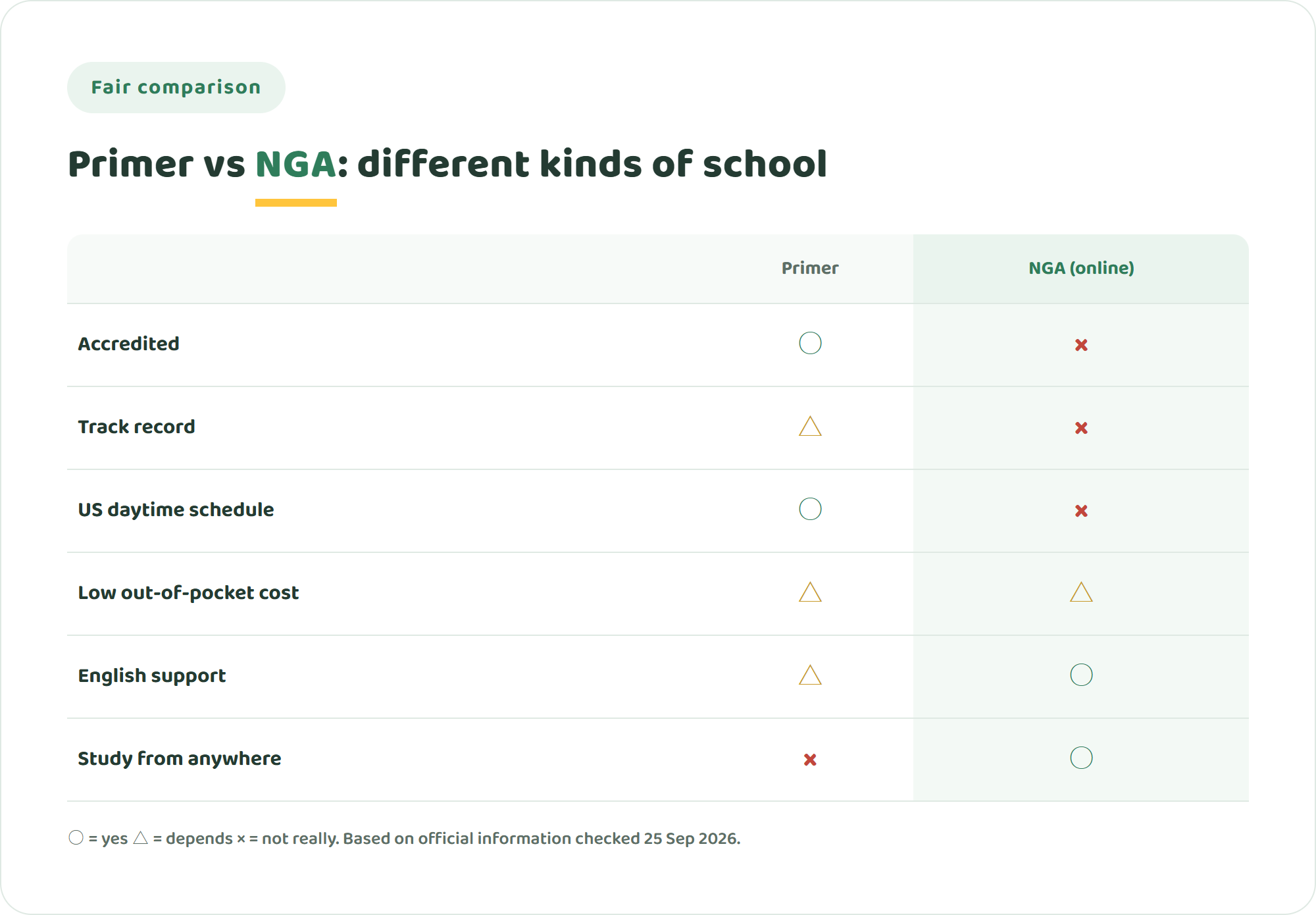
Parents looking at Primer often compare it with other US schools that break from the traditional classroom. Alpha School is an in-person private network built around two hours a day of adaptive software. Acton Academy is a worldwide network of independently owned, learner-driven schools. NIJIN GLOBAL ACADEMY (NGA) is our own online international school, opening in 2027. One difference matters above all the others. Primer, Alpha and Acton are schools you attend in person. NGA is taught online and is built for Asia and Oceania time zones. For most US families living near a Primer campus, NGA is not a like-for-like alternative. It is more relevant to families who move abroad, live in Asia or Oceania, or want to combine a local school with international study.
| Primer | NIJIN GLOBAL ACADEMY | Alpha School | Acton Academy | |
|---|---|---|---|---|
| School type | Private, in-person microschool network (FL, AL, AZ, TX) | Online international school (operated by NIJIN Inc., Japan) | Private, in-person school network (US) | Network of independently owned, learner-driven schools (300+ worldwide) |
| Grades / ages | K–8 | Ages 6–18 | PreK/K–8 at most campuses; K–12 at some | Most academies ages 4–18 (varies by campus) |
| Tuition (2026–27) | Out of pocket after state scholarship/ESA: TX $0 (income ≤$75K) up to $10,710; FL/AZ $0–$6,752 by income; AL $500. Full price before scholarships not published | Not yet published. No enrolment, facility or uniform fees; materials included; sibling discounts | Set by campus: $10,000–$75,000 per year (Austin $40,000) | Set by each campus; see official site |
| Curriculum | Teacher-led mastery of reading, writing and maths at each child’s level; afternoon “Pursuits” projects | Subjects in English in small live dialogue groups (about 8); bilingual mentor; CEFR-based English levels; optional Cambridge IGCSE / A-Level pathway | “2 Hour Learning”: adaptive software plus life-skills workshops | Self-paced mastery, Socratic discussions, hands-on “quests” |
| Live classes & time zone | In person on campus; daily hours not published | Live online, timetable built for Asia & Oceania daytime; may fall outside daytime in the Americas and Europe | In person on campus | In person; see local campus |
| Accreditation / diploma | States Cognia “Accreditation with Merit”; K–8 so no diploma | Not yet accredited; no graduates yet | Cognia-accredited | Not stated on the network site; varies by campus |
| Admission | Parent meeting first; no application fee; $20 enrolment fee | No entrance exam, no English requirement | Info session, application ($100), shadow day, MAP results review | Set by each campus (tours, information sessions, audition days) |
| Start dates | Enrolling for 2026–27 and 2027–28 | Opening September 2027 (planned); free trial classes monthly from September 2026 | School-year start; ask each campus | Varies by campus |
Sources: Primer Tuition, Primer Schools, Primer accreditation article, Alpha School Locations, Acton Academy, and NGA’s curriculum and timetable. All checked 25 September 2026.

Reviews and common concerns, answered honestly
Parent reviews of individual Primer campuses on sites such as Niche are mixed. Many are warm about the teachers and the small-group attention. Others raise concerns that differ from campus to campus. Below are the recurring themes, with what Primer’s official pages say about each.
“Is it really $0?”
Only in some cases. Out-of-pocket tuition is $0 for families who qualify for and receive enough state funding: Texas households earning $75,000 or less, and Florida and Arizona households earning up to $50,000. Other families pay up to $6,752 (Florida and Arizona) or up to $10,710 (Texas), plus uniforms and aftercare. Alabama is $500. Primer’s own headline is that “most” families pay $0–$3,000. That describes the typical family, not every family.
“What if the state scholarship doesn’t come through, or changes?”
Primer’s prices depend on state programmes that are set by legislators and administered by others. Primer encourages families to apply for the scholarship early. In Alabama, the $500 price applies once you have applied, whether or not you receive a scholarship. For other states, the tuition FAQ says Primer will work with families whose circumstances change. The price if you do not receive any funding is not published on the official site, so ask admissions directly.
“Is it too much screen time?”
Primer describes its approach as “not ‘more tech’ or ‘less tech'”, using technology “with intention”. Students use adaptive tools such as i-Ready, and some courses are taught through the Prism video platform. Teachers also run small groups, reading groups and hands-on Pursuits. Screen time is one of the most common questions parents ask about microschools that use adaptive software. Ask your campus what share of the day is spent on screens at your child’s grade.
“Mixed-age classes: good or bad?”
Primer deliberately combines grades (K–2, 3–5, 6–8) and teaches each child at their own level, not their grade level. Some parents value this and say younger children learn from older ones. Others would rather have single-grade classes. It is a design choice, so decide whether it suits your child.
“Art, PE and extras?”
Primer’s pages focus on literacy, maths and Pursuits projects. Recess and “fun Friday” are mentioned by students. Some reviews say there is less dedicated art or PE than at traditional schools. The official site does not publish a fixed timetable of specialist subjects, so ask what Pursuits are running at your campus this session.
“It’s new. Is it stable?”
Primer opened its first campus in 2023 and has grown quickly to four states. Rapid growth brings energy but also change, such as new campuses, new staff and updated pricing (as the Texas example shows). The founder writes that Primer is “still early. Very early.” Ask how long your campus has been open and how long its Primer Leader has been in post.
Alternatives to Primer worth comparing
- Alpha School. An in-person private network with a compressed academic block and life-skills afternoons. It is Cognia-accredited and much more expensive ($10,000–$75,000 a year by campus). See our Alpha School tuition and review.
- Acton Academy. Learner-driven, independently owned academies in 42 US states and about 30 countries, generally for ages 4–18. Tuition, and whether a campus accepts state scholarships, is set by each academy, so check locally.
- NIJIN GLOBAL ACADEMY (NGA). An online international school for ages 6–18 focused on Asia and Oceania, opening September 2027 (planned). It has no entrance exam and no English requirement, uses small live dialogue groups of about 8 with a bilingual (English–Japanese) mentor, and can be combined with a local school. It is not yet accredited and has no graduates. The timetable is built for Asia and Oceania daytime, so it will not suit most families in the US. Tuition is not yet published.
If you do not live near a Primer campus, or you want a school your child can keep attending if you move, a publicly funded online programme may also be worth a look. See our Connections Academy tuition and review, Pearson Online Academy tuition, and the wider comparison of online international schools.
FAQ
How much does Primer cost per year?
Primer says most families pay $0–$3,000 a year out of pocket once a state scholarship or ESA is applied. Texas: $0 for households earning up to $75,000 with TEFA, and up to $10,710 per student above that. Florida and Arizona: $0–$6,752 depending on household income. Alabama: $500. There is also a one-time $20 enrolment fee, and uniforms and aftercare cost extra. The full tuition before scholarships is not published on the official site.
Is Primer accredited?
Primer states that it has earned “Accreditation with Merit” from Cognia. Ask admissions whether your campus is covered and when the accreditation took effect. Primer is a K–8 school, so it does not issue a high school diploma.
Can international students enrol?
Primer is an in-person school in Florida, Alabama, Arizona and Texas. Its pricing relies on state scholarship programmes, which generally require residence in that state. Procedures for international or visa students are not published on the official site. A family moving to one of those states should contact admissions before arrival.
Is Primer worth it?
For a family near a campus that qualifies for state funding, Primer offers small, teacher-led classes focused on the fundamentals, at a low or zero out-of-pocket cost. That is a strong value proposition on paper. Whether it is worth it for your child depends on how they respond to mixed-age classes, adaptive software and project afternoons. A parent meeting and a campus visit will tell you more than any review.
What are the alternatives to Primer?
In person: Alpha School (higher tuition, Cognia-accredited) and Acton Academy (learner-driven, pricing set by each campus). Online: publicly funded virtual schools in many states and, for families in or moving to Asia or Oceania, NIJIN GLOBAL ACADEMY, which opens in September 2027 (planned).
Choosing calmly
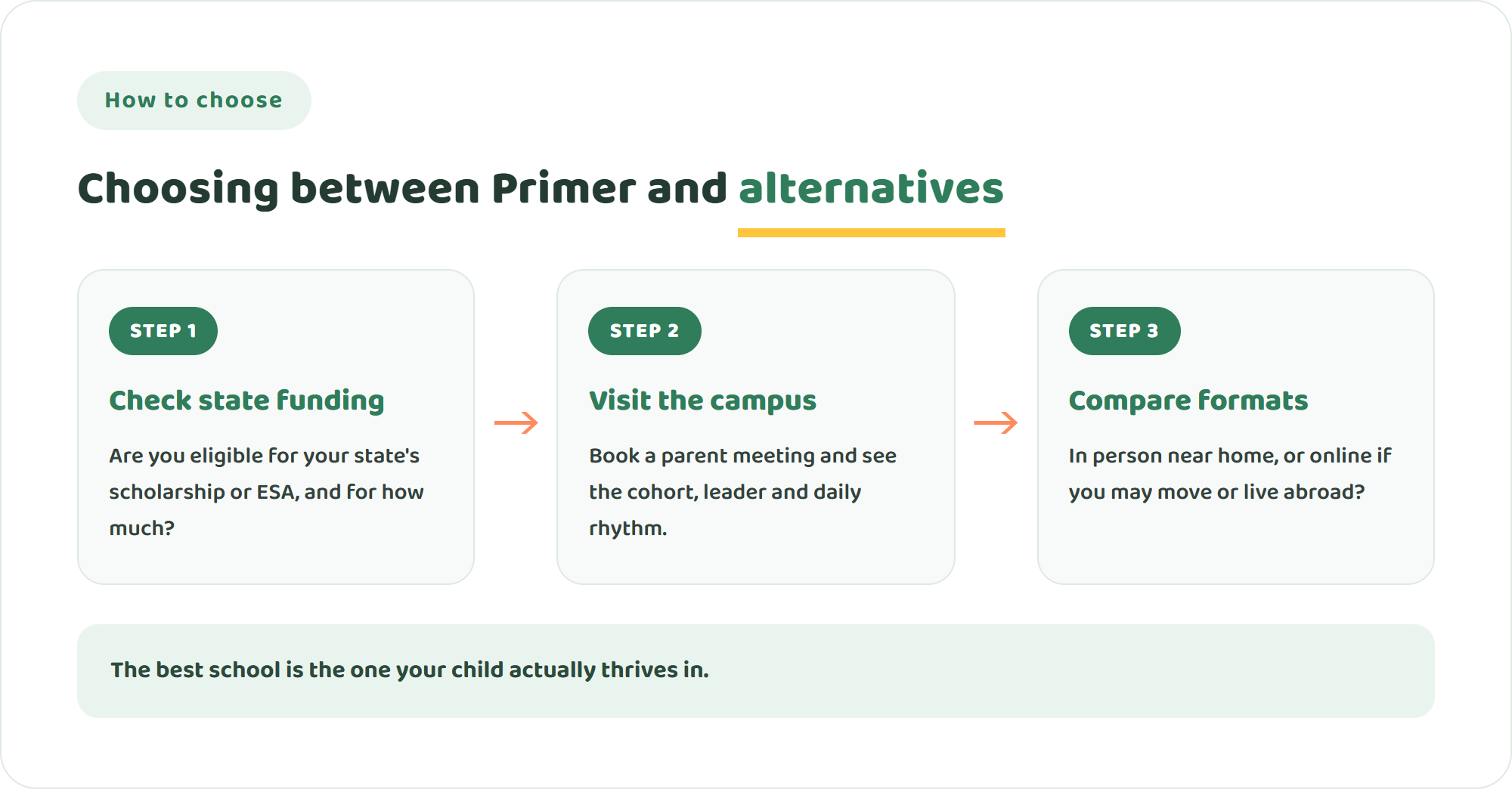
Primer shows what a school designed around state scholarships can look like. For families in the right state and income band, it offers a small school with a clear focus on reading, writing and maths, and costs very little. The best next step is simple. Check your state’s programme, book a parent meeting, and see the campus with your child. If your family’s path leads outside the US, or you want to understand what a small, live, online class feels like, you are welcome to follow NGA’s progress. There is no pressure and no commitment.
Tuition and admissions details were checked on the official websites on 25 September 2026. Schools revise fees every year, so always confirm on the official site before applying.
Get NGA opening updates by email →
Related reading
- Alpha School vs Sora vs Primer——three new school models, and which a family in Asia can actually use