If you have just moved to Ota City — perhaps for a Haneda-based posting, perhaps because Denenchofu or Omori is where your family put down roots — you have probably discovered the same awkward fact everyone else does. Ota has plenty of English-medium preschools, and almost nothing after age six. The ward is home to Haneda Airport and around 32,000 foreign residents out of a population of roughly 740,000 (Ota City resident register, 1 January 2025), yet as far as published information goes there is no full-time international school inside the ward that a primary-age child can attend every day. This guide lists all eleven international schools in Ota, English preschools included — every one genuinely located in the ward, with ages, published fees where they exist, the ward subsidy that changes the maths for a lot of families, and how far your realistic commute actually stretches — including south into Kawasaki and Yokohama.
Quick Answer: Your Options in Ota
If you only read one section, read this. Below are the schools covered in this guide, plus the online option — so you can see every route side by side before the details.
- Hope International School (Kamata & Umeyashiki) | fees on enquiry — Ages: roughly 3–6 for the main programme; after-school for primary-age children (confirm… / Fees: a fee schedule is provided by the school — contact them directly for current figures
- Kids Duo International Ikegami | fees on enquiry — Ages: 2–6 / Fees: shared at admissions information sessions — enquire directly
- Kinderkids International School Tokyo (Higashi-Minemachi) | fees on enquiry — Ages: 0–6 (preschool two to five days a week; five-day kindergarten from age three) / Fees: vary by year group and course — request the fee sheet from the school
- SkyCrest International School (Denenchofu) | fees on enquiry — Ages: 1–6 (preschool 1–3, kindergarten 4–6) / Fees: not published — enquire directly
- Pan International Academie Denenchofu | preschool from ¥37,000/month — Ages: preschool through primary after-school / Fees: preschool class from ¥37,000 per month as published on the school’s site;…
- Mintleaf International Preschool Yukigaya (Higashi-Yukigaya) | fees on enquiry — Ages: 0–5 / Fees: on enquiry (Tokyo-certified and subsidy-eligible — ask about the Ota ward subsidy…
- Cocoro Lab International Denenchofu | fees on enquiry — Ages: 0–5 (capacity 40) / Fees: on enquiry (Tokyo-certified; check Ota subsidy eligibility)
- Diluca International School Kamata (Shinkamata) | fees on enquiry — Ages: 3–5 (company-led childcare; confirm current age bands) / Fees: on enquiry — terms differ between community places and employee places
- First Learning Omori / Bright Kids International (Omori-Kita) | fees on enquiry — Ages: 0 through primary (preschool, kindergarten, after-school) / Fees: not published — enquire directly
- FUTURE Jidoen Shimomaruko | fees on enquiry (subsidy-eligible) — Ages: 2–6 (regular class); age 3 to Grade 6 (after-school) / Fees: on enquiry; subsidy-eligible, and Ota residents should check the ward’s parental…
- Zoo-phonics Academy Minami-Yukigaya | fees on enquiry — Ages: 1 through Grade 6, across four age-banded courses / Fees: vary by course and frequency — enquire directly
- NIJIN GLOBAL ACADEMY (online) — Ages 6–18 / opening September 2027, currently taking opening-update registrations / fees around one-fifth of a typical campus international school / Japanese-language support. An option when commute or fees are the wall.
Quick Answer: The International Schools in Ota, at a Glance
- Hope International School (Kamata & Umeyashiki campuses) | roughly ages 3–6 plus a primary-age after-school | fees on enquiry | the closest thing Ota has to a full international school, with an inquiry-led STEAM curriculum
- Kids Duo International Ikegami | ages 2–6 | fees on enquiry | bilingual kindergarten open 7:30–20:00, built for two-career households
- Kinderkids International School Tokyo (Higashi-Minemachi) | ages 0–6 | fees on enquiry | preschool from two days a week, five-day kindergarten classes from age three
- SkyCrest International School (Denenchofu) | ages 1–6 | fees on enquiry | a house-and-garden campus that teaches Japanese — including haiku and calligraphy — alongside English
- Pan International Academie Denenchofu | preschool to primary after-school | preschool from ¥37,000/month, subsidy-certified | seconds from Tamagawa Station, 60+ field trips a year
- Mintleaf International Preschool Yukigaya | ages 0–5 | fees on enquiry (Tokyo-certified, subsidy-eligible) | bilingual care focused on non-cognitive skills
- Cocoro Lab International Denenchofu | ages 0–5 | fees on enquiry (Tokyo-certified) | resident native staff and a genuinely cultural, not drill-based, approach
- Diluca International School Kamata | ages 3–5 | fees on enquiry (company-led childcare) | Nordic method, all-English with 45 minutes of Japanese daily
- First Learning Omori / Bright Kids International | age 0 to primary | fees on enquiry | the US Creative Curriculum, from infants through an elementary after-school
- FUTURE Jidoen Shimomaruko | ages 2–6 plus after-school to Grade 6 | fees on enquiry (subsidy-eligible) | English immersion with deliberate Japanese literacy support
- Zoo-phonics Academy Minami-Yukigaya | age 1 to Grade 6 | fees on enquiry | phonics specialists; one of the few places in Ota a child can stay for a decade
- NIJIN GLOBAL ACADEMY (online / opening September 2027 · ages 6–18 · around one-fifth of on-campus tuition · Japanese-language support built in) | pre-launch; currently taking opening-update sign-ups
International schools in Ota: the landscape and what they cost
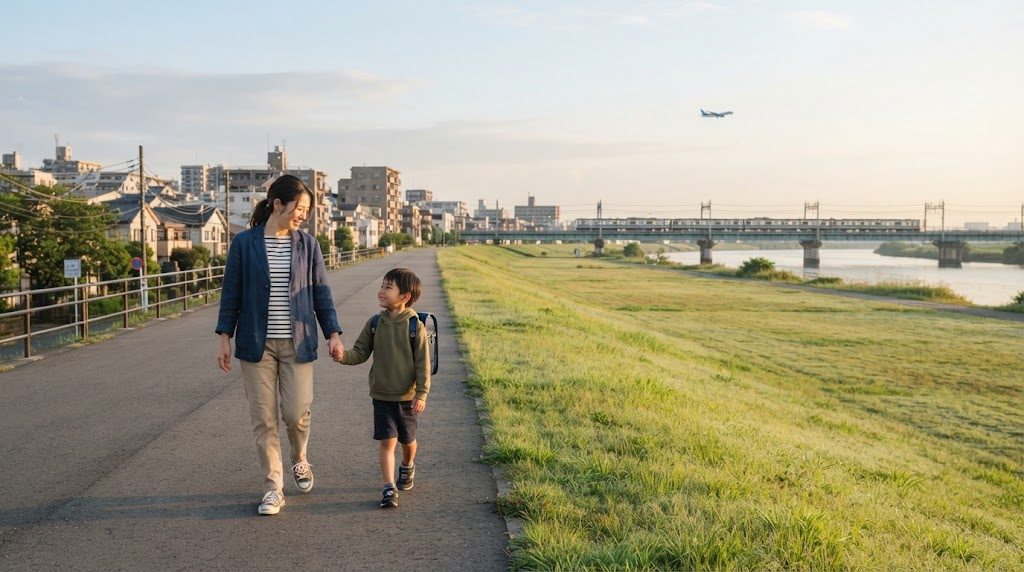
Ota City’s school map has one defining shape: abundant before six, empty after it. English-medium preschools and kindergartens are scattered across both halves of the ward — the leafy northwest around Denenchofu, Yukigaya and Kugahara, and the denser southeast around Omori, Kamata and Shimomaruko. Go looking for a full-time international school that takes primary and secondary students, though, and the published record comes up empty. What exists for school-age children instead is a strong network of after-school English programmes: Hope International School, First Learning Omori, FUTURE Jidoen Shimomaruko, Zoo-phonics Minami-Yukigaya, plus chains like Kids Duo and KidsUP.
The second thing to understand is the money, and here Ota is genuinely different from the wards you may have read about. Most English preschools in Ota operate as Tokyo-certified childcare centres, licensed-exempt facilities or company-led childcare — which means they can fall under Ota City’s subsidy for parents using unlicensed childcare facilities. The ward’s published ceilings are up to ¥80,000 a month for ages 0–2 and up to ¥77,000 a month for ages 3–5, subject to conditions: you must be an Ota resident, hold a contract of at least 120 hours a month, and the amount tapers by income bracket. It covers monthly fees and meals — not enrolment fees, uniforms or activity charges — and it is a reimbursement, so you pay first and claim after. Before you write off English-medium education on the strength of the seven-figure fees quoted for Minato or Shibuya, run the Ota numbers.
One caution the ward itself publishes: international schools are not schools under Japan’s School Education Act, so a Japanese-national child attending one is not considered to have satisfied compulsory education. Ota City spells this out on its official page and asks families to consult its school affairs section. If you want the full picture of what international education actually costs in Japan, our breakdown of international school fees goes deeper.
Note: fees and details reflect publicly available information as of August 2026. Always confirm the current figures on each school’s official site.
All 11 international schools in Ota, by age range and fees
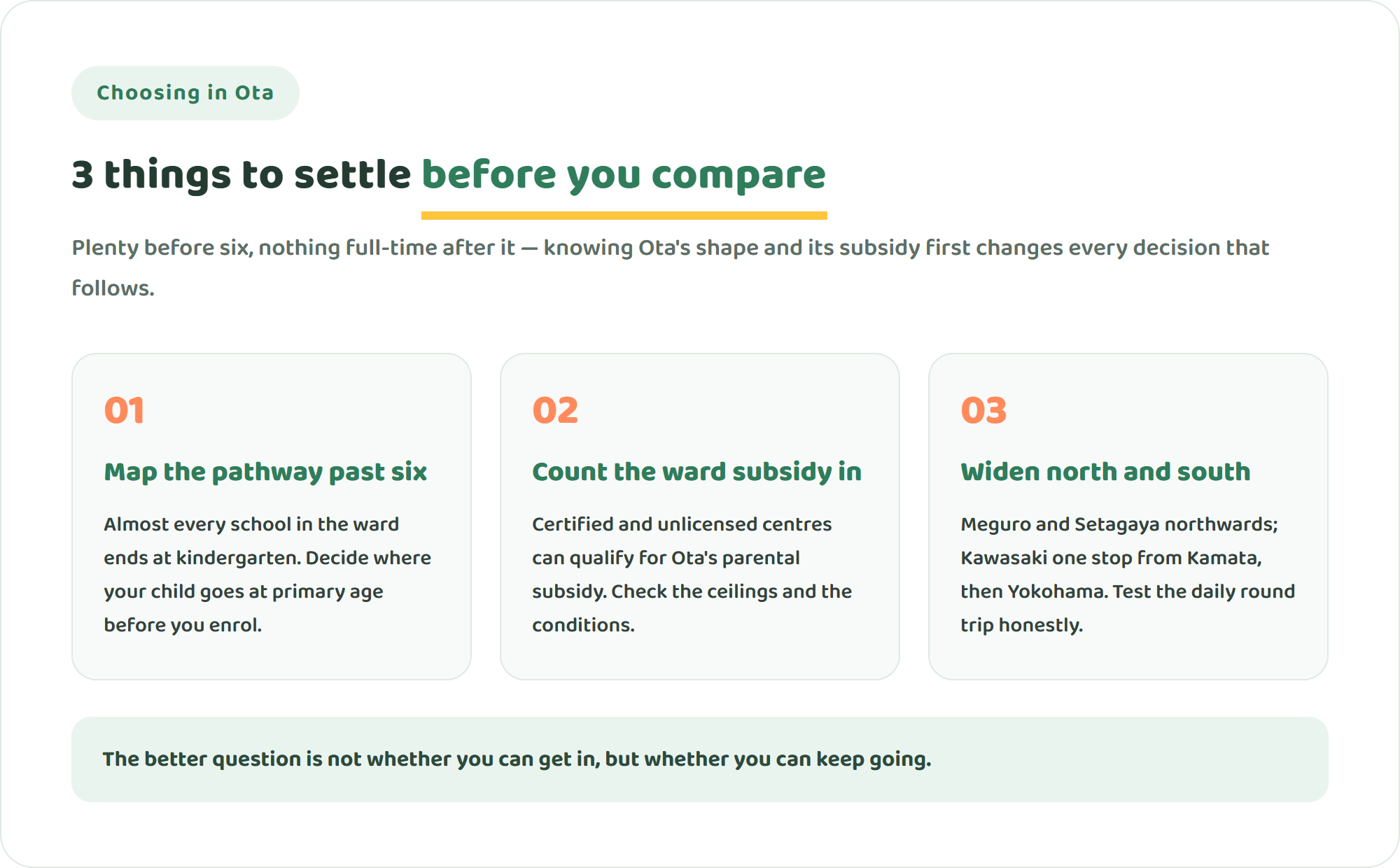
Here is every international school and English-medium preschool genuinely located in Ota City. We are not padding this to a round seven — there are eleven, and they differ enormously in what they are for. Read them in this order: age range first, total cost after subsidy second, educational philosophy third.
1. Hope International School (Kamata & Umeyashiki) | fees on enquiry
With campuses in Kamata and Omori-Nishi, Hope is the school in Ota that most resembles a conventional international school. It combines an international curriculum with a STEAM emphasis, teaching through inquiry and project work with an explicit goal of raising confident, globally-minded students. The school day runs 8:30–16:00 with classes from 10:00 to 15:00 and extended care afterwards, and a primary-age after-school programme means families at Japanese schools can keep an English environment going.
- Curriculum: international curriculum, inquiry- and project-based, with STEAM
- Ages: roughly 3–6 for the main programme; after-school for primary-age children (confirm current class structure)
- Fees: a fee schedule is provided by the school — contact them directly for current figures
- Best for: Kamata and Omori families wanting an all-English, inquiry-led environment that continues past kindergarten
2. Kids Duo International Ikegami | fees on enquiry
A bilingual kindergarten run by the Yaruki Switch group, in Nakaikegami. The programme stacks English immersion on top of cognitive training, a physical education strand, hands-on career-experience stations, and STEM elements including programming and mental arithmetic. Opening hours of 7:30–20:00, with core hours 9:00–17:00, make it one of the most practical options in the ward for households where both parents work full time.
- Curriculum: English immersion plus cognitive training, sport, career experience and STEM
- Ages: 2–6
- Fees: shared at admissions information sessions — enquire directly
- Best for: Ikegami and Kugahara families who want long hours and enrichment under one roof
3. Kinderkids International School Tokyo (Higashi-Minemachi) | fees on enquiry
Five minutes’ walk from Ontakesan Station on the Tokyu Ikegami Line, this is the Tokyo flagship of a national chain whose stated concept is an international school built for children growing up in Japan. What makes it unusually flexible is the entry structure: a preschool you can attend two to five days a week from age zero, and a five-day kindergarten class from age three. If jumping straight into full-time English feels like too much, this is the softest landing in Ota.
- Curriculum: English immersion through daily life, including literacy and presentation work
- Ages: 0–6 (preschool two to five days a week; five-day kindergarten from age three)
- Fees: vary by year group and course — request the fee sheet from the school
- Best for: Yukigaya and Ontakesan families who want to start at two days a week and build up
4. SkyCrest International School (Denenchofu) | fees on enquiry
Opened in 2018 a short walk from Tamagawa Station, SkyCrest occupies a brick house with a lawn, wooden deck and gardening beds in one of the greenest corners of Denenchofu. The day mixes morning yoga, food education, life science and inquiry activities. The distinguishing feature is that Japanese is taught seriously — conversation and reading, but also haiku and calligraphy. For families who want their child’s mother tongue to grow alongside English rather than under it, that matters.
- Curriculum: English plus structured Japanese (conversation, reading, haiku, calligraphy), food education, maths and science, inquiry
- Ages: 1–6 (preschool 1–3, kindergarten 4–6)
- Fees: not published — enquire directly
- Best for: Denenchofu and Tamagawa families wanting small classes, outdoor space and real Japanese literacy
5. Pan International Academie Denenchofu | preschool from ¥37,000/month
Literally at the exit of Tamagawa Station, wedged between Tamagawadai Park and Denenchofu Seseragi Park, this school leans hard into being outdoors — it advertises more than sixty field-trip destinations a year. Teaching is phonics-based, and independence is built through play rather than drilling. Classes run from preschool through a primary after-school, and it is certified under Japan’s early childhood education subsidy scheme, which keeps the real cost unusually low for an English-medium setting.
- Curriculum: phonics-based English immersion with a heavy outdoor and excursion component
- Ages: preschool through primary after-school
- Fees: preschool class from ¥37,000 per month as published on the school’s site; subsidy-certified. Varies by class and days attended
- Best for: Denenchofu and Tamagawa families who want their child outdoors and in English at the same time
6. Mintleaf International Preschool Yukigaya (Higashi-Yukigaya) | fees on enquiry
A Tokyo-certified childcare centre in Higashi-Yukigaya, eligible for the national early childhood subsidy. Its in-house Mintleaf Method is explicitly aimed at non-cognitive skills — persistence, curiosity, working with others — delivered through Japanese-English bilingual care rather than English drilling. Open Monday to Saturday, 7:30–20:30, with core hours 8:00–18:00. Because it is a certified centre, it pairs well with Ota’s parental subsidy.
- Curriculum: the Mintleaf Method, bilingual Japanese-English, focused on non-cognitive development
- Ages: 0–5
- Fees: on enquiry (Tokyo-certified and subsidy-eligible — ask about the Ota ward subsidy too)
- Best for: Yukigaya and Senzokuike families needing long hours without giving up an English environment
7. Cocoro Lab International Denenchofu | fees on enquiry
A forty-place Tokyo-certified centre in Denenchofu-Honcho with an honest positioning: it is about experiencing other cultures rather than acquiring a language. A resident American member of staff is part of daily life — outdoor play, mealtimes, and structured English Time of fifteen to thirty minutes depending on age. Rhythm training, gymnastics, hip-hop and swimming fill out the week, and lunches rotate through world cuisines. Care runs from 7:00 in the morning to 20:00 at night.
- Curriculum: culture-first bilingual childcare with a resident native speaker, English Time, and a broad activity programme
- Ages: 0–5 (capacity 40)
- Fees: on enquiry (Tokyo-certified; check Ota subsidy eligibility)
- Best for: Denenchofu-Honcho families who want early, unforced exposure to English and other cultures
8. Diluca International School Kamata (Shinkamata) | fees on enquiry
A company-led childcare facility near Kamata Station whose name comes from a Swedish word for deep respect — and the Nordic influence is real, with music and expressive arts treated as core rather than extra. The school’s stated priority is emotional growth first, English second. The environment is all-English, but 45 minutes of Japanese every day keeps the mother tongue and Japanese cultural literacy in place. Open 7:30–19:30, with an outdoor play area, meals cooked on site and transport.
- Curriculum: all-English care shaped by a Nordic method, plus 45 minutes of daily Japanese
- Ages: 3–5 (company-led childcare; confirm current age bands)
- Fees: on enquiry — terms differ between community places and employee places
- Best for: Kamata and Zoshiki families who want emotional development and Japanese held alongside English
9. First Learning Omori / Bright Kids International (Omori-Kita) | fees on enquiry
Minutes from JR Omori Station, this centre covers infants through primary in one place, built on the American Creative Curriculum and aiming to grow imagination, logical thinking and cooperation alongside English. The ladder runs Preschool, Preschool Advance, Kinder School, English Music & Movement, and then the Bright Kids International after-school for elementary students, with science experiments, presentations and field trips to places like Miraikan along the way.
- Curriculum: US Creative Curriculum with STEM, experiments and presentation work
- Ages: 0 through primary (preschool, kindergarten, after-school)
- Fees: not published — enquire directly
- Best for: Omori and Sanno families who want one consistent philosophy from infancy to elementary
10. FUTURE Jidoen Shimomaruko | fees on enquiry (subsidy-eligible)
Three minutes from Shimomaruko Station on the Tokyu Tamagawa Line. The regular preschool class spends the whole day in English with native teachers, and an after-school programme extends from age three all the way to Grade 6. What sets it apart is that Japanese reading and writing lessons run in parallel, explicitly to prepare children for Japanese elementary school. Classes are capped at ten children, meals are included, Japanese-speaking staff are on hand, and the centre qualifies for the Tokyo subsidy scheme.
- Curriculum: full-day English care in groups of ten or fewer, plus Japanese literacy lessons and summer programmes
- Ages: 2–6 (regular class); age 3 to Grade 6 (after-school)
- Fees: on enquiry; subsidy-eligible, and Ota residents should check the ward’s parental subsidy too
- Best for: Shimomaruko, Unoki and Musashi-Nitta families heading to Japanese elementary school without losing English
11. Zoo-phonics Academy Minami-Yukigaya | fees on enquiry
A detached house in a quiet Minami-Yukigaya street, running an all-English programme built on the Zoo-phonics method — animal characters paired with letter sounds and physical movement, so children learn to decode with their whole bodies. Four age-banded courses cover Mummy & Baby from age one, English Preschool from age two, a kindergarten-age class from three, and an elementary class through Grade 6. That span makes it one of the very few places in Ota where a child can stay from age one to age twelve.
- Curriculum: all-English instruction using the Zoo-phonics method, focused on reading and writing foundations
- Ages: 1 through Grade 6, across four age-banded courses
- Fees: vary by course and frequency — enquire directly
- Best for: Yukigaya-Otsuka and Senzokuike families keeping English literacy going alongside Japanese school
Beyond these, Ota has several English-medium after-school and childcare chains — Kids Duo in Omori and Yukigaya-Otsuka, KidsUP in Omori, Kamata, Ikegami, Nagahara and Denenchofu. Combining a Japanese public school with an English after-school is, realistically, the mainstream choice in this ward rather than a compromise.
When Ota runs out: Shinagawa, Setagaya — and Kawasaki and Yokohama to the south
Hunt for a pathway past age six inside Ota alone and you will hit a wall. What Ota has instead is an unusually wide commuting radius. Northwards from Denenchofu, the Tokyu lines put Meguro and Setagaya within easy reach: international schools in Meguro include KAIS International School and Gregg International School, and KAIS’s high school division sits in the area covered by international schools in Shinagawa. International schools in Setagaya include long-established names such as St. Mary’s in Seta and Seisen in Yoga, with Laurus in Tamagawa-Denenchofu essentially on the ward boundary.
Then there is the direction other Tokyo ward guides never mention: south. From Kamata, Kawasaki is a single stop on both the JR and the Keikyu. Kawasaki International School takes children from 2 to 12, and the wider set of international schools in Kawasaki can genuinely be an easier daily journey from Omori, Kamata or Shimomaruko than anything in central Tokyo. Push a little further and international schools in Yokohama open up the K-12 options that Ota itself lacks. To compare across the whole capital, start with international schools in Tokyo.
Comparing the three routes honestly
Lists of schools rarely answer the real question, which is which type fits your family. In Ota the choice resolves into three routes: an English preschool inside the ward, a full-time international school outside it, or an online international school with no commute at all. The table below sets out the trade-offs without pretending any of them is perfect.
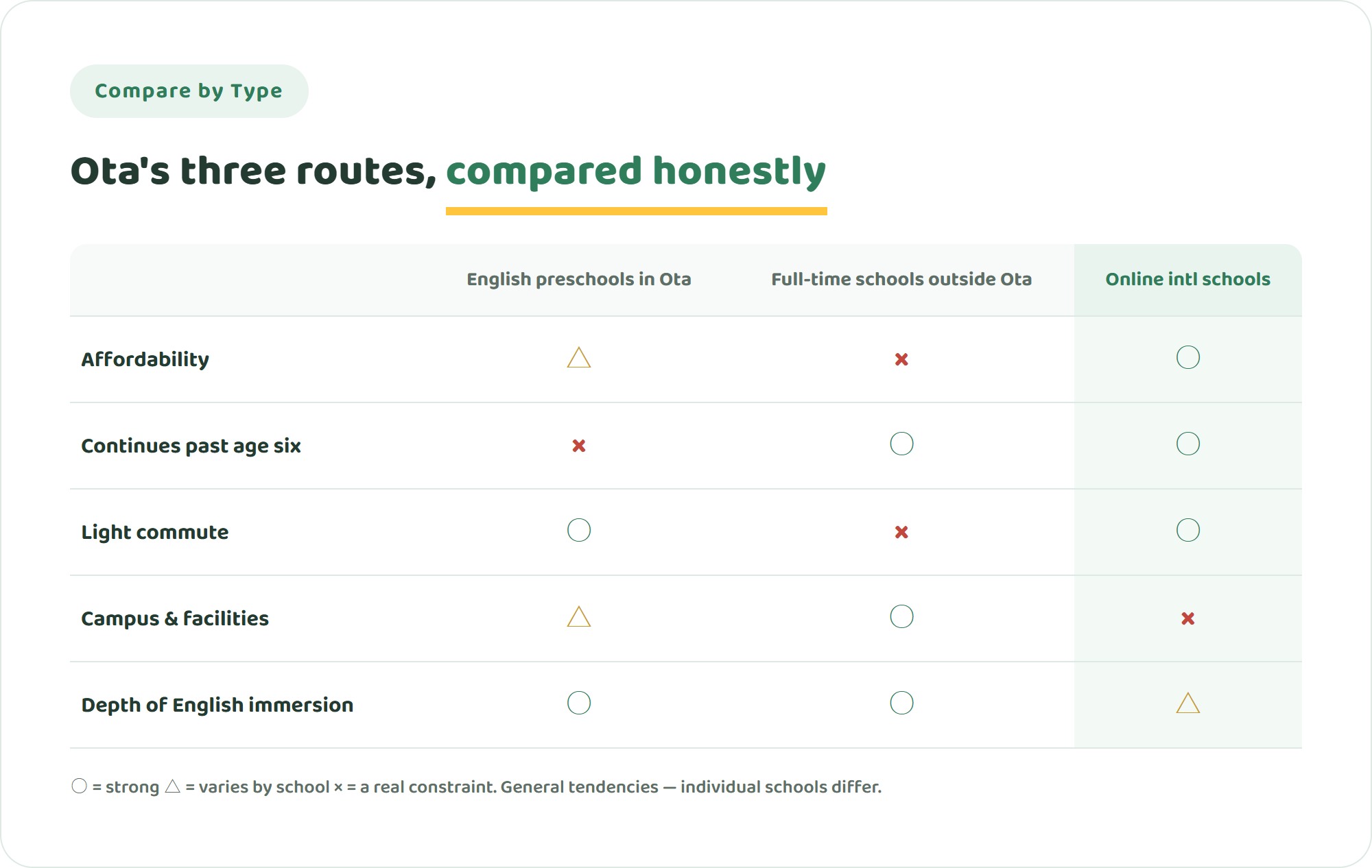
Preschools inside Ota win on convenience and on cost, because the national subsidy and the ward’s parental subsidy can both apply. Their limit is hard: almost all of them end at six, so a second search is guaranteed. Full-time international schools outside the ward solve continuity but push annual fees into the two-to-three-million-yen range and add a commute that a small child has to survive every single day. The third route is the one families overlook. With no commute, where you live stops deciding what your child can learn. If the fees are what is stopping you, is international school too expensive? is worth reading before you decide.
See how learning works online →
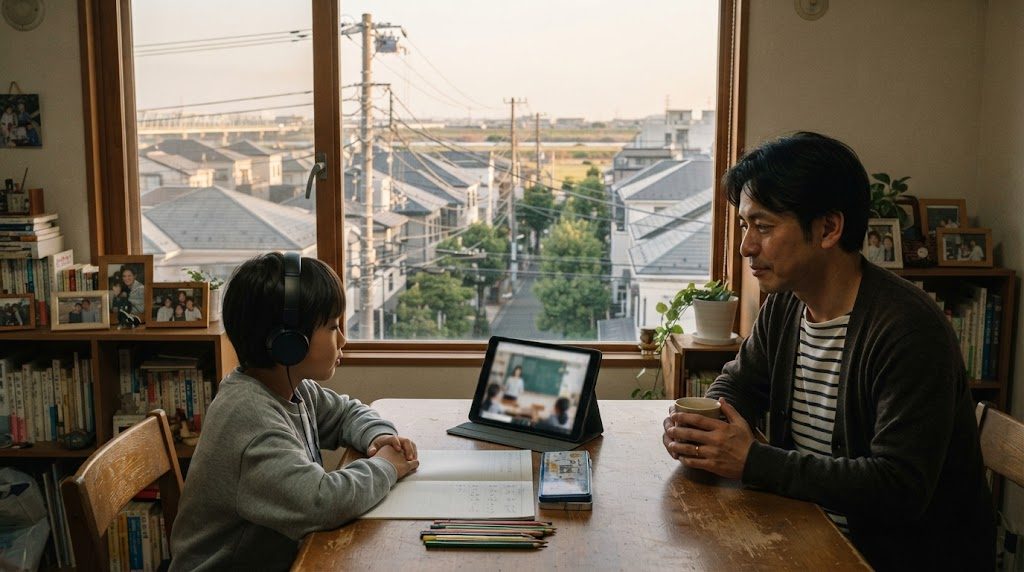
When fees or the commute are the wall: the online option
Ota is a genuinely good place to raise children — the Tama riverbank, the greenery around Senzokuike, the streets of Denenchofu, and an international airport on the doorstep. But the constraints are real: no full-time international school inside the ward for school-age children, fees that jump sharply the moment you look outside it, and a commute that gets longer the better the school. If you have found yourself thinking that you want an international education for your child but cannot see how to sustain the cost for a decade, there is another route that does not assume a daily journey.
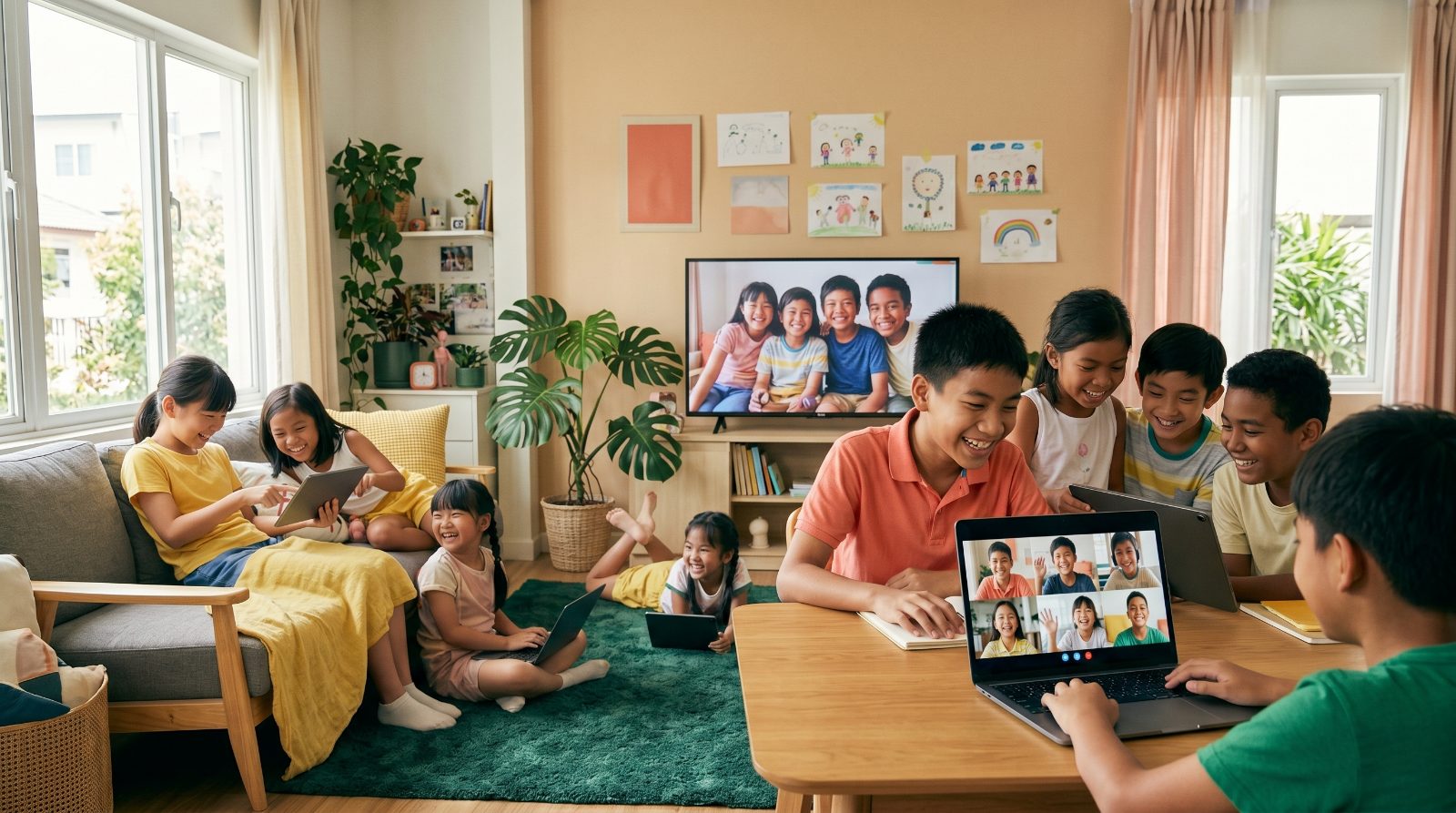
NIJIN GLOBAL ACADEMY (NGA) is an online international school opening in September 2027. It is run by NIJIN Inc., the Japanese company behind NIJIN Academy, an alternative school with more than 1,000 students enrolled in Japan. Our approach rejects ranking children by test scores, and centres on small-group dialogue and a simple aim: that children come to like themselves and the world. It is designed for 6- to 18-year-olds across Asia and Oceania, wherever they live, with Japanese-language support built in so children can grow into English gradually. We are working towards fees at around one-fifth of on-campus international school tuition.
In fairness, we should say plainly: NGA has not opened yet, and our track record is still ahead of us. We cannot offer the playground, the corridors and the physical campus life that a bricks-and-mortar school gives. But if you are weighing options in Ota, learning that connects your child to the world without the commute or the fees is a route worth putting on the list.
Frequently asked questions
Q. From what age can my child start at an international school in Ota?
A. From birth, at the earliest. Kinderkids Tokyo, Mintleaf Yukigaya, Cocoro Lab Denenchofu and First Learning Omori take children from age zero; SkyCrest and Zoo-phonics Minami-Yukigaya from age one; Kids Duo International Ikegami and FUTURE Jidoen Shimomaruko from age two; Hope International School and Diluca Kamata from roughly age three. Filter by your child’s age first, then check whether the school qualifies for the national subsidy and Ota’s own parental subsidy — that second step often changes the shortlist more than the first.
Q. Is there a full-time international school in Ota for primary-age children? What about Japanese support?
A. As far as published information shows, no — there is no full-time international school inside Ota that a primary-age child attends every day. What exists for school-age children is after-school English: Hope International School, First Learning Omori, FUTURE Jidoen Shimomaruko, Zoo-phonics Minami-Yukigaya, Kids Duo and KidsUP. For full-time schooling you will need Meguro, Shinagawa or Setagaya, or the short hop south to Kawasaki and Yokohama. Japanese-language support varies enormously between schools, so ask exactly how many hours a week are taught and by whom before you enrol.
Q. Can we transfer mid-year, and when should we start applying?
A. Preschools in Ota often take mid-year entrants when places exist, and because the ward has a relatively large number of them, your odds are better here than in wards with only two or three options. Popular schools and Tokyo-certified centres do run waiting lists, so begin touring and enquiring six to twelve months ahead. Transfers into full-time international schools outside the ward cluster around the April or August-September intake and may involve English assessments, student interviews and a parent meeting. Note too that Ota’s subsidy is claimed retrospectively and requires an application, so sort out the paperwork at the same time you sort out the place.
The time you spend deciding is time spent caring
There is no single right answer to this. In a ward like Ota — rich in options before six, and open in every direction after it — the useful question is not which school is best, but which one your family can sustain for years. Fees, travel time, your child’s temperament: no two households weigh these the same way. The fact that you are hesitating at all is evidence of how seriously you are taking your child’s future. Take your time, visit two or three schools in person, and compare how they feel. And if you would also like to know what the non-commuting route looks like, we would be glad to be quietly on your list.
International Schools in Other Cities
- International Schools in Sendai: 7 Picks and Fees
- International Schools in Shinjuku: Fees
- International Schools in Karuizawa: All 4 Schools
- International Schools in Sapporo: Fees
- International Schools in Dubai: Fees
- International Schools in Meguro: All 8 Schools
- International Schools in Tsukuba: Fees
- International Schools in Yokohama: Full Comparison
- International Schools in Tokyo
- International Schools in Minato: Fees
- International Schools in Shibuya, Tokyo
- International Schools in Setagaya: All 14 Schools
- International Schools in Koto, Tokyo
- International Schools in Shinagawa, Tokyo