If you have just moved to Bunkyo — perhaps for a post at the University of Tokyo, a lab in Hongo, or simply because the neighbourhood is quiet, green and full of bookshops — you have probably already discovered the awkward truth. Bunkyo is one of Tokyo’s most education-obsessed wards, yet searching for an international school here turns up page after page of preschools. This guide lists the international schools in Bunkyo Ward, preschools included — every one genuinely located here — eight of them — with the ages each one serves, the fees they publish, and the honest gaps between them. Because the biggest thing to know about Bunkyo is not how many schools it has. It is that only one takes primary-age children full time, and only one takes teenagers.
Quick Answer: Your Options in Bunkyo
If you only read one section, read this. Below are the schools covered in this guide, plus the online option — so you can see every route side by side before the details.
- Aoba-Japan International School, Bunkyo Campus (Honkomagome) | approx. ¥2,862,000 per year — Ages: Grades 10–12. Younger grades are at the Hikarigaoka (Nerima) and Harumi (Chuo)… / Fees: approx. ¥2,862,000 tuition per year (Grades 6–12, 2026–27 published rate), plus…
- MEES International School (Hakusan & Sendagi) | approx. ¥1.24m preschool, ¥1.52m elementary — Ages: preschool 1–6 (both campuses); elementary 6–12 (Hakusan only). Full day 8:30–15:00… / Fees: preschool five days approx. ¥1,236,400/year; elementary full day approx.…
- Joy to the World American International School (Koishikawa) | fees on enquiry — Ages: 0 (parent-and-child) to 6 preschool and kindergarten; afterschool elementary 7–11;… / Fees: not published — contact the school (and ask whether the childcare subsidy applies…
- Hello Kids International School (Koishikawa / Myogadani) | approx. ¥44,100–¥132,200 per month — Ages: 1.5–6 preschool and kindergarten; 3–10 for afternoon and Saturday classes / Fees: morning class approx. ¥44,100/month (two days) to ¥95,000/month (five days); full…
- Laurus International School of Science, Bunkyo (Koishikawa / Kasuga) | fees on enquiry — Ages: 10 months–6 (mother & toddler, preschool, kindergarten); afterschool programmes to… / Fees: not published on the campus page — check the admissions fee page or contact the…
- Sakura International School Bunkyo (Otsuka / Myogadani) | fees on enquiry — Ages: 0–6 (parent-and-child, infant/toddler, kindergarten divisions) / Fees: not published — request materials or contact the school
- SOLTILO GSA International School Bunkyo Motomachi (Hongo) | fees on enquiry — Ages: 2–6 (Pre-K, K3–K5) plus afterschool for elementary students / Fees: not published — contact the school
- NAS KIDS UNIVERSITY Bunkyo (Sendagi) | fees on enquiry — Ages: 2–5 (preschool) plus Grades 1–6 (English afterschool) / Fees: not published — contact the school
- NIJIN GLOBAL ACADEMY (online) — Ages 6–18 / opening September 2027, currently taking opening-update registrations / fees around one-fifth of a typical campus international school / Japanese-language support. An option when commute or fees are the wall.
Quick Answer: The International Schools in Bunkyo, at a Glance
- Aoba-Japan International School, Bunkyo Campus (Honkomagome) | Grades 10–12 | approx. ¥2,862,000 tuition per year (2026–27, published) | The ward’s only IB Diploma pathway
- MEES International School (Hakusan & Sendagi) | ages 1–12, preschool plus elementary | approx. ¥1,236,400/year preschool, ¥1,515,938/year elementary (2025–26, published, pre-tax) | The only full-day primary school in Bunkyo
- Joy to the World American International School (Koishikawa) | 0–6 plus afterschool elementary to 11 | contact the school | Small American-style immersion school, subsidy-eligible
- Hello Kids International School (Koishikawa / Myogadani) | 1.5–6, plus afternoon and Saturday classes for ages 3–10 | approx. ¥44,100–¥132,200 per month (published) | Cambridge-focused, flexible two-to-five-day enrolment
- Laurus International School of Science, Bunkyo (Koishikawa / Kasuga) | 10 months–6, afterschool to 12 | contact the school | STEM specialist, opened July 2025
- Sakura International School Bunkyo (Otsuka / Myogadani) | 0–6 | contact the school | Bilingual Japanese–English inquiry learning, open 8am to evening
- SOLTILO GSA International School Bunkyo Motomachi (Hongo) | 2–6 plus elementary afterschool | contact the school | Football and English combined, IEYC-based
- NAS KIDS UNIVERSITY Bunkyo (Sendagi) | 2–5 plus elementary afterschool | contact the school | All-English childcare with swimming and gymnastics, open until 7pm
- NIJIN GLOBAL ACADEMY (online / opening September 2027, ages 6–18, roughly one-fifth the fees of an on-campus international school, Japanese-language support built in) | An online international school with no commute; currently taking registrations for opening updates
How International Schools in Bunkyo Actually Work — and What They Cost
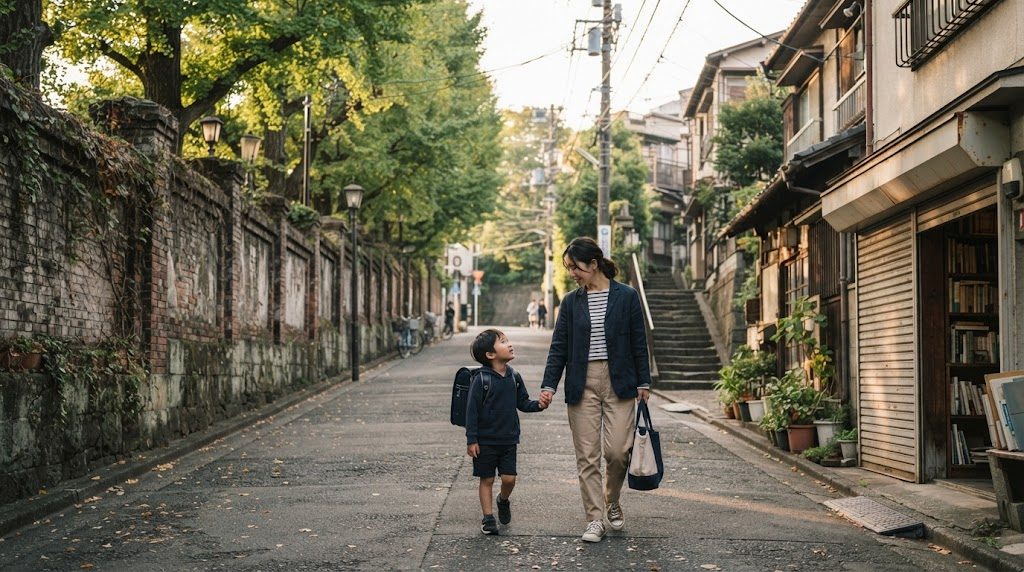
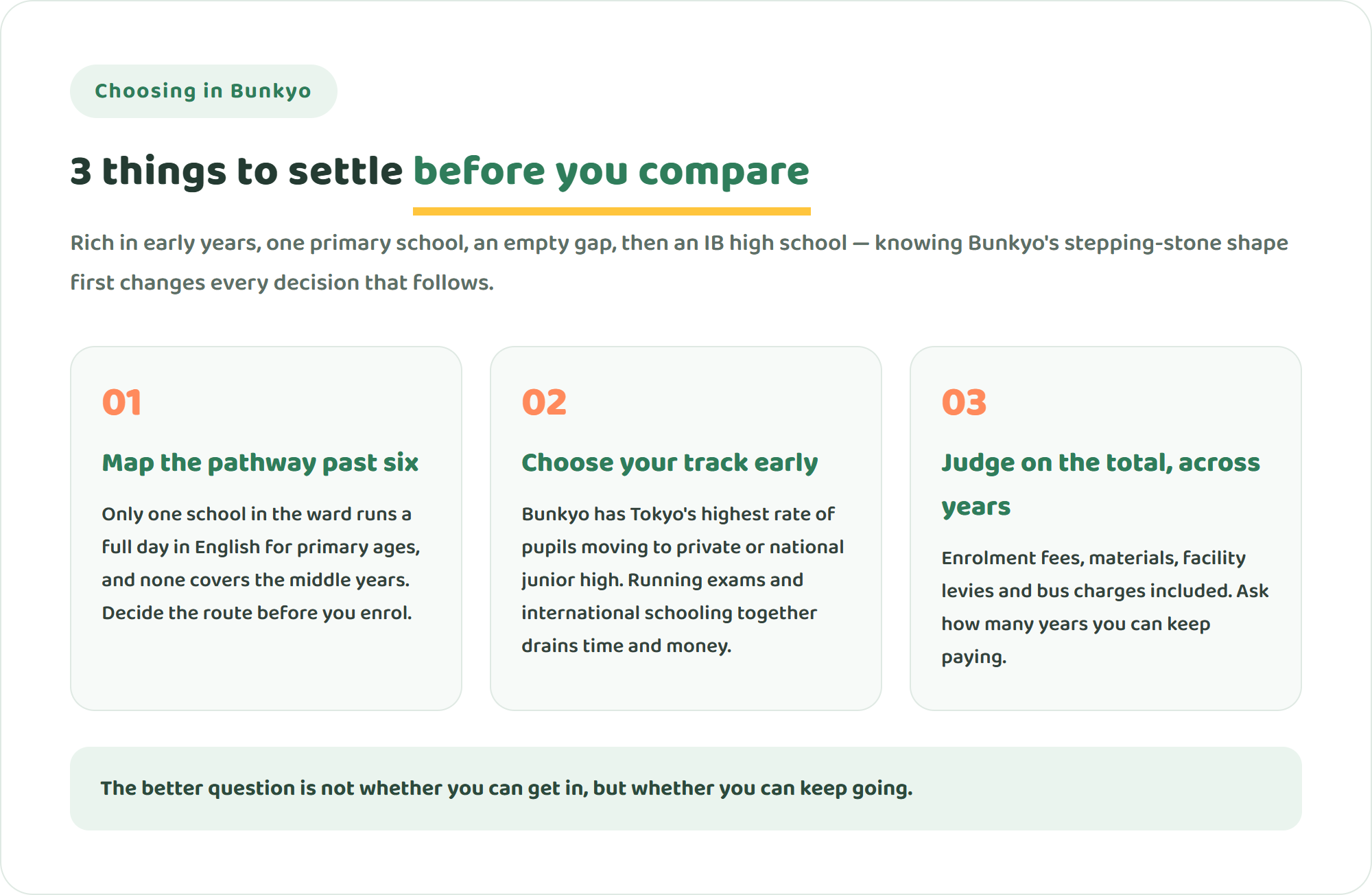
The shape of Bunkyo’s international school scene can be summed up in one line: rich in early years, stepping-stones after that. Koishikawa, Myogadani, Otsuka, Hongo, Hakusan and Sendagi all have schools where children spend their whole day in English, and two more opened in 2025 alone — Laurus in Kasuga and SOLTILO GSA in Hongo. For families with children under six, Bunkyo is a genuinely comfortable place to live.
Then the ground gets thin. Only MEES International School’s Hakusan campus runs a full-day elementary programme for ages six to twelve. For the middle-school years there is essentially nothing inside the ward. And then, at the top, Aoba-Japan International School’s Bunkyo Campus in Honkomagome takes Grades 10 to 12 and carries students all the way to an IB Diploma. Preschool, one primary school, a gap, then an IB high school — that is the real map, and it is unlike almost any other ward in Tokyo. Plan the whole journey before you enrol anywhere.
There is a second Bunkyo-specific factor worth knowing, especially if you are raising a bilingual child here for the long term. Bunkyo has the highest rate in Tokyo’s 23 wards of public elementary graduates moving on to private or national junior high schools — well over 40 per cent — and the catchment areas of four sought-after public primaries are talked about openly when families choose where to rent or buy. If your child is in the local school system, the pull toward Japanese entrance exams from around Grade 4 is strong and social. Deciding early which track your family is on — international schooling or the Japanese exam route — saves a great deal of money and heartache later.
On fees: a full-time, five-day preschool place in Bunkyo generally lands somewhere around ¥1.2 to ¥1.6 million a year. MEES’s elementary programme is about ¥1.52 million a year, and Aoba’s high school tuition is about ¥2.86 million a year. Compared with the long-established schools of Minato and Shibuya, which start near ¥3 million, Bunkyo is comparatively affordable up to primary level. But every school adds enrolment fees, materials charges, facility levies and bus costs on top, so your first year will be noticeably higher than the tuition line. Judge on the total. If you want the components broken down, see our guide to what international school really costs.
Note: fees and details here reflect information published as of August 2026. Always confirm the current figures on each school’s official site.
All 8 International Schools in Bunkyo, by Age Range and Fees
We are not padding this out to a tidy “top seven”. Eight schools in Bunkyo genuinely run their day in English. Read them in this order: age range first, fees second, educational philosophy third. In a ward with this shape, the age range is what determines whether a school is even an option for you.
1. Aoba-Japan International School, Bunkyo Campus (Honkomagome) | approx. ¥2,862,000 per year
Aoba’s dedicated upper-secondary campus, opened in 2022 inside part of the Bunkyo Gakuin University Girls’ Junior and Senior High School building, when Grades 10–12 moved here from the Hikarigaoka campus. Students choose between the IB Diploma Programme and Aoba’s own Global Leadership Diploma. The building was designed for teenagers rather than adapted for them: open-plan classrooms, a black box theatre, soundproofed music studios, multimedia rooms and a large cafeteria. Aoba was also selected by the IB Organisation as Asia’s first pilot school for an online IB Diploma, so Grades 11 and 12 can be taken on campus or fully online. This is the only route to an IB Diploma inside Bunkyo.
- Curriculum: IB Diploma Programme or Aoba Global Leadership Diploma
- Ages: Grades 10–12. Younger grades are at the Hikarigaoka (Nerima) and Harumi (Chuo) campuses
- Fees: approx. ¥2,862,000 tuition per year (Grades 6–12, 2026–27 published rate), plus first-year enrolment and facility development fees, lunch and bus
- Good fit for: families in Honkomagome, Sengoku or Komagome wanting a full IB pathway through high school
2. MEES International School (Hakusan & Sendagi) | approx. ¥1.24m preschool, ¥1.52m elementary
Two campuses — Hakusan (preschool plus elementary, five minutes’ walk from Hakusan Station) and Sendagi (preschool) — and the only school in Bunkyo where a primary-age child can learn in English all day. The early years draw on Montessori and Reggio Emilia thinking; the elementary programme runs on project-based learning with STEM, digital literacy and a forest education strand that takes children outdoors regularly. The Hakusan campus has a 400-square-metre open space, a maker space and a gym studio, and the school is working through IB candidate status. It is also one of the few schools in the ward that publishes its fees in full, with lunch included.
- Curriculum: Project-based learning with STEM and outdoor education; Montessori and Reggio influences in early years. IB candidate school
- Ages: preschool 1–6 (both campuses); elementary 6–12 (Hakusan only). Full day 8:30–15:00, optional English support to 16:00
- Fees: preschool five days approx. ¥1,236,400/year; elementary full day approx. ¥1,515,938/year (2025–26 published, excluding tax, lunch included). Plus ¥20,000 application, ¥180,000 enrolment, ¥40,000/year materials, ¥50,000/year development fund, optional bus ¥220,000/year
- Good fit for: families in Hakusan, Sengoku or Honkomagome who want continuity from toddler years through primary
Official site / Elementary and fees
3. Joy to the World American International School (Koishikawa) | fees on enquiry
A small American-style immersion school in Koishikawa, reachable from Myogadani Station, that has quietly built a full ladder of ages under one roof: a Mommy & Me class from birth, toddler and pre-kinder classes for ones and twos, kindergarten for threes to sixes, and an afterschool elementary programme for ages seven to eleven, plus a Saturday school. Everything runs in English, with a stated emphasis on creativity, exploration and individual attention rather than scale. It is registered as an eligible facility under Bunkyo’s early childhood education and childcare subsidy, which is worth checking against your own situation. For families whose children attend Japanese primary school, the afterschool track is one of the few ways in Bunkyo to keep an English environment going past six.
- Curriculum: full English immersion, American approach built around creativity and exploration
- Ages: 0 (parent-and-child) to 6 preschool and kindergarten; afterschool elementary 7–11; Saturday school 3–11
- Fees: not published — contact the school (and ask whether the childcare subsidy applies to you)
- Good fit for: Koishikawa and Myogadani families who want English to continue after their child starts Japanese school
4. Hello Kids International School (Koishikawa / Myogadani) | approx. ¥44,100–¥132,200 per month
Founded in Myogadani in 2009 and now based in Koishikawa, Hello Kids is built around flexibility. You can enrol for morning classes (10:00–14:30), afternoon classes (15:00–18:00), full days (10:00–18:00) or Saturdays, from two days a week upward. That makes it one of the few realistic entry points in Bunkyo for a family not ready to commit to a full-time international school. The programme runs toward Cambridge English examinations, and the school organises an annual trip to British Columbia, Canada. It also publishes its full fee schedule online — rare enough in this ward to be worth noting.
- Curriculum: English immersion with international classes leading to Cambridge English exams
- Ages: 1.5–6 preschool and kindergarten; 3–10 for afternoon and Saturday classes
- Fees: morning class approx. ¥44,100/month (two days) to ¥95,000/month (five days); full day up to approx. ¥132,200/month. Enrolment approx. ¥88,200 plus ¥25,000 annual fee (published, as of August 2026)
- Good fit for: families who want to start with two or three days a week, or keep English going on Saturdays after school entry
5. Laurus International School of Science, Bunkyo (Koishikawa / Kasuga) | fees on enquiry
The newest arrival on this list: Laurus opened its eighth preschool and kindergarten in Koishikawa in July 2025, five minutes from Kasuga Station and seven from Korakuen. Laurus is a STEM specialist, and the Bunkyo campus follows the group’s English-plus-science model using the Cambridge international curriculum, with native-English teachers leading every classroom. Children go on a monthly science trip, and the year is punctuated by a Performance Day, Sports Day and STEAM Fair. Hours run 8:30–18:00, with a five-hour option (9:00–14:00) or a full day. Because Laurus also operates elementary and junior high divisions elsewhere in Tokyo, there is a route onward within the same organisation.
- Curriculum: English × STEM, project-based, on the Cambridge international curriculum
- Ages: 10 months–6 (mother & toddler, preschool, kindergarten); afterschool programmes to age 12
- Fees: not published on the campus page — check the admissions fee page or contact the school. Noted as eligible for the early childhood education and care fee exemption programme as of January 2026
- Good fit for: Kasuga, Korakuen and Hongo families with a child who loves experiments and building things
6. Sakura International School Bunkyo (Otsuka / Myogadani) | fees on enquiry
Run by Kansai International Academy and located in Otsuka, within walking distance of both Myogadani and Shin-Otsuka stations. The defining feature is that it does not treat English and Japanese as a trade-off: the school explicitly builds bilingual Japanese–English development alongside inquiry-based learning. There is a parent-and-child class from birth, an infant and toddler programme (short course 10:00–14:00, long course 8:00–18:00) and a kindergarten division (9:00–18:00), with extended care available into the evening. For dual-income households in Bunkyo who want their child immersed in English without letting Japanese slip, this is one of the more balanced options in the ward.
- Curriculum: bilingual Japanese–English inquiry-based early education
- Ages: 0–6 (parent-and-child, infant/toddler, kindergarten divisions)
- Fees: not published — request materials or contact the school
- Good fit for: working parents in Myogadani, Otsuka and Kohinata who need long hours and want both languages held
7. SOLTILO GSA International School Bunkyo Motomachi (Hongo) | fees on enquiry
Opened in 2025 on the fourth floor of Motomachi Wellness Park in Hongo 1-chome, five minutes from Suidobashi Station and eight from Ochanomizu. The concept is a genuine hybrid: the sports programme of SOLTILO Familia Soccer School combined with Global Step Academy’s international curriculum. Teaching follows the International Early Years Curriculum (IEYC), using thematic inquiry to build curiosity and independence, with physical activity woven through the day rather than bolted on. The main programme runs 9:00–14:30, and afterschool options for both preschoolers and elementary students extend to 17:00–19:00.
- Curriculum: International Early Years Curriculum (IEYC) combined with a structured sports programme
- Ages: 2–6 (Pre-K, K3–K5) plus afterschool for elementary students
- Fees: not published — contact the school
- Good fit for: Hongo, Suidobashi and Ochanomizu families with an active child who learns better while moving
8. NAS KIDS UNIVERSITY Bunkyo (Sendagi) | fees on enquiry
An all-English childcare facility and afterschool centre in Sendagi, run by the NAS sports club group. Its distinguishing feature is that swimming and gymnastics are taught in English alongside music, art and maths, with native-speaking instructors paired with bilingual Japanese childcare staff. Three schedules are available — short (8:00–14:30), middle (8:00–16:00) and long (8:00–19:00) — from three to five days a week, and the afterschool programme continues to Grade 6. For families whose child attends Japanese primary school, this is a practical way to keep afternoons in English without a second commute.
- Curriculum: all-English childcare with swimming, gymnastics and academic English
- Ages: 2–5 (preschool) plus Grades 1–6 (English afterschool)
- Fees: not published — contact the school
- Good fit for: Sendagi, Nezu and Honkomagome families needing long hours and an English environment together
Beyond these eight, Bunkyo also has smaller English preschools such as First Learning Hongo and Phoenix Kids in Hongo and Kids Heart in Hakusan, plus English afterschool providers including Kids Duo in Myogadani, Hakusan, Komagome and Nezu, and J PREP Kids in Myogadani. In terms of English exposure before and around school age, the ward is well served. But to repeat the point that matters: one full-day primary school, no middle school, one IB high school. That is the structure you are planning around.
When Bunkyo Runs Out: Options in Shinjuku, Minato and Shibuya
If you try to solve the primary and middle-school years within Bunkyo alone, you will hit a wall. Widening the commute by one ward changes everything. International schools in Shinjuku are the natural first step — much of the ward is reachable from Bunkyo without changing trains on the Marunouchi, Namboku or Oedo lines, and the Waseda, Takadanobaba and Yotsuya areas include schools with primary years and above.
Go a little further and you reach the long-established institutions of Minato and the Hiroo and Shibuya cluster covered in international schools in Shibuya. From Hongo or Korakuen these are roughly half an hour door to door — realistic on paper, but test whether your child can actually do that round trip every day for years. To compare across the whole city rather than ward by ward, start with our guide to international schools in Tokyo.
Choosing What Actually Fits Your Family
Lists only get you so far. It helps to collapse Bunkyo’s options into three types: full-time international schools inside the ward (MEES elementary, Aoba’s high school campus), local preschools and kindergartens, and online international schools with no commute at all. The table below compares them honestly — including where the online option is weaker.
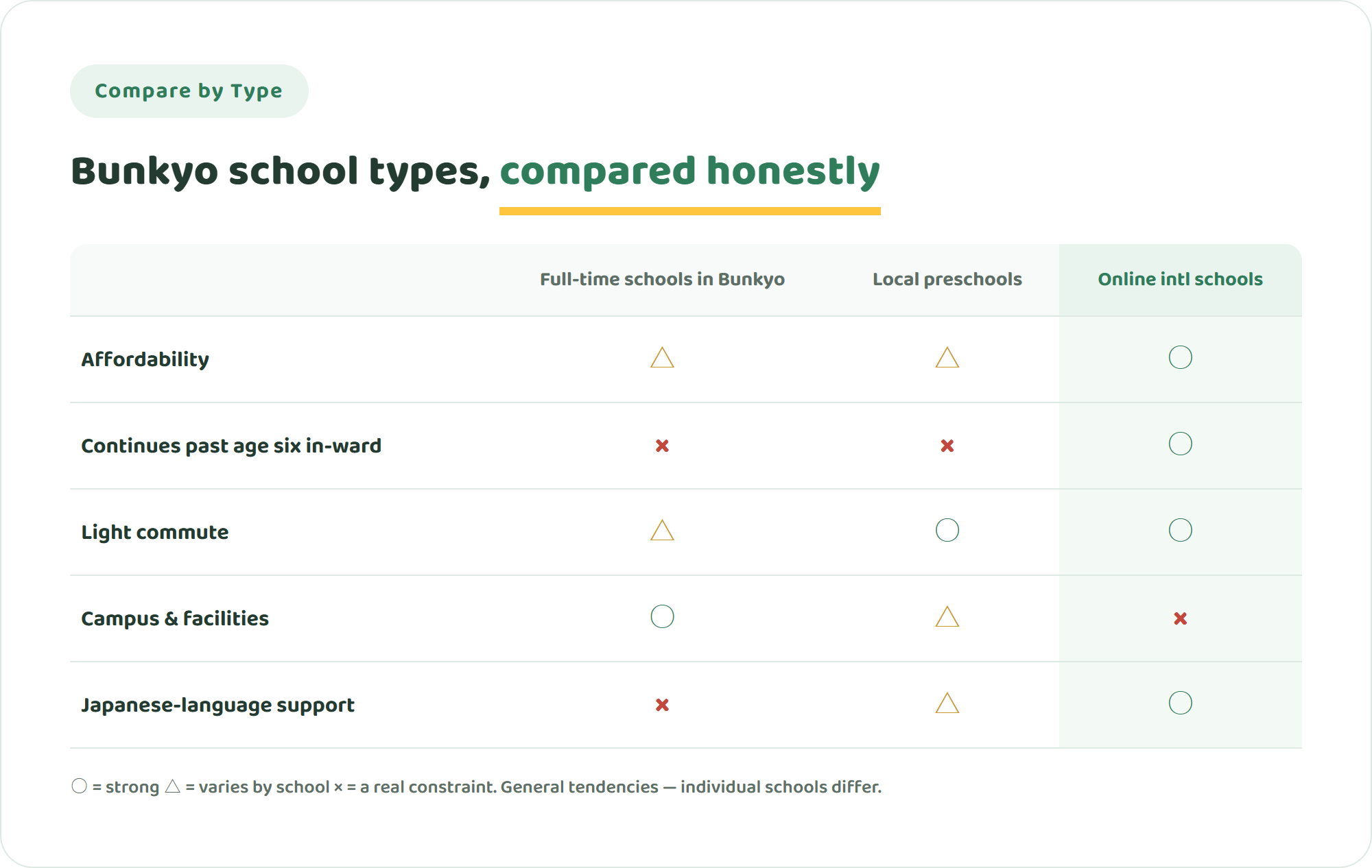
Bunkyo’s full-time options are reasonably priced by central Tokyo standards — about ¥1.52 million a year at primary level — but with a single school, a place may simply not exist in your child’s year group. Aoba’s high school campus steps up to around ¥2.86 million, the price of an IB Diploma pathway. Preschools are the ward’s strength: close enough to walk or cycle to, sometimes subsidy-eligible, but every one of them hands you the same problem at age six. The third route is the one most families overlook. With no commute, where you live and how many schools your ward happens to contain stop determining what your child can access. If cost is the sticking point, is international school too expensive? may help you think it through.
See how learning works online →
When Fees or the Commute Are the Barrier: The Online Alternative
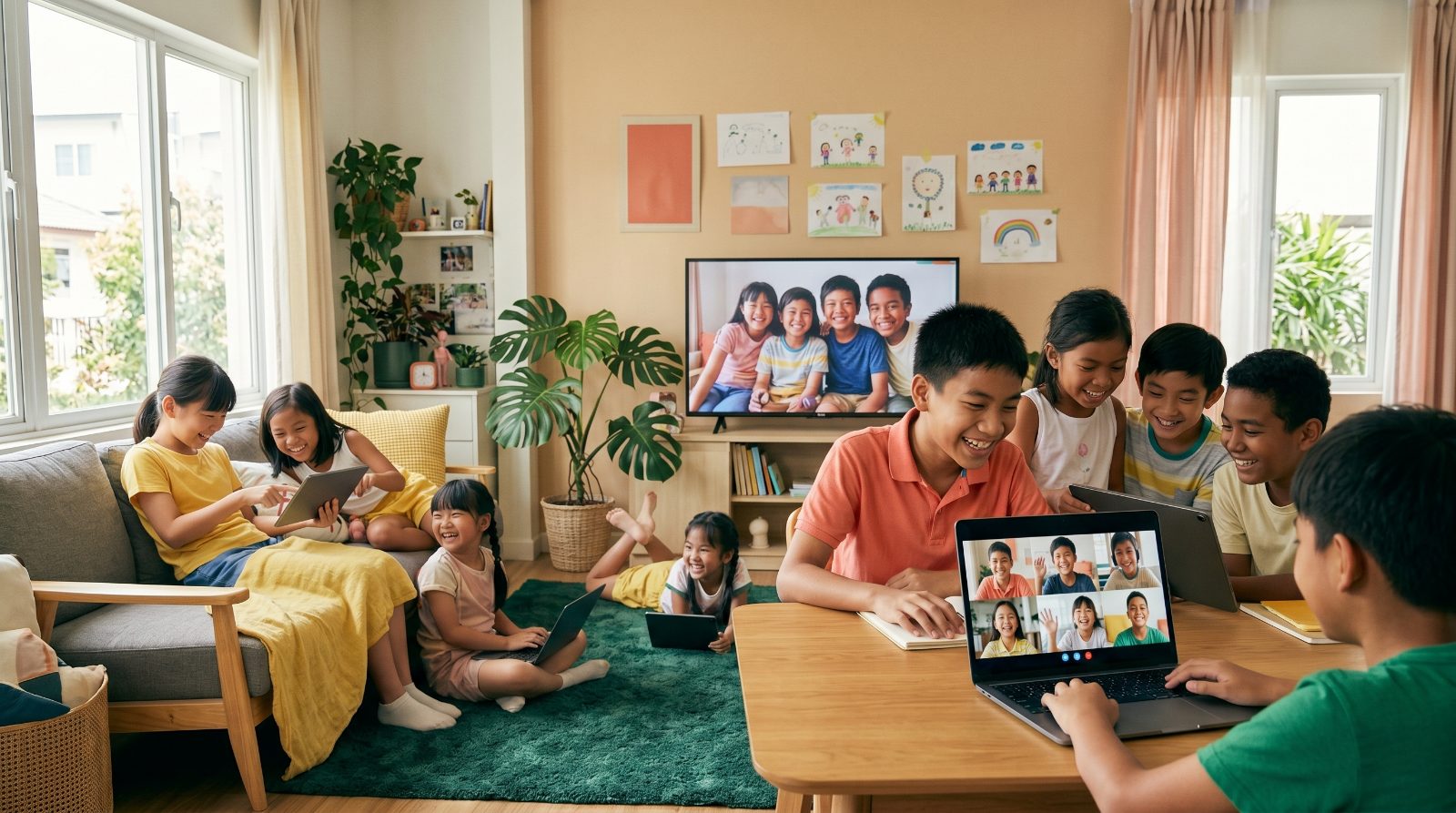
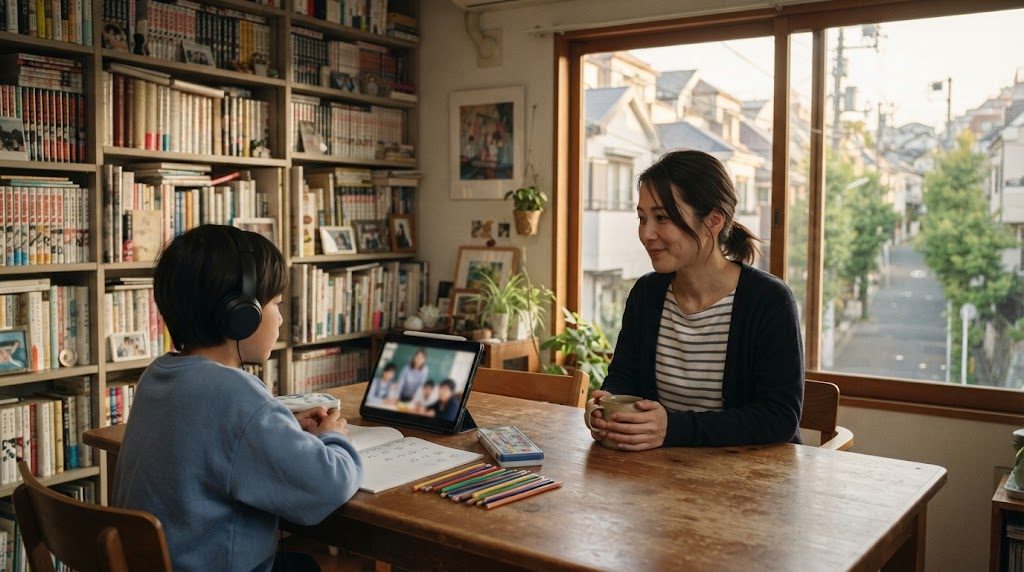
Bunkyo is a genuinely good place to raise a child — the ginkgo avenues, Koishikawa Korakuen, the quiet sloping streets, the sense that learning is simply what this neighbourhood does. But the facts remain: one full-day primary school, almost nothing for the middle years, and a long daily commute if you look outside the ward. For plenty of families, that is where the plan breaks. If you find yourself thinking “I want this education for my child, but not for the next twelve years at this cost,” there is another shape it can take.
NIJIN GLOBAL ACADEMY (NGA) is an online international school opening in September 2027. It is run by NIJIN Inc., the Japanese company behind NIJIN Academy, an alternative school with more than 1,000 students enrolled in Japan. We do not rank children by test scores. Learning happens in small groups built around dialogue, with the aim that children come to like both themselves and the world. We serve ages 6 to 18 across Asia and Oceania, wherever a family lives, and the programme is designed so that children can move gradually into English with Japanese-language support underneath them. We are working toward fees at roughly one-fifth of an on-campus international school.
To be straight with you: NGA has not opened yet, and our track record is still ahead of us. We cannot offer the playground, the corridors or the physical campus life that a bricks-and-mortar school does. But learning that connects your child to the world, without the commute and at a fraction of the cost, is worth putting on your list while you compare options in Bunkyo.
Frequently Asked Questions
Q. What is the youngest age I can enrol my child in Bunkyo?
A. Very young, if you want. Sakura International School Bunkyo and Joy to the World both run parent-and-child classes from birth; Laurus Bunkyo takes children from 10 months; MEES from age 1; Hello Kids from 18 months; SOLTILO GSA Motomachi and NAS KIDS UNIVERSITY from age 2. For school-age children, the full-day options are MEES Hakusan (elementary, 6–12) and Aoba-Japan’s Bunkyo Campus (Grades 10–12). Filtering by your child’s age is genuinely the fastest way to shorten this list.
Q. Can my child stay in an international school in Bunkyo past age six, and what about Japanese?
A. Full time, only at MEES International School’s Hakusan campus, which runs to age 12. No school in Bunkyo currently takes the middle-school years, and Aoba’s campus begins at Grade 10. So from primary age onward, most families either widen the commute into Shinjuku, Minato or Shibuya, or combine Japanese school with an English afterschool programme — Joy to the World, NAS KIDS UNIVERSITY and Hello Kids all run one. On Japanese: support varies enormously between schools in both hours and philosophy, so ask specifically before you enrol. If you are worried about your child’s Japanese slipping as English hours increase, our sister service Tomodachi Japan (online Japanese for children, also run by NIJIN) is worth a look.
Q. When should I apply, and can we transfer mid-year?
A. Most schools recruit for the April or August–September intakes, with English assessments, an interview and often a parent meeting. In a ward with this few school-age places, the real variable is whether a seat exists at all in your child’s year — so contact schools directly about a year before you want to start, and attend open days while you wait. Where a school feeds its own kindergarten into its primary years, external places are naturally tighter. If you are also weighing Japanese junior high school entrance exams, note that Bunkyo has the highest private and national junior high progression rate of Tokyo’s 23 wards; running both tracks at once tends to squeeze your child’s time more than either one alone.
The Time You Spend Deciding Is Time Spent Caring
There is no single right answer to this. In a ward like Bunkyo — thick with educational options, yet with international schooling arranged in stepping-stones — the useful question is less “which school is best” and more “which one can we sustain, year after year”. Fees, commute times, entrance exams, your child’s temperament: no two families weigh these the same way. The fact that you are sitting with the question at all is evidence of how seriously you are taking your child’s future. Take your time. Visit two or three schools and compare how they feel, not just what they cost. And if you find yourself wanting to know what an option without a commute looks like, we would be glad to be on your list.
International Schools in Other Cities
- International Schools in Kobe: All 20 Schools
- International Schools in Yokohama: Full Comparison
- International Schools in Chofu and ASIJ Fees
- International Schools in Fukuoka: Fees
- International Schools in Ho Chi Minh City
- International Schools in Melbourne
- International Schools in Itabashi, Tokyo
- International Schools in Kanazawa
- International Schools in Tokyo
- International Schools in Minato: Fees
- International Schools in Shibuya, Tokyo
- International Schools in Setagaya: All 14 Schools
- International Schools in Koto, Tokyo
- International Schools in Shinagawa, Tokyo