If you are searching for international schools in Chiba Prefecture and finding it hard to get a clear picture, that is not your fault. Chiba is a wide prefecture, and the reality in Makuhari is nothing like the reality in Kashiwanoha, Urayasu, Narita or Kisarazu. This guide maps every international school we could verify in Chiba Prefecture, area by area. It also draws the line that matters most for families: which schools are preschools only, and which ones actually take your child through the school years. Along the way we cover the fee range (roughly 1 million to over 5 million yen a year), the honest option of commuting into Tokyo, and a no-commute online alternative. By the end you should know which area works for your family, and how far ahead you need to plan.
Quick Answer: Your Options in Chiba
If you only read one section, read this. Below are the areas where schools can be confirmed, with their school names, plus the online option — so you can see every route side by side before the details.
- Chiba City and Makuhari — Makuhari International School (MIS)
- Toukatsu area — Rugby School Japan (RSJ) / Gyosei International Elementary School Nagareyama
- Tokyo Bay area — Chuo International School (CIS), Shin-Urayasu campus
- NIJIN GLOBAL ACADEMY (online) — Ages 6–18 / opening September 2027, currently taking opening-update registrations / fees around one-fifth of a typical campus international school / Japanese-language support. An option when distance or fees are the wall.
International schools in Chiba Prefecture: the landscape and fee range
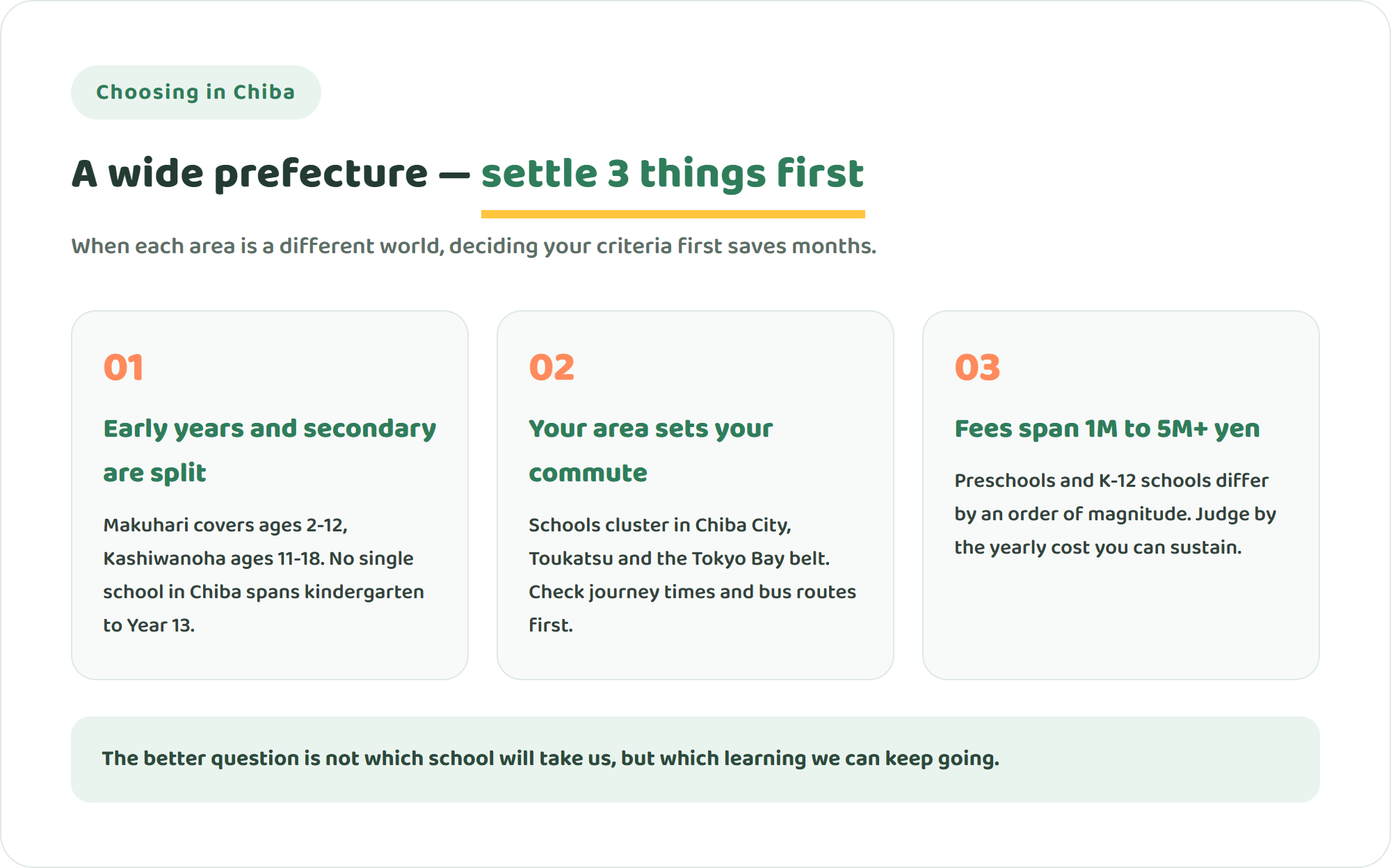
Chiba’s international schools cluster into five areas: Chiba City (Makuhari and Mihama), the Toukatsu area (Kashiwa, Nagareyama, Matsudo), the Tokyo Bay area (Ichikawa, Urayasu, Funabashi), Narita and the north, and the Uchibo coast (Kisarazu, Ichihara). Public listings show around twenty places in the prefecture calling themselves international schools — but most of them are preschools and international kindergartens for children under six. Once you filter for schools that continue into the primary years and beyond, the list gets short very quickly.
Chiba’s other distinguishing feature is that the early years and the secondary years are served by different schools. Makuhari International School in Chiba City covers ages 2 to 12; Rugby School Japan in Kashiwanoha covers ages 11 to 18. In other words, as of July 2026 there is no single international school in Chiba Prefecture that takes a child from kindergarten all the way through high school. Planning the handover between stages before you enrol is essential here in a way it is not in Tokyo.
Fees stretch across a wide band. Preschools typically run 60,000 to 120,000 yen a month (roughly 1.0 to 1.5 million yen a year). Makuhari International School is about 1.5 million yen a year at primary level. Rugby School Japan runs 4.5 to 5.5 million yen a year for day pupils, with boarding adding another 2.9 to 3.2 million. Same prefecture, very different orders of magnitude. For context, foreign residents make up about 3.7% of Chiba’s population (roughly 230,000 people as of December 2024, per prefectural statistics), concentrated around Narita Airport, the Makuhari business district and Kashiwanoha Smart City.
Note: fees reflect publicly available information as of July 2026 and are subject to revision. Always confirm current figures with each school.
Every international school in Chiba Prefecture, by area
Below is what we could verify area by area. Schools that continue past kindergarten get their own section; preschools are grouped in lists. Read them against two questions: can we actually get there, and how long can our child stay?
Chiba City and Makuhari
Makuhari International School (MIS)
A 13-minute walk from Kaihin-Makuhari Station in Mihama Ward, MIS is the flagship international school of Chiba Prefecture. It takes a pre-school class from age 2, Kindergarten 1 to 3 (ages 3 to 6) and Grades 1 to 6 (ages 6 to 12). What makes it unusual nationally is its status as an Article 1 school under Japan’s School Education Act — an international school that also confers a recognised Japanese elementary school graduation. For families worried about how English-medium schooling squares with Japan’s compulsory education rules, that is a rare answer. School buses serve Chiba, Inage, Funabashi, Motoyawata, Tsudanuma, Makuhari-Hongo and the Urayasu and Shin-Urayasu areas, so the practical catchment covers much of northwestern Chiba.
- Curriculum: English-medium bilingual programme, delivered within Article 1 school status
- Ages: 2 to 12 (pre-school and kindergarten through Grade 6)
- Fees: around 1.2 million yen a year for kindergarten and 1.5 million yen for primary, plus an entrance fee of about 200,000 yen and a facility contribution of about 400,000 yen (published information, 2026; confirm current figures)
- Good fit for: families who want an English environment without giving up a recognised Japanese primary qualification
Chiba City also hosts several early-years options, including Kids International Makuhari Center (Mihama Ward), Little Garden International School (Chiba Port Town and Makuhari), Zoo-phonics Academy Chiba and Hands On English International.
Toukatsu area: Kashiwa, Nagareyama, Matsudo
Rugby School Japan (RSJ)
Opened in September 2023 in Kashiwanoha Smart City, RSJ is the Japan campus of the historic British public school Rugby. It teaches Years 7 to 13 (ages 11 to 18) entirely in English on the British curriculum, through IGCSE and A-Level, with day, weekly boarding (five nights) and full boarding (seven nights) options. Kashiwanoha is about 30 minutes from Akihabara on the Tsukuba Express, so a meaningful share of pupils commute from Tokyo. For a full British secondary education, this is effectively the only option inside Chiba Prefecture.
- Curriculum: British — IGCSE and A-Level; day and boarding
- Ages: 11 to 18 (Years 7 to 13)
- Fees: published 2026-27 day tuition is 4,500,000 yen for Year 7, 4,750,000 for Years 8-9, 5,300,000 for Years 10-11 and 5,500,000 for Years 12-13. Boarding adds 3,200,000 (full) or 2,900,000 (weekly). Add an annual facility maintenance fee of 500,000 yen, an enrolment fee of 500,000, a school development fee of 500,000 and a 40,000 yen application fee
- Good fit for: families aiming at UK-style secondary education and overseas university pathways
Gyosei International Elementary School Nagareyama
Strictly speaking a Japanese private elementary school rather than an international school, this Nagareyama campus belongs to the Gyosei International group described below. It runs an English immersion programme in which subjects are taught in English, and adds French lessons from the lower grades. More than half of its pupils reportedly reach Eiken Grade 2 or above by graduation. Sitting on the fast-growing Tsukuba Express corridor, it is a practical middle path for families who want strong English inside the Japanese school system. Fees on enquiry.
Early-years options in this area include Polku International School (Higashi-Matsudo) and DUCK International School (Shiroi and Kamagaya, near Shin-Kamagaya and Chiba New Town).
Tokyo Bay area: Ichikawa, Urayasu, Funabashi
Bordering Tokyo and served by the Tozai, Sobu and Keiyo lines, this is the densest preschool belt in the prefecture — and also the area from which the largest number of families commute into Tokyo for school.
Chuo International School (CIS), Shin-Urayasu campus
A Montessori-plus school in Urayasu combining the Cambridge International Curriculum with Montessori practice. It is early-years focused, though it began piloting lower-primary programmes in 2025. A sister campus operates in Chuo City, Tokyo. Fees on enquiry.
Other options here include Little Gems International School Tokyo Bay (Myoden, Ichikawa), Little Garden International School Ichikawa, Imagine Japan Minami-Gyotoku, PV International School (Shin-Urayasu), Sunshine Kids Academy Shin-Urayasu (ages 0 to 3), International School Funabashi and Kadena American Preschool in Funabashi, plus Laule’a International School in neighbouring Narashino (Kanade-no-Mori), which took over from the former Kailua International School and offers all-English early-childhood education with a Hawaiian cultural focus. Nearly all are pre-primary, so the decision about what comes next arrives at age six.
Narita and the north
Despite Narita Airport and its aviation workforce, this area has surprisingly few dedicated international schools. Sunvalley International School in Hashigadai, Narita, together with the affiliated Narita Kokusai certified childcare centre, anchors the early years. From primary onward, families here generally look toward Makuhari, Kashiwanoha, Tokyo — or the online route discussed below.
Uchibo coast: Kisarazu and Ichihara
Gyosei International School (elementary, junior high and senior high)
Located in Yana, Kisarazu, this Catholic Article 1 school is not an international school as such, but it runs an international course at elementary level, emphasises language education through the secondary years, maintains boarding facilities and has a long record of enrolling returnee students. For families who want an English-rich environment while keeping Japanese qualifications and domestic university pathways, it is one of the most established options in the prefecture — and considerably more affordable: the elementary international course is published at around 620,000 yen a year plus roughly 200,000 yen on entry (bus and other costs separate; confirm current figures).
Early-years options nearby include Sunny Garden International School (Kisarazu) and Turtle Kids International School (Ichihara).
All of the above reflects publicly available information as of July 2026. Small schools open, close and change programmes often, so please confirm directly with each school. For the national picture, see our prefecture-by-prefecture index of international schools in Japan (in Japanese).
The honest question: should you commute into Tokyo?
No guide to Chiba is complete without this. From Ichikawa, Urayasu or Funabashi, central Tokyo schools are 30 to 50 minutes away; from Matsudo and Kashiwa, under an hour. Because secondary options inside the prefecture are so limited, plenty of Chiba families do commute daily into Tokyo, where IB, British, American and Indian-curriculum K-12 schools are concentrated in numbers Chiba cannot match. Our guide to international schools in Tokyo covers those options.
But be honest with yourself about the arithmetic. A one-hour commute each way is two hours a day for a primary-age child — six years of it, taken out of sleep and out of unstructured play. The right question is not whether you can commute, but for how many years you can keep doing it.
Comparing your options: what actually fits your family
It helps to sort everything into three types: preschools inside Chiba, K-12 international schools in Chiba or Tokyo, and online international schools with no commute at all. The table below compares them honestly on cost, admissions, commuting burden and continuity.
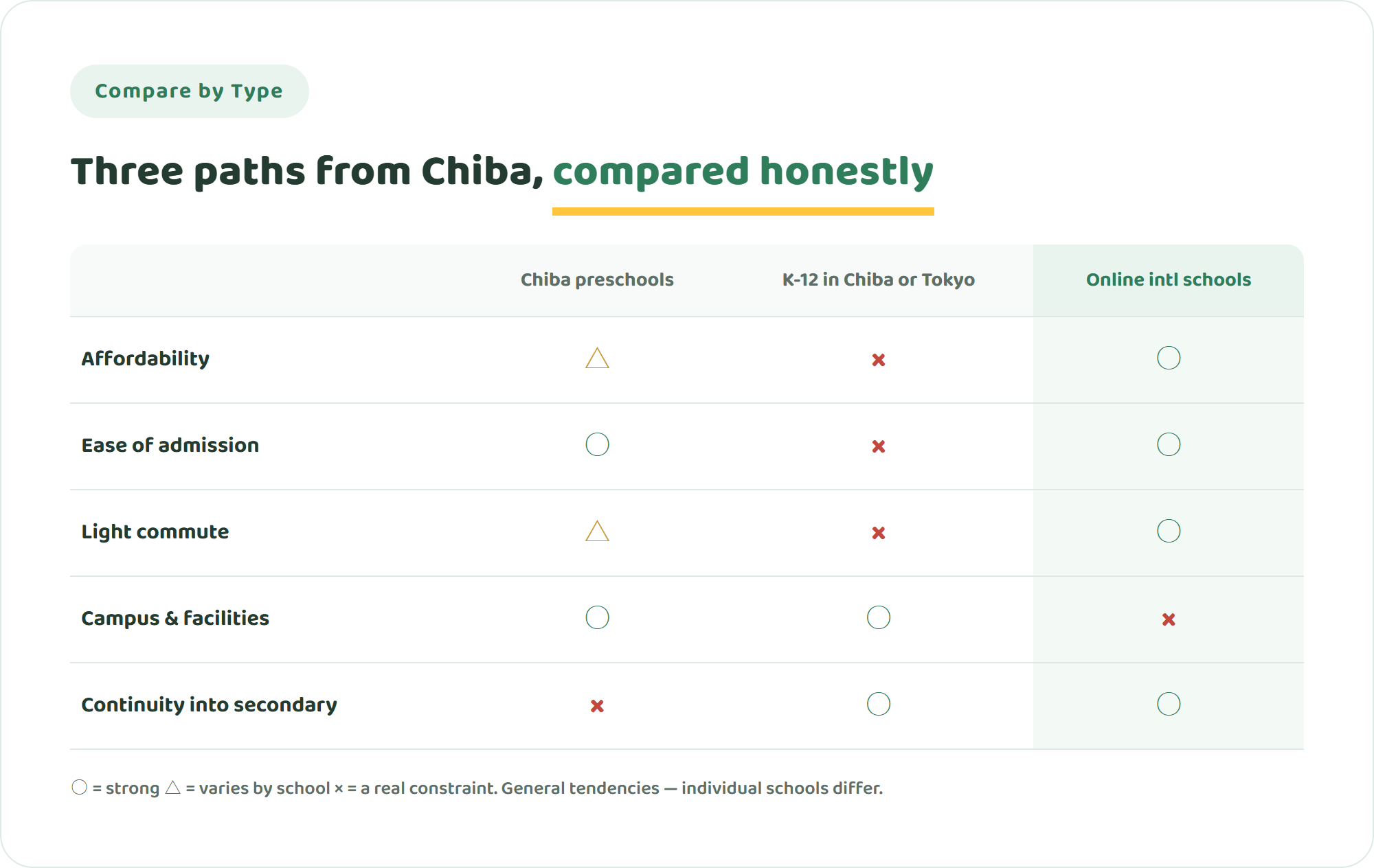
Chiba’s preschools are relatively affordable and relatively easy to enter, which makes them a good start before age six. Their weakness is the wall families hit at primary entry, when there is often nowhere local to continue. Makuhari International School, Rugby School Japan and Gyosei International clear that wall — but depending on where you live, the commute may be impractical, or the annual cost may pass five million yen. If you want to see where the money actually goes, our breakdown of international school fees goes deeper. And there is one more option that does not assume a commute at all.
See how learning works online →
When nothing is within reach: the online option
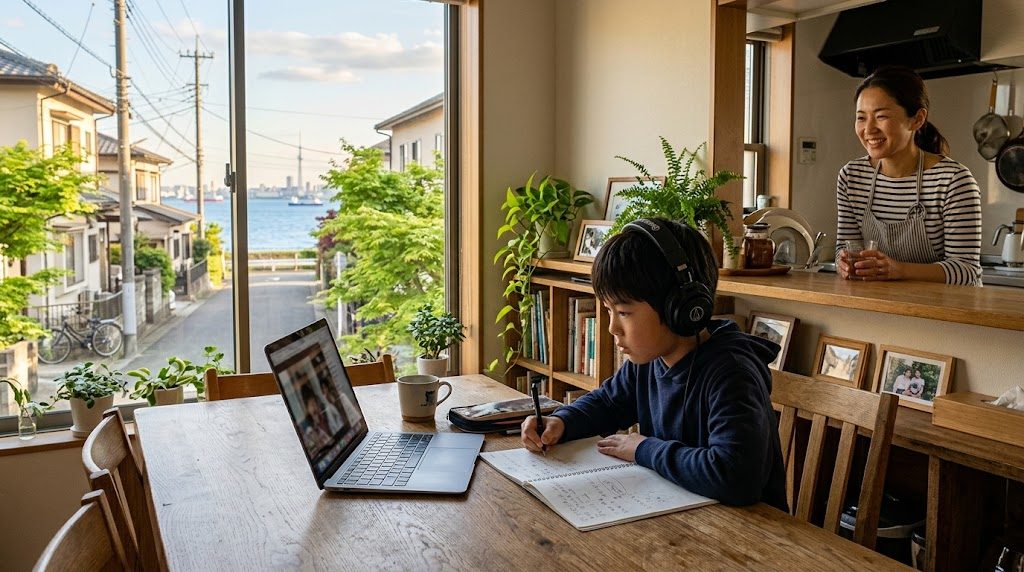
Chiba is large. If you live on the Uchibo or Sotobo coast, or out in the northern countryside, even Makuhari and Kashiwanoha are ninety minutes each way. The schools exist in your prefecture, but not in your life — that is a particularly Chiba kind of frustration. If that describes you, an online international school removes the commute from the equation entirely, so your child’s education is less determined by which station you live near.
We are NIJIN GLOBAL ACADEMY (NGA), an online international school opening in September 2027. We are run by NIJIN Inc., the Japanese company behind NIJIN Academy, an alternative school with more than 1,000 enrolled students in Japan. We do not rank children by test scores — our approach is deliberately post-deviation-score, built on small-group dialogue and a simple aim: to help children come to love themselves and the world. We serve ages 6 to 18 across Asia and Oceania, wherever they live, with Japanese-language support underneath so students can grow into English step by step. We are working toward fees around one fifth of a bricks-and-mortar international school.
In fairness, we should say this plainly: NGA has not opened yet, and our track record is still ahead of us. We cannot offer the playground and campus life of a physical school in the same way. But for families in Chiba who cannot reach a school, or cannot sustain a daily trip into Tokyo, learning that reaches the world without the commute is a path worth weighing.
Frequently asked questions
Q. Can families anywhere in Chiba Prefecture reach an international school?
A. Not really. The schools cluster in three areas — Chiba City and Makuhari, the Toukatsu area around Kashiwa and Nagareyama, and the Tokyo Bay belt of Ichikawa, Urayasu and Funabashi. From the Sotobo coast or southern Boso, a one-way trip of ninety minutes or more is common. Some schools, notably Makuhari International School, run wide school bus networks, so checking bus routes is the fastest way to test feasibility. If it still does not work, commuting into Tokyo or studying online become the realistic choices.
Q. Do many Chiba families send their children to school in Tokyo?
A. Yes, especially from Ichikawa, Urayasu, Funabashi and Matsudo. Because secondary-level international options within Chiba are limited, some families move to a Tokyo school at the end of primary. Just budget realistically for both commuting time and season-ticket costs. Our Tokyo guide lists the options.
Q. What Japanese-language support is available?
A. It varies enormously. Makuhari International School delivers bilingual education within Article 1 status, and Gyosei International teaches languages inside the Japanese school framework, so both keep Japanese literacy in play. British and other foreign-curriculum schools are English throughout, in class and out. If you want your child’s first language kept as a foundation while English grows, an online school designed with Japanese support built in — NGA among them — is worth considering.
Not being near a school is not a reason to give up
There is no single right answer in school choice. In a prefecture as wide as Chiba, where schools sit in a few specific pockets, it is easy to conclude that nothing suitable is nearby and stop looking. But the question that matters is less which school will admit your child, and more which learning your child can sustain for years. Commuting to Makuhari or Kashiwanoha, travelling into Tokyo, or connecting with the world from home — any of these can be the right answer for your family. The time you are spending on this research is itself evidence of how seriously you are thinking about your child’s future. If you would like to keep a no-commute path in view as well, we would be glad for you to keep us on your list.
International School Guides for Other Prefectures
- International Schools in Kanagawa Prefecture
- International Schools in Saitama: All 34 Listed
- International Schools in Ibaraki Prefecture
- International Schools in Tochigi Prefecture
- International Schools in Gunma Prefecture
- International Schools in Hokkaido Prefecture
- International Schools in Aichi Prefecture
- International Schools in Ehime Prefecture
- International Schools in Fukui Prefecture
- International Schools in Fukushima Prefecture
- International Schools in Gifu Prefecture
- International Schools in Hiroshima Prefecture
- International Schools in Hyogo Prefecture
- International Schools in Ishikawa Prefecture
- Browse all 47 prefectures of Japan