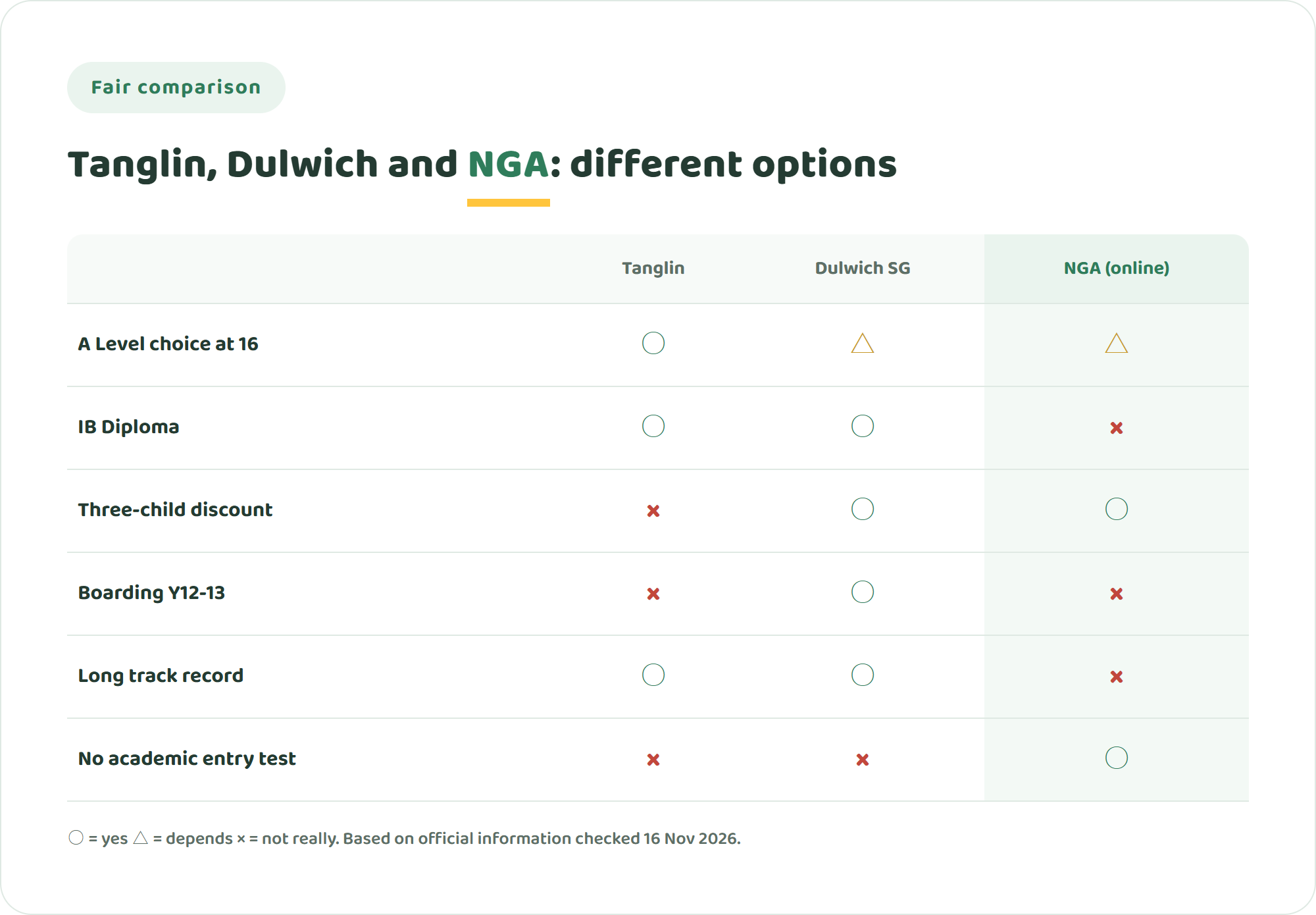
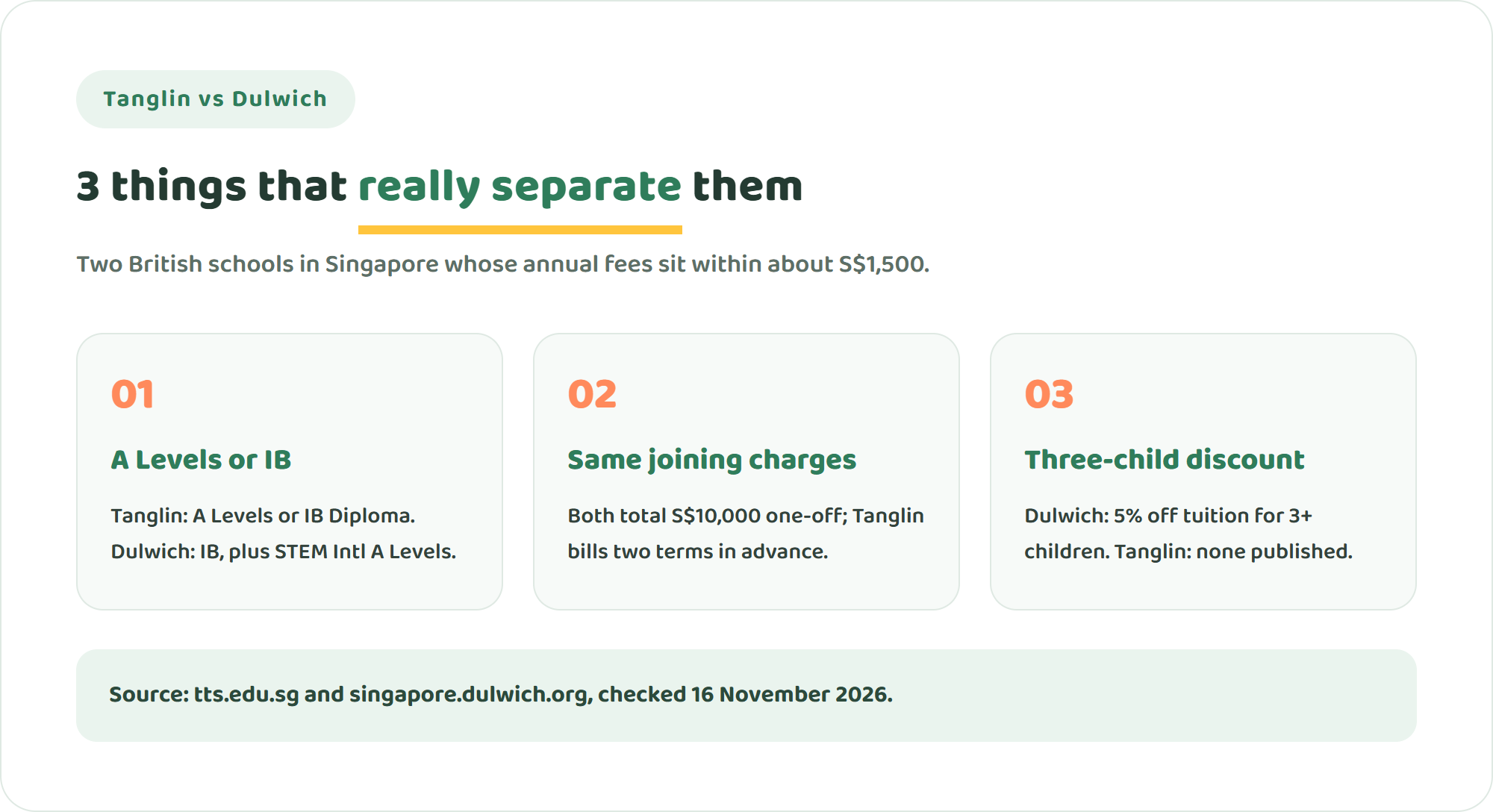
Tanglin vs Dulwich, in one paragraph: both are British international schools in Singapore that take children from age 2 or 3 to 18, both quote 2026/27 fees in Singapore dollars including 9% GST, and their annual fees sit within about S$1,500 of each other in every year group. The real differences are elsewhere. Tanglin Trust School, a not-for-profit school on Portsdown Road near one-north, lets Sixth Form students choose between A Levels and the IB Diploma, and it closes entry into Year 11 and Year 13. Dulwich College (Singapore), on a campus at Bukit Batok West Avenue 8, takes students from (I)GCSE in Year 9 into the IB Diploma, with a STEM International A Level programme and its own Dulwich High School Diploma alongside, gives a 5% tuition discount to families with three or more children, and has a boarding option for Years 12 and 13. All figures below come from the two schools’ official websites, checked 16 November 2026.
If you searched for Tanglin vs Dulwich, or Dulwich vs Tanglin Singapore, you are probably a family relocating to Singapore, or already there, and weighing two of the city’s best-known British schools. This page does not rank them. Both are well established, well resourced and selective about English and readiness, and the honest answer depends on your child and your plans. Instead, it puts the official facts side by side, including the things a quick fee search does not add up for you: the full cost from Year 7 or Reception to Year 13, the joining charges and how much cash you need before the first day, the three-child discount, Placement Rights, the Sixth Form choice and the entry rules. It ends with options for families who find neither school fits, including NIJIN GLOBAL ACADEMY (NGA), a very different online school for ages 6–18 that opens in September 2027 (planned).
The short answer: which family fits Tanglin, which fits Dulwich
- Tanglin may fit better if: your teenager wants to choose between A Levels and the IB Diploma at 16. Tanglin offers both as a “Dual Pathway” in its Sixth Form and says it is the only school in Singapore to do so.
- Tanglin may fit better if: you prefer a not-for-profit school with a single long-established campus. Tanglin was founded in 1925 and is a registered charity.
- Tanglin may fit better if: you have one or two children and are joining in the primary years. Its Year 3–6 fee is S$730 a year above Dulwich’s, but from Year 7 to Year 13 Tanglin’s published fees are the lower of the two.
- Dulwich may fit better if: you have three or more children at the school from Reception up. Dulwich gives a 5% discount on tuition fees; Tanglin’s fees page does not list a sibling discount.
- Dulwich may fit better if: your child is in Year 7 or 8 and still building English. Dulwich does not run a separate EAL programme, but says an offer to a Year 7 or 8 student whose first language is not English will include supplementary EAL lessons. Tanglin has no EAL programme.
- Dulwich may fit better if: a parent may have to leave Singapore before your child finishes school. Dulwich has a boarding option for Years 12 and 13; Tanglin does not offer boarding.
- Neither may fit if: your child is Singaporean without one of the narrow MOE exemption routes, needs to join Year 11 at Tanglin, or you are looking for a much lower budget. See the options further down this page.

Tanglin vs Dulwich vs NIJIN GLOBAL ACADEMY at a glance (official data)
Tanglin and Dulwich details below come from each school’s official website for 2026/27, checked 16 November 2026. NGA is included because it is the kind of alternative many families never hear about, not because it resembles these two schools. It is online, has no campus in Singapore, and is not yet open.
| Item | Tanglin Trust School | Dulwich College (Singapore) | NIJIN GLOBAL ACADEMY |
|---|---|---|---|
| School type | Not-for-profit British international day school, founded 1925, one campus at 95 Portsdown Road | British international school in the Dulwich College family, campus at 71 Bukit Batok West Avenue 8 | Online international school focused on Asia and Oceania, operated by NIJIN Inc. (Japan) |
| Ages | Nursery (age 3) to Year 13 (age 18) | Toddler (age 2) to Year 13 (age 18) | Ages 6–18; opening September 2027 (planned) |
| Curriculum | English National Curriculum, (I)GCSE, then A Levels or the IB Diploma in the Sixth Form | EYFS and English National Curriculum, IGCSE from Year 9, then the IB Diploma; STEM International A Levels and the Dulwich High School Diploma also listed | Subjects learned in English with a bilingual English–Japanese mentor; CEFR-based English levels; optional Cambridge IGCSE / A-Level pathway listed |
| Annual fee 2026/27 (incl. 9% GST) | S$36,300 (Nursery) to S$58,080 (Years 12–13), Building Fund included | S$21,080 (Toddler/Nursery half day) to S$59,220 (Year 13) | Not yet published; described as far more affordable than a typical international school |
| Joining charges | Application S$1,000, enrolment fee S$4,500, Capital Levy S$4,500, all non-refundable | Application S$1,500, enrolment fee S$4,000, capital levy S$4,500, all non-refundable | No enrolment, facility or uniform fees; materials included |
| Sibling discount | Not published on the official site | 5% on tuition fees for families with three or more children enrolled (Reception and above) | Sibling discounts |
| Selection | Age-appropriate English fluency (no EAL); reports, interviews and assessments; diagnostic assessments from Year 7 | Academic assessment, English proficiency, school records and teacher recommendations; interviews possible | No academic entrance exam, no English requirement |
| Boarding | None; students live in Singapore with at least one parent | Years 12–13 only, at ACS Oldham Hall | No boarding; children learn from home |
| Accreditation and inspection | Lists CIS and COBIS accreditation; reports a 2025 BSO inspection | CIS accredited; also states WASC accreditation; HMC member | Not yet accredited; no graduates yet |
| Timetable and time zone | In person, Singapore time; Senior School about 8:30am–2:50pm | In person, Singapore time; Junior and Senior about 8:30am–3:35pm | Small live online groups of about 8; built for Asia–Oceania daytime, so it suits Singapore hours but may fall outside the day in Europe or the Americas |
Sources: Tanglin fees 2026/27, Tanglin admissions FAQs, Tanglin Sixth Form pathways, Dulwich fees and its 2026–2027 fee schedule (PDF), Dulwich admissions criteria and Dulwich Senior School curriculum, all checked 16 November 2026. Accreditation and school-day timings are as listed on each school’s website.
Fees side by side, year by year (2026/27)
Both schools state their fees in Singapore dollars inclusive of 9% GST, billed in three terms. Tanglin’s annual figure combines tuition and a Building Fund of S$2,090 a term; Dulwich quotes one school fee per year group and lists no separate annual development levy. Neither school had published 2027/28 fees when we checked.
| Year group (2026/27, SGD incl. GST) | Tanglin Trust School | Dulwich College (Singapore) |
|---|---|---|
| Toddler / Nursery | Nursery S$36,300 | Half day S$21,080; full day S$37,520 |
| Reception | S$44,490 | S$45,240 |
| Years 1–2 | S$45,375 | S$45,240 |
| Years 3–6 | S$47,490 | S$46,760 |
| Years 7–9 | S$53,535 | S$53,850 |
| Year 10 | S$56,010 | S$56,540 |
| Year 11 | S$56,010 (no new students admitted) | S$57,540 |
| Year 12 | S$58,080 | S$58,470 |
| Year 13 | S$58,080 (no new students admitted) | S$59,220 |
| Application fee | S$1,000, non-refundable | S$1,500, non-refundable |
| Enrolment fee | S$4,500, non-refundable, paid on accepting with Term 1 fees | S$4,000, payable after a successful entry assessment; non-refundable except as set out in the Admission Policy |
| Capital levy | S$4,500, non-refundable, paid before the first term with the next term’s fees | S$4,500, one-off, non-refundable |
| Sibling discount | Not published on the official site | 5% on tuition fees for three or more children, Reception and above |
| Included | Textbooks; most CCAs | Textbooks and exercise books |
| Extras | Bus, food, uniform, a device for Years 7–13, trips; exam fees of about S$1,000–2,500 (school’s guide) | Bus, food, uniform, a device for Years 7–13, trips; exam fees not published; 3% fee on card payments |
Read across the table and the pattern is clear: Dulwich is slightly cheaper in Years 1–6, and Tanglin is slightly cheaper from Year 7 to Year 13. The largest single-year gap is Year 11, where Dulwich charges S$1,530 more; the smallest is Years 1–2, where Tanglin charges S$135 more. Toddler and half-day Nursery places exist only at Dulwich, which matters if your child is two.
Joining charges: the same S$10,000, paid in different ways
Add up each school’s one-off charges for a new student and both come to exactly S$10,000: S$1,000 + S$4,500 + S$4,500 at Tanglin, and S$1,500 + S$4,000 + S$4,500 at Dulwich. The difference is timing. Tanglin asks new students to pay two terms in advance: Term 1 with the enrolment fee on accepting, and the next term with the Capital Levy before the first term starts. For a new Year 7 student that is S$1,000 + S$4,500 + S$17,845 + S$4,500 + S$17,845 = S$45,690 before the first day (our arithmetic). Dulwich’s fact sheet describes termly billing in advance and does not mention a second term up front, so the same Year 7 student would need S$1,500 + S$4,000 + S$4,500 + S$17,950 = S$27,950 (our arithmetic; confirm the invoice schedule with the school). If your employer pays fees directly, check which charges the package covers: capital levies and enrolment fees are often treated differently from tuition.
Year 7 to Year 13 at today’s prices
This uses official 2026/27 numbers only, assumes no fee rises, no discount and no extras, and adds the S$10,000 joining charges once. Real totals will be higher because both schools review fees every year.
| Cost line | Tanglin Trust School | Dulwich College (Singapore) |
|---|---|---|
| Years 7–9 | 3 × S$53,535 = S$160,605 | 3 × S$53,850 = S$161,550 |
| Years 10–11 | 2 × S$56,010 = S$112,020 | S$56,540 + S$57,540 = S$114,080 |
| Years 12–13 | 2 × S$58,080 = S$116,160 | S$58,470 + S$59,220 = S$117,690 |
| Joining charges | S$10,000 | S$10,000 |
| Total, seven years | S$398,785 | S$403,320 |
Over seven years the gap is S$4,535, about 1% of the total. From Reception to Year 13 (14 years) the totals are S$723,985 at Tanglin and S$726,080 at Dulwich, a gap of S$2,095, because Dulwich’s lower primary fees offset most of its higher secondary fees. For a new Sixth Form student joining in Year 12, two years cost S$126,160 at Tanglin and S$127,690 at Dulwich including joining charges. In other words, for one child the fee schedule should not decide this choice. For full breakdowns of each school, see our Tanglin Trust School fees page and our Dulwich College Singapore fees page.
Three children: where the discount changes the answer
Take three children in Year 1, Year 4 and Year 8 in 2026/27. At Tanglin the year costs S$45,375 + S$47,490 + S$53,535 = S$146,400, with no published sibling discount. At Dulwich it costs S$45,240 + S$46,760 + S$53,850 = S$145,850 before the discount; 5% off is S$7,292.50, leaving S$138,557.50 (our arithmetic, applying 5% to the whole school fee; ask Dulwich exactly which lines count as tuition). That is about S$7,800 less at Dulwich in a single year, a bigger difference than the seven-year gap for one child.
Placement Rights: two very different prices
Both schools sell a limited number of Placement Rights, usually bought by companies. Tanglin’s Guaranteed Placement Rights cost S$165,000 excluding GST (S$179,850 including GST) for a seven-year term and offer a guaranteed place under its terms. Dulwich’s Placement Right costs S$275,000 excluding GST and gives the holder entry prioritisation for one nominated child; Dulwich says the money funds its Alleynian Scholarship Programme. Neither is a fee families normally pay themselves, but it explains why some children of corporate transferees are placed quickly.
Entry: applicant pools, deadlines and who can apply
Both schools have replaced waiting lists with an applicant pool. You apply, the school reviews applications in rounds, and the outcome is an offer, a place in the pool for vacancies during the year, or a decline.
| Step | Tanglin Trust School | Dulwich College (Singapore) |
|---|---|---|
| Deadline | 15 February of the intended enrolment year (for August 2027 entry: 15 February 2027) | Dulwich announced its applicant pool in September 2024 with a first deadline of 31 October that year; current-year deadlines were not shown on the admissions pages we could read on 16 November 2026, so ask admissions |
| When offers come | Early offers possible in Term 1; most offers from March for an August start | Decision made by the Head of School after assessment; current timeline: ask admissions |
| Main intakes | Nursery (160 places) and Reception (32 more); other years depend on withdrawals; no new students into Year 11 or Year 13 | Number of places per year group: not published on the official site |
| Assessment | Play-based activities for the youngest; interviews or assessments for Junior and Senior; diagnostic assessments from Year 7, possibly written papers | Academic assessment after a completed application; English proficiency, past records and teacher recommendations; interviews possible; re-sit allowed after 6–12 months |
| English | Age-appropriate fluency; no EAL programme; one parent fluent in English | No separate EAL programme; supplementary EAL lessons for some Year 7–8 offers; one parent fluent in English |
| Living arrangements | Must live in Singapore with at least one parent; no boarding | Must live full-time with a parent; boarding for Years 12–13 only |
| Singapore Citizens | MOE waivers only for staff children, siblings of waiver holders and alumni children; pre-P1 years possible without a waiver | Only if a sibling attends, a parent is an Old Alleynian, or another listed criterion applies; the College applies to MOE after an offer |
Applying to both
Nothing on either school’s pages forbids applying to both, and many relocating families do. Applying to both costs S$2,500 in non-refundable application fees. Because Tanglin closes entry to Year 11 and Year 13, a family arriving mid-way through (I)GCSE or Sixth Form may find Dulwich, or another school, is the only realistic choice of the two that year. Ask each school how long it will hold an offer, because the enrolment fee falls due on accepting and is non-refundable at both.
Curriculum and the Sixth Form choice
Up to age 14 the two schools teach a very similar British curriculum, from the Early Years Foundation Stage through the English National Curriculum. Both then take students through (I)GCSEs. The fork comes at 16. Tanglin’s Sixth Form runs a Dual Pathway: students choose A Levels or the IB Diploma, with classes capped at 15 per subject. Dulwich’s Senior School lists three routes: the IB Diploma Programme, a STEM International A Level programme, and the Dulwich High School Diploma. Its own summary describes the core path as the IGCSE syllabus from Year 9 followed by the IB Diploma.
So if your child already knows they want three or four A Levels across a broad range of subjects, Tanglin offers that directly; at Dulwich the A Level route is focused on STEM. If you are confident about the IB Diploma, both schools offer it. Both publish results. For 2026, Tanglin reports an IB average of 39.1 points and 63% of A Level grades at A* or A; Dulwich reports an IB average of 37.7 points out of 45, four perfect scores and 29 bilingual diplomas. These figures come from each school’s own pages, cover different cohorts and different mixes of courses, and are not a ranking. Ask both schools about your child’s subjects and university plans instead.
The school day, boarding and life on campus
School day. Tanglin’s Senior School runs from about 8:30am to 2:50pm, with the Infant and Junior Schools on similar hours. Dulwich’s Junior and Senior School day runs from 8:30am to 3:35pm, with CCAs from 3:45pm; its DUCKS early years section starts at 9:00am and ends at 12:30pm (half day) or 3:25pm (full day). Both follow a three-term year on Singapore time.
Location. Tanglin is on Portsdown Road in the one-north area, and says its site is secured until 2056. Dulwich is in Bukit Batok in the west. For most families, the daily bus journey from home matters more than any difference on paper; bus fees at both are set and invoiced by the transport provider.
Boarding. Tanglin has none. Dulwich offers residential boarding for Years 12 and 13 at ACS Oldham Hall for S$46,700 a year, plus a S$380 application fee and a S$4,000 refundable deposit. Two Sixth Form years as a new boarder at Dulwich would therefore cost S$127,690 in school fees and joining charges plus S$93,400 boarding and S$380 application, S$221,470 in all, with the deposit held on top (our arithmetic).

Common concerns, answered honestly
“We arrived mid-year and there is no place”
Both schools fill most places at their main intakes and depend on withdrawals for others. Tanglin is explicit that it takes no new students into Year 11 or Year 13. Apply to more than one school and keep an eye on both applicant pools.
“My child’s English is still developing”
Neither school runs a full EAL programme. Dulwich adds supplementary EAL lessons to some Year 7–8 offers; Tanglin requires age-appropriate fluency. If your child is still learning English, ask each school how it assesses this, and look at schools with structured EAL support too.
“Is a big British school right for a quieter child?”
Tanglin reports about 2,850 students; Dulwich’s Senior School alone has nearly 1,400. Both organise pupils into smaller schools by age. Visit, ask about pastoral care and class sizes for your child’s year, and talk to your child about how they felt on the day.
“What will extras really add?”
Neither school publishes a typical annual extras figure. Tanglin gives a guide of S$1,000–2,500 for exam fees; Dulwich does not publish one. Budget for bus, lunches, uniform, a device from Year 7 and trips at both, and ask for a sample invoice for your child’s year.
Which suits which family
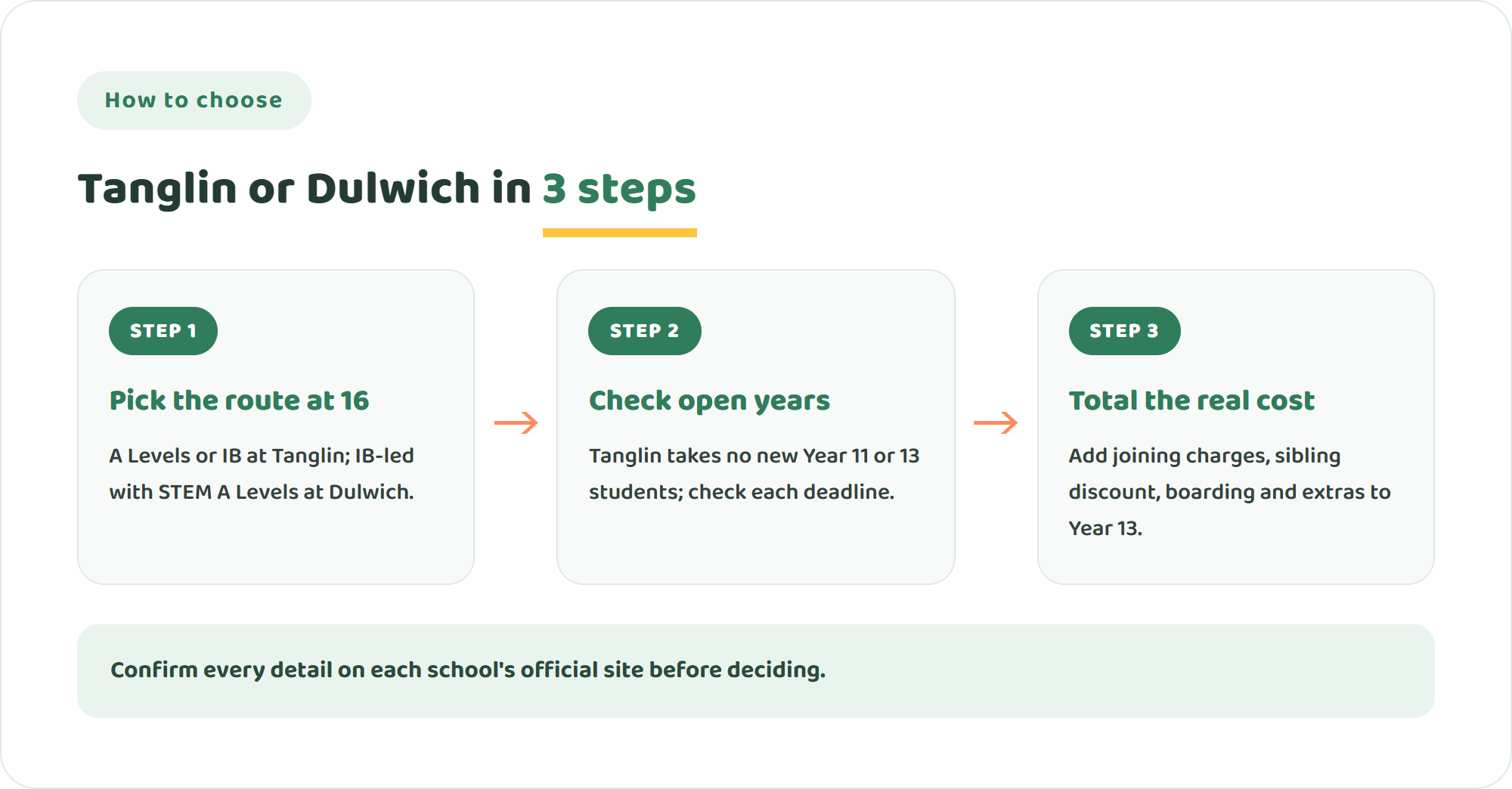
- A family with one child entering secondary school: fees differ by about 1% over seven years. Decide on the Sixth Form route (A Level choice at Tanglin, IB-led at Dulwich), the journey from home and how your child felt on each visit.
- A family with three children: Dulwich’s 5% three-child discount is worth roughly S$7,000–8,000 a year in our example; ask Tanglin whether anything similar applies to you.
- A family arriving for Year 11 or Year 13: Tanglin does not admit new students in those years, so look at Dulwich and other schools.
- A family whose posting may end before Year 13: Dulwich’s Year 12–13 boarding can keep a Sixth Former in place if parents move; at Tanglin a parent must stay in Singapore.
- A family with a two-year-old: only Dulwich takes Toddlers, with a half-day option; Tanglin starts at Nursery (age 3).
- A Singaporean family: check the MOE exemption routes first; both schools admit Singapore Citizens only in narrow cases.
Many families also compare UWCSEA, which follows the IB through the school, and Singapore American School; our guide to international schools in Singapore lists the main options in one place.
If neither fits: other routes and NIJIN GLOBAL ACADEMY
Other Singapore schools. If the budget is the issue, schools such as GIIS and OWIS publish lower annual fees, and our page on more affordable alternatives to Singapore international schools sets them out. If a campus school is not the right step at all, our online international schools compared guide and our explainer on how an online international school day works are good starting points.
NIJIN GLOBAL ACADEMY (NGA) is a different kind of option. It is an online international school for ages 6–18 focused on Asia and Oceania, opening in September 2027 (planned), with free trial classes monthly from September 2026 and pre-opening trial classes in April–May 2027. Its first cohort is 100 students, and it is operated by NIJIN Inc. in Japan, whose alternative school NIJIN Academy has more than 1,000 students. NGA does not rank children by test scores. Lessons are small-group live dialogue (classes of about 8), subjects are learned in English with a bilingual English–Japanese mentor, English levels follow the CEFR, and students join social co-creation projects with companies and governments plus international exchange. An optional Cambridge IGCSE / A-Level pathway is listed on the curriculum and timetable page. There is no academic entrance exam, no English requirement. It can run alongside a local school or as the main school, and it travels with the family if they relocate. Tuition is not yet published; NGA says it will be far more affordable than a typical international school, with no enrolment, facility or uniform fees, materials included and sibling discounts.
Be clear about the trade-offs. NGA is not yet open, is not yet accredited and has no graduates or track record. It has no campus, no sports fields and nothing like the century of history at Tanglin or the Dulwich network behind Dulwich College (Singapore). Its timetable is built for Asia–Oceania daytime, which suits families in Singapore, but for families in Europe or the Americas live classes may fall outside their day. If your child is ready for a selective British school and you can secure a place, Tanglin and Dulwich offer something NGA does not. NGA may be worth a look if your child is still learning English, you move countries often, you want a route without academic selection, or you need a much lower budget than either school.
FAQ
Which is more expensive, Tanglin or Dulwich?
It depends on the year group. In 2026/27 Dulwich is slightly cheaper in Years 1–6 and Tanglin is slightly cheaper from Year 7 to Year 13. From Year 7 to Year 13 the totals including joining charges are S$398,785 at Tanglin and S$403,320 at Dulwich, a gap of about 1% (our arithmetic from official fees, checked 16 November 2026).
Do Tanglin and Dulwich offer A Levels or the IB?
Tanglin’s Sixth Form offers a choice of A Levels or the IB Diploma. Dulwich’s core route is IGCSE then the IB Diploma, and it also lists STEM International A Levels and the Dulwich High School Diploma.
Is there a sibling discount at Tanglin or Dulwich?
Dulwich gives a 5% discount on tuition fees to families with three or more children enrolled, from Reception up. Tanglin’s fees page does not list a sibling discount.
Can Singaporean children attend Tanglin or Dulwich?
Only in limited cases with an MOE exemption. Tanglin prioritises staff children, siblings of waiver holders and alumni children; Dulwich accepts applications only where criteria such as a sibling at the College or an Old Alleynian parent apply.
What are the alternatives to Tanglin and Dulwich?
Families often compare UWCSEA, Singapore American School and lower-fee schools such as GIIS and OWIS. NIJIN GLOBAL ACADEMY is an online option for ages 6–18, with no academic entrance exam, no English requirement; it opens in September 2027 and is not yet accredited.
Related reading
Choosing calmly, with your child in the room
Tanglin and Dulwich are both strong, well-run British schools, and on fees they are almost level. That frees you to choose on what really matters: the route your teenager wants at 16, which year groups are open when you arrive, how many children you are enrolling, and where you will live. Visit both if you can, ask the questions above, and listen to how your child felt walking around each campus. There is more than one good path, and a settled, happy child usually does well on any of them.
Tuition and admissions details were checked on the official websites on 16 November 2026. Schools revise fees every year — always confirm on the official site before applying.