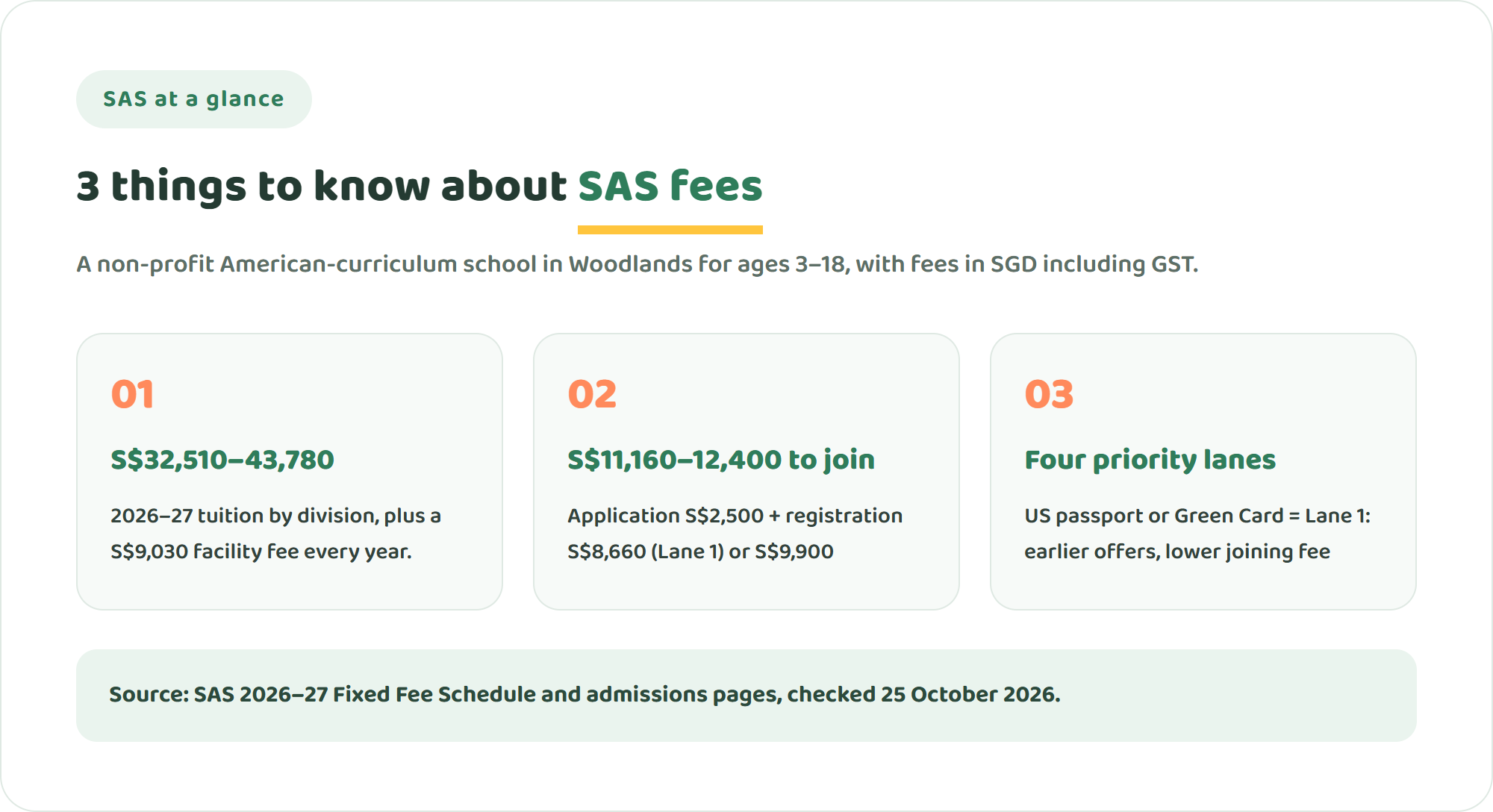
Singapore American School (SAS) tuition for 2026–27 is S$32,510 a year for Early Childhood (preschool and pre-kindergarten), S$37,640 for kindergarten to grade 5, S$41,560 for middle school (grades 6–8) and S$43,780 for high school (grades 9–12), with GST included at the prevailing rate (official Tuition and Fees page and its 2026–27 Fixed Fee Schedule and Policy PDF, checked 25 October 2026). Every student also pays an annual facility fee of S$9,030 (S$7,770 for students enrolled before August 2017), and a new student pays a S$2,500 application fee plus a one-time registration fee of S$8,660 (Lane 1: a student or parent holding a US passport or Green Card) or S$9,900 (Lanes 2–4). The school’s own published first-year total for a new high school student is therefore S$63,970 (Lane 1) or S$65,210 (Lanes 2–4), before bus, lunch, laptop, trips and AP exams.
If you searched “Singapore American School fees” or “SAS tuition”, you are most likely an American, Canadian, British or Australian family moving to Singapore on a corporate posting, or a Singapore-based family weighing the largest American-curriculum school in Asia against UWCSEA, Tanglin or Stamford. You want the real numbers in one place, what the facility fee and the priority lanes mean, what is not included, how admissions actually work, and whether there is a more affordable or more flexible route. This page answers from the official SAS site and fee schedule first, then compares SAS fairly with UWCSEA, Stamford American International School and NIJIN GLOBAL ACADEMY — a different kind of option: an online international school for Asia and Oceania that opens in 2027.
The short answer: who Singapore American School suits — and who it doesn’t
- Suits: families who want a US-style education that transfers cleanly back to North American schools and universities. SAS teaches an American curriculum from preschool (age 3) to grade 12 (age 18), with 25+ Advanced Placement courses and its own Advanced Topics, Catalyst and Quest programs in high school.
- Suits: US citizens and Green Card holders. SAS places them in Lane 1 of its priority system, which brings earlier offers and a lower registration fee (S$8,660 rather than S$9,900).
- Suits: families who value scale and track record: founded in 1956, over 4,000 students in 2024–25 holding 72 different passports, a 36-acre Woodlands campus, and Western Association of Schools and Colleges (WASC) accreditation.
- Suits: younger children still learning English — SAS runs an English as an Additional Language (EAL) program in elementary school (Foundational support in kindergarten to grade 3 costs S$7,230 a year).
- Harder fit: students in grade 4 and above who are not yet proficient in English. The language requirements page states that English proficiency is required from fourth grade and that SAS does not have an EAL program for students beyond fourth grade.
- Harder fit: families outside Lane 1 arriving at short notice for a full grade. Grades 7–8 are listed as “Waitpool Forming” and grade 12 is closed for 2026–27 (space availability page, updated 26 August 2026).
- Harder fit: families on a short or uncertain posting who would pay the non-refundable application, registration and facility fees from their own pocket, or who need financial aid (not published on the official site).
What Singapore American School is
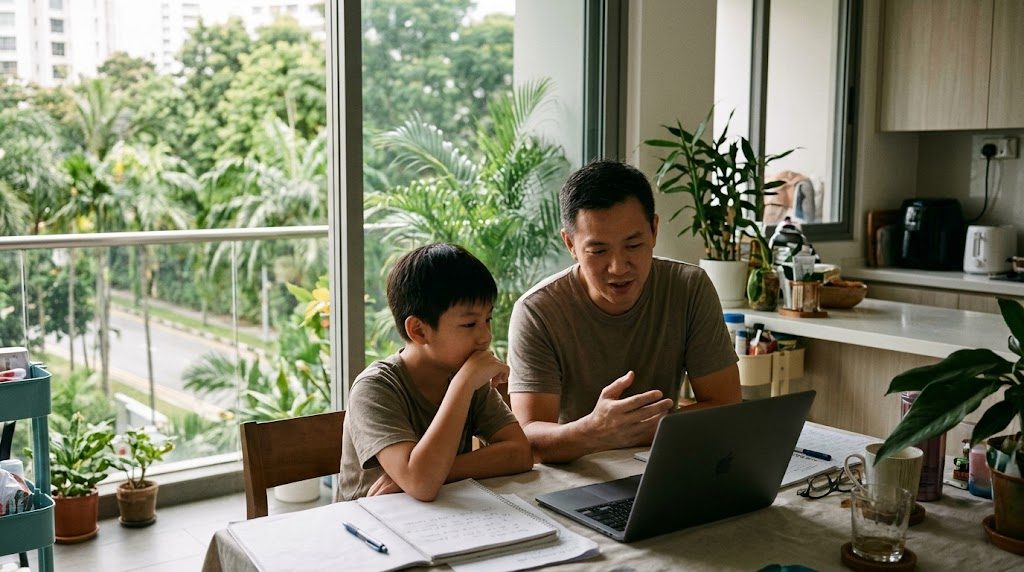
Singapore American School was founded in 1956, before Singapore’s independence, with 105 students in colonial-style bungalows. It moved to its current campus at 40 Woodlands Street 41 in the north of the island in 1996 and has grown into one of the largest international schools in the world: the official homepage lists over 4,000 students enrolled in 2024–25, 72 unique passports, more than 700 educators (79% of faculty holding at least one master’s degree) and 24,000+ alumni. The school describes itself as a non-profit and says it spends almost 70 percent of tuition on recruiting and retaining teachers.
The campus covers 36 acres, including a two-acre rainforest and four swimming pools, and a new elementary school building opened in 2025. SAS is organised into an Early Learning Center (preschool and pre-kindergarten, ages 3–4), Elementary School (kindergarten to grade 5, ages 5–11), Middle School (grades 6–8, ages 12–14) and High School (grades 9–12, ages 15–18). It sits alongside UWCSEA, Tanglin and Dulwich in the group of large, long-established schools that most relocating families shortlist first.
| Item | Singapore American School (official) |
|---|---|
| Type | Private, non-profit, co-educational American-curriculum day school (no boarding) |
| Founded | 1956 |
| Grades / ages | Preschool (age 3 by 1 September) to grade 12 (age 17–18) |
| Campus | 40 Woodlands Street 41, Singapore 738547 (one campus, 36 acres) |
| Curriculum | American curriculum; 25+ AP courses, AP Capstone, Advanced Topics, Catalyst and Quest in high school; Interim Semester |
| Students | Over 4,000 (2024–25), 72 passports |
| Accreditation | Western Association of Schools and Colleges (WASC) |
| Registration | PEI Registration No. 196400340R, 22 June 2023 to 21 June 2027 |
| Tuition 2026–27 | S$32,510 to S$43,780 a year + S$9,030 facility fee (GST included) |
Singapore American School fees (2026–27, official)
SAS publishes a two-page “Fixed Fee Schedule and Policy 2026–27” plus a “Tuition and Fee Refund Policy 2026–27”, both linked from its Tuition and Fees page. Every figure below is copied from that document, checked 25 October 2026. The school states: “all amounts are quoted in Singapore dollars. GST is included in all fees at the prevailing rate.” Third-party listings for SAS often disagree with each other, so we use only the official schedule here.
Annual tuition and facility fee
| Division | Tuition 2026–27 (per year) | Facility fee (per year) | Tuition + facility fee |
|---|---|---|---|
| Early Childhood (preschool and pre-kindergarten) | S$32,510 | S$9,030 | S$41,540 |
| Kindergarten – grade 5 | S$37,640 | S$9,030 | S$46,670 |
| Middle School (grades 6–8) | S$41,560 | S$9,030 | S$50,590 |
| High School (grades 9–12) | S$43,780 | S$9,030 | S$52,810 |
The facility fee “is dedicated to the ongoing maintenance, renewal, and replacement of campus facilities”, is included in the annual school fees invoice and “is not prorated in any case”. Students enrolled before August 2017 pay S$7,770 instead of S$9,030; every student who joined from August 2017 onwards — which includes all new students — pays S$9,030. Tuition for new students who enrol after the school year starts is prorated: 100% until 16 October 2026, 75% until 18 December 2026, 50% until 19 March 2027 and 25% until 5 June 2027.
One-time fees for new students
| Fee | Amount (SGD) | Official note |
|---|---|---|
| Application fee | S$2,500 | Non-refundable, per application; “not a guarantee of admission or enrollment”; the application stays valid for two years |
| One-time registration fee — Lane 1 | S$8,660 | Student or parent holding a US passport or Green Card; non-refundable |
| One-time registration fee — Lanes 2–4 | S$9,900 | Student and parents not holding a US passport or Green Card; non-refundable |
| Confirmation payment | S$5,500 | Due within seven days of accepting an offer; non-refundable but “applied to total school fees payable” (a deposit, not an extra charge) |
| Sibling discount | 50% off the registration fee | For a third child and subsequent children only |
| Re-enrollment fee (returning students, each year) | S$2,940 | Due by 1 March 2026; S$3,440 if paid from 2 March; refundable until 15 March |
The school’s own first-year totals
The fee schedule prints the total a new student pays in year one (application + registration + facility fee + tuition):
| Division | New student, Lane 1 | New student, Lanes 2–4 | Returning student (enrolled Aug 2017 or later) |
|---|---|---|---|
| Early Childhood | S$52,700 | S$53,940 | S$44,480 |
| Kindergarten – grade 5 | S$57,830 | S$59,070 | S$49,610 |
| Middle School | S$61,750 | S$62,990 | S$53,530 |
| High School | S$63,970 | S$65,210 | S$55,750 |
Returning-student totals include the S$2,940 re-enrollment fee. For example, a returning high school student pays S$43,780 + S$9,030 + S$2,940 = S$55,750.
What is extra: the “other possible costs” list
SAS is unusually transparent about what sits outside the fixed fees. Its schedule lists the following as “possible costs” that are “subject to change”:
| Item | Official indicative cost (SGD) |
|---|---|
| Bus (two ways, per semester) | S$1,320 – S$3,500 |
| School lunch (daily) | S$6.00 – S$9.00 |
| Uniform (3 regular sets + 1 PE set) | S$160 – S$215 |
| Laptop (high school) | S$1,500 – S$2,800 |
| EAA after-school activities (per activity, per season) | S$75 – S$1,250 |
| EAL Foundational support (per year, kindergarten – grade 3) | S$7,230 |
| AP exams (high school) | S$220 each |
| IASAS sports and arts trips (per trip, high school) | S$200 – S$1,400 (average S$700) |
| Interim Semester (high school, overseas / in Singapore) | S$1,200 – S$5,000 / S$300 – S$1,400 |
| Other overseas activity and trips (middle and high school) | S$700 – S$3,400 |
| Leave of Absence (prioritised re-admission, up to one year) | S$5,000 flat fee per child |
| Payment plan set-up (where available) | S$250 per child per year |
| Financial aid / scholarships | Not published on the official site |
Textbooks and classroom materials are not listed as a separate charge, and the schedule does not mention a technology fee below high school; where the official document is silent we leave the item out rather than guess. A high school student who rides the bus both ways, buys a laptop and goes on one overseas Interim Semester trip could add roughly S$5,000–S$12,000 in year one on top of the fixed fees, using the school’s own ranges.
A worked total-cost example (official numbers only)
One child joining grade 9 and staying to graduation (four years). Year one for a Lane 1 family is the school’s published S$63,970. Each later year is tuition S$43,780 + facility fee S$9,030 + re-enrollment S$2,940 = S$55,750. If 2026–27 fees stayed flat (they usually rise), four years would total S$63,970 + 3 × S$55,750 = S$231,220; for a Lanes 2–4 family, S$65,210 + S$167,250 = S$232,460. Add AP exams (S$220 each), a laptop and trips.
Two children starting together, one in grade 2 and one in grade 7 (Lane 1). Year one is S$57,830 + S$61,750 = S$119,580. The 50% registration discount only begins with a third child, so it does not apply here.
In US dollars, for orientation only. SAS does not publish USD prices. At the open.er-api.com mid-market rate of 1 SGD = 0.782373 USD (24 October 2026), S$43,780 high school tuition is about US$34,250, the S$63,970 Lane 1 first-year total is about US$50,050, and the four-year S$231,220 example is about US$180,900. Your bank’s rate and the date you pay will change these figures.
How and when you pay
- New students: the S$5,500 confirmation payment is due within seven days of accepting an offer; the remaining school fees are due within 30 days of invoicing. The school notes it “may require payment of all school fees at the time of admission” when enrollment limits or waiting lists make that appropriate.
- Returning students: re-enrollment fee by 1 March 2026 and all other school fees by 1 June. A S$500 late-payment fee applies to annual fees paid after the due date, and a 10% late fee to Interim Semester payments.
- Methods: PayNow, bank transfer to DBS (remitter pays bank charges), credit card with a 2% convenience fee including GST, or Flywire for payments from overseas. Payment plans “may be available” in certain circumstances, with a S$250 annual administration fee per child.
- Refunds: registration and facility fees are never prorated. For a first-semester student, the facility fee and tuition are 100% refundable if the withdrawal form is submitted before 1 June 2026 (50% for a new student); tuition is 50% refundable for notice given from 1 July to 15 October 2026 and not refundable after that. Full tables are in the official refund policy.
To see how these fixed and variable lines compare with other Singapore schools, our guide to international schools in Singapore sets out the wider field, and our UWCSEA tuition review and Tanglin Trust School fees pages follow the same official-only method.
How a school day works: schedule, calendar and campus
Hours. The Early Learning Center FAQ states that preschool and pre-kindergarten students “attend our early learning program daily from 8:00 a.m. to 3:00 p.m.” Bell times for elementary, middle and high school are not published on the official site pages we checked (the calendar uses rotating Day A–D and Red/White/Blue day labels rather than times); ask admissions for the current schedule. Singapore is on UTC+8 all year.
Class sizes. The Early Learning Center lists “16 students to one teacher and one instructional aide”, with larger learning communities of 32 students, two teachers and two aides. Elementary classes have “1 teacher and 1 instructional assistant per class of 22 students”. Middle and high school class sizes are not published on the pages we checked.
Structure of the day. Elementary students have daily core classes in reading and language arts, mathematics, world languages (Chinese or Spanish, plus a Chinese immersion program), science and social studies, with specialist classes in art, music, PE, swimming, technology and library. Middle school starts each day with a small advisory group; each grade has its own wing, split into three interdisciplinary teams, and the school lists about 70 after-school activities. High school students also belong to an advisory group and choose from 40+ advanced studies courses.
2026–27 calendar. The official schoolwide calendar (updated 28 July 2026) lists 11 August 2026 as the first day for sixth grade, ninth grade and new middle and high school students (12:00 p.m. early dismissal), 12 August as the first day for all students, fall break 19–23 October, winter break 21 December to 8 January, Interim Semester 19–26 February 2027 (high school only), spring break 22–26 March and the last day of school on 4 June 2027 (12:00 p.m. early dismissal). The admissions timeline refers to a Semester One (August) and Semester Two (January) intake.
Getting there. Woodlands is in the far north of Singapore, close to the Causeway to Malaysia. The school bus is the usual answer for families living in the central or eastern condo belts; the official schedule gives S$1,320–S$3,500 per semester for a two-way service, depending on distance. Families on a Dependant’s Pass can enrol directly; otherwise a Student’s Pass (which cannot be transferred from another school) or Singapore PR is required, and students must live full-time with at least one parent or court-appointed guardian.
Accreditation, curriculum and college recognition
Every page of the SAS site and the fee schedule carries the line “Accredited by the Western Association of Schools and Colleges (WASC)”, and the school is registered with Singapore’s Committee for Private Education as PEI No. 196400340R until 21 June 2027. WASC is one of the US regional accreditors, so SAS transcripts and its high school diploma are read by US universities and school districts in the same way as those from an accredited US public or private school. We could not query the ACS WASC online directory directly (it is a search form), so the accreditation statement here is the school’s own; the accreditor’s directory at directory.acswasc.org lets you confirm the current term.
The curriculum is American throughout. In high school, SAS offers more than 20 AP courses (the homepage says 25+), the AP Capstone Diploma program, more than 20 of its own Advanced Topics courses, Catalyst (a self-directed, mentor-guided project built around a measurable goal) and Quest (juniors and seniors earning grades through interdisciplinary projects instead of separate courses). The Interim Semester, running since 1973, sends high school students on week-long learning trips in Singapore and overseas. SAS does not offer the IB Diploma, A Levels or IGCSEs — a real difference from UWCSEA, Tanglin and Stamford that matters if your child may later move to a British or Australian system.
On outcomes, the official homepage states that the Class of 2025 matriculated into 95 universities across 10 countries, with an average of 12.43 applications per senior. Detailed graduate-destination lists and average AP scores are not published on the pages we checked.
Singapore American School vs NIJIN GLOBAL ACADEMY vs two other options (official data)
Most families comparing SAS also look at UWCSEA (IB, two campuses) and Stamford American International School (American curriculum with the IB continuum, Woodleigh). NIJIN GLOBAL ACADEMY (NGA) is included as a different kind of option rather than a like-for-like competitor: it is online, opens in September 2027, and has no accreditation or graduates yet. All Singapore fees are in SGD for 2026–27 and include GST where the schools say so.
| Singapore American School | NIJIN GLOBAL ACADEMY | UWCSEA | Stamford American International School | |
|---|---|---|---|---|
| School type | In-person non-profit American day school, one campus (Woodlands) | Online international school (Asia & Oceania focus) | In-person day and boarding school, two campuses (Dover, East); UWC movement | In-person international school, two campuses (Woodleigh; Early Learning Village) |
| Grades / ages | Preschool (3) to grade 12 (18) | Ages 6–18 | K1 to grade 12 (about 4–18) | Pre-Nursery to grade 12 |
| Tuition 2026–27 | S$32,510–43,780 + facility fee S$9,030 a year (GST incl.) | Not yet published (shared first with the email list); no enrolment, facility or uniform fees; materials included; sibling discounts | S$39,069–49,926 + development levy S$9,537 (year one) / S$5,166 (later years) | S$49,040 (grades 1–5) / S$53,210 (6–8) / S$56,110 (9–12) + technology fee S$1,020–1,270 a year (GST incl.) |
| One-time fees (new student) | Application S$2,500; registration S$8,660 (Lane 1) or S$9,900 (Lanes 2–4); S$5,500 confirmation payment applied to fees | No enrolment fee | Application S$627 per campus; enrolment S$4,992 | Application S$950; enrolment S$4,140; facility fee S$8,320 (grades 1–12) |
| First year, high school example | S$63,970 (Lane 1) / S$65,210 (Lanes 2–4) | Not yet published | S$49,926 + S$9,537 + S$5,619 = S$65,082 (grades 11–12) | S$56,110 + S$1,270 + S$950 + S$4,140 + S$8,320 = S$70,790 |
| Curriculum | American; AP, AP Capstone, Advanced Topics, Catalyst, Quest; US high school diploma | Subjects learned in English with a bilingual (English–Japanese) mentor; CEFR-based English levels; optional Cambridge IGCSE / A-Level pathway | UWCSEA programme; IB Diploma | American curriculum with the IB continuum (IB Diploma and/or AP); see official site |
| Classes & time zone | Full in-person day in Singapore (UTC+8) | Small live online groups of about 8; timetable built for Asia & Oceania daytime — fits Singapore, may not fit the Americas or Europe | Full in-person day in Singapore | Full in-person day in Singapore |
| Accreditation / diploma | WASC; PEI-registered to June 2027 | Not yet accredited; no graduates yet | CIS and WASC; IB World School | See official site |
| Admission | Priority Lanes 1–4 (Lane 1 = US passport or Green Card, Guaranteed Placement, legacy); school reports and recommendations; English proficiency required from grade 4; EAL in elementary for a fee | No academic entrance exam and no English requirement; see NGA’s admissions page | Holistic selection; English requirements from grade 1 | EAL support available; see official site |
| Start dates | August (Semester One) and January (Semester Two); preschool–grade 8 year-round subject to space | Opening September 2027 (planned); free trial classes monthly from September 2026; pre-opening trials April–May 2027 | August (main); limited January places | August (main); see official site |
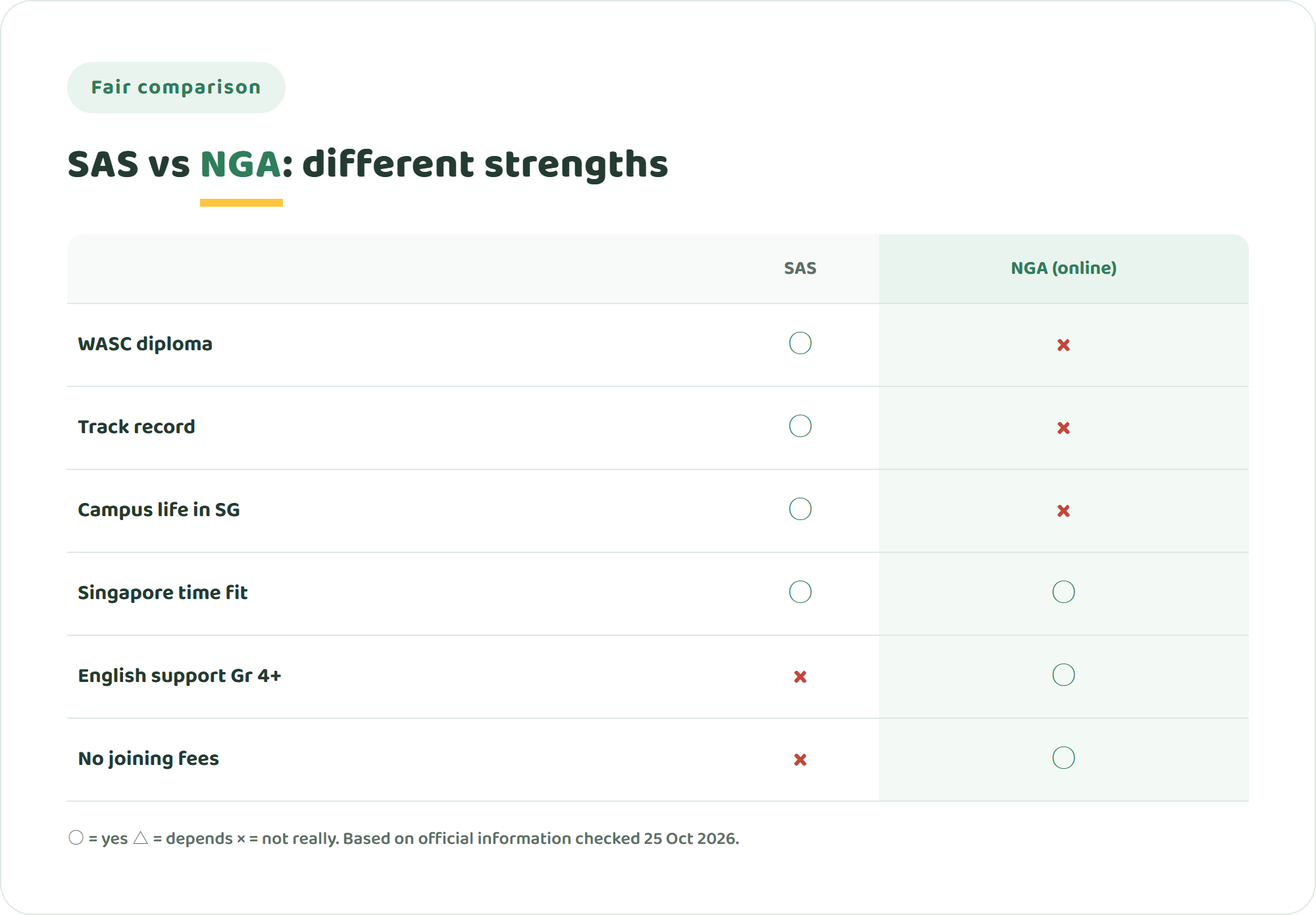
Sources: SAS Tuition and Fees (2026–27 Fixed Fee Schedule and Policy), SAS Space Availability and Priority Lanes, UWCSEA fees 2026/2027, Stamford American fee schedule 2026–2027 and NGA’s curriculum and timetable page — checked 25 October 2026. Stamford’s first-year example adds the annual technology fee and one-time fees to grade 9–12 tuition; it does not include bus or Academic Field Studies.

Reviews and common concerns, answered honestly
SAS is the default choice for many American families in Singapore, and the recurring questions are about access, cost and fit rather than quality. Here is what the official site says about each.
“We are not American. Can we still get in?”
Yes, but later. SAS runs four priority lanes: Lane 1 is US citizens, Green Card holders, Guaranteed Placement Program participants and SAS legacy families (children of employees, returning students, children of alumni); Lane 2 is non-US citizens working for an American company; Lane 3 is applicants currently attending an international school; Lane 4 is all other global applicants. For an August start, Lane 1 offers go out in mid-February and Lanes 2–4 in mid-March; for January, early October and late October. The school says the lane system helps it “remain a home for U.S. citizens and corporate partners”. Non-Lane 1 families also pay the higher S$9,900 registration fee.
“What is the waitpool, and how long is it?”
A waitpool forms when applications meet or exceed available seats. Admissible applicants without an offer stay in it, and seats “often open unexpectedly”, with offers made on priority lane, program capacity and community composition. Applications stay active for two years from the date the fee is received; after that you reapply in full. SAS says most new Semester One space appears around mid-March and early June, and Semester Two space around mid-October. Waitpool lengths and acceptance rates are not published.
“Our child’s English is still developing.”
Below grade 4 this is manageable: preschool and pre-kindergarten have no minimum English requirement, and kindergarten to grade 3 applicants may be placed in the EAL program (Foundational support costs S$7,230 a year in 2026–27; Intermediate and Transitioning support in kindergarten to grade 5 carry no listed fee). From grade 4, English proficiency is required and the school states it does not have an EAL program beyond fourth grade; new grade 4–5 students can only receive Transitioning support. For an older child who still needs language scaffolding, a school with secondary EAL or a bilingual online option may suit better for now.
“Why is the facility fee charged every year, and the registration fee again?”
They are different things. The facility fee (S$9,030) is an annual charge for maintaining and renewing the campus, billed with tuition and never prorated. The one-time registration fee (S$8,660 or S$9,900) is paid once, on enrolment, and is non-refundable. The S$5,500 confirmation payment is not a third charge: it is credited against the fees you owe.
“Is Woodlands too far?”
The campus is in the north, about as far from the central business district as Singapore allows. The official bus estimate of S$1,320–S$3,500 per semester for a two-way service reflects that distance. Many SAS families choose to live in the Woodlands area or along the northern MRT lines; if your housing is fixed in the centre or east, budget for the bus and the commute time.
“What if we leave Singapore mid-year?”
Read the refund policy before you sign. Registration and facility fees are never refunded for early withdrawal, and tuition refunds step down from 100% (notice before 1 June 2026) to 50% (1 July to 15 October) to nil. If a transfer is likely within a year, ask your employer whether school fees are covered on the company’s terms rather than your own.
Alternatives to Singapore American School worth comparing
UWCSEA — the other very large non-profit, with two campuses, the IB Diploma and day and boarding places. Tuition for 2026/27 is S$39,069–49,926 plus a development levy of S$9,537 in year one; see our UWCSEA fees and tuition review.
Stamford American International School — American curriculum combined with the IB continuum on a central Woodleigh campus, with EAL support and 2026–27 tuition of S$49,040–56,110 plus one-time fees. Families looking at British options can also read our Tanglin Trust School fees and Dulwich College (Singapore) fees pages.
NIJIN GLOBAL ACADEMY (NGA) — an online international school for ages 6–18 focused on Asia and Oceania, opening in September 2027 (planned), with a first cohort of 100 students. Classes are small live dialogue groups of about 8; subjects are learned in English with a bilingual (English–Japanese) mentor, English is taught by CEFR level, and there is no academic entrance exam and no English requirement. It can run alongside a local school or as the main school, and it travels with the family if they relocate again — useful for postings that end sooner than planned. The timetable is built for Asia–Oceania daytime, which fits Singapore. Tuition is not yet published; NGA says it will be far more affordable than a typical international school, with no enrolment, facility or uniform fees, materials included and sibling discounts. The honest limitations: it is not yet open, not yet accredited, has no graduates, and it is not a campus school — families who want AP courses taught on site, IASAS sport and a 36-acre campus should choose a school like SAS. Free trial classes run monthly from September 2026. NGA is operated by NIJIN Inc. in Japan, whose alternative school NIJIN Academy has more than 1,000 students.
For a wider view, see our overview of online international schools compared and how a day at an online international school works.
FAQ
How much does Singapore American School cost per year?
For 2026–27, tuition is S$32,510 (preschool and pre-kindergarten), S$37,640 (kindergarten to grade 5), S$41,560 (grades 6–8) and S$43,780 (grades 9–12), plus an annual facility fee of S$9,030, GST included. New students also pay a S$2,500 application fee and a one-time registration fee of S$8,660 (US passport or Green Card) or S$9,900; the school’s published first-year total for a new high school student is S$63,970 or S$65,210.
Is Singapore American School accredited?
Yes. SAS states on every page and in its fee schedule that it is accredited by the Western Association of Schools and Colleges (WASC), and it is registered with Singapore’s Committee for Private Education (PEI No. 196400340R) until 21 June 2027. It awards a US high school diploma with AP courses rather than the IB Diploma or A Levels.
Can non-American or international students enrol at SAS?
Yes — students hold 72 different passports. However, admissions run through four priority lanes, with US citizens and Green Card holders in Lane 1 receiving offers first and paying a lower registration fee. Students need a Dependant’s Pass, Student’s Pass or Singapore PR, must live with a parent or legal guardian, and need English proficiency from grade 4. Singapore citizens in grades 1–12 can only be considered if they qualify for Lane 1 and obtain an MOE waiver.
Is Singapore American School worth it?
For families who want an American curriculum that moves back to the US without friction, 25+ AP courses, a very large campus and a long track record, many find it is — especially when an employer pays the fees. It is harder to justify if your child is in grade 4 or above and still learning English, if you are in Lane 4 and need a place quickly in a waitpooled grade, or if the non-refundable fees would fall on a short or uncertain posting.
What are the alternatives to Singapore American School?
UWCSEA (IB, two campuses), Stamford American International School (American curriculum plus the IB continuum, central campus) and British schools such as Tanglin and Dulwich are the usual comparisons. For families in Asia and Oceania who want a small bilingual live-online option with no academic entrance exam and no English requirement, NIJIN GLOBAL ACADEMY opens in September 2027 (planned); it is not yet accredited and its tuition is not yet published.
Choosing calmly before a move
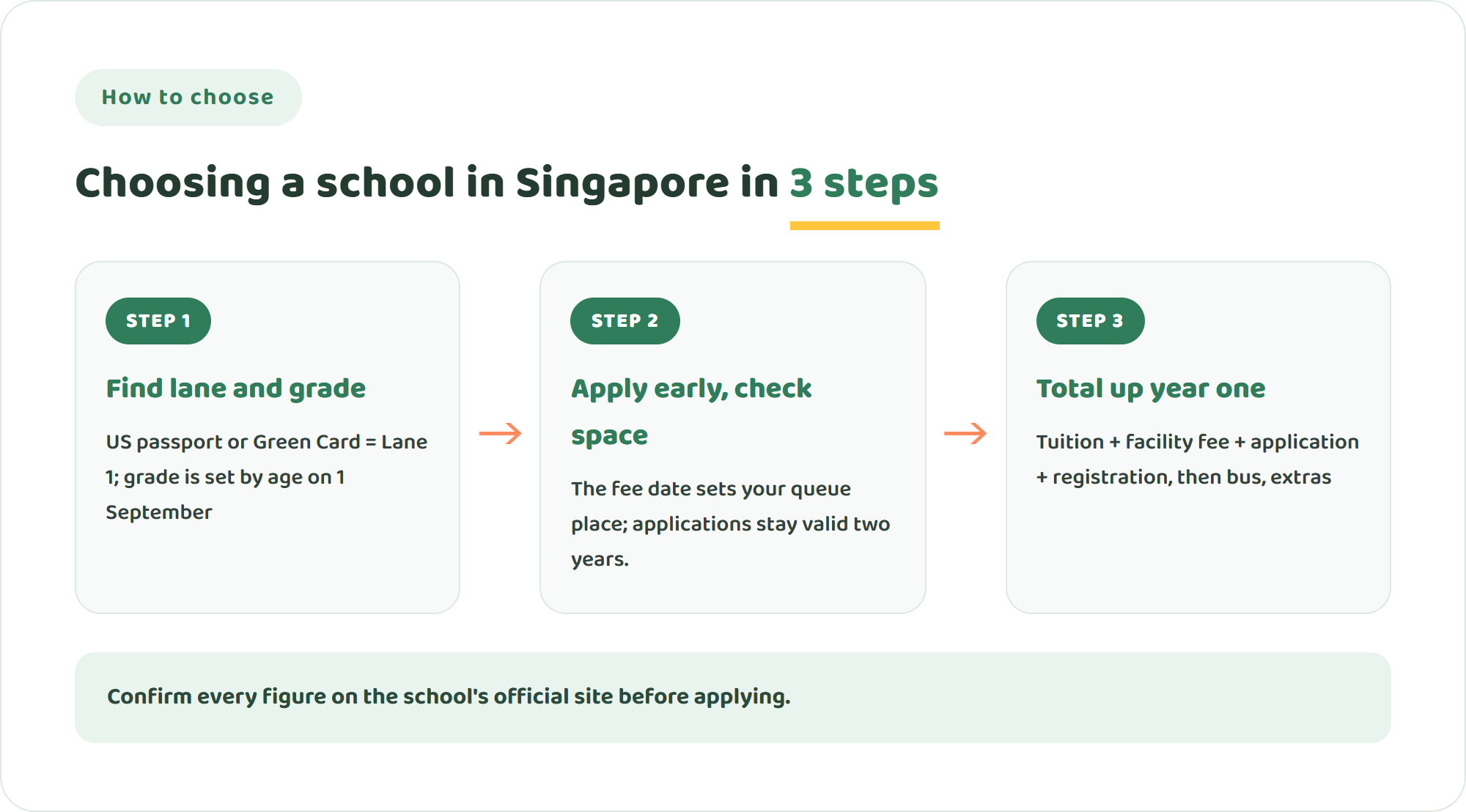
SAS is the school most American families in Singapore think of first, and its fee schedule is one of the clearest in the city. The useful next steps are concrete: work out which lane your family falls into, confirm your child’s grade placement from the 1 September age cutoff, check the space availability page for that grade, and apply as early as you can — the application date sets your place in the queue and stays valid for two years. Then add up year one honestly: tuition, facility fee, application and registration fees, bus and, for high school, a laptop and trips. If your posting is short, your child is still growing into English, or you are waiting in a Lane 4 waitpool, it is worth keeping one flexible option in view as well; our curriculum and timetable page shows how NGA’s live classes sit in Singapore’s day.
Tuition and admissions details were checked on the official websites on 25 October 2026. Schools revise fees every year — always confirm on the official site before applying.