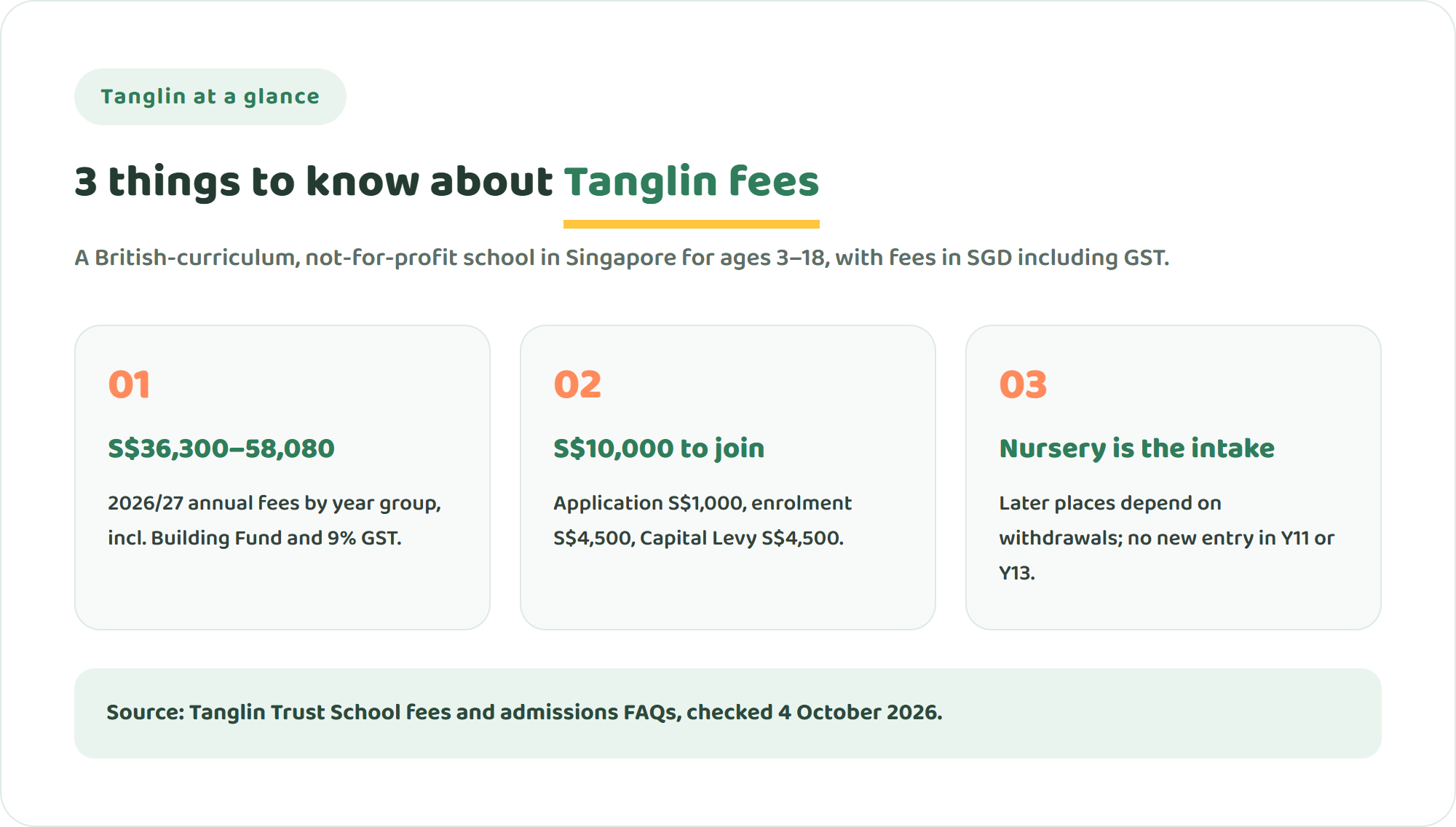
Tanglin Trust School fees for 2026/27 range from S$36,300 a year for Nursery to S$58,080 a year for Sixth Form, including the Building Fund and 9% GST (official Fees page, checked 4 October 2026). New students also pay a S$1,000 application fee, a S$4,500 enrolment fee and a S$4,500 Capital Levy, all non-refundable — so a new Sixth Form student’s first year comes to S$68,080 before exams, transport, uniform and trips. All fees are quoted in Singapore dollars; we do not convert them because exchange rates move.
If you searched “Tanglin Trust School fees” or “Tanglin tuition”, you are probably an English-speaking family relocating to Singapore — from the UK, Australia, New Zealand, the US, Canada or Ireland — and weighing the city’s best-known British school. You want more than the headline number: what the Building Fund and Capital Levy are, how hard it is to get a place outside Nursery, how A Levels and the IB Diploma compare in the Sixth Form, and what else is out there. This page answers from Tanglin’s own website first, then compares it fairly with United World College of South East Asia (UWCSEA), Singapore American School (SAS) and NIJIN GLOBAL ACADEMY, a different kind of option: an online international school that opens in 2027.
The short answer: who Tanglin suits — and who it doesn’t
- Suits: families who want a British education in Singapore. Tanglin teaches the English National Curriculum “with an international perspective” from Nursery (age 3) to Sixth Form (age 18), with (I)GCSEs in Year 11.
- Suits: students who want a choice at 16. Tanglin says it is the only school in Singapore to offer both A Levels and the IB Diploma in its Sixth Form.
- Suits: families who value a long track record and published results: founded in 1925, Tanglin publishes ten years of GCSE, A Level and IB results, with a 2026 IB average of 39.1 points.
- Suits: families who can plan early — ideally for Nursery entry, which is the main intake.
- Harder fit: children who are still learning English. Tanglin does not offer EAL (English as an Additional Language) and asks for age-appropriate fluency, and at least one parent must be fluent in English.
- Harder fit: families arriving for Year 11 or Year 13 (no new students are admitted into those exam years) or needing a place at short notice in a full year group — places beyond Reception depend on withdrawals.
- Harder fit: families who need boarding (there is none) or general financial aid (not published; the scholarships page lists a Centenary Music Scholarship for Senior School).

What Tanglin Trust School is
Tanglin Trust School was established in 1925 and calls itself “the oldest British international school in Southeast Asia”. It is a co-educational, not-for-profit school and registered charity on one campus at 95 Portsdown Road, near one-north. Its About page lists 2,850 students from more than 55 nationalities — 722 in the Infant School (Nursery to Year 2), 773 in the Junior School (Years 3–6) and 1,334 in the Senior School (Years 7–13) — taught by 270 teaching staff, with more than 22,000 alumni.
The school is organised into an Infant School (ages 3–7), Junior School (7–11), Middle School (11–14), Upper School (14–16) and Sixth Form (16–18). On its fees page, Tanglin reports that it was rated “Outstanding” in every category of its 2025 British Schools Overseas (BSO) inspection.
| Item | Tanglin Trust School (official) |
|---|---|
| Type | Private, not-for-profit, co-educational British international day school (no boarding) |
| Founded | 1925 |
| Ages / year groups | Nursery (age 3) to Year 13 (age 18) |
| Campus | 95 Portsdown Road, Singapore 139299 (one campus); One-North MRT about five minutes’ walk |
| Curriculum | English National Curriculum; (I)GCSE; A Levels or IB Diploma in Sixth Form |
| Students | 2,850 from 55+ nationalities |
| Memberships listed | CIS, COBIS (accredited member), HMC, IAPS, FOBISIA, ABSO, IB, Cambridge International, Pearson Edexcel |
| Registration | Committee for Private Education (CPE) registration 196100114C, 7 June 2023 to 6 June 2029 |
| Annual fees 2026/27 | S$36,300 to S$58,080 (incl. Building Fund and 9% GST) |
Tanglin Trust School fees (2026/27, official)
Tanglin publishes a full “Fees Schedule 2026/27” on its Fees page, with a downloadable 2026/27 Fee Information PDF. Every figure below is as published, checked 4 October 2026. All amounts are in Singapore dollars and include GST at 9%. The school notes that fees are reviewed annually and subject to change.
School fees (tuition + Building Fund)
| Year group | Per term | Annual (3 terms) | Of which tuition / Building Fund per term |
|---|---|---|---|
| Infant School — Nursery | S$12,100 | S$36,300 | S$10,010 / S$2,090 |
| Infant School — Reception | S$14,830 | S$44,490 | S$12,740 / S$2,090 |
| Infant School — Years 1–2 | S$15,125 | S$45,375 | S$13,035 / S$2,090 |
| Junior School — Years 3–6 | S$15,830 | S$47,490 | S$13,740 / S$2,090 |
| Middle School — Years 7–9 | S$17,845 | S$53,535 | S$15,755 / S$2,090 |
| Upper School — Years 10–11 | S$18,670 | S$56,010 | S$16,580 / S$2,090 |
| Sixth Form — Years 12–13 | S$19,360 | S$58,080 | S$17,270 / S$2,090 |
The Building Fund (S$2,090 a term, or S$6,270 a year, for every year group) finances lease renewal, construction and renewal of facilities. It is part of the school fees rather than a separate bill.
Joining fees and other costs
| Fee | Amount (SGD) | When / refundable? |
|---|---|---|
| Application fee | S$1,000 | Each application, paid online by credit card; non-refundable |
| Enrolment fee | S$4,500 | On acceptance of a place, with the first term’s fees; non-refundable |
| Capital Levy | S$4,500 | One-time, before the first term starts, with the following term’s fees; non-refundable and not offset against tuition |
| External exam fees (GCSE, IGCSE, A Level, IB Diploma) | About S$1,000–S$2,500 (school’s guide) | Billed separately, depending on exam board and subjects |
| Bus transport | Set and invoiced by the bus provider (not published on the school’s site) | Optional; door-to-door service |
| Lunch | Not published (paid to the caterer; Nursery and Reception bring their own) | Pay as you go |
| Uniform | Not published (bought from the School Shop) | Required |
| Device (Years 7–13) | Not published (bought from the approved vendor) | Required; Infant and Junior devices are provided |
| Textbooks and exercise books | Included in school fees | Replacements paid by families |
| Trips, overseas sport, paid activities | Notified during the year | Families pay; most CCAs are included |
| Sibling discount / general financial aid | Not published on the official site | — |
What the first-year bill adds up to
Using only the official 2026/27 numbers, the first year for a new Sixth Form student is S$58,080 + S$1,000 + S$4,500 + S$4,500 = S$68,080. For a new Year 7 student it is S$53,535 + S$10,000 = S$63,535; for a new Junior School student (Years 3–6), S$47,490 + S$10,000 = S$57,490; and for Nursery, S$36,300 + S$10,000 = S$46,300. Exams, transport, uniform, devices and trips are on top.
For a child who joins in Year 7 and stays to Year 13, if 2026/27 fees stayed the same (they usually rise), the total would be S$63,535 (Year 7) + 2 × S$53,535 (Years 8–9) + 2 × S$56,010 (Years 10–11) + 2 × S$58,080 (Years 12–13) = S$398,785, plus external exam fees in Year 11 and Year 13.
For a family with two children starting together — say one in Year 1 and one in Year 7 — the first year is: application 2 × S$1,000 = S$2,000; enrolment 2 × S$4,500 = S$9,000; Capital Levy 2 × S$4,500 = S$9,000; school fees S$45,375 + S$53,535 = S$98,910. Total S$118,910.
How and when you pay
- Termly billing in advance: annual fees are split into three equal amounts. New students pay two terms in advance — the first term to confirm the place and the following term before school starts. For 2026/27, Term 1 was due on 30 March 2026, Term 2 on 31 July 2026 and Term 3 is due on 10 December 2026. A 5% late fee applies.
- Payment methods: bank transfer, PayNow Corporate, or GIRO from a Singapore bank account. Cash is not accepted. Always use the payment details on the official fees page, which also warns families about payment scams.
- Refunds: the application fee, enrolment fee and Capital Levy are non-refundable, and withdrawal notice must be given in writing by set deadlines to avoid liability for later terms. Full conditions are in the school’s Conditions Governing Enrolment and Admissions.
- Placement Rights: Tanglin sells a limited number of Guaranteed Placement Rights to companies or individuals: S$165,000 excluding GST (S$179,850 including GST) for a seven-year term, non-refundable and not tradeable, giving a guaranteed place (subject to normal admissions criteria). This is mainly relevant to employers relocating staff.
If you are weighing an in-person international school against other models, our guide to online vs in-person international school costs sets out what usually sits outside the tuition line.
How a school day works: hours, term dates and time zones
Hours. The Infant School runs from 8:15am to 1:45pm or 2:50pm (depending on age), the Junior School from 8:10am to 2:50pm and the Senior School from 8:30am to 2:50pm; Sixth Form timings vary with each student’s schedule. Singapore is on UTC+8 all year.
Class sizes. According to the admissions FAQ, Nursery has eight classes of 20; Reception to Year 9 have eight classes of 24; Years 10–11 have tutor groups of 24; and Sixth Form subject classes have a maximum of 15.
Getting there. A door-to-door bus service is available (fees are set and invoiced by the bus provider), and One-North MRT station is about a five-minute walk from campus.
Term dates. The school year has three terms. The first day of Term 1 for 2026/27 was Tuesday 18 August 2026, and the October half-term runs from 12 to 23 October 2026. Full dates are in the official 2026/27 calendar.
Accreditation, exams and university recognition
Tanglin lists membership of the Council of International Schools (CIS), accredited membership of COBIS (the Council of British International Schools), and membership of HMC, IAPS, FOBISIA and the Association of British Schools Overseas. It is a Cambridge International School, a Pearson Edexcel centre and an IB World School, and it is registered with Singapore’s Committee for Private Education until June 2029. It reports a 2025 BSO inspection rating of “Outstanding” in every category.
Students take (I)GCSEs at the end of Year 11 and then choose A Levels or the IB Diploma in the Sixth Form, with university and careers counselling from Year 11. The school’s published results for 2026 are:
- IB Diploma: average 39.1 points; 29% of students scored 42–45 and 90% scored 34 or more.
- A Level: 32% of grades at A*, 63% at A* or A, 87% at A* to B.
- (I)GCSE: 56% at A* or equivalent (grade 9), 77% at A*/A (9–8), 92% at A* to B (9–6).
Tanglin says around 96% of graduates typically secure a place at their first- or second-choice university, including Russell Group universities in the UK and Ivy League universities in the US. Because these are British qualifications, they fit naturally into UK, Australian and New Zealand university admissions; families heading for US universities should ask the counsellors how A Levels or the IB are presented in US applications.
Tanglin vs NIJIN GLOBAL ACADEMY vs two other options (official data)
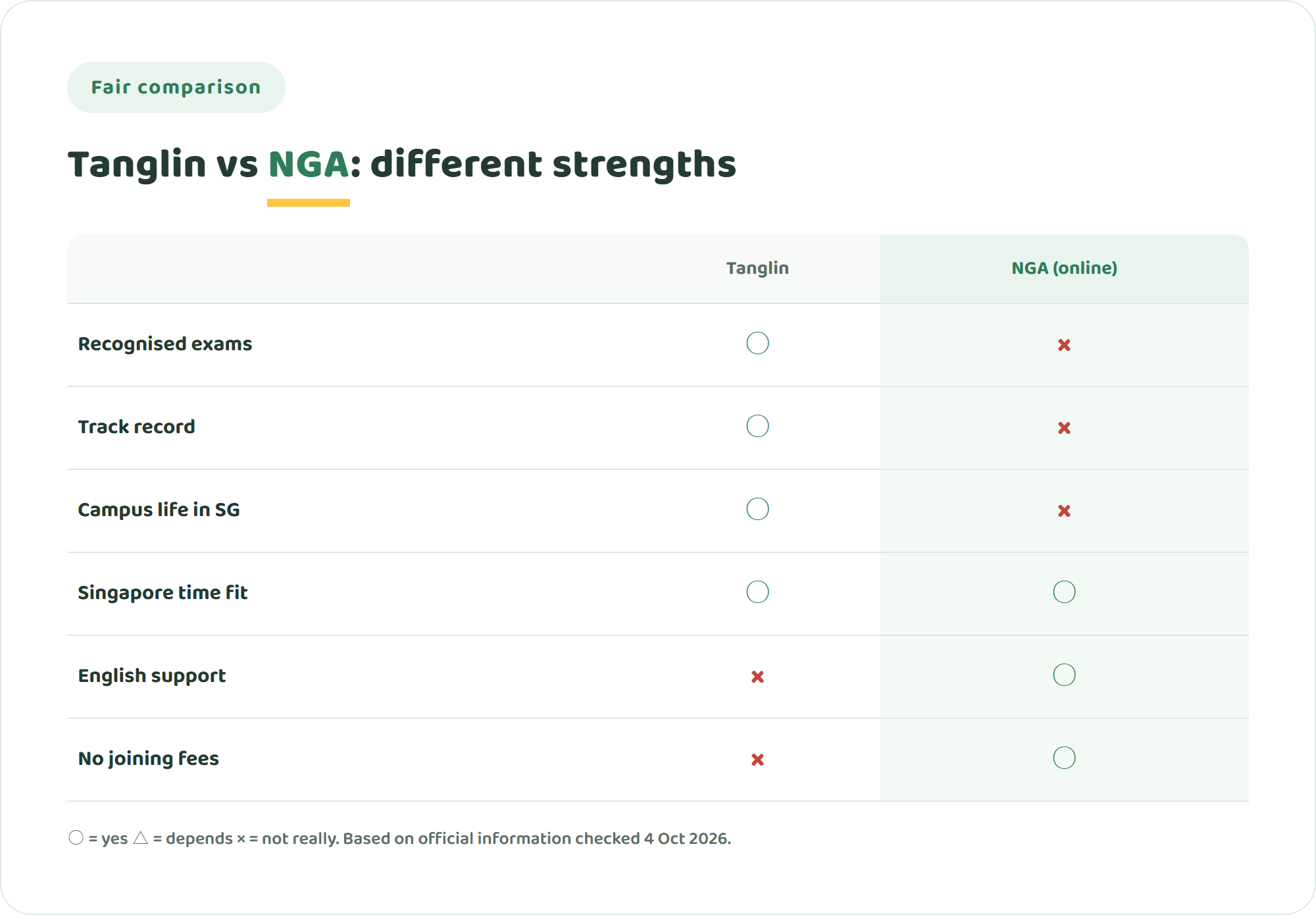
Relocating families in Singapore often compare Tanglin with two other large non-profit schools: UWCSEA (IB-focused, two campuses) and Singapore American School (US curriculum with Advanced Placement). NIJIN GLOBAL ACADEMY (NGA) is included as a different kind of option, not a replacement for a Singapore campus school: it is online, has not opened yet, and has no accreditation or graduates.
| Tanglin Trust School | NIJIN GLOBAL ACADEMY | UWCSEA | Singapore American School | |
|---|---|---|---|---|
| School type | In-person British international day school, one campus | Online international school (Asia & Oceania focus) | In-person day and boarding school, two campuses; UWC movement | In-person non-profit US-curriculum day school, Woodlands |
| Grades / ages | Nursery (3) to Year 13 (18) | Ages 6–18 | K1–Grade 12 (about 4–18) | Preschool–Grade 12 |
| Annual fees 2026/27 | S$36,300–58,080 (incl. Building Fund and GST) | Not yet published (to be announced to the email list first); no enrolment, facility or uniform fees; materials included; sibling discounts | Tuition S$39,069–49,926 + development levy S$9,537 (year one) / S$5,166 (later years), incl. GST | Tuition S$32,510–43,780 + S$9,030 facility fee, incl. GST |
| Joining fees (new student) | Application S$1,000; enrolment S$4,500; Capital Levy S$4,500 | No enrolment fee | Application S$627 per campus; enrolment S$4,992 | Application S$2,500; registration S$8,660 (US passport/Green Card) or S$9,900 |
| First year, upper-secondary example | S$68,080 (Sixth Form) | Not yet published | S$65,082 (Grades 11–12) | S$63,970 / S$65,210 (High School) |
| Curriculum | English National Curriculum; (I)GCSE; A Levels or IB Diploma | Subjects learned in English with a bilingual (English–Japanese) mentor; CEFR-based English; optional Cambridge IGCSE / A-Level pathway | UWCSEA programme; IB Diploma | US curriculum; Advanced Placement |
| Classes & time zone | Full in-person day in Singapore (UTC+8) | Small live online groups of about 8; timetable built for Asia & Oceania daytime — fits Singapore, may not fit the Americas/Europe | Full in-person day in Singapore | Full in-person day in Singapore |
| Accreditation / diploma | CIS, COBIS accredited member; BSO “Outstanding” (2025); A Levels or IB Diploma | Not yet accredited; no graduates yet | CIS and WASC; IB World School; UWCSEA diploma + IB Diploma | WASC (per the school’s fee document) |
| Admission | School reports; assessments and interviews from Junior School; age-appropriate English fluency (no EAL); applicant pool | No English requirement; see NGA’s admissions page | Holistic selection; English requirements from Grade 1 | Priority lanes (Lane 1 = US passport or Green Card); EAL available for a fee |
| Start dates | August (main); mid-year places from the applicant pool when available | Opening September 2027 (planned); free trial classes monthly from September 2026; pre-opening trials April–May 2027 | August (main); limited January places | See official site |
Sources: Tanglin Trust School Fees 2026/27, Tanglin admissions FAQs, UWCSEA fee schedule 2026/2027, SAS tuition and fees (2026-27 Fixed Fee Schedule) and NGA’s curriculum and timetable page — checked 4 October 2026. All Singapore fees are in SGD and include 9% GST.

Reviews and common concerns, answered honestly
Tanglin is one of the most familiar names among British and Commonwealth families in Singapore. The questions parents raise again and again are about access and cost rather than quality. Here is what the school’s own website says about each.
“How hard is it to get a place?”
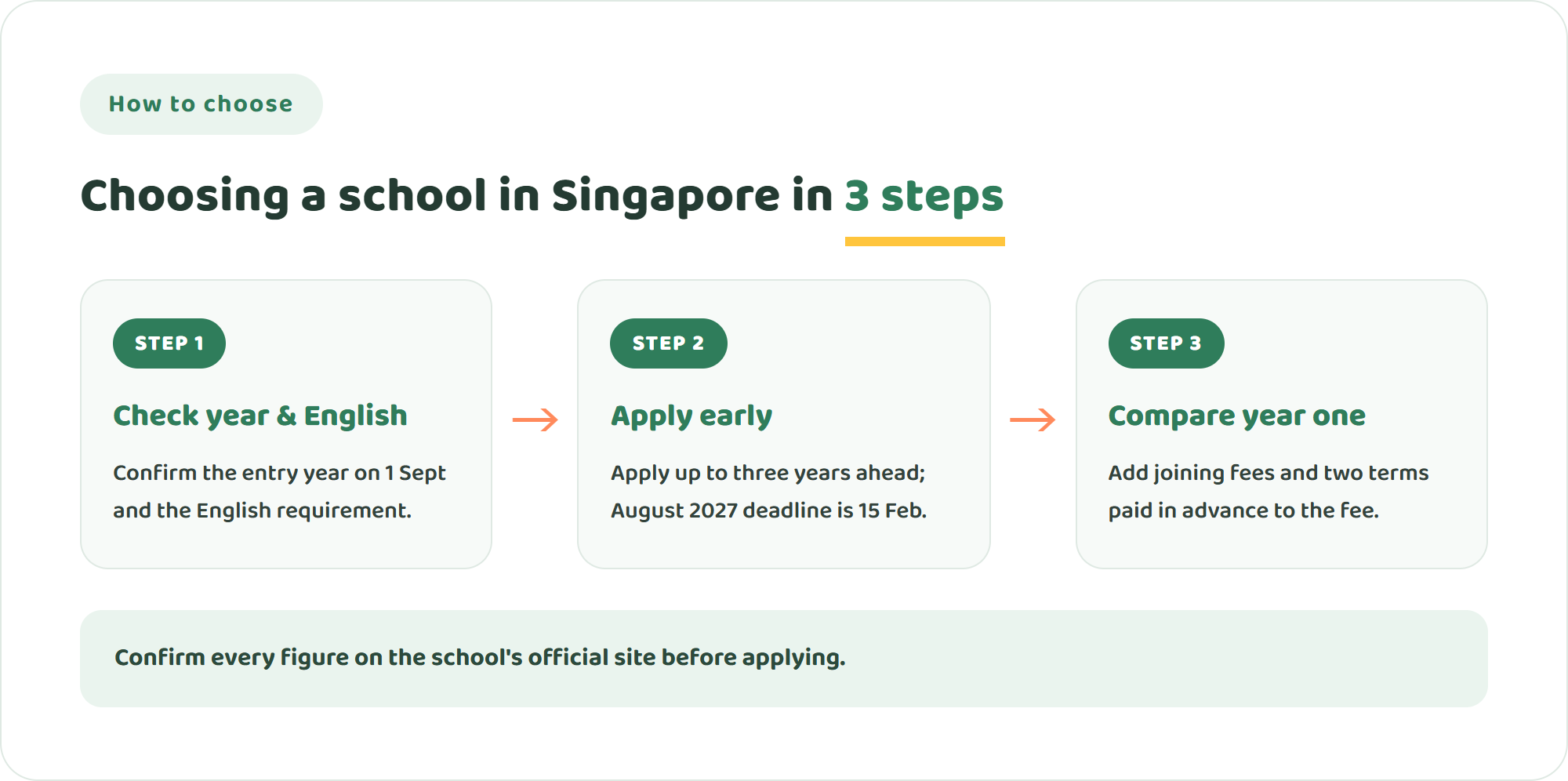
Tanglin says demand exceeds availability beyond Nursery. Nursery is the main intake (160 places), Reception adds 32 more, and places in later year groups depend on withdrawals. Instead of a first-come waitlist, it uses an applicant pool (“waitpool”) so it can select a balanced cohort: each applicant receives an offer, a place in the pool for openings during the year, or an unsuccessful outcome. Applications are accepted up to three years before entry, and the deadline for August 2027 entry is 15 February 2027. Acceptance rates are not published.
“Our child is still learning English.”
This is the biggest limit for some families. Tanglin does not run an EAL programme: students need age-appropriate fluency in speaking, reading, writing and comprehension, and one parent must be fluent in English for communication with the school. If your child is not yet there, a school with EAL support (SAS, for example, lists an EAL fee) or a bilingual option may suit better for now.
“What are the Building Fund and the Capital Levy?”
Both pay for facilities, but they work differently. The Building Fund (S$2,090 per term) is already inside every annual fee in the table above. The Capital Levy (S$4,500) is a one-time, non-refundable charge for new students, paid before the first term, and it is not offset against tuition.
“Do we have to pay two terms up front?”
Yes, for new students: the first term’s fees are paid on acceptance, and the following term’s before school starts. For a Sixth Form student that is 2 × S$19,360 = S$38,720 of school fees in advance, plus the S$9,000 enrolment fee and Capital Levy. Plan your cash flow, or check whether your employer pays the school directly.
“Will there be assessments?”
Previous school reports are required for everyone. Pre-school applicants take part in play-based activities; Junior and Senior School applicants may have interviews and assessments; and from Year 7, diagnostic assessments are required, with online assessments or written papers possible for Middle, Upper and Sixth Form entry. Children are placed strictly by age on 1 September.
“Can our child board, or live with a relative?”
No. Tanglin has no boarding, and students must live in Singapore with at least one parent. Singapore citizens face additional rules (including Ministry of Education waivers), which are set out in the school’s admissions documents.
Alternatives to Tanglin worth comparing
UWCSEA — a large IB-focused school on two campuses (Dover and East), part of the UWC movement, with a development levy in place of a capital levy and day and boarding places. Our UWCSEA fees and tuition review sets out its 2026/27 costs and admissions in detail.
Singapore American School — a large non-profit school in Woodlands with a US curriculum and an extensive Advanced Placement programme, useful for families who expect to return to North American schools or universities. Its first-year cost for High School is similar to Tanglin’s once registration and facility fees are counted, and it lists EAL support.
NIJIN GLOBAL ACADEMY (NGA) — an online international school for ages 6–18 focused on Asia and Oceania, opening in September 2027 (planned), with a first cohort of 100 students. Classes are small live dialogue groups of about 8, subjects are learned in English with a bilingual (English–Japanese) mentor, and English is taught by CEFR level, with no English requirement to join. It can run alongside a local school or as the main school, and travels with the family if they move again. Its timetable is built for Asia–Oceania daytime, which suits families in Singapore. Tuition is not yet published; NGA says it will be far more affordable than a typical international school, with no enrolment, facility or uniform fees, materials included and sibling discounts. The honest limitations: it is not yet open, not yet accredited, has no graduates, and it is not a campus school — families who want British campus life, sport and A Levels taught on site should choose a school like Tanglin. Free trial classes run monthly from September 2026. It is operated by NIJIN Inc. in Japan, whose alternative school NIJIN Academy has more than 1,000 students.
For a wider view, see our guide to international schools in Singapore, our overview of online international schools compared, and how a day at an online international school works. Families also considering Japan can read our American School in Japan tuition and review, and families comparing US online schools can read our Laurel Springs School tuition and review.
FAQ
How much does Tanglin Trust School cost per year?
For 2026/27, annual school fees are S$36,300 (Nursery), S$44,490 (Reception), S$45,375 (Years 1–2), S$47,490 (Years 3–6), S$53,535 (Years 7–9), S$56,010 (Years 10–11) and S$58,080 (Sixth Form), including the Building Fund and 9% GST. New students also pay S$10,000 in one-time fees (application S$1,000, enrolment S$4,500, Capital Levy S$4,500).
Is Tanglin Trust School accredited?
Tanglin lists membership of the Council of International Schools and accredited membership of COBIS, reports a 2025 British Schools Overseas inspection rating of “Outstanding” in every category, is an IB World School and Cambridge International School, and is registered with Singapore’s Committee for Private Education until June 2029.
Can international students enrol at Tanglin?
Yes — it serves families from more than 55 nationalities. Students must live in Singapore with at least one parent, have age-appropriate English fluency (there is no EAL programme), and at least one parent must be fluent in English. Singapore citizens have additional requirements. There is no boarding.
Is Tanglin Trust School worth it?
For families who want a British curriculum, a choice between A Levels and the IB, strong published results and a long track record in Singapore, many find it is. It is harder to justify if your child still needs English support, if you arrive needing a place in a full year group at short notice, or if the joining fees and two terms paid in advance would come from personal funds on a short posting.
What are the alternatives to Tanglin?
Families often compare it with UWCSEA (IB, two campuses) and Singapore American School (US curriculum and AP), as well as other British schools in Singapore. For families in Asia and Oceania who want a small bilingual live-online option, NIJIN GLOBAL ACADEMY opens in September 2027 (planned); it is not yet accredited and its tuition is not yet published.
Choosing calmly before a move
Tanglin is the school many British and Commonwealth families think of first in Singapore, and for good reason. The most useful next steps are concrete: use the school’s year-group calculator to confirm which year your child enters on 1 September, check the English requirement honestly, apply well before the 15 February deadline, and work out the first-year total including the joining fees and two terms paid in advance. If your plans are still uncertain — a short posting, a child still growing into English, or a wait for a place — it is worth keeping one flexible option in view too. You can read more about why families choose an online international school.
Tuition and admissions details were checked on the official websites on 4 October 2026. Schools revise fees every year — always confirm on the official site before applying.