“We want a British curriculum online, but we cannot line the schools up and compare them.” That is the sentence families keep arriving with. Schools offering IGCSE and A Levels online are easy to find. Getting their prices into the same shape is not: one publishes an annual figure, another a two-year total, another a per-subject rate, another three payment plans that come to different totals.
So this guide ranks six schools on one axis: can you verify the actual online British curriculum school fees on the official site, today, without sending an enquiry? The finding surprised us. Five of the six publish real figures. The real obstacle is not secrecy — it is that the published numbers do not mean the same thing. One school’s “£6,245” covers two years. At another, the payment plan alone changes the annual total by £2,565. Everything below was read on the schools’ own sites on 19 September 2026.

Why the shape of the price list is the first thing to check
In an ideal world you would start with the teaching. There are three practical reasons to start with the price list anyway.
First, it narrows the field fast. Some schools take one to two weeks to return a quote. Enquire at five and wait for all of them, and a month of your decision window is gone. Schools that publish let you place your family’s budget on the map in an hour.
Second, it gives you a reference point. Once you know that one named school charges about £7,250 a year for a full GCSE programme, you can judge any quote that arrives from a school that does not publish. Without a reference point, you simply accept whatever number you are given.
Third, how a school discloses tells you how it behaves. A school that prints one big annual figure and stays silent on registration fees, deposits and exam entries will surprise you later. A school that lists what is not included will not. So below we look at both: what is published, and what is left out.
Online British curriculum school fees fall into three tiers of disclosure
Read across six official sites and the pattern is unusually clean.
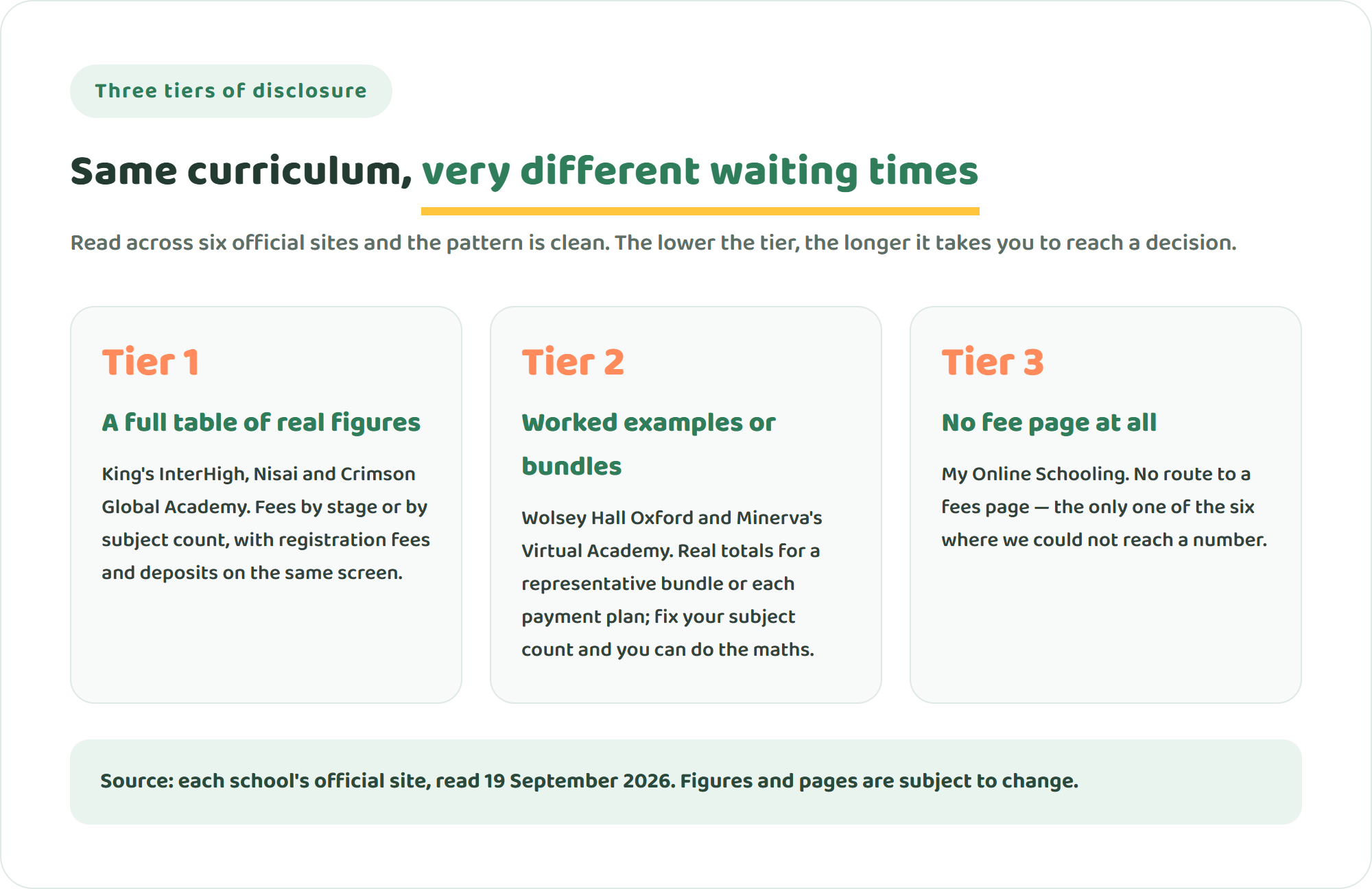
The tiers map directly onto how long it takes you to build a budget. Tier one: one hour. Tier two: one hour, once you have fixed your subject count or payment plan. Tier three: however long the school takes to reply.
1. King’s InterHigh — a full annual table, by stage
This is the most readable fee page in the group. The 2026/27 Annual Contract figures are published in full:
| Stage | Annual Contract |
|---|---|
| Primary (ages 7–11) | £4,395 |
| Middle School (ages 11–14) | £5,995 |
| GCSE (ages 14–16) | £7,250 |
| A Levels (ages 16–19) | £7,585 |
| IB Diploma | £10,990 |
Checked again on 19 September 2026, the page also carries the costs around the headline figure, on the same screen: a £100 one-off registration fee, and a deposit of £500 for UK students but £1,000 for students outside the UK. Additional subjects are £405 a year at Primary. The site describes the annual contract as saving 30% against the alternative, and it can be paid monthly across ten months from September to June. Sibling discounts exist.
For an international family, that doubled deposit is the line to notice. Year one starts at the annual fee plus £1,100 before a single lesson. In exchange, King’s InterHigh runs a full live timetable with a recorded-lesson library, and a Rolling Contract (Primary £955 per half term — a UK half term being one of six blocks in the school year, not half of it) lets you leave at the end of any block. That is a genuine way to start small. The catch is time zone: it teaches on UK hours.
2. Nisai — published per subject, in local currency, tax included
Nisai British International Online School offers International GCSE and A-Level. Its Japan-facing site publishes every course fee as an actual figure, in yen, tax included, broken down by how many subjects you take. No currency conversion, no tax to add on afterwards.
| Course | Monthly, per subject | Annual fee |
|---|---|---|
| Pre-course | from ¥29,800 | varies by pace (standard or intensive) |
| NS primary-stage course | ¥22,000 | ¥264,000 for one subject to ¥1,425,600 for six (10% off from five) |
| IGCSE course | ¥24,200 | ¥290,400 for one subject to ¥1,568,160 for six (≈£7,400) |
| A-Level course | ¥26,400 | ¥316,800 for one, ¥633,600 for two, ¥950,400 for three (≈£4,500) |
Source: Nisai British International Online School Japan site, fees page, read 19 September 2026; all figures tax-inclusive. An enrolment fee of ¥33,000 applies on first joining, stated as chargeable for the Booster, CEFR and Units of Sound programmes of four months or more. Sterling equivalents at £1 ≈ ¥211 (18 September 2026).
The real advantage here is not the price. It is that the timetable sits in the evening in the students’ own time zone. The Japan site advertises free trial lessons on Wednesdays at 20:30 and Fridays at 17:40 and 20:30 — local time, on a Japan-facing site with a Japanese-language phone line open 09:00–18:00 on weekdays. Local school by day, British live lessons in the evening, without anyone losing sleep.
The warning sits in the same place. A 20:30 start is manageable once or twice a week; stacked against homework, clubs and everything else, it can quietly push bedtime back. Write out one full week on paper during the trial before you commit. The school itself is covered in our seven-school comparison.
3. Crimson Global Academy — publishes in local currency too
CGA publishes actual figures on its Japan-facing site in yen, which again removes the exchange-rate guesswork. Full-time runs ¥2,090,000–¥2,400,000 a year by stage (¥2,720,000 for the six-credit Honours version of its US High School Diploma), and part-time starts at ¥350,000 for a single IGCSE subject.
What makes CGA structurally different is that it offers both British (IGCSE, A-Level) and American (High School Diploma, AP) tracks. Its pricing is effectively two-layered: go full-time and you approach the cost of a campus international school; add subjects one at a time and the number drops by an order of magnitude.
4. Wolsey Hall Oxford — priced by subject count, not year group
Same curriculum family, completely different pricing logic. There is no annual table at all. Fees are bundled by how many courses you take: from £600 per course for one to three, from £550 for four, from £500 for five.
The school then publishes worked examples. Its most popular eight-course GCSE bundle is £6,245 paid in full (£6,590 by instalments) — and that figure covers two years, which works out at roughly £3,120 a year. A full-time four-course AS/A Level bundle is £5,485, with AS priced for one year and A Level for two.
The defining feature is not the price, though. It is that the school states it runs “no live lessons, set timetables or crowded classrooms”. That erases the time-zone problem entirely, and hands the job of building a school day to the household. We cover the trade in detail in Wolsey Hall Oxford fees: what a no-live-lessons school actually costs. Credit where it is due: the site also lists what is excluded — a £95 registration fee, exam fees paid to your own exam centre, and international shipping quoted at cost.

5. Minerva’s Virtual Academy — publishes that the payment plan changes the total
A British online school offering IGCSE and International A Level. Its fees page is unusually candid: it shows three payment options side by side, and says outright which ones cost more overall.
| Payment option | As published | Approximate annual total |
|---|---|---|
| Annual (marked “Best Value”) | £9,365, stated as including a £930 deposit and £95 annual subscription | £9,365 |
| Termly | £3,550 per term, also stated as including the £930 deposit | £10,650 across three terms |
| Monthly | £1,100 × 10, deposit of £930 excluded | £11,930 |
Source: Minerva’s Virtual Academy official Fees page, read 19 September 2026. The termly option is described only as “includes £930 deposit” without saying whether that is once or each term, so the three-term figure is the published amount multiplied out. The site also notes that your total depends on entry point.
Same education, a spread of £2,565 a year between the cheapest and most expensive way of paying for it. The school flags this itself — “Termly plans cost more in total”, “Monthly plans cost more in total” — so nothing is hidden. It still catches families who compare the monthly figure against other schools’ annual ones.
The site also states that final IGCSE and International A Level exam entries are paid separately to the exam boards, and that optional school trips are charged separately. Its school-life menu includes a GST Timezone section, which indicates classes are offered outside UK hours — worth confirming as your very first enquiry question if you are east of the UK.
6. My Online Schooling — no route to a fee page at all
A British-curriculum online school that clearly targets families across Asia-Pacific and the Gulf; its own site carries parent comments from Dubai, Bahrain and the Asia-Pacific region.
As of 19 September 2026, however, we could find no link to a fees page on the official site, and no published figures. There is an admissions-process page, but it carries no amounts. Of the six, this was the only one where we could not reach a number. If you shortlist it, put four questions in the very first message: annual fee, registration fee and deposit, exam entry costs, and what hours lessons run in your time zone.
All six on one sheet
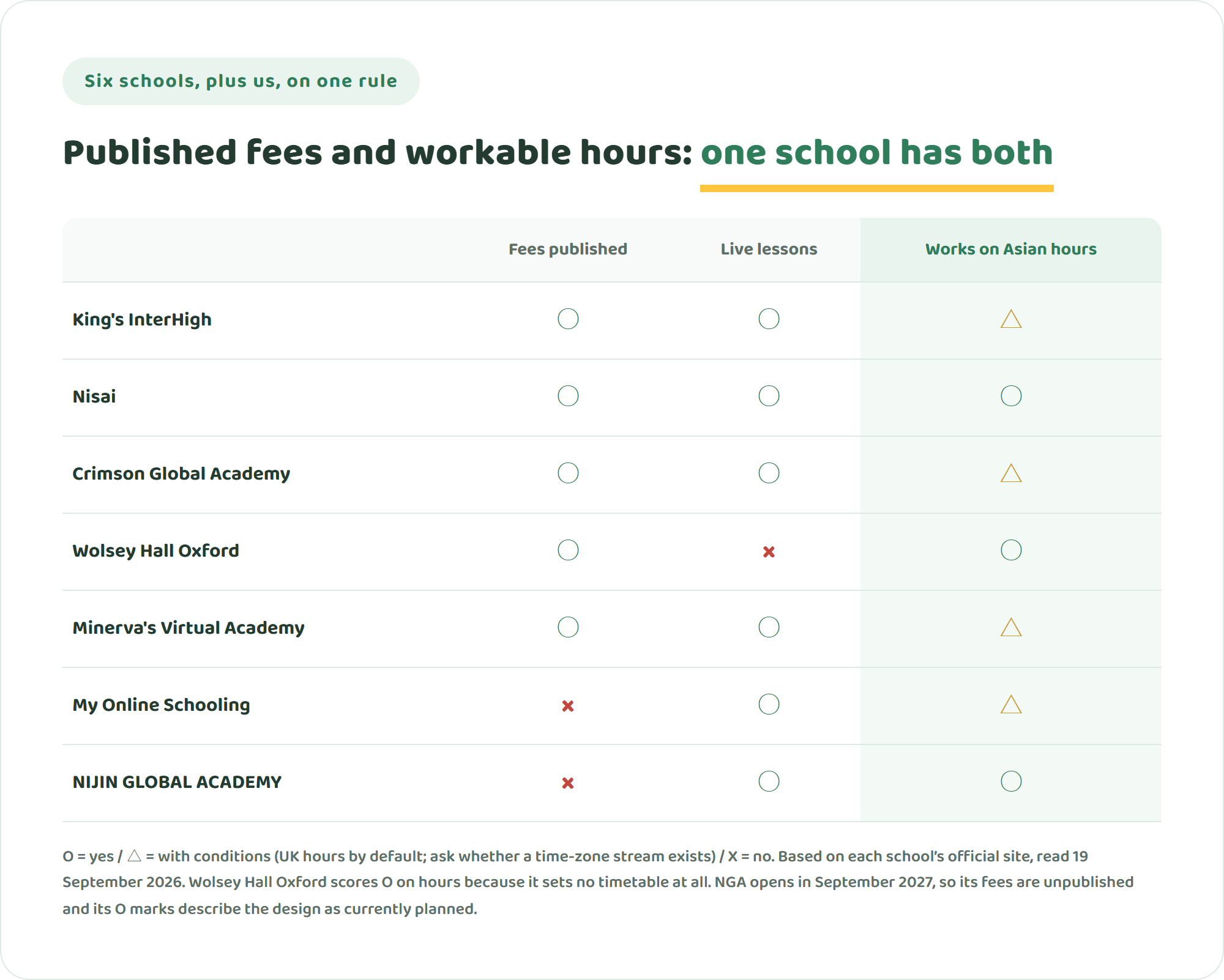
Laid out, the answer was not the one we expected. The school that has both published fees and workable Asian hours is Nisai. Its prices are set in local currency, tax included, per subject, and its lessons run in the evening where its students actually live. For a family that wants to keep a local school place and add a British qualification, that is a structural fit rather than a compromise.
Wolsey Hall Oxford also scores on both, but it means something different. It removes the time-zone problem by having no timetable at all, so the experience of being in a room with a teacher at a fixed hour is simply not part of what you are buying — which is also why it costs less. King’s InterHigh and Minerva’s sit at the top for readable pricing and teach on UK hours, so the further up the school your child goes, the later the evening runs.
NIJIN GLOBAL ACADEMY carries a cross in the fees column, because we open in September 2027 and our fee structure is still being finalised. It would be incoherent to score other schools on disclosure and exempt ourselves, so we are on the same sheet under the same rule. What we can already describe is the teaching design itself, set out in how we learn.
Three steps to a budget you can trust
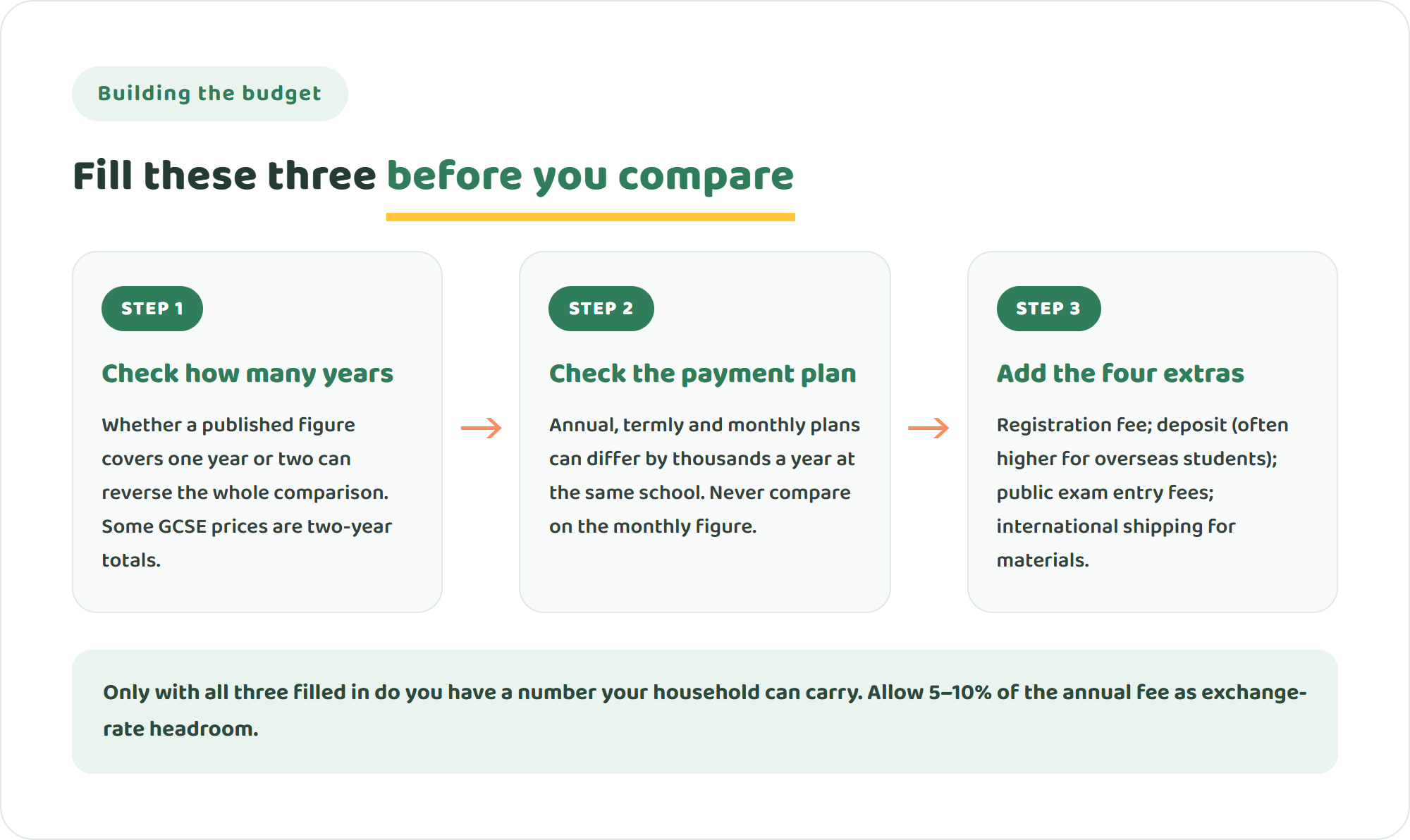
Do it in this order and every school produces a number in the same shape. Skipping step one is the expensive mistake: set Wolsey Hall Oxford’s £6,245 next to King’s InterHigh’s £7,250 and they look comparable, when the real annual gap is 2.3 times.
The costs outside the table are broadly the same four everywhere: registration fee; deposit (often higher for overseas students); public exam entry fees paid to the exam board or centre rather than the school; and international shipping for printed materials. Only with those added do you have a figure your household budget can actually carry.
If you want the American side of the market on the same axes, the Pearson Online Academy fee table is the clearest published example, and sitting IGCSE online from Japan covers the exam-entry step that several of these schools leave to you. For the everyday shape of the thing, where the hours actually go turns a timetable into real hours.
For a closer look at two British online schools, see our fee reviews of King’s InterHigh and Nisai Virtual Academy.
Common questions
So what does an online British curriculum education cost per year?
Across the figures we could verify, full-time ran from roughly £3,120 to £11,930 a year — the low end being Wolsey Hall Oxford’s eight-course GCSE bundle annualised, the high end being Minerva’s monthly plan (the same school is £9,365 paid annually). The range is that wide because the schools are selling different things: live teaching or not, a full timetable or a handful of subjects. There is no single market rate.
Is a cheaper school a false economy?
Not necessarily — but look at what has been removed to make it cheaper. No live lessons means your household builds the timetable. No exam entry service means you find the centre. Less pastoral support means you notice the problems first. None of that is wrong. It just does not disappear; it moves to you.
Does my child have to leave their current school?
Usually not. In Japan specifically, enrolling in an overseas online school does not by itself satisfy the compulsory education requirement, so most families keep the local school place and add the online track alongside it. Attendance treatment varies by school and municipality — talk to the class teacher and head before you enrol, not after.
What about currency risk?
For sterling-priced schools it lands directly on your household budget. Treat roughly 5–10% of the annual fee as exchange-rate headroom and you will not be squeezed halfway through the year. Nisai and Crimson Global Academy price in yen for their Japan markets, so that swing does not apply there.
For what Minerva’s payment rules and UK-hours timetable mean for a family in Asia, see Minerva Virtual Academy fees: what a family in Asia actually pays.
Matching the units matters more than avoiding the secretive school
We started expecting to find a market that hides its prices. Opening all six, only one did. The real problem was that the five that publish do so in units that will not add up against each other — an annual fee, a two-year total, a per-subject rate, a figure that changes with the payment plan. Skip the step of converting them to a common unit and you can read published numbers all day and still decide wrongly.
And once the units matched, the conclusion stopped being about money. The schools with the most readable pricing teach on UK hours; the school that fits an Asian evening prices itself for that market. Which means the first question is not “which is cheapest” but “what hour of a weekday can this learning live in?” Answer that, and six schools become two.
NIJIN GLOBAL ACADEMY opens in September 2027 (planned), with a pre-opening term of trial classes in April–May 2027. We are designing from that same starting point — an online international school with no campus, so a child can keep the school they already belong to and still learn subjects in English in small, talk-based classes. Our approach to fees is being worked out backwards from that, and goes to the mailing list as it is decided.