Somewhere in the search for an online international school, the name Wolsey Hall Oxford appears. It has Oxford in the title, it was founded in 1894, and it leads to British qualifications. Every directory page says that much. The moment you try to answer the practical question — what are the Wolsey Hall Oxford fees for my child, this year — you stall. There is no table of annual fees by year group on the site, because the school does not price that way.
Here is the short version. Wolsey Hall Oxford fees are set by the number of courses you take, not by your child’s year group. The published bundle pricing runs from £600 per course for one to three courses, from £550 per course for four, and from £500 per course for five. And the school states plainly on its own site that it has no live lessons and no set timetables. For a family in Asia, that single design decision matters more than the price. It removes the time-zone problem completely — and it hands the job of building a school day back to you.

What kind of school Wolsey Hall Oxford is
Wolsey Hall Oxford is an online homeschooling school based in Oxford, England, for children aged 4 to 18. Its site states that it has “been doing learning differently since 1894”, that it now has students in more than 130 countries, and that it has supported over 750,000 students. The company is registered in England (No. 9270091) with an address in Oxford.
The academic backing is specific rather than vague. According to the school’s own pages, it is one of only a handful of online schools that are Cambridge-approved for Lower Secondary, GCSE Level and A Level, and the first online school to be Cambridge-approved at Primary Level. That is a meaningful distinction. Plenty of providers describe themselves as British; rather fewer have been approved by the British exam organisation whose curriculum they teach.
And then there is the sentence that defines everything else. On its “How homeschooling with us works” page the school says its students choose what, where, when and how they study, “with no live lessons, set timetables or crowded classrooms”. Course books and an online learning platform do the teaching. A dedicated Tutor marks assignments and returns detailed feedback within three to five working days. A Student Progress Manager helps you build a personal study schedule. That is the whole model: structured, asynchronous, self-paced.
How Wolsey Hall Oxford fees actually work
Most online international schools publish an annual figure per stage: primary costs this, GCSE costs that. Wolsey Hall Oxford does not. Its fees are built from course bundles, and the more courses you take, the lower the price of each one.
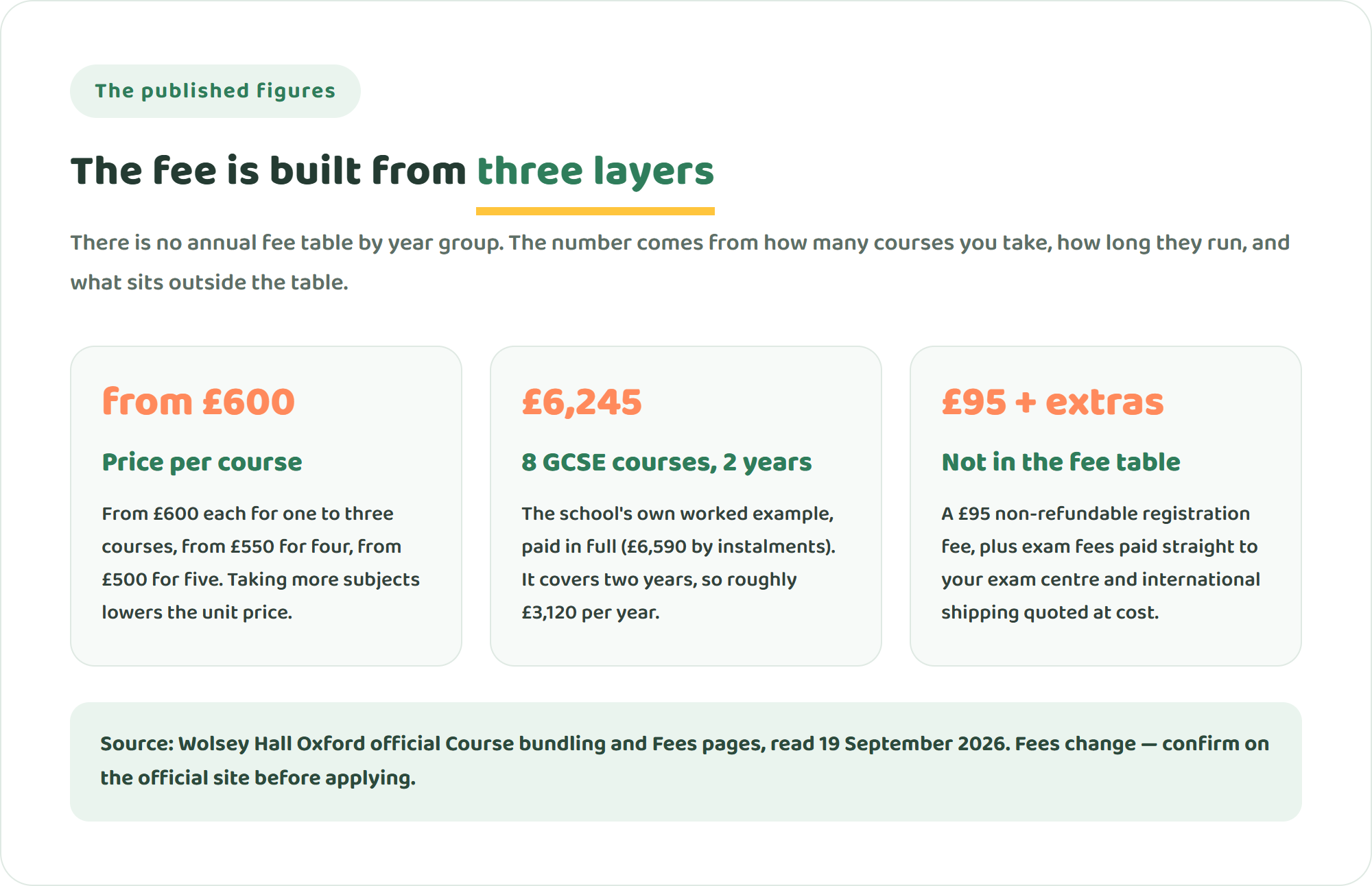
The three published tiers on the Course bundling page are:
- 1–3 courses: from £600 per course
- 4 courses: from £550 per course
- 5 courses: from £500 per course
The word “from” is doing real work there. The school notes that fees vary with both the number of courses and the level of study, so the tier alone will not give you a final number. What it will give you is the shape of the decision: at this school, choosing fewer subjects is the lever that lowers the bill, and that lever is not available at schools which sell a full-timetable package.
For families who want a concrete total, the school publishes two worked examples of its most popular bundles.
| Published example | Paid in full | By instalments | Period covered |
|---|---|---|---|
| GCSE bundle, 8 courses | £6,245 | £6,590 | Two years (≈£3,120/year) |
| Full-time AS / A Level, 4 courses | £5,485 | £5,780 | AS priced for 1 year, A Level for 2 |
| Each additional GCSE course | from £700 | — | |
| Each additional A Level course | from £800 | — | |
| Registration fee (one-off, per student) | £95 | Non-refundable | |
Source: Wolsey Hall Oxford official Course bundling and Fees pages, read 19 September 2026. Fees change; confirm on the official site before you apply.
The detail most families miss is the period. The school states that Primary, Lower Secondary and single AS Level fees cover one year of study, while GCSE Level and full A Level fees cover two. So £6,245 is not an annual figure. Spread across two years it is roughly £3,120 a year for eight GCSE subjects — which is where the comparison with live-lesson schools becomes stark. A British online school that runs a full live timetable charges more than twice that per year — King’s InterHigh, for instance, lists £7,250 a year for GCSE. Neither is overpriced. They are selling different things.
Four costs the fee table does not include
To its credit, Wolsey Hall Oxford lists what is excluded. Read that list before you budget, or your number will be wrong.
- £95 registration fee — one-off, per student, non-refundable.
- Exam fees — these are not paid to the school. They are paid directly to the exam centre you choose. Finding that centre is your job, not the school’s.
- International postage — course books are included and UK shipping is free, but international shipping is quoted separately, at cost. A full set of printed textbooks sent to Asia is not a rounding error.
- Exam texts — students source their own if required; the school notes most exams do not allow them anyway.
Point two deserves emphasis, because it is the one that surprises people after enrolment. “You can gain a British qualification” can mean two very different things: a school that enters you for exams, or a school that teaches the syllabus and leaves the entry to you. Wolsey Hall Oxford is the second kind. If you are working out how that plays out from Asia, sitting IGCSE online from Japan walks through the centre-finding step in detail. Do it before you pay, not after.

What happens when you use it from Asia
This is the part worth slowing down for.
No live lessons means no time zone. For families in Japan, Singapore, Bangkok, Hong Kong or Sydney, the time difference is usually what kills a British online school in the final round. A 9am lesson in the UK lands in the late afternoon or evening across most of Asia, and as subjects stack up through the senior years, dinner and bedtime slide with them. At Wolsey Hall Oxford that problem simply does not exist. Morning, evening, weekend — the work is where you put it. For a family that wants to keep a local school place and add an English-medium track alongside it, that flexibility is genuinely hard to match.
The cost is symmetrical. If the school does not set the timetable, someone else has to. In practice that someone is a parent. The school does provide a Student Progress Manager to help design a study schedule, but nobody is going to notice at 9:15 on a Tuesday that your child has not started.
So, honestly: a child who struggles with self-direction will struggle most at a self-directed school. If the reason you are looking at online options is that school stopped working, be careful not to buy more freedom than your child can carry right now. Conversely, for a student who can already run their own day — or one whose training, health or travel makes fixed hours impossible — this is close to an ideal design. The school’s own student stories feature learners with autism and dyslexia alongside a tennis player and a cyclist, and that is not accidental marketing; it is who the model fits.
How to read the reviews
Wolsey Hall Oxford displays its Trustpilot score on every page. As of 19 September 2026 it reads Excellent, 4.9 out of 5, based on 415 reviews. That is a strong score and there is no reason to discount it.
There is one reason to read it carefully. Trustpilot does not publish where its reviewers are based, so the number tells you nothing about who those families are. What the school does show, under Student stories, are learners in the UK, Kenya, Tanzania, Russia and Namibia — and none in Asia. “The materials are well structured” and “the tutor feedback is fast” are true and useful. They still do not answer the questions an Asian family actually has: can we sit the exams locally, what does shipping cost to our country, and can we keep our child’s local school place while doing this?
Ask the school these four instead. They are comparable across every provider you are considering:
(1) roughly what does international shipping to our country cost; (2) will you help us find an exam centre locally, or is that entirely on us; (3) do you have students in our country now; (4) is there any support in our home language for the parent, not just the student?
Wolsey Hall Oxford next to the alternatives
A single school in isolation tells you nothing about whether it is expensive or suitable. Put the design choices side by side instead.
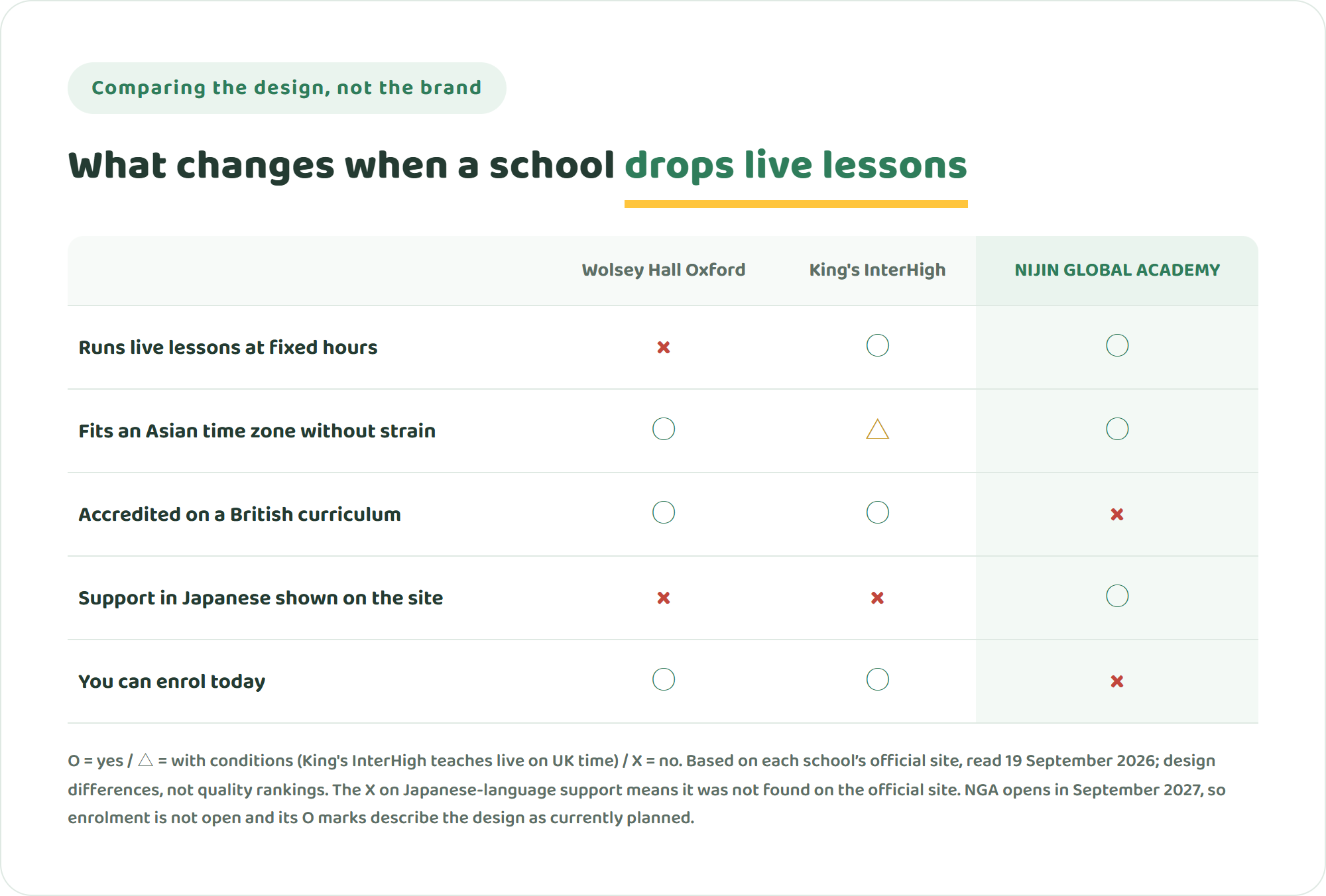
The table is not a ranking. The point is that by not running live lessons, Wolsey Hall Oxford erases both the time-zone problem and much of the cost — and by running them, a school like King’s InterHigh takes on the job of keeping a child moving every day. Which trade you want depends entirely on whether your child can sit down at a desk without being asked. If you want the same read across more providers, seven online international schools compared sets them out on the same three axes, and the Pearson Online Academy fee table shows what the American equivalent looks like when a school does publish everything.
Three things to settle before you apply
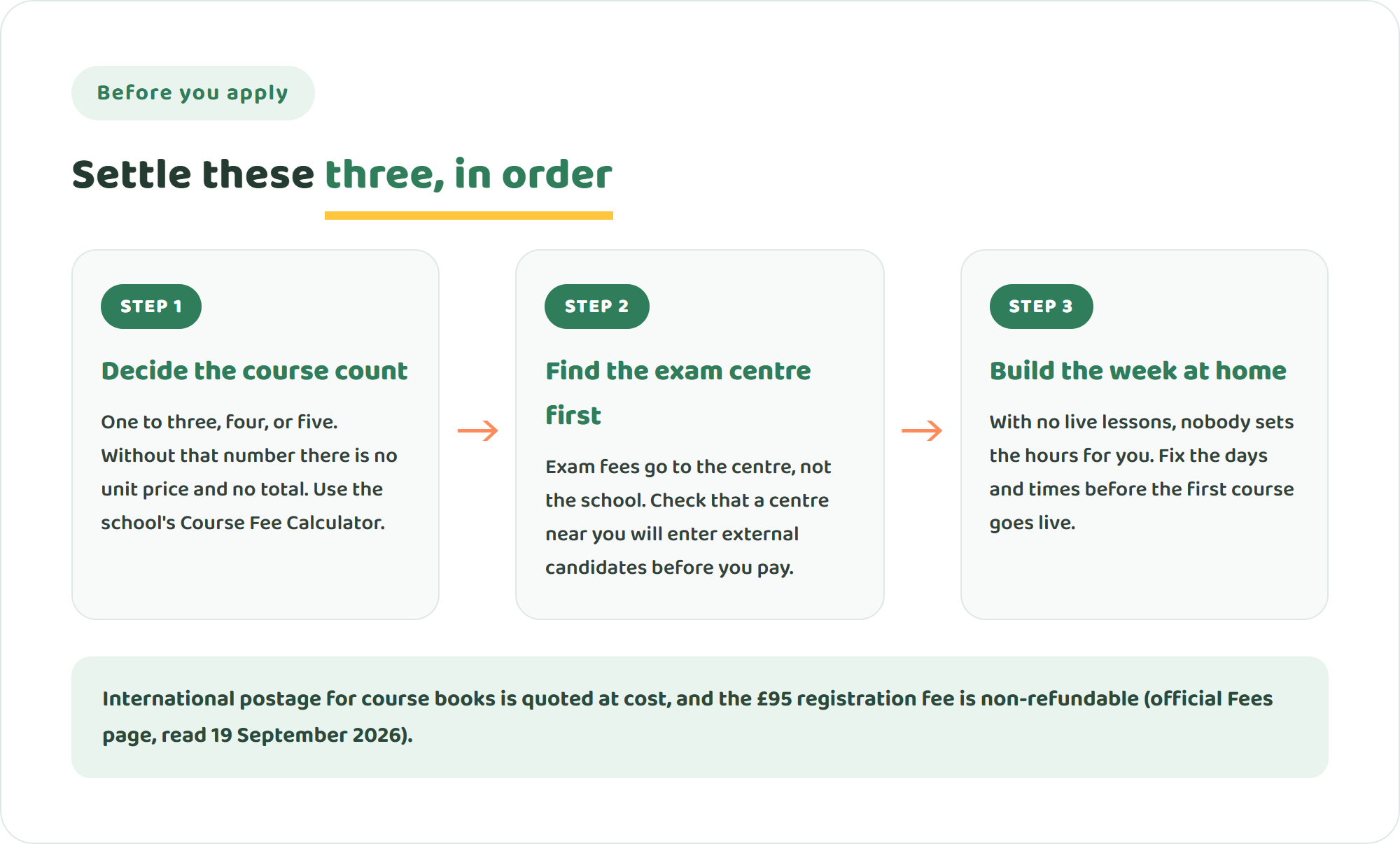
The order matters. Without a course count there is no price; without an exam centre there is no qualification; without a timetable there is no second term. Settle those three and the application itself is trivial.
If step two is where you get stuck, it is worth asking whether a British qualification is what your family actually needs. The seven high school routes open in Japan lays out the alternatives, including ones that keep a local school place. And if you want to see what a day looks like at a school that does run live lessons, where the hours actually go converts a timetable into real hours — including how we are designing ours, described in how we learn.
Common questions
What should I budget per year for Wolsey Hall Oxford?
Using the school’s own examples: roughly £3,120 a year for a full-time eight-course GCSE programme (£6,245 across two years), or £5,485 in total for a full-time four-course AS/A Level programme. Add the £95 registration fee, international shipping (quoted at cost) and exam fees paid to your centre. Until you decide how many courses to take, no accurate figure exists. The school’s Course Fee Calculator is the reliable way to get one.
Can we enrol from outside the UK?
The school states it has students in over 130 countries and prices international shipping, so overseas enrolment is clearly within its model. Conditions can change by year, so confirm directly. We will not assert it on the school’s behalf.
Does my child have to leave their current school?
Usually not. In Japan, enrolling in an overseas online school does not by itself satisfy the compulsory education requirement, so most families keep the local place and add the online track alongside it. Attendance treatment varies by school and municipality, so speak to the class teacher and head before you enrol.
With no live lessons, how does my child ask a question?
Through the assignment cycle. A dedicated Tutor marks work and returns detailed feedback within three to five working days, language courses include online speaking practice, and a Student Progress Manager supports pacing. It is not a model where a question asked now gets answered now — which is fine for some students and unworkable for others.
Freedom is a design choice, not a default
By declining to run live lessons, Wolsey Hall Oxford removed the one obstacle that stops most Asian families from choosing a British online school, and it lowered the price while doing it. Cambridge approval is real. The fee logic, once you see it, is transparent. The official site answers all of that with numbers.
What it cannot answer is whether your child will sit down on their own on a Tuesday morning. That is not a question about school quality; it is a question about fit. For a self-starting student, few options come close. For a child who is still building that muscle, a school with people in the room at a fixed hour will last longer.
NIJIN GLOBAL ACADEMY opens in September 2027 (planned), with a pre-opening term of trial classes in April–May 2027. We are an online international school with no campus, designed so a child can keep the school they already belong to and still learn subjects in English, in small, talk-based classes — because we would rather children came to like themselves and the world than be sorted by a score. Join the mailing list and we will send the curriculum, the timetable, our approach to fees and first-intake details before they go public.
Nothing has to be decided today. But the more options you can line up honestly, the less regret there is later.