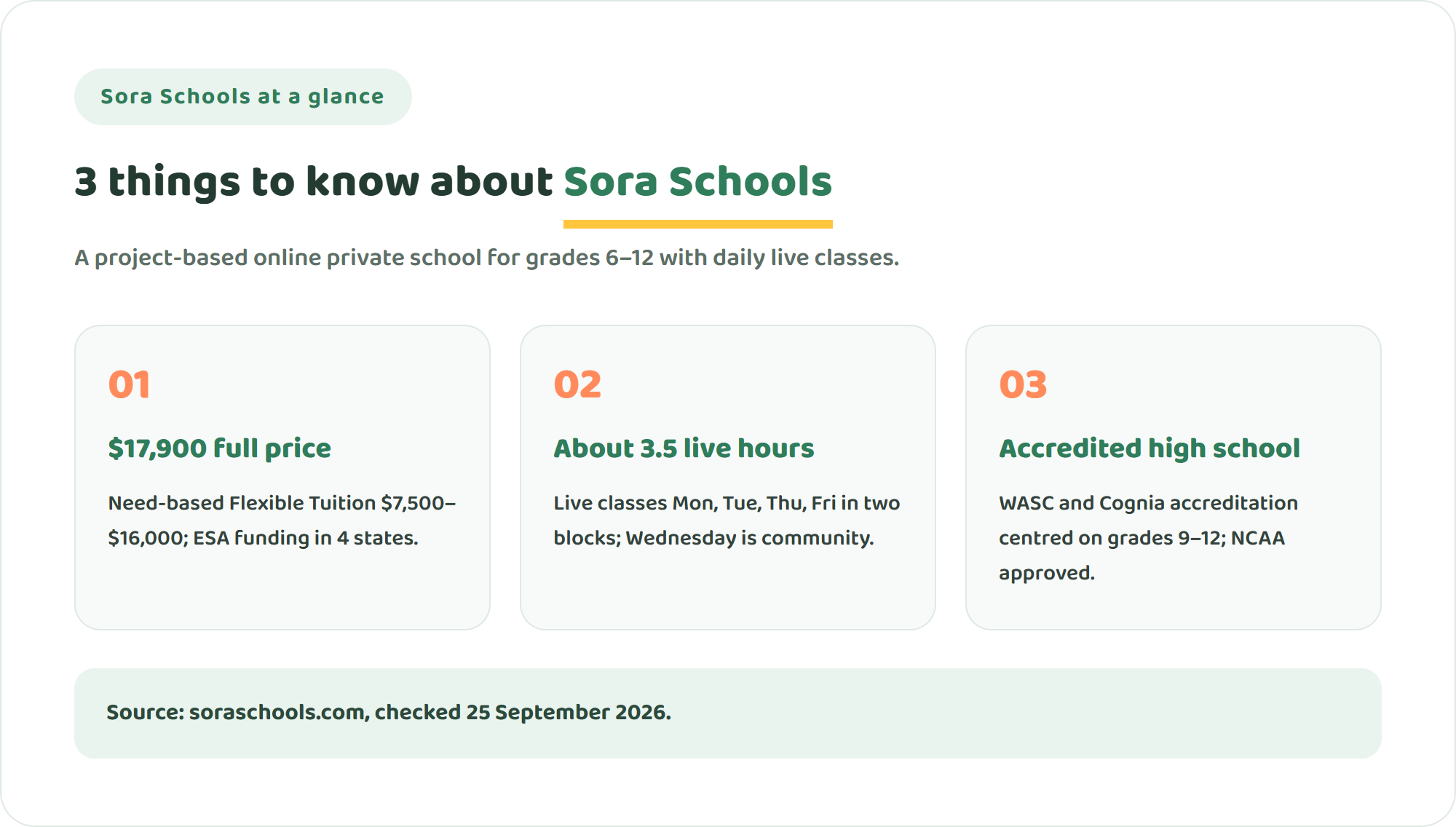
Sora Schools tuition is $17,900 per year at full price ($1,790 per month) for its online private middle and high school (grades 6–12), and the school says most families pay less: need-based Flexible Tuition ranges from $7,500 to $16,000 a year, with a median of about $8,700 (official tuition page, checked 25 September 2026). Families in Arizona, Utah, West Virginia and New Hampshire can also apply state Education Savings Account (ESA) funds, which the school says may cover tuition in full for some families. The tuition page does not print an academic-year label, so treat these as the current published prices and confirm them before you apply.
If you searched “Sora Schools tuition” or “Sora Schools review”, you probably want more than the headline number: what the $17,900 includes, how a project-based online school day actually runs, whether the diploma is recognised by colleges, whether you can enrol from outside the United States, and what families raise as concerns. This page answers those questions from Sora’s own website first, then compares it fairly with Alpha School, Laurel Springs School and NIJIN GLOBAL ACADEMY, a different kind of online school that opens in 2027.
The short answer: who Sora Schools suits — and who it doesn’t
- Suits: middle and high school students (grades 6–12) who learn best through projects and discussion rather than tests. Sora’s classes blend subjects into 12-week “expeditions” that end in a project presentation, and assessment is mastery-based.
- Suits: students who want real people on screen every day. Sora says students spend about 3.5 hours a day in live meetings — a daily advisory “house” meeting, live classes and office hours — with a 9:1 student-to-teacher ratio.
- Suits: families with irregular lives — military families, athletes, performers, families living abroad — who need school to travel with them and leave the afternoon free.
- Suits: families in Arizona, Utah, West Virginia or New Hampshire, where Sora is an approved ESA provider, and families who qualify for need-based Flexible Tuition.
- Harder fit: children in elementary school. Sora only serves grades 6–12.
- Harder fit: students who are still learning English. Sora’s FAQ says all lessons are in English, students are expected to demonstrate English proficiency, and transcripts must be submitted in English.
- Harder fit: students who need a fully self-paced school with no fixed live times, or families whose day falls outside US school hours; live classes run on a US-based timetable.

What Sora Schools is
Sora Schools describes itself as an accredited online private school for grades 6–12. According to its About page, founder and CEO Garrett Smiley started Sora in 2019 to build an online private school around project-based learning, interdisciplinary study and mastery-based assessment. The school calls itself “the first private school” to bring that progressive approach into the online space. Everything is delivered online; there is no campus, although families can form in-person “Sora Pods” — small local groups of enrolled Sora students who learn together each day while following Sora’s live online classes.
The school runs two programs: an online middle school (grades 6–8) and an online high school (grades 9–12). Students are grouped into “houses” that meet daily with a faculty advisor, and Wednesdays are reserved for clubs, all-school meetings and one-to-one time with teachers instead of classes. Sora’s pages give slightly different reach figures depending on the page (between 45 and 48 US states and between 12 and 18 countries), which is normal for a growing school but worth knowing if you are looking for classmates in your region.
| Item | Sora Schools (official) |
|---|---|
| Type | Private, tuition-based online school (not a free public/charter program) |
| Founded | 2019, by Garrett Smiley |
| Grades | 6–12 (Middle School 6–8, High School 9–12) |
| Accreditation | WASC and Cognia (centred on the high school, grades 9–12); approved by the NCAA; member of the Mastery Transcript Consortium |
| Learning model | Live, synchronous classes plus independent project time; 12-week project “expeditions”; mastery-based assessment |
| Live time | About 3.5 hours a day; 3 hours 20 minutes of live classes and office hours on Mon, Tue, Thu, Fri; Wednesday is community day |
| Student-teacher ratio | 9:1 |
| Start dates | Rolling admissions; three enrolment periods a year (Fall, Winter, Spring) |
| Full tuition | $17,900 per year ($1,790 per month) |
Sora Schools tuition and fees (2026–27, official)
These figures come from the official Sora Tuition & Affordability page and the About page, in US dollars. The same prices apply to middle and high school; the site does not list different tuition by grade.
| Tuition level | Per year | Per month | Who it applies to |
|---|---|---|---|
| Full tuition | $17,900 | $1,790 | Families not receiving aid; the school says this is the maximum anyone pays |
| Flexible Tuition — higher band | $16,000 | $1,600 | Need-based, set after a financial review |
| Flexible Tuition — median family | $8,700 | $870 | Median in the program (median household income in the program: $100,000) |
| Flexible Tuition — lower band | $7,500 | $750 | Need-based, set after a financial review |
| ESA-funded | As low as $0 | As low as $0 | “Select ESA-eligible families” in AZ, UT, WV and NH |
What is included. Sora’s tuition page lists curriculum, books and testing, live teachers and small classes, project-based expeditions, one-to-one mentorship, college counselling, the learning platform and an accredited transcript as included in tuition, and says there are no annual fundraising asks. The high school page adds that dual enrollment is included, meaning students can earn college credit — the school says up to an associate’s degree — “with no additional costs”. Partners named in the official FAQ are Arizona State University’s Universal Learner program and the Acadeum consortium.
Other fees. The application fee is $50; if the student is admitted and enrolls, it is applied to tuition (admissions page). The tuition page describes other application and enrolment fees only as “Minimal”; exact amounts for any enrolment deposit are not published on the official site. Refund terms and the length of the monthly payment plan are also not published on the official site, although $1,790 a month equals $17,900 over ten months.
Discounts and funding. The school says it awards over $3 million a year in need-based Flexible Tuition grants, and you apply for them during the normal application. Military families (active-duty, reserve and veteran) get reduced tuition, but the size of that discount is not published on the official site. Families who form a Sora Pod may qualify for a tuition discount of up to 15%. The ESA page says Sora is an approved provider in Arizona, West Virginia, New Hampshire and Utah, and is not eligible in North Carolina, Florida, Indiana, Arkansas, Mississippi, Montana, South Carolina or Iowa. 529 plans and other education savings accounts can also be used. A sibling discount is not published on the official site.
Total-cost example (official numbers only). A family with two children who each spend four years at Sora at full tuition would pay $17,900 × 4 years × 2 children = $143,200, plus two $50 application fees that are credited back to tuition on enrolment. For one child at the Flexible Tuition median, four years would be $8,700 × 4 = $34,800. Your own figure depends on your financial review and state, so use the estimator on the official tuition page rather than either example. For context on how online schools compare with in-person international schools on cost, see our guide to online vs in-person international school costs.
How a school day works: schedule, live classes and time zones
Sora’s “A Day in the Life” page describes the day in three parts. It starts with a 15-minute check-in with a small advisory group and a dedicated advisor, who is the main adult supporting the student. Then come about two to three hours of live classes, balanced with independent work on personalised assignments, projects and clubs. By early afternoon the rest of the day belongs to the student — the page gives examples such as sports practice, volunteering or an internship shift.
The middle and high school pages give the exact structure: 3 hours and 20 minutes of live classes and office hours on Monday, Tuesday, Thursday and Friday, with families choosing between two schedule blocks (or mixing them). Wednesday has no classes; it is a community day for club meetups, all-school meetings and one-to-one time with teachers. The official FAQ puts the typical total at about 3.5 hours a day of live meetings. Each trimester, students take three to four expeditions, and each 12-week expedition ends with a project presentation. The school says it offers more than 400 expeditions across maths, science, social studies and English, plus independent studies, a mentorship program in grade 11 and a capstone project in grade 12.
Time zones. The clock times of the two schedule blocks are not published on the official pages we checked. Sora is a US school serving families in most US states, so the blocks are built around a US school day. If you live in Europe, Asia or Oceania, ask admissions exactly which local hours each block falls in before you apply — this is the single most important practical question for an international family, and it is not answered on the public site. For a general picture of how online international schools structure the day, see a day at an online international school.
Accreditation, diploma and college recognition
Sora’s homepage says the school is “fully accredited by Cognia and WASC, approved by the NCAA and Mastery Transcript Consortium”. A detail many reviews miss is on Sora’s own accreditation article (updated 21 September 2026): the school states that its accreditation through both WASC and Cognia “centers on grades 9 through 12”, and that the middle school (grades 6–8) “isn’t the focus of the school’s accreditation”. For most families this matters little, because accreditation is what colleges look at on a high school transcript — but it is worth knowing if you need an accredited middle school record for a transfer.
Students graduate with what Sora describes as an accredited high school diploma. The school says its transcript shows credits, GPA and individual projects. High school students must complete one PE credit (done at home) and two levels of a world language through Rosetta Stone. The total number of credits required for the diploma is not published on the official pages we checked.
On outcomes, Sora’s “Life After Sora” page says 95% of its students are accepted to one of their top three college choices, and its FAQ names acceptances at Harvard, Tufts, Georgia Tech, Rhode Island School of Design, William & Mary and the University of Southern California. The school also describes a “path-agnostic” counselling approach that supports students heading to work, a business or a gap year. These are the school’s own figures; it does not publish the size of each graduating class alongside them.
Sora Schools vs NIJIN GLOBAL ACADEMY vs two other options (official data)
Below, Sora is compared with two well-known US alternatives — Alpha School (an in-person private school known for its “2-hour learning” model) and Laurel Springs School (a self-paced online private school) — and with NIJIN GLOBAL ACADEMY (NGA). NGA is a different kind of option, not a replacement: it has not opened yet and has no accreditation or graduates.
| Item | Sora Schools | NIJIN GLOBAL ACADEMY | Alpha School | Laurel Springs School |
|---|---|---|---|---|
| School type | Private online school, live + project-based | Online international school (opening September 2027, planned) | Private in-person campus school; adaptive software + workshops | Private online school, mostly self-paced |
| Grades / ages | Grades 6–12 | Ages 6–18 | PreK/K–8 at most campuses; some campuses K–12 | K–12 |
| Tuition (2026–27) | $17,900/yr full; Flexible Tuition $7,500–$16,000; ESA in 4 states | Not yet published (no enrolment, facility or uniform fees; materials included; sibling discounts) | $10,000–$75,000/yr depending on campus (Austin $40,000) | $7,200–$17,250/yr by program (High School $11,700) |
| Curriculum | Interdisciplinary expeditions, mastery-based; dual enrollment included | Subjects learned in English; CEFR-based English levels; co-creation projects; optional Cambridge IGCSE / A-Level pathway | About 2 hours of core academics on adaptive software, then life-skills workshops | Self-paced courses incl. Honors/AP; see official site |
| Live classes & time zone | About 3.5 hrs/day live, 4 days a week; two blocks on a US timetable (clock times not published) | Small live groups of about 8; timetable built for Asia & Oceania daytime — may fall outside daytime in the Americas/Europe | Full in-person school day at the campus | Asynchronous 24/7; live weekly Workshops in The Academy tier |
| Accreditation / diploma | WASC and Cognia (grades 9–12); accredited US diploma | Not yet accredited; no graduates yet | Cognia (per school site) | WASC and Cognia; accredited US diploma |
| Admission | Application ($50), parent meeting, student interview, teacher evaluation, records; English proficiency expected | No entrance exam; no English requirement | Info session, $100 application, shadow day, MAP results | Application via Parent Portal, transcripts; see official site |
| Start dates | Fall, Winter, Spring; applications reopen in October | Opens September 2027; free trial classes monthly from September 2026 | See official site | Rolling — almost any Wednesday |
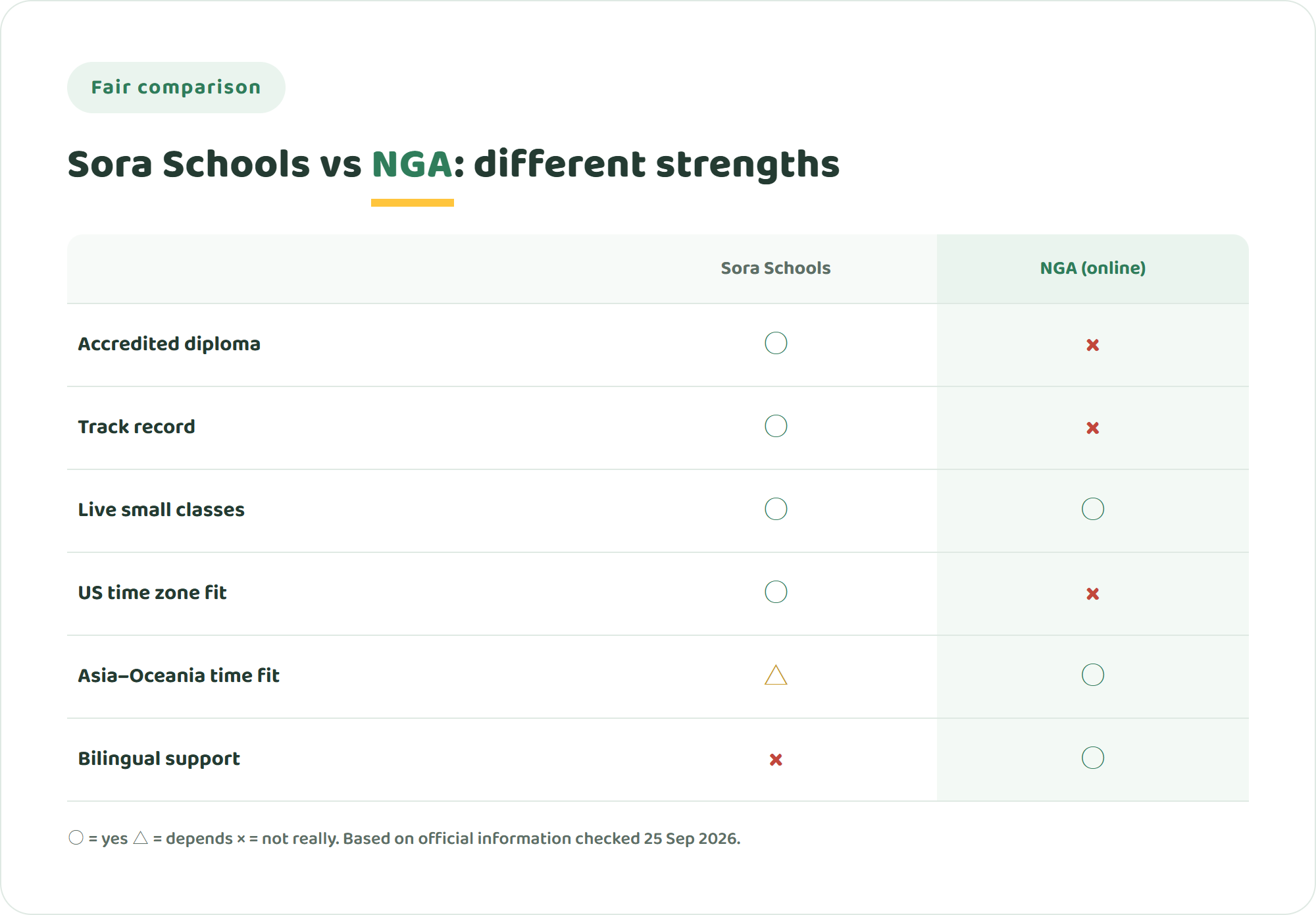
Sources: Sora tuition, Sora admissions, Alpha School locations, Alpha School admissions, Laurel Springs tuition, NGA’s curriculum and timetable page — checked 25 September 2026.

Reviews and common concerns, answered honestly
Parent and student reviews on third-party sites such as Niche are mixed: many praise the teachers, the projects and the sense of community, while others describe frustrations with communication and organisation. Below are the recurring themes, and where Sora addresses them on its own site.
“Is it rigorous without tests and letter grades?”
This is the most common question about project-based schools. Sora uses mastery-based assessment: students show what they have learned through projects and can improve work over time rather than sitting traditional tests. The high school page lists the standard US course content behind the projects — Algebra I through Calculus, Biology, Chemistry, Physics, US and World History, American Government, and a sequence of literature and composition courses. Whether this suits your child depends on how self-directed they are; the model gives students a lot of independent time.
“How much independent work is there?”
Live time is about 3.5 hours a day, four days a week. The rest is independent work on projects, assignments and clubs. Students who need an adult to structure their afternoon may need support at home. Sora’s answer is the daily advisory meeting and a dedicated advisor who works with both student and parents.
“Will my child make friends online?”
Sora points to daily house meetings, student-led clubs, more than 20 events a year (spirit week, movie nights, prom), week-long trips tied to expeditions, and in-person Sora Pods. Families who want daily in-person contact can look at forming a pod, which the school supports.
“Communication and organisation”
Some reviews mention inconsistent communication. Sora’s admissions page describes a structured onboarding (workshops, advisor meetings, welcome-week activities, new-student check-ins and parent chats). The practical step is to ask admissions, during the intro call, how and how quickly teachers and advisors respond to parents.
“Does it work from outside the US?”
Yes, officially: Sora has a page for families living abroad and says it has families in countries including India, Italy, Mexico, Switzerland and China. The limits are English — the FAQ expects proficiency — and time zones, since block times are not published. Families in Asia or Oceania should check the local time of each block carefully.
“Is $17,900 worth it when public online school is free?”
Free state-funded online programs exist in most US states, and Sora is not one of them. What the tuition buys, according to Sora, is small live classes (9:1), project-based expeditions, an advisor, college counselling and dual enrollment at no extra cost. If you live in an ESA state or qualify for Flexible Tuition, the real price may be far lower than the sticker price.
Alternatives to Sora Schools worth comparing
Laurel Springs School — if you want an accredited US diploma with maximum flexibility and a K–12 range, Laurel Springs is mostly self-paced, with rolling starts. See our full Laurel Springs School tuition and review.
Alpha School — if you live near a campus and want an in-person school built around short adaptive-software sessions and afternoon life-skills workshops, compare costs campus by campus in our Alpha School tuition and review.
NIJIN GLOBAL ACADEMY (NGA) — an online international school for ages 6–18 focused on Asia and Oceania, opening in September 2027 (planned), with a first cohort of 100 students. Classes are small live dialogue groups of about 8, subjects are learned in English with a bilingual (English–Japanese) mentor, and English is taught by CEFR level. There is no entrance exam and no English requirement, and NGA can run alongside a local school or as the main school. Tuition is not yet published; NGA says it will be far more affordable than a typical international school, with no enrolment, facility or uniform fees, materials included and sibling discounts. The honest limitations: it is not yet open, not yet accredited, has no graduates, and its timetable is built for Asia–Oceania daytime, so live classes may fall outside the day for families in the Americas or Europe. Free trial classes run monthly from September 2026. It is operated by NIJIN Inc. in Japan, whose alternative school NIJIN Academy has more than 1,000 students.
For a wider view, see our overview of online international schools compared, including Pearson Online Academy tuition.
FAQ
How much does Sora Schools cost per year?
Full tuition is $17,900 per year ($1,790 per month) for grades 6–12. Need-based Flexible Tuition ranges from $7,500 to $16,000 a year, with a median of about $8,700. ESA funds may cover tuition for eligible families in Arizona, Utah, West Virginia and New Hampshire. The $50 application fee is credited to tuition if the student enrolls.
Is Sora Schools accredited?
Yes. Sora states that it is accredited by WASC and Cognia, approved by the NCAA and a member of the Mastery Transcript Consortium. Its own accreditation article says both accreditations centre on the high school program (grades 9–12).
Can international students enrol at Sora Schools?
Yes. Sora has families outside the US and a dedicated page for families living abroad. Students are expected to be proficient in English and to submit transcripts in English. Check the local time of the two schedule blocks with admissions, because the block times are not published on the website.
Is Sora Schools worth it?
It depends on your child. Sora is a strong fit for self-directed middle and high schoolers who enjoy projects, discussion and live classes and who want an accredited diploma with college counselling and dual enrollment included. It is a weaker fit for students who need a fully self-paced schedule, who are still learning English, or who live far from US time zones. Reviews are mixed on communication, so ask admissions how advisors keep parents informed.
What are the alternatives to Sora Schools?
Common alternatives include Laurel Springs School (self-paced, accredited, K–12), Alpha School (in-person campuses with a short adaptive-learning day) and, for families in Asia and Oceania who want small bilingual live classes, NIJIN GLOBAL ACADEMY, which opens in September 2027 (planned) and is not yet accredited.
Choosing calmly
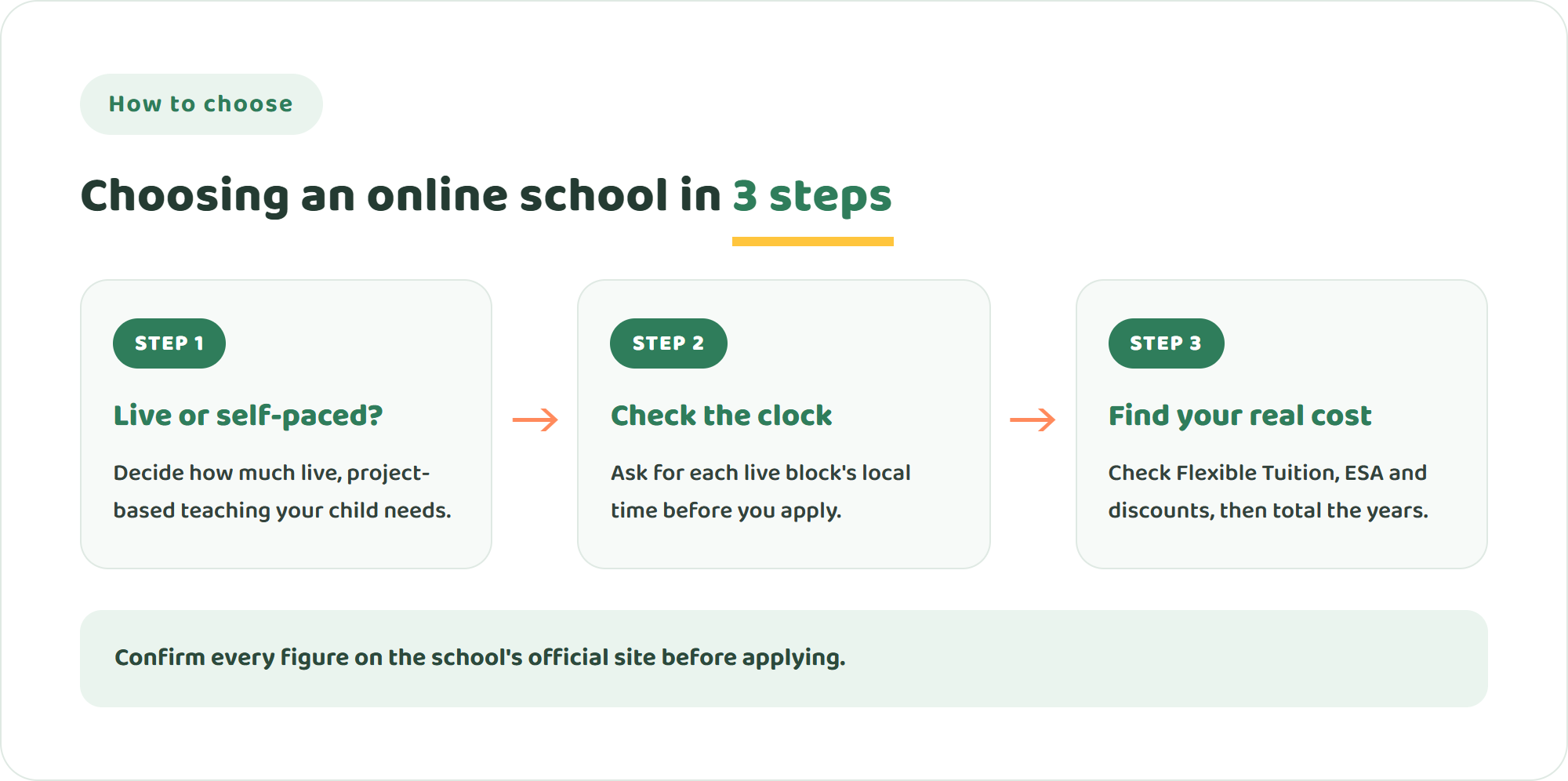
Sora Schools is a thoughtful, accredited option for project-minded teenagers, and its Flexible Tuition and ESA eligibility mean many families pay well under the $17,900 sticker price. The best next step is simple: watch Sora’s info session, book the intro call, and ask the three questions the website does not answer — the clock times of each block in your time zone, your likely Flexible Tuition figure, and how advisors communicate with parents. If your family lives in Asia or Oceania, or your child is still growing into English, it may also be worth keeping a small bilingual option in view. There is no rush; the right school is the one whose day fits your child’s day. You can read more about why families choose an online international school.
Tuition and admissions details were checked on the official websites on 25 September 2026. Schools revise fees every year — always confirm on the official site before applying.
Get NGA opening updates by email →
Related reading
- Alpha School vs Sora vs Primer——three new school models, and which a family in Asia can actually use