Look at online international schools for long enough and you hit a fork in the road. British curriculum (IGCSE, then A Level) or American (high school diploma and AP)? While you are comparing school names it is easy to miss that these are not two flavours of the same thing. They build qualifications differently, they run on different clocks, and the money behaves differently too.
The short version: the British system asks a student to narrow down and prove themselves in external exams. The American system asks them to accumulate credits broadly and prove themselves through daily grades. And for a family living in Asia, the deciding factor is usually not the curriculum at all — it is the clock. Nine in the morning in the UK is early evening across most of Asia. Nine in the morning on the US East Coast is 22:00 or 23:00 there. Only one of those fits after school. This guide compares the two honestly on four axes: qualifications, hours, cost, and where each one leads.

British vs American online international school: who awards the marks
In one line: the two systems disagree about who awards the marks.
In the British system, the external exam result is the qualification. Students sit IGCSEs at roughly 14–16 and A Levels at 16–18, and the exams are set and marked by exam boards — Cambridge, Pearson Edexcel and others — not by the school. The school teaches the syllabus; someone else grades it. That is why a British transcript reads as a list of subjects and grades rather than a school record, and why which subjects a student took matters more than where they studied.
In the American system, the school awards credits, and those credits add up to a diploma. A GPA accumulates from everyday assignments, quizzes and participation, and students who want to show extra rigour add AP courses. Because the school itself issues the qualification, who accredits the school becomes the critical question. Pearson Online Academy, for example, lists its accreditors openly in its site footer: SACS CASI, the Northwest Accreditation Commission, NCA CASI and the Middle States Association. If a US-style online school will not name its accreditors, that is your answer.
The practical consequence is about reversibility. British subjects can be added or dropped one at a time. American credits form a total that must be completed, so changing schools mid-route turns into a credit-transfer negotiation. Put simply: the American model is built for one school across many years; the British model is built for collecting the qualifications you actually need.
Three differences to hold in your head
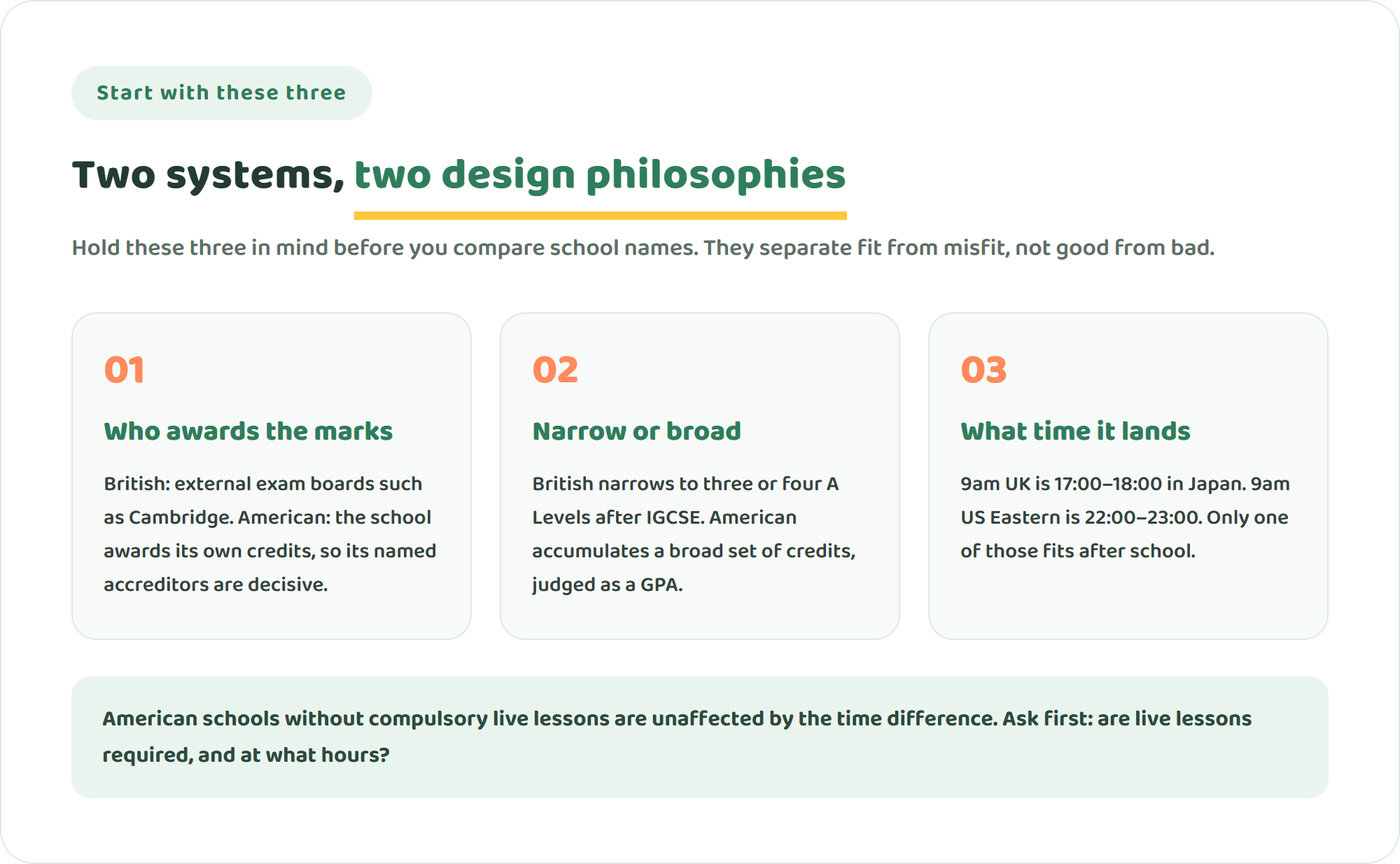
Of the three, the third is the one that decides whether a family lasts a year. Curriculum preferences can be revised. Time zones cannot.
The clock: what each system does to your evening
Japan Standard Time is UTC+9. The UK runs at UTC+1 in summer (BST) and UTC+0 in winter (GMT). US Eastern is UTC−4 in summer (EDT) and UTC−5 in winter (EST). Converted, that looks like this:
| Local time at school | British school (UK time) → JST | American school (US Eastern) → JST |
|---|---|---|
| 09:00 | 17:00 (summer) / 18:00 (winter) | 22:00 (summer) / 23:00 (winter) |
| 12:00 | 20:00 / 21:00 | 01:00 / 02:00 next day |
| 15:00 | 23:00 / midnight | 04:00 / 05:00 next day |
That table is effectively the conclusion. A British school’s morning lands on an Asian family’s after-school hours. It is late for a seven-year-old, but 17:00–19:00 is a schedule a household can actually run. A US-style school with compulsory live lessons lands in the middle of the night. No family sustains that by cutting into a child’s sleep.
There is an important qualifier, though. Most American online schools do not require live attendance. Where the model is asynchronous — materials, assignments and teacher contact inside a learning management system, as at Pearson Online Academy — the time difference stops mattering. So the question to ask a US-style school is not “are you American?” but “are live lessons required, optional, or absent, and at what hours?” Families who skip that question tend to quit for reasons that have nothing to do with the teaching.
Adjust for where you are: Singapore, Hong Kong and Malaysia (UTC+8) subtract an hour from the JST column; Bangkok and Jakarta (UTC+7) subtract two; Sydney adds one or two depending on the season.

The money behaves differently — seen inside a single school
Comparing costs across schools mixes in currency and pricing policy. To isolate the systems, here is Crimson Global Academy, which sells both, as published on its Japan-facing site. Same school, same currency, same year, so only the structural difference remains.
| Track | Full-time (annual) | Per subject / per credit |
|---|---|---|
| IGCSE (British, 14–16) | ¥2,300,000 for 10 subjects | ≈ ¥230,000 per subject |
| A-Levels (British, 16–18) | ¥2,400,000 for 4 subjects | ≈ ¥600,000 per subject |
| US High School Diploma | ¥2,090,000 for 4.5 credits | ≈ ¥464,000 per credit |
| US High School Diploma (6 credits, Honours) | ¥2,720,000 | ≈ ¥453,000 per credit |
Source: Crimson Global Academy official Japan fees page, September 2026. Per-subject and per-credit figures are the published full-time fee divided by the stated number of subjects or credits. Figures are subject to change.
Two things fall out of that. First, on the British route the cost per subject rises sharply as the stage goes up. At this school an IGCSE subject works out at about ¥230,000 and an A Level at about ¥600,000 — 2.6 times more. That is not a penalty for narrowing; an A Level simply carries far more teaching time per subject. Expect each subject to weigh more once your child reaches sixth form.
Second, the American route prices credits at a flat-ish rate — roughly ¥453,000–464,000 per credit whether you take 4.5 or 6 — so volume does not buy a discount. What it buys is control: you adjust the total by adjusting how many credits you take this year. Both observations come from one school’s price list, not from the systems themselves.
Change schools and the numbers move far more than the systems do. Pearson Online Academy’s high school band is $8,250 for a full year as published in September 2026, well under the American figures above. So “British is expensive” or “American is cheap” are not real rules; per-school design differences are much larger than system differences. For British schools side by side, see online British curriculum school fees: which schools publish real numbers, and for how to read an American fee table, the Pearson Online Academy fee table.
Where each route leads
Here we will give you the method rather than a verdict.
For UK universities, the British route is the straight line. Offers are routinely made conditional on A Level grades, and the whole admissions machinery is built around them. For US universities, the American route fits the evaluation shape — four years of GPA, teacher references and activities, read holistically rather than as a single exam result.
Neither country refuses the other’s qualification. A student with A Levels applies to US universities every year; a student with a US diploma applies to UK ones. It is less “you will be at a disadvantage” and more “there is one extra piece of paperwork to prepare.”
Japan is the case that needs care. A qualification earned outside the Japanese school system does not automatically count as graduating from a Japanese high school; instead, Japan’s Ministry of Education sets out several routes by which university entrance eligibility is recognised, including internationally recognised qualifications and completion of a twelve-year programme at a school accredited by an internationally recognised accrediting body. Check the eligibility clause in each university’s admissions guidelines rather than relying on a general rule. We work through what that means for online learners in what actually happens to online international school graduates.
Both designs on one sheet
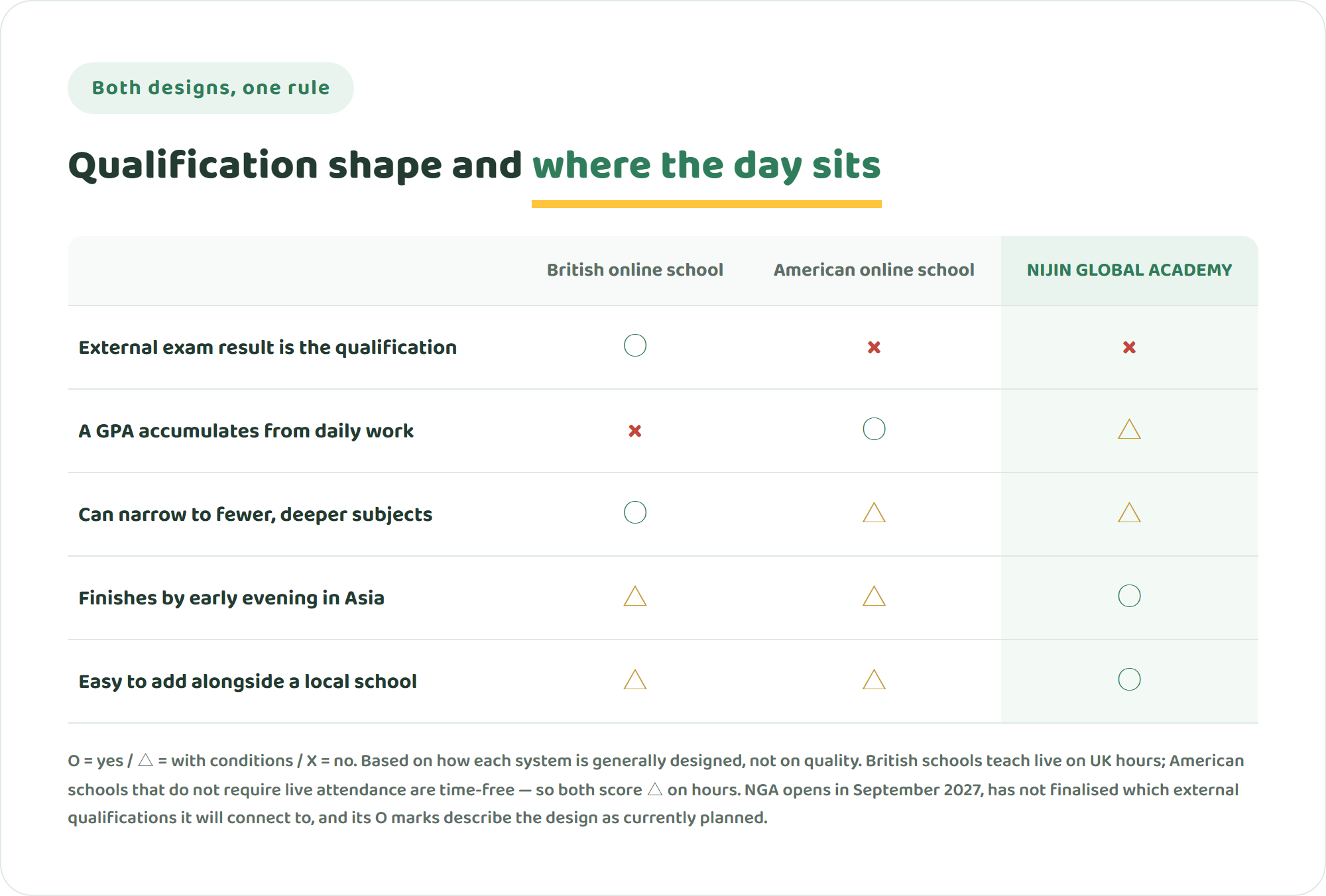
As the sheet shows, NIJIN GLOBAL ACADEMY takes a cross on “the external exam result is the qualification.” We open in September 2027 and have not finalised which external qualifications we will connect to. It would be incoherent to hold other schools to a standard and exempt ourselves. What we do take on is different: making room for a child to learn subjects in English without leaving the school they already belong to.
Three questions that settle it
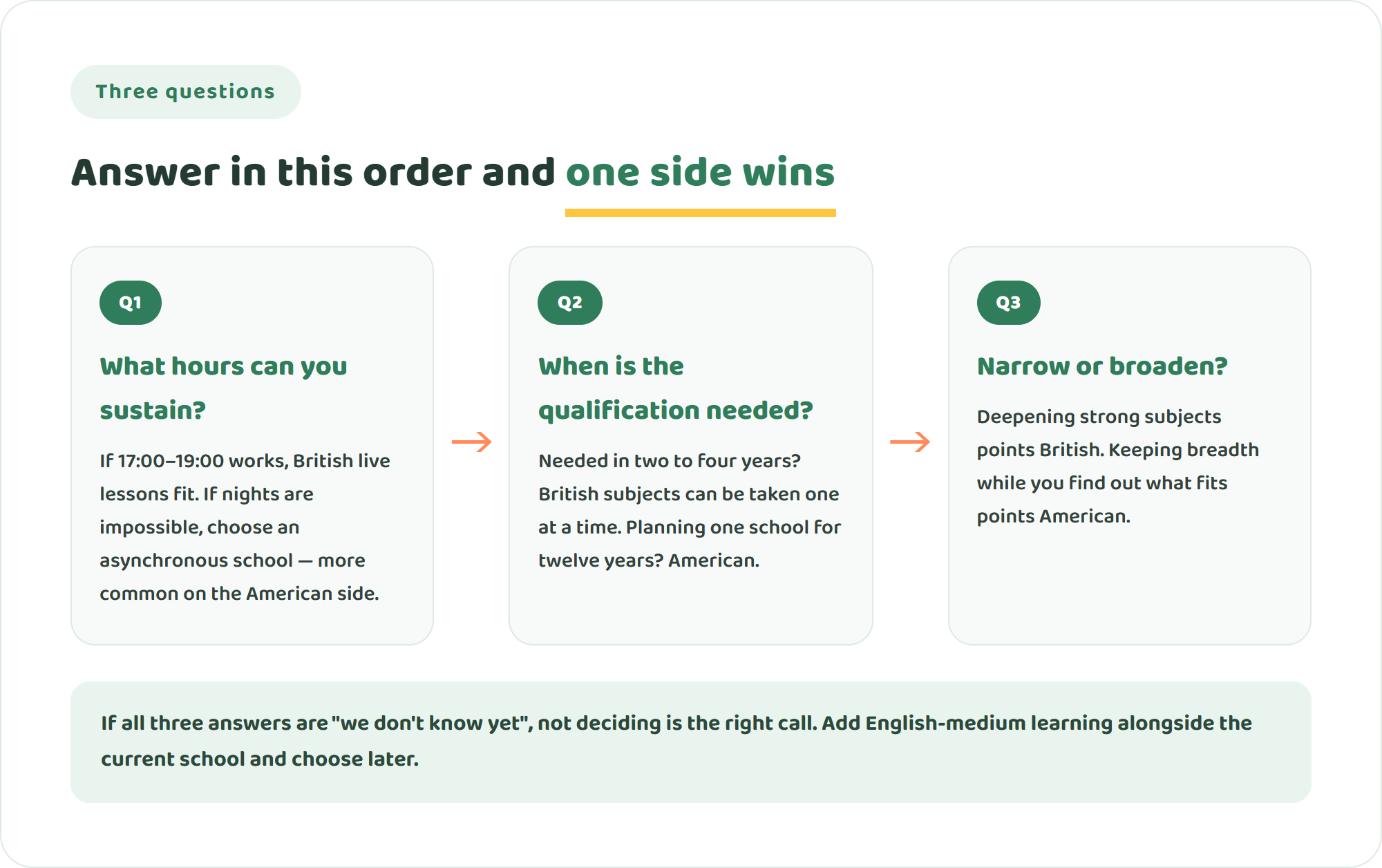
Answer those three and one side usually wins outright. “Evenings work for us, we need the qualification in two to four years, and we want to go deep in strong subjects” points British. “Nights are impossible so asynchronous is fine, we want one school for the long haul, and we want breadth” points American.
And if all three answers are “we do not know yet”, then not choosing is the right move. Add English-medium subject learning alongside the current school, and leave the qualification decision until you can see what your child is becoming good at. That is rarely too late. Where the hours actually go shows what such a day looks like in practice, and the five checks before choosing an online international school covers the questions to put to any school on your list. Our own answer to the same problem is set out in how we learn.
Common questions
Which system is respected more?
Neither, as a rule. Admissions offices care first about whether you meet the entrance eligibility criteria, and after that about grades and evidence. Read the eligibility clause in the admissions guidelines rather than comparing brand reputations.
Can we switch systems partway through?
Yes, at a cost. Because American diplomas require a fixed total of credits, how much transfers is a judgement call for the receiving school. Moving the other way means sitting IGCSEs or A Levels subject by subject. The later the switch — especially after 15 — the more is lost.
Can you get a qualification from a school with no live lessons?
On the British side, yes: IGCSE and A Level are external exams, so the school does not administer them. The catch is that many such schools leave you to find an exam centre yourself — sitting IGCSE online from Japan walks through that step. On the American side, an asynchronous school can still issue a diploma because it awards its own credits, which is exactly why you must verify its accrediting bodies by name.
Can we add either one without leaving our current school?
Yes, and most families in Japan do exactly that, keeping the local school place and adding an English-medium track. On hours, that means either British live lessons in the early evening or an asynchronous school you can slot in anywhere. Attendance treatment varies by school and municipality, so speak to the class teacher and head first. The seven high school routes open in Japan maps the wider set of options.
Choose the day before you choose the system
“British or American” looks like a question about curriculum quality. In practice it is a question about what time on a Tuesday this learning can live in your household. Settle that and the qualification shape and the cost structure follow. Settle it last, and the timetable collapses inside a term.
It is also fine not to decide yet. Choosing a qualification route at 15 or 16 is soon enough. What you can do before then is put English-medium thinking somewhere sustainable.
NIJIN GLOBAL ACADEMY opens in September 2027 (planned), with a pre-opening term of trial classes in April–May 2027. We started from the clock rather than the curriculum: an online international school with no campus, running at hours that let a child keep the school they already belong to, in small classes built on talk rather than on being sorted by a score. When the timetable is fixed, the mailing list hears it first.
You do not have to choose a system today. Choose the hour, and the rest gets easier.