Adachi is one of Tokyo’s largest wards — 703,926 residents across 386,471 households as of 1 March 2026 — and Kita-Senju is a five-line interchange that puts Otemachi within twenty minutes. So families arriving here reasonably expect a choice of international schools. The honest answer is smaller than the ward. We checked every candidate against Adachi City’s own register of licensed nurseries, the Tokyo Metropolitan Government’s international schools portal and each provider’s official website. Seven facilities in Adachi offer an English-medium environment, and every one of them is early-years. There is no full-day international school in the ward for primary age or above. Below is what genuinely exists, what it costs, one structural advantage Adachi has that central Tokyo does not, where families go from age six, and one option that removes the commute entirely.
Quick Answer: Your Options in Adachi
- Aloha International Preschool, Kita-Senju campus (Adachi 1-chome) | 9 months to age 6, plus an after-school for ages 3 to grade 6 | fees not published; enquire directly (approved for Japan’s early-years fee subsidy) | kindergarten class runs 700+ hours a year of all-English teaching built on the IB Primary Years Programme approach
- Kids Academy Noah, Kita-Senju campus (Senju Tatsutacho) | age 1 to primary | Preschool course ¥75,000/month for five days (≈¥900,000/year); Nursery course ¥121,000/month for five days (≈¥1,452,000/year), official price list | the only school in the ward publishing a full fee table
- Shikahama English Adventures (Shikahama) | ages 2 to 5, plus a primary programme | ¥65,000/month for five days (≈¥780,000/year) plus a ¥65,000 enrolment fee, official price list | open 8:30am to 7:30pm; the primary-age ESP class is ¥26,250/month
- International With Senju-Akebonocho / International With Nishiarai | ages 0 to 5 | licensed nurseries, so fees are set by household income, not by the school | listed on Adachi City’s licensed nursery register; the Nishiarai site was renamed in April 2026
- English School Wakuwaku and Wakuwaku Kids (Takenotsuka) | ages 0 to 5 | fees not published; enquire (government-subsidised corporate-led childcare) | native-speaker English woven through the ordinary nursery day
- Tokyo IQRA International School (Hosoda, Katsushika) | kindergarten (ages 4–5) and Grade 1 to Grade 9 (ages 6–15) | fee table published as an image; enquire directly | the nearest school where a primary-age child learns in English every day. Cambridge International curriculum
- Lycée Français International de Tokyo (Kita) / K. International School Tokyo (Koto) | ages 3 to 18 | ≈¥1.73m–¥2.10m per year / ≈¥2.85m–¥3.02m per year (published figures) | the realistic routes if you want one school through to graduation
- NIJIN GLOBAL ACADEMY (online, opening September 2027, ages 6–18, aiming for roughly one-fifth of in-person fees, Japanese-language support built in) | no commute, no ward boundary. Still pre-launch; you can register for opening updates now
International schools in Adachi: the real landscape and what it costs
Adachi sits on Tokyo’s northern edge, wrapped by the Arakawa and Sumida rivers, with Saitama on the far bank. Kita-Senju is where the JR Joban line, the Chiyoda and Hibiya subway lines, the Tobu Sky Tree line and the Tsukuba Express all meet; two universities have moved campuses into the area in the last decade and the station district looks nothing like it did. Rents are meaningfully lower than in Minato or Shibuya. For a family weighing up where to live in Tokyo, the practical case for Adachi is strong.
Education tells a different story. In October 2025 the Tokyo Metropolitan Government launched an international schools portal — a public database covering location, capacity, curriculum and fees for schools across the city. Adachi does not appear in its ward filter. Chiyoda, Minato, Chuo, Shinagawa, Shibuya, Shinjuku, Koto, Meguro, Bunkyo, Setagaya, Kita, Nerima and Taito are all there. A ward of 700,000 people is not. That absence is the single most useful fact in this article.
What Adachi has instead is unusual, and worth understanding before you compare anything. English-medium provision here has moved inside the licensed nursery system. Adachi City’s official register of licensed nurseries lists International With Senju-Akebonocho (capacity 80) and International With Nishiarai (capacity 85), the latter renamed from With Nishiarai Nursery in April 2026. Because these are licensed nurseries, fees are set by the ward according to household income, and the English programme carries no separate charge. In central Tokyo an English-immersion preschool routinely costs ¥1.5m–¥2.5m a year. In Adachi, part of the same provision sits inside the ordinary childcare system. That is a genuine structural advantage, and it is invisible if you only search for the phrase “international school”.
Laid out by age band, international schools in Adachi look like this:
- Ages 0–2: the widest choice — Aloha from nine months, Kids Academy Noah’s Cloud and Sky classes, both With nurseries, Wakuwaku, Play Island Nursery
- Ages 3–5: the ward’s strongest band — Aloha’s kindergarten, Noah’s Sun and Rainbow classes, Shikahama, both With nurseries
- Ages 6–12: zero full-day schools. Only after-school and weekly English programmes (Aloha’s Afterschool, Noah’s Little Star, Shikahama’s ESP and ASP)
- Ages 13–18: nothing in the ward. You commute out, or you learn differently
Fees follow that shape. Inside Adachi, a full day in English at an unlicensed facility runs roughly ¥780,000 to ¥1,450,000 a year plus meals and extras, based on the published price lists of Shikahama and Kids Academy Noah. Those facilities are also approved under Japan’s early-years fee subsidy, and Adachi City’s official guidance states that from the October 2026 billing month, families of three-to-five-year-olds with a certified childcare need can claim up to ¥40,300 a month (up to ¥45,700 for under-threes in non-taxable households). Meals, event costs and transport are excluded, so keep them in a separate column.
Step outside the ward for a full-day school from age six and the numbers change category: ¥600,000 to over ¥3,000,000 a year, depending on the school. If you want to understand what sits inside those headline figures before you compare, our breakdown of international school costs in Japan covers enrolment fees, facility levies and the charges that rarely appear in brochures. For the citywide picture, see international schools in Tokyo.
All seven international-school facilities in Adachi, honestly described
Here are the seven facilities we could verify as operating in 2026, with ages, fees and the kind of family each suits. They share a label but not a legal category: some are licensed nurseries, some unlicensed facilities, one is corporate-led childcare. None of them is a school for compulsory-education age — these are preschools and nurseries. Please hold that distinction as you read.
1. Aloha International Preschool, Kita-Senju campus (Adachi 1-chome)
Aloha International Preschool runs its Kita-Senju campus across two buildings — Adachi 1-3-11 and an annex at Adachi 1-29-3 — as an unlicensed childcare facility. With its sister campus in Minami-Senju just across the river in Arakawa, the two together cover nine months to grade 6, the widest age range of any English provider in the ward.
Courses run from Music & Movement (a parent-and-child class from nine months) through Preschool and Junior Kindergarten to the main Kindergarten class for ages 3 to 5, then Afterschool and Learning & Care Support for primary-age children. The Kindergarten class is inquiry-based, organised into themed units on the International Baccalaureate PYP model (the school announced PYP authorisation in 2025), and the school states it delivers more than 700 hours a year of all-English teaching. English runs 10:15am to 2:15pm; a Japanese literacy class follows on Mondays, Tuesdays, Thursdays and Fridays and is offered at no additional tuition cost. Extended care is available from 9am to 6pm.
- Curriculum: inquiry-based all-English as an authorised IB PYP school (announced 2025) (700+ hours/year), with a daily Japanese class. Unlicensed childcare facility
- Ages: 9 months to 6, plus an after-school for ages 3 to grade 6
- Fees: not published — enquire directly. The Kindergarten course is confirmed on the school’s site as approved for the national early-years fee subsidy
- Best for: families around Kita-Senju who want an unbroken English environment from toddler years through primary after-school, without dropping Japanese
2. Kids Academy Noah, Kita-Senju campus (Senju Tatsutacho)
Kids Academy Noah sits at Senju Tatsutacho 3-15, a short walk from Kita-Senju station, with a sister campus in Tatsumi, Koto. Its distinguishing feature for a foreign family is simple and rare in this ward: the whole fee table is published, so you can budget before you visit.
Classes are Cloud and Sky (ages 1–2), Sun and Rainbow (ages 3–5, five days a week only), Afterschool (ages 3–5, Tuesday to Thursday 3:30–5:30pm) and Little Star (primary age, Mondays 4:00–5:30pm). Within the same age band you choose between a shorter Preschool course and a longer Nursery course. Per the official price list, the Preschool course runs ¥42,000 for two days a week, ¥53,000 for three, ¥66,000 for four and ¥75,000 for five; the Nursery course runs ¥72,000, ¥87,000, ¥100,000 and ¥121,000 respectively, all monthly. Afterschool and Little Star are ¥15,000 for one day a week and ¥30,000 for two. Joining costs ¥30,000 enrolment, ¥15,000 administration and ¥15,000 facility maintenance, with the maintenance fee recurring each April.
- Curriculum: experience-led English immersion with an explicit focus on non-cognitive skills
- Ages: 1 to primary (Little Star is a weekly primary-age class)
- Fees: ¥75,000/month for five days on the Preschool course (≈¥900,000/year); ¥121,000/month for five days on the Nursery course (≈¥1,452,000/year), plus joining fees (official price list)
- Best for: families commuting through Kita-Senju who want to dial days per week up or down and know the total in advance
3. Shikahama English Adventures (Shikahama)
Shikahama English Adventures (SEA), at Shikahama 6-23-3 near Nishiarai-Daishi-Nishi station, is part preschool and part English school, with a school bus. It is deliberately local — the school describes students who stay with it for fifteen years and speaks of building sibling-like bonds between them. Of everything inside Adachi, this is the provider with the most developed primary-age offering, and it runs family-style English boot camps as well.
The published price list gives preschool tuition at ¥65,000 a month (before tax) for five days, a one-off ¥65,000 enrolment fee, ¥10,000 materials twice a year, ¥20,000 facilities once a year and a one-off ¥15,000 emergency-preparedness fee. Extended care between 8:30am and 7:30pm is ¥1,000 an hour. On top of that sit an Extended Care Program (¥27,000 a month for five days), the primary-age Elementary School Program at ¥26,250 a month, and the After School Program — an Adventure Course at ¥24,000 for four days a week or ¥16,000 for two, and a Wednesday-only class at ¥12,000.
- Curriculum: all-English preschool that incorporates American Sign Language, plus Japanese cultural units and international exchange projects
- Ages: 2 to 5 in the preschool, plus ESP and ASP for primary age
- Fees: ¥65,000/month for five days (≈¥780,000/year) plus enrolment, materials and facilities fees; ESP ¥26,250/month (official price list)
- Best for: families in the Shikahama, Nishiarai and Koya areas who want the same place to keep teaching their child after age six
4. International With Senju-Akebonocho (Senju Akebonocho)
At Senju Akebonocho 17-3, three minutes from Ushida and Keisei-Sekiya stations, this is a licensed nursery listed on Adachi City’s official register with a capacity of 80. It is operated by WITH Co. as part of its WITH International Preschool programme, which builds three English periods into the ordinary nursery day: Lesson Time with foreign teachers, Play Time during activities and walks, and Activity Time for storytelling and interactive play. Opening hours run 7:00am to 8:30pm, Monday to Saturday.
- Curriculum: a licensed Japanese nursery with an English programme integrated into daily care, at no extra charge
- Ages: 0 to 5 (nine places for infants, 12 at age one, 14 at age two, 15 in each of the three-to-five classes)
- Fees: set by Adachi City according to household income, as with any licensed nursery
- Best for: families who need long hours at a manageable cost and want English exposure without paying preschool premiums
5. International With Nishiarai (Nishiarai 3-chome)
At Nishiarai 3-13-15, this is the sister licensed nursery, capacity 85. Adachi City’s register carries an explicit note: from April 2026 the facility changed its name from With Nishiarai Nursery to International With Nishiarai Nursery. A licensed nursery choosing to put “international” in its name is a small thing that says a lot about where Adachi is heading, and it is easy to miss because map apps and review sites still carry the old name.
- Curriculum: licensed nursery plus the WITH International Preschool English programme
- Ages: 0 to 5 (capacity 85)
- Fees: set by Adachi City according to household income
- Best for: families in Nishiarai, Sekihara and Umejima who want English inside the licensed system
6. English School Wakuwaku and Wakuwaku Kids (Takenotsuka)
English School Wakuwaku at Takenotsuka 6-24-1 and its sister site Wakuwaku Kids at Takenotsuka 1-12-14 both operate as corporate-led childcare. Legally that is an unlicensed facility, but one that receives national funding in exchange for meeting licensed-nursery standards — which is why fees tend to sit below those of a comparable English preschool. Children hear native-speaker English through the ordinary day, via music, dance and activities rather than sit-down lessons.
- Curriculum: everyday English exposure with native-speaker teachers, plus eurhythmics
- Ages: 0 to 5
- Fees: not published — enquire. Corporate-led childcare funding generally keeps costs below private preschool rates
- Best for: families around Takenotsuka and Hokima prioritising cost while still wanting daily English
7. Play Island Nursery (Nishiarai area)
Play Island Nursery takes children from infancy in the Nishiarai area and runs its English curriculum in partnership with Shikahama English Adventures. The design is aimed squarely at working parents: open 7:00am to 8:00pm, open on Saturdays, classes from four children, home-cooked meals, and a “come empty-handed” policy under which the nursery supplies nappies and changes of clothes.
- Curriculum: small-group care with a native-speaker English programme delivered with Shikahama English Adventures
- Ages: from 0 (infants and toddlers)
- Fees: not published — enquire
- Best for: families wanting English exposure from the earliest years alongside long hours and a very small group size
Listings to treat carefully when researching international schools in Adachi
Verifying this list took longer than writing it. This is not criticism of anyone — it is a practical warning.
- Kids Duo Takenotsuka (Hokima 2-1-1): several directories still list it, but Kids Duo’s own Tokyo classroom index — 57 locations — contains none in Adachi. Check the official classroom search before you plan around it
- Round-up articles from 2020–2022: Adachi sees relatively high turnover among small English providers. Always check the publication date on any “best preschools in Adachi” list
- Renamings: as with With Nishiarai in April 2026, names change faster than map apps update
- The elastic word “international school”: most Adachi results are early-years settings or once-a-week English classes, not schools. Decide first whether you need a full-day school or English exposure — the two searches produce completely different lists
From age six, look outside the ward: international schools within reach of Adachi
Once your child reaches primary age, and with no full-day school inside Adachi, the choice narrows to commuting out or learning differently. The good news is that Adachi borders in three useful directions. These are the realistic candidates.
- Tokyo IQRA International School (Hosoda 4-38-8, Katsushika): ages 3–11, kindergarten to grade 5. English-medium with a Cambridge International curriculum in the primary years and a Montessori-based kindergarten, taught within an Islamic ethos. Reachable from Keisei-Koiwa and Keisei-Takasago. The fee table is published as an image, so enquire directly
- Lycée Français International de Tokyo (Takinogawa 5-57-37, Kita): ages 3–18, French Ministry of Education curriculum through to the French Baccalaureate. Published figures on the Tokyo metropolitan portal are roughly ¥1.82m (kindergarten), ¥1.73m (primary), ¥2.01m (lower secondary) and ¥2.10m (upper secondary) a year. Full campus with grounds, gym and pool
- École Internationale Franco-Japonaise (EIFJ) (Nishigaoka, Kita): ages 18 months to 15. Notably, it runs an English-and-Japanese track with no French requirement, which makes it one of the few small English-based day schools genuinely open to an Adachi family. Fees are issued year by year, so enquire
- K. International School Tokyo (Shirakawa 1-5-15, Koto): ages 3–18, with IB PYP, IGCSE and the IB Diploma under one roof. Tuition for August 2026 to June 2027 is roughly ¥2.85m–¥3.02m a year depending on grade (official)
- India International School in Japan, Tokyo campus (Sengoku 3-1-4, Koto): kindergarten to grade 12 on the Indian CBSE curriculum. The Tokyo metropolitan portal lists tuition at about ¥600,000 a year to junior high and ¥1,200,000 for high school — the affordable full-day route for ages six and up
- Across the river into Saitama: Kawaguchi has several full-day settings and primary-age classes; Kawaguchi is worth a look if you can cross the river. Further out, LoV Christian International School in Toda takes children from infancy to age 15, with published primary tuition of ¥1,104,000 a year
For the picture immediately west, see international schools in Kita and international schools in Itabashi.
Fees and details reflect information published as of September 2026. Always confirm current figures with each school directly.
Comparing the options: which column fits your family
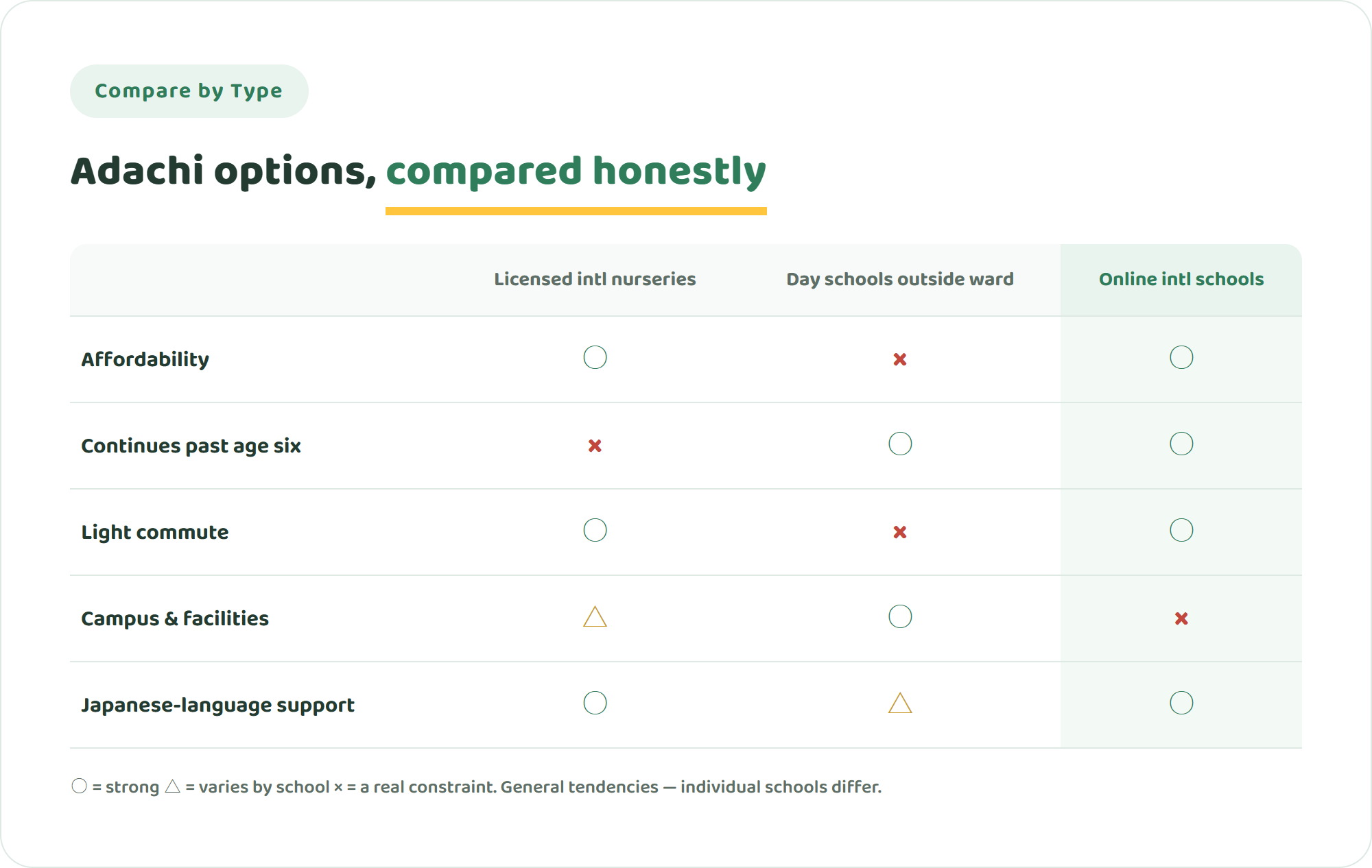
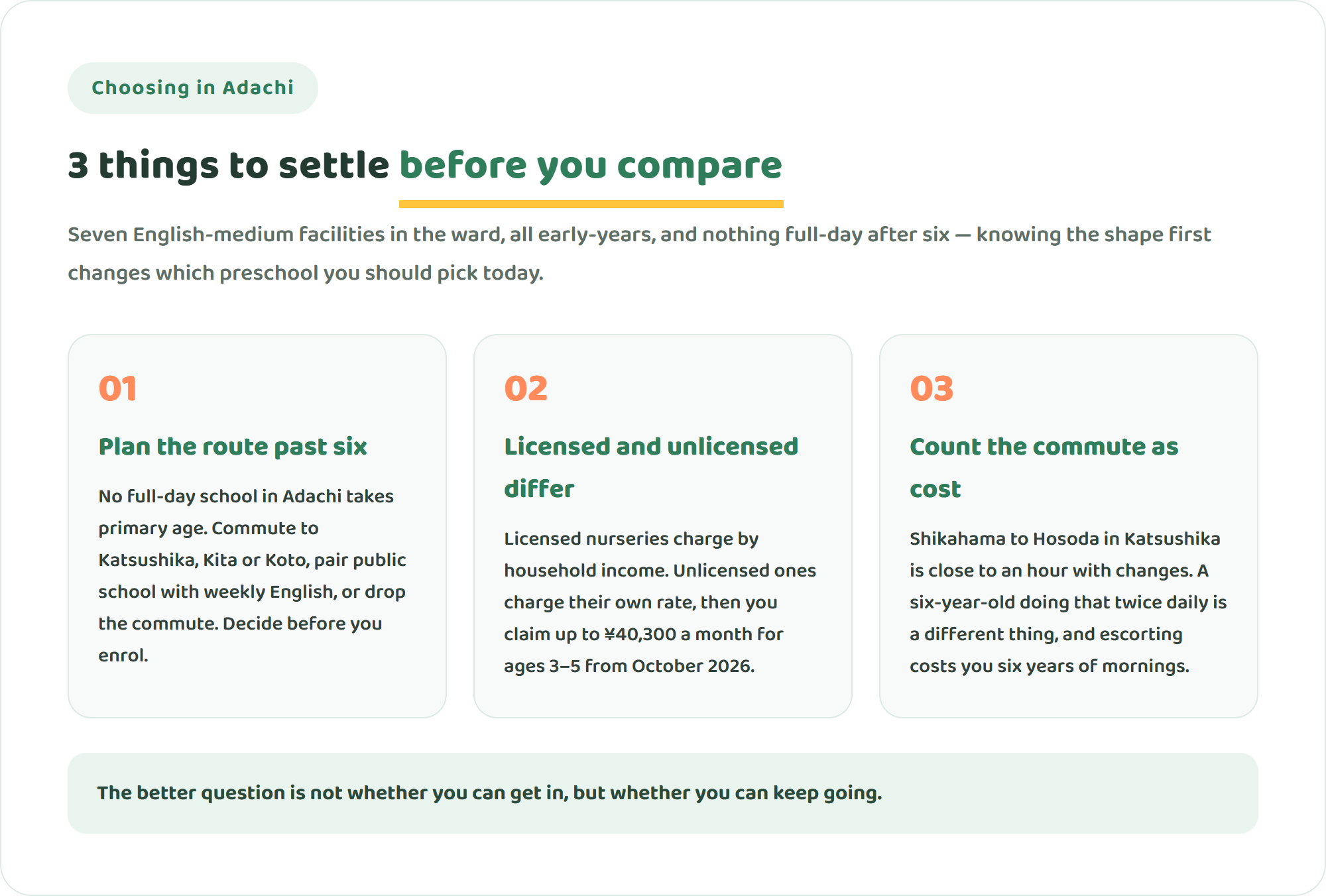
The decision that matters most in Adachi is how you get past age six, settled before you enrol anywhere. The ward’s early-years options are decent on both cost and convenience — better than most of Tokyo, in fact, because part of the provision sits inside the licensed nursery system. But the choice arrives on schedule at primary entry: commute to Katsushika, Kita or Koto; combine public primary school with weekly English; or drop the commute altogether. Answer that first and it changes which preschool you should pick today.
The second thing to understand is that licensed and unlicensed facilities work on completely different financial logic. The two International With nurseries are licensed, so the ward sets your fee from your household income. Aloha, Shikahama and Kids Academy Noah are unlicensed, so you pay the school’s published rate and then claim the subsidy if you hold a certified childcare need — up to ¥40,300 a month for ages three to five from the October 2026 billing month in Adachi. Meals, events and transport fall outside it. That boundary is where “the tuition looked lower but our total barely moved” comes from.
The third is the one families underestimate: count the commute as a family cost. Kita-Senju to Kiyosumi-Shirakawa is around thirty minutes; Shikahama to Hosoda in Katsushika is closer to an hour with changes. A six-year-old doing that twice a day is a different proposition from an adult measuring it on a map, and if you need to escort them, that hour becomes yours for six years. As much as tuition, this is what determines whether a choice is sustainable.
See how learning works online →
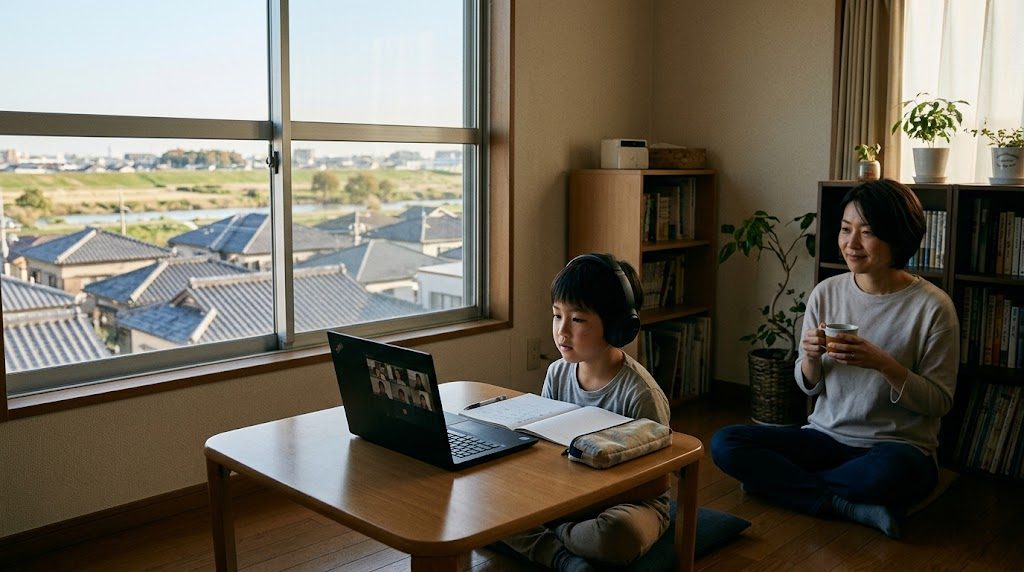
When fees or the commute are the barrier: online as an eighth option
If your reaction to all of the above is “I understand there is no full-day school in the ward, but Koto is expensive and I am not putting a six-year-old on an hour-long commute twice a day” — that is a fair reaction, not a failure of ambition. There is another route.
NIJIN GLOBAL ACADEMY is an online international school opening in September 2027. It is run by NIJIN Inc. in Japan, which already operates NIJIN Academy, an alternative school with more than 1,000 children enrolled. It is designed for children aged 6 to 18 across Asia and Oceania. Because it is online, where you live stops mattering — you can join from an apartment in Adachi.
What the school is built around is a refusal to rank children by test scores. Learning happens in small groups through dialogue, and the curriculum is organised around helping a child come to like themselves and the world. Fees are targeted at roughly one-fifth of in-person international school costs, and the design assumes Japanese-language support as a foundation, with English introduced gradually rather than all at once.
Two honest caveats. First, it has not opened yet. There is no graduating class to point to, and there will not be for some years. Second, it is not the same experience as being on a campus. Nothing online replaces a playground or a shared lunch table. But for a family in a ward with no provision at all after age six, “no commute, still connected to the world” is a condition that genuinely changes the arithmetic.
Frequently asked questions
Q. From what age can my child start at an international school in Adachi?
Aloha’s Music & Movement class starts at nine months, Kids Academy Noah’s Cloud and Sky classes at age one, and Shikahama English Adventures at age two. The two licensed International With nurseries take children from birth. So yes, there are places that accept infants. The important caveat is the other end: there is no full-day option in the ward once your child reaches primary age, so map out the route past six before you enrol.
Q. Is there Japanese-language support? We worry about our child’s Japanese.
Most Adachi settings are bilingual by design rather than English-only. Aloha’s kindergarten, for instance, runs a Japanese class after the English day at no extra tuition cost, and the two licensed International With nurseries fold English into an otherwise Japanese nursery programme. That said, the more hours a child spends in English, the more deliberately you have to plan where Japanese literacy gets built — reading and writing do not develop on their own. Home reading helps, and so does a structured Japanese class outside school. If Japanese is a worry in your household, our sister service Tomodachi Japan, an online Japanese programme for children run by NIJIN, is worth a look.
Q. Can we transfer in at primary level, and when should we start asking?
Because Adachi has no full-day school beyond the early years, a primary transfer means looking outside the ward — Tokyo IQRA in Katsushika, Lycée Français International or EIFJ in Kita, K. International School Tokyo in Koto. Admission at each depends on places in the specific year group and on your child’s language level. Some schools run English support programmes, but those places are limited too. Contact schools six months to a year before your target term. Capacity, entry requirements and fees are all subject to revision, so confirm current details directly.
In a ward with few options, the families who move early do best
Searching for international schools in Adachi is genuinely hard. Seven hundred thousand people live here, and the ward does not even appear in the Tokyo metropolitan government’s own school portal filter. What exists is seven early-years settings and nothing full-day after age six, while old round-up articles keep the names of closed classrooms in circulation.
But Adachi has something most wards do not: English provision that has moved inside the licensed nursery system, which makes starting far more affordable here than in central Tokyo. And a short list has one quiet advantage — it forces clarity. Decide what happens after six. Everything else gets lighter once that is answered. Families who enrol locally while touring schools in Katsushika and Koto, families who pair a public primary school with weekly English, families who drop the commute and go online — none of those is the wrong answer. The only thing worth avoiding is arriving at primary entry with the question still open.
The time you are spending on this is time spent taking your child seriously. Please do not use it to be hard on yourself. That you are reading this at all is already action on their behalf.
International Schools in Other Cities
- International Schools in Tsukuba: Fees
- International Schools in Sendai: 7 Picks and Fees
- International Schools in Shinjuku: Fees
- International Schools in Karuizawa: All 4 Schools
- International Schools in Sapporo: Fees
- International Schools in Dubai: Fees
- International Schools in Arakawa, Tokyo
- International Schools in Ashiya
- International Schools in Bangkok
- International Schools in Tokyo
- International Schools in Minato: Fees
- International Schools in Shibuya, Tokyo
- International Schools in Setagaya: All 14 Schools
- International Schools in Koto, Tokyo
- International Schools in Shinagawa, Tokyo