If you are looking for an international school in Ashiya, two questions usually come first: how many schools are actually inside the city, and what do they really cost? Ashiya sits on the narrow strip between the Rokko mountains and Osaka Bay, with three rail lines running east to west — JR, Hanshin and Hankyu — putting Sannomiya about ten minutes away and Osaka about fifteen. That location makes Ashiya one of the most convenient bases in Kansai for a school search. But it also hides an awkward truth: the number of international schools with an Ashiya address is small. This guide names every one of them honestly, publishes the real fees where schools publish them, and then maps the schools you can genuinely reach from Ashiya Station and Ashiyagawa Station — with the commute for each one spelled out.
Quick Answer: Your Options in Ashiya
If you only read one section, read this. Below are the schools covered in this guide, plus the online option — so you can see every route side by side before the details.
- Ashiya International School — fees and character — Ages: 18 months to 12 (preschool, kindergarten K3–K5, elementary Grades 1–6) / Fees: Elementary tuition 1,200,000 yen (Grade 1) / 1,330,000 yen (Grades 2–6) a year;…
- YSE International School Ashiya — fees and character — Ages: 0 to 6 (preschool and kindergarten), plus after-school and Saturday classes / Fees: enquire directly; charges vary by class and days attended. We do not publish…
- Canadian Academy, Rokko Island — fees and the Ashiya bus route — Ages: PreK to Grade 12 / Fees: tuition 2,100,000 yen (PreK / Kindergarten A), 2,710,000 yen (Kindergarten B and…
- NLCS Kobe, Rokko Island — fees and character — Ages: from Grade 1, with year groups expanding progressively — confirm current intake on… / Fees: tuition 2,800,000 yen (Grades 1–3) / 2,900,000 yen (Grades 4–6) a year, plus a…
- German School Kobe International, Rokko Island — fees and character — Ages: roughly 2 to 11 (pre-kindergarten through primary; confirm year structure… / Fees: about 1,609,000 yen (pre-kindergarten and early years), 1,746,000 yen (preschool…
- Marist Brothers International School, Suma — fees and character — Ages: from about 3 (early years) through Grade 12 / Fees: about 1,916,000 yen (Kindergarten 1–3), 2,171,000 yen (Grades 1–5), 2,307,000 yen…
- St. Michael’s International School, central Kobe — fees and character — Ages: 3 to about 11 (early years through Year 6) / Fees: about 1,590,900 yen (Kindergarten 1–2) and 1,779,000 yen (Kindergarten 3 and Grades…
- Sakura International School Ashiya (Kansai International Academy) — fees and character — Ages: parent-and-child classes through age 6 (toddler classes and kindergarten K1–K3) / Fees: request materials or enquire directly. K1–K3 are eligible for subsidy support of up…
- NIJIN GLOBAL ACADEMY (online) — Ages 6–18 / opening September 2027, currently taking opening-update registrations / fees around one-fifth of a typical campus international school / Japanese-language support. An option when commute or fees are the wall.
International schools in Ashiya: the landscape and what fees really look like
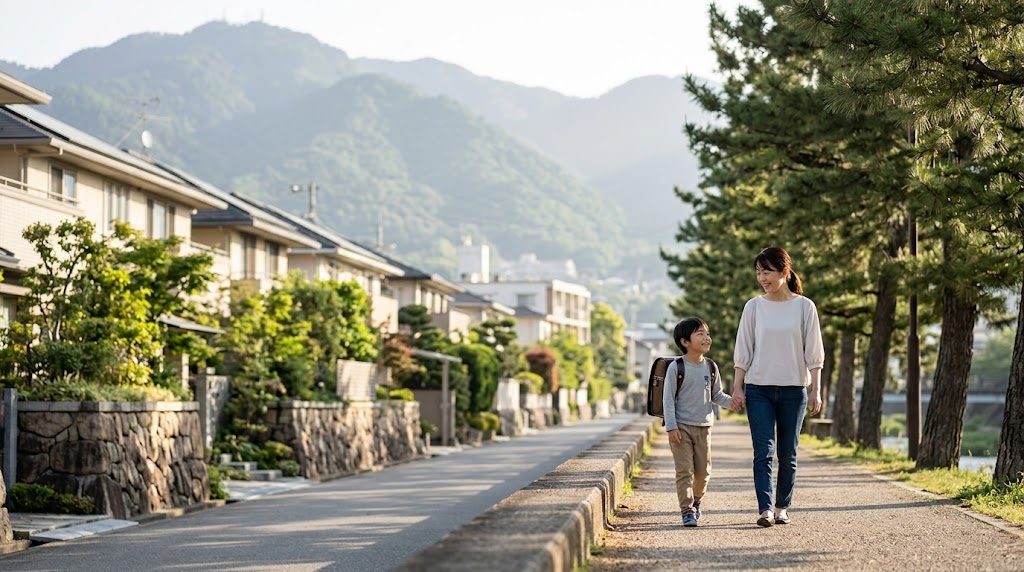
Start with the honest picture. Only two schools with an Ashiya address teach primarily in English: Ashiya International School and YSE International School Ashiya. The first covers 18 months through Grade 6. The second focuses on the early years, plus after-school and Saturday programmes. In practice, that means a family looking for a full-time English-medium school for a child of elementary age has essentially one option inside the city limits.
This is why most Ashiya families widen the search from the very beginning — to Rokko Island and central Kobe to the west, and to Nishinomiya to the east. If you have not yet looked at the wider picture, the guide to international schools in Kobe pairs naturally with this page, and the Hyogo Prefecture overview covers everything beyond the Kobe–Ashiya corridor.
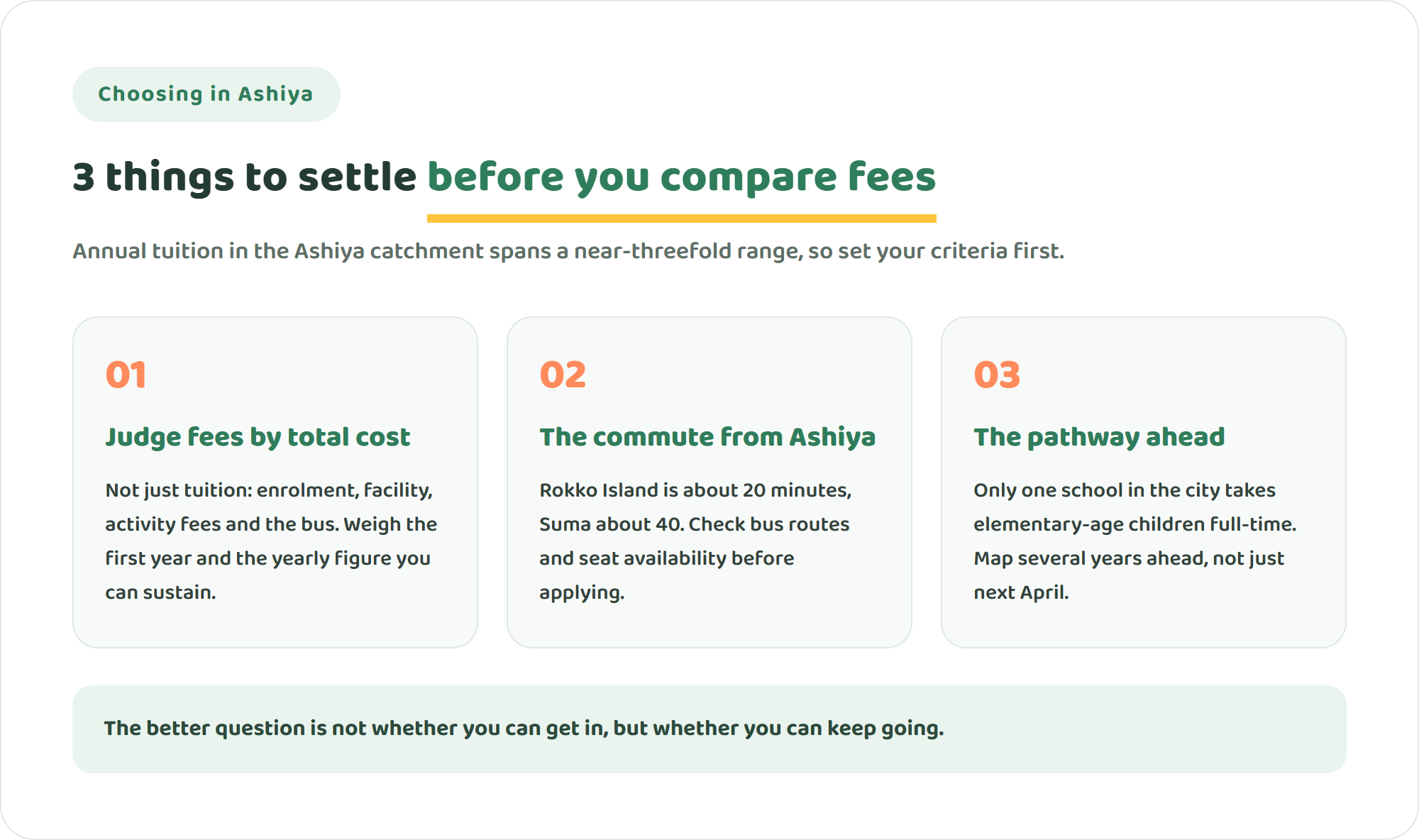
On fees, here is the range you are choosing within. Inside Ashiya, elementary tuition at Ashiya International School runs 1.20–1.33 million yen a year. Widen the search to Rokko Island and Canadian Academy charges 2.10–3.37 million yen, while NLCS Kobe charges 2.80–2.90 million yen plus a 410,000 yen annual facility fee. In between sit German School Kobe International (roughly 1.61–1.88 million yen), St. Michael’s International School (roughly 1.59–1.78 million yen) and Marist Brothers International School (roughly 1.92–2.32 million yen). In other words, the Ashiya catchment spans a near-threefold difference in annual tuition — which is exactly why comparing on name recognition alone is a mistake. For a fuller breakdown of what these numbers include, see our guide to international school tuition costs.
All fees below reflect published information as of August 2026. Always confirm current figures on each school’s official site.
The two international schools inside Ashiya: fees and character
No padded list of seven here. Ashiya has two, and they are built for very different stages of childhood. Read them against your child’s age and your household budget, not against reputation.
1. Ashiya International School — fees and character
Located in Yoko-cho on Ashiya’s reclaimed southern waterfront, this is an incorporated educational institution founded as the sister school of Mikage International Preschool, one of the oldest in Kansai. It runs three divisions: preschool from 18 months, kindergarten (K3–K5), and elementary Grades 1–6. Instruction follows the A Beka curriculum developed over five decades at Pensacola Christian Academy in Florida, known particularly for its strength in reading. The school is ACSI-accredited and grounds its programme in Christian values alongside manners and character development. The academic year runs late August to mid-June. Crucially for local families, it is the only school in Ashiya where an elementary-age child can study full-time in English — and one of the few in the region that publishes its full fee schedule openly.
- Curriculum: A Beka (US-style, Christian; ACSI-accredited)
- Ages: 18 months to 12 (preschool, kindergarten K3–K5, elementary Grades 1–6)
- Fees: Elementary tuition 1,200,000 yen (Grade 1) / 1,330,000 yen (Grades 2–6) a year; kindergarten 1,200,000–1,240,000 yen. Plus a 30,000 yen application fee, 240,000 yen enrolment fee, 140,000 yen annual facility fee and 130,000–140,000 yen annual activity fee. Preschool runs 31,000–110,000 yen monthly with a 180,000 yen enrolment fee (2025–2026 published figures)
- Getting there from Ashiya: Yoko-cho, on the Minami-Ashiyahama waterfront; local bus from JR or Hanshin Ashiya Station, and within cycling or driving distance for many in-city families
- Best for: families who want a full-time English environment through elementary without leaving Ashiya
At the same address you will also find Ashiya International Preschool, the sister programme for children from six months to three years. Its parent-and-child Mama & Toddler lessons cost 2,000 yen per session (or 9,000 yen for five), which makes it an unusually low-commitment way to test whether an English-medium environment suits your family.
2. YSE International School Ashiya — fees and character
A five-minute walk from the east exit of Hanshin Ashiya Station, in Chaya-no-cho, YSE opened in Ashiya in 1999 and has since expanded to Kobe, Osaka, Kyoto and Sanda. It serves children from infancy to age six, teaching English, mathematics, science and social studies entirely in English, with Montessori materials used in the preschool programme. Small classes and genuine dialogue between children and teachers are central to the approach, and there are after-school classes, Saturday programmes covering coding, art, sport and science, and seasonal schools. For Ashiya families, the walkable station location is a real advantage — few schools in the catchment can match it. Fees are quoted per family rather than published as a single table.
- Curriculum: US-style all-English instruction with Montessori materials in preschool
- Ages: 0 to 6 (preschool and kindergarten), plus after-school and Saturday classes
- Fees: enquire directly; charges vary by class and days attended. We do not publish estimates
- Getting there from Ashiya: about a 5-minute walk from the east exit of Hanshin Ashiya Station
- Best for: families starting English seriously in the early years, or continuing it alongside a Japanese local school
International schools you can reach from Ashiya: fees and commute times
For elementary age and above, the realistic map extends to Rokko Island and central Kobe in Higashinada and Chuo wards, out to Suma, and east into Nishinomiya. Ashiya borders Kobe, so the journeys are shorter than many families expect. Each school below comes with the actual route from Ashiya or Ashiyagawa Station — the detail that decides whether a school stays workable in year three, not just year one.
3. Canadian Academy, Rokko Island — fees and the Ashiya bus route
On Rokko Island in Higashinada ward, Canadian Academy has more than 110 years of history and runs the full International Baccalaureate continuum — PYP, MYP and Diploma — from PreK to Grade 12, with boarding available. It is usually the first name Ashiya families consider. The practical detail that matters most here: the school operates a dedicated Ashiya bus route, stopping at Kikutani-cho, Iwagahira, JR Ashiya and Konan Yamate, so children travel without changing trains. Bus fees run 149,000 yen one-way and 279,000 yen round-trip per year for 2026–27. Note that the school has posted that all routes reached capacity and registration closed, so confirm availability before you apply.
- Curriculum: IB PYP, MYP and Diploma Programme (day and boarding)
- Ages: PreK to Grade 12
- Fees: tuition 2,100,000 yen (PreK / Kindergarten A), 2,710,000 yen (Kindergarten B and Grades 1–5), 3,170,000 yen (Grades 6–8), 3,240,000 yen (Grades 9–11), 3,370,000 yen (Grade 12). Plus a 90,000 yen application fee, 400,000 yen registration fee, 600,000 yen capital contribution and 300,000 yen building and development fee (2026–27 official figures)
- Getting there from Ashiya: dedicated Ashiya bus route (Kikutani-cho, Iwagahira, JR Ashiya, Konan Yamate) at 149,000 yen one-way / 279,000 yen round-trip a year. By train, JR Ashiya to Sumiyoshi, then the Rokko Liner
- Best for: families who want one uninterrupted IB pathway from early years to university entry, and who prioritise track record over cost
4. NLCS Kobe, Rokko Island — fees and character
North London Collegiate School Kobe opened in September 2025 at the Asia One Center on Rokko Island, joining the family of schools founded on the tradition of the original NLCS, established in London in 1850. It began with Grades 1 to 6 and is adding year groups progressively. The approach pairs British academic rigour with a deliberate grounding in Japanese culture and values. For Ashiya families, the deciding factor is often that it shares a location with Canadian Academy — the same commute, a different philosophy. As a new school it has no graduating cohorts yet, but year groups are correspondingly less crowded.
- Curriculum: British, following the NLCS family’s academic programme
- Ages: from Grade 1, with year groups expanding progressively — confirm current intake on the official site
- Fees: tuition 2,800,000 yen (Grades 1–3) / 2,900,000 yen (Grades 4–6) a year, plus a 35,000 yen application fee, 400,000 yen enrolment fee and 410,000 yen annual facility maintenance cost (2026–27 official figures). Bus, meals and uniform are billed separately
- Getting there from Ashiya: Rokko Island, Higashinada ward. JR Ashiya to Sumiyoshi, then the Rokko Liner toward Island Center. Check bus availability with the school
- Best for: families who want an academically ambitious British education at the calmer scale of a new school
5. German School Kobe International, Rokko Island — fees and character
Also on Rokko Island, this school traces its founding to 1909, making it one of the oldest German schools in East Asia. It runs two sections — a German-medium section and a European section taught mainly in English — and delivers the IB Primary Years Programme to children roughly aged two to eleven. Its defining feature is a genuinely trilingual environment. With annual tuition between roughly 1.61 and 1.88 million yen, it is the most affordable of the three Rokko Island schools by a clear margin, and families with no German background are welcome in the English-medium European section.
- Curriculum: IB Primary Years Programme, across a German section and an English-medium European section
- Ages: roughly 2 to 11 (pre-kindergarten through primary; confirm year structure officially)
- Fees: about 1,609,000 yen (pre-kindergarten and early years), 1,746,000 yen (preschool and Grades 1–5), 1,876,950 yen (Grade 6), plus a 51,500 yen application fee and 300,000 yen registration fee. All figures exclude 10% consumption tax (published official figures)
- Getting there from Ashiya: Rokko Island, Higashinada ward — JR Ashiya to Sumiyoshi, then the Rokko Liner. Confirm any shuttle service with the school
- Best for: families drawn to the Rokko Island environment who need annual tuition to stay under two million yen
6. Marist Brothers International School, Suma — fees and character
Set on a hillside in Chimori-cho, Suma ward, between the mountains and the Seto Inland Sea, Marist is a Catholic IB school running from the early years through Grade 12, combining the IB PYP, MYP and Diploma Programme with US Common Core standards. Students commute from Kobe, Osaka, Kyoto, Akashi and Himeji. For Ashiya families the practical appeal is clear: it is a full PreK-to-Grade-12 IB pathway at meaningfully lower fees than Canadian Academy. The commute is longer because it runs west, though the JR Kobe Line makes it straightforward. The school also publishes fee reductions, including 20% for children of alumni and 50% for families on religious activities visas.
- Curriculum: IB PYP, MYP and Diploma Programme with US Common Core standards (Catholic)
- Ages: from about 3 (early years) through Grade 12
- Fees: about 1,916,000 yen (Kindergarten 1–3), 2,171,000 yen (Grades 1–5), 2,307,000 yen (Grades 6–10), 2,317,000 yen (Grades 11–12) a year, plus a 70,000 yen application fee and 650,000 yen registration fee (2026–2027 published figures)
- Getting there from Ashiya: JR Kobe Line westbound toward Suma, roughly 40 minutes including a change at Sannomiya. There is a hill walk from the station, so time it yourself on a visit
- Best for: families committed to an IB pathway through high school but unable to sustain fees above three million yen a year
7. St. Michael’s International School, central Kobe — fees and character
In Nakayamatedori, on the edge of the Kitano district just above Sannomiya, St. Michael’s is a small British school with roots going back to the 1940s. It specialises entirely in primary education, from early years at age three through Year 6, built around the International Primary Curriculum alongside English, mathematics, Japanese, music, PE and technology. Notably, tuition covers curriculum materials, swimming lessons, one class excursion a year and a family copy of the yearbook — so the budget you plan is close to the budget you spend. A 15% sibling discount is available. From Ashiya it is the shortest commute of any school in this guide.
- Curriculum: British, using the International Primary Curriculum (IPC)
- Ages: 3 to about 11 (early years through Year 6)
- Fees: about 1,590,900 yen (Kindergarten 1–2) and 1,779,000 yen (Kindergarten 3 and Grades 1–5) a year, plus a 50,000 yen application fee, 300,000 yen registration fee and a 180,000 yen annual maintenance fee (2026–2027 published figures)
- Getting there from Ashiya: JR Ashiya to Sannomiya in about 10 minutes, then a walk uphill toward Kitano or a short bus ride
- Best for: families who want small-group British primary education with predictable, contained costs
8. Sakura International School Ashiya (Kansai International Academy) — fees and character
Despite the name, this campus is actually located in Horikiri-cho, Nishinomiya, a seven-minute walk from Koroen Station on the Hanshin Line — two stops east of Hanshin Ashiya, near the mouth of the Shukugawa river. Run by Kansai International Academy, which operates campuses across Osaka, Hyogo and Kyoto, it delivers bilingual inquiry-based learning in English and Japanese, emphasising learning through play, non-cognitive development and a deliberate balance between mother tongue and English. Programmes run from parent-and-child classes through toddler classes and kindergarten years K1 to K3. Under Japan’s early childhood education subsidy, K1–K3 families are eligible for support of up to 37,000 yen a month regardless of household income.
- Curriculum: bilingual English–Japanese inquiry-based early years education
- Ages: parent-and-child classes through age 6 (toddler classes and kindergarten K1–K3)
- Fees: request materials or enquire directly. K1–K3 are eligible for subsidy support of up to 37,000 yen monthly. We do not publish estimates
- Getting there from Ashiya: about a 7-minute walk from Koroen Station, two stops from Hanshin Ashiya — the closest out-of-city option for Ashiya families
- Best for: families who want inquiry-based early learning without giving up Japanese
Beyond these, Nishinomiya International School in Minami-Koshikiiwa-cho (Kurakuen) offers a preschool for ages one to six and an after-school programme for ages three to twelve, while Sweet Heart International School in Fukae-Minami-cho, Higashinada ward, operates within Japan’s early childhood subsidy scheme. Neither is a full-time international school, but both give families a way to secure an English environment alongside a Japanese local school — a reminder that Ashiya has options on both sides of its borders.
Comparing the types: which one actually fits your family
If you are still unsure how to decide, it helps to collapse the Ashiya catchment into three types: large international schools in Kobe and on Rokko Island; small schools in Ashiya and nearby Nishinomiya; and online international schools with no commute at all. The table below sets out how each type tends to perform on cost, admission, commute, campus experience and mother-tongue support — honestly, including where each falls short.
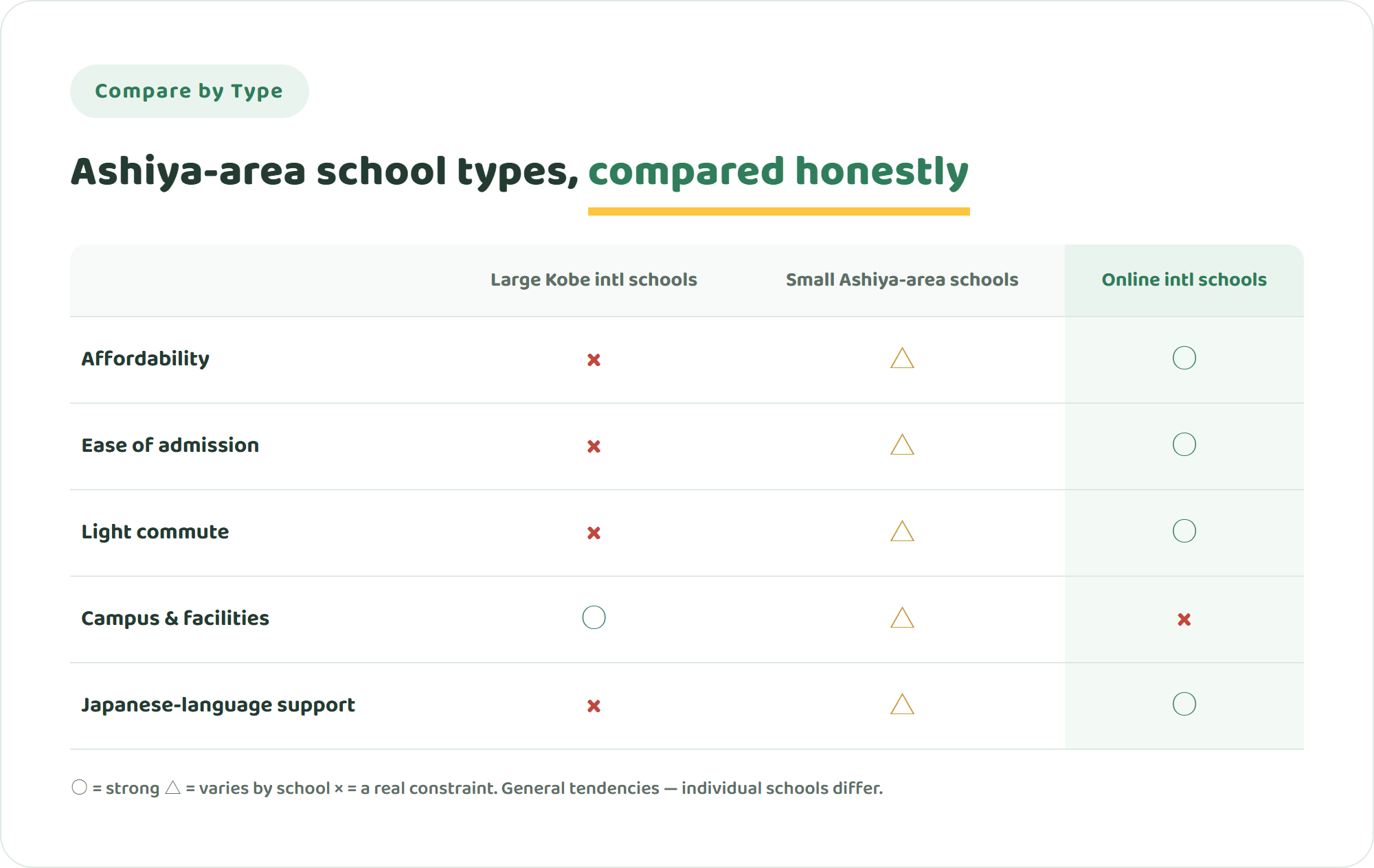
The large schools offer facilities and university outcomes that are genuinely hard to match — but at roughly three million yen a year, plus 279,000 yen for a round-trip bus seat, and usually with an entry requirement that the child can already follow lessons in English. For a child raised in Japanese, that language threshold comes before anything else. The smaller Ashiya-area schools balance fees and commute far more comfortably, but pathways beyond elementary age vary sharply from one school to the next. And the option families most often overlook is the one that does not involve full-time attendance at all: keeping a child in the local Japanese school while building English learning alongside it. In a city with as few schools as Ashiya, that is a serious answer, not a compromise. It is worth being honest about whether the fees are straining the household, and whether a daily round trip is quietly draining your child.
See how learning works online →
When fees or the commute are the barrier: online as a third option
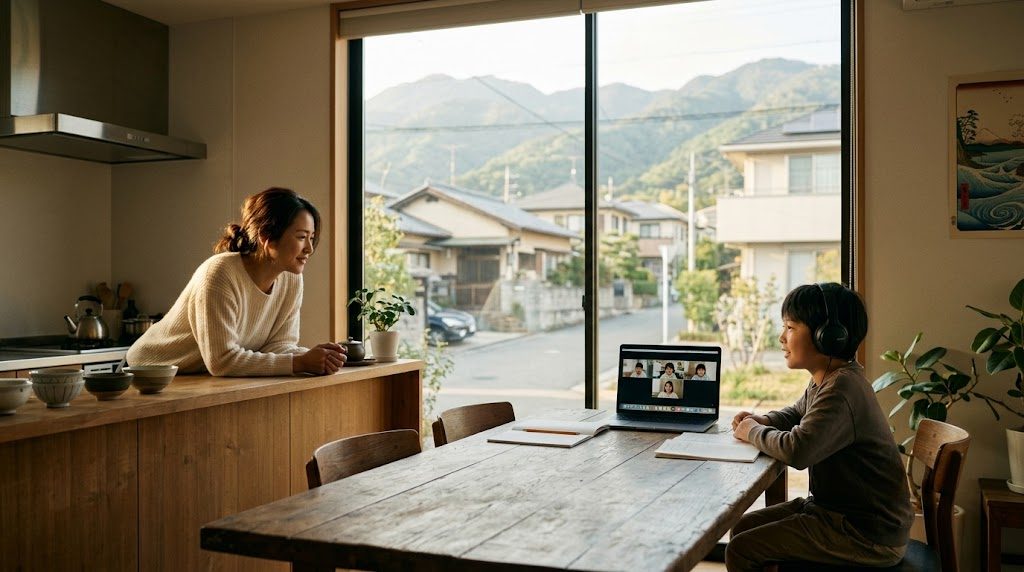
Ashiya is well placed — Kobe on one side, Osaka on the other. Even so, the reality is that only one school inside the city takes elementary-age children full-time, that widening the search to Rokko Island means annual tuition near three million yen, and that the bus routes families depend on can close when they reach capacity. If you find yourself thinking that you want an international education for your child but cannot picture carrying this load for the next decade, there is a third option that does not require a commute at all: an online international school.
We are NIJIN GLOBAL ACADEMY (NGA), an online international school opening in September 2027. We are operated by NIJIN Inc., the Japanese company behind NIJIN Academy, an alternative school with more than 1,000 students enrolled in Japan. Our approach rejects ranking children by test scores, and centres on small-group dialogue and a simple aim: helping each child come to like themselves and the world. We serve 6- to 18-year-olds across Asia and Oceania, wherever they live, with a design that supports children in Japanese while easing them gradually into English. We are working toward tuition around one-fifth that of a bricks-and-mortar international school.
To be straightforward with you: NGA has not opened yet, and our track record is still ahead of us. We cannot offer the playground, the gym or the physical campus life that an in-person school provides. But an education that connects your child to the world, without the commute and at a fraction of the cost, is a path worth weighing while you compare your options in Ashiya.
Frequently asked questions
Q. From what age can a child start at an international school in Ashiya, and when do fees begin?
A. Inside the city, Ashiya International Preschool accepts children from six months, the preschool division of Ashiya International School from 18 months, and YSE International School Ashiya from infancy. Fees begin at enrolment: the preschool division at Ashiya International School runs 31,000 to 110,000 yen monthly, and kindergarten 1,200,000 to 1,240,000 yen a year (2025–2026 published figures). Narrowing by your child’s age is the fastest first filter.
Q. Can a child join with no English at all? Is Japanese-language support available?
A. It varies enormously. Larger schools such as Canadian Academy and NLCS Kobe generally expect a child to be able to follow lessons in English on entry. Smaller bilingual schools in Ashiya and Nishinomiya are more often set up for children whose first language is Japanese. If mother-tongue support matters to you, ask each school directly, before applying, how much English is required and what Japanese-language provision exists.
Q. How long does the commute from Ashiya to a Kobe international school actually take?
A. It depends on the direction. Central Kobe near Sannomiya, including St. Michael’s International School, is around 10 minutes by JR. Rokko Island — Canadian Academy, NLCS Kobe and German School Kobe International — is roughly 20 minutes via JR Ashiya to Sumiyoshi and then the Rokko Liner. Suma, for Marist Brothers International School, is closer to 40 minutes. Canadian Academy also runs an Ashiya bus route stopping at Kikutani-cho, Iwagahira, JR Ashiya and Konan Yamate, though seats can sell out, so ask early.
The time you spend deciding is time spent caring
There is no single right answer in school choice. In a city like Ashiya — superbly connected, yet with very few schools of its own — the uncertainty can feel heavier than it should. What matters most is not whether your child can get in, but whether your family can keep going for years: the fees, the daily journey, your child’s English, your child’s temperament. Every household weighs those differently. The fact that you are still deliberating is evidence of how seriously you are taking your child’s future. Take your time, visit a few campuses, ride the bus route, and compare in person. And if you would also like to keep an option open that does not involve a commute at all, we would be glad to be on your list.
International Schools in Other Cities
- International Schools in Melbourne
- International Schools in Nagoya: All 8 Schools
- International Schools in Minato: Fees
- International Schools in Setagaya: All 14 Schools
- International Schools in Nakano, Tokyo
- International Schools in Tsukuba: Fees
- International Schools in Chofu and ASIJ Fees
- International Schools in Chuo, Tokyo
- International Schools in Dubai: Fees
- International Schools in Tokyo
- International Schools in Osaka
- International Schools in Fukuoka: Fees
- International Schools in Yokohama: Full Comparison
- International Schools in Shibuya, Tokyo