Search for international schools in Itabashi and you will mostly turn up English preschools — bright, friendly places that stop at age six. That leaves the obvious question hanging: what happens when your child turns seven? Here is the short version. Itabashi, in Tokyo’s north-west, has one full-time international school that runs all the way from Grade 1 to Grade 12, and its published tuition is roughly 1.3 to 1.5 million yen a year — about half what the well-known campuses in Minato or Shibuya charge. Around it sit seven English preschools and bilingual programmes, plus English-language after-school care. This guide lists all eight schools honestly, by age range and by fees, then works through the two questions every Itabashi family eventually faces: can we realistically commute into central Tokyo every day, and should we be looking across the border into Saitama?
Quick Answer: Your Options in Itabashi
If you only read one section, read this. Below are the schools covered in this guide, plus the online option — so you can see every route side by side before the details.
- Camelot International School (Mukaihara) | approx. ¥1.3m-¥1.5m per year — Ages: 6-18 (Grades 1-12). Applicants must be at least six by 31 August of the entry year.… / Fees: Published for 2026-2027 — tuition and building fee plus annual resource fee…
- New Hope International Preschool (Narimasu) | approx. ¥613,000 per year, five days — Ages: 3-6 for the preschool; English classes for ages 1-12 and junior high / Fees: For April 2026-March 2027 — about ¥613,000 across three terms for five days a…
- Tokyo Hikarigaoka International Pre-School (Akatsuka-shinmachi) | fees on enquiry — Ages: 18 months to 5 years / Fees: Not published online — enquire directly, and ask at the same time whether your…
- SEEDS English Preschool (Tokiwadai) | fees on enquiry — Ages: Preschool (confirm class structure and minimum age directly) / Fees: Not published online — enquire; the total varies by programme length
- Mulberry International School (Komone) | fees on enquiry — Ages: 6 months to elementary school age, by class level / Fees: Not published online — enquire
- Happy Koala International School (Azusawa) | fees on enquiry — Ages: 18 months to 12 years / Fees: Vary by course and days attended — enquire
- Happy ABC (Akatsuka-shinmachi) | fees on enquiry — Ages: 2-12 (preschool classes plus primary after-school) / Fees: Vary by class and course — enquire
- First Learning Senkawa Doremi Garden Preschool (Mukaihara) | fees on enquiry — Ages: From age 1 through primary school, by programme / Fees: Not published online — enquire
- NIJIN GLOBAL ACADEMY (online) — Ages 6–18 / opening September 2027, currently taking opening-update registrations / fees around one-fifth of a typical campus international school / Japanese-language support. An option when commute or fees are the wall.
Quick Answer: The International Schools in Itabashi, at a Glance
- Camelot International School (Mukaihara) | Ages 6-18, Grades 1-12 | approx. ¥1.3m-¥1.5m/year | The ward’s only full-time school; Cambridge curriculum plus Singapore Maths
- New Hope International Preschool (Narimasu) | Ages 3-6 | approx. ¥613,000/year for five days (plus fees) | Bible-based; publishes its full fee schedule openly
- Tokyo Hikarigaoka International Pre-School (Akatsuka-shinmachi) | 18 months-5 years | Enquire | Founded 1999; all-English, the ward’s longest-running programme
- SEEDS English Preschool (Tokiwadai) | Preschool ages | Enquire | One minute from Tokiwadai Station; maths, science and music taught in English
- Mulberry International School (Komone) | 6 months-primary age | Enquire | Small school with seven class levels and a Saturday programme
- Happy Koala International School (Azusawa) | 18 months-12 years | Enquire | Shimura area; continues into elementary-age English classes
- Happy ABC (Akatsuka-shinmachi) | Ages 2-12 | Enquire | Preschool classes plus after-school English for primary students
- First Learning Senkawa Doremi Garden Preschool (Mukaihara) | Age 1-primary | Enquire | Uses the American Creative Curriculum®
- NIJIN GLOBAL ACADEMY (online / opening September 2027, ages 6-18, roughly one-fifth of on-campus fees, Japanese-language support built in) | Not open yet; currently taking sign-ups for opening news
International schools in Itabashi: what the ward actually offers, and what it costs
Itabashi’s school map has a distinctive shape: a healthy supply of English-immersion preschools, and exactly one full-time international school for children aged six and up. Residential pockets such as Narimasu, Akatsuka-shinmachi, Tokiwadai, Azusawa and Komone each have an English preschool or two. But when you look for a school that will take your child every day, in English, through primary, middle and high school, the list narrows to Camelot International School, two minutes from Kotake-Mukaihara Station at the ward’s southern edge.
Families who do not know this often enrol at two or three, love it, and then hit an unwelcome scramble in the autumn before primary school starts. The single most useful thing you can do in Itabashi is to decide what happens at age six before you enrol at age two. That is the real difference between this ward and somewhere like Minato, where full-time campuses cluster.
The upside is money. Camelot’s published 2026-2027 fees come to roughly ¥1,300,000 a year for Grades 1-5, ¥1,400,000 for Grades 6-8 and ¥1,500,000 for Grades 9-12, once tuition, building fee and the annual resource fee are combined. For comparison, AOBA-Japan International School’s Hikarigaoka campus, just over the boundary in Nerima, publishes ¥2,518,000 for elementary grades in the same academic year. Preschools follow the same pattern: New Hope in Narimasu publishes a five-day-a-week fee of about ¥613,000 a year, which is well below central Tokyo norms. If you want the full picture of what international schooling costs in Japan, our breakdown of international school fees goes line by line.
Note: all figures reflect information published as of August 2026. Always confirm the current numbers with each school directly.
All 8 international schools in Itabashi, by age range and fees
What follows is every international school and English-immersion preschool genuinely located in Itabashi Ward. We are not padding the list to a round seven or ten. There are eight, and only one of them takes children past kindergarten. Read them in this order: age range first, fees second, educational philosophy third. That sequence saves a lot of wasted enthusiasm.
1. Camelot International School (Mukaihara) | approx. ¥1.3m-¥1.5m per year
Founded in 2014 and a two-minute walk from Kotake-Mukaihara Station, where the Yurakucho, Fukutoshin and Seibu Yurakucho lines meet, Camelot is the only school in Itabashi where a child can start at six and finish at eighteen. It follows Cambridge International programmes end to end — Cambridge Primary, Cambridge Lower Secondary, IGCSE and GCE A-Level — and layers the Singapore Maths curriculum on top for mathematics. It is genuinely small: around 94 students and more than 15 teaching and support staff, with Grade 1 capped at eight children, lower secondary classes of 10-14, and upper secondary classes of up to eight. Grades 9-10 sit IGCSEs marked by external examiners in the UK; Grades 11-12 take three or four A-Levels, a qualification accepted both by overseas universities and by English-medium programmes at Japanese universities including Waseda, Keio, Sophia, Rikkyo and the University of Tokyo. Upper secondary uses an annex building five minutes from the main campus.
- Curriculum: Cambridge Primary / Lower Secondary / IGCSE / A-Level, with Singapore Maths
- Ages: 6-18 (Grades 1-12). Applicants must be at least six by 31 August of the entry year. No kindergarten section
- Fees: Published for 2026-2027 — tuition and building fee plus annual resource fee totalling ¥1,300,000 (G1-5), ¥1,400,000 (G6-8) and ¥1,500,000 (G9-12). Separately: ¥20,000 application fee; entrance fee of ¥350,000 (G1-8), ¥250,000 (G9-10) or ¥200,000 (G11-12); uniform; and external IGCSE/A-Level examination fees
- Good fit for: Families near Kotake-Mukaihara, Oyama or Kami-Itabashi who want an English-medium pathway that does not require leaving the ward
Official website | Tuition and fees
2. New Hope International Preschool (Narimasu) | approx. ¥613,000 per year, five days
Within walking distance of Narimasu Station on the Tobu Tojo Line, New Hope is a Bible-based international preschool and, unusually for this ward, publishes its complete fee schedule as a downloadable PDF. That alone makes it far easier to compare than most. Families choose anywhere from one to five days a week, and extended care runs from 8:00 to 18:00, which makes it workable for two-income households. The school also guarantees that the fee level you enrol at will not rise before graduation — a rare and genuinely useful commitment when you are budgeting several years ahead. Alongside the preschool, it runs parent-and-child classes for ages 1-3, English classes for ages 6-12, and a junior high class.
- Curriculum: English-medium early years education grounded in Christian teaching
- Ages: 3-6 for the preschool; English classes for ages 1-12 and junior high
- Fees: For April 2026-March 2027 — about ¥613,000 across three terms for five days a week, or about ¥454,000 for three days. Plus a ¥66,000 one-off enrolment fee and ¥54,000 annual family fee. Extended afternoon care (14:30-18:00) is ¥29,560 a month. Some households qualify for Japan’s early childhood education subsidy
- Good fit for: Narimasu and Akatsuka families who want to compare days-per-week options against a real, published total
Official website | Fee schedule (PDF)
3. Tokyo Hikarigaoka International Pre-School (Akatsuka-shinmachi) | fees on enquiry
Opened in 1999 and reachable on foot from both Narimasu Station (Tobu Tojo) and Chikatetsu-Narimasu (Yurakucho and Fukutoshin lines), this is the longest-established international programme in the ward. It runs an all-English environment on a curriculum the school has developed in-house over more than twenty years, built around the idea that children should discover for themselves that learning is enjoyable rather than be drilled toward it. Lunch is provided, and several programme lengths are available.
- Curriculum: All-English, school-developed early years programme focused on bilingual development and creativity
- Ages: 18 months to 5 years
- Fees: Not published online — enquire directly, and ask at the same time whether your household qualifies for the government childcare subsidy
- Good fit for: Narimasu and Akatsuka families who want a long-established all-English setting for the preschool years
4. SEEDS English Preschool (Tokiwadai) | fees on enquiry
One minute from Tokiwadai Station on the Tobu Tojo Line, on the fourth floor of the EQUiA Tokiwadai complex directly above the station. It opened in April 2021, drawing on decades of English-kindergarten experience from Kawagoe in Saitama. The distinguishing feature is that English is not a separate subject here: maths, science, social studies, music and PE are themselves taught in English. The school sets concrete targets — conversational ability at roughly Eiken pre-grade-3 level and reading and writing at grade-4 level by graduation. Five-hour and eight-hour options are available, and the location above a station removes a great deal of daily friction for working parents.
- Curriculum: Bilingual early years education delivered through subject teaching in English
- Ages: Preschool (confirm class structure and minimum age directly)
- Fees: Not published online — enquire; the total varies by programme length
- Good fit for: Tokiwadai and Kami-Itabashi families who need an easy drop-off without compromising on the English content
5. Mulberry International School (Komone) | fees on enquiry
A small school in Komone, reachable from four stations — Kotake-Mukaihara, Hikawadai, Tokiwadai and Kami-Itabashi. Its defining feature is continuity: seven class levels running from a Baby & You class for six-month-olds through to elementary-age groups, all in the same building. The approach favours long stretches of time with native-speaker teachers and a balanced build-up of listening, speaking, reading and writing. There is a Saturday school for families who cannot commit on weekdays, and lunch is provided.
- Curriculum: English-medium international programme with a communication-first, four-skills approach
- Ages: 6 months to elementary school age, by class level
- Fees: Not published online — enquire
- Good fit for: Kotake-Mukaihara and Hikawadai families wanting one unbroken English environment from infancy through primary
6. Happy Koala International School (Azusawa) | fees on enquiry
Near Shimura-sakaue on the Toei Mita Line, Happy Koala is an English-immersion preschool where day-to-day conversation happens entirely in English, staffed by teachers from English-speaking countries. Its range is unusually wide — 18 months to 12 years — so children who graduate from the preschool can keep going in the elementary-age classes rather than starting somewhere new. Toilet training and everyday routines are handled inside the English environment too. Five-hour courses and Saturday classes make it workable alongside Japanese nursery or elementary school.
- Curriculum: English immersion preschool plus English classes for primary-age children
- Ages: 18 months to 12 years
- Fees: Vary by course and days attended — enquire
- Good fit for: Shimura and Takashimadaira families who want the English environment to continue after their child starts Japanese elementary school
7. Happy ABC (Akatsuka-shinmachi) | fees on enquiry
An English school in Akatsuka-shinmachi combining preschool classes with after-school provision for primary students. Songs, dance, games and picture books do most of the work, with phonics laying the reading foundation and elements of STEAM-style activity woven in. Classes are separated by age and level from age two through to twelve, which makes it straightforward for siblings at different stages to attend the same place. Short summer courses run as well.
- Curriculum: Play-based English acquisition, including phonics and STEAM-influenced activities
- Ages: 2-12 (preschool classes plus primary after-school)
- Fees: Vary by class and course — enquire
- Good fit for: Akatsuka and Narimasu families building English alongside Japanese nursery or elementary school
8. First Learning Senkawa Doremi Garden Preschool (Mukaihara) | fees on enquiry
A one-minute walk from Kotake-Mukaihara Station, this preschool relocated to Mukaihara 2-chome in June 2024. It uses Creative Curriculum®, one of the most widely adopted early-childhood frameworks in the United States, with play as the vehicle for developing thinking skills, emotional expression, independent problem-solving, resilience and creativity. Programmes are finely segmented by age and purpose: Preschool, Music & Movement, Preschool Advance, Kinder School, and After-School Learning for primary students.
- Curriculum: Play-based early years education built on the American Creative Curriculum®
- Ages: From age 1 through primary school, by programme
- Fees: Not published online — enquire
- Good fit for: Mukaihara and Kotake-Mukaihara families who want English and non-cognitive skills developed together
Beyond these eight, Itabashi also has English-immersion after-school care — Kids Duo Nishidai in Takashimadaira and Kids Duo Tokiwadai in Tokiwadai — plus Hybrid Mom Nursery School in Narimasu. Pairing a Japanese elementary school with a genuinely English afternoon is a legitimate strategy here, and for many families it is the affordable one. But the core fact stands: one full-time international school in the ward for children aged six and up. Everything else in your plan follows from that.
Central Tokyo or Saitama? Commuting from Itabashi, realistically
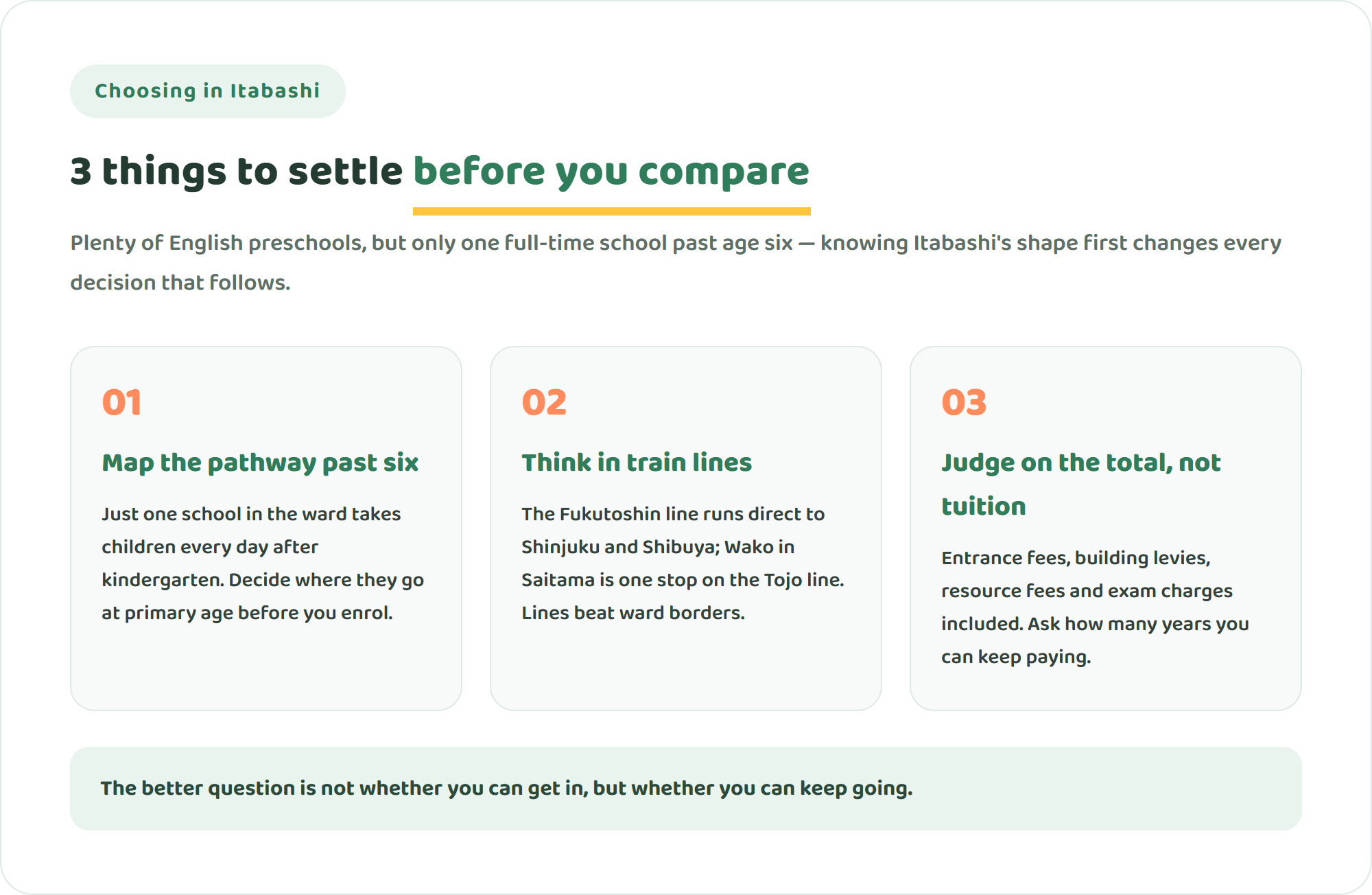
Sooner or later every Itabashi family asks the same thing: if the one school in the ward is not the right fit, then where? Think in train lines rather than in wards, and the answer clarifies quickly.
Start with the Yurakucho and Fukutoshin lines. Kotake-Mukaihara is where the two branch, and the Fukutoshin line runs straight through to Shinjuku-sanchome and Shibuya without a change. Before you rule out the central wards as impossible, actually time the journey from your station — for some Itabashi addresses it is shorter than families assume. Our guides to international schools in Shibuya and international schools in Shinjuku set out the numbers and age ranges for each. If you want the established Minato campuses in the comparison too, see international schools in Minato, and for the full picture across the capital, start with our guide to international schools in Tokyo.
Then the Tobu Tojo Line. From Narimasu and Akatsuka, Wako-shi in Saitama Prefecture is a single stop away. For families in Itabashi’s north-west, a school on the Saitama side can genuinely be an easier daily trip than heading forty-plus minutes south into the city, and fee levels there tend to sit below central Tokyo. It is worth treating as a real option rather than a fallback — see international schools in Saitama.
Finally the Toei Mita Line. From Takashimadaira, Nishidai and Shimura you have a direct run to Otemachi and Hibiya, but reaching the international-school cluster around Hiroo, Azabu and Shibuya means changing trains — a lot to ask of a seven-year-old twice a day, every day. If you live on this side of the ward, the honest shortlist is: the school inside Itabashi, the Saitama side, or online.
Comparing the options: which one actually fits your family
Lists of schools rarely answer the question you came with. It helps to collapse Itabashi into three types: the single full-time international school in the ward, the local English preschools and after-school programmes, and online international schools that require no commute at all. The table below sets out how each type tends to perform — including where each one is genuinely weak.
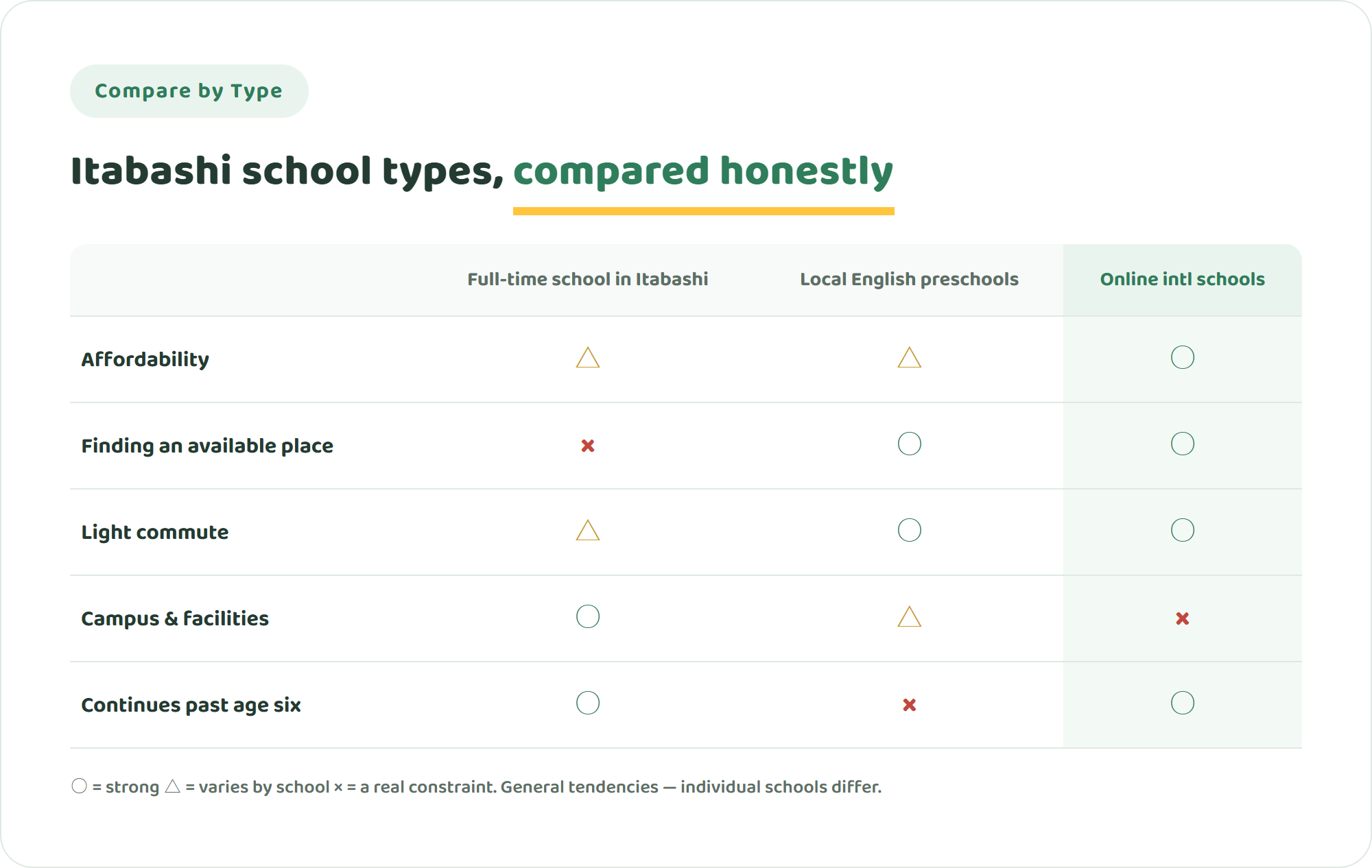
Camelot’s appeal is the combination of roughly half the central-Tokyo price and classes of around ten. The flip side of a school that size is that a given year group may simply have no space. The academic year starts in September and applications generally run March to June, so there is no version of this where you move next month. Preschools are the easy part — walkable, sometimes subsidised — but every one of them ends, and you will be searching again at six. And then there is the third path, which most families never seriously price out. An online school removes the commute entirely, which means your address and your train line stop determining what your child can study. If the fees themselves are the sticking point, is international school too expensive? may help you decide.
See how learning works online →
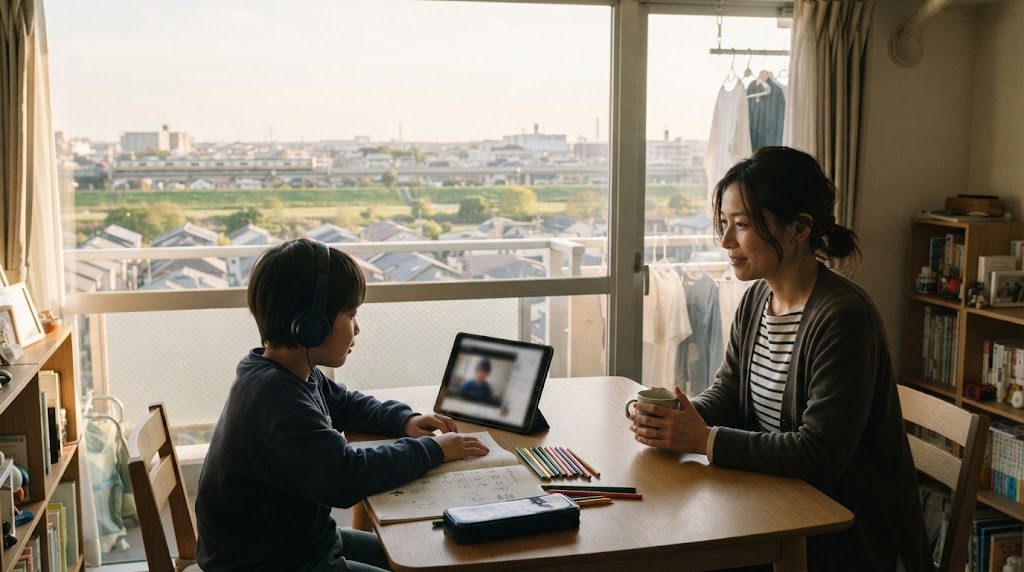
When fees or the commute are the real obstacle: online as an eighth option
Itabashi is a genuinely good place to raise children — the green space around Akatsuka, the open riverside along the Arakawa, calm and well-regarded local schools. But the constraints are real too. One full-time international school in the whole ward. A year group that may be full. And a commute that stretches long the moment you look outside the ward. Plenty of families reach the same point: they want an international education for their child and cannot see how to carry it for the next decade. If that is where you are, an online international school is worth pricing out properly rather than dismissing.
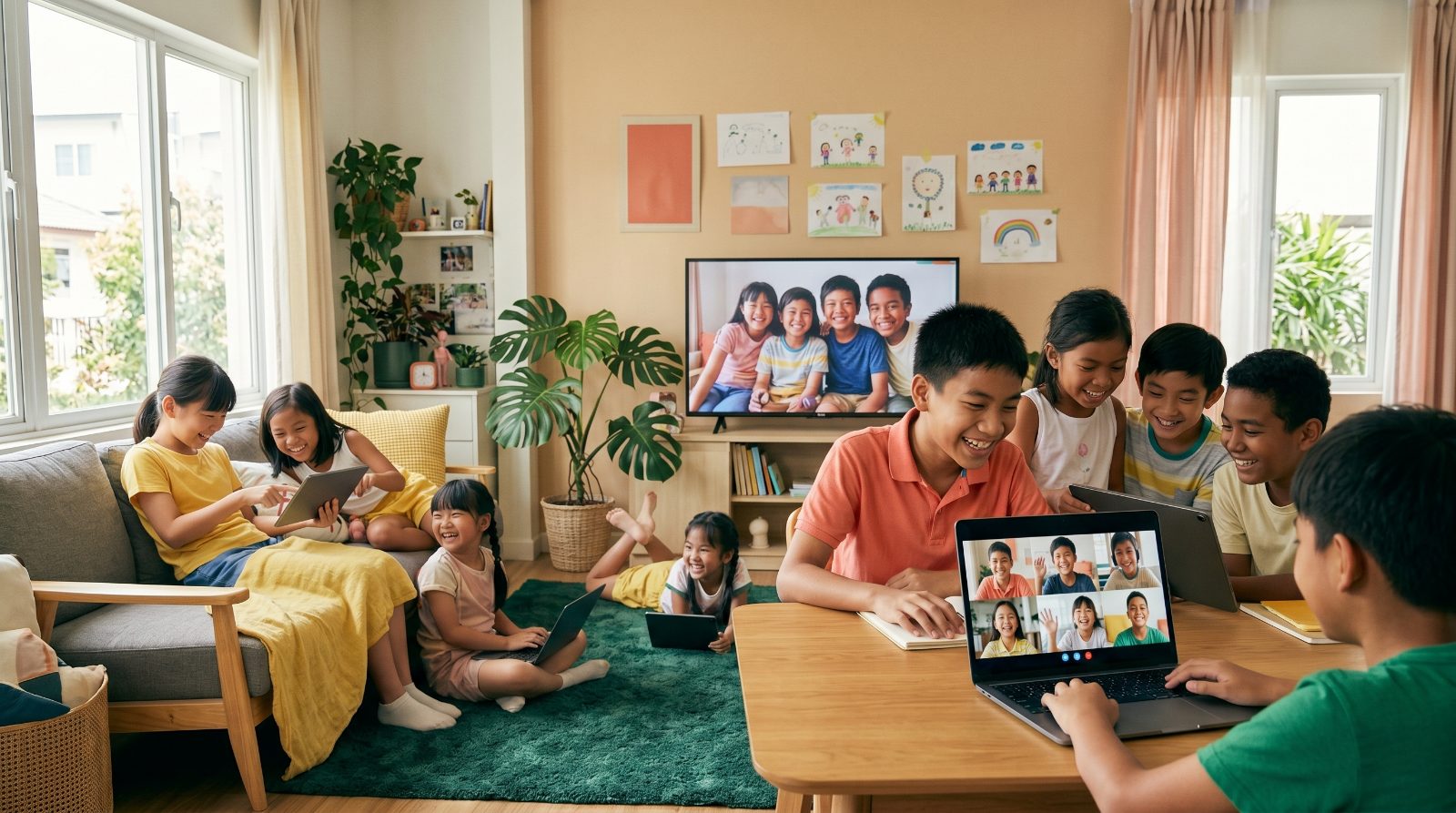
NIJIN GLOBAL ACADEMY (NGA) is an online international school opening in September 2027. It is run by NIJIN Inc., the Japanese company behind NIJIN Academy, an alternative school with more than 1,000 enrolled students in Japan. We do not rank children by test scores. Learning happens in small groups built around dialogue, with one aim: that children come to like themselves and the world. We serve students aged 6-18 across Asia and Oceania, wherever they happen to live, and the design assumes Japanese-language support as a foundation while English is introduced gradually. We are working toward fees at roughly one-fifth of on-campus international schools.
In fairness, we should say plainly: NGA has not opened yet, and our track record is still ahead of us. We cannot offer a playground, a science lab or the physical texture of a campus in the way a school with a building can. What we can offer is an international education with no commute and a fee level that a normal household can sustain — which, if you have been comparing options in Itabashi, may be worth a look.
Frequently asked questions
Q. What is the youngest age international schools in Itabashi accept?
A. On the preschool side, six months. Mulberry International School starts at six months; Tokyo Hikarigaoka International Pre-School and Happy Koala from 18 months; First Learning Senkawa from age one; Happy ABC from two; New Hope International Preschool from three. The full-time option is different: Camelot International School requires applicants to be at least six years old as of 31 August of the entry year and has no kindergarten section. Narrowing by age first will save you a great deal of time.
Q. Is there an international school in Itabashi for primary-age children, and what about Japanese-language support?
A. One: Camelot International School in Mukaihara, covering Grades 1-12. Everything else in the ward is either preschool or English classes and after-school care for primary students. Japanese-language provision differs sharply between schools, and at full-time international schools the hours devoted to Japanese are often limited — ask specifically before you apply. Note too that schools which are not accredited as Article 1 schools under Japan’s School Education Act change how compulsory-education obligations apply to children with Japanese nationality, so it is worth raising with the Itabashi Board of Education in advance. If keeping your child’s Japanese strong is a concern, our sister service Tomodachi Japan (online Japanese for children, also run by NIJIN) is worth a look.
Q. Can we transfer mid-year, and when should we start the process?
A. In a ward with a single full-time school, availability is the binding constraint rather than admissions policy. At Camelot the academic year begins in September, applications are generally accepted from March to June, and the process includes an entrance assessment in English and mathematics, interviews, and one year of academic records from the current school presented in English. Start contacting schools and attending open days roughly a year before your intended start. Preschools mostly work on the April Japanese school year, though several will accept mid-year entry with fees calculated pro rata.
The time you spend deciding is time spent caring
There is no correct answer to this. In a ward like Itabashi, where the full-time options come down to one, the useful question is not which school is best but which arrangement your family can sustain for a decade — financially, logistically, and in terms of your child’s own temperament. Every household weighs those differently. The fact that you are agonising over it at all says something good about how seriously you are taking your child’s future. Take your time. Visit two or three places and compare how the rooms actually feel. And if you would also like to know what a path without a commute looks like, we would be glad to have you follow along as we open.
Get opening updates by email →
International Schools in Other Cities
- International Schools in Nakano, Tokyo
- International Schools in Tsukuba: Fees
- International Schools in Sendai: 7 Picks and Fees
- International Schools in Shinjuku: Fees
- International Schools in Karuizawa: All 4 Schools
- International Schools in Sapporo: Fees
- International Schools in Shanghai
- International Schools in Shibuya, Tokyo
- International Schools in Shinagawa, Tokyo
- International Schools in Tokyo
- International Schools in Minato: Fees
- International Schools in Setagaya: All 14 Schools
- International Schools in Koto, Tokyo
- International Schools in Meguro: All 8 Schools
- International Schools in Chofu and ASIJ Fees