If you have just moved to Toyota City for a supplier assignment, or you are raising a family in Toyohashi or Okazaki, the question is rarely which international school is best. It is whether there is one you can actually reach. Here is the honest answer. There are more than 30 international and foreign schools in Aichi Prefecture that we could verify — but almost all of the English-medium ones sit in Nagoya City and the towns immediately east of it. Across the Mikawa region, home to the densest concentration of automotive manufacturing in Japan, there is no permanent English-medium school that continues past kindergarten. This guide maps every area of Aichi, gives real fee ranges with sources, and is straight with you about what to do when nothing is within reach.
Quick Answer: Your Options in Aichi
If you only read one section, read this. Below are the areas where schools can be confirmed, with their school names, plus the online option — so you can see every route side by side before the details.
- Nagoya City — Nagoya International School (NIS, Moriyama Ward) / Enishi International School / Aichi International School (NIPAIS, Meito Ward) and 2 more (5 in total)
- Eastern Owari — NUCB International College / Discovery International School / Kids International School and 2 more (5 in total)
- Western Mikawa — Noborders International School / Brazilian schools
- Eastern Mikawa — Escola Cantinho Brasileiro (Cantinho Gakuen)
- Western and northern Owari — Head Start International Preschool Ichinomiya / La Porte International School / Tohshun Elementary School
- NIJIN GLOBAL ACADEMY (online) — Ages 6–18 / opening September 2027, currently taking opening-update registrations / fees around one-fifth of a typical campus international school / Japanese-language support. An option when distance or fees are the wall.
International schools in Aichi Prefecture: the landscape and what they cost
Aichi has roughly 350,000 foreign residents — about 4.8% of the prefectural population, the second highest total of any prefecture in Japan (Aichi Prefectural Government, December 2025). Vietnamese and Brazilian nationals lead the count. Because Toyota’s supply chain reaches into almost every city in the prefecture, returning Japanese expat families, newly posted foreign employees and long-settled Japanese-Brazilian families all live well outside Nagoya.
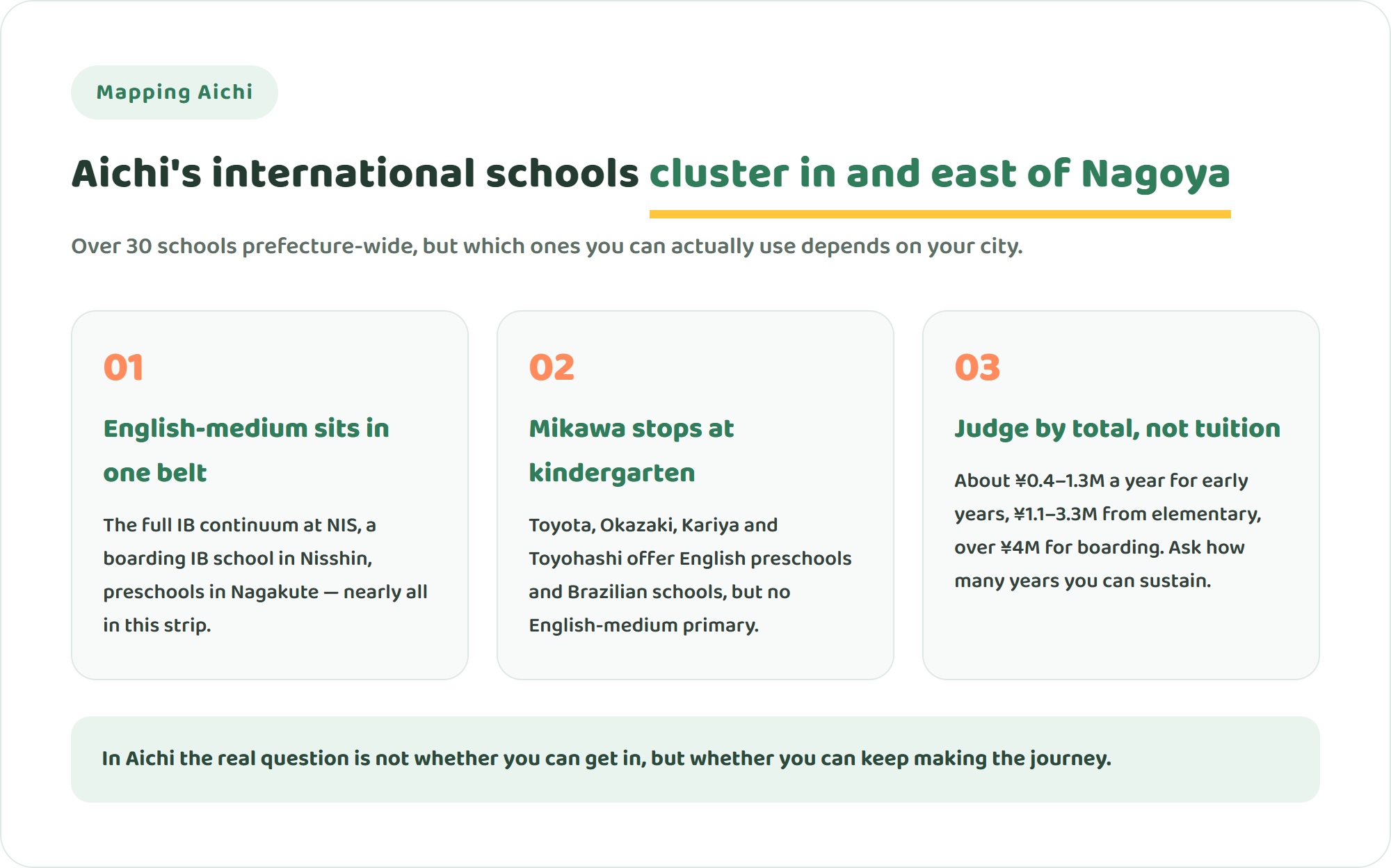
The schools, however, did not follow them. English-medium international schools cluster in Nagoya City and in Nagakute and Nisshin just to its east. In the western Mikawa cities — Toyota, Okazaki, Kariya, Anjo — and in eastern Mikawa around Toyohashi, what exists instead are English-immersion preschools and Portuguese-medium Brazilian schools. Very little bridges the gap for a seven-year-old who needs to keep learning in English.
On fees: expect roughly ¥400,000–¥1.3 million a year for preschool and early years, ¥1.1–3.3 million a year for full international schools from elementary upward, and over ¥4 million for the prefecture’s one boarding school. Enrolment fees (¥150,000–¥1,000,000), facility levies and bus charges sit on top. Judge by the total you can sustain for a decade, not the headline tuition — our breakdown of international school costs walks through every line item. Figures here are public information as of July 2026; always confirm current fees with each school.
Every area of Aichi Prefecture: international schools by region
Below is what we could verify, grouped by realistic commuting zone. Note carefully which schools stop at kindergarten and which continue into elementary and beyond — in Aichi that distinction decides almost everything.
Nagoya City
Most of the prefecture’s English-medium capacity is here. Nagoya International School (NIS, Moriyama Ward), founded in 1964, is effectively the only school in Aichi offering the full IB continuum — PYP, MYP and DP — from early years to grade 12, at ¥2.19–3.18 million per year for 2026/27 plus a ¥1,000,000 registration fee and a ¥250,000 annual campus development fee. Enishi International School is a newer IB authorised option running roughly ¥1.27–2.4 million a year. Aichi International School (NIPAIS, Meito Ward) is WASC accredited for ages 3–12 at about ¥1.09–1.33 million; UPBEAT International School runs an IB PYP programme with fees on enquiry; and Nagoya International Junior and Senior High School (Showa Ward) offers IB MYP/DP inside a Japanese-accredited school at roughly ¥600,000–630,000 tuition. Numerous preschools — Kakuozan, Hisaya, Grow, Playpourri, International Kids Academy, Beanstalk — plus the Nepali TOKAI BATIKA International School and the Brazilian Colégio Brasil Japan complete the picture.
Each Nagoya school is compared in detail — curriculum, fees, who it suits — in our guide to international schools in Nagoya. If you will be commuting from inside the city, start there. The rest of this article focuses on everywhere else.
Eastern Owari: Nagakute, Nisshin, Toyoake, Seto
The strip east of Nagoya is the prefecture’s second cluster. In Nisshin, NUCB International College opened in 2022 as a fully residential IB Diploma school where lessons and dorm life run entirely in English. Its first graduating cohort in June 2025 sent over 90% of students to universities abroad. Fees run around ¥4.1 million a year (roughly ¥2.1 million tuition plus ¥1.4 million boarding and other costs, with a ¥500,000 entrance fee; public information, confirm current figures) — the highest in Aichi, though meals and a laptop are included. Because it boards, distance stops being the deciding factor: families anywhere in Japan can apply.
In Nagakute, Discovery International School runs a Reggio Emilia-inspired preschool and kindergarten for ages 1.5–6 (fees on enquiry), drawing children from Nagakute, Nisshin, Meito Ward, Seto, Toyota and Owariasahi. Kids International School in the same city serves ages 2–6. Toyoake is home to two Korean ethnic schools, Aichi Korean Junior and Senior High School and Nagoya Korean Elementary School.
Western Mikawa: Toyota, Okazaki, Kariya, Anjo, Hekinan
This is where Aichi’s map breaks down. The region hosts Toyota’s headquarters and hundreds of tier-one suppliers, yet we could not identify a single permanent English-medium school here that continues past kindergarten. Two realistic options exist:
- Noborders International School — four Mikawa campuses in Toyota (Maeyama), Okazaki (Tatsumidai), Kariya (Hanjishi-nishi) and Anjo (Aioi), alongside four in Nagoya. All-English preschool and kindergarten, plus after-school and Saturday classes for elementary-aged children. For many Mikawa families this is the only way to keep a daily English environment without moving. Fees on enquiry.
- Brazilian schools — Escola Alegria de Saber (EAS) in Toyota and Hekinan, Colégio Pitágoras Japan Aichi in Kariya, and the NPO-run Escola Néctar in Toyota. These follow the Brazilian national curriculum in Portuguese, and several including EAS hold Aichi Prefecture’s kakushu gakko accreditation (prefectural survey). For Brazilian-heritage families they are a vital way to protect the mother tongue and a recognised school record.
So a Mikawa family who wants English-medium schooling from grade 1 is choosing between a commute of about an hour each way into eastern Nagoya, boarding at Nisshin from high school, or not commuting at all.
Eastern Mikawa: Toyohashi, Toyokawa, Tahara
Toyohashi has Escola Alegria de Saber Toyohashi and Escola Cantinho Brasileiro (Cantinho Gakuen), the latter an accredited school taking students by year group from age 3 to 18 — a rare through-school in this part of the prefecture. Both, however, teach in Portuguese; there is no English-medium international school in eastern Mikawa. Nagoya is about 20 minutes away by Shinkansen or 50 by local train, which is workable for a teenager and unrealistic for a six-year-old every school day.
Western and northern Owari: Ichinomiya, Komaki, Kasugai
Ichinomiya offers Head Start International Preschool Ichinomiya and La Porte International School for the early years, and Kasugai has the Korean Tohshun Elementary School. We found no permanent international school in Komaki, Inazawa or Konan. Because Nagoya Station is only 20–30 minutes away by JR or Meitetsu, most families here simply commute into the city. Sunnyside International School in Gifu City — a Japanese-accredited school with IB PYP authorisation — is also within reach from Ichinomiya.
To compare Aichi with the rest of the country, see our index of international schools across all 47 prefectures (in Japanese).
Comparing your options honestly
What the area-by-area map shows is that in Aichi your choice is decided by which city you live in multiplied by how many years you need. Here are the three broad types side by side.
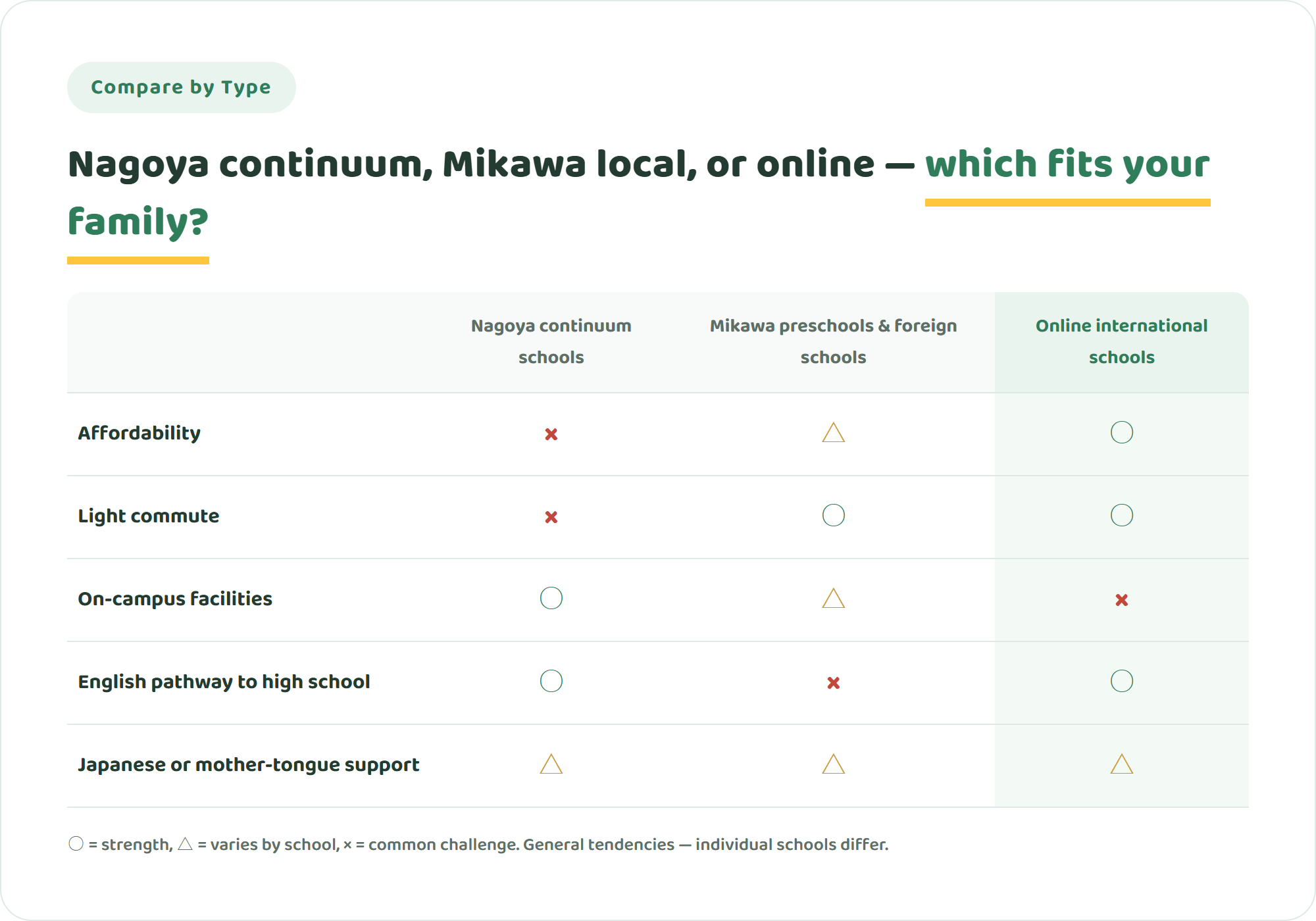
Campuses, playing fields and a full day of spoken English are the strengths of in-person schooling. Affordability, a light commute and independence from your postcode are the strengths of online. In Aichi the decisive question is whether an English-medium school your child can still attend at age twelve is within a survivable daily journey. An hour each way from Toyota into Moriyama Ward is manageable for a term and exhausting for a decade — and families do withdraw for exactly that reason. Choose for the finish line, not the entrance exam. You can see how online learning actually works here: See how learning works online →
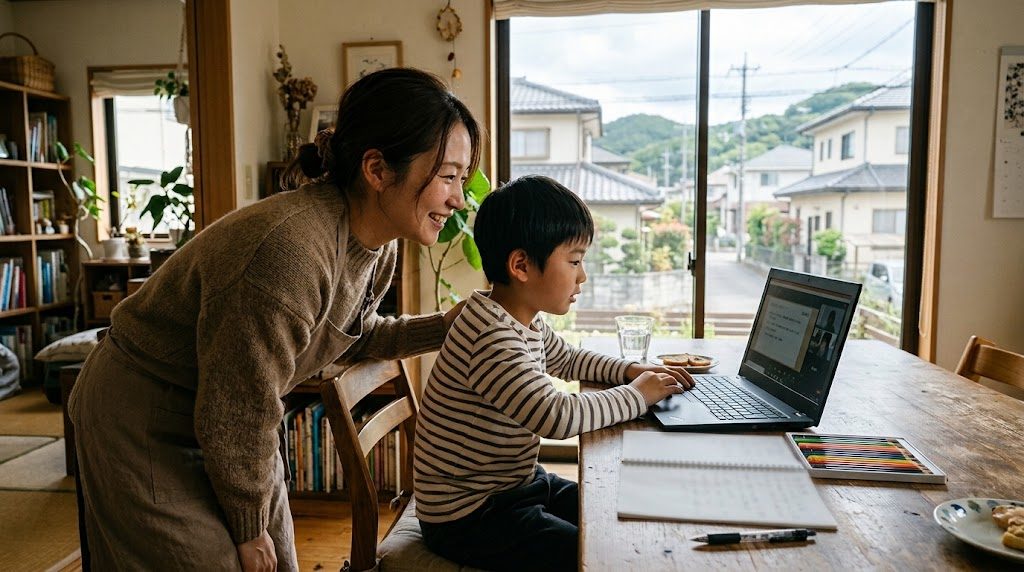
When nothing is within reach — the online option
If you have read this far and concluded that living in Toyota rules out English-medium primary schooling, or that ¥3 million a year at NIS is not something you can sustain, that is not a failure of effort on your part. It is a distribution problem. Commuting is not the only answer.
NIJIN GLOBAL ACADEMY (NGA) is an online international school opening in September 2027, run by NIJIN Inc. in Japan. Our domestic alternative school, NIJIN Academy, already has over 1,000 students enrolled. NGA is built around learning that does not rank children by test scores, small dialogue-centred classes, and fees we aim to keep at roughly one-fifth of an in-person international school. It serves ages 6–18 across Asia and Oceania — Nagoya, Toyota, Toyohashi, Tahara, anywhere. Japanese-language support underpins the design, so children new to English can build up gradually.
To be straight with you: NGA has not opened yet, so there is no track record to point to, and an online school cannot replicate a playing field or a science lab. But for a prefecture whose schools are this unevenly distributed, we think it is worth putting on your list.
Frequently asked questions
Can families anywhere in Aichi Prefecture reach an international school?
Honestly, no. Nagoya, Nagakute, Nisshin, Owariasahi and Ichinomiya have schools within commuting distance. From Toyohashi, Tahara, Shinshiro and the Atsumi Peninsula, a daily commute to an English-medium school is not realistic. From Toyota and Okazaki it is roughly an hour each way into eastern Nagoya. Test the actual journey with your child’s age and stamina in mind before you commit.
Can we enrol in a school in Gifu or Mie instead?
Yes. From Ichinomiya and the northwest, Sunnyside International School in Gifu City is within reach. Families in northern Mie often commute into Nagoya. And because NUCB International College in Nisshin is fully residential, it accepts applications from across Japan and solves the distance problem with boarding rather than a train line. Crossing a prefectural border is worth considering from the start.
What Japanese-language support is available?
It varies widely. IB schools such as NIS and Enishi teach Japanese as a subject, but instruction is in English. Brazilian schools teach in Portuguese, so if returning to the Japanese system is a possibility you will need a separate plan for Japanese literacy. Families worried about their child’s Japanese may also want to look at Tomodachi Japan, our sister service from NIJIN offering online Japanese for children.
Your address should not decide your child’s education
Aichi Prefecture has more than 30 international and foreign schools — a full IB continuum at NIS, a boarding IB school in Nisshin, English immersion across the Mikawa cities through Noborders, and long-established Brazilian schools in Toyota, Kariya, Hekinan and Toyohashi. They simply are not spread evenly. Living far from Nagoya, or finding nothing within reach, is not something you did wrong.
There is no need to chase the most famous name. Weigh the total cost, the daily journey, your child’s temperament and above all how many years you can keep going, and choose the place where your child can most be themselves.
NIJIN GLOBAL ACADEMY opens in September 2027. We will send you the learning model, the fee structure and first-cohort admissions news by email as soon as it is confirmed.
International School Guides for Other Prefectures
- International Schools in Nagoya (city guide in Aichi)
- International Schools in Shizuoka Prefecture
- International Schools in Nagano Prefecture
- International Schools in Gifu Prefecture
- International Schools in Niigata Prefecture
- International Schools in Ishikawa Prefecture
- International Schools in Toyama Prefecture
- International Schools in Hokkaido Prefecture
- International Schools in Akita Prefecture
- International Schools in Aomori Prefecture
- International Schools in Chiba Prefecture
- International Schools in Ehime Prefecture
- International Schools in Fukui Prefecture
- International Schools in Fukushima Prefecture
- International Schools in Gunma Prefecture
- Browse all 47 prefectures of Japan