Maybe your family is moving to Japan when your child is 14 or 15. Maybe you are already here, and your teenager has decided that a Japanese high school is not the right fit. Either way, the question is the same: which international high schools in Japan will still take a new student at this stage, what do they cost, and how good does your child’s English need to be on day one?
The short answer is that there are real options, but joining in high school is not like joining in Grade 3. Three things change. Many schools close the door before the final year. English support gets thinner. And the one-off entry fees weigh more when your child will only be there for two to four years.
This guide compares 20 international schools in Japan that admit students at high school level (Grades 9 to 12, or Years 10 to 13 in British schools). Every fee and admissions rule comes from each school’s own website or official fee schedule, checked on 13 November 2026. Figures are for 2026-27 unless stated. US dollar amounts use a reference rate of ¥1 = US$0.00627 (12 November 2026, ExchangeRate-API) and are rounded.
Quick answer: international high schools in Japan that admit new students
- Who admits high school students: ten schools in Tokyo and Kanagawa, seven in Nagoya, Kansai, Hiroshima, Fukuoka and Tsukuba, and three schools with boarding all run high school programmes and take new students (Hiroshima and Fukuoka do not publish their high school entry conditions).
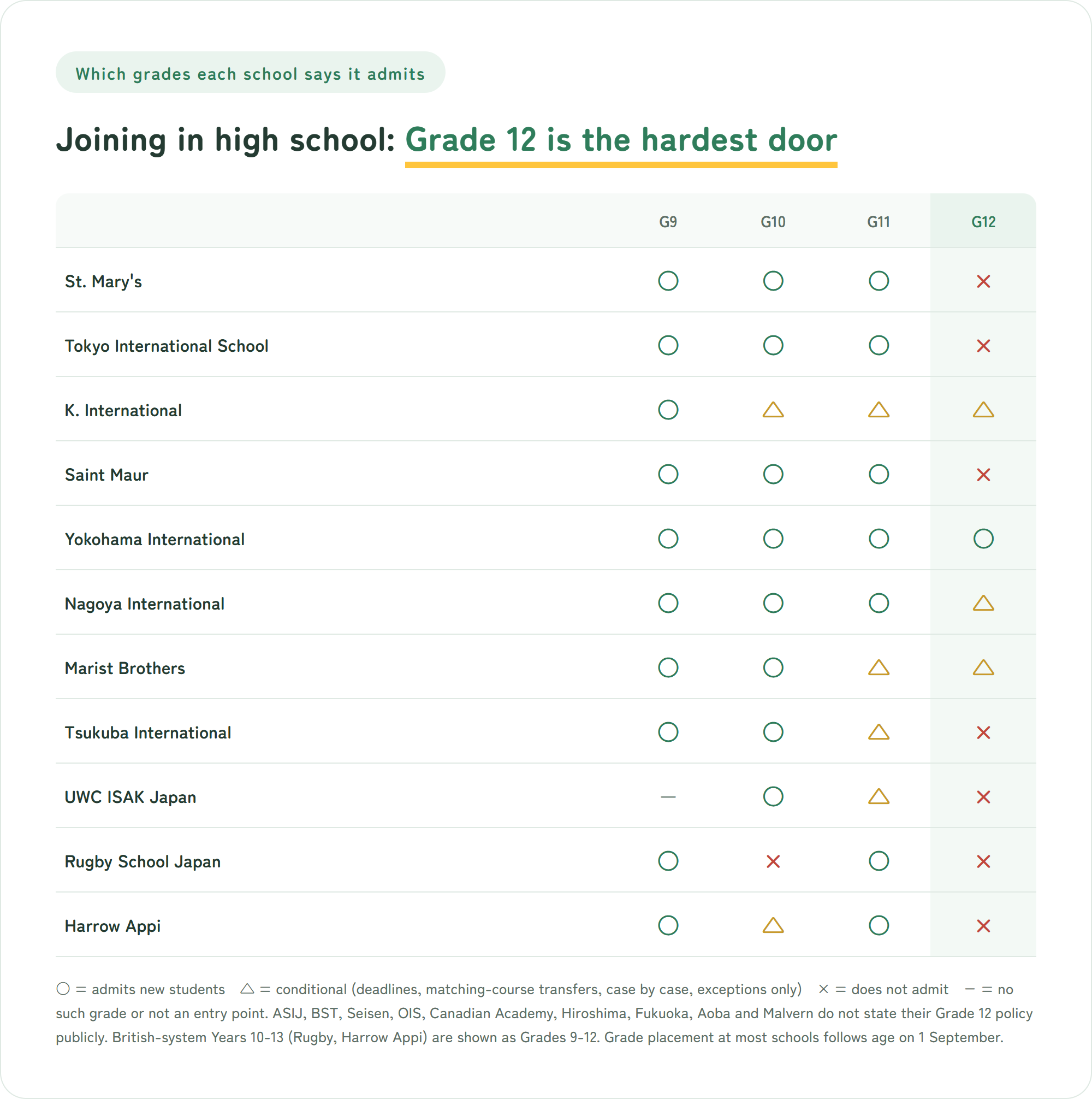
- Which grade: most of these schools build the last two years around the IB Diploma (Grades 11 and 12), so they want students in by the start of Grade 11. St. Mary’s International School and Tokyo International School state that they do not accept new Grade 12 students, and K. International School Tokyo accepts Grade 12 only as a transfer from a matching full IB Diploma course elsewhere.
- English: high school EAL support is limited at many schools. The American School in Japan offers language support only in Grades 1 to 8. At the other end, Tokyo International School says English proficiency is “a factor for admissions, not a requirement”, and Canadian Academy sets no minimum English level and provides EAL at no extra charge.
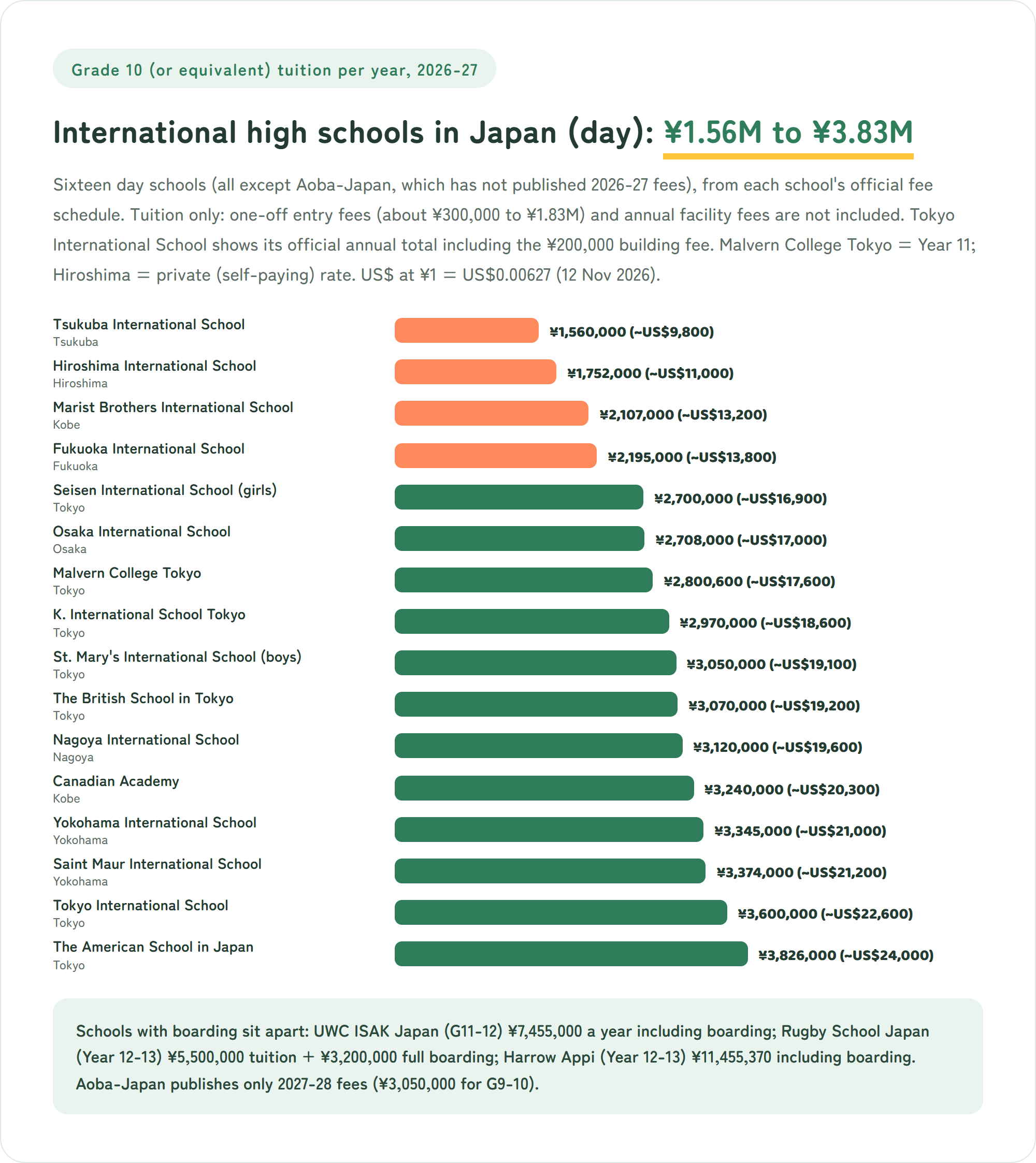
- Tuition: for the 16 day schools that publish 2026-27 fees (all except Aoba-Japan), Grade 10 tuition runs from ¥1,560,000 (about US$9,800) at Tsukuba International School to ¥3,826,000 (about US$24,000) at The American School in Japan. One-off entry fees of roughly ¥300,000 to ¥1.83 million come on top. The three boarding options cost ¥7 million to ¥11.5 million a year including boarding.
- Status in Japan: most international schools are not Japanese high schools under Japanese law, so their diplomas are not Japanese high school diplomas. Graduates of schools accredited by recognised international bodies, and IB Diploma holders, can still qualify to apply to Japanese universities.
Three things that change when you join an international high school in Japan
1. Entry deadlines: the IB Diploma starts in Grade 11
Most schools on this list teach the IB Diploma Programme across Grades 11 and 12. It is a single two-year programme, so a student who arrives halfway through often cannot match the subjects. Saint Maur International School puts it plainly: it “does not usually accept 12th grade students due to the demands of the IB Program that commences in 11th grade”. K. International School Tokyo closes general Grade 10 applications on 31 May. If the IB is new to you, our guide to what the International Baccalaureate is explains the structure.
2. English support gets thinner
High school classes run on essays, lab reports and discussion, all in English. St. Mary’s states that there is no English language support for students entering Grade 11, and only limited support in Grades 9 and 10. K. International School Tokyo does not accept applicants for Grade 8 and above who are identified as needing language support. For most schools on this list, plan on your child being able to follow lessons in English from the first week.
3. One-off fees weigh more
International schools in Japan charge one-off entry fees on top of tuition: registration, enrolment, capital or development fees. Yokohama International School’s registration fee is ¥1,480,000. The American School in Japan charges a ¥300,000 registration fee plus a ¥1,525,000 building maintenance fee. Spread over twelve years from kindergarten, that is one thing; spread over two to four years of high school, it is another.
International high schools in Japan: fees, entry grades and curriculum
All 20 schools in one table. Tuition is the 2026-27 annual high school fee. One-off fees are entry-only charges (registration, enrolment, capital or development), excluding the application fee. “Entry” reflects what each school publishes; where a school says nothing about a grade, we say so.
| School (location) | High school tuition per year | One-off entry fees | Entry (as published) | Curriculum |
|---|---|---|---|---|
| The American School in Japan (Chofu, Tokyo) | ¥3,826,000 | ¥1,825,000 | Grades 9-12; no mid-year transfers for families already living in Tokyo | US + AP |
| The British School in Tokyo (Shibuya) | ¥3,070,000 (Years 10-13) | ¥1,180,000 | Years 7-13; no grade limits published | (I)GCSE → IB Diploma |
| St. Mary’s International School (Setagaya, boys) | ¥3,050,000 | ¥1,400,000 | Grades 9-11; no Grade 12 applications | IB Diploma |
| Seisen International School (Setagaya, girls) | ¥2,700,000 | ¥1,000,000 | Assessments for Grades 1-11; Grade 12 not stated | IB MYP → IB Diploma |
| K. International School Tokyo (Koto) | G9 ¥2,850,000 / G10-12 ¥2,970,000 | ¥1,000,000 | G10 by 31 May; G12 only from a matching full IB Diploma | IGCSE → IB Diploma |
| Aoba-Japan International School (Tokyo) | G9-10 ¥3,050,000 / G11-12 ¥3,080,000 (2027-28) | ¥700,000 (2027-28) | Year-round, subject to vacancies | IB MYP → IB Diploma |
| Yokohama International School | G9-11 ¥3,345,000 / G12 ¥3,440,000 | ¥1,480,000 | Grades 9-12 (interviews common for G11-12) | IB MYP → IB Diploma and other diplomas |
| Saint Maur International School (Yokohama) | G10-11 ¥3,374,000 / G12 ¥3,559,000 | ¥950,000 | Grades 9-11; Grade 12 not usually accepted | IGCSE → IB |
| Tokyo International School (Minato) | G10-12 ¥3,600,000 incl. ¥200,000 building fee | ¥1,400,000 | Grades 9-11; no Grade 12 entry | IB MYP → IB Diploma |
| Malvern College Tokyo (Kodaira) | Years 7-11 ¥2,800,600 / Year 12 ¥2,910,000 | ¥1,042,000 | Up to Year 12 in 2026-27; Year 13 opens August 2027 | IB MYP → IB Diploma |
| Nagoya International School | G9-10 ¥3,120,000 / G11-12 ¥3,180,000 | ¥1,000,000 | Rolling; G12 joiners must complete a full senior year | IB MYP → IB Diploma and other pathways |
| Osaka International School of Kwansei Gakuin (Minoh) | G9-10 ¥2,708,000 / G11-12 ¥2,828,000 | ¥330,000 | Rolling, case by case | IB MYP → IB Diploma |
| Canadian Academy (Kobe) | G9-11 ¥3,240,000 / G12 ¥3,370,000 | ¥1,000,000 | Any time of year | IB MYP → CA Diploma + IB |
| Marist Brothers International School (Kobe) | G9-10 ¥2,107,000 / G11-12 ¥2,117,000 | ¥650,000 | G12, and G11 after week 4, case by case | IB MYP → IB Diploma |
| Hiroshima International School | ¥1,752,000 (private rate) | ¥330,000 | No high school limits published | IB MYP → IB Diploma |
| Fukuoka International School | G9-10 ¥2,195,000 / G11-12 ¥2,286,000 | ¥850,000 | No limits published; minimum one year of enrolment | IB MYP → IB Diploma |
| Tsukuba International School | ¥1,560,000 | ¥300,000 | Normally up to G10; G11 by exception at the start of the year; no G12 | IB MYP → IB Diploma |
| UWC ISAK Japan (Karuizawa, boarding) | G10 ¥7,225,000 / G11-12 ¥7,455,000 (total incl. boarding) | ¥300,000 | G10 direct; G11 only via a UWC national committee or similar; no G12 | IB Diploma |
| Rugby School Japan (Kashiwa-no-ha) | Years 10-11 ¥5,300,000 / Years 12-13 ¥5,500,000 (+ ¥3,200,000 full boarding) | ¥1,000,000 | Years 10 and 12 are the main entry points; Years 11 and 13 not usually | IGCSE → A Level |
| Harrow International School Appi Japan (Iwate, boarding) | Years 10-11 ¥11,045,720 / Years 12-13 ¥11,455,370 (incl. boarding) | ¥1,000,000 (+ refundable deposit) | Year 12 yes; Year 13 no; Year 11 by exception | (I)GCSE → A Level |
Sources: each school’s official website (linked below). One-off fees exclude application fees, annual facility fees, buses, lunches and exam fees. Aoba-Japan did not publish 2026-27 fees on its official pages, so its 2027-28 figures are shown. British Years 10-13 correspond to Grades 9-12.
International high schools in Tokyo and Kanagawa (10 schools)
Tokyo has the most choice, but entry grades and English rules differ sharply between schools. For a wider view of the city, see our guide to international schools in Tokyo.
The American School in Japan (ASIJ)
An American curriculum with AP courses, and no IB Diploma. High school tuition is ¥3,826,000, plus a ¥300,000 registration fee, a ¥1,525,000 one-off building maintenance fee and a ¥250,000 annual capital assessment. The admissions FAQ asks for strong English, and language support stops at Grade 8. Families already living in Tokyo cannot transfer mid-year (official fees). Full breakdown: ASIJ tuition and fees.
The British School in Tokyo (BST)
(I)GCSEs in Years 10-11 and the IB Diploma in Years 12-13. Tuition for Years 10-13 is ¥3,070,000, with a ¥500,000 enrolment fee and a ¥680,000 educational resources fee on entry. BST lists English proficiency as an entry requirement (official fees). More: British School in Tokyo fees.
St. Mary’s International School (boys)
High school tuition is ¥3,050,000, with a ¥400,000 registration fee and a ¥1,000,000 development fund. St. Mary’s states that it does not accept applications for Grade 12, because IB Diploma students must enrol by the beginning of Grade 11 (admissions policy). More: St. Mary’s tuition.
Seisen International School (girls)
An IB continuum school. High school tuition is ¥2,700,000, among the lowest in Tokyo, with ¥1,000,000 in entry fees. Places in the EAL programme are limited (official fees). More: Seisen fees.
K. International School Tokyo (KIST)
IGCSE in Grades 9-10 and the IB Diploma in Grades 11-12. Tuition is ¥2,850,000 in Grade 9 and ¥2,970,000 in Grades 10-12. Deadlines are strict: Grade 10 general applications by 31 May, and Grade 12 only as a transfer from a matching full IB Diploma course. Applicants for Grade 8 and above who need language support are not accepted (official fees).
Aoba-Japan International School
Offers the IB Diploma in Grades 11-12 and admits students throughout the year if there is a vacancy. Published 2027-28 tuition is ¥3,050,000 for Grades 9-10 and ¥3,080,000 for Grades 11-12 (official fees). Its Grade 12 policy and high school English threshold are not published.
Yokohama International School (YIS)
Its FAQ indicates it considers applicants up to Grade 12 (Grades 11 and 12 usually with an interview). High school requires “a high degree of academic English proficiency”, with no separate ESL track. Tuition is ¥3,345,000 for Grades 9-11 and ¥3,440,000 for Grade 12; the one-off registration fee is ¥1,480,000 (official fees).
Saint Maur International School
IGCSE in Grades 9-10, IB in Grades 11-12. Tuition is ¥3,374,000 for Grades 10-11 and ¥3,559,000 for Grade 12, with a ¥950,000 registration fee. Grade 12 entry is not usually accepted, and academic English is assumed from Grade 10 (admissions criteria).
Tokyo International School (TIS)
Runs through Grade 12 with the IB Diploma. The annual total for Grades 10-12 is ¥3,600,000 including a ¥200,000 building fee; entry fees are ¥1,400,000. No new students are accepted into Grade 12. English is “a factor for admissions, not a requirement”, there is EAL, and at least one parent must be fluent in English (official fees).
Malvern College Tokyo
Its IB Diploma Sixth Form admits Year 12 (Lower Sixth) in 2026-27, at ¥2,910,000 a year. Year 13 is planned for August 2027 and its fee is still listed as TBC. External accreditation such as CIS is described as a goal (official fees).
International high schools outside Tokyo (7 schools)
Fees are often lower outside Tokyo, and some schools are more flexible about when students can join. Our guide to international schools in Japan by prefecture covers every region.
Nagoya International School (NIS)
Tuition is ¥3,120,000 for Grades 9-10 and ¥3,180,000 for Grades 11-12, with a ¥1,000,000 registration fee. Applications are rolling, but Grade 12 transfers must complete a full senior year, so joining partway through Grade 12 is not possible (official fees).
Osaka International School of Kwansei Gakuin (OIS)
Tuition is ¥2,708,000 for Grades 9-10 and ¥2,828,000 for Grades 11-12, and the registration fee is a modest ¥330,000. Admission is rolling and individual, with language, maths and cognitive testing; the school may limit places for non-English speakers by grade (official fees).
Canadian Academy (Kobe)
Accepts students at any point in the year, sets no minimum English level and provides EAL free of charge, although Grades 11-12 assume enough English to access classes. Tuition is ¥3,240,000 for Grades 9-11 and ¥3,370,000 for Grade 12. Boarding for Grades 9-12 costs ¥3,500,000 a year on top of tuition, including term-time meals (official fees).
Marist Brothers International School (Kobe)
Tuition is ¥2,107,000 for Grades 9-10 and ¥2,117,000 for Grades 11-12, the lowest among Kansai day schools here. Applicants take WIDA and MAP tests, with WIDA 4.0 or above as the guide for Grades 9-10. Grade 12, and Grade 11 after the fourth week of the year, are case by case and depend on matching courses (official fees).
Hiroshima International School (HIS)
Private-rate tuition is ¥1,752,000 for Grades 9-12. Secondary students need a working level of English, and EAL costs an extra ¥100,000 a year (official fees). More: international schools in Hiroshima.
Fukuoka International School (FIS)
Tuition is ¥2,195,000 for Grades 9-10 and ¥2,286,000 for Grades 11-12, with ¥850,000 in entry fees. Secondary applicants take WIDA, English learners are supported through ELL, and students must enrol for at least one year (official fees).
Tsukuba International School
The lowest day-school tuition on this list: ¥1,560,000 for every grade, plus ¥210,000 facilities and ¥240,000 materials fees each year. Entry is normally up to Grade 10; Grade 11 only by exception at the start of the year; no new Grade 12 students. The guide for Grade 11 entry is roughly Eiken Pre-1 or above (official fees). More: international schools in Tsukuba.
Boarding international high schools in Japan (3 schools)
UWC ISAK Japan (Karuizawa)
A foundation year in Grade 10, then the IB Diploma. The annual total is ¥7,225,000 in Grade 10 and ¥7,455,000 in Grades 11-12 (tuition, boarding, facilities and IB fees). Grade 10 is a direct application; Grade 11 is only through a UWC national committee or a similar route; there is no Grade 12 or mid-year entry. Financial aid is need-based only, and about 70% of students receive it, according to the school (fees and financial assistance). It is approved by Japan’s education ministry, and graduates also receive a Japanese high school diploma. More: UWC ISAK Japan fees.
Rugby School Japan (Kashiwa-no-ha)
IGCSEs in Years 10-11 and A Levels in Years 12-13. Tuition is ¥5,300,000 for Years 10-11 and ¥5,500,000 for Years 12-13; full boarding adds ¥3,200,000 (weekly ¥2,900,000) plus meals. Years 10 and 12 are the main entry points, and Years 11 and 13 do not usually take new students (official fees).
Harrow International School Appi Japan (Iwate)
Fees including boarding are ¥11,045,720 for Years 10-11 and ¥11,455,370 for Years 12-13. Year 12 entry is possible, Year 13 is not, and Year 11 only by exception. Students joining Year 10 and above need English at CEFR B2 or higher (official fees).
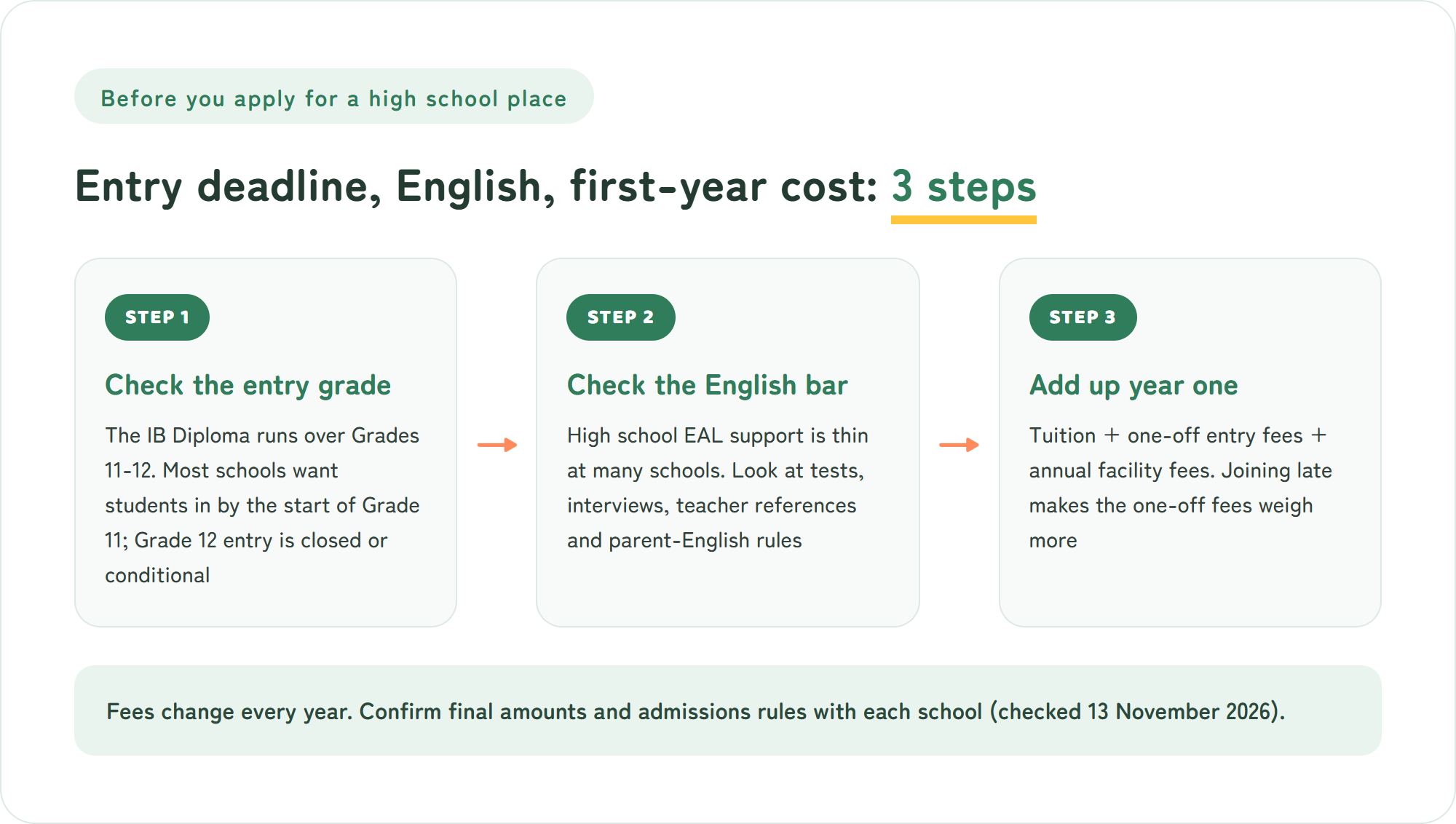
How to choose an international high school in Japan: three steps
- Step 1: Check the entry grade. Work out which grade your child will be in on 1 September and whether that grade is open to new students. If the IB Diploma is the goal, focus on schools your child can join before Grade 11 starts.
- Step 2: Check the English bar. Tests (WIDA, the Duolingo English Test, school exams), interviews, English teacher references and rules about parents’ English all vary. Ask which grades still receive EAL support.
- Step 3: Add up year one and plan the exit. Tuition, one-off fees, annual facility fees, bus, lunch and exam fees. Then decide whether your child is heading to a Japanese or an overseas university, and which qualification that route needs.
If the right school is too far away or a move is coming soon, it helps to know how online learning in English works as well. You can read how our classes are designed on our curriculum page.

Where NIJIN GLOBAL ACADEMY fits
NIJIN GLOBAL ACADEMY (NGA) is an online international school for ages 6 to 18, planned to open in September 2027. It is run by NIJIN Inc., whose online school NIJIN Academy has taught more than 1,000 children in Japan. We plan small live classes taught in English, with bilingual mentors, and an approach that does not rank children by test scores. How admissions will work is still being decided.
To be honest: NGA has not opened yet, is not accredited, has not published fees and has no graduates. For a teenager who needs an IB Diploma or A Levels now, it is not a substitute for the schools above. It may be worth comparing if your child wants more learning in English alongside their current school, or if your family may move again before high school ends.
Frequently asked questions
Can my child join an international high school in Japan in Grade 10 or 11?
Yes. All 20 schools here run high school programmes and take new students, although Hiroshima and Fukuoka do not publish their high school entry conditions. Most want students in by the start of Grade 11, and St. Mary’s, Tokyo International School and Tsukuba International School, among others, do not take new Grade 12 students.
What do international high schools in Japan cost?
For the 16 day schools that publish 2026-27 fees, Grade 10 tuition ranges from ¥1,560,000 (Tsukuba International School) to ¥3,826,000 (The American School in Japan), plus one-off entry fees of roughly ¥300,000 to ¥1.83 million. The three boarding options cost ¥7 million to ¥11.5 million a year including boarding.
Which international high schools in Tokyo accept students with limited English?
Options are narrow at high school level. Tokyo International School treats English as a factor rather than a requirement and offers EAL. St. Mary’s offers no English support to Grade 11 entrants, and K. International School Tokyo does not accept Grade 8+ applicants who need language support. Outside Tokyo, Canadian Academy sets no minimum English level and provides free EAL.
Is an international school diploma recognised by Japanese universities?
Most international schools are not Japanese high schools, so their diploma is not a Japanese high school diploma. Graduates of schools accredited by recognised international bodies, and IB Diploma holders, can qualify to apply to Japanese universities. UWC ISAK Japan graduates also receive a Japanese high school diploma. Always check the admissions guidelines of the university your child is aiming for.
Which international high schools in Japan offer boarding?
UWC ISAK Japan and Harrow Appi are fully boarding. Rugby School Japan offers full and weekly boarding, and Canadian Academy has boarding for Grades 9-12.
Joining late does not have to mean joining blind
Starting international school in high school is not too late. But the entry deadline, the English needed from day one and the one-off fees can close doors quietly if you only find out at the application stage. Start with your teenager: what do they want from an international school, and where do they want to go after it? With that answer, the table above stops being a list of who will take you and becomes a way to see which school fits. If you would like to keep an online option in view as well, we will share updates as NGA prepares to open, including trial classes planned for April and May 2027.