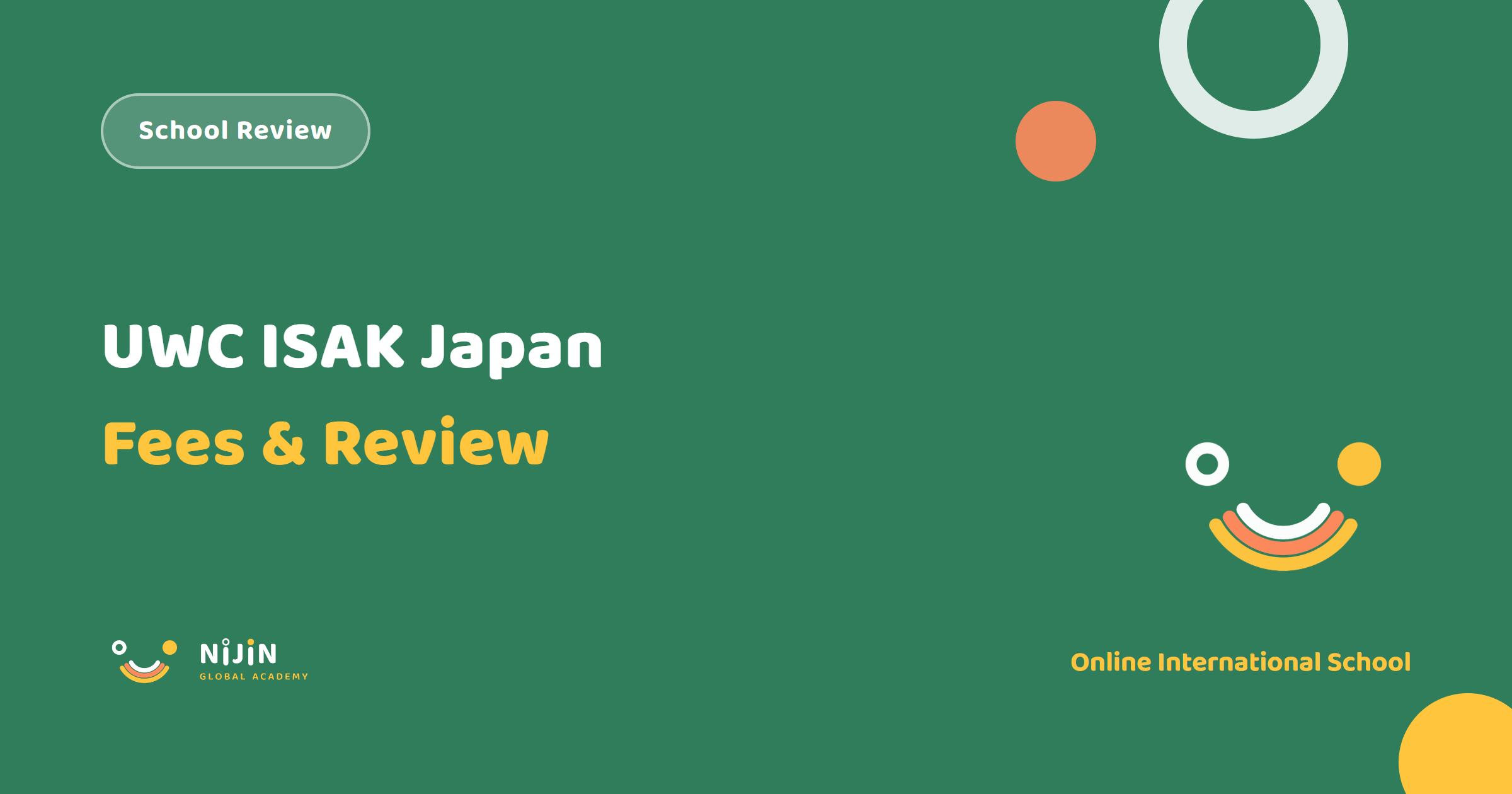
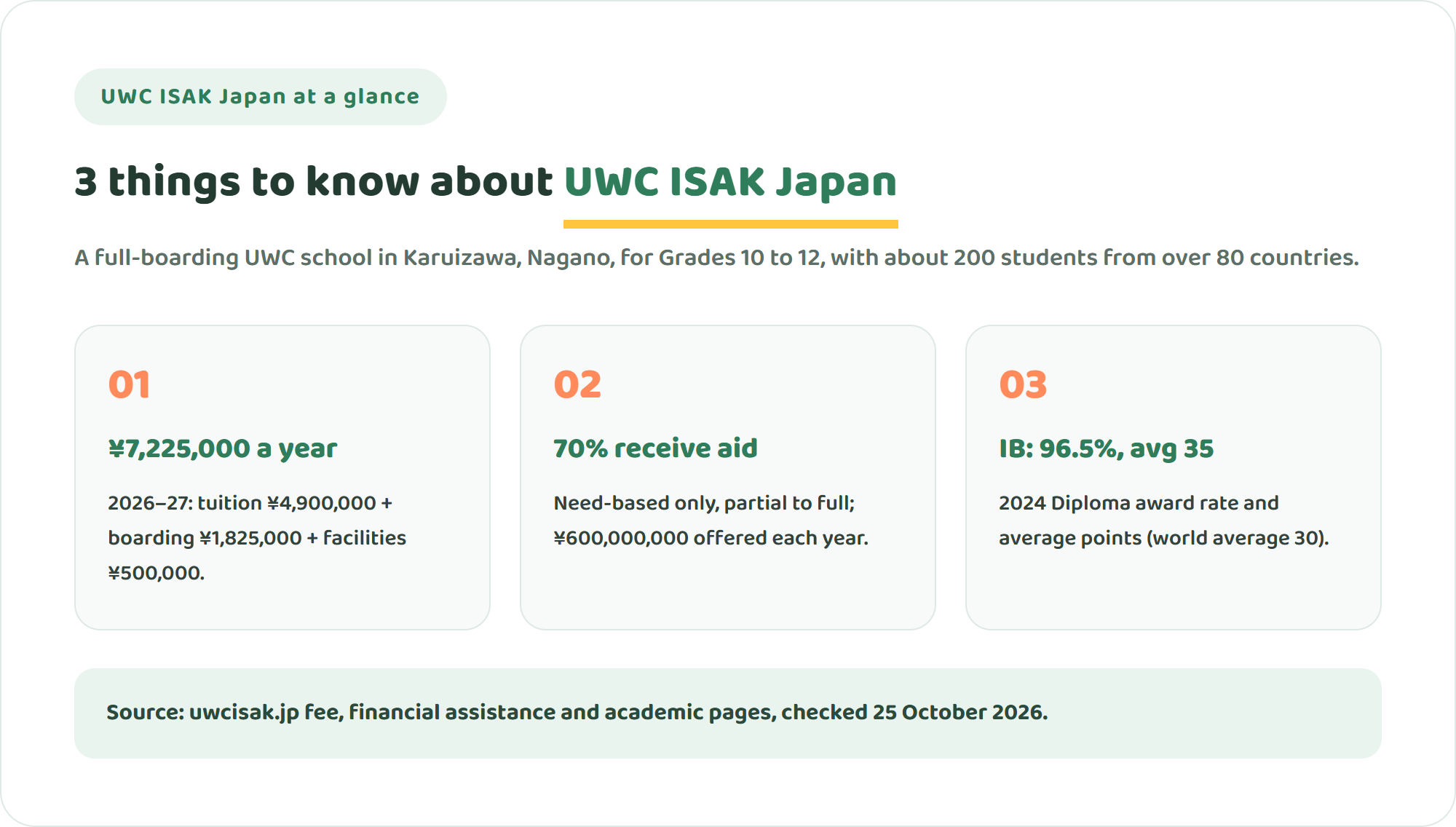
UWC ISAK Japan’s fees for the 2026–27 academic year are ¥7,225,000 per student: a tuition fee of ¥4,900,000, a boarding fee of ¥1,825,000 and a facilities fee of ¥500,000 (official Fees & Financial Assistance page, checked 25 October 2026). The same page says that 70% of students receive some level of need-based financial assistance and that ¥600,000,000 in assistance is offered each year, so the list price is not what most families pay. All figures on this page are in Japanese yen as the school publishes them; we do not convert them because exchange rates move.
If you searched “UWC ISAK Japan fees”, you are probably an English-speaking family — in Japan or abroad — weighing a full-boarding IB high school in the mountains of Nagano against day schools in Tokyo, a boarding school at home, or something more flexible. This page answers, from the school’s own website and fee documents, the questions that Google’s own suggestions show people ask: the fees and what they include, how the financial assistance works, whether an acceptance rate is published, the application timeline and the difference between applying directly and applying through a UWC national committee, the summer school, what campus and boarding life look like, and the IB Diploma results. It then compares UWC ISAK Japan with two other boarding options in Japan and with NIJIN GLOBAL ACADEMY, a different kind of option (an online school opening in 2027), in one table.
The short answer: who UWC ISAK Japan suits — and who it doesn’t
- Suits: a 15-year-old who wants a deliberately international boarding community. The school has about 200 students from more than 80 countries and about 70 faculty and staff, and it is the UWC movement’s 17th member school.
- Suits: families who need financial help to afford a boarding school. All assistance is need-based, ranges from partial to full scholarships, and 70% of students receive some level of it; the published income-bracket averages show what Grade 10 aid recipients actually paid in 2025.
- Suits: students who want the IB Diploma with a published track record: 96.5% of UWC ISAK students were awarded the Diploma in 2024 with an average of 35 points against a world average of 30.
- Suits: families who want a Japanese high school diploma as well as the IB. The school is accredited through MEXT, Japan’s Ministry of Education, and graduates receive a Japanese high school diploma.
- Harder fit: families who want a day place. There are no day students; everyone lives in the on-campus houses.
- Harder fit: students who want to join in Grade 11 or 12 directly, or mid-year. Direct applications are only for Grade 10 entry (a three-year programme); Grade 11 entry is only through a UWC national committee or the Global Selection Programme, and there are no Grade 12 entries or mid-year transfers.
- Harder fit: families who want a conventional academic competition. Selection is by written application, references, two short videos and an online interview with a group assessment; there is no entrance test, and no acceptance rate is published.

What UWC ISAK Japan is
According to the school’s history page, its founders set out in 2008 to create a new kind of school and, with 100 founding donors, began building the International School of Asia, Karuizawa (ISAK). After six years of preparation it opened in 2014, and on 1 August 2017 it joined the United World Colleges movement, becoming UWC ISAK Japan. The school celebrated its tenth anniversary as a high school in 2024. It describes itself as Japan’s first full-boarding international high school for Grades 10–12 and frames everything around a leadership mission: its vision is “Realize Your Potential” and “Be a Catalyst for Positive Change”, and it adopts the UWC mission, “UWC makes education a force to unite people, nations and cultures for peace and a sustainable future.”
The campus is in Karuizawa, a mountain resort town in Nagano Prefecture that the school describes as about an hour from Tokyo by bullet train and famous for its cool climate. For a view of the Tokyo market that a day-school family would consider instead, see our guide to international schools in Tokyo.
| Item | UWC ISAK Japan (official) |
|---|---|
| Type | Private, full-boarding international high school; no day students |
| Opened | 2014 as ISAK; UWC member since 1 August 2017 |
| Grades / ages | Grades 10–12; the financial assistance policy describes students aged 15–19 |
| Students | About 200 from over 80 countries; about 70 faculty and staff |
| Location | 5827-136 Nagakura, Karuizawa, Kitasaku-gun, Nagano 389-0111 |
| Curriculum | Grade 10: MEXT-approved curriculum with a leadership programme; Grades 11–12: IB Diploma Programme |
| Accreditation named on the official site | Accredited through MEXT (graduates receive a Japanese high school diploma); IB World School authorised for the Diploma Programme; a CIS logo appears in the site footer |
| Intake | About 40 students a year by direct application into Grade 10; about 40 more into Grade 11 through UWC national committees |
| Fees 2026–27 | ¥7,225,000 a year (tuition ¥4,900,000 + boarding ¥1,825,000 + facilities ¥500,000); 70% of students receive need-based assistance |
| School year | 2026–27: new-student registration 18 August, classes begin 24 August 2026 |
UWC ISAK Japan fees (2026–27, official): tuition, boarding, deposit and other fees
The school publishes the 2026–27 headline fees as text on its Fees & Financial Assistance page and links a fuller School Fees and Expenses sheet for 2025–26. The one-time fees and additional expenses below come from that 2025–26 sheet, because a 2026–27 version is not published on the official site; confirm them with Admissions before you budget.
| Fee | 2026–27 (official page) | 2025–26 (official fee sheet) |
|---|---|---|
| Tuition fee (per year) | ¥4,900,000 | ¥4,500,000 |
| Boarding fee (per year) | ¥1,825,000 | ¥1,770,000 |
| Facilities fee (per year) | ¥500,000 | ¥420,000 |
| Annual total | ¥7,225,000 | ¥6,690,000 |
| IB Years Fee (Grades 11 and 12 only, per year) | Not published on the official site for 2026–27 | ¥230,000 |
| Application fee (one-time, non-refundable) | Not published on the official site for 2026–27; the How to Apply page states ¥20,000 for the current cycle | ¥20,000 |
| Enrollment fee (one-time, non-refundable, at acceptance) | Not published on the official site for 2026–27 | ¥300,000 |
| Security deposit (refundable, returned at graduation) | Not published on the official site for 2026–27 | ¥40,000 |
What the annual fees include. The 2025–26 sheet says school fees “cover all costs for tuition, dormitory housing during the school year, daily meal service, textbooks, compulsory medical health checks, insurance, Project Weeks, and expenses for most school activities and trips.” Fees are invoiced in June before each school year and paid in full in July or in two equal instalments in July and December; the total is the same either way. The school provides free transport from Narita Airport to campus for new students arriving on the designated arrival day.
What families pay on top. The sheet lists a laptop (variable; MacBooks are “strongly encouraged, but not mandatory”), later airport transport, holiday travel home (students are expected to return home over the summer at their own expense), university application costs, and pocket money of approximately ¥5,000 a month for snacks, stationery and local transport. The IB Years Fee is waived for students who enter through a national committee and is prorated in line with a financial assistance award for everyone else: a student with a 70% award pays 30% of it.
How the fees have moved. Between the 2025–26 sheet and the 2026–27 page the annual total rose from ¥6,690,000 to ¥7,225,000 — an increase of ¥535,000, or 8.0%. The school says it reviews fees periodically and takes care to communicate changes clearly. Budget for further increases over a three-year stay. If you are comparing it with the other English-medium options in the same town, our guide to international schools in Karuizawa sets them side by side.
What three years adds up to at list price
For a student entering Grade 10 in August 2027 and paying full fees, if the 2026–27 annual total stayed unchanged: 3 × ¥7,225,000 = ¥21,675,000, plus the IB Years Fee for two years at the 2025–26 rate (2 × ¥230,000 = ¥460,000), plus the application and enrollment fees (¥20,000 + ¥300,000 = ¥320,000), comes to ¥22,455,000. Add the refundable ¥40,000 deposit, a laptop, flights, and roughly ¥50,000 a year of pocket money over a ten-month school year. That is the ceiling; the next section shows why most families pay less.
Financial assistance: how it works and what families actually pay
UWC ISAK Japan’s financial assistance is unusual for a private boarding school in Japan, and it is the reason the headline fee can mislead. From the official page and the school’s Financial Assistance Policy (last updated 18 June 2024):
- Need-based only. “All of our financial assistance is need-based. We do not offer academic or merit-based scholarships.” Awards range “from partial scholarships up to full scholarships”. The school says it offers ¥600,000,000 in assistance annually and that 70% of students receive some level of it.
- Who can apply. All applicants, “regardless of nationality” or country of residence. Aid is for direct Grade 10 entry (the three-year programme) and must be requested with the application; the deadline is the same as the application deadline. Grade 11 applicants through a national committee ask that committee about scholarships. Students selected through the UWC Global Selection Programme are not eligible for assistance.
- How it is assessed. The Financial Assistance Office reviews family income, assets, expenditure and debt, and considers family size and other children’s school costs. Both parents are expected to contribute where financial responsibility is shared. Tax returns or official income statements are required, in English or Japanese.
- Need-aware admissions. The school says its process is need-aware: merit is prioritised in the final decision and financial need is also considered. Families whose income or assets disqualify them from assistance are told before decisions are announced, so they can decide whether to continue at full fees. Aid decisions are released with acceptance notifications; the school cannot give estimates in advance.
- What aid does not cover. Except in extremely rare cases: flights to and from Japan, school supplies, university application and standardised test fees, pocket money, the security deposit and travel money during long breaks. National Health Insurance is included in fees, and the school says Project Week and most activities are covered or funded for students with high need. Students on full assistance can borrow a laptop and graphing calculator.
- Renewal. Families re-apply every year with updated documents; the school generally keeps the same level of support while the student remains in good standing and circumstances are unchanged. Families who did not apply at enrolment cannot apply later unless there is a significant unanticipated change such as job loss or illness.
The official page also publishes the average 2025 school fees paid by Grade 10 aid recipients by family income bracket, with the caveat that averages “are not a guarantee of assistance” and exclude the one-time enrollment fee:
| Family income (JPY) | Average school fees paid | Number of families |
|---|---|---|
| Less than 5 million | ¥607,500 | 20 |
| 5 to 10 million | ¥1,750,000 | 13 |
| 10 to 15 million | ¥2,318,182 | 18 |
| 15 to 20 million | ¥3,388,889 | 7 |
| 20 to 30 million | ¥4,500,000 | 5 |
Read this table carefully: it covers aid recipients only, so a family in the 15–20 million bracket that applied for aid paid about ¥3.4 million a year on average, while a family that did not qualify paid the full ¥6,690,000 that year. If cost is the deciding factor, our guide to online vs in-person international school costs explains what usually sits outside a boarding fee.
Admissions: eligibility, the timeline, and national committee vs direct application
Two routes. The Admissions Office “accepts applications exclusively for our 3-year program”: you apply directly to UWC ISAK Japan for Grade 10, and Grade 10 students continue automatically into the IB Diploma Programme without reapplying. The two-year route (Grades 11–12) is only through your country’s UWC national committee or the UWC Global Selection Programme (GSP); the school states plainly that “we do not accept direct applications for Grade 11 entry”, and only one pathway may be used per year. Financial assistance is not available through the GSP, which the school describes as the route for families able to pay full fees. The school admits approximately 40 students a year for direct Grade 10 entry and about 40 more into Grade 11 through national committees; about 30% of Grade 10 students are Japanese citizens or residents and about 70% come from abroad.
Eligibility for Grade 10 entry in August 2027. Applicants must be in the equivalent of US Grade 9, UK Year 10 or Japanese middle-school Grade 3 when they apply, complete that grade by August 2027, and have been born between 1 January 2011 and 31 December 2012. Students in Grade 8 or younger, or born in 2013 or later, are not eligible.
English. No test score is required. The school says non-native speakers may apply if they have completed at least three years of English study and are at an intermediate level, and it recommends EIKEN Level 2 or higher, TOEFL 65 or higher, TOEIC 600 or higher, or IELTS 6 or higher as a guide. Grade 10 is described as “a foundation year that will give you time to build your English skills before starting the IB Diploma Programme.”
Timeline for 2027 entry (from the How to Apply page; the school lists dates without years, and they refer to the 2026–27 cycle):
- 1 September: applications open. 1 December: application deadline.
- 2 December – 13 January: application review. 15 January: Stage 1 results.
- 23 January – 4 February: online interview and group assessment for shortlisted applicants. “All final assessments are conducted online.”
- 12 February: early results for students at Japanese-calendar schools who opt in (opting in “will not increase or decrease their chance of selection”); 18 February: early commitment deadline.
- 24 February: regular results. 2 March: regular commitment deadline.
What the application contains. A 15-minute registration form (eligibility confirmed within a week), then the full application covering the student and a parent: short answers of up to 250 words, one 500-word response, two videos of up to two minutes, one academic and one non-academic reference (in English or Japanese), transcripts for the current and two previous years, a photo and proof of date of birth, and the ¥20,000 non-refundable application fee at submission. The school looks for students “who are curious, creative and independent” with strong academic motivation. If places remain, a late application period typically opens from April to June at full fees; after 1 June only Japanese citizens or residence-visa holders may apply.
Acceptance rate. Not published on the official site. With about 40 direct places a year and applicants from around the world, the honest statement is that entry is selective, but we will not invent a percentage. The school runs online admissions Q&A sessions (October and November dates are listed), an Open Campus on 2 November and student-led campus tours on 14 November in the 2026–27 cycle; individual visits are not possible from 1 June to 31 July.
Campus, boarding and a school day in Karuizawa
Campus. The campus overview describes a forested site with the Kamiyama Academic Center (administration, teaching spaces and library), the Asama building (cafeteria and science labs), The Accord Center for assemblies, performances and humanities classes, a full-sized gymnasium and sports field, and a Creative Center and Health & Wellness Center under development. Students also use curling, skating, swimming, fitness and martial arts facilities at nearby Kazakoshi Park. The campus size in hectares is not published on the official site.
Boarding. Students share a two-person or four-person bedroom in a house of 12 to 18 students, each with a lounge, kitchenette and free laundry, and most are paired with roommates from different countries. Each house has a House Mentor (a faculty member) and student Residential Advisors; students design their own house management systems. Blended housing is available with written parental consent, with rooms assigned by self-identified gender. Campus staff include nurses, counsellors, peer supporters and advisory leaders, staff undergo international background checks, and non-graded advisory groups meet weekly.
Academics and the rhythm of the year. Grade 10 follows a MEXT-approved curriculum built on small, discussion-based classes and a project-based Leadership Program; Grades 11–12 follow the IB Diploma with six subjects (three higher, three standard) plus Theory of Knowledge, the Extended Essay and CAS. The published IB subject list covers English, Japanese and Chinese Language A, English B at higher level, Mandarin, Japanese and Spanish as second languages, four humanities, four sciences, both IB mathematics courses, and Film, Theatre and Visual Arts. Outdoor Education runs every season with a required class trip (autumn hiking, winter skiing or snowboarding, spring climbing), optional trips every weekend, and multi-day expeditions to places such as the Izu Peninsula, Mt Fuji or the Sea of Japan coast. Students take part in at least two Core Activity areas (from Model United Nations to tea ceremony and sustainable farming) and can join Core Sports with seasons and fixtures, from volleyball to kyudo and curling. The 2026–27 calendar lists UWC Day on 21 September, a Fall Break from 19 to 23 October, the Global Culture Festival on 3 November, a Project Week from 25 to 27 November and a Winter Break from 19 December; in 2025–26, graduation was on 24 May and the last day of school on 12 June.
Not published on the official site: a daily timetable (wake-up, lesson and lights-out times), meal menus, phone and technology rules, and class sizes beyond “small”. Ask at an admissions Q&A session. If you want to see how a structured day works in a very different model, our explainer on how an online international school day works is a useful contrast.
Accreditation, the IB Diploma and results
The governance page states that “UWC ISAK Japan is accredited through the Japanese Ministry of Education (MEXT)”, that graduates “receive a Japanese high school diploma upon graduation”, and that the school is “an Official IB World School” authorised to teach the two-year Diploma Programme. The site footer carries IB, MEXT and CIS (Council of International Schools) logos; we did not find a dated CIS accreditation statement on the pages we checked, and WASC is not mentioned. For a family moving on from Japan, a Japanese diploma plus the IB Diploma is a strong combination, and the school says graduates have matriculated to universities in sixteen countries.
The academic overview publishes three years of IB Diploma results:
- 2024: 96.5% of UWC ISAK students awarded the IB Diploma; average 35 points (world average 30); highest score 43; 51.8% scored 35 or above; 35.3% of diplomas were bilingual.
- 2023: 94.4% awarded; average 33 (world 30); highest 43; 40.1% scored 35 or above.
- 2022: 98.5% awarded; average 36 (world 32); highest 43; 64.2% scored 35 or above.
University advising runs across all three years, from choosing IB subjects in Grade 10 to regular meetings with a University Advisor in Grade 12 and applications to a maximum of 10 universities (the UC and UCAS systems each count as one). A few graduates each year take a gap year. A list of named university destinations is not published on the pages we checked.
UWC ISAK Japan vs NIJIN GLOBAL ACADEMY vs Harrow Appi vs Rugby School Japan (official data)
English-speaking families looking at boarding in Japan usually shortlist the three full-boarding or boarding-option schools that teach entirely in English: UWC ISAK Japan (IB), Harrow International School Appi Japan in Iwate (IGCSE and A-Level) and Rugby School Japan in Kashiwanoha, Chiba (day and boarding). We used each school’s own fee page, checked 25 October 2026. NIJIN GLOBAL ACADEMY is in the second column as a different kind of option: an online day school, not a boarding school.
| UWC ISAK Japan | NIJIN GLOBAL ACADEMY | Harrow International School Appi Japan | Rugby School Japan | |
|---|---|---|---|---|
| School type | Full-boarding international high school; UWC member | Online international school (Asia & Oceania focus); no boarding | Seven-day full-boarding British international school | British international school with day, weekly-boarding and full-boarding places |
| Grades / ages | Grades 10–12 (ages about 15–19) | Ages 6–18 | Years 7–13 (ages 11–18) | Years 7–13; applications accepted into Years 7–10 and 12 |
| Location / boarding | Karuizawa, Nagano; about an hour from Tokyo by bullet train; houses of 12–18 students | Online from home; timetable built for Asia–Oceania daytime (fits Japan; families in the Americas or Europe should check live-class times against local time) | Appi Kogen, Hachimantai City, Iwate; boarding house system | Kashiwanoha, Kashiwa City, Chiba; purpose-built boarding Houses |
| Fees 2026–27 (annual) | ¥7,225,000 incl. boarding and meals (tuition ¥4,900,000 + boarding ¥1,825,000 + facilities ¥500,000); IB Years Fee ¥230,000 in G11–12 (2025–26 rate) | Not yet published; no enrolment, facility or uniform fees; materials included; sibling discounts | ¥10,548,740 (Years 7–8), ¥11,045,720 (Years 9–11), ¥11,455,370 (Years 12–13), boarding included; plus year-group trips ¥200,000–600,000 and uniform about ¥260,000 | Day tuition ¥4,500,000 (Year 7) to ¥5,500,000 (Years 12–13); full boarding +¥3,200,000 or weekly +¥2,900,000; facility maintenance ¥500,000 a year; meals billed termly |
| One-time fees | Application ¥20,000; enrollment ¥300,000; refundable deposit ¥40,000 (2025–26 sheet) | None of these fees (exact tuition shared first with the email list) | Application ¥50,000; enrolment ¥1,000,000; refundable deposit ¥440,000 (¥880,000 with visa support) | Application ¥40,000; enrolment ¥500,000; school development fee ¥500,000 |
| Financial aid | Need-based only, partial to full; 70% of students receive some; ¥600,000,000 a year | Affordable by design; no published aid scheme | Scholarship policy published separately; bursaries for existing students after one full year | Scholarships page on official site; sibling remission 5–30%; early-payment discounts 3–5% |
| Curriculum | Grade 10 MEXT-approved foundation year; IB Diploma Programme | Subjects in English with a bilingual (English–Japanese) mentor; CEFR-based English levels; small live dialogue groups of about 8; optional Cambridge IGCSE / A-Level pathway | Harrow international curriculum leading to IGCSE and A-Level; core subjects taught and assessed in English | British-style inquiry-based learning; IGCSE in Years 10–11, A-Level in Years 12–13 |
| Accreditation / diploma | MEXT-accredited (Japanese high school diploma); IB World School; CIS logo on site | Not yet accredited; no graduates yet (opens 2027) | IGCSE and A-Level examinations; see official site for accreditation statements | COBIS accreditation and membership (November 2024); accredited by the Governor of Chiba Prefecture under the Private Schools Act |
| Admission | Written application, two references, two videos, online interview and group assessment; no entrance test; English at intermediate level recommended (e.g. IELTS 6) | No academic entrance exam and no English requirement | 90-minute online test (maths, English, non-verbal reasoning) + 20-minute writing + interview; English assessed, EAL programme | Pre-screening interview, CAT4, Oxford English Placement Test and interview; A-Level papers for Year 12 |
| Start dates | Late August only (classes began 24 August 2026); Grade 10 entry by 1 December deadline; no mid-year transfers | Opening September 2027 (planned); free trial classes monthly from September 2026; pre-opening trials April–May 2027 | Academic year late August to end of June; rolling applications, Autumn Term entry recommended | Academic year August to July; results in about 1–2 weeks |
Sources: UWC ISAK Japan Fees & Financial Assistance and its 2025–26 fee sheet, Harrow International School Appi Japan Fees and Financing, Rugby School Japan Fees and Admissions, and NGA’s curriculum and timetable page — checked 25 October 2026. A worked example for Rugby School Japan: a Year 12 full boarder in 2026–27 pays ¥5,500,000 + ¥3,200,000 + ¥500,000 = ¥9,200,000, plus termly meals of ¥830,000 and ¥1,040,000 in one-time fees. Each school lists further items on its own site.

Reviews and common concerns, answered honestly
Families searching for “UWC ISAK Japan reviews” tend to raise the same themes. Here is what the official site says on each, without rumour or embellishment.
“The fees are over ¥7 million — is it only for wealthy families?”
No, and this is the most misunderstood fact about the school. The full fee is ¥7,225,000 for 2026–27, but 70% of students receive need-based assistance, awards go up to full scholarships, and the published 2025 averages show Grade 10 aid recipients from families earning under ¥5 million paid about ¥607,500. The flip side is that the admissions process is need-aware and families above the assistance threshold pay the full amount, which the school tells them before decisions are announced.
“What is the acceptance rate?”
The school does not publish one, and we have not found an official figure. What it does publish is the shape of the intake — about 40 direct Grade 10 places and about 40 national-committee places for Grade 11 — and the fact that there is no entrance test: the application essays, videos, references and the online interview with group assessment decide. Prepare for those rather than for a score.
“Our child is not a native English speaker.”
The school explicitly admits non-native speakers, asks for about three years of English study at an intermediate level, and suggests guide levels such as EIKEN 2, TOEFL 65, TOEIC 600 or IELTS 6 without requiring a test. Grade 10 is designed as a foundation year before the IB, and the IB offers English B at higher level as well as Japanese and Chinese Language A, so bilingual diplomas (35.3% in 2024) are common.
“Is a mountain boarding school too isolated?”
Karuizawa is a resort town about an hour from Tokyo by bullet train, and the school leans into the setting with Outdoor Education every season, weekend trips and expeditions. Whether that is a strength or a drawback depends on your child; a student who needs the city every weekend may find it a stretch.
“We will be moving on — will the diploma transfer?”
Graduates receive both a Japanese high school diploma (via MEXT accreditation) and, for those who complete it, the IB Diploma, with three years of published results. The limitation is the other way round: a student who has to leave mid-way cannot transfer in from another school mid-year, and the school does not accept Grade 12 entries, so the three-year commitment matters.
“Can my younger child try it first?”
Yes, through the short courses. The 2027 Summer School runs from 18 to 31 July 2027 (14 days) for 13- and 14-year-olds born between July 2012 and June 2014, costs 3,850 USD / ¥600,000 excluding transport, offers full and partial scholarships based on proven need, and takes applications from 7 December 2026 to 31 January 2027 with results by 16 March 2027; the school lists 85 students and more than 30 nationalities. A Winter School for ages 12–13 is also offered.
Alternatives to UWC ISAK Japan worth comparing
Harrow International School Appi Japan — a seven-day full-boarding British school in the Appi Kogen ski area of Iwate for ages 11–18, with IGCSE and A-Level, core subjects taught in English, an EAL programme and rolling admissions. Its 2026–27 annual fees of ¥10,548,740 to ¥11,455,370 include boarding, with a ¥1,000,000 enrolment fee and a refundable deposit on top. It suits families who want the British system, a younger start (from Year 7) or a sixth-form entry point that UWC ISAK Japan does not offer.
Rugby School Japan — a British day-and-boarding school in Kashiwanoha, Chiba, a short train ride from central Tokyo, with COBIS accreditation and day, weekly and full boarding. Day tuition of ¥4,500,000 to ¥5,500,000 for 2026–27 plus ¥3,200,000 for full boarding makes it an option for a family that wants a child home at weekends or living at home in Tokyo. Families comparing Tokyo day schools can also read our British School in Tokyo fees guide, and those heading to Kansai our page on Kyoto International School.
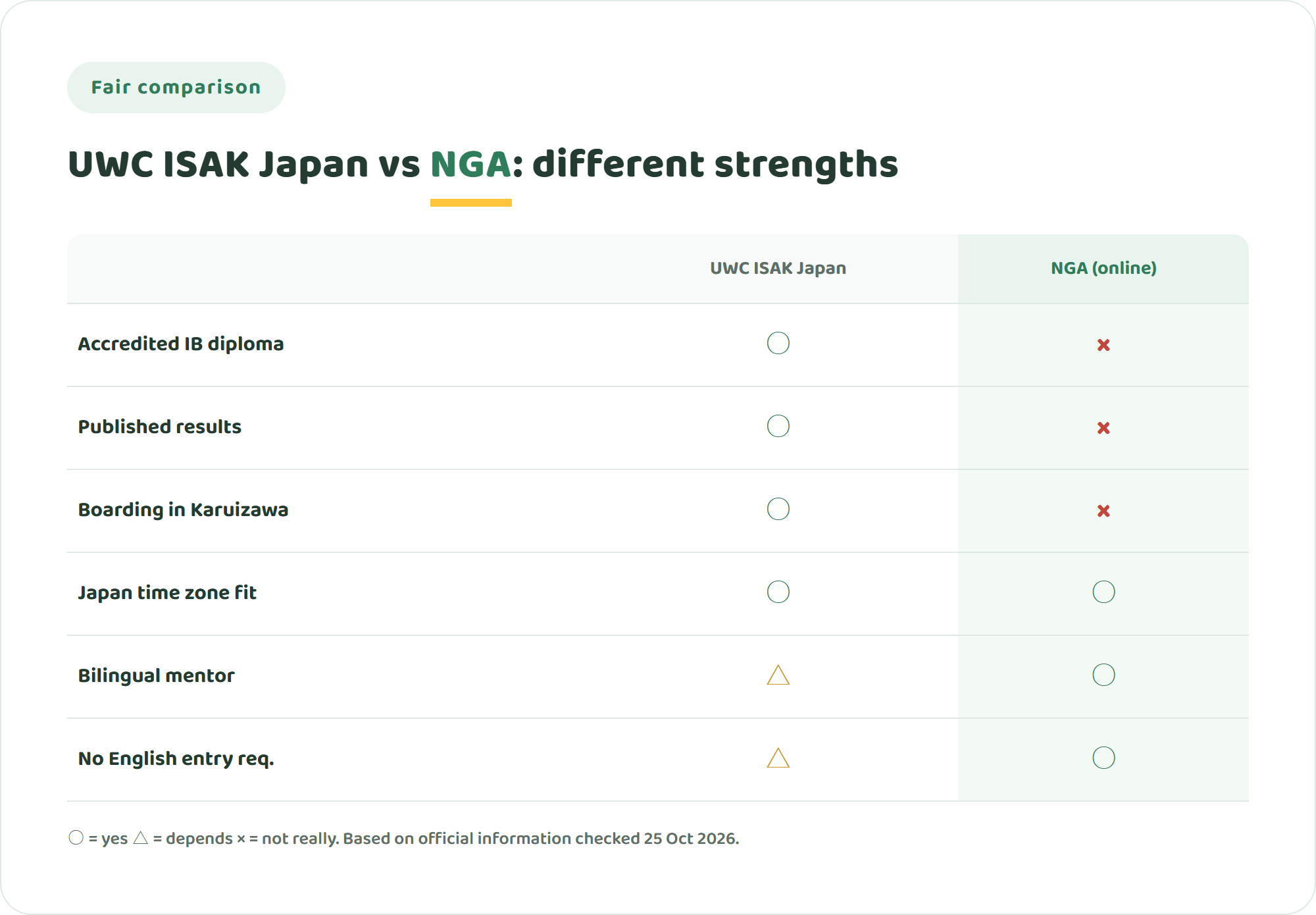
NIJIN GLOBAL ACADEMY (NGA) — an online international school for ages 6–18 focused on Asia and Oceania, opening in September 2027 (planned), with a first cohort of 100 students. Classes are small live dialogue groups of about 8, subjects are learned in English with a bilingual (English–Japanese) mentor, English is taught by CEFR level, and an optional Cambridge IGCSE / A-Level pathway is listed on its curriculum and timetable page. There is no academic entrance exam and no English requirement; it can run alongside a local school or as the main school, and it travels with the family if they relocate. Its timetable is built for Asia–Oceania daytime, which fits a family in Japan or Singapore, but families in the Americas or Europe should check live-class times against their own clock. Tuition is not yet published; NGA says it will be far more affordable than a typical international school, with no enrolment, facility or uniform fees, materials included and sibling discounts. The honest limitations: it is not yet open, not yet accredited, has no graduates or results, and it is not a boarding community — a 15-year-old who wants the house, the roommates and the mountains should choose a school like UWC ISAK Japan. Free trial classes run monthly from September 2026. NGA is operated by NIJIN Inc. in Japan, whose alternative school NIJIN Academy has more than 1,000 students. Our overview of online international schools compared shows how it sits beside established online schools.
FAQ
How much does UWC ISAK Japan cost per year?
For 2026–27, ¥7,225,000: tuition ¥4,900,000, boarding ¥1,825,000 and facilities ¥500,000, covering dormitory housing, daily meals, textbooks, health checks, insurance, Project Weeks and most activities. Grades 11–12 add an IB Years Fee (¥230,000 at the 2025–26 rate), and new students pay a ¥20,000 application fee, a ¥300,000 enrollment fee and a ¥40,000 refundable deposit according to the 2025–26 sheet. Seventy per cent of students receive need-based assistance.
Is UWC ISAK Japan accredited?
The school states that it is accredited through MEXT, Japan’s Ministry of Education, so graduates receive a Japanese high school diploma, and that it is an IB World School authorised for the Diploma Programme. A CIS logo appears on the site; WASC is not mentioned.
What is the acceptance rate at UWC ISAK Japan?
Not published on the official site. The school admits about 40 students a year by direct application into Grade 10 and about 40 into Grade 11 through UWC national committees, with no entrance test; selection is by application, references, videos and an online interview with group assessment.
Can international students enrol, and do they get financial aid?
Yes. About 70% of Grade 10 students come from abroad, and all applicants are eligible to apply for need-based assistance regardless of nationality, provided they apply for it with their Grade 10 application. Students coming through a national committee for Grade 11 ask their committee about scholarships; Global Selection Programme students pay full fees.
Is UWC ISAK Japan worth it?
For a 15-year-old who wants a full-boarding, deliberately international IB school with published results and a serious financial assistance programme, many families conclude it is — especially those whose income bracket would otherwise rule out a boarding school. Families who need a day place, a Grade 11 or 12 entry, a British curriculum or a younger start should compare Rugby School Japan or Harrow Appi.
What are the alternatives to UWC ISAK Japan?
Harrow International School Appi Japan (full boarding, British curriculum, Iwate) and Rugby School Japan (day and boarding, British curriculum, Chiba) are the closest boarding alternatives in Japan. For children aged 6–18 who need a flexible or bilingual-supported option rather than a boarding community, NIJIN GLOBAL ACADEMY opens online in September 2027 (planned); it is not yet accredited.
Choosing a boarding school calmly, with the real numbers in hand
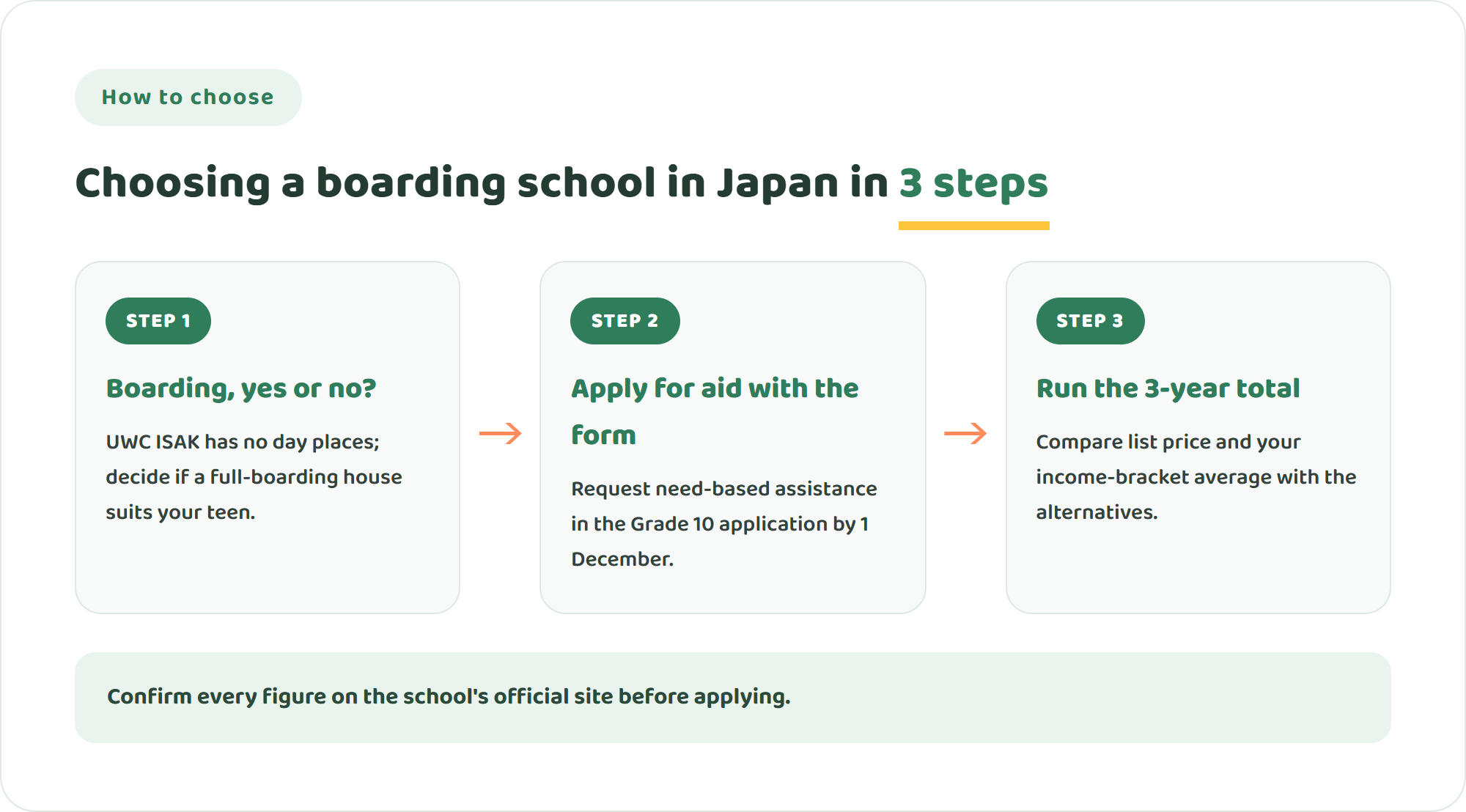
UWC ISAK Japan is a genuinely distinctive school: small, full-boarding, international by design, accredited by MEXT and the IB, and funded in a way that lets most of its students attend on need-based assistance. The practical next steps are concrete. Check the birth-date window for Grade 10 entry, register for an online admissions Q&A or the Open Campus, decide honestly whether your family will apply for financial assistance (you cannot add it later), gather three years of transcripts and two referees, and submit by 1 December. Run the three-year arithmetic at list price and again at the income-bracket average that matches your family. If weekends at home, a British curriculum or a later entry point matter more, compare Rugby School Japan or Harrow Appi. And if your child is younger, still growing into English, or your plans are not settled enough for a three-year boarding commitment, keep one flexible option in view as well; our page on why families choose an online international school explains when that makes sense.
Tuition and admissions details were checked on the official websites on 25 October 2026. Schools revise fees every year — always confirm on the official site before applying.