“We’d love an international school for our child, but the fees are simply out of reach.” “How much does it actually differ from one Asian country to the next?” “In the end, is it an amount our family can sustain for years?” For many parents starting to think about a global education, the first wall is the cost. And because the going rate differs so much by country and city — with information scattered everywhere — it’s hard to get the full picture even when you try to compare. Below, we compare international school fees across Asia, country by country, in plain annual ranges.
This piece lays out, honestly, international school fees across Asia, country by country — approximate annual ranges for Japan, Singapore, Thailand, Malaysia, the Philippines and Vietnam. From there, it shows how on-campus and online differ in the very structure of their cost, and how “the online third path” changes the maths. Note: every figure here is a rough guide that varies widely by school, grade and timing. Always confirm the latest with each school’s official information.

Fees aren’t visible from “tuition” alone
When comparing costs, many people look only at tuition (the monthly or annual fee). But that isn’t all you actually pay. Enrolment fees, facilities charges, materials, uniforms, the school bus or commuting, trips and extracurriculars — unless you look at the yearly total including these add-on costs, you can end up thinking “that was pricier than I expected.” On-campus international schools in particular tend to accumulate these extras. So as you read the country ranges below, take them as “a tuition guide, plus more.”
Comparing international school fees in Asia, country by country
From here we look at the approximate going rate for on-campus international schools, country and city by turn. To repeat: each is a rough annual range that varies greatly by school and grade. These numbers are meant to give a feel for “roughly this kind of band,” not a precise figure. For any school you’re considering, always check its latest official information.
Japan
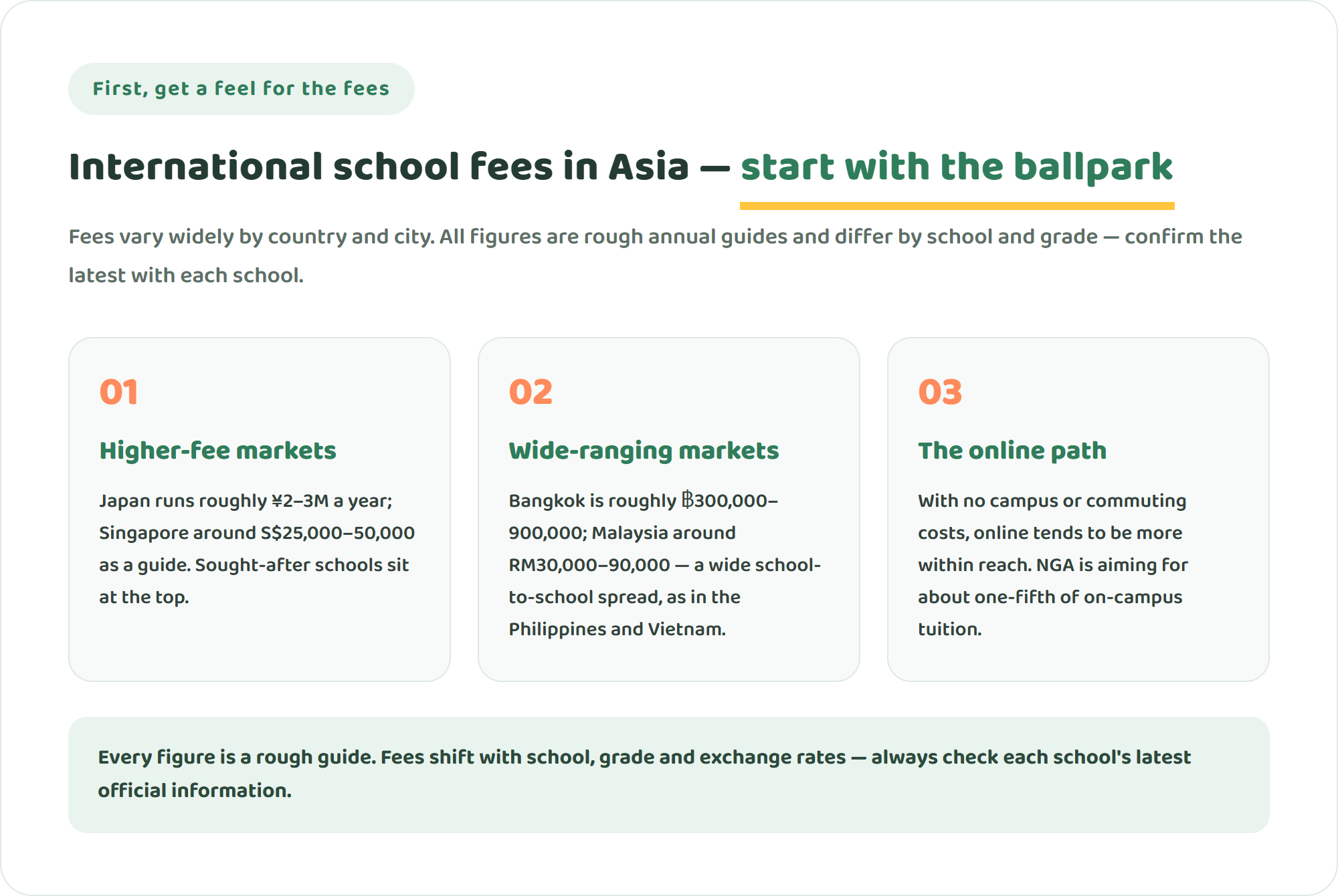
International schools in Japan run, as one guide, around ¥2–3 million a year (with sought-after city schools higher still). Enrolment and facilities fees are often charged on top, so the total tends to climb further. The environment is rich, but the load on a household budget is far from small. This is a guide only, and it shifts by school and grade.
Singapore
Known as an education hub, Singapore sits at a guide of around S$25,000–50,000 a year. Popular schools and higher grades tend to cost more, and combined with the high cost of living the total burden can be heavy. Again this is a guide — confirm the exact amount with each school’s official information.
Thailand (Bangkok)
Bangkok has many schools and a wide price band. A guide of around ฿300,000–900,000 a year is often cited, but the gap between top schools and the rest is large, so no single figure applies. Assume “the range is wide” and check school by school to be safe.
Malaysia
Malaysia is often seen as one of the more within-reach countries, with a guide of around RM30,000–90,000 a year. That said, prestige schools in the cities are expensive, and the school-to-school spread is again large. Treat the numbers strictly as a guide.
The Philippines, Vietnam and others
The Philippines runs a guide of around US$3,000–25,000 a year and Vietnam around US$10,000–30,000 — both with a very wide range. Even within one country, the gap between a more local school and a full international school can be an order of magnitude. Be careful not to lump a country together as simply “cheap” or “expensive.” Here too the figures are guides, to be confirmed.
To say it again: these are all rough guides, and the latest accurate amount should be confirmed with each school’s official information. What matters to notice here is less the individual numbers and more the bigger picture — that the going rate differs this much by country and school. Which is exactly why, alongside the price, the question “can our family keep it up?” is essential.
See how online learning works →
On-campus and online differ in the very structure of cost
We’ve looked at on-campus going rates, but in fact on-campus and online differ in how their cost is built in the first place. On-campus tuition includes the “cost of having a place” — building upkeep, utilities, the school bus, facilities and equipment. These are fixed costs to maintain an environment rather than the substance of the education itself. If you’d like a closer look at what’s inside the fees, see also How much is international school tuition? A breakdown of annual costs. An online international school, by contrast, has no campus and no commuting, so it doesn’t load those fixed costs onto tuition. That’s why the same “international education” tends to be more within reach online. Of course, on-campus has its own value (daily in-person contact and so on), so this isn’t a simple better-or-worse.
Comparing the options by cost and ease of continuing
So let’s line the representative ways to learn up by cost and ease of continuing. We compare four — an on-campus international school, a local school plus supplementary programmes, homeschooling, and an online international school — across affordability, few extra costs, working anywhere you live, connection with the world, and ease of keeping it up. This is a comparison of general tendencies, not numbers.
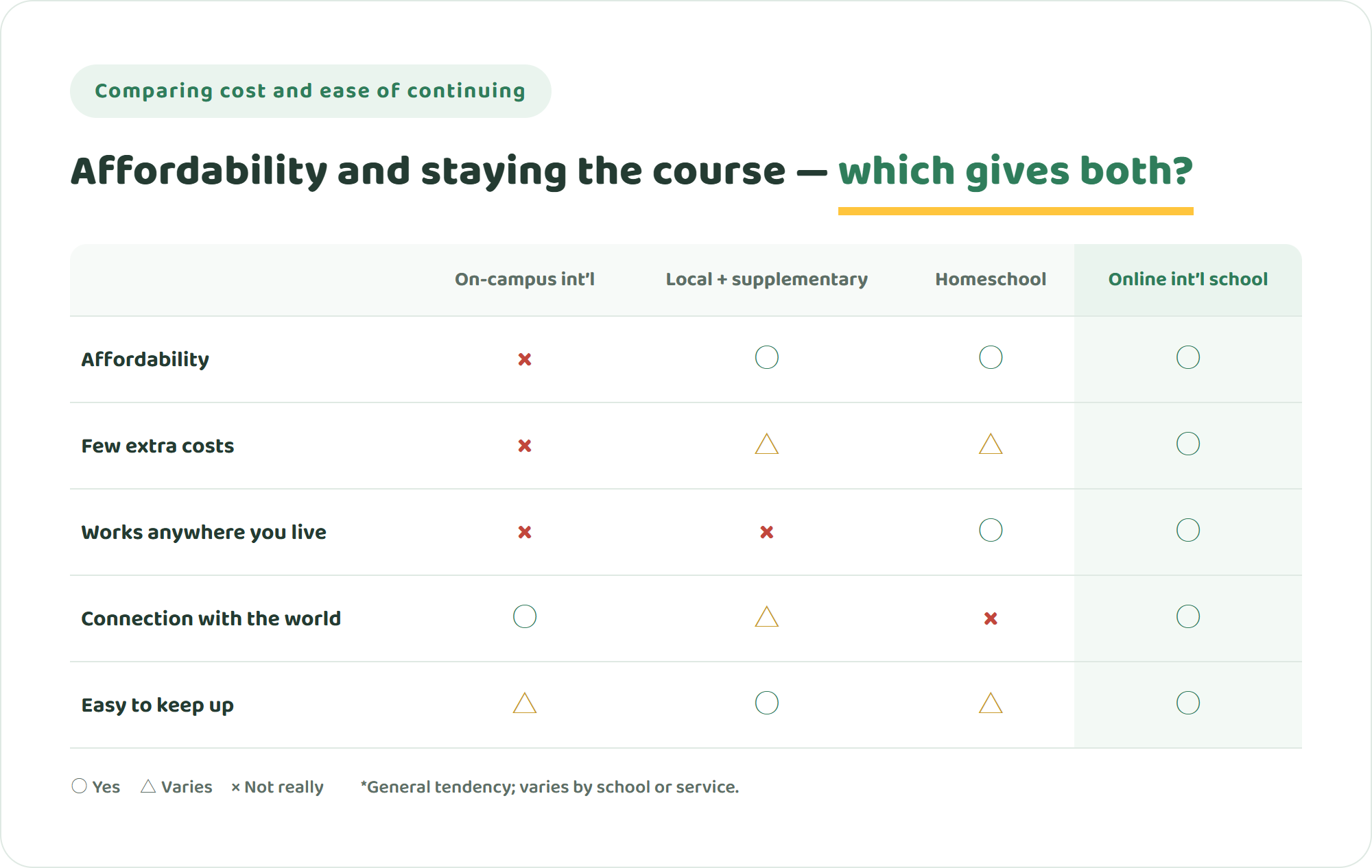
Looking at the table, the option that most easily holds affordability and connection with the world together is an online international school. That said, this is only a general tendency, and it varies by school and service. The point isn’t to find “the cheapest option,” but “the option your family can sustain for years that also fits your child.” Choose on price alone and you may find it can’t be kept up.
Three steps to international school fees you won’t regret
Finally, here’s a three-step way to choose so cost doesn’t leave you lost. Having an order keeps you from being swayed by the monthly-fee number alone.
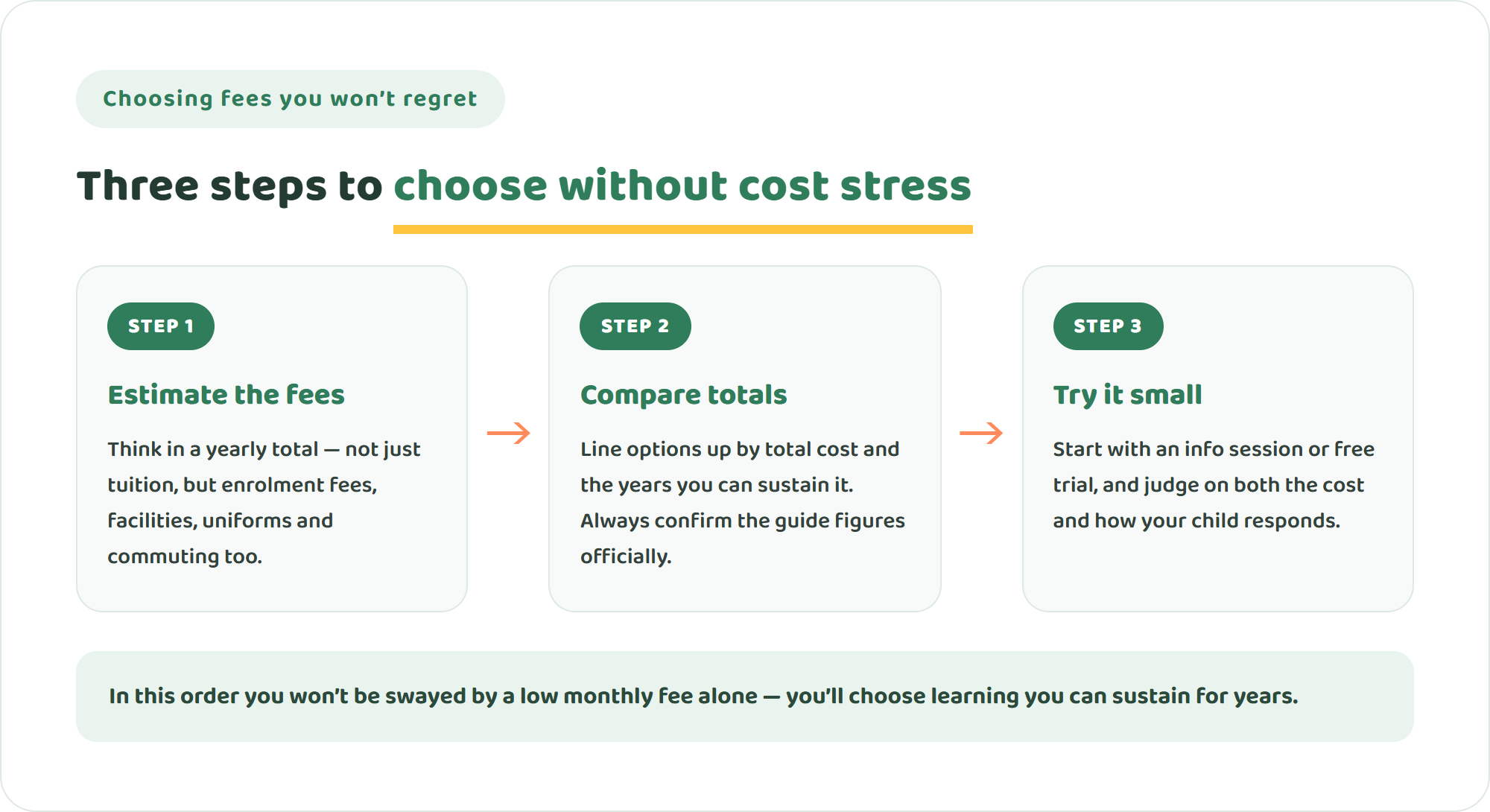
First, estimate the fees as a total — not just tuition, but enrolment fees, facilities, uniforms and commuting, added into a yearly figure. Next, compare totals. Even when the countries and formats differ, lining them up by total cost and “how many years can we sustain it” reveals the real burden. Then, try it small — start with an info session or a free trial, and judge on both the cost and how your child responds. Don’t leap at a low monthly fee; choose on whether you can keep it going.
Where NGA sits within that comparison
Having laid the going rates out honestly, here is where our NIJIN GLOBAL ACADEMY (NGA) sits. NGA is an online international school beyond the exam race, opening in September 2027, operated by NIJIN Inc. NIJIN Academy, the alternative school we run in Japan, already has over 1000 children learning with us.
Drawing on the online strength of carrying no fixed campus or commuting costs, we’re aiming for tuition around one-fifth of an on-campus international school — within reach. We’ll share the specific amounts alongside the opening news, but what we’re aiming for is a price that reaches families for whom it was “too expensive to choose.” We don’t rank children by test scores; on the foundation of learning to love yourself and the world, children connect globally through small-group dialogue — that, alongside the price, is what we hold dear. It isn’t a cure-all, of course. We’d simply ask that you compare it fairly with the others and choose it when it feels right for your child.
Frequently asked questions
Which Asian country has the cheapest international school fees?
There’s no single answer. Across whole-country rates, Malaysia, the Philippines and Vietnam are often said to have more within-reach schools, but the school-to-school spread within a country is very large, so “that country equals cheap” doesn’t hold. Since the figures are only guides, always check a school’s latest official information and compare by the total cost, add-ons included.
Why are on-campus international school fees so high?
A big reason is the “fixed cost of maintaining a place” — buildings, facilities and the school bus. These are built into tuition and tend to be higher in cities. Online international schools can be more affordable precisely because they don’t carry those fixed costs. That said, on-campus has its own value, so cost alone doesn’t decide which is better.
If our budget is limited, do we have to give up on an international education?
No. In recent years the online international school has been added as an option, letting families receive learning connected to the world at a more within-reach price than on-campus. “The fees are too high” is no longer the only reason to give up on an international education. Start by estimating the total, and explore within a range you can sustain.
Turning “too expensive to choose” into “a choice our family can make.”
Where you live, the country and city, and the family budget once shaped a child’s international-education options sharply. Faced with the fees, many families gave up before the first step. But now the online third path has been added, and wherever you are in Asia, you can increasingly choose learning connected to the world at a within-reach price. What matters is not being swayed by the up-front number, but choosing the one option that fits your child — by the total, and by whether you can keep it up.
NIJIN GLOBAL ACADEMY opens in September 2027. We’ll share how our learning works — beyond the exam race, within-reach pricing, and connection with the world through small-group dialogue — along with first-cohort enrolment news, straight to your inbox. A global education, within reach for your child.
Get opening updates by email →
More on choosing an international education
- Are There Subsidies for International Schools?——Realistic ways to lower the cost
- A Cheaper Alternative to a Singapore International School——Affordable online options
- Affordable International Schools in Bangkok——Fees, and an online alternative
- 10 Ways to Help Your Child Learn English at Home——What parents can do
- Online High School for Expat and Globally Mobile Families——Learning that moves with you
- How to Choose an International School——7 questions to ask before you enrol
- 6 International Qualifications You Can Earn Online——An honest guide
- When Your Child Does Not Want to Go to School——How to respond, and 5 real options
- How Much Household Income Do You Need for an International School?——Budgeting so it lasts
- What Is the International Baccalaureate?——IB vs Cambridge, honestly compared