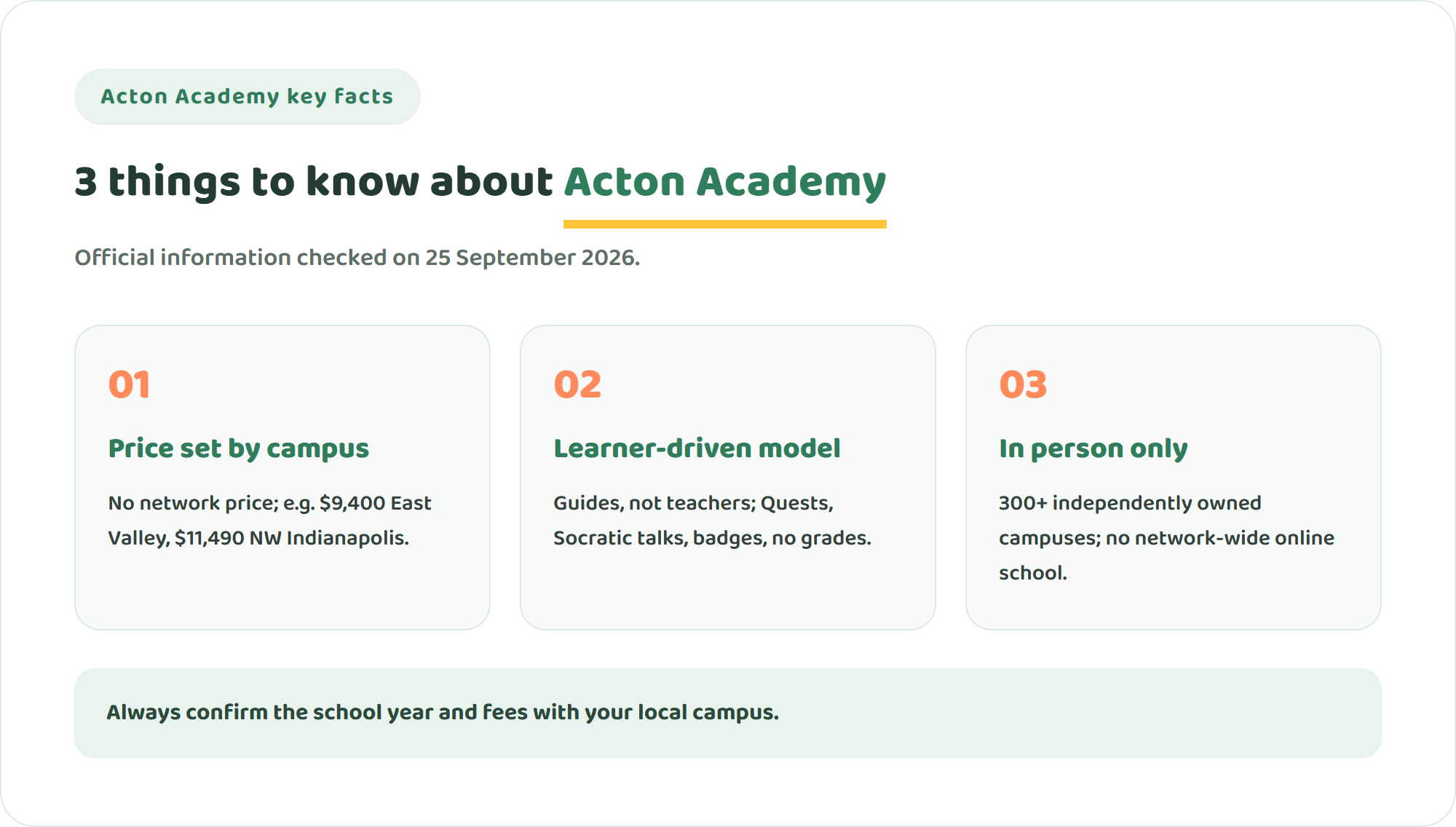
There is no single Acton Academy tuition. Acton Academy is a network of more than 300 independently owned campuses, and each campus owner sets its own price. The network site (actonacademy.org) does not publish a tuition figure. On the campuses’ own official pages, checked 25 September 2026, prices ranged from $9,400 a year (Acton Academy East Valley, Arizona, 2026–27) and $11,490 a year (Acton Academy NW Indianapolis, 2026–27) to $24,070 a year base tuition for elementary and middle school at Acton Academy Silicon Valley (the page does not label the school year). Your local campus may be cheaper or more expensive than any of these.
If you searched “acton academy tuition” or “acton academy review”, you probably want more than a number. What does the fee include? What happens in a learner-driven school day without lectures, grades or homework? Is Acton accredited, and can a Launchpad (high school) learner get into college? What if there isn’t a campus near you? This guide answers those questions from Acton’s network site and from individual campus sites, and says clearly when something isn’t published. It then compares Acton with Alpha School, Primer and our own school, NIJIN GLOBAL ACADEMY (NGA). Acton is an in-person school and NGA is online, so they are different kinds of option. We’ve tried to be fair to both.
The short answer: who Acton Academy suits — and who it doesn’t
- Suits families who live near an Acton campus and want a small, in-person, mixed-age school where children set goals, manage their own work and learn through projects (“Quests”) and Socratic discussion instead of lectures.
- Suits children who are curious and self-motivated, or who have lost their spark in a conventional classroom and could do with more ownership and less pressure. Acton Academy Columbus, for example, says there is no homework, no grades and no tests.
- Suits families looking for private-school values at a lower price than many traditional private schools. Several campuses publish tuition around $9,000–$12,000 a year, and in states with education savings accounts or vouchers (Arizona, Indiana and others) public funding can cover much of it.
- Suits parents who want to stay closely involved. Acton campuses are small communities; Albuquerque, for example, invites parent and learner feedback every six weeks.
- Less suited to families with no campus nearby. Acton is an in-person model with no network-wide online school, so the location decides everything.
- Less suited to parents who want a conventional report card, teacher-led instruction and one standard curriculum. Progress is shown through badges, portfolios and public exhibitions, and quality depends a lot on each campus’s owner and guides.
- Less suited to children who need a specialist programme. One campus FAQ says plainly that it is “not a special-education program”.

What Acton Academy is
Acton Academy was founded in 2009 in Austin, Texas, by Jeff and Laura Sandefer. According to the network’s story page, it began in a rented house with the founders’ two sons and a few neighbourhood children. The first affiliate campuses opened in 2012 (Venice Beach, California and Guatemala City), and the network passed 300 schools in more than 30 countries in 2024. The homepage now lists “300+” campuses in 30 countries and 42 US states.
Each campus is independently owned and run, often by parent entrepreneurs rather than career educators, and follows shared design principles. The homepage says a new owner pays a one-time $20,000 affiliate fee and a 4% annual royalty. That’s useful context: it explains why tuition, hours, age range and even accreditation differ from one Acton to the next.
Inside the school, adults are called guides, not teachers. They ask questions rather than lecture. Learners are grouped into mixed-age studios: Spark (ages 4–7), Elementary (7–11), Middle School (11–14) and Launchpad (14–18). Not every campus runs every studio. The network describes three aims — learning to learn, learning to do and learning to be — and says learners use technology for about 1 to 1.5 hours a day for core skills, alongside hands-on projects and real books.
| Item | Acton Academy (official information) |
|---|---|
| Type | Network of independently owned, in-person private schools and microschools |
| Founded | 2009, Austin, Texas (Jeff and Laura Sandefer) |
| Size | 300+ campuses in 30 countries and 42 US states (network homepage) |
| Ages | Most campuses serve ages 4–18 across four studios; many serve a narrower range |
| Model | Learner-driven: self-paced core skills, project “Quests”, Socratic discussion, badges and exhibitions |
| Tuition | Set by each campus; no network-wide figure published |
| Accreditation | Varies by campus (e.g. Acton Academy Columbus states IALDS accreditation) |
| Online option | No network-wide online school listed on actonacademy.org |
Acton Academy tuition and fees (2026–27, official)
Because every campus sets its own fees, the only honest way to answer “how much is Acton Academy?” is campus by campus. The table below lists only what each campus publishes on its own website. We haven’t used review sites or directories as a source for prices.
| Campus (official site) | School year stated | Tuition | Other fees and notes |
|---|---|---|---|
| Acton Academy East Valley, Arizona (actoneastvalley.org) | 2026–27 | $9,400 per academic year (or $2,350 per quarter; 10 monthly instalments available) | $300 one-time, non-refundable enrolment fee for new learners; 10% family discount for second and later children; learners bring their own Chromebook; field trips, supplies and materials included; accepts Arizona ESA and tax-credit scholarships |
| Acton Academy NW Indianapolis (actonindy.org) | 2026–27 | $11,490 per year, tuition and supplies included | 8:30 am–3:15 pm, Monday–Friday, August–May; accepts Indiana School Choice Scholarship; application fee, deposit and sibling discount not published on the official site |
| Acton Academy Albuquerque (actonabq.org) | Not stated next to the price | $10,450 per year, all ages | $500 non-refundable annual deposit; learners bring a laptop and headphones; sibling discounts and limited need-based aid mentioned |
| Acton Academy Columbus (actonacademycolumbus.com) | 2025–26 | $1,230 per month, full school day, all studios | $400 one-time enrolment fee per learner; number of billed months not published on the official site |
| Acton Academy Silicon Valley (actonsv.com) | Not labelled on the page (separate 2025–26 and 2026–27 PDFs offered) | $24,070 base annual tuition, elementary and middle school (ages 5–13) | $1,800 non-refundable enrolment deposit; $1,000 sibling discount per extra child; after-care $3,620/year; preschool priced separately |
| Acton Academy East Bay, California (actoneastbay.org) | 2026–27 enrolment open | Not published on the official site (request the info kit) | Says tuition includes supplies, music, robotics, around 8 field trips and software; offers financial support and payment plans |
What these pages have in common: tuition usually covers supplies and field trips; a device may be extra; there is usually a non-refundable enrolment fee or deposit; and a sibling discount is common. What varies a lot: the headline price (nearly three times higher in Silicon Valley than in Arizona), whether you pay 10, 11 or 12 instalments, and whether state school-choice money can be used.
Total-cost example (official numbers only): two children at Acton Academy East Valley for four years at the 2026–27 rate, with no future increases and before any ESA or scholarship. First child $9,400 + second child $9,400 × 0.9 = $8,460, which comes to $17,860 a year. Over four years, $17,860 × 4 = $71,440. Add two one-time enrolment fees of $300 each ($600) to get $72,040, plus the cost of two Chromebooks. For one child at NW Indianapolis, four years at $11,490 comes to $45,960 before any state scholarship. Fees normally rise each year, so treat these as a floor, not a quote.
If you’re weighing an in-person microschool against an online programme on cost alone, our online vs in-person international school cost guide breaks down the costs that don’t appear in a tuition table, such as commuting, after-care and devices.
How a school day works: schedule, live classes and time zones
Acton is an in-person school, so there are no time-zone questions: the day runs on local time. The network’s model page shows a sample day from 8:00 drop-off and free time to 3:15 pick-up. In between are work sprints for core skills (reading, writing and maths, often on adaptive software), Quest time for hands-on projects, and group Socratic discussions led by guides. Campus hours are similar: NW Indianapolis runs 8:30 am–3:15 pm, Columbus 8:00/8:30 am–3:00 pm, and Silicon Valley 8:15 am–3:15 pm for preschool, with paid after-care available.
Some things a first-time visitor notices:
- Learners run much of the day. Children set their own goals and track them, and peers review each other’s work.
- Screen time is limited and has a purpose. The network says about 1–1.5 hours a day. Acton Academy Columbus keeps its youngest studio screen-free.
- Progress is shown, not graded. Badges, portfolios and public exhibitions replace report cards and tests. Columbus’s FAQ confirms there is no homework, no grades and no tests.
- Campuses are small. Columbus, for example, says it serves about 45 learners across four studios.
For comparison, an online international school day looks very different: live small-group classes on video, with independent work around them. Our guide to how an online international school works walks through a typical day.
Accreditation, diploma and college recognition
This is where “it depends on the campus” matters most. The network site does not list a single accreditation for all Acton schools. Individual campuses make their own choices. For example, Acton Academy Columbus states that it “is accredited by the International Association of Learner Driven Schools (IALDS)”. IALDS describes itself as an accreditation organisation that has accredited schools in more than twenty countries. Its own site doesn’t say whether US state agencies or regional accreditors recognise it, so if recognition matters to you, ask the campus how its accreditation is treated in your state.
High school follows the same pattern. Launchpad (ages 14–18) is the high-school studio, but not every campus has one. Columbus says its Launchpad opens with a first cohort in 2027–28, and Albuquerque’s tuition page mentions textbooks for dual-credit courses through Launchpad. A standard network-wide policy on diplomas, transcripts or college admission is not published on actonacademy.org. If your child is 12 or older, ask the campus three things: does it issue a diploma, how are badges turned into a transcript, and where have its own graduates gone? Get the answers in writing.
Moving back to a conventional school is also a campus-level question. Because there are no grades or standard tests at many campuses, ask how the campus documents progress for a receiving school.
Acton Academy vs NIJIN GLOBAL ACADEMY vs two other options (official data)
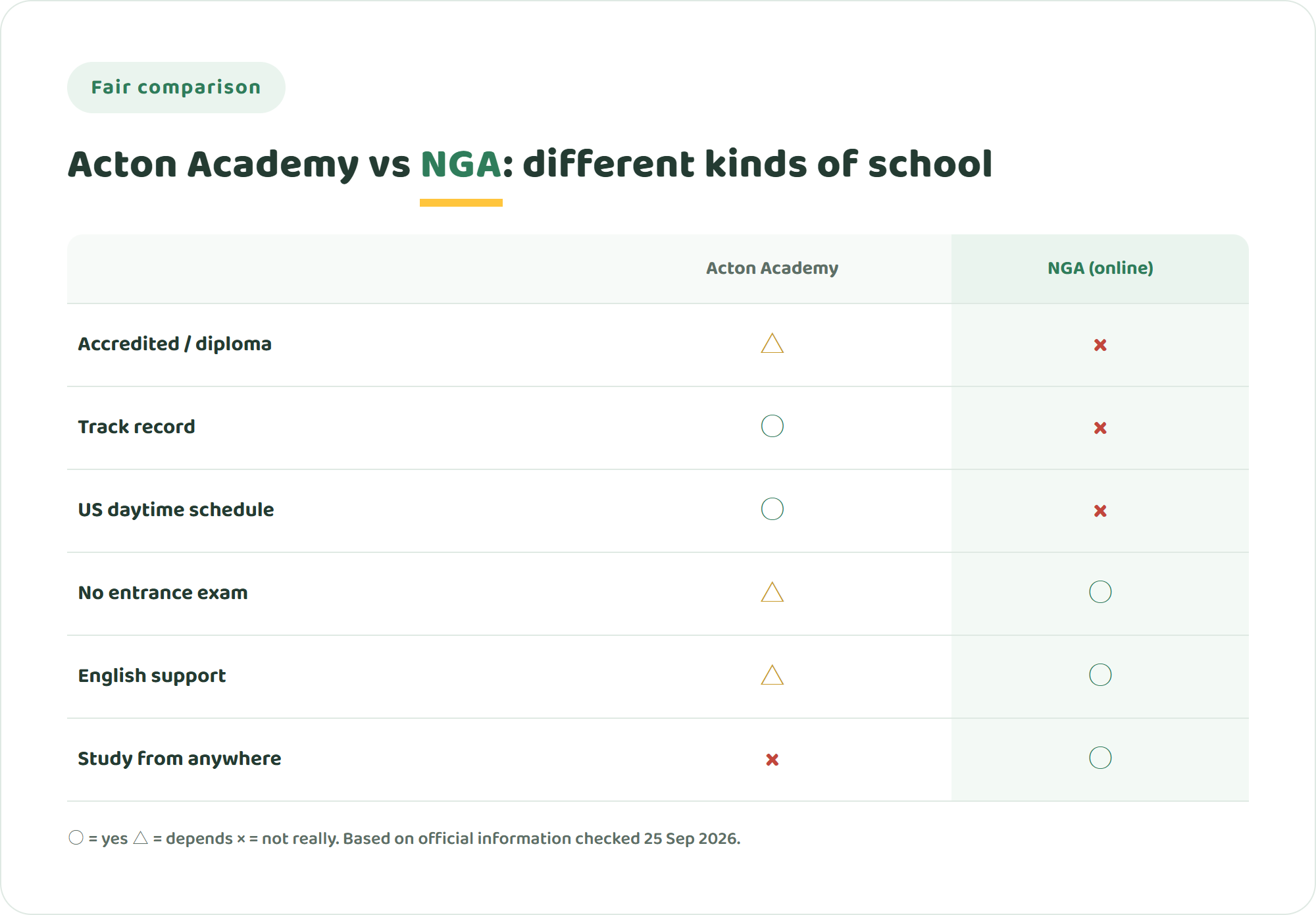
Alpha School and Primer are two other US school models that often come up next to Acton in “microschool” searches. Alpha is also in-person and started in Austin. Primer is a network of in-person microschools that works closely with state scholarships. NGA is the odd one out: it is online and aimed at families in Asia and Oceania. We’ve put them in one table so you can see the trade-offs.
| Acton Academy | NIJIN GLOBAL ACADEMY | Alpha School | Primer | |
|---|---|---|---|---|
| School type | In-person, learner-driven network of independently owned campuses | Online international school (Asia & Oceania focus) | In-person private school network (“2 Hour Learning”) | In-person microschools, mixed-age groups |
| Grades / ages | Ages 4–18 at most campuses; varies | Ages 6–18 | PreK/K–8 at most campuses; some K–12; Alpha High 9–12 (Austin) | K–8 |
| Tuition (2026–27) | Set by campus; e.g. $9,400 (East Valley, 2026–27), $11,490 (NW Indianapolis, 2026–27) | Not yet published; designed to be far more affordable than a typical international school; no enrolment, facility or uniform fees | $10,000–$75,000 a year by campus; Austin $40,000 (school year not stated) | “Most Primer families pay between $0 and $3,000 per year” after state scholarships; varies by state and income |
| Curriculum | Adaptive software for core skills, project Quests, Socratic discussion, badges | Subjects learned in English, CEFR-based English levels, co-creation projects; optional Cambridge IGCSE / A-Level pathway | About 2 hours of adaptive mastery software, then life-skills workshops | Blends human guidance with technology for personalised learning; see official site |
| Live classes & time zone | In person, local hours (about 8:00–3:15) | Live small-group classes (about 8 per class) on an Asia & Oceania daytime timetable; may fall outside daytime in the Americas or Europe | In person; Austin 8:15 am–4:00 pm | In person; hours not published on the official site |
| Accreditation / diploma | Varies by campus (e.g. Columbus: IALDS); diploma policy set locally | Not yet accredited; no graduates yet (opens 2027) | Cognia (Alpha states all locations are accredited) | Not published on the official site |
| Admission | Campus tour and application; process set by each campus | No entrance exam, no English requirement | Info session, application ($100 fee), shadow day, MAP review | Application; no application fee, $20 enrolment fee |
| Start dates | Usually August/September; some campuses enrol during the year | Opening September 2027 (planned); free trial classes monthly from September 2026 | See official site | See official site |
Sources: actonacademy.org (homepage, model page, Acton’s story), the official tuition pages of Acton Academy East Valley, NW Indianapolis, Albuquerque, Columbus, Silicon Valley and East Bay, the Acton Academy Columbus FAQ, ialds.org, alpha.school/locations, primer.com/tuition and primer.com/company, all checked 25 September 2026. For Alpha in more depth, see our Alpha School tuition and review.

Reviews and common concerns, answered honestly
Acton’s network homepage says 9 in 10 families recommend Acton. Reviews of individual campuses are often very positive and sometimes mixed. The same themes keep coming up, so here they are with what the official pages say.
“Every Acton is different”
This is the most common theme, and it’s built into the model. Campuses are independently owned, so the owner, the guides and the community shape the experience. A good review of one campus says little about another. Visit, meet the owner and ask how long the guides have been there.
“Is there enough academic rigour without teachers or tests?”
Acton replaces lectures with adaptive software, Socratic discussion and self-set goals, and measures progress through badges, exhibitions and peer reviews. Children who like to direct their own work often do very well. Children who need a lot of external structure may struggle at first. Ask the campus how it spots and supports a learner who is falling behind in maths or reading.
“What about high school and college?”
Launchpad isn’t offered everywhere, and diploma and transcript policies are set by each campus. If your child is approaching 14, confirm there’s a Launchpad at your campus and what it produces: a diploma, a transcript, dual credit or a portfolio.
“Children with learning differences”
The self-paced, low-pressure environment suits many children. The Columbus FAQ also says honestly that it is “not a special-education program and can’t replace clinical services”. Talk openly with the campus before you apply.
“Is it worth the price?”
At around $9,000–$12,000 a year, many campuses cost less than many traditional private schools, and school-choice funding can reduce this further in some states. At higher-priced campuses the question is sharper. The model is the same brand everywhere, but the price is set locally, so compare what the fee includes (supplies, field trips, after-care, device).
Alternatives to Acton Academy worth comparing
Alpha School is in person too, but more structured: about two hours of adaptive software for academics, then life-skills workshops, with Cognia accreditation. It usually costs much more, at $40,000 a year in Austin.
Primer runs in-person K–8 microschools in Florida, Arizona, Alabama and Texas and builds its pricing around state scholarships. It says most families pay $0–$3,000 a year. It’s worth a look if you live in one of those states.
NIJIN GLOBAL ACADEMY (NGA) is an online international school for ages 6–18, opening in September 2027 (planned), with free trial classes every month from September 2026. Children learn subjects in English in small live dialogue groups of about eight, with a bilingual (English–Japanese) mentor. There is no entrance exam and no English requirement, and it can run alongside a local school or as the main school. The limitations are real: it isn’t accredited yet, has no graduates or track record, and its timetable is built for Asia and Oceania daytime, so families in the Americas or Europe should check live class times against their local time. Tuition isn’t published yet. The school says it will be far more affordable than a typical international school. You can see the subjects and timetable on our curriculum and timetable page, and compare more online schools in Online International Schools Compared or our review of Laurel Springs School tuition.
FAQ
How much does Acton Academy cost per year?
It depends on the campus, because each independently owned campus sets its own tuition and the network publishes no single figure. Official campus pages, checked 25 September 2026, show $9,400 a year at East Valley, Arizona (2026–27), $11,490 at NW Indianapolis (2026–27), $10,450 at Albuquerque, $1,230 a month at Columbus (2025–26) and $24,070 base tuition at Silicon Valley. Enrolment fees or deposits ($300–$1,800) are usually extra.
Is Acton Academy accredited?
Accreditation is decided campus by campus. For example, Acton Academy Columbus states it is accredited by the International Association of Learner Driven Schools (IALDS). Ask your local campus which body accredits it and how that is recognised in your state.
Can international students enrol?
Acton has campuses in more than 30 countries, so families abroad may find one locally. For US campuses, procedures for international students and visas are not published on the official network site. Ask the individual campus directly.
Is Acton Academy worth it?
For a self-motivated child near a well-run campus, many families say yes, and several campuses cost less than many traditional private schools. It’s a weaker fit if you want teacher-led instruction, conventional grades, a guaranteed high-school pathway or specialist support. Visit, talk to current parents at that campus and check what the fee includes.
What are the alternatives to Acton Academy?
In person: Alpha School (structured, Cognia-accredited, higher tuition) and Primer (K–8 microschools built around state scholarships). Online: established accredited programmes, or NIJIN GLOBAL ACADEMY, a new online international school for ages 6–18 opening in September 2027 (planned) that suits families in Asia and Oceania best.
Choosing a school your child will actually love
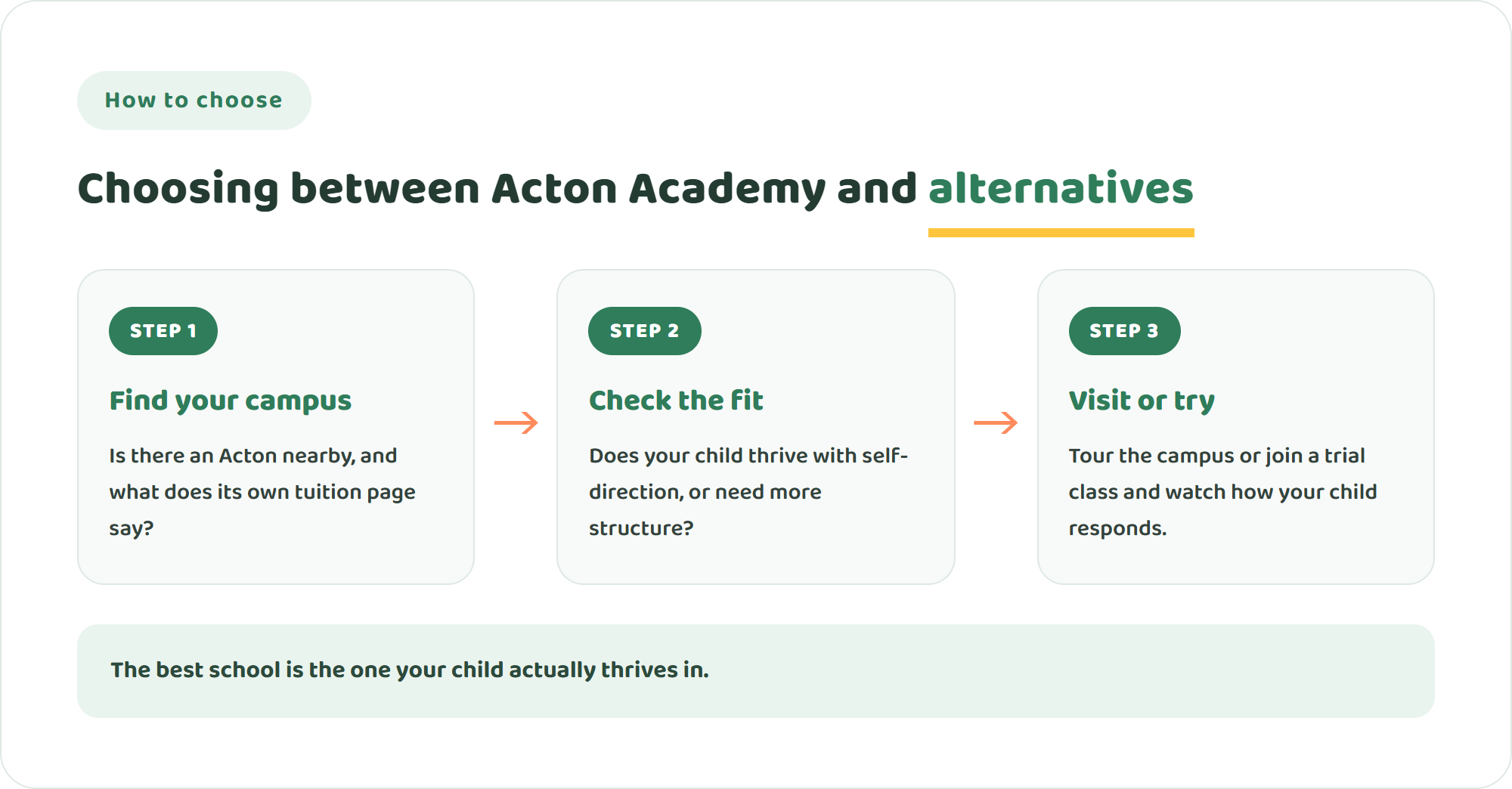
Acton Academy’s big idea, that children can take real ownership of their learning, has spread to hundreds of campuses because it works for many families. The price, the programme and the people still depend on the campus down the road, so the best research you can do is to visit it. If there’s no Acton near you, or you’d rather your child learned with peers across Asia and Oceania online, you’re welcome to follow NGA as it prepares to open, with no pressure and no commitment. You can read more about why families choose an online international school.
Tuition and admissions details were checked on the official websites on 25 September 2026. Schools revise fees every year — always confirm on the official site before applying.