If you are searching for international schools in Karuizawa, you have probably already run into the same wall everyone does: there are fewer than you expected, and the most famous one is a boarding high school. Karuizawa is unusual in Japan. A town of about 20,000 people in the mountains of Nagano, 70 minutes from Tokyo by bullet train, it hosts a residential IB school drawing students from more than 80 countries, plus a handful of small English-medium schools tucked into the larch forest. But the options are age-specific, the tuition range is wide, and almost every path requires either relocating or boarding. This guide lists the four international schools that actually exist in the Karuizawa area, plus three realistic options in nearby Saku, Ueda and Matsumoto, with published fees, honest notes on admissions, and a fair look at what each choice really costs a family.
Quick Answer: Your Options in Karuizawa
If you only read one section, read this. Below are the schools covered in this guide, plus the online option — so you can see every route side by side before the details.
- UWC ISAK Japan — Ages: Grades 10-12 (three-year programme); a two-year entry at Grade 11 also exists… / Fees: Tuition 4,900,000 yen + boarding 1,825,000 yen + facilities 500,000 yen = 7,225,000…
- EtonHouse International School Karuizawa — Ages: 2-6 (mixed-age preschool) and Grades 1-2 as of 2026-27, expanding annually / Fees: Preschool five days, three terms combined: 639,000 + 779,000 + 436,000 yen = about…
- LCA Kitakaru Mori no Inter Elementary School — Ages: Elementary (combined Grades 1-2 at opening), plus an attached preschool for ages… / Fees: Tuition 240,000 yen per month (includes administration, facilities and ICT costs)…
- ABC International School (Karuizawa) — Ages: Preschool age upward, plus one-day, seasonal and adult courses / Fees: No standard fee table is published. Contact the school for a quote based on course…
- International School of Nagano (ISN) Saku Kirihara Campus — Ages: 0-5 / Fees: Structured as a certified childcare facility rather than a fixed international…
- Ueda International School (UIS) — Ages: 0-5, with eligibility varying by site / Fees: Contact the school. We do not publish estimates
- International School of Nagano (ISN) Elementary — Ages: Elementary (Grades 1-5), with further programmes above / Fees: Tuition 98,000 yen per month, lunch 5,500 yen per month, facilities 125,000 yen per…
- NIJIN GLOBAL ACADEMY (online) — Ages 6–18 / opening September 2027, currently taking opening-update registrations / fees around one-fifth of a typical campus international school / Japanese-language support. An option when commute or fees are the wall.
International schools in Karuizawa: the landscape and what fees really look like
Karuizawa sits at the eastern edge of Nagano Prefecture, at roughly 1,000 metres of altitude, and it has quietly become one of Japan’s most talked-about destinations for families relocating specifically for education. The town has three public elementary schools, a public junior high, a public high school, the residential UWC ISAK Japan, and Karuizawa Kazakoshi Gakuen, a private mixed-age kindergarten-through-junior-high school. All seven have signed a cooperation agreement with one another. For a town this size, that density of choice is genuinely rare.
Within that landscape, four schools teach primarily in English in the Karuizawa area: UWC ISAK Japan (a fully residential IB high school), EtonHouse International School Karuizawa (ages 2 to 6 plus lower elementary), LCA Kitakaru Mori no Inter Elementary School (opened April 2026 in Kita-Karuizawa, technically just over the border in Gunma Prefecture), and ABC International School (a preschool and language school). What makes Karuizawa distinctive is that these schools barely overlap in age range. The right question is not which school is best, but which school will take a child your child’s age right now.
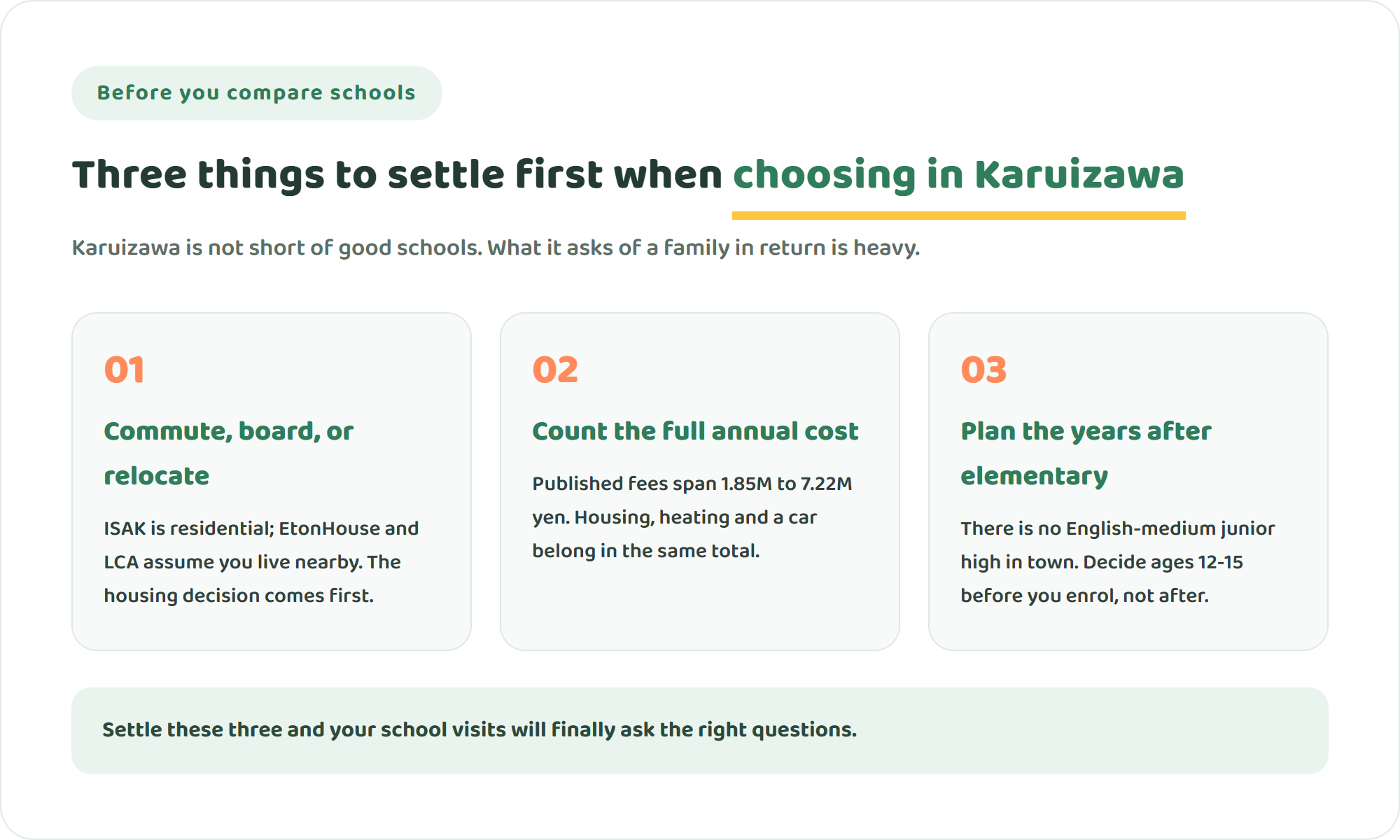
On fees, the published range across the Karuizawa area runs from roughly 1.85 million yen to 7.22 million yen per year — close to a fourfold spread. UWC ISAK Japan sits at the top: 4,900,000 yen tuition plus 1,825,000 yen boarding plus 500,000 yen facilities, for a total of 7,225,000 yen for 2026-27. EtonHouse Karuizawa publishes roughly 1.85 million yen a year for full-time preschool and roughly 2.2 million yen a year for elementary (elementary tuition is subject to 10% consumption tax; preschool is exempt). LCA Kitakaru charges 240,000 yen per month in tuition. Widen the radius to Matsumoto and ISN’s elementary programme comes in at 98,000 yen a month, a very different bracket. If you want to understand where those differences come from, our breakdown of international school tuition costs is a useful companion read.
Please note: all fees quoted here are publicly available information as of August 2026. Schools revise fees regularly, so always confirm the current figures on each school’s official site.
There is one more thing that defines Karuizawa, and it is worth saying plainly. Attending any of these schools means either moving your household or sending your child to board. ISAK is fully residential. EtonHouse and LCA assume you live within the Karuizawa, Naka-Karuizawa or Kita-Karuizawa area. There is no version of this where you commute in from Tokyo. If you would like to see how Karuizawa compares with the rest of the prefecture before you commit, our guide to international schools across Nagano Prefecture gives you the wider map.
The four international schools in Karuizawa, plus three nearby options
What follows is an honest list. We have not padded it to reach a round number. The first four schools are in the Karuizawa area; the last three are realistic alternatives in Saku, Ueda and Matsumoto for families who are still deciding where in Nagano to settle.
1. UWC ISAK Japan
Japan’s first fully residential international high school, opened in 2014 as the International School of Asia Karuizawa and admitted to the United World Colleges movement in 2017. It is an accredited Japanese high school that teaches entirely in English through the International Baccalaureate Diploma Programme. Around 200 students from more than 80 nationalities live on campus in the forest at Nagakura, Karuizawa. The school is built around the idea of developing changemakers, with outdoor education, project weeks and student-led initiatives woven into the academic programme. Graduates go on to universities around the world. The one constraint families need to absorb early: ISAK only takes students from Grade 10. If your child is in elementary or junior high, this is a future option, not a present one.
- Curriculum: IB Diploma Programme, taught in English, fully residential
- Ages: Grades 10-12 (three-year programme); a two-year entry at Grade 11 also exists through national committees
- Fees: Tuition 4,900,000 yen + boarding 1,825,000 yen + facilities 500,000 yen = 7,225,000 yen per year (2026-27, official). Flights and personal expenses are separate
- Financial assistance: Roughly 600 million yen awarded annually; about 70% of students receive some level of support, including full scholarships. All aid is need-based, not merit-based
- Best for: Families ready for three boarding years and an international university pathway
2. EtonHouse International School Karuizawa
The Karuizawa campus of EtonHouse, the Singapore-founded education group. It runs a mixed-age preschool for children aged 2 to 6 and a growing elementary programme, all in English. The approach is inquiry-led and influenced by Reggio Emilia, with Karuizawa’s forest treated as part of the classroom: camping, river trekking and forest exploration are built into the year rather than bolted on. Preschool runs 8:30 to 14:00 and elementary 8:30 to 15:00, Monday to Friday, with an optional afternoon care block. The elementary section is expanding one grade at a time — Grades 1-2 for 2026-27, Grade 3 in 2027-28, Grade 4 in 2028-29 and Grade 5 in 2029-30 — so depending on when you join, your child may be in the oldest cohort in the school. Ask about this directly at the open day; it affects peer group and continuity more than most families expect.
- Curriculum: Inquiry-led, Reggio-influenced, with a strong nature and outdoor education component. English medium
- Ages: 2-6 (mixed-age preschool) and Grades 1-2 as of 2026-27, expanding annually
- Fees: Preschool five days, three terms combined: 639,000 + 779,000 + 436,000 yen = about 1,854,000 yen per year (tax exempt). Elementary, three terms combined: 758,000 + 924,000 + 518,000 yen = about 2,200,000 yen per year plus 10% consumption tax. Registration fee 200,000 yen per family (one-time) and application fee 22,000 yen (2025-2026, official)
- Location: 1690 Nagakura, Karuizawa-machi, Kitasaku-gun, Nagano
- Best for: Families with young children who want an English, nature-based start without boarding
3. LCA Kitakaru Mori no Inter Elementary School
Opened in April 2026 in a repurposed former public school building in Kita-Karuizawa, run by Edure LCA, the company behind LCA International Elementary School in Sagamihara. The address is technically in Naganohara Town, Gunma Prefecture, but a school bus runs from Karuizawa and Naka-Karuizawa stations, and the school is clearly designed with Karuizawa-side families in mind (arrival around 8:45, departures at 15:30 and 17:30). The important structural point: it is an accredited Japanese elementary school and also holds a special curriculum designation from MEXT, which lets it run an active immersion model where students spend most of the school day in English with foreign homeroom teachers — while still earning a standard Japanese elementary school qualification. Classes are capped at around 15 students with three teachers, and the school has created its own subjects around life philosophy and local community. Being brand new, it has no graduate track record yet.
- Curriculum: Active immersion bilingual model, accredited Japanese elementary school with special curriculum designation
- Ages: Elementary (combined Grades 1-2 at opening), plus an attached preschool for ages 3-5. A secondary continuation is planned
- Fees: Tuition 240,000 yen per month (includes administration, facilities and ICT costs), lunch 15,000 yen per month plus tax, school bus contribution 45,000 yen per month plus tax. On entry: examination fee 30,000 yen, entrance fee 600,000 yen, deposit 300,000 yen (from the school’s published admissions guidelines)
- Location: 1924-44 Kitakaruizawa, Naganohara-machi, Agatsuma-gun, Gunma, with school bus links to Karuizawa
- Best for: Families who want an English-dominant school day without giving up the Japanese elementary qualification
4. ABC International School (Karuizawa)
A small, long-established school in Nagakura, Karuizawa that combines a preschool with a language school. Alongside English it teaches Korean, French, Chinese and Japanese, and it also runs courses for adults, including business and hospitality English. Drop-in care, one-day programmes and seasonal spring and summer schools make it an unusually practical entry point for families who are still trying Karuizawa out, or who want to add English around a local school rather than replace it. A Gakken learning room is attached and students can sit Eiken exams on site, which suits households running Japanese and English in parallel. Think of it less as a full-time international school and more as a way to build English into daily life.
- Curriculum: Preschool plus language school (English, Korean, French, Chinese, Japanese); attached Gakken room and Eiken testing
- Ages: Preschool age upward, plus one-day, seasonal and adult courses
- Fees: No standard fee table is published. Contact the school for a quote based on course and frequency. We do not publish estimates
- Location: 2703-20 Nagakura, Karuizawa-machi, Kitasaku-gun, Nagano
- Best for: Families combining a local school, homeschooling or online learning with regular English
Visit the official site (fees vary by course and frequency, so confirm directly with the school)
5. International School of Nagano (ISN) Saku Kirihara Campus
Now for the nearby options. ISN is the largest international school network in Nagano Prefecture, and it opened a certified childcare campus in Saku City in April 2026 for children aged 0 to 5. Saku is about 30 minutes by car from Karuizawa, and also reachable by rail, which makes a pattern like living in Karuizawa and attending preschool in Saku entirely workable. ISN has been running English-immersion, inquiry-based education in Nagano for years. Because this campus is a certified childcare facility rather than a private international school, the fee structure works differently and municipal childcare subsidies may apply depending on your household and residency status — worth checking with both Saku City and the campus, since it can change the maths substantially.
- Curriculum: English immersion using ISN’s inquiry-based method; certified childcare facility
- Ages: 0-5
- Fees: Structured as a certified childcare facility rather than a fixed international school fee. Contact the campus directly. We do not publish estimates
- Location: Saku City, Nagano — around 30 minutes by car from Karuizawa
- Best for: Families living in Karuizawa who want an English early-years environment at a manageable cost
6. Ueda International School (UIS)
A bilingual early-years provider in Ueda City operated by Mirai Project, with three sites. The main campus serves ages 3 to 5 and accepts children from outside Ueda City; two smaller sites, Furusato Campus and Uedahara Campus, are licensed small-scale facilities for ages 0 to 2 and are limited to Ueda City residents. Ueda is about 15 minutes from Karuizawa by bullet train and roughly an hour by car. That is a stretch for a daily preschool run, but it belongs on your list if you are still deciding where in eastern Nagano to settle. The model is genuinely bilingual rather than English-only, which appeals to families who want both languages held steady rather than one traded for the other. No standard fee table is published.
- Curriculum: Bilingual Japanese and English early-years education
- Ages: 0-5, with eligibility varying by site
- Fees: Contact the school. We do not publish estimates
- Location: Ueda City, Nagano (three sites); about 15 minutes from Karuizawa by shinkansen
- Best for: Families still choosing a base in eastern Nagano who want both languages supported
7. International School of Nagano (ISN) Elementary
ISN’s elementary programme, centred on the Gojo campus in Matsumoto. It combines the IB Primary Years Programme framework with the Japanese national curriculum and holds a MEXT special curriculum designation (confirm the exact status with the school). Learning is organised around Units of Inquiry rather than isolated subjects. Matsumoto is roughly two hours from Karuizawa, so this is not a daily commute — but it belongs in this guide for a specific reason: it is by far the most affordable option on this page, and it tells you what English-medium education actually costs elsewhere in Nagano. For families whose relocation search is still open, that comparison matters.
- Curriculum: IB PYP framework combined with the Japanese national curriculum; inquiry-based
- Ages: Elementary (Grades 1-5), with further programmes above
- Fees: Tuition 98,000 yen per month, lunch 5,500 yen per month, facilities 125,000 yen per year, registration 30,000 yen one-time (2025-2026, official). School bus and after-school care are extra
- Location: Matsumoto City, Nagano; about two hours from Karuizawa
- Best for: Families open to living in central Nagano who want English-medium learning at a lower price point
What international schools in Karuizawa actually cost per year
Here is the fee picture in one place, based on published information:
- UWC ISAK Japan: 7,225,000 yen per year (tuition 4,900,000 + boarding 1,825,000 + facilities 500,000; 2026-27)
- LCA Kitakaru Mori no Inter: tuition 240,000 yen per month = 2,880,000 yen per year; with lunch and bus, roughly 300,000 yen per month. First year adds 600,000 yen entrance fee and a 300,000 yen deposit
- EtonHouse Karuizawa elementary: about 2,200,000 yen per year plus 10% tax
- EtonHouse Karuizawa preschool: about 1,854,000 yen per year, five days, tax exempt
- ABC International School: on enquiry
- For reference, ISN Elementary in Matsumoto: about 1,370,000 yen per year including lunch and facilities
Two honest caveats. First, every figure above is only what you pay the school. Living in Karuizawa means housing costs, high winter heating bills and, realistically, a car. The true cost of an education move is meaningfully higher than any fee table suggests. Second, the most expensive school on this list is also the one with the most support. UWC ISAK Japan distributes roughly 600 million yen in need-based financial assistance each year, and around 70% of students receive some level of it, including full scholarships. Writing the school off at the sticker price is a mistake worth avoiding.
All figures are publicly available information as of August 2026 and are subject to revision. Confirm with each school before deciding.
Do international schools in Karuizawa have entrance rankings or a hensachi score?
Japanese families often search for a hensachi — the standardised deviation score used to rank high schools. None of the schools in this guide has one. Hensachi comes from nationwide mock exams that these schools do not participate in. Cram schools and information sites sometimes publish their own estimates, but they are not official. Rather than hunting for a number, it is far more useful to understand what each admissions process actually assesses.
UWC ISAK Japan does not select on test scores alone. Its process combines essays, recommendations, interviews and group activities, and it is looking for evidence of initiative — what a student has already tried to change in their community. Applications are competitive, particularly from within Japan, but that competitiveness comes from a small cohort and a wide applicant pool, not from an academic ranking. A strong applicant is one with a story, not one with a score.
At elementary level, EtonHouse and LCA Kitakaru rely on interviews, observed activities and parent meetings. What is being assessed is often less the child’s English and more whether the family understands the school’s approach and can support it at home — especially in a school where the day runs mostly in English. Without a single yardstick to prepare for, the most valuable preparation is being able to articulate clearly why this school, and how your family will walk alongside it.
Comparing your options: how to choose the right school in Karuizawa
If everything on this page sounds reasonable and nothing feels decisive, that is normal. Karuizawa really offers three shapes of choice: a residential international school, a day international school in or near town, and the option of not commuting at all. Each has real weaknesses.
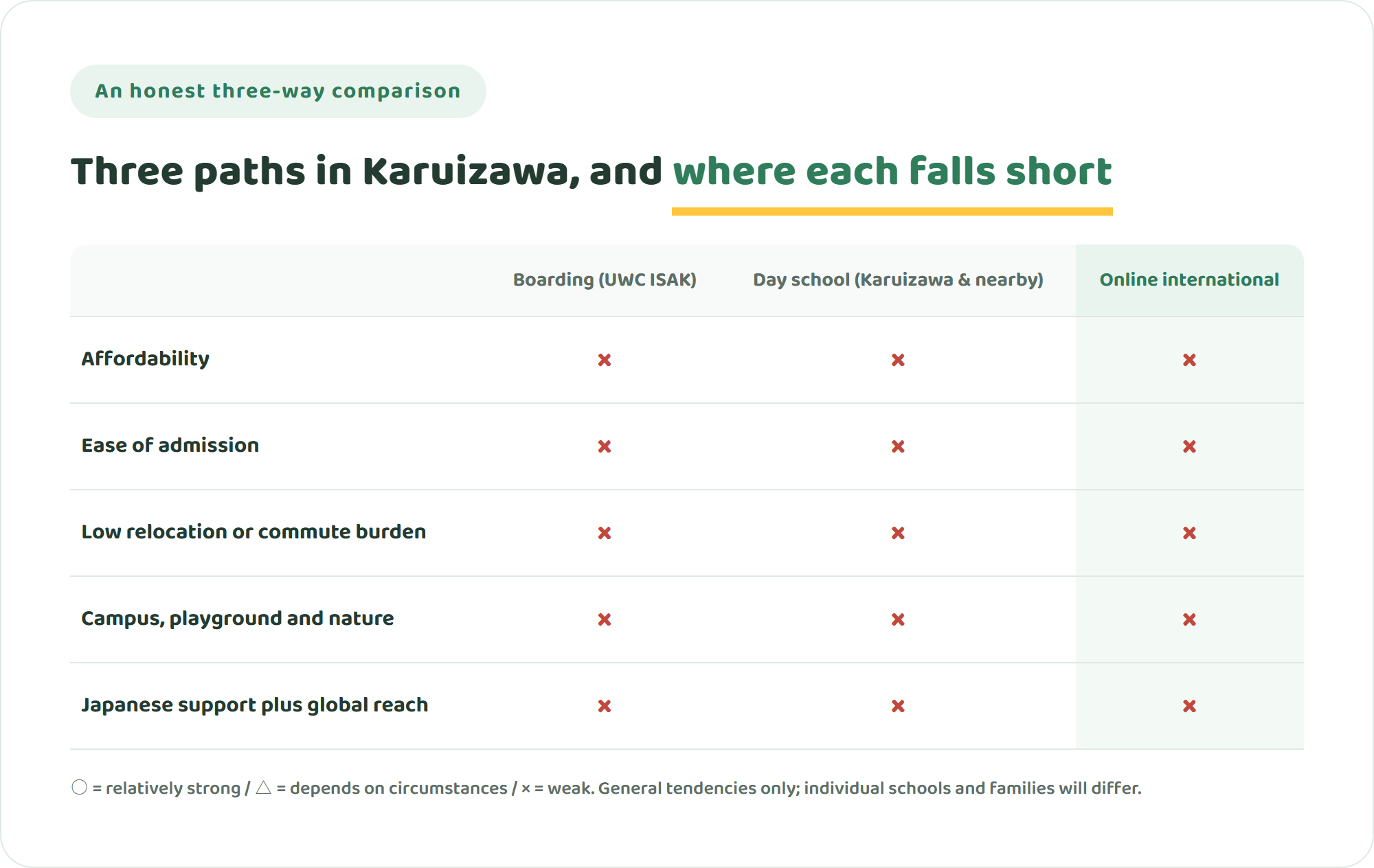
The point of the table is that there is no complete option. Boarding offers a global peer group that nothing else matches, but it is the most expensive, the hardest to enter, and it means your child lives away from home. Day schools give you daily contact and a familiar routine, but they assume you move your household into the Karuizawa area. Online removes the fee pressure and the relocation entirely, but it cannot give a child a playground, a forest walk with classmates, or a dorm conversation at midnight.
So work in this order. Decide the one thing your family will not trade away. If that is living together under one roof, boarding is out. If it is keeping education under a certain annual figure, the list shrinks immediately. If it is starting an English environment now rather than in three years, then waiting for the right grade to open is not an option. Choosing your single non-negotiable makes comparing seven schools remarkably simple. See how learning works online →
One more thing worth knowing: Karuizawa Kazakoshi Gakuen, a private mixed-age kindergarten-through-junior-high school in town, is not an international school and teaches mainly in Japanese, but its inquiry-driven, mixed-age philosophy means many relocating families weigh it alongside the schools above. If what draws you to Karuizawa is a way of learning rather than a language, it belongs on your list.

When fees or relocation are the barrier: online as an eighth option
Having read this far, you may be thinking something like: we would have to move to Karuizawa to attend, our child is too young to board, and two million yen a year for a decade is not something our family can sustain. Those are reasonable conclusions. Karuizawa is not short of good schools. What it asks in return — relocate, board, or pay a premium indefinitely — is heavy.
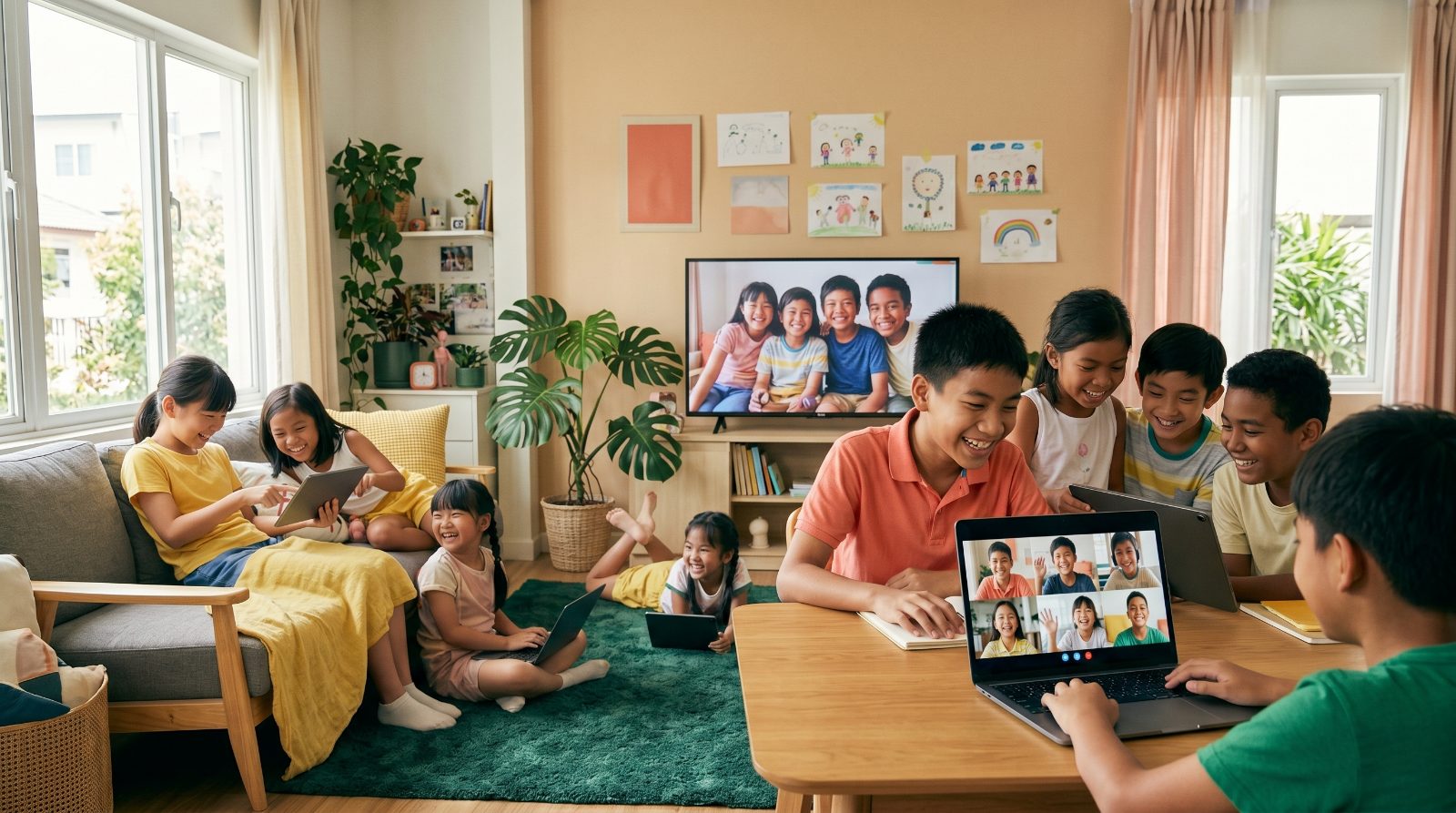
NIJIN GLOBAL ACADEMY (NGA) is an online international school opening in September 2027, operated by NIJIN Inc. in Japan. NIJIN already runs NIJIN Academy, an alternative school in Japan with more than 1,000 enrolled students. NGA is for students aged 6 to 18 across Asia and Oceania. Because it is online, it works whether you have already moved to Karuizawa, are still deciding, or have chosen not to move at all. Where you live is not determined by where your child studies.
The learning model deliberately steps away from ranking children by test scores. It is built on small-group dialogue and a single aim: helping each student come to like themselves and the world. Japanese-language support is assumed as a foundation, with English introduced gradually, which matters for families who are not ready to drop a child into an English-only environment overnight. Tuition is designed to be around one-fifth of a face-to-face international school.
And the honest caveats. NGA has not opened yet. There are no graduate outcomes and no student testimonials — those are still ahead of us. It is also not the same experience as a physical school. Walking the Karuizawa woods every morning, late-night conversations in a dorm, the noise of a shared playground: online cannot replace those. What we can offer is this — that no child’s possibilities close simply because of geography or price. If, knowing that, our school still fits your family, we would be glad to have you.
Frequently asked questions
Q. From what age can my child attend an international school in Karuizawa?
The answer depends almost entirely on age. Ages 2-6 are served by EtonHouse Karuizawa and ABC International School. Elementary-age children can attend LCA Kitakaru or EtonHouse’s elementary section (Grades 1-2 as of 2026-27). High school means UWC ISAK Japan, from Grade 10. The thinnest band in Karuizawa is junior high — there is no realistic full English-medium option in town for those years. If you are choosing an elementary school now, decide how you will handle ages 12 to 15 before you commit, not after.
Q. Will my child’s Japanese suffer in an English-medium school?
This is the most common worry we hear from families relocating to Karuizawa. At an accredited school like LCA Kitakaru, Japanese language study is guaranteed by the curriculum framework. At an English-medium school like EtonHouse, what happens at home carries much more weight — Japanese literacy in particular does not develop on its own. It is genuinely possible for Japanese to thin out as English grows, and it needs deliberate support rather than optimism. For families worried about this, our sister service Tomodachi Japan (online Japanese for children, also run by NIJIN) is worth a look.
Q. Can we transfer in mid-year?
It varies, and cohorts here are small enough that timing matters more than in a big city. EtonHouse is adding one grade per year, so whether a place exists depends on which grades are open that year. LCA Kitakaru runs three application rounds a year with deadlines around June, October and January, and takes roughly 15 students per grade. UWC ISAK Japan is built around the three-year Grade 10 entry and does not generally accommodate mid-year transfers. Assuming you can enter whenever you arrive is the mistake that most often derails a relocation timeline. Once you have a first choice, read that school’s admissions guidelines directly and plan the move around them.
A town in the forest, and a wider world for your child
Looked at through an educational lens, Karuizawa is both remarkable and difficult. A town of 20,000 people hosts a school with students from more than 80 countries, a preschool that treats the forest as a classroom, and a brand-new elementary school built inside a closed-down public school building. That is extraordinary. And reaching any of it asks you to move your home or send your child away. Of course you are hesitating. Reading this page without having decided anything is not falling behind.
What matters more than which school you choose, we believe, is how much time your child gets to feel that they are allowed to be exactly who they are. That can happen in a Karuizawa forest, in a dorm common room, or at a kitchen table with a laptop open. Place is only one of the conditions. Go and visit the schools that caught your attention. And if you ever want to question the assumption that your child has to commute anywhere at all, we would be glad to be part of that conversation.
To compare every option across the wider prefecture, see our guide to international schools in Nagano Prefecture, which covers schools outside this city and prefecture-wide fee ranges.
International Schools in Other Cities
- International Schools in Tsukuba: Fees
- International Schools in Sendai: 7 Picks and Fees
- International Schools in Shinjuku: Fees
- International Schools in Sapporo: Fees
- International Schools in Dubai: Fees
- International Schools in Meguro: All 8 Schools
- International Schools in Sumida, Tokyo
- International Schools in Sydney
- International Schools in Taipei
- International Schools in Tokyo
- International Schools in Osaka
- International Schools in Nagoya: All 8 Schools
- International Schools in Fukuoka: Fees
- International Schools in Yokohama: Full Comparison
- International Schools in Minato: Fees