If you have been searching for international schools in Hiroshima Prefecture and the results feel contradictory, that is because they are. Hiroshima holds a 60-year-old IB continuum school in the city, a public boarding IB school on an island in the Seto Inland Sea, accredited Japanese schools running English immersion and the IB Diploma in Fukuyama, and a residential elementary school charging over ¥7.5 million a year. Few prefectures in Japan span that range, which is exactly why no single fee figure makes sense here. This guide maps every school we could verify — across Hiroshima City, Hatsukaichi, Higashi-Hiroshima, Fukuyama, and the islands and highlands — with the fees each school actually publishes, and is honest about the distances involved.
Quick Answer: Your Options in Hiroshima
If you only read one section, read this. Below are the areas where schools can be confirmed, with their school names, plus the online option — so you can see every route side by side before the details.
- Hiroshima City — YMCA International Kindergarten (7-11 Hatchobori, Naka-ku) / Alcott International School (15-10 Wakakusa-cho, Higashi-ku) / International Preschool Do-Re-Mi (Itsukaichi, Saeki-ku)
- A different kind of international education — Hiroshima Korean Elementary, Junior and Senior High School
- NIJIN GLOBAL ACADEMY (online) — Ages 6–18 / opening September 2027, currently taking opening-update registrations / fees around one-fifth of a typical campus international school / Japanese-language support. An option when distance or fees are the wall.
International schools in Hiroshima Prefecture: the landscape and what they cost
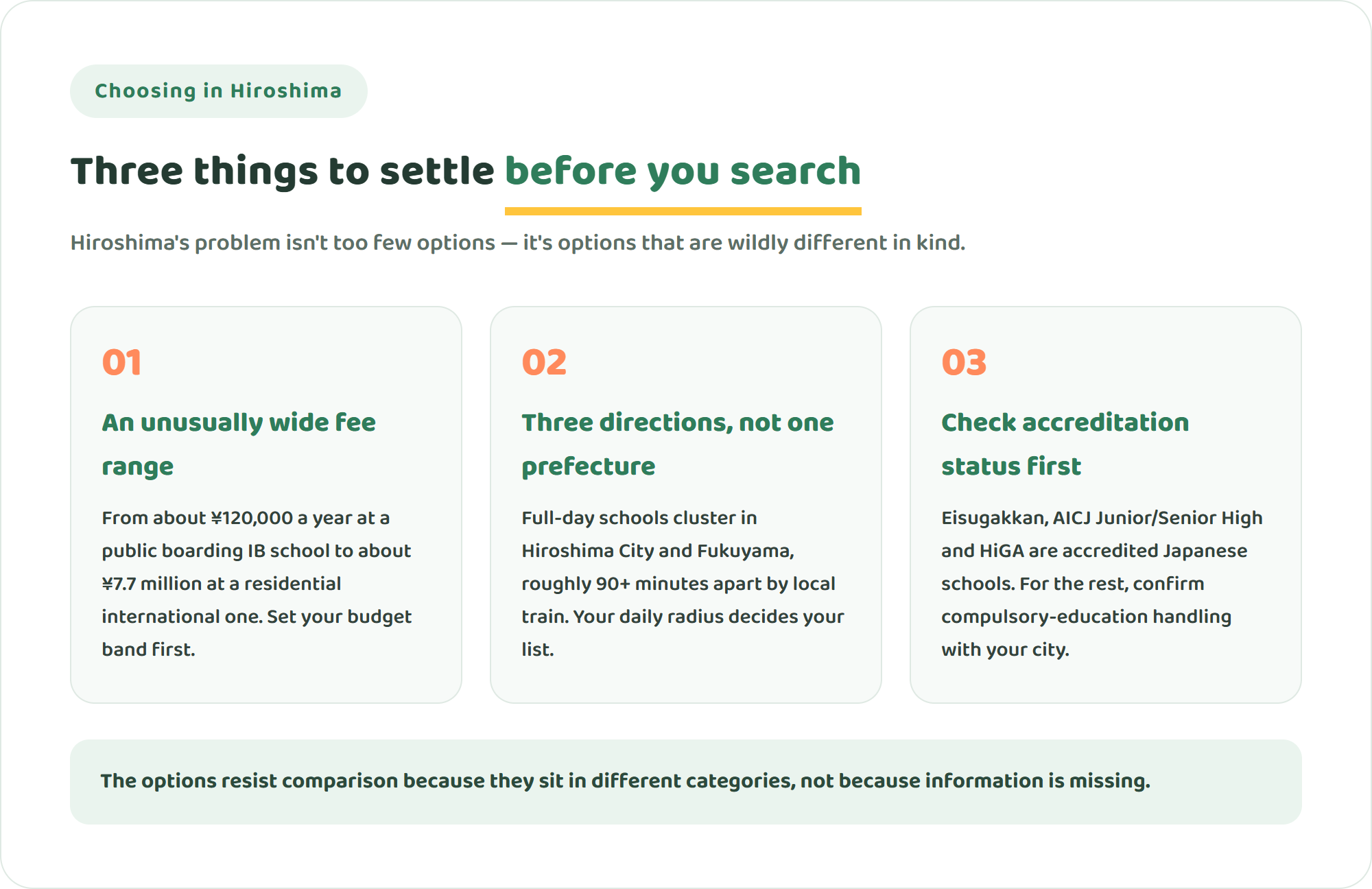
Start with the good news: unlike many prefectures outside the Tokyo–Osaka corridor, Hiroshima genuinely does have full-day international schooling from early years through Grade 12. What it also has is a fee range running from roughly ¥120,000 to ¥7.7 million a year — a spread you will not find in most of Japan.
That spread exists because four different traditions of international education grew here in parallel.
The first is a long-established international school: Hiroshima International School, founded in 1962, running the full International Baccalaureate continuum — PYP, MYP and DP — under one roof. The second is the IB and English immersion inside accredited Japanese schools, led by Eisugakkan in Fukuyama and AICJ Junior & Senior High School in Hiroshima City. The third is a public boarding IB school: Hiroshima Global Academy, which opened in 2019 on Osaki-Kamijima island and was the first public school in Japan to combine full boarding with the IB. The fourth is a residential international elementary school: Jinseki International School, Japan’s first boarding primary school, in the mountains of Jinsekikogen.
If the distinction between an international school and an accredited Japanese school is still fuzzy, our explainer on what an international school actually is is worth reading first — in Hiroshima that distinction changes which options are even legally straightforward for you.
The demographic backdrop matters too. Compilations based on Immigration Services Agency statistics put Hiroshima Prefecture’s foreign resident population at roughly 64,000 as of mid-2025, led by Vietnamese (about 15,000), Chinese (about 12,000) and Filipino (about 10,000) residents — a profile shaped by automotive, shipbuilding and food-processing industry. By municipality, Hiroshima City has around 20,000 foreign residents, Higashi-Hiroshima around 9,500 and Fukuyama around 9,100. Higashi-Hiroshima is the outlier worth noting: with a population of roughly 200,000, its foreign residents make up about 5% of the city — the highest ratio in the prefecture, driven by Hiroshima University and local manufacturing.
Fees only make sense grouped by school type. Based on published figures:
- Full-day English-medium private international school (Hiroshima City) | roughly ¥1.35–1.75 million a year, plus one-time fees and bus charges
- IB and immersion inside accredited Japanese schools (Fukuyama, Hiroshima City) | roughly ¥540,000–1,020,000 a year, plus enrolment fees
- Public boarding IB school (Osaki-Kamijima) | high school tuition about ¥120,000 a year, with meals and dormitory charges on top
- Residential international elementary school (Jinsekikogen) | roughly ¥7.51–7.71 million a year, boarding and meals included
- Preschools and English kindergartens | mostly unaccredited childcare facilities eligible for Japan’s early-childhood subsidy; fees on enquiry
Where the money actually goes — registration fees, facility charges, bus fees, EAL support — is worth understanding before you compare, because several Hiroshima schools add hundreds of thousands of yen in one-time charges on top of the headline annual figure. Our breakdown of international school costs goes into the anatomy.
Every international school in Hiroshima Prefecture, by region
Below are the schools we could verify through official school sites or municipal publications. For a nationwide view, see our index of international schools across all 47 prefectures of Japan.
Hiroshima City — full-day schooling in English
Hiroshima City is where a continuous path from early years to graduation actually exists.
- Hiroshima International School (HIS) (3-49-1 Kurakake, Asakita-ku, Hiroshima) | Founded in 1962, serving ages 3 to 18 from Early Childhood through Grade 12, and running the complete IB continuum: PYP (EC–G5), MYP (G6–G10) and DP (G11–G12). Accredited by the Council of International Schools and authorised by the IBO, with roughly 25 nationalities on campus and a student-teacher ratio of 8:1. Published tuition for private students is ¥1,352,000 a year for Early Childhood and Kindergarten, ¥1,719,000 for Grades 1–8 and ¥1,752,000 for Grades 9–12. On top of that: a ¥220,000 registration fee and ¥110,000 facility maintenance fee as one-time charges, a ¥20,000 application fee, a ¥100,000 capital fee, ¥100,000 for EAL support where required, and ¥242,000 a year for school bus service. It is the only school in the prefecture where a family can start at three and finish at eighteen without switching institutions.
- AICJ International School Elementary, Hiroshima Campus (13-13 Osuga-cho, Minami-ku, Hiroshima) | Opened in April 2021 and authorised as an IB PYP school on 4 December 2023. It sits about five minutes on foot from Hiroshima Station, which makes it the most transit-accessible international school in the prefecture. Most instruction is in English, with Japanese language and culture running alongside; Singapore Math and inquiry-based cross-subject units are distinctive features. Grade 1 entry requires no prior English, provided the family lives together in Japan; mid-year transfers are assessed on English proficiency. After-school programmes run until 5pm. Note that the operator, AIC Education, renamed “AIC World College” to “AICJ International School” and “AIC Bilingual Kindergarten” to “AICJ Bilingual Kindergarten” effective 1 April 2026. Fees are not published on the official site — request materials directly. (Third-party guides cite figures in the ¥1.3–1.6 million a year range; treat that as indicative only and confirm with the school.)
- AICJ Junior & Senior High School (Gion, Asaminami-ku, Hiroshima) | The junior high opened in 2006 and the senior high in 2007; in 2009 it became the first IB-authorised school in western Japan, and the senior high runs an IB Diploma course. Junior high classes are structured so that everything except Japanese language and social studies can be taught in English, with native-speaker team teaching in maths, science and English. Separate boys’ and girls’ dormitories house around 60 students. Because it is an accredited Japanese school, students can graduate with both a Japanese high school diploma and, on the IB track, the Diploma. Third-party databases put annual costs in the ¥600,000s, but this varies by course — check the current admissions materials.
Hiroshima City — preschools and English kindergartens
Early years is where choice widens considerably, and most of it is concentrated in Naka-ku, the central ward.
- AICJ Bilingual Kindergarten, Hiroshima (1-1 Nakamachi, Naka-ku) | Bilingual programme from age two, operating as an unaccredited childcare facility eligible for Japan’s early-childhood education subsidy. Its advantage is the internal pathway on to the AICJ elementary and secondary schools. Fees on enquiry.
- YMCA International Kindergarten (7-11 Hatchobori, Naka-ku) | Preschool classes for ages one and two, plus three age-graded kindergarten years. Runs an English-speaking-country kindergarten curriculum in an English environment, with Zoo-phonics, circle time, music, gymnastics and swimming. Subsidy-eligible.
- Sophia International Kindergarten (14-15 Higashi-Hakushima-cho, Naka-ku) | Ages 18 months to six, with a strict English-only policy through the day. Unaccredited childcare facility.
- Little Newton International Kindergarten (7-16 Nakamachi, Naka-ku) | An all-English setting for up to 90 children, three minutes from Fukuromachi tram stop, with daily outings to nearby parks built into the routine.
- Alcott International School (15-10 Wakakusa-cho, Higashi-ku) | Preschool for ages two to six with aftercare until 7pm, plus English classes for kindergarten and elementary children. Registered with Hiroshima Prefecture and subsidy-eligible.
- Sun-Rise International Club (8-38-30 Nishihara, Asaminami-ku) | Open since 2013, combining a preschool for ages 18 months to four with an after-school programme for kindergarten through Grade 6, one to three sessions a week. Foreign and bilingual teachers on staff; practical for dual-income households.
- International Preschool Do-Re-Mi (Itsukaichi, Saeki-ku) | Ages two to six, English immersion in a combined kindergarten-nursery format with both short (kindergarten-style) and long (nursery-style) day options. The realistic choice for families in the western wards.
Hatsukaichi and Higashi-Hiroshima
Just outside the city, two options are worth knowing — and one of them has a fee structure that is genuinely unusual nationwide.
- Tsukinohikari International Nursery (625-1 Ono Tainohara, Hatsukaichi) | Opened in 2019 for children from birth to age five, running daily care in both English and Japanese as immersion rather than English-as-a-subject. The school explicitly commits to respecting each child’s mother tongue and home culture, and serves international dishes made with local ingredients. The key point: this is an accredited nursery under Hatsukaichi City, so fees are set on the municipal income-based scale — dramatically lower than a private English-medium preschool. Open 7am to 7pm on weekdays and Saturdays.
- C&E International Preschool (Shitami, Saijo-cho, Higashi-Hiroshima) | Ages two to six with care until 6pm, balancing reading, listening, writing and speaking, and preparing children explicitly for elementary entry. The same operator runs English classes from preschool age through adults, exam-preparation courses, and a tutoring school for elementary through high school students, so continuity after graduation is built in. It serves the prefecture’s most internationally mixed city.
Fukuyama and the Bingo region
Fukuyama, the eastern hub, holds something the rest of the prefecture does not: an accredited Japanese school with both the IB PYP and the IB Diploma.
- Eisugakkan Elementary, Junior High and High School (980-1 Hikino-cho, Fukuyama) | An accredited Japanese school running integrated elementary-through-high education, authorised for the IB PYP at elementary level in 2020 and as an IB World School (Diploma Programme) at high school level in 2016. The elementary school teaches about 50% of all subjects in English, with each class staffed by a pair of homeroom teachers — one foreign, one Japanese — so maths, science and the arts are all part of the immersion. The junior high offers immersion (IM) classes; the high school offers an IB class and an Advanced class. Fees are published openly: enrolment fee ¥200,000 at every level, with annual totals of ¥960,000 for elementary IM, ¥900,000 for junior high IM, ¥1,020,000 for the high school IB class and ¥540,000 for the high school Advanced class (tuition, practical fees, facilities and sundries combined). The IB class runs ¥480,000 a year above the Advanced class. For families who want a guaranteed Japanese diploma alongside English-medium learning, this is the prefecture’s most transparent option.
- STELLA International Kindergarten (5-5-6 Miyoshi-cho, Fukuyama) | English kindergarten from age one, with five-, eight- and ten-hour course options, meals and extended care, plus an after-school programme for elementary students. Subsidy-eligible.
- FOUND academy Kannabe (1-7 Yuno, Kannabe-cho, Fukuyama, inside Across Plaza Kannabe) | Eight- and ten-hour care with meals and extended hours. Subsidy-eligible.
Islands and highlands — boarding, the Hiroshima speciality
These two schools are where Hiroshima’s character shows most clearly. Neither is about commuting; both are about living somewhere while you learn, and their cost structures have nothing in common.
- Hiroshima Global Academy (HiGA), Hiroshima Prefectural Junior and Senior High School (3137-2 Ogushi, Osakikamijima, Toyota-gun) | Opened in 2019 as the first public school in Japan to combine full boarding with the IB. It holds MYP authorisation at junior high level and DP authorisation (including the Japanese-language DP) at senior high, and in principle every student takes both. Intake is 40 students a year at junior high and 60 at senior high. Demand is intense: the 2026 junior high entrance round was reported at roughly 7.3 times oversubscribed, up from about 5.8 the year before. Costs reflect its public status — junior high tuition is free, and senior high tuition is ¥9,900 a month (¥118,800 a year). But boarding adds up: meals around ¥37,000 a month, dormitory fees ¥6,300 a month, and class fees in the ¥10,000s, putting the six-year total in the region of ¥4.1–4.5 million, with a ¥145,000 IB final examination fee in the third year of high school. Financial support schemes exist; check the school’s fees page and the prefectural board of education. Living on a Seto Inland Sea island is not incidental to this school — it is part of the curriculum.
- Jinseki International School (JINIS) (5020-77 Tokiyasu, Jinsekikogen-cho, Jinseki-gun) | Opened in April 2020 as Japan’s first full-boarding elementary school, taking Grades 1 through 6 with 24 children per year group and a maximum of 16 per class. The curriculum integrates the Japanese national course of study with the International Primary Curriculum; everything except Japanese language is taught in English immersion. Live-in house parents support daily life, and families connect through weekly video calls and a digital portfolio. It is designed as a bridge to Western boarding schools, though graduates also move on to Japanese public and private junior highs. The fees are, honestly, extraordinary: published 2026 figures indicate a ¥500,000 enrolment fee, then ¥5,390,000 tuition plus ¥1,710,000 boarding plus roughly ¥490,000 for facilities, materials and uniform — about ¥7.51–7.71 million a year, with a first year near ¥9.21 million including a refundable deposit. It is among the most expensive elementary schools in Japan.
A different kind of international education
One school never appears in international-school searches but belongs in any honest account of Hiroshima. Hiroshima Korean Elementary, Junior and Senior High School in Higashi-ku is the only Korean school in the Chugoku region with a senior high division, and it also runs a kindergarten class. Classified as a miscellaneous school, it delivers education equivalent to Japanese elementary, junior high and high school, and since 1990 senior high students have been able to enrol concurrently in the correspondence course at Hiroshima Prefectural Nishi High School to obtain a Japanese high school diploma. It is not an English-medium school, but learning while holding on to a mother tongue and a home culture is international education by any reasonable definition.
One clarification: Setouchi Global Academy, which appears in many Hiroshima search results, opened in 2020 as a post-secondary programme partnered with the College of the Atlantic in Maine, not a K-12 school, so it is not listed above. And where aggregator sites claim dozens of international schools in Hiroshima, most of those counts include English conversation schools and cram schools.
Note: fees and curriculum details reflect publicly available information as of July 2026 and are revised frequently. Always confirm with each school directly.
Comparing the paths, and finding yours
Families in Hiroshima tend to arrive at three questions. Should we pay for a full-day English-medium international school? Is IB or immersion inside an accredited Japanese school enough? And what is left if neither commuting nor boarding works for us?
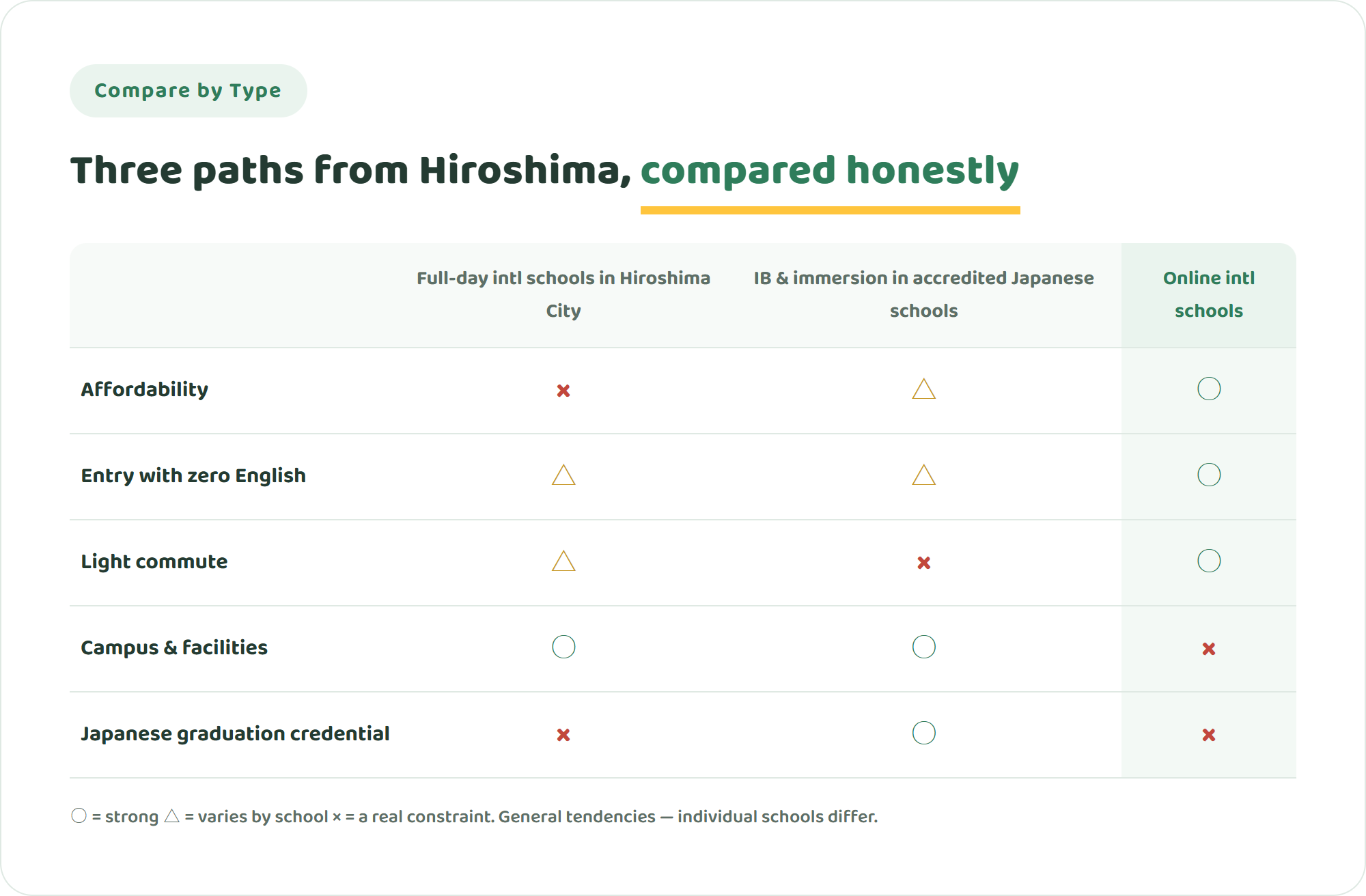
Hiroshima International School and AICJ International School Elementary offer a depth of English-medium learning nothing else here matches. But ¥1.35–1.75 million a year compounds over twelve years, and because they are not accredited Japanese schools, you will need to clarify how compulsory-education requirements are handled with your municipal board of education.
Eisugakkan and AICJ Junior & Senior High invert that. A Japanese diploma is guaranteed, and fees run ¥540,000–1,020,000 a year. The catch is location: Fukuyama and Asaminami-ku are not daily commutes from most of the prefecture, and a journey over 90 minutes each way steadily wears down both a child’s energy and family life.
Boarding at HiGA or JINIS removes the commute entirely, but asks a family to separate while a child is still in elementary or junior high. HiGA also requires clearing an entrance round oversubscribed seven to one; JINIS requires ¥7.5 million a year. Both are excellent for the families they fit. Neither is a door open to everyone.
There is a fourth pattern many Hiroshima families quietly use: staying in the local school and adding international learning around it. Public school by day, an English environment after school or at weekends. It is the easiest design to sustain on both money and time — our guide to what to do when international school fees don’t fit covers how families make that work.
The thing worth optimising for is not the school you can get into, but the learning you can keep going. Multiply the annual cost and the daily round trip by twelve years, and see whether the answer is still liveable.
See how learning works online →
If nothing is within reach — the online option
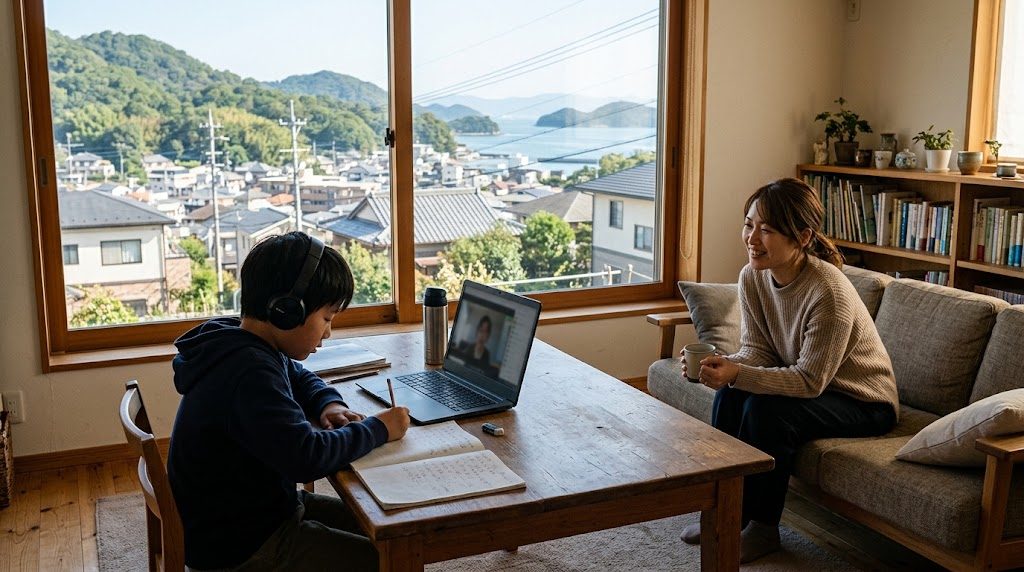
The most common wall families hit in Hiroshima is not that no good school exists. It is that the good school is unreachable. From Miyoshi or Shobara into Hiroshima City, from Kure or Mihara into either hub, from an island to the mainland — the same prefecture on a map, a different world in daily life. Preschool directories currently list no English-immersion kindergarten at all in Kure, Onomichi or Mihara. Distance is not something family effort can fix.
Which is why a school without a commute is worth considering. NIJIN GLOBAL ACADEMY (NGA) is an online international school opening in September 2027, operated by NIJIN Inc. in Japan. Its sister school in Japan, NIJIN Academy — an alternative school — already has more than 1,000 students enrolled.
What NGA is built around is a rejection of ranking children by test scores, and small-group, dialogue-centred learning. Its promise is simple: help children come to like themselves and the world. It serves ages 6 to 18 across Asia and Oceania, wherever they live, and aims for fees around one-fifth of a face-to-face international school. English is not switched on all at once either — the design assumes Japanese-language support underneath, so children move into English gradually. Neither language has to be sacrificed for the other, and that matters most for families in places like Hiroshima, where the school exists but the journey does not.
The honest caveats: NGA has not opened yet, so there are no graduate outcomes to point to. It is not an accredited Japanese school, so confirm how compulsory education is handled with your municipal board of education. And online cannot replicate a playground or the detour home with friends. If those matter most to you, a school in the prefecture is the better fit. But if it can turn “we can’t get there, so we’re giving up” into “we don’t need to get there”, it is worth a look.
Frequently asked questions
Q. Can we reach these schools from anywhere in Hiroshima Prefecture?
No. Full-day schools cluster in Hiroshima City (Asakita, Minami and Asaminami wards) and Fukuyama, and those two metropolitan areas are roughly 90 minutes or more apart by local train. Daily commuting from Kure, Onomichi, Mihara, Miyoshi or Shobara is not realistic. Decide first how long a one-way journey your family could sustain for twelve years, then look only at what falls inside that radius. HiGA and JINIS are, in effect, the schools that solve this problem by having students live there.
Q. Can we commute to an international school in a neighbouring prefecture?
You can, but price it honestly. Fukuyama is about 20 minutes from Okayama by shinkansen and Hiroshima City about 35 minutes, and some families do cross the prefectural border. Shinkansen season tickets run into the hundreds of thousands of yen a year, though, and elementary-age children almost always need an accompanying adult. A common compromise is to stay local through elementary school and switch to a cross-prefecture commute or a dormitory at junior high or high school age.
Q. Can a child with no English get in? Is there Japanese-language support?
At preschool and kindergarten level, almost every school here accepts children with no English at all. At elementary level, AICJ International School Elementary requires no prior English for Grade 1 entry, while mid-year transfers are assessed. Hiroshima International School offers EAL (English as an Additional Language) support for an additional fee. If keeping Japanese-language study intact is the priority, an accredited Japanese school like Eisugakkan or AICJ Junior & Senior High is the safer structure, since Japanese subjects remain part of the formal curriculum.
Hiroshima is not a prefecture without options
Hiroshima is not a place where international education is missing. It has an IB continuum school more than sixty years old, accredited Japanese schools delivering both a Japanese diploma and the IB, the first public boarding IB school in the country, and the first boarding elementary school in the country. The problem was never scarcity. It is that the options here are wildly different in kind — which is why they resist comparison, and why no honest single fee range exists.
From ¥120,000 a year at a public boarding school to ¥7.7 million at a residential international one. Somewhere in that range is the shape your family can actually sustain. Put all of it on the same table — local schools, a cross-prefecture commute, boarding, and online — and work backwards from the life you want to be living in five years. Whichever path you take, if your child ends up liking themselves and the world, you chose right.
International School Guides for Other Prefectures
- International Schools in Okayama Prefecture
- International Schools in Yamaguchi Prefecture
- International Schools in Hokkaido Prefecture
- International Schools in Kanagawa Prefecture
- International Schools in Aichi Prefecture
- International Schools in Hyogo Prefecture
- International Schools in Chiba Prefecture
- International Schools in Ibaraki Prefecture
- International Schools in Ishikawa Prefecture
- International Schools in Iwate Prefecture
- International Schools in Kagawa Prefecture
- International Schools in Kagoshima Prefecture
- International Schools in Kochi Prefecture
- International Schools in Kumamoto Prefecture
- Browse all 47 prefectures of Japan