If you are looking for international schools in Hokkaido — perhaps you have just moved to Sapporo, bought a place in Niseko, or you are a local family who wants an English-medium education for your child — the honest headline is this: Hokkaido’s international schools are concentrated in just two places, Sapporo City and Niseko Town, and only about three schools carry English-medium study beyond kindergarten. Campus tuition runs roughly ¥1.0–1.65 million per year (about USD 6,500–11,000), plus an entrance fee of around ¥200,000. In Hakodate, Asahikawa, Obihiro, Kushiro and Kitami you will find English preschools, but no full international school.
This guide maps every English-medium option we could verify in Hokkaido, area by area, with real fees, age ranges and honest notes — including what to do if there is simply nothing within commuting distance of where you live. We are not here to sell you one school. By the end, you should know exactly what to weigh for your own family.
Quick Answer: Your Options in Hokkaido
If you only read one section, read this. Below are the areas where schools can be confirmed, with their school names, plus the online option — so you can see every route side by side before the details.
- Sapporo Area — Hokkaido International School (HIS), Sapporo / Tokyo International School Sapporo Maruyama Kindergarten / Jelly Beans English Preschool and 2 more (5 in total)
- Niseko & Kutchan Area (Shiribeshi) — Hokkaido International School Niseko (HIS Niseko) / KIU Academy Niseko / Niseko International High School
- Hakodate Area — Heroes International Preschool
- NIJIN GLOBAL ACADEMY (online) — Ages 6–18 / opening September 2027, currently taking opening-update registrations / fees around one-fifth of a typical campus international school / Japanese-language support. An option when distance or fees are the wall.
International Schools in Hokkaido: The Landscape and Typical Fees
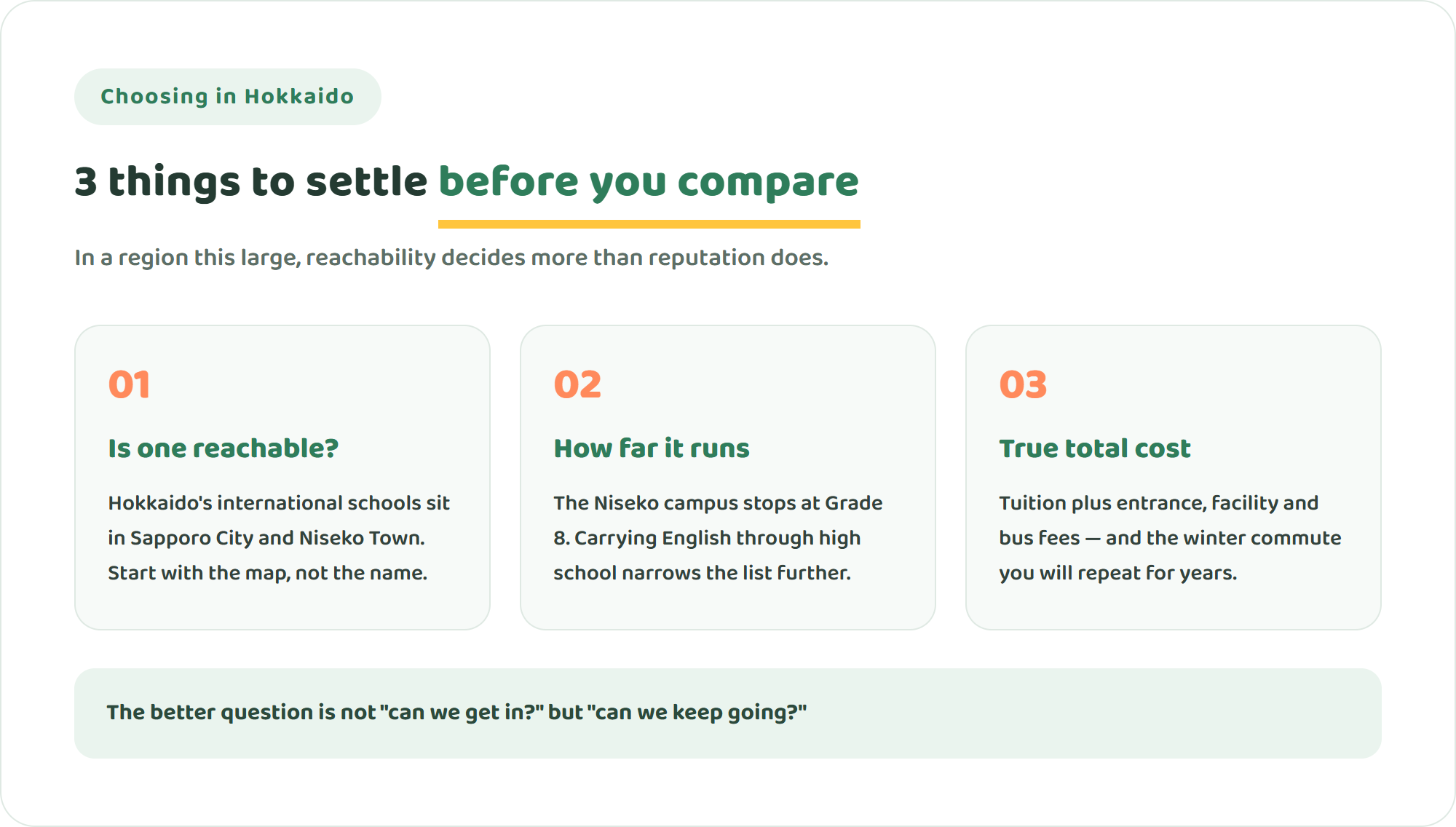
Hokkaido accounts for roughly a fifth of Japan’s land area, yet English-medium schooling is available in essentially two locations. The only full K-12 international school on the island is Hokkaido International School (HIS) in Sapporo, founded in 1958 and accredited by WASC in the United States. Its Niseko campus runs through Grade 8, and KIU Academy Niseko — which opened in April 2025 — covers Grades 1 to 12 in a bilingual Japanese-English model. Around these sit a handful of English-immersion preschools in Sapporo and Hakodate.
The second thing worth knowing is how fast the Niseko-Kutchan area is internationalising. Driven by ski tourism and inbound relocation, roughly 16% of residents in Kutchan and Niseko towns are foreign nationals, with the population swelling further each winter as seasonal workers arrive. That demographic shift is why two towns of a few thousand people now support two international schools — a genuinely unusual situation in Japan. Elsewhere in Hokkaido, families have to start from the opposite assumption: there is nothing within daily reach.
On fees, budget roughly ¥1.0–1.65 million per year in tuition for a campus school, plus an entrance fee (around ¥200,000), annual and facility fees, device fees and bus costs. One Hokkaido-specific line item rarely mentioned online: winter. Snow clearing, icy roads and longer commute times all affect whether a school is sustainable for years, not just for one term. For how the full cost breaks down, see our guide to international school tuition costs. Fees are as published in July 2026 — always confirm the current figures with each school.
Every International School in Hokkaido, by Area
Here is what we could verify, organised by area. Read it not as a ranking, but as a map of which options are realistically open to your family.
Sapporo Area
Hokkaido’s largest city offers the widest choice on the island — though “widest” still means one full international school plus several preschools.
- Hokkaido International School (HIS), Sapporo (Toyohira-ku, Sapporo) | Founded 1958; the only school in Hokkaido running from early years through Grade 12. WASC-accredited, fully English-medium, American-style curriculum. Ages 3 (Early Years) to Grade 12. Annual tuition for 2026-2027: Early Years half day ¥1,028,000 / full day ¥1,440,000; Kindergarten–Grade 5 ¥1,584,000; Grades 6–8 ¥1,624,000; Grades 9–12 ¥1,648,000. Add a ¥20,000 application fee, ¥200,000 entrance fee, ¥200,000 annual fee, ¥5,000 insurance, ¥10,000 PTA and a ¥25,000 device management fee for K–Grade 5.
- Tokyo International School Sapporo Maruyama Kindergarten / After School (Chuo-ku, Sapporo) | English kindergarten plus an after-school programme for elementary-aged children. Fees on enquiry.
- Jelly Beans English Preschool (Sapporo) | All-native teaching staff; full immersion, with English used throughout the day.
- IKS Sapporo International Preschool (Sapporo) | Ages 1–5, combining English with music, movement and early-learning programmes.
- UNDERDOGS (near Sapporo Station north exit) | A small-group English preschool.
- Doremi Garden Preschool International (Sapporo) | English-environment preschool from 18 months.
The pattern in Sapporo is clear: plenty of choice for the early years, and effectively one option once your child reaches elementary school. If you are enrolling a toddler in an English preschool, it is worth deciding now what happens at age six.
Niseko & Kutchan Area (Shiribeshi)
Small in population, but — for some age groups — richer in international schooling than Sapporo itself.
- Hokkaido International School Niseko (HIS Niseko) (12 Aza Fujimi, Niseko Town) | A campus of HIS Sapporo, serving Early Years (ages 3–4) through Grade 8. The elementary programme follows the International Primary Years Curriculum (IPC), with inquiry-led learning at its centre. Annual tuition for 2025-2026: Early Years half day ¥1,000,000 / full day ¥1,400,000; K–Grade 5 ¥1,540,000; Grades 6–8 ¥1,580,000, plus a ¥150,000 facilities fee, ¥20,000 application fee and ¥200,000 entrance fee. There is no high school here, so plan ahead for Grade 9 onward — the Sapporo campus, or schools outside Hokkaido.
- KIU Academy Niseko (56-3 Motomachi, Niseko Town) | Opened April 2025 by Kyoto International University, offering a bilingual Japanese-English programme for Grades 1–12, accredited by WASC and ACSI. The campus looks out on Mt. Yotei and comes with a free school bus and school-owned apartments nearby (around ¥72,000 per month including utilities) — practical touches for relocating families. Discounts include a ¥200,000 annual reduction for native English speakers, plus bilingual and sibling discounts and need-based scholarships. Published figures for the Kyoto campus give a sense of scale — ¥953,000 tuition, ¥300,000 entrance fee, ¥50,000 course registration and ¥150,000 facilities fee (about ¥1.45 million in year one) — but confirm Niseko’s current fees directly with the school.
- Niseko International High School (Niseko Town) | Not an international school in the strict sense, but notable: the town’s former agricultural high school reopened in April 2026 as a university-track comprehensive high school with an international character, recruiting students from across Japan and abroad. Around 70 places, with dormitories.
Hakodate Area
We could not verify any full international school in Hakodate. What exists is early-years immersion.
- Heroes International Preschool (Hakodate) | All-English from 18 months, with science, art, music and maths taught by native-speaking teachers.
- Happy English House (Hakodate) | Up to ten hours a day in a 100% English environment, including art, science, PE and outdoor activities.
Asahikawa, Obihiro, Kushiro, Kitami and Elsewhere
Plainly: we found no permanent international school teaching academic subjects in English in any of these cities. There are conversation schools and part-time English programmes, but “sending your child to an international school” is not a realistic option locally. Asahikawa is roughly two hours by car from Sapporo, Obihiro about two and a half, Kushiro around four. A daily commute does not work. For most families outside Sapporo and the Niseko area, choosing international education in Hokkaido effectively means choosing between moving house, or learning without commuting at all.
Hokkaido’s Other Route into International Education
Beyond international schools, Hokkaido has one option worth knowing about. Sapporo Kaisei Secondary School, a municipal six-year secondary school that opened in 2015, became the first public school in Japan authorised to offer the International Baccalaureate MYP (2017) and later the Diploma Programme (2018). Students can take the Japanese-language DP in years five and six, studying at least two of the six subject groups in English. With 160 students per year group and public-school fees, it is not an English-immersion environment — but it does mean an internationally recognised curriculum is available in Hokkaido without international-school tuition. Niseko International High School, with its dormitories, is similarly open to students from elsewhere on the island.
Comparing Honestly: What Fits Your Family
Here is the trade-off laid bare. Nothing scores well on every line — the useful question is which compromises your family can live with.
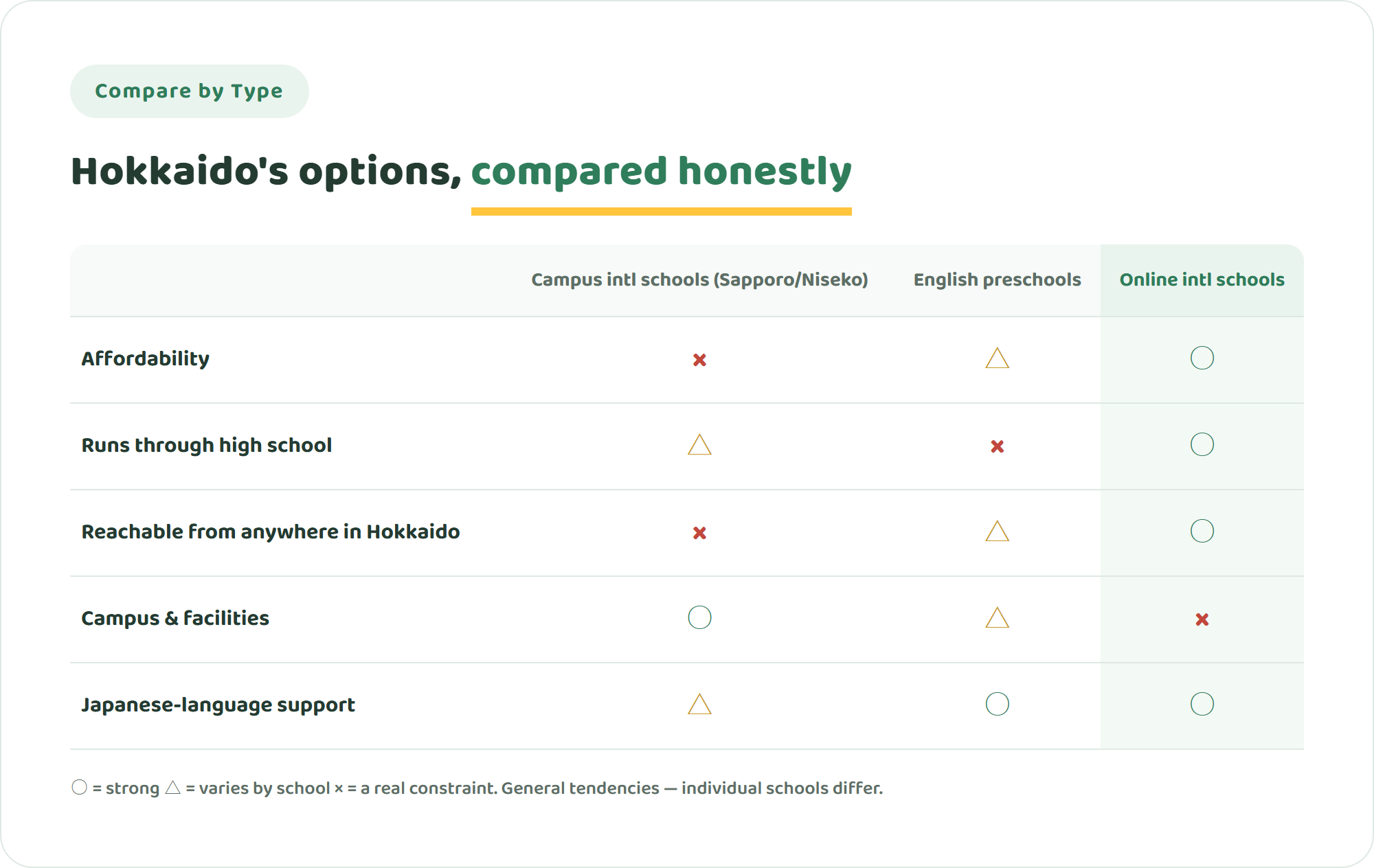
If you live in Sapporo or Niseko, can absorb the fees, and value a physical campus above all, a commuting school is a strong choice. If you live anywhere else in Hokkaido, dropping the assumption that school means commuting is what genuinely widens your options. See how learning works online →
When Nothing Is Within Reach — the Online Option
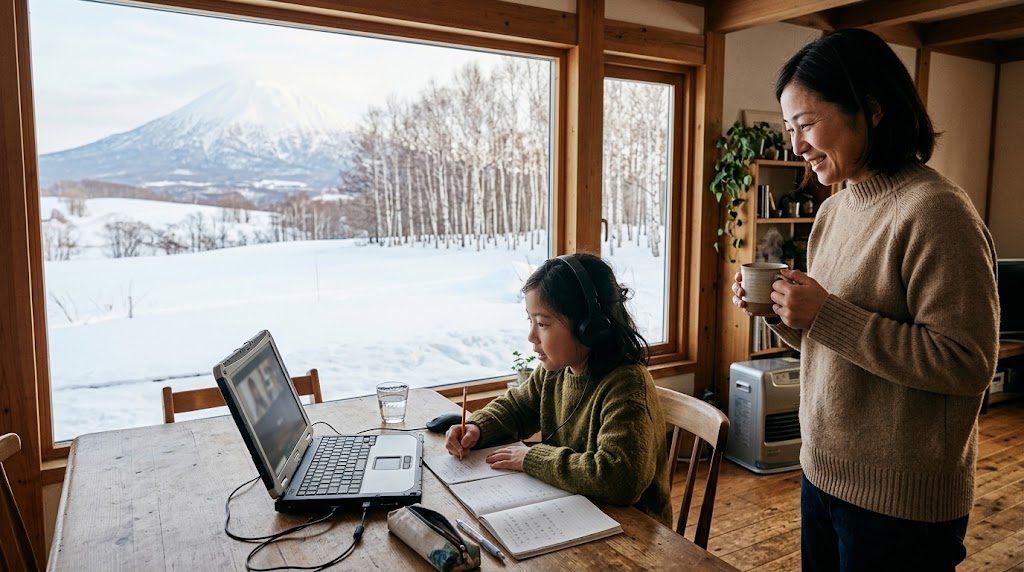
If you have read this far and concluded that there is nothing near your town, you are not alone. Hokkaido may have the widest gap in Japan between the size of a region and the number of schools in it. A child’s options narrowing simply because of where the family lives is precisely the problem we set out to work on.
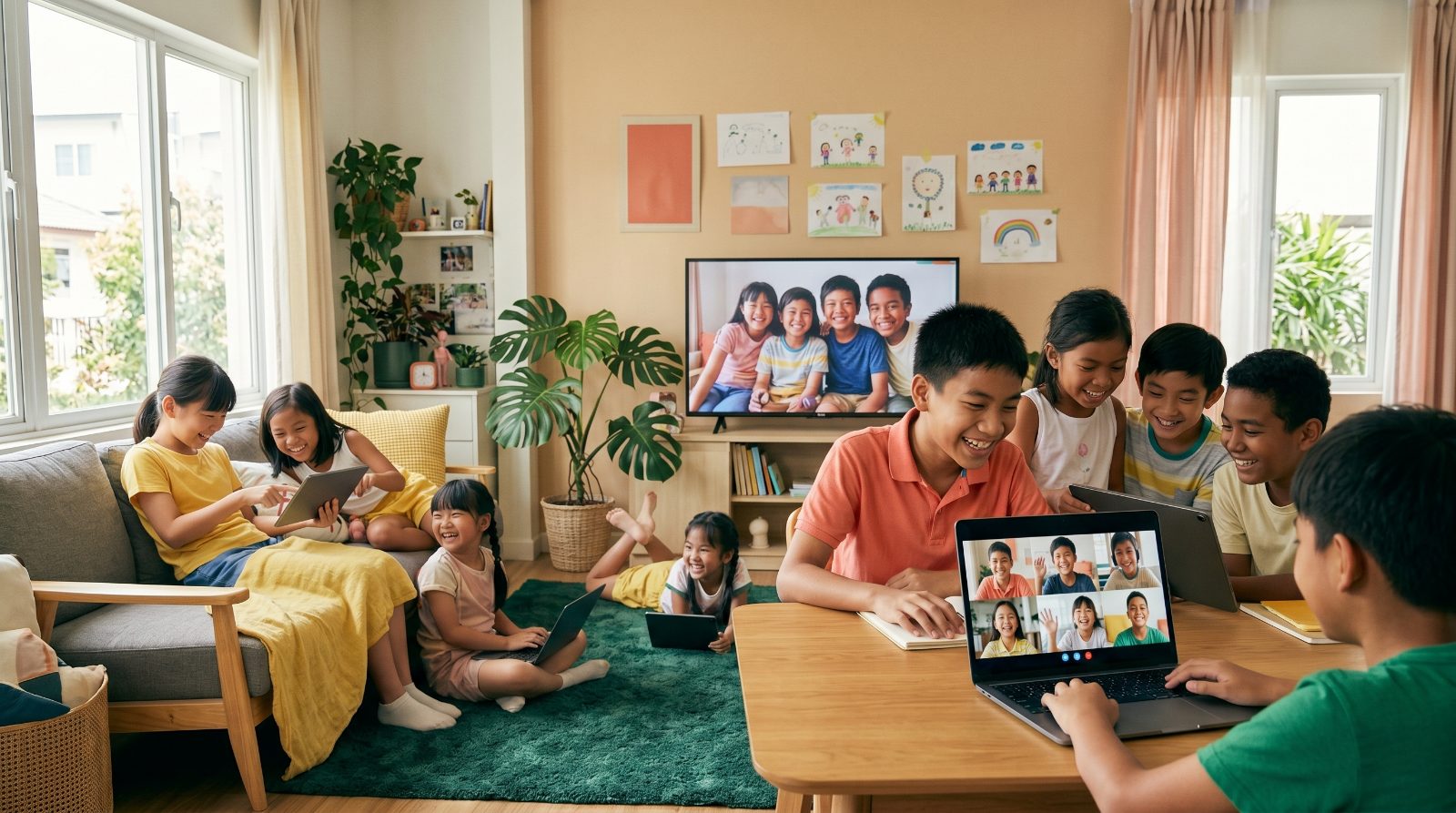
NIJIN GLOBAL ACADEMY (NGA) is an online international school opening in September 2027, run by NIJIN Inc. in Japan. Its sister school in Japan, NIJIN Academy, already enrols more than 1,000 students. We do not rank children by test scores; learning happens in small, dialogue-centred groups, guided by one idea — to grow to love yourself and the world. It is open to students aged 6 to 18 across Asia and Oceania, and because location is irrelevant, a family in Asahikawa, Kushiro or Wakkanai has exactly the same access as one in Sapporo. We are aiming for fees around one-fifth of a typical campus international school, and the design assumes Japanese-language support so children can move into English gradually — no prior English required.
To be straight with you: NGA has not opened yet, so there is no track record to point to, and it will never replicate a schoolyard or a gymnasium. But for families who cannot move house and have no school nearby, we believe it belongs on your shortlist.
Frequently Asked Questions
Can I reach an international school from anywhere in Hokkaido?
Realistically, no. Campus international schools cluster in Sapporo City and Niseko Town, and a daily commute from Asahikawa, Obihiro, Kushiro, Kitami or Hakodate is not feasible. Families who can attend without relocating are essentially those in the Sapporo metropolitan area or the Shiribeshi (Niseko-Kutchan) area. Factor in winter, too: snow and ice reliably add time to every school run.
Should we consider boarding, or schools outside Hokkaido?
It depends on your child’s age. From junior high upward, boarding options — Niseko International High School, or schools elsewhere in Japan — become genuinely viable. Sending an elementary-aged child away from home is a much heavier decision, and it is at this stage that more families are comparing online international schools alongside campus ones.
What about Japanese-language support?
It varies sharply by school. HIS teaches entirely in English and communicates with parents mainly in English. KIU Academy Niseko is bilingual by design, so Japanese study continues in parallel. If your family’s concern is the opposite — keeping your child’s Japanese strong while they study in English — ask each school directly what Japanese-language provision exists before you enrol.
The Right School Is the One Your Child Can Grow In
Measured purely by numbers, Hokkaido’s international education scene is small. But it is not empty: a long-established school in Sapporo, two newer options in a rapidly internationalising Niseko, a public IB school, and now credible online alternatives. Because the list is short, there is no need to rush toward the best-known name. Weigh the total cost, the winter commute, and above all where your child will feel free to be themselves. That is the school worth choosing.
NIJIN GLOBAL ACADEMY opens in September 2027. To hear first about our learning model, accessible fees, and founding-cohort enrolment, join our mailing list.
International School Guides for Other Prefectures
- International Schools in Sapporo (city guide in Hokkaido)
- International Schools in Kanagawa Prefecture
- International Schools in Aichi Prefecture
- International Schools in Hyogo Prefecture
- International Schools in Chiba Prefecture
- International Schools in Saitama: All 34 Listed
- International Schools in Kyoto Prefecture
- International Schools in Shizuoka Prefecture
- International Schools in Ibaraki Prefecture
- International Schools in Ishikawa Prefecture
- International Schools in Iwate Prefecture
- International Schools in Kagawa Prefecture
- International Schools in Kagoshima Prefecture
- International Schools in Kochi Prefecture
- International Schools in Kumamoto Prefecture
- Browse all 47 prefectures of Japan