If you are looking for international schools in Setagaya, Tokyo, you have probably found yourself asking two simple questions: how many are actually there, and what do they really cost? Setagaya is one of Tokyo’s leafiest, most residential wards — quiet streets, green space, and a settled family atmosphere that has long appealed to parents who want an international education without the density of central Tokyo. This guide honestly maps 14 international schools genuinely located in Setagaya, from the schools that take children through to Grade 12 down to the preschools and kindergartens. You will find a fee table (roughly 1.08 to 3.48 million yen a year), a straight answer on the “school ranking / deviation score” question that Japanese families keep searching for, the admissions and transfer calendar with the documents you will need, and the schools in neighbouring wards that are still a realistic commute. It also introduces an eighth option — online learning — for when tuition or the commute becomes the real obstacle.
Quick Answer: Your Options in Setagaya
If you only read one section, read this. Below are the schools covered in this guide, plus the online option — so you can see every route side by side before the details.
- St. Mary’s International School — Ages: Kindergarten to Grade 12 (boys, roughly ages 5-18) / Fee guide: Tuition JPY 2,860,000 (elementary) / 2,970,000 (middle) / 3,050,000 (high) per…
- Seisen International School — Ages: Age 2 to Grade 12 (kindergarten coed; girls only from Grade 1) / Fee guide: Tuition JPY 1,600,000 (half-day kindergarten) / 2,500,000 (full-day…
- The British School in Tokyo, Showa Campus — Ages: Year 7 to Year 13 (12-18, coeducational). Nursery-Year 6 is at the Azabudai Hills… / Fee guide: Tuition JPY 2,980,000 (Years 7-9) / 3,070,000 (Years 10-13) per year — 2026-27…
- Tokyo International Progressive School (TIPS) — Ages: Grade 4 to Grade 12 (approx. 9-18, coeducational) / Fee guide: Tuition about JPY 3,437,500 (G4-9) / 3,483,700 (G10-12) for 2026/2027, per a…
- Kunimoto Girls’ Junior and Senior High School — Double Diploma Course — Ages: Junior high year 1 to senior high year 3 (girls) / Fee guide: Double Diploma Course tuition about JPY 1,080,000 a year (including 600,000 of…
- Sakura International School, Setagaya — Ages: 0-6 (preschool to kindergarten age) / Fee guide: Confirm via the school’s official inquiry/brochure request (varies by hours…
- Tokyo International School — Gakugeidai Kindergarten / After School — Ages: Kindergarten (ages ~3-6) plus after-school (roughly to Grade 4) / Fee guide: Confirm via the school’s official inquiry (varies by program and hours)
- Laurus International School of Science, Den-en-chofu — Ages: 18 months-3 years (preschool), 3-6 years (kindergarten) / Fee guide: Confirm via the school’s official inquiry (varies by class and hours)
- Grace International Learning Center — Ages: A few months old to around age 6 / Fee guide: Confirm via the school’s official inquiry (varies by class and hours)
- Oakwood Tokyo International School — Ages: From around 10 months through nursery, preschool, kindergarten and elementary / Fee guide: Confirm via the school’s official inquiry
- Komazawa Park International School — Ages: 18 months-6 years, plus an after-school programme for ages 6-14 / Fee guide: Confirm via the school’s official inquiry
- Seta International School — Ages: From around 8 months to age 5 / Fee guide: Confirm via the school’s official inquiry
- Keiki Intercultural Preschool — Ages: 12 months-6 years / Fee guide: Confirm via the school’s official inquiry
- TIK International School, Den-en-chofu (Tokyo International Kindercare) — Ages: 18 months-6 years / Fee guide: Confirm via the school’s official inquiry
- NIJIN GLOBAL ACADEMY (online) — Ages 6–18 / opening September 2027, currently taking opening-update registrations / fees around one-fifth of a typical campus international school / Japanese-language support. An option when commute or fees are the wall.
New to all this? Start with What is an international school? Types, fees, entry requirements and how to choose for the full picture.
International schools in Setagaya: the landscape and fee ranges
Let’s be honest up front: Setagaya is not packed with full K-12 international schools the way Minato or Shibuya are. Those central wards cluster around embassies and multinational headquarters; Setagaya’s heart is the calm, green residential belt of Seta, Yoga, Futako-Tamagawa, Sangenjaya and Tamagawa-Den-en-chofu. As a result, the ward’s offering breaks down into two long-established K-12 schools, three more schools that take students from upper primary or secondary age, and a deep bench of preschools and kindergartens. The number is modest, but the quality is not — Setagaya is home to two of Japan’s most respected traditional international schools, St. Mary’s and Seisen, and the secondary campus of The British School in Tokyo sits in Sangenjaya.
One more thing worth saying early: do not try to solve this entirely inside the ward boundary. Setagaya is served by the Tokyu Den-en-toshi, Oimachi and Toyoko lines plus the Odakyu and Keio lines, putting the major schools of Shibuya and Minato within about 30 minutes. Filtering only for “is it in Setagaya?” narrows your own options for no good reason, so this guide also maps the neighbouring wards with realistic travel times.
On fees, a school in Setagaya that takes children from elementary age upward runs roughly 1.08 to 3.48 million yen a year in tuition alone. At the top sit the small-class school for Grades 4-12 at about 3.44-3.48 million yen, the boys’ K-12 school at about 2.86-3.05 million yen, and the British secondary campus at about 2.98-3.07 million yen. The girls’ school that starts in kindergarten begins from about 1.6 million yen for a half-day kindergarten place. Add application fees, enrolment fees, development funds, building maintenance and bus charges, and a first year can reach 4.0-4.6 million yen. Preschools vary so much by hours and class that most are best treated as “contact the school to confirm” — though Setagaya’s own childcare subsidy of up to 77,000 yen a month for ages 3-5 changes that maths considerably (see the FAQ below).
Note: fees here reflect information published as of July 2026. Always confirm the latest figures on each school’s official site.
Setagaya international school fees at a glance: the 5 schools for elementary age and up
Here is the whole picture in one table — fees, curriculum, nearest station and age range for the five schools in Setagaya that take students from elementary age upward. Figures are annual tuition; application, enrolment and development fees, building maintenance and buses are extra. They are not sorted by price, because the most expensive is not automatically the best fit.
| School | Area / nearest station | Curriculum | Ages | Annual tuition | One-time entry fees |
|---|---|---|---|---|---|
| St. Mary’s International School | Seta / Futako-Tamagawa, Kaminoge | American curriculum + IB DP in high school (boys) | Kindergarten-Grade 12 (approx. 5-18) | JPY 2.86m-3.05m | Registration 400k + Development Fund 1.0m |
| Seisen International School | Yoga / Yoga Station | IB PYP, MYP, DP + IGCSE | Age 2-Grade 12 (girls from Grade 1) | JPY 1.60m-2.70m | Registration 300k + Land & Building Development 700k |
| The British School in Tokyo, Showa Campus | Taishido / Sangenjaya Station | English National Curriculum, IGCSE + IB Diploma | Year 7-13 (12-18) | JPY 2.98m-3.07m | Enrolment 500k + Educational Resources 680k |
| Tokyo International Progressive School (TIPS) | Kamata / bus from Futako-Tamagawa | American curriculum, very small classes, learning support | Grade 4-12 (approx. 9-18) | JPY 3.44m-3.48m | Registration 385k + School Development 726k |
| Kunimoto Girls’ Junior & Senior High, Double Diploma Course | Kitami / Kitami Station, 2 min walk | Japanese national curriculum + Alberta (Canada) diploma | Junior high 1-senior high 3 (girls) | JPY 1.08m (incl. 600k Canadian tuition) | Confirm with the school |
Laid out side by side, the spread is striking: within one ward, an international education from elementary age up ranges from about 1.08 million to 3.48 million yen a year — more than a threefold difference. The dual-diploma route inside a Japanese Article 1 school is by far the cheapest; the American, British and IB schools sit at the top. Figures are drawn from each school’s official 2026 publications (TIPS tuition from a published fee database) and vary by grade, year and extras. Always confirm directly with the school.
The 5 international schools in Setagaya for elementary age and above
Here is an honest inventory. We won’t pad it to seven. Start with the five schools that take elementary, middle and high school students — they differ enormously in character, so read with “does this fit our child’s age, gender and values?” in mind rather than “is it famous?”
1. St. Mary’s International School
Founded in 1954 in Seta, Setagaya, St. Mary’s is one of Japan’s most respected boys’ international schools. It serves kindergarten through Grade 12 on an American-based curriculum, with the option of the International Baccalaureate Diploma Programme (IB DP) in high school. Students come from across the world, and its graduate outcomes are strong. Admission is assessed on transcripts from previous schools, standardised test results, a screening test, and a personal interview with the student and parents; applications are accepted year-round.
- Access: About a 12-minute walk from Futako-Tamagawa Station (Tokyu Den-en-toshi / Oimachi lines); also walkable from Kaminoge Station
- Curriculum: American-based curriculum, with IB Diploma (IB DP) offered in high school
- Ages: Kindergarten to Grade 12 (boys, roughly ages 5-18)
- Fee guide: Tuition JPY 2,860,000 (elementary) / 2,970,000 (middle) / 3,050,000 (high) per year — 2026-2027 official figures
- First-year total: Tuition + registration 400,000 + development fund 1,000,000 + building maintenance 200,000 + application 50,000 = roughly JPY 4.5-4.7 million (bus 310,000 one way / 420,000 both ways)
- Transfers: Rolling applications, assessed as places open. Popular year groups rarely have vacancies, so enquire early
- Best for: Families of boys who want a continuous, rigorous K-12 international education with an IB pathway in sight
Fee source (official: Tuition & Fees) / Official website
2. Seisen International School
Located in Yoga, Setagaya, Seisen is a Catholic school with a distinctive structure: its kindergarten is coeducational, and from Grade 1 it becomes an all-girls school. It offers the International Baccalaureate across all three programmes (PYP, MYP, DP) plus IGCSE, and is known for small classes, individual attention, and a Montessori-informed early years. The academic year begins in late August and ends in early June. Applicants for Grades 1-11 sit assessments in English and mathematics, after which the admissions office arranges a family interview with the relevant principal.
- Access: About a 10-12 minute walk from Yoga Station (Tokyu Den-en-toshi line)
- Curriculum: International Baccalaureate (IB PYP, MYP, DP) plus IGCSE
- Ages: Age 2 to Grade 12 (kindergarten coed; girls only from Grade 1)
- Fee guide: Tuition JPY 1,600,000 (half-day kindergarten) / 2,500,000 (full-day kindergarten) / 2,650,000 (Grades 1-5) / 2,700,000 (Grades 6-12) — 2026-2027 official figures
- First-year total: Tuition + registration 300,000 + land and building development 700,000 + building maintenance 150,000 + application 30,000 = roughly JPY 3.85 million at elementary level (bus 310,000 one way / 420,000 both ways)
- Transfers: Assessed for Grades 1-11, but places in the EAL (English as an Additional Language) programme are limited, and the English level expected rises sharply with age
- Best for: Families of girls who want IB inquiry-based learning and a Catholic ethos from early childhood onward
Fee source (official: Tuition & Fees) / Entry criteria (official) / Official website
3. The British School in Tokyo, Showa Campus
This one is routinely missed in Setagaya round-ups. The British School in Tokyo (BST) runs its secondary campus inside the Showa Women’s University site in Taishido, Setagaya, opened in 2007. More than 500 students from Year 7 (age 12) to Year 13 (age 18) study there on a curriculum founded on the National Curriculum for England, moving into IGCSE at Key Stage 4 and the IB Diploma Programme in Years 12-13. It is a short walk from Sangenjaya Station and two stops from Shibuya. Nursery to Year 6 is at BST’s Azabudai Hills campus in Minato, so the practical pattern is primary in Minato, secondary in Setagaya.
- Access: About a 7-minute walk from Sangenjaya Station (Tokyu Den-en-toshi / Setagaya lines); around 5 minutes from Shibuya by express
- Curriculum: National Curriculum for England, IGCSE at Key Stage 4, IB Diploma in Years 12-13
- Ages: Year 7 to Year 13 (12-18, coeducational). Nursery-Year 6 is at the Azabudai Hills campus in Minato
- Fee guide: Tuition JPY 2,980,000 (Years 7-9) / 3,070,000 (Years 10-13) per year — 2026-27 official figures
- First-year total: Tuition + enrolment 500,000 + educational resources 680,000 + capital development 100,000 + application 40,000 = roughly JPY 4.3-4.4 million
- Transfers: Depends on availability by year group. A British-curriculum background helps; Year 10 (start of IGCSE) and Year 12 (start of IBDP) are natural entry points
- Best for: Families who want a coeducational, full-strength secondary school inside Setagaya, or a British-to-IB pathway
Fee source (official: Fees) / Showa Campus (official)
4. Tokyo International Progressive School (TIPS)
In Kamata, Setagaya, TIPS is a small coeducational school for Grades 4 through 12. Classes average around six students and are capped at ten, and the school openly specialises in students with mild learning differences or who need an individualised academic environment. For a child who gets lost in a large mainstream classroom, it is one of very few realistic options inside the ward. Admission requires transcripts in English; the process can include an English proficiency assessment, an interview with the principal, a one- to two-day trial period, and where appropriate an assessment by the school psychologist.
- Access: Bus from Futako-Tamagawa Station (Tokyu Den-en-toshi line); Kamata, along the Tama River in Setagaya
- Curriculum: American curriculum — Elementary (G4-5), Middle (G6-8), High School (G9-12) — with individualised, small-group teaching
- Ages: Grade 4 to Grade 12 (approx. 9-18, coeducational)
- Fee guide: Tuition about JPY 3,437,500 (G4-9) / 3,483,700 (G10-12) for 2026/2027, per a published fee database; a 10% discount is offered for two or more children
- First-year total: Tuition + registration 385,000 + school development 726,000 + application 33,000 = roughly JPY 4.58 million (optional bus about 381,700)
- Transfers: Places are limited by the small class size, but mid-year entry via a trial period is part of the normal process. Start with the initial contact form
- Best for: Families whose child needs genuine individual attention but wants to keep learning in English
Official website / Fee source (International Schools Database)
5. Kunimoto Girls’ Junior and Senior High School — Double Diploma Course
Strictly speaking this is not an international school: it is a private Japanese girls’ school under Article 1 of the School Education Law. But in Kitami, Setagaya, it runs a Double Diploma Course in partnership with Alberta Education (Canada), allowing students to earn both a Japanese and a Canadian high school diploma. For Japanese families who need to satisfy Japan’s compulsory education requirement but still want a heavy load of learning in English, it is a genuinely practical answer — and at about 1.08 million yen a year in tuition (including 600,000 yen of Canadian tuition), roughly a third of the cost of a full international school.
- Access: About a 2-minute walk from Kitami Station (Odakyu line)
- Curriculum: Japanese junior/senior high curriculum plus the Alberta programme (dual diploma)
- Ages: Junior high year 1 to senior high year 3 (girls)
- Fee guide: Double Diploma Course tuition about JPY 1,080,000 a year (including 600,000 of Canadian tuition); the general course is 480,000. Other levies, trips and uniform are additional
- Transfers: General and returnee entrance routes plus a transfer enquiry desk; conditions vary by timing and year group
- Best for: Families who want a Japanese diploma secured while keeping an overseas university pathway open
Official website (Double Diploma Course)
9 international preschools and kindergartens in Setagaya
This is where Setagaya is genuinely strong. More than a dozen English-environment preschools and kindergartens operate in the ward, and many qualify for Setagaya’s childcare subsidy — which makes the early years here better served than almost anywhere else in Tokyo.
6. Sakura International School, Setagaya
In Kamiyoga near Kinuta Park, this preschool is part of the Kansai International Academy group. It is built around bilingual (Japanese-English), inquiry-based early education, giving young children an environment where they grow both their independent thinking and their comfort with English. Opened in June 2020 and listed as eligible for early-childhood education subsidies.
- Access: Yoga Station (Tokyu Den-en-toshi line), Kamiyoga near Kinuta Park
- Curriculum: Bilingual, inquiry-based English early education
- Ages: 0-6 (preschool to kindergarten age)
- Fee guide: Confirm via the school’s official inquiry/brochure request (varies by hours and class)
- Best for: Families who want a gentle, early introduction to English and inquiry before school age
7. Tokyo International School — Gakugeidai Kindergarten / After School
In Shimouma, Setagaya, this kindergarten and after-school program is based on the curriculum of Tokyo International School, an IB World School. It offers a learning-in-English, inquiry-based environment for early childhood through the lower elementary years, and running from 14:00 to 21:00 it doubles flexibly as an English-language after-school program.
- Access: About a 12-minute walk from Gakugeidaigaku Station (Tokyu Toyoko line), Shimouma
- Curriculum: Inquiry-based English education based on IB-authorized Tokyo International School
- Ages: Kindergarten (ages ~3-6) plus after-school (roughly to Grade 4)
- Fee guide: Confirm via the school’s official inquiry (varies by program and hours)
- Best for: Local families who want an immersive English environment that continues after regular school hours
8. Laurus International School of Science, Den-en-chofu
In Tamagawa-Den-en-chofu, Setagaya, this preschool belongs to a Cambridge-accredited group with a strong STEM focus. Its curriculum lets young children explore science in English from an early age, and it sits within walking distance of Den-en-chofu Station. Note that the group’s elementary school is in Minato, so check the onward commute if you want to continue in the same system.
- Access: Walking distance from Den-en-chofu Station (Tokyu Toyoko / Meguro lines), 1-16-17 Tamagawa-Den-en-chofu
- Curriculum: Cambridge-based English-plus-science (STEM) early education
- Ages: 18 months-3 years (preschool), 3-6 years (kindergarten)
- Fee guide: Confirm via the school’s official inquiry (varies by class and hours)
- Best for: Families who want to grow a child’s science and inquiry curiosity alongside English, early
9. Grace International Learning Center
In the Seta / Futako-Tamagawa area of Setagaya, Grace is an all-English preschool grounded in the Montessori method. Serving children from a few months old to around age six, it nurtures independence and kindness within an English-speaking environment. As a licensed-exempt facility eligible for early-childhood education subsidies, it is a practical pre-school-age choice for many families.
- Access: Walking distance from Futako-Tamagawa Station, 2-13-11 Seta
- Curriculum: Montessori method (all-English early childhood care)
- Ages: A few months old to around age 6
- Fee guide: Confirm via the school’s official inquiry (varies by class and hours)
- Best for: Families who want a calm Montessori, English-language setting from infancy
10. Oakwood Tokyo International School
In Nakamachi, Setagaya, Oakwood runs nursery, preschool, kindergarten and elementary programmes on one site, and is a candidate school pursuing authorisation as an IB World School for the Primary Years Programme. That matters: it means the English environment does not have to stop at age six. The school runs bus services for families in Setagaya and surrounding areas, provides meals from an organic cafe, and offers after-school and summer programmes — a practical package for dual-income families.
- Access: About a 9-minute walk from Kaminoge Station (Tokyu Oimachi line), 3-27-11 Nakamachi
- Curriculum: All-English; candidate school for IB PYP authorisation
- Ages: From around 10 months through nursery, preschool, kindergarten and elementary
- Fee guide: Confirm via the school’s official inquiry
- Best for: Families who need bus service and meals, and want English to continue into the elementary years
11. Komazawa Park International School
Beside Komazawa Olympic Park in Fukasawa, this coeducational preschool takes children from 18 months to six years with a play-based, child-centred philosophy that combines outdoor exploration with classroom activity. It also runs an English after-school programme for ages 6-14 from 17:00 to 19:00, so the English environment can carry on once your child starts elementary school.
- Access: Bus from Komazawa-daigaku Station (Den-en-toshi line) or Jiyugaoka Station (Toyoko line), 2-12-16 Fukasawa
- Curriculum: Play-based, child-centred learning
- Ages: 18 months-6 years, plus an after-school programme for ages 6-14
- Fee guide: Confirm via the school’s official inquiry
- Best for: Families who want plenty of outdoor time alongside English
12. Seta International School
A small preschool and kindergarten in Seta, with Montessori materials in every classroom and experienced teachers who also draw on current US early-years resources. Core hours run 9:00-14:30 with an optional afternoon class from 14:30-16:30, and the school runs a summer programme.
- Access: Walking or short bus ride from Futako-Tamagawa, Kaminoge or Yoga stations, 1-27-12 Seta
- Curriculum: Montessori-informed English early years
- Ages: From around 8 months to age 5
- Fee guide: Confirm via the school’s official inquiry
- Best for: Families who want to start somewhere small where everyone knows your child
13. Keiki Intercultural Preschool
A small intercultural preschool in Nakamachi, close to Kaminoge Station, for children from 12 months to six years, built around English and cross-cultural understanding. The Kaminoge-Nakamachi pocket has several preschools including Oakwood, which makes it an easy area to compare two or three schools in a single morning.
- Access: Walking distance from Kaminoge Station (Tokyu Oimachi line), 4-5-8 Nakamachi
- Curriculum: English-medium early years with an intercultural focus
- Ages: 12 months-6 years
- Fee guide: Confirm via the school’s official inquiry
- Best for: Families looking for a small English setting close to home
14. TIK International School, Den-en-chofu (Tokyo International Kindercare)
In Tamagawa-Den-en-chofu, TIK is a 100% English environment for children from 18 months to six, built on a whole-child philosophy that balances intellectual, social and artistic growth. What sets it apart is that, inside that English environment, it devotes around 30 minutes every morning to Japanese — including hiragana and katakana, explicitly preparing children who may go on to Japanese elementary school. If you worry about your child’s first language while they learn in English, that design is reassuring.
- Access: Walking distance from Den-en-chofu Station (Tokyu Toyoko / Meguro lines), 2-10-20 Tamagawa-Den-en-chofu
- Curriculum: All-English whole-child education plus daily Japanese language and culture
- Ages: 18 months-6 years
- Fee guide: Confirm via the school’s official inquiry
- Best for: Families who want English without giving up Japanese literacy
Beyond these, Setagaya also has Sangenjaya International School in Kamiuma (English after-school and conversation across a wide age range), Daizawa International School (Sprout), Yoga Kids World, and Kitty International School in Seta, among others. So it is simply not true that Setagaya has no options — there are well over a dozen. What is true is that for elementary age and above, the field narrows to the five schools above. To compare Setagaya alongside the rest of the city, see the full picture of international schools in Tokyo here.
Do international schools in Setagaya have a “deviation score”? Seisen and St. Mary’s as examples
Search in Japanese for “Seisen International School hensachi” or “St. Mary’s hensachi” and you will find numbers. Here is the straight answer: international schools do not have a hensachi, the deviation score used to rank Japanese schools. A hensachi expresses where a candidate sits relative to everyone who took the same national mock exam. International school applicants do not sit those exams, so the reference population that would produce the number never exists.
Where numbers do appear online, they are third-party estimates created to line these schools up against Japanese private schools — not figures the schools publish. We do not invent them here either. Taking them at face value is the fastest way to overlook the school that would actually suit your child.
Four things to compare instead
- 1. English requirements and eligibility. This is the real gate. Seisen’s published entry criteria describe categories such as children of expatriate or bicultural families where at least one parent is fluent in English, children who use English at home, Japanese students who have spent at least two years at an English-medium school abroad, and students transferring from another international school. Kindergarten (K1-K3) does not require native-level English, but the bar rises steeply with age, and EAL places are limited.
- 2. Which qualifications are actually offered. Seisen is a full IB continuum school (PYP, MYP, DP) that also offers IGCSE. St. Mary’s is American-based with IB DP available in high school. BST’s Showa Campus runs IGCSE into the IB Diploma. Two schools can both be “full international schools” and still send your child out with different credentials.
- 3. University destinations. Far more informative than any ranking. Each school publishes a university destinations list on its official site. Check whether its strength lies with Japanese universities or English-speaking ones, and whether that matches your child’s hopes. We deliberately do not quote admission counts here — they swing year to year and invite guesswork.
- 4. What the admissions process actually looks at. St. Mary’s assesses transcripts, standardised test results, a screening test, and an interview with the student and parents. Seisen runs English and maths assessments for Grades 1-11 and then a family interview with the principal. What is being measured is accumulated learning and whether your child can keep learning in English — not a rank.
Seisen and St. Mary’s side by side
With no single ranking axis available, the honest comparison is on gender, structure, curriculum and cost — where the two schools differ substantially.
| Item | Seisen International School | St. Mary’s International School |
|---|---|---|
| Location / station | 1-12-15 Yoga, Setagaya / Yoga Station | 1-6-19 Seta, Setagaya / Futako-Tamagawa, Kaminoge |
| Gender and structure | Coed kindergarten; girls only from Grade 1 (age 2-18) | Boys, kindergarten to Grade 12 (approx. 5-18) |
| Curriculum | IB PYP, MYP, DP + IGCSE | American curriculum + IB DP option in high school |
| Annual tuition | 1.60m (half-day KG) / 2.50m (full-day KG) / 2.65m (G1-5) / 2.70m (G6-12) | 2.86m (elementary) / 2.97m (middle) / 3.05m (high) |
| Application fee | JPY 30,000 | JPY 50,000 |
| One-time entry fees | Registration 300,000 + development 700,000 | Registration 400,000 + development fund 1,000,000 |
| Annual building maintenance | JPY 150,000 | JPY 200,000 |
| School bus (per year) | 310,000 one way / 420,000 both ways (11 routes) | 310,000 one way / 420,000 both ways |
| Admissions assessment | English and maths assessments (G1-11) + family interview with principal | Transcripts, standardised tests, screening test + interview with student and parents |
Sources: Seisen International School, official Tuition & Fees (2026-2027) and St. Mary’s International School, official Tuition & Fees (2026-2027). Information as published in July 2026.
Set out like this, the question stops being “which is better” and becomes “which one is my child eligible for and suited to”. Gender, current age, whether you want the IB all the way through, and your ceiling on cost will decide it far more reliably than any invented number. That is also why NIJIN GLOBAL ACADEMY is built on moving beyond ranking: rather than lining children up by score, we want each of them to come to love themselves and the world. If you want to think this through more broadly, see how to choose an international school.
Admissions and transfer timing in Setagaya: the calendar and the paperwork
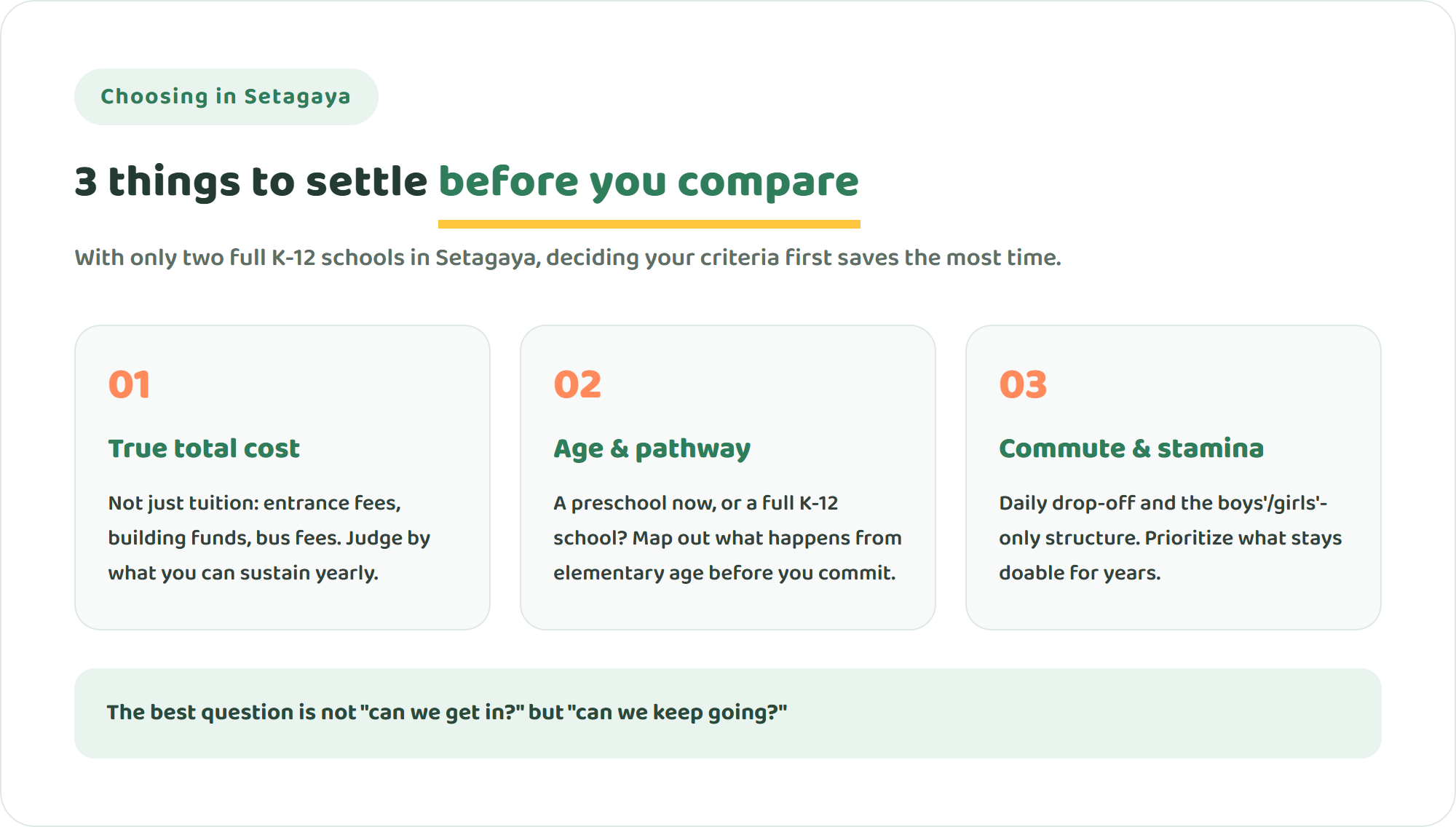
This is where families most often come unstuck. There is no single national exam date the way there is for Japanese junior high entrance, so it is genuinely hard to know when to move.
The school year starts in late August — so you start 12-15 months ahead
Seisen states officially that its academic year begins in late August and finishes in early June. St. Mary’s and BST follow the same Western calendar. If you are mentally planning around an April start, you are half a year out. Working backwards:
- 12-15 months before entry: tours, open houses, information sessions. Ask bluntly at this stage whether your child’s English is at the right level — it saves months later
- Autumn of the previous year (roughly September-November): apply. Application fees are JPY 30,000 (Seisen), 50,000 (St. Mary’s), 40,000 (BST) and 33,000 (TIPS)
- Winter (roughly November-February): assessments in English and maths, interviews, and at some schools a trial period
- Spring (roughly February-May): decisions. On acceptance, one-time fees fall due — around 1.0m (Seisen), 1.4m (St. Mary’s), 1.18m (BST) or 1.11m (TIPS) yen
- Late August: the school year begins
That said, St. Mary’s accepts applications year-round and assesses them as places arise. Before you conclude you have missed the window, ask.
The documents are the slow part
For families applying from a Japanese school, paperwork is usually the bottleneck. Requirements vary, but expect most of the following:
- Transcripts in English for the past two to three years — your current school may need weeks to issue these, and TIPS requires English transcripts outright
- Certificate of enrolment or expected graduation
- Recommendation letters in English from a homeroom, English or maths teacher
- Copies of passport and residence card, plus photographs
- Immunisation records and a health certificate
- Any standardised test results you already have
- A statement of parents’ English ability and the language used at home — this feeds directly into the eligibility categories
English levels, and one local rule worth knowing
Expectations change sharply with age. At kindergarten level a child who can greet a teacher and follow simple instructions has a real chance. From upper elementary and into secondary, the question becomes whether your child can learn academic subjects through English, and EAL places are limited. If the honest answer is “not yet”, building English volume through a double-school arrangement or online learning before applying is a legitimate sequence.
There is also a rule many families discover too late. Seisen’s official FAQ states that mid-year transfers between member schools of the Japan Council of International Schools (JCIS) will not be accepted without prior consultation between the heads of both schools. In other words, “get in somewhere and trade up later” is far harder than it sounds. That is a strong argument for choosing something financially and logistically sustainable the first time.
Finally, for Japanese-national children there is the compulsory education question. Setagaya Ward’s official guidance states that guardians have a duty to enrol children who hold Japanese nationality and live in Japan in a school established under the School Education Law, and that international schools are classified as miscellaneous or unaccredited educational facilities rather than Article 1 schools. Where a child holds dual nationality, is likely to choose the foreign nationality in future, and has education otherwise secured, an exemption may be granted through the Board of Education’s school enrolment section. Seisen’s own FAQ says the same thing from the school side. Check the ward’s official page and speak to the ward directly.
How to find the right fit for your family
Even with the ward’s schools laid out, “so how do we actually choose?” is the honest reaction. It helps to think in three types: (1) established major international schools (St. Mary’s, Seisen, BST Showa), (2) mid-size and newer preschools for early childhood, and (3) online international schools with no commute. The table below shows, honestly, how each type tends to perform on cost, ease of admission, commute burden, and more.
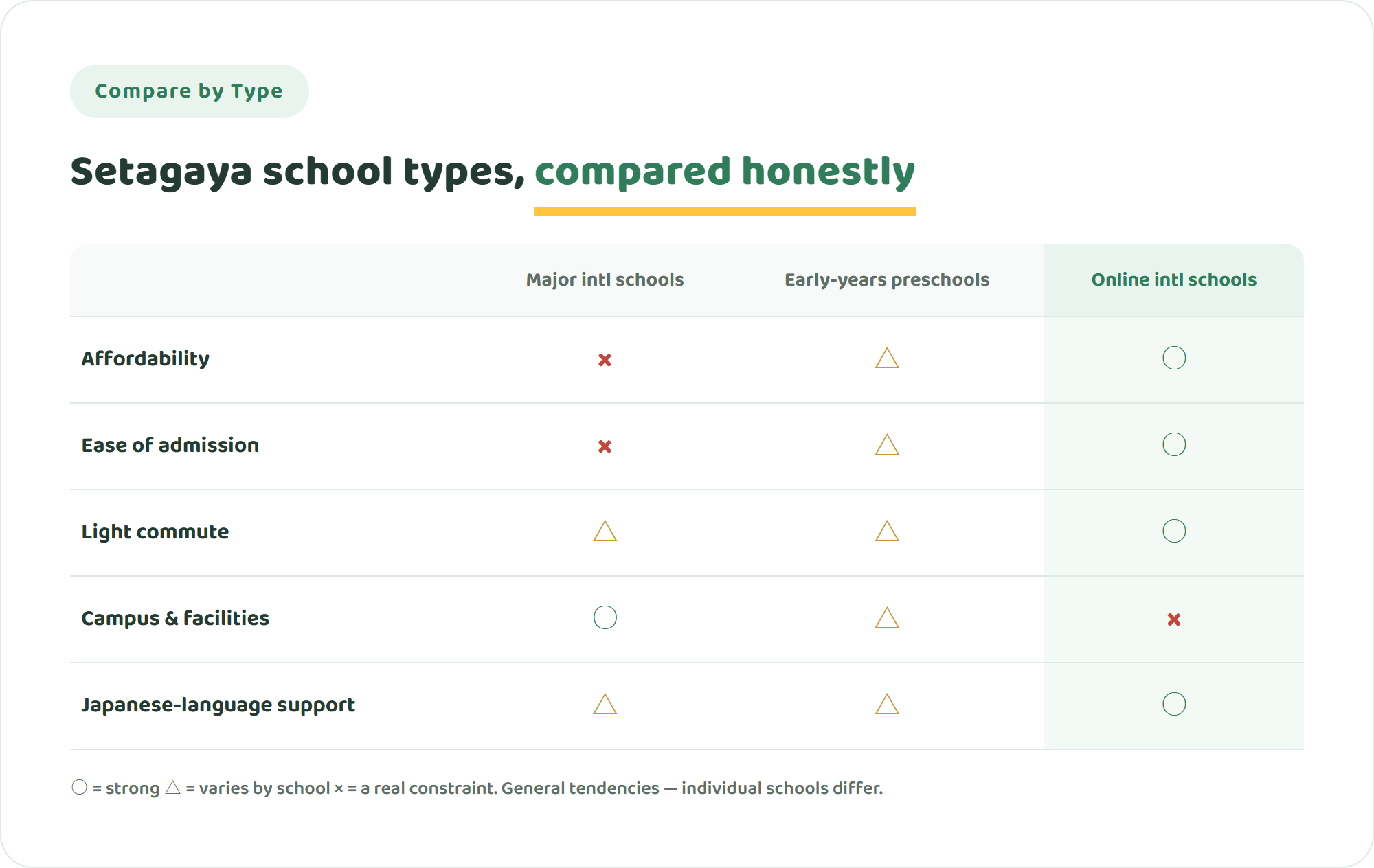
Major schools like St. Mary’s and Seisen are appealing for both environment and outcomes, but tuition and admission bars are high — and the schools running all the way from kindergarten to Grade 12 on one campus are limited to these two, split by gender. Preschools give a rich pre-school-age start, but you’ll want to think early about “what happens from elementary school.” And it’s easy to overlook the option that doesn’t assume a commute at all. Is tuition of around 3 million yen a year straining the household? Is the daily drop-off wearing your child down? These are worth facing honestly. For a line-by-line view of what you actually pay, see the real cost of international school tuition; if the fees feel out of reach, this piece on whether international school is too expensive may help.
See how learning works online →
International schools within reach of Setagaya in neighbouring wards
The reason not to over-restrict yourself to the ward is simple: about thirty minutes on the train multiplies your options. If you want a coeducational full school, an American curriculum with AP, or a full international school from elementary age, looking outside Setagaya is the pragmatic move. Travel times below are rough guides and vary with connections and time of day.
- International School of the Sacred Heart (Hiroo, Shibuya — girls, kindergarten to Grade 12) — about 35 minutes from Futako-Tamagawa via Shibuya, or 25-30 minutes from Sangenjaya. Like Seisen, a Catholic girls’ school, and the natural comparison point.
- Nishimachi International School (Motoazabu, Minato — kindergarten to Grade 9) — about 30 minutes from Sangenjaya via Shibuya. Coeducational, with a Japanese-English bilingual, inquiry-led programme.
- Tokyo International School (Mita, Minato — IB authorised) — about 25-30 minutes from Sangenjaya via Shibuya. The Gakugeidai kindergarten in Setagaya belongs to the same group, so early years in Setagaya into school years in Minato is a workable sequence.
- The British School in Tokyo, Azabudai Hills Campus (Minato — Nursery to Year 6) — about 25-30 minutes from Sangenjaya. Since secondary is at the Showa Campus in Setagaya, the pattern is primary in Minato, secondary in Setagaya.
- Gregg International School (Jiyugaoka, Meguro — 12 months to age 13) — about 15 minutes from Futako-Tamagawa on the Oimachi and Toyoko lines. For southern Setagaya, one of the closest options that continues into the elementary years.
- American School in Japan, Chofu Campus (Chofu — kindergarten to Grade 12, American curriculum with AP) — roughly 25-40 minutes by bus or car from western Setagaya (Seijogakuen-mae, Kitami, Kami-kitazawa). The first stop for families who want an American pathway with AP.
- Ota Ward and the Den-en-chofu area — Tamagawa-Den-en-chofu is in Setagaya, but there are more preschools just across the river in Ota. Worth scanning for early years rather than for elementary age and above.
Ward-by-ward detail is in our guides to international schools in Shibuya, international schools in Minato and international schools in Chofu. One caution if you cross ward lines: work out the commute from your child’s daily energy, not from the timetable. Forty minutes each way is a very different thing over twelve years than it looks on a map.
When fees or the commute are the wall — the eighth option: online
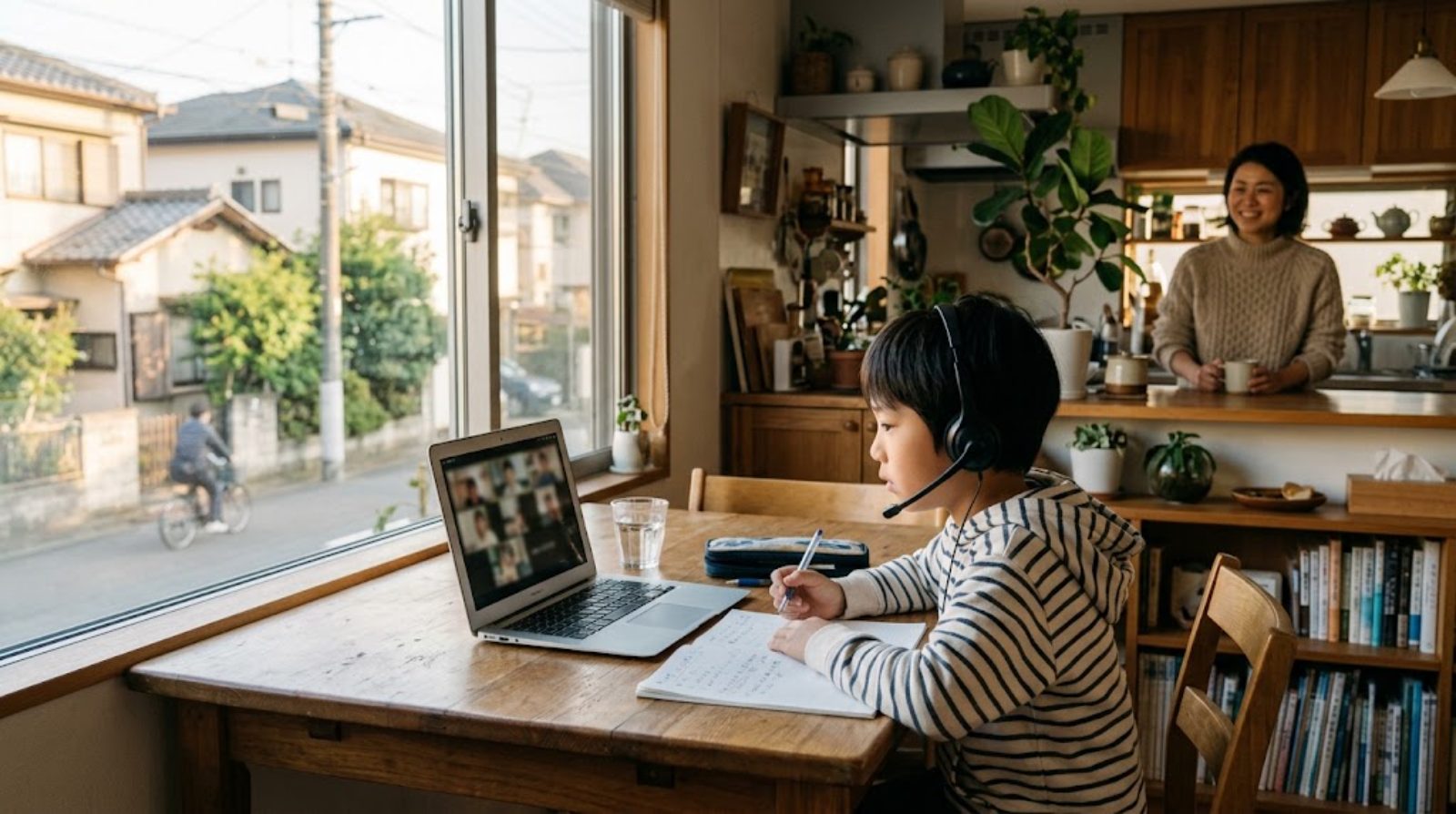
Setagaya is a fortunate place, rich in calm surroundings and respected schools. Even so, the fact that only two schools run all the way through K-12 on one campus, tuition of around 3 million yen a year, and the boys’/girls’-only structure can each become a real wall for a family. If you find yourself thinking “we want an international education, but sustaining this cost for years…” or “our options narrow sharply once elementary school starts,” there is an eighth option that assumes no commute at all: an online international school.
NIJIN GLOBAL ACADEMY (NGA) is an online international school scheduled to open in September 2027. It is run by NIJIN Inc., the company behind “NIJIN Academy,” an alternative school in Japan with more than 1,000 enrolled students. Guided by a philosophy of moving beyond ranking children by test scores, NGA centers on small-group dialogue and aims to help children come to love themselves and the world. It is designed for ages 6-18 across Asia and Oceania, wherever they live, and built so children can ease into English with Japanese-language support underneath. It aims to keep tuition at roughly one-fifth of a face-to-face international school.
In fairness, NGA has not opened yet, and its track record is still to come. It cannot offer the on-campus, in-person experience of a physical school in the same way. Even so, for a family weighing options in Setagaya, learning that connects your child to the world — without the commute, at a lower cost — is a path worth considering.
Frequently asked questions
Q. From what age can children enter international schools in Setagaya?
A. Preschools often accept children from around 8-10 months old, and Setagaya is unusually well served at this stage. Seisen admits from age 2 and St. Mary’s from kindergarten, both continuing to Grade 12. From elementary age the options are St. Mary’s (boys), Seisen (girls) and Oakwood (elementary); from Year 7 there is BST’s Showa Campus; and from Grade 4 there is TIPS. Start by narrowing to schools that accept your child’s current age.
Q. Can older children still attend a full international school in Setagaya?
A. Only two schools run from kindergarten to Grade 12 on a single campus in the ward: St. Mary’s (boys) and Seisen (girls). But from secondary age there is BST’s Showa Campus in Taishido (Years 7-13, coeducational, IGCSE and IB Diploma), from Grade 4 there is TIPS in Kamata (coeducational, very small classes), and for girls there is the Kunimoto Double Diploma Course in Kitami. So “only two schools” is not accurate. If you specifically want a coeducational American K-12, widening to Shibuya, Minato or Chofu is realistic.
Q. Can Japanese families enrol? Is there a returnee track?
A. Yes, but each school defines eligibility categories. Seisen’s published criteria include families where a parent is fluent in English, children who use English at home, Japanese students who have spent at least two years at an English-medium school, and students transferring from another international school. Rather than a formal “returnee quota”, eligibility plus the English assessment is what decides it in practice. Note too that for Japanese nationals, international schools are not Article 1 schools, so the compulsory education duty applies: Seisen’s own FAQ states plainly that a Japanese-national student in Grades 1-9 there will not be meeting Japan’s compulsory education expectation. Check the ward’s guidance and speak to the enrolment section.
Q. Is there a school bus, and how do Setagaya families actually commute?
A. Seisen runs 11 bus routes, listed in its official FAQ as serving Roppongi, Kamiyacho/Aobadai, Shoto, Yotsuya, Shinagawa, Hiroo, Akasaka, Shirokane, Den-en-chofu, Yoyogi-Uehara and Kudan, at JPY 310,000 a year one way or 420,000 both ways. St. Mary’s charges the same. Because those routes point at central Tokyo, families living in Setagaya usually walk, cycle or take the train instead — and being within walking distance of Futako-Tamagawa, Yoga or Sangenjaya can save 300,000-400,000 yen a year in bus fees. Among the early-years schools, Oakwood runs its own bus service across Setagaya and nearby areas.
Q. Are there any fee subsidies in Setagaya?
A. Before school age, yes — and they are generous. On top of the national early-childhood education subsidy, Setagaya adds its own top-up: for a licence-exempt facility that holds the national compliance certificate (which includes many international preschools), the ward subsidises up to JPY 77,000 a month for ages 3-5 (80,000 where meals are provided), and up to 80,000 a month for ages 0-2 in tax-exempt households. You must hold a “need for childcare” certification in advance, and it cannot be backdated, so apply early; eligible facilities are listed by the ward. From elementary age upward, however, there is essentially no public subsidy for international school tuition. See the ward’s official page and our guide to international school subsidies and ways to save.
Q. Is mid-year transfer possible?
A. Most schools have transfer places, but popular ones rarely have openings, and conditions vary by timing and grade. Entrance tests, interviews, and English-level requirements may apply, so contacting each school about a year before your intended start is the safe approach. Note also that, per Seisen’s official FAQ, mid-year transfers between JCIS member schools require prior consultation between both heads — moving between Tokyo international schools mid-year is harder than families expect.
Time spent deciding is time spent caring for your child
There is no single “right answer” in choosing a school. Even in a fortunate ward like Setagaya, what matters is less “can we get in?” and more “can we keep this going, unstrained, for years?” Tuition, commute, your child’s temperament — every family’s situation is different. The absence of a single ranking is, in its way, a relief: with nothing to line up against, all you have to judge is fit. That is exactly why the time you spend agonising over this is proof of how seriously you care about your child’s future. Take your time, visit a few schools, and compare them in person. And if you would also like to know about the paths that don’t involve commuting, we would be glad to be quietly on your list.
International Schools in Other Cities
- International Schools in Yokohama: Full Comparison
- International Schools in Chofu and ASIJ Fees
- International Schools in Fukuoka: Fees
- International Schools in Ho Chi Minh City
- International Schools in Melbourne
- International Schools in Nagoya: All 8 Schools
- International Schools in Chuo, Tokyo
- International Schools in Dubai: Fees
- International Schools in Edogawa, Tokyo
- International Schools in Tokyo
- International Schools in Minato: Fees
- International Schools in Shibuya, Tokyo
- International Schools in Koto, Tokyo
- International Schools in Shinagawa, Tokyo
- International Schools in Meguro: All 8 Schools